
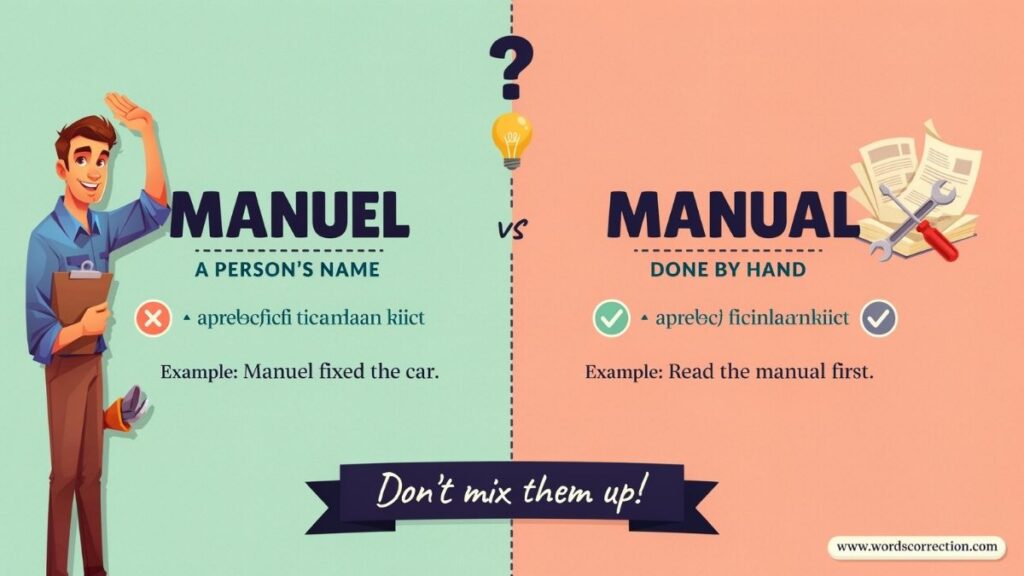
The words Manuel or Manual may look almost the same, but they have very different meanings. Using the wrong word can confuse your readers and change the meaning of your sentence. A manual is a guide that explains how to use or operate something, while Manuel is usually a person’s name. For example, you might read a car manual, but Manuel could be the person driving the car. Understanding this difference helps you avoid common spelling and grammar mistakes. In this guide, you’ll learn the meanings, key differences, and simple examples to help you use both words correctly.
Manuel vs Manual Quick Answer
The easiest way to understand the difference between Manuel and manual is to examine their meanings and how people use them in sentences.
| Word | Meaning | Example |
|---|---|---|
| Manual | An instruction book or something done or operated by hand | Read the car’s manual before driving. |
| Manuel | A personal name | Manuel left his notebook on the desk. |
Both spellings are valid. Neither is automatically incorrect. The mistake occurs when you use one word in place of the other.
Consider these examples
- Correct: I downloaded the user manual for my new phone.
- Incorrect in the intended context: I downloaded the user Manuel for my new phone.
- Correct: Manuel helped me set up my new phone.
In the first sentence, manual refers to a document containing instructions. The second, the spelling changes the apparent meaning and makes the sentence incorrect for the intended purpose. In the third, Manuel correctly identifies a person.
Correct Examples
Here are several examples that demonstrate how to use each word correctly.
Using manual
- The printer manual explains how to replace the ink cartridge.
- My new car has a manual transmission.
- The office requires manual entry of employee information.
- The technician followed the equipment’s operating manual.
- Manual labor can involve lifting, carrying, or assembling materials.
Using Manuel
- Manuel is my new coworker.
- I sent the document to Manuel yesterday.
- Manuel knows how to repair old computers.
- We invited Manuel to the graduation ceremony.
- The package was addressed to Manuel Garcia.
The key is context. When a sentence refers to a person, use that person’s correct name. When it refers to instructions, hand-operated work, or a related process, use manual.
Incorrect Examples
Some spelling mistakes become easier to recognize when you consider the meaning of the entire sentence.
| Incorrect usage | Correct usage | Explanation |
|---|---|---|
| Please read the Manuel. | Please read the manual. | An instruction book is a manual. |
| I drive a Manuel car. | I drive a manual car. | Manual describes the transmission type. |
| Manuel labor is physically demanding. | Manual labor is physically demanding. | The phrase refers to physical work. |
| I emailed the report to Manual. | I emailed the report to Manuel. | The person’s name is Manuel. |
Remember that capitalization alone doesn’t determine the correct word. A sentence may begin with Manual because English capitalizes the first word of a sentence. The intended meaning still determines which spelling you need.
Simple Rule to Remember
Use this straightforward rule whenever you’re unsure:
- Manual means instructions or work performed by hand.
- Manuel refers to a person with that name.
For example, you might ask Manuel to read the manual. Both words are correct because they serve different purposes in the same sentence.
Learn the difference between more words people mix up
It’s vs Its What’s the Difference?
What Does Manual Mean in English?
The word manual has several related meanings in English. Depending on the sentence, it can function as a noun or an adjective. Its most common uses involve written instructions, activities performed by hand, and equipment controlled directly by a person.
Understanding the definition of manual helps you choose the correct spelling without second-guessing yourself.
Manual Definition and Word Meaning
As a general English definition, manual refers to something involving the hands or something operated, controlled, or performed by a person rather than through an automatic process.
The word has two main grammatical uses:
- Noun: A book, document, or digital resource that explains how to use, operate, maintain, or understand something.
- Adjective: Something performed by hand or controlled directly by a person.
For instance, a washing machine manual explains how to operate the appliance. Meanwhile, a manual setting lets you adjust a feature yourself instead of allowing the machine to select the setting automatically.
Although these meanings are connected, they aren’t interchangeable in every sentence. The grammatical role determines how the word functions.
Manual as a Noun
A manual is a document that provides instructions, explanations, procedures, or reference information. It may appear as a printed book, a small instruction booklet, a PDF, or a help document on a website.
You may encounter several types of manuals in daily life
- User manual: Explains how to use a product or system.
- Owner’s manual: Provides information about owning, operating, and maintaining equipment, especially vehicles.
- Instruction manual: Gives step-by-step directions for completing a task.
- Technical manual: Provides detailed information about equipment, systems, repairs, or technical procedures.
- Employee manual: Explains workplace policies, expectations, and procedures.
- Training manual: Helps people learn a process, skill, or job responsibility.
For example, a new laptop might come with a digital user manual that explains how to connect to Wi-Fi, adjust display settings, and troubleshoot common problems.
A car owner’s manual may explain dashboard warning lights, recommended maintenance intervals, fluid specifications, and safety features.
Example in a sentence: “The technician consulted the technical manual before repairing the machine.”
Here, manual acts as a noun because it names a document.
Manual as an Adjective
When manual functions as an adjective, it describes an activity, process, or system involving direct human effort or control.
Consider these common expressions
- Manual labor: Physical work performed by hand or with tools.
- Manual entry: Information entered by a person rather than imported automatically.
- Manual operation: Controlling a machine or process directly.
- Manual adjustment: Changing a setting yourself.
- Manual transmission: A vehicle transmission that requires the driver to select gears.
- Manual process: A task completed through human actions rather than a fully automated workflow.
For example, an employee who enters customer details into a spreadsheet one record at a time performs manual data entry. If software imports the information automatically, that part of the process is automated instead.
The distinction matters in workplaces because manual and automated processes often have different costs, speeds, and error risks.
Example in a sentence: “The technician switched the machine to manual operation to adjust its settings.”
In this example, manual describes the type of operation.
Learn the difference between everyday English mistakes
Canceled vs Cancelled Which Spelling Is Correct?
Manual Book Meaning Is a Manual the Same as a Guide?
A manual, handbook, guidebook, and instruction booklet can serve similar purposes, but their functions aren’t always identical.
| Term | Typical purpose | Example |
|---|---|---|
| Manual | Detailed instructions or reference information | A printer’s user manual |
| Handbook | A compact reference covering rules, procedures, or general information | An employee handbook |
| Guidebook | Advice or information that helps someone understand a subject or complete an activity | A travel guidebook |
| Instruction booklet | Short, task-focused directions | A booklet showing how to assemble a desk |
| Reference guide | Quickly accessible facts or explanations | A software keyboard-shortcut guide |
These terms sometimes overlap. A product guide might contain the same setup instructions as a manual, while a handbook may explain a company’s policies rather than how to operate a particular device.
If you’re referring to a document that explains how to operate, maintain, or troubleshoot something, manual is usually an appropriate choice.
Manual Word Examples in Everyday English
The following sentences show how manual appears in different contexts.
- Technology: “I checked the router manual to find the reset instructions.”
- Education: “The teacher distributed a manual for the laboratory equipment.”
- Business: “Manual data entry delayed the report.”
- Manufacturing: “Workers inspected the components during the manual assembly process.”
- Driving: “She learned to drive a car with a manual transmission.”
- Home maintenance: “The dishwasher manual explains how to clean the filter.”
Notice how the meaning changes slightly from one example to another. Nevertheless, the spelling stays the same because each sentence uses the English word manual.
Learn the difference between commonly misused words
Happy New Year or Happy New Years Which Is Correct?
What Does Manuel Mean?
Unlike manual, Manuel is primarily a proper noun used as a personal name. It is a masculine given name commonly found in Spanish- and Portuguese-speaking communities, although people with this name live throughout the world.
The distinction between Manuel and manual is especially important when writing about people. A name identifies someone, so changing its spelling can create confusion or appear careless.
Manuel as a Proper Noun
A proper noun identifies a specific person, place, organization, or other named entity. Personal names belong to this category, which is why English capitalizes them.
For example
- Manuel works in the accounting department.
- I spoke with Manuel after the meeting.
- Manuel sent me a copy of the report.
- The invitation was addressed to Manuel.
- We asked Manuel to explain the new procedure.
In each sentence, Manuel identifies a particular person. It doesn’t describe a document, a task, or a machine.
Compare these two sentences
- Manuel reviewed the manual.
- The manual mentions Manuel.
Both are grammatically correct. In the first, Manuel is the person reading the document. In the second, the document refers to a person named Manuel.
This simple comparison illustrates why the two words can’t normally replace each other.
Learn the difference between similar English words the easy way
Authorised or Authorized Which Spelling Is Correct?
Manuel Meaning and Name Origin
The meaning of Manuel is connected to the longer name Emmanuel, which comes through Greek from a Hebrew name commonly interpreted as “God is with us.” Manuel developed as a form of this name in languages including Spanish and Portuguese.
The name has a long history in Iberian cultures and remains familiar in many Spanish- and Portuguese-speaking communities.
However, a name’s historical meaning doesn’t change its grammatical role in English. When you write Manuel to identify a person, it remains a proper noun.
For example, you wouldn’t replace someone’s name with manual simply because the two words look similar. Personal name spelling should follow the individual’s actual name.
Is Manuel a Spanish Name?
Yes. Manuel is a traditional Spanish male name and is also widely used in Portuguese-speaking communities. It may appear as a first name or as part of a full personal name.
For example
- Manuel Alvarez attended the conference.
- Manuel Silva submitted the application.
- Mr. Manuel joined the discussion.
These examples demonstrate ordinary name usage. The surnames are illustrative, and the spelling of a real person’s name should always be checked rather than assumed.
It’s also worth distinguishing a name’s language of origin from the language of a sentence. An English sentence can contain the Spanish name Manuel without any grammatical problem.
Manuel Used in a Sentence
Here are more examples showing how to use Manuel correctly.
- Manuel is responsible for preparing the presentation.
- Have you spoken to Manuel about the schedule?
- Manuel’s office is next to the conference room.
- I asked Manuel to send the owner’s manual.
- The manager thanked Manuel for his help.
In the sentence “Manuel’s office is next to the conference room,” the apostrophe and s indicate possession. The name itself remains Manuel.
In “I asked Manuel to send the owner’s manual,” both spellings appear naturally. Manuel is the person receiving the request, while the manual is the document he needs to send.
Learn the difference between basic English word mistakes
Grey or Gray Which Spelling Is Correct?
Is Manuel a Real English Word?
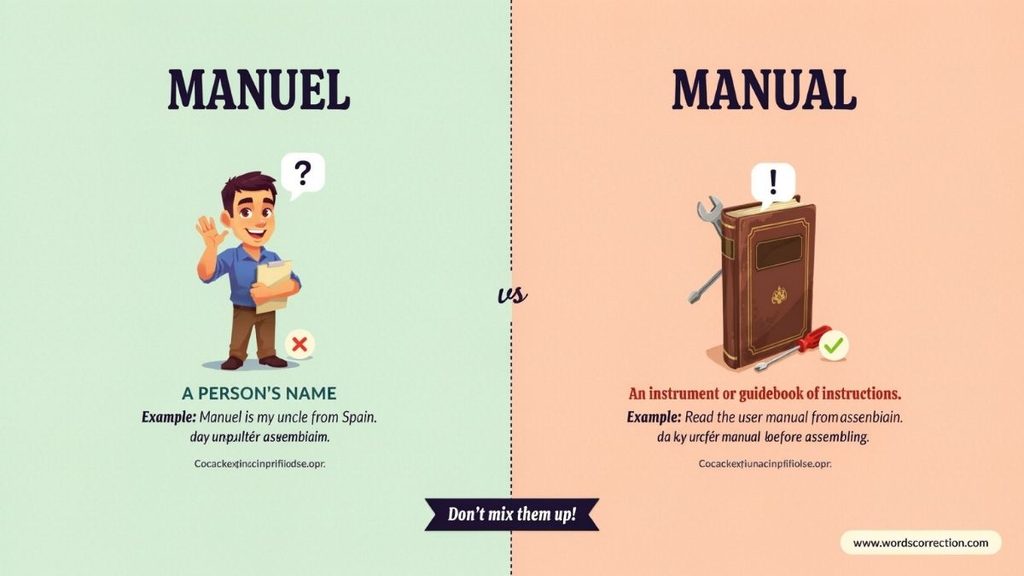
Yes. Manuel is a valid spelling of a personal name used in English-language writing. However, it isn’t the standard spelling of the common English noun for an instruction book.
That distinction answers a frequent question: Is Manuel a misspelling of manual?
It is a misspelling when someone intends to write manual but types Manuel. It isn’t a mistake when the writer intends to refer to a person whose name is Manuel.
Context determines whether the spelling is correct.
Manuel vs Manual Key Differences at a Glance
The difference between Manuel and manual goes beyond spelling. The words have different meanings, grammatical roles, and typical uses.
| Feature | Manual | Manuel |
|---|---|---|
| Word type | Common noun or adjective | Proper noun |
| Main meaning | Instructions, hand-operated activity, or work done by hand | A personal given name |
| Capitalization | Usually lowercase within a sentence | Capitalized when used as a name |
| Typical context | Books, equipment, work, driving, and procedures | People, correspondence, and personal references |
| Example | Read the manual before starting the machine. | Manuel will start the machine. |
| Common phrase | Manual labor | Manuel’s office |
| Opposite or related term | Automatic in some contexts | No direct grammatical opposite |
Manuel vs Manual Difference in Grammar
English grammar provides another reliable way to tell the words apart.
A common noun names a general person, place, thing, or concept. The word manual can be a common noun when it refers to an instruction book.
An adjective describes a noun. In phrases such as manual process and manual transmission, the word describes how something operates or gets done.
A proper noun identifies a particular person or named entity. Manuel functions this way when it refers to someone with that name.
Consider the sentence
“Manuel used the manual to learn how to operate the machine manually.”
This sentence contains three related-looking forms:
- Manuel: The person’s name.
- Manual: The instruction book.
- Manually: An adverb describing how an action is performed.
The third word is worth noticing. Manually is the adverb form commonly used to describe an action performed by hand or through direct human control. It isn’t a substitute for either Manuel or manual.
For example, you might write, “The employee entered the information manually,” rather than “The employee entered the information manual.”
Understanding these grammatical differences makes correct word usage much easier.
Learn the difference between often confused words
To That Effect or To That Affect Which Is Correct?
Manuel and Manual Pronunciation
Because Manuel and manual look similar, readers sometimes assume they sound identical. In standard English pronunciation, however, the words have different vowel sounds and syllable patterns.
How to Pronounce Manual
In American English, manual is commonly pronounced “MAN-yoo-uhl,” with the stress on the first syllable.
Its pronunciation can be represented approximately as manual
The word usually has three syllables
- MAN
- yoo
- uhl
The exact sound may vary slightly by speaker and accent. In ordinary American speech, the middle sounds often flow together.
How to Pronounce Manuel
The pronunciation of Manuel depends on the language and the person’s preferred pronunciation.
In Spanish, it is commonly pronounced approximately as “mah-NWEL,” with two syllables and stress on the second syllable. In English-language conversation, people may use an anglicized pronunciation or follow the pronunciation associated with the individual.
This difference can help you recognize the words when spoken, but pronunciation alone isn’t always a reliable spelling test. Names can have personal or regional pronunciations, and speakers may pronounce unfamiliar words differently.
The safest approach is to consider both meaning and context. If the sentence discusses an instruction book, manual is likely the intended word. If it refers to a person, check the person’s name.
Learn the difference between confusing word pairs
Whose or Who’s What’s the Difference?
Why Do People Confuse Manuel and Manual?
At first glance, the two spellings seem almost interchangeable. They share five letters in a similar order and differ mainly in the arrangement of the final vowel letters.
That visual similarity creates an easy typing mistake, particularly when someone writes quickly or relies on autocorrect.
The One-Letter Difference
Compare the spellings carefully:
- MANUAL
- MANUEL
The difference is between the final vowel letters: manual ends in al, while Manuel ends in el.
This small change affects the word’s identity. English contains many words that look similar but have different meanings, so checking the sentence’s context is more useful than simply looking for familiar letter patterns.
For example, imagine you’re writing a product review:
“I found the Manuel helpful because it explained how to install the software.”
If you mean the document, the correct sentence is:
“I found the manual helpful because it explained how to install the software.”
The revised sentence uses the correct common noun.
Common Manual Spelling Confusion
Several everyday situations make this spelling mistake more likely.
- Autocorrect: A phone or computer may capitalize a word because it recognizes it as a name or has learned that spelling from previous typing.
- Typing too quickly: Writers may select a familiar-looking word without checking the sentence.
- Unfamiliar names: Someone who rarely encounters the name Manuel may assume it is a typo.
- Limited context: A short message such as “Send Manuel” may be unclear without knowing whether Manuel is a person or a product name.
- Capitalization habits: Writers sometimes mistake a capital letter for evidence that a word is a proper noun, even when it appears at the beginning of a sentence.
Autocorrect can contribute to these errors, but it isn’t always responsible. A writer may simply confuse the spellings while composing a sentence.
Learn the difference between tricky grammar more words
Cannot or Can Not which one is Correct Spelling?
Case Study A Small Spelling Mistake at Work
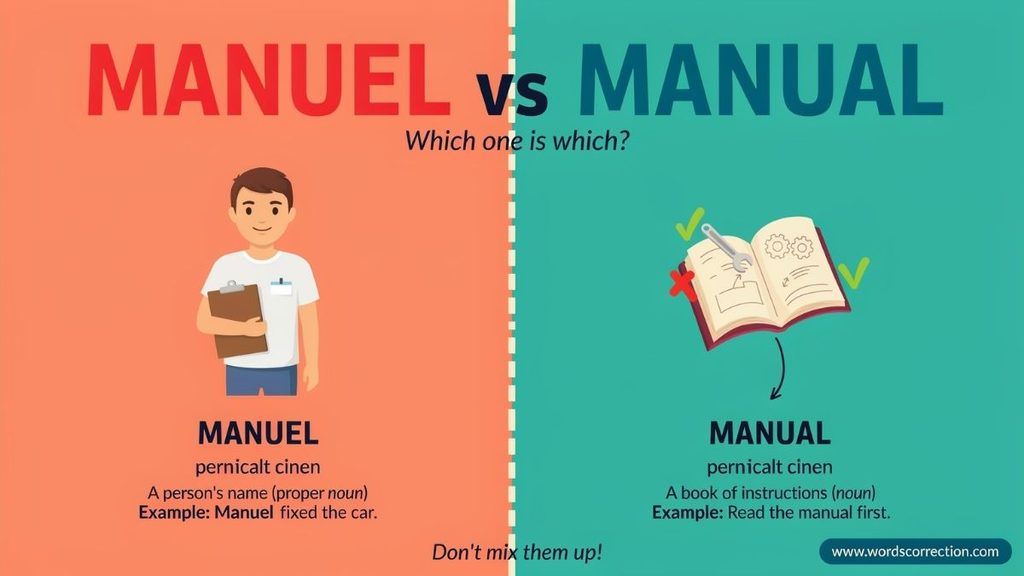
Imagine that an office employee sends this email to a colleague:
Hi, please review the Manuel before operating the new copier.
The colleague may understand the intended meaning from the surrounding conversation. Still, the wording introduces an unnecessary distraction: Is Manuel a person who should review the copier, or is the message referring to an instruction document?
A clearer version would be:
Hi, please review the copier manual before operating the new machine.
The revised sentence identifies the document and its purpose. It also removes ambiguity without adding unnecessary words.
This example shows why correct spelling matters in professional communication. A one-letter difference rarely prevents understanding completely, but it can make a message less clear.
An Easy Memory Trick
Use this simple association to remember the correct spelling:
Manual refers to an instruction book or a process that involves direct human effort. Manuel, meanwhile, is a name you might see on a person’s identification or email signature.
You can also remember the two words through a short sentence:
“Manuel reads the manual.”
The person is Manuel. The book is the manual. Both words fit naturally into the same sentence, making the distinction easy to recall.
Learn the difference between commonly mixed-up more words
Nevermind or Never Mind Which Spelling Is Correct?
Manuel or Manual in Everyday Situations
The best way to learn correct word usage is to see the words in the settings where people commonly use them.
In Emails and Workplace Communication
Workplace writing often involves documents, people, procedures, and instructions. That makes it especially important to distinguish names from common nouns.
Correct examples include
- I’ve attached the employee manual to this email.
- Manuel will lead tomorrow’s training session.
- Please follow the manual instructions before restarting the equipment.
- I asked Manuel to review the updated handbook.
When writing to a colleague named Manuel, capitalize the name. When referring to a document, use manual unless the document’s official title uses a different spelling.
If a sentence could reasonably refer to either a person or a document, add context rather than relying on the reader to guess.
In Technology and Product Instructions
Technology is one of the most common contexts for the noun manual. Devices often come with printed or digital documents that explain setup, operation, maintenance, and troubleshooting.
For example:
- The router manual explains how to reset the device.
- The printer’s user manual includes troubleshooting steps.
- I downloaded the software manual as a PDF.
- The technician performed a manual reset.
These examples use manual as either a noun or an adjective.
A manual reset generally means that a person initiates the reset directly rather than allowing an automatic process to do it. However, the exact procedure depends on the device.
Manual Car Meaning What Does Manual Mean in Driving?
In driving, manual usually describes a vehicle with a manual transmission. This type of transmission requires the driver to select gears, typically using a gear lever and a clutch pedal in cars with conventional manual gearboxes.
For example
“My first car had a manual transmission, so I had to learn how to coordinate the clutch and accelerator.”
A manual car isn’t a car belonging to someone named Manuel. The word describes the vehicle’s transmission.
Related terms include:
- Manual transmission: A transmission in which the driver selects gears.
- Stick shift: An informal term for a manual transmission or its gear lever, especially in American English.
- Automatic transmission: A transmission that selects gears automatically under normal driving conditions.
Learn the difference between confusing more English words
Per Se or Per Say Which Spelling Is Correct?
Manual vs Automatic What’s the Difference?
Manual and automatic transmissions differ mainly in how they select gears and how much direct input the driver must provide.
| Feature | Manual transmission | Automatic transmission |
|---|---|---|
| Gear selection | Driver selects gears | Transmission selects gears automatically under normal conditions |
| Clutch operation | Usually requires a clutch pedal in conventional cars | Typically doesn’t require a clutch pedal |
| Driver involvement | More direct control over gear selection | Less direct involvement in routine shifting |
| Learning process | Requires practice coordinating gear changes | Generally simpler for new drivers to operate |
| Fuel economy | Depends on the vehicle, engine, and driving conditions | Depends on the vehicle, engine, and driving conditions |
Neither transmission type is universally better. Modern automatic vehicles can be highly efficient, and the driving experience varies by vehicle design.
The important language point is straightforward: write manual transmission, not Manuel transmission, when referring to the type of gearbox.
In Academic and Formal Writing
Academic and professional documents often use manual to describe procedures, reference documents, and activities completed by hand.
Examples include
- The research team followed the laboratory manual.
- Participants completed the questionnaire through manual entry.
- The report outlines the manual inspection process.
- The employee manual describes the organization’s reporting procedures.
Use Manuel only when referring to a person, a quoted name, or another proper noun with that spelling.
If a person’s name appears in a report, verify the spelling against a reliable source, such as their own correspondence or an official staff directory. Correct names deserve the same care as technical terms.
Learn the difference between confusing more English words
Trys or Tries Which is Correct Spelling?
When Should You Use Manuel or Manual?
Choosing the correct word becomes simple when you identify what the sentence describes.
Use manual when discussing a guide, a process, a task, or equipment that a person controls directly. Use Manuel when referring to an individual whose name is spelled that way.
Here are a few additional examples
- “The mechanic checked the repair manual.” The word refers to an instruction document.
- “Manuel checked the repair manual.” The word identifies the mechanic.
- “The workers performed manual inspections.” The adjective describes how they inspected the items.
- “Manuel performed the inspections.” The name identifies the person who did the work.
Notice that the words can appear in the same context without creating any grammatical problem. What matters is using each one for its intended meaning.
Quick Checklist for Correct Word Choice
Before submitting an email, report, or article, ask yourself
- Am I referring to a person named Manuel?
- Am I talking about a book or document containing instructions?
- Am I describing work done by hand or a process controlled by a person?
- Does the spelling fit the meaning of the entire sentence?
- If I’m using a person’s name, have I checked its correct spelling?
These questions can help you catch a spelling mistake before it reaches your reader.
Practice Session
Fill in the Blanks
- The word ______ refers to a book that provides instructions.
- ______ is a personal name commonly used in Spanish and Portuguese.
- A task performed by hand is described as ______ work.
- Please read the instruction ______ before using the device.
- My friend ______ is learning to drive.
- The correct spelling for an instruction guide is ______.
- A car that requires the driver to change gears manually has a ______ transmission.
- The name ______ is related to the Hebrew name Immanuel.
- A person who performs physical tasks may be engaged in manual ______.
- The word ______ can function as both a noun and an adjective.
- The feminine form of the name Manuel is ______.
- A document explaining how to operate a machine is called a user ______.
- The opposite of an automatic process is often a ______ process.
- In the sentence “Manuel arrived early,” ______ is a proper noun.
- The word ______ should be used when referring to work performed by hand.
- The name Manuel is associated with the meaning “God is with ______.”
- A vehicle that changes gears without requiring the driver to select each gear has an ______ transmission.
- The words Manuel and manual have similar spelling but different ______.
- The first letter of a person’s name, such as ______, should be capitalized.
- A guide containing directions for using a product is called a ______.
- “She completed the task manually” means she completed it by ______.
- ______ is the appropriate spelling when referring to a person named Manuel.
- A book containing operating instructions can be called an owner’s ______.
- The word manual is generally written in lowercase unless it begins a ______.
- To avoid confusion, remember that Manuel is a name, while manual refers to instructions or work done by ______.
Answers
- Manual
- Manuel
- Manual
- Manual
- Manuel
- Manual
- Manual
- Manuel
- Labor
- Manual
- Manuela
- Manual
- Manual
- Manuel
- Manual
- Us
- Automatic
- Meanings
- Manuel
- Manual
- Hand
- Manuel
- Manual
- Sentence
- Hand
Here’s a trusted source for clear word meanings:
Cambridge Dictionary
FAQ’s
What is the difference between Manuel and manual?
Answer: Manuel is a personal name commonly used in Spanish and Portuguese, whereas manual is an English word that refers to an instruction guide or something performed by hand.
Does the word “manual” mean something done by hand?
Yes. The word manual can describe an activity performed by hand or through physical effort rather than by an automated system. For example, manual labor involves physical work performed by people.
What is the correct spelling of the English word for an instruction guide?
The correct spelling is manual. It refers to a document or booklet that provides instructions, explanations, or guidance on how to use or operate something.
Should you write manual or Manuel when referring to a car transmission?
Use manual when referring to a vehicle with a transmission that requires the driver to change gears. Manuel is a personal name and is not the correct term for this type of transmission.
Is Manuel a correctly spelled personal name?
Yes. Manuel is a recognized personal name used in Spanish, Portuguese, and several other linguistic and cultural traditions. Its spelling is correct when used as a person’s name.
What does the name Manuel mean?
The name Manuel is derived from Immanuel, a Hebrew name meaning “God is with us.” It has a long history of use, particularly in Spanish- and Portuguese-speaking communities.
What is the origin of the name Manuel?
Manuel originates from the Hebrew name Immanuel and developed through historical language forms. It became widely established as a given name in Spanish and Portuguese and is now used in many parts of the world.
Is Manuel used as a first name in English-speaking countries?
Yes. Manuel is used as a first name in English-speaking countries, particularly among families with Spanish, Portuguese, or other European cultural connections.
Is there an English equivalent of the name Manuel?
Emmanuel and Immanuel are related forms of Manuel that share the same Hebrew origin and meaning. However, Manuel remains a distinct and valid name rather than simply an incorrect spelling of either form.
What are the common nicknames for Manuel?
Common nicknames for Manuel include Manu, Manny, and Manolo. The preferred nickname may vary according to cultural traditions, language, and individual preference.
What does the name Manuel mean in the Bible?
Manuel is related to Immanuel, meaning “God is with us.” The biblical name Immanuel appears in Isaiah 7:14 and is referenced in Matthew 1:23 in connection with the Christian understanding of Jesus.
What is the feminine equivalent of the name Manuel?
Manuela is the feminine form of Manuel in Spanish and Portuguese. Both names share the same historical roots and are used across different cultures.
Can Manuel be used as an English vocabulary word?
Manuel is primarily used as a proper noun rather than as a standard English vocabulary word. When referring to an instruction guide or an activity performed by hand, the appropriate word is manual.
How can you use the word manual correctly in a sentence?
Manual can function as both a noun and an adjective. For example, “I consulted the user manual before installing the software” uses it as a noun, while “He drives a manual car” uses it as an adjective.
How do you use Manuel as a proper noun in a sentence?
Use Manuel when referring to a person, and capitalize the first letter because it is a proper noun. For example, “Manuel helped his colleague prepare the presentation.”
Is manual a noun or an adjective?
Manual can be used as both a noun and an adjective. As a noun, it refers to an instructional document; as an adjective, it describes something performed by hand or operated through human effort rather than automatically.
What is the difference between a manual and an instruction booklet?
A manual is a general term for a document containing instructions, explanations, or operating information. An instruction booklet usually refers to a smaller publication that provides step-by-step guidance for completing a task or using a product.
What does manual transmission mean in a vehicle?
A manual transmission is a vehicle gearbox that requires the driver to select gears manually, typically using a gear lever and clutch pedal. Unlike an automatic transmission, it gives the driver direct control over gear selection.
What is the opposite of manual when describing a process?
Automatic is a common opposite of manual when describing a process or operation. For example, manual data entry requires a person to enter information, whereas automatic data entry allows a system to perform the task without the same level of direct human input.
Why do people confuse Manuel with manual?
People often confuse Manuel and manual because their spellings and pronunciations are similar. However, their meanings are different: Manuel is a personal name, while manual refers to an instruction guide or an activity performed by hand.
How is the word manual pronounced in English?
Manual is commonly pronounced “MAN-yoo-uhl” in English, with the stress on the first syllable. The precise pronunciation may vary slightly between regional accents.
How is the name Manuel pronounced?
In Spanish, Manuel is commonly pronounced approximately “mah-NWEL,” while Portuguese pronunciation varies by region. The exact pronunciation depends on the person’s language and cultural background.
Should manual always be written in lowercase?
The word manual is generally written in lowercase unless it begins a sentence or appears in a title that requires capitalization. In contrast, Manuel is capitalized because it is a proper name.
What are some common expressions that use the word manual?
Common expressions include user manual, instruction manual, owner’s manual, manual labor, and manual transmission. These phrases describe instructional documents, physical work, or systems that require direct human operation.
How can you remember when to use Manuel instead of manual?
Remember that Manuel is a personal name, while manual refers to instructions or something performed by hand. Use Manuel when referring to a person and manual when discussing a guidebook, manual labor, or a hand-operated process.
Conclusion
Understanding the difference between Manuel and Manual is easy once you know their meanings. A manual is a guide that explains how to use something, while Manuel is usually a person’s name. Confusing these words can change the meaning of your sentence and leave readers puzzled. To avoid this common spelling mistake, remember that a manual provides instructions, while Manuel refers to a person. With a little practice, you can use both words correctly in everyday writing. After all, you want your readers to follow your instructions, not wonder why a person named Manuel suddenly appeared in them.

Stella AJS is an experienced blogger and dedicated English language writer at Words Correction. She turns confusing grammar, word meanings, spelling, and usage into clear, practical insights that readers can easily understand and apply. With a passion for precise and engaging writing, Stella helps readers avoid common language mistakes, strengthen their vocabulary, and communicate with greater clarity and confidence.




