
The difference between “todays” and “today’s” may seem like a tiny grammar detail, but one misplaced or missing apostrophe can make your writing look less polished. This common spelling confusion often leaves writers second guessing themselves, even when the rest of the sentence is perfectly clear. Fortunately, mastering this rule is easier than it seems. You don’t need a grammar degree or an apostrophe detective to get it right. In this guide, you’ll learn the difference between “today” and “today’s,” understand common grammatical mistakes, and explore practical examples to help you use each form correctly in everyday and professional writing.
Todays or Today’s The Quick Answer
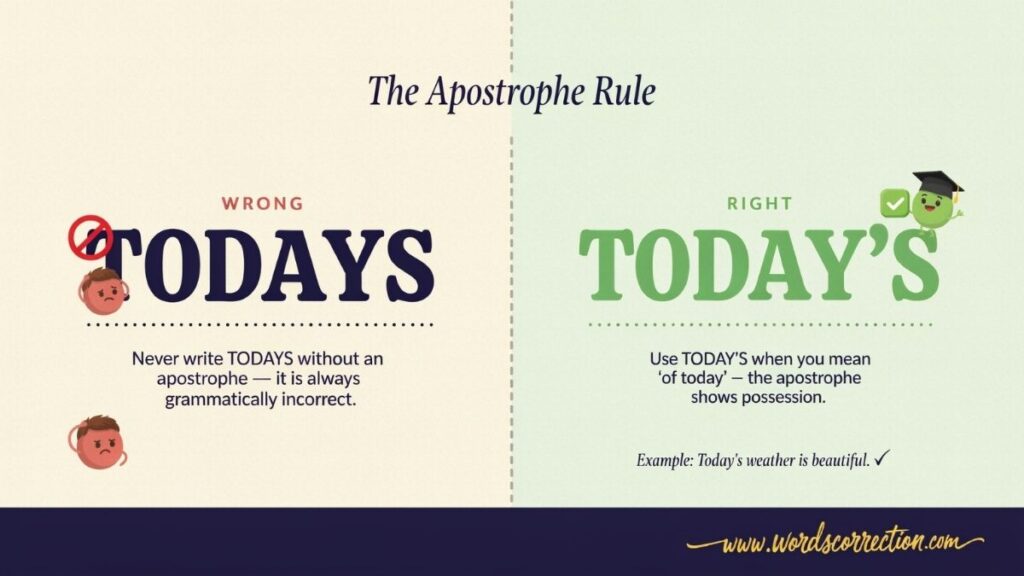
The answer to “Is it todays or today’s?” is simple use “today’s” when expressing possession or a connection with the current day. Use “today” when referring to the day itself or describing when something happens.
In standard English, “todays” without an apostrophe is generally incorrect when you intend the possessive form.
| Form | Meaning or Function | Example |
|---|---|---|
| Today | Refers to the current day | Today is unusually warm. |
| Today’s | Shows possession or association with the current day | Today’s weather is unusually warm. |
| Todays | Not the standard spelling of the possessive form | Incorrect: Todays weather is warm. |
Consider these examples
- Correct: Today’s class begins at 9 a.m.
- Incorrect: Todays class begins at 9 a.m.
- Correct: I will attend the class today.
- Correct: What is today’s date?
The difference becomes clear when you look at how each word functions. In “I will attend the class today,” the word “today” tells you when the action will happen. In “today’s class,” the word identifies the particular class associated with the current day.
Todays or Today’s Meaning in Brief
The meaning of “today’s” is generally “belonging to today” or “associated with the current day.” It usually appears before a noun to identify a particular event, task, activity, or item.
For example, “today’s assignment” refers to the assignment associated with today. The apostrophe doesn’t necessarily indicate literal ownership. Instead, it establishes a grammatical relationship between the current day and the assignment.
Learn the difference between confusing more English words
Cannot or Can Not which one is Correct Spelling?
What Does Today’s Mean?
To understand the definition of “today’s,” start with the word “today.” It refers to the current day in ordinary conversation.
When you add an apostrophe and an s, you create “today’s.” This form connects the current day to something else, such as a meeting, schedule, lesson, or announcement.
You’ll encounter this construction in everyday conversations, workplace emails, school assignments, news reports, and countless other forms of writing.
Here are several common examples
- Today’s news: News associated with the current day.
- Today’s schedule: A plan of activities for the current day.
- Today’s lesson: A lesson scheduled for or associated with today.
- Today’s results: Results reported or obtained today.
- Today’s opportunities: Opportunities available or relevant today.
In each phrase, “today’s” helps readers identify which item, event, or activity you’re discussing.
The Meaning of Today’s in English Grammar
In grammatical terms, “today’s” is the possessive form of the noun “today.” It commonly functions as a determiner before another noun.
For example, consider this sentence
“Today’s announcement surprised everyone.”
Here, “today’s” identifies the announcement by connecting it to the current day. The announcement doesn’t belong to the day in a literal sense. Instead, the phrase indicates a relationship based on timing or association.
This relationship can express several meanings
- Association: Today’s discussion concerns a topic relevant to the current day.
- Timing: Today’s appointment is scheduled for today.
- Relevance: Today’s challenges are the challenges that matter today.
- Publication: Today’s edition is the edition published for the current day.
The precise meaning depends on the surrounding words. In most cases, the context makes the relationship clear.
What Does Todays Mean Without an Apostrophe?
The question “What does todays mean?” usually comes from someone looking for the meaning of “today’s.” In standard English, however, “todays” isn’t the conventional spelling of the possessive form.
Writers sometimes omit apostrophes in quick messages, informal notes, or search queries. That omission doesn’t make the spelling correct in standard written English.
For example
- Incorrect: Todays schedule is full.
- Correct: Today’s schedule is full.
The word “Todays” may also appear as a proper name, brand, title, or deliberately stylized term. In those cases, its spelling depends on the name or title itself. These exceptions don’t change the ordinary grammatical rule.
Learn the difference between commonly mixed-up more words
Per Se or Per Say Which Spelling Is Correct?
Todays vs Today’s Understanding the Difference
The main difference between “todays” and “today’s” is the apostrophe. In the possessive form, this punctuation mark establishes a relationship between the current day and another noun.
English uses apostrophes for several purposes, including possession and contractions. In “today’s meeting,” the apostrophe forms a possessive construction. In “today’s been busy,” it marks a contraction of “today has.”
Understanding these two functions helps you recognize the correct form without relying on memorization alone.
Today vs Today’s What Is the Difference?
Although “today” and “today’s” look similar, they serve different grammatical purposes.
The word “today” can function as an adverb or a noun. As an adverb, it tells the reader when something happens. As a noun, it refers to the present day.
Examples
- I’ll finish the report today.
- Today is the final day of registration.
- We have plenty to do today.
By contrast, “today’s” commonly expresses possession or association before a noun. It can also appear in contractions.
Examples
- Today’s report contains the final figures.
- Today’s event starts at noon.
- Today’s been exhausting.
In the first two examples, “today’s” identifies a report and an event associated with the current day. In the last example, it means “today has.”
The difference between today and today’s therefore depends on the word’s grammatical function and the meaning you want to convey.
Learn the difference between confusing more English words step by step
Peak or Peek What’s the Difference?
Is Today’s a Possessive Word?
Yes. In phrases such as “today’s meeting” and “today’s weather,” the word is possessive because it connects the current day to another noun.
However, possession doesn’t always mean literal ownership. A person can own a car, but a day doesn’t literally own a meeting or a weather forecast. Instead, the possessive construction indicates that the meeting or forecast relates to that day.
The same pattern appears in expressions such as “yesterday’s news,” “tomorrow’s plans,” and “Monday’s appointment.”
Although “today” refers to a period of time, English allows it to take the possessive form just like other nouns.
Is Today’s a Contraction?
Yes, “today’s” can function as either a possessive form or a contraction. The correct interpretation depends on the sentence.
Here are three examples
- Possessive: Today’s meeting starts at noon.
- Contraction of today is: Today’s the day we’ve been waiting for.
- Contraction of today has: Today’s been more productive than yesterday.
In the first example, “today’s” modifies the noun “meeting.” The second, it means “today is.” In the third, it means “today has.”
A useful way to distinguish these meanings is to examine the sentence structure. When “today’s” directly modifies a noun such as meeting, class, or activity, it generally expresses possession or association. When it appears before a description or a past participle, it may be a contraction.
Learn the difference between tricky grammar more words
Trys or Tries Which is Correct Spelling?
Why Does Today’s Have an Apostrophe?
The apostrophe in “today’s” follows a standard English grammar rule: form the possessive of most singular nouns by adding an apostrophe and s.
For example
- The student’s notebook
- The teacher’s desk
- The company’s policy
- Today’s schedule
In each case, the apostrophe marks a relationship between the noun and something associated with it. In “today’s schedule,” the schedule relates to the current day.
The same principle applies whether the noun refers to a person, an organization, an object, or a period of time.
The Apostrophe Rule for Today’s
When you need the possessive form of “today,” place the apostrophe before the final s.
Correct: today’s
Incorrect for the intended possessive meaning: todays
Incorrect apostrophe placement: todays’
This follows the same general rule used with other singular nouns. For example, “the student’s assignment” refers to an assignment associated with one student. Without the apostrophe, the phrase doesn’t follow standard possessive punctuation.
The same rule applies to “today’s date,” “today’s activity,” “today’s class,” and “today’s meeting.”
Is Today’s a Singular Possessive Noun?
Yes. “Today’s” is the possessive form of the singular noun “today.” Adding an apostrophe and s doesn’t make the word plural.
This distinction is easier to understand when you compare singular nouns, plural nouns, and their possessive forms.
| Form | Grammatical Function | Example |
|---|---|---|
| Day | Singular noun | The day is nearly over. |
| Days | Plural noun | The days seem longer in summer. |
| Day’s | Singular possessive | The day’s schedule is full. |
| Days’ | Plural possessive | The days’ schedules are different. |
| Today’s | Possessive form of today | Today’s schedule is full. |
The word “today” already identifies the current day. Adding an apostrophe and s creates a possessive construction or, in some sentences, a contraction. It doesn’t create a plural form.
Is Today’s Grammatically Correct?
Yes. “Today’s” is grammatically correct when you use it in the appropriate context.
For example, “Today’s class was interesting” is correct because the phrase identifies the class associated with the current day. Similarly, “Today’s activity requires teamwork” correctly connects the activity to today.
However, consider this sentence:
Incorrect: I will finish the assignment today’s.
Correct: I will finish the assignment today.
The first sentence uses the possessive form where an adverb is needed. The second sentence correctly uses “today” to indicate when the assignment will be finished.
The purpose of correct punctuation isn’t to add apostrophes wherever possible. It’s to use them when the grammar and meaning require them.
Learn the difference between confusing word pairs
Accel or Excel Which Spelling Is Correct?
How to Use Today’s Correctly in a Sentence
The easiest way to understand the rule is to see how it works in everyday writing. From meetings and school assignments to dates and weather forecasts, the same principle applies across many contexts.
Today’s Meeting Correct Spelling and Grammar
When referring to a meeting associated with the current day, write “today’s meeting.”
Examples
- Today’s meeting will begin at 10 a.m.
- I reviewed the agenda for today’s meeting.
- The manager postponed today’s meeting until the afternoon.
The word “today’s” modifies “meeting” and identifies the particular meeting under discussion.
However, when you simply want to explain when a meeting will happen, use “today.”
Examples
- The meeting will take place today.
- We are meeting today to discuss the proposal.
Both constructions are grammatically correct. The choice depends on the sentence structure and the meaning you intend to express.
Today’s Activity Correct Usage and Meaning
The correct phrase is “today’s activity” when you mean an activity associated with the current day.
Examples
- Today’s activity helps students practice teamwork.
- Please complete today’s activity before the end of class.
- The children enjoyed today’s outdoor activity.
The apostrophe connects the activity to today. Without it, “todays activity” would be an incorrect spelling in standard English.
However, not every sentence about an activity requires the possessive form. For example, “The activity takes place today” is also correct because “today” simply tells the reader when the activity happens.
How to Write Today’s Class Correctly
Use “today’s class” when referring to the class scheduled for or associated with the current day.
Examples
- Today’s class will cover basic grammar.
- Please bring your notebook to today’s class.
- I missed today’s class because my train was delayed.
Compare these sentences with “My class is today.” The phrase “today’s class” identifies a particular class, while “My class is today” states when the class takes place.
Learn the difference between tricky English words with easy explanations
Sent or Send Which one Is Correct?
Today’s Date Correct Spelling and Usage
One common question is whether to write “todays date” or “today’s date.” The correct phrase is “today’s date.”
Examples
- What is today’s date?
- Please write today’s date at the top of the page.
- I entered today’s date on the application form.
The apostrophe belongs before the s because the phrase uses the possessive form of “today.”
You can also write “What date is it today?” In this sentence, “today” functions as an adverb, so it doesn’t require an apostrophe.
Today’s Weather, News, and Schedule
The same grammar rule applies to many common expressions.
| Phrase | Example Sentence |
|---|---|
| Today’s weather | Today’s weather looks pleasant. |
| Today’s news | Today’s news includes several local updates. |
| Today’s schedule | Today’s schedule has three appointments. |
| Today’s lesson | Today’s lesson explains apostrophes. |
| Today’s work | Today’s work must be completed by 5 p.m. |
| Today’s task | Today’s task requires careful attention. |
| Today’s assignment | Today’s assignment is due tonight. |
| Today’s event | Today’s event begins at the community center. |
| Today’s discussion | Today’s discussion focuses on communication. |
| Today’s results | Today’s results will be published this afternoon. |
| Today’s announcement | Today’s announcement explains the new policy. |
| Today’s special | Today’s special includes soup and a sandwich. |
| Today’s experience | Today’s experience taught me a useful lesson. |
| Today’s challenges | Today’s challenges require practical solutions. |
| Today’s opportunities | Today’s opportunities may lead to new projects. |
Each example follows the same pattern. “Today’s” identifies an item, event, task, or experience associated with the current day.
Learn the difference between often confused words
Authorised or Authorized Which Spelling Is Correct?
Today’s in Emails and Professional Writing
Correct apostrophe usage helps your emails, reports, and workplace messages look polished and professional.
Consider these examples:
Incorrect: Please review todays report before the meeting.
Correct: Please review today’s report before the meeting.
Another example:
Incorrect: Todays discussion will focus on the project timeline.
Correct: Today’s discussion will focus on the project timeline.
These mistakes are easy to overlook when you’re typing quickly. A brief proofreading check can help you catch them, especially in email subject lines, headings, and short messages.
Today’s in School and Academic Writing
Students frequently use phrases such as “today’s lesson,” “today’s class,” and “today’s homework.” Each phrase needs an apostrophe when it identifies work or an activity associated with the current day.
Examples:
- Today’s lesson covers sentence structure.
- I completed today’s homework before dinner.
- Today’s assignment includes three questions.
In academic writing, standard punctuation helps readers focus on your ideas instead of distracting grammatical errors. Even if informal messages sometimes omit apostrophes, formal assignments should follow conventional spelling rules.
Today’s in News Headlines and Social Media
The possessive form also appears in headlines, captions, and short social media posts.
Examples
- Today’s top stories
- Today’s weather update
- Today’s photo
- Today’s special offer
Short writing still follows standard spelling conventions. Even when a headline doesn’t contain a complete sentence, the apostrophe remains necessary when the phrase requires the possessive form.
Learn the difference between basic English word mistakes
Manuel or Manual An Easy Guide to the Correct Word
Common Mistakes With Todays or Today’s
The most common errors involve missing apostrophes, incorrect apostrophe placement, and confusion between “today” and “today’s.” Understanding these mistakes will help you apply the rule more confidently.
Forgetting the Apostrophe
Incorrect: Todays report is ready.
Correct: Today’s report is ready.
The possessive form is necessary because the phrase identifies the report associated with today.
Writing Todays Date Instead of Today’s Date
Incorrect: Please confirm todays date.
Correct: Please confirm today’s date.
The apostrophe establishes the relationship between the current day and the date being discussed.
Putting the Apostrophe After the S
Incorrect: Todays’ schedule is available.
Correct: Today’s schedule is available.
The form “todays’” doesn’t fit the intended meaning. Since “today” is singular, the standard possessive form is “today’s.”
Using Today’s When You Only Mean Today
Incorrect: I will send the document today’s.
Correct: I will send the document today.
In the corrected sentence, “today” tells the reader when the document will be sent. A possessive construction isn’t necessary.
Assuming Today’s Always Means Today Is
“Today’s” can mean “today is,” but that isn’t its only function.
Compare these examples:
- Possessive: Today’s class begins soon.
- Contraction: Today’s going to be busy.
In the first sentence, “today’s” identifies the class. In the second, it means “today is.”
Reading the entire sentence helps you determine which meaning applies.
Adding an Unnecessary Apostrophe
Incorrect: I will see you today’s.
Correct: I will see you today.
Apostrophes serve specific grammatical purposes. Adding one to an ordinary adverb doesn’t make the sentence more accurate.
Learn the difference between commonly misused words
Gopher or Gofer Which Spelling Is Correct?
Is Today’s Correct in American and British English?
Yes. “Today’s” is the standard spelling in both American and British English. Unlike words such as “color” and “colour,” it doesn’t have different regional spellings.
Both varieties follow the same basic possessive apostrophe rule.
Examples that work in American and British English include:
- Today’s meeting starts at noon.
- Today’s weather forecast looks promising.
- Please complete today’s assignment.
- What is today’s date?
Writers in both regions place the apostrophe before the s to form the possessive. You don’t need to change the spelling based on your audience’s location.
When writing for an international audience, focus on consistent spelling and correct grammar rather than treating “todays” and “today’s” as regional alternatives.
Learn the difference between everyday English mistakes
Monkeys or Monkies Which Spelling Is Correct?
Practice Session Todays or Today’s
Fill in the Blanks
- Please review ______ agenda before the meeting begins.
- I have several important tasks to complete ______.
- ______ weather is perfect for a walk.
- We need to finish the report by the end of ______.
- The manager discussed ______ sales figures with the team.
- I will call the client ______ afternoon.
- ______ lesson covers the correct use of apostrophes.
- Can we reschedule the appointment for ______?
- Please send me ______ meeting notes.
- The office is unusually quiet ______.
- ______ announcement contains important information.
- She plans to submit the assignment by the end of ______.
- We reviewed ______ project updates this morning.
- The word ______ is often used to refer to the current day.
- ______ deadline is approaching quickly.
- I feel more productive ______ than I did yesterday.
- The teacher explained ______ homework requirements.
- Please check ______ schedule before making other plans.
- We are expecting an important delivery ______.
- ______ news includes several local updates.
- The team will discuss the results at ______ meeting.
- I have already completed most of my work ______.
- ______ temperature is expected to rise this afternoon.
- Please write ______ date at the top of the form.
- The correct spelling for something associated with the current day is ______.
Answers
- today’s
- today
- Today’s
- today
- today’s
- this
- Today’s
- today
- today’s
- today
- Today’s
- today
- today’s
- today
- Today’s
- today
- today’s
- today’s
- today
- Today’s
- today’s
- today
- Today’s
- today’s
- today’s
Here’s a trusted source for clear word meanings:
Cambridge Dictionary
FAQ’s
Is today’s singular or plural?
“Today’s” is not a plural form. It is the possessive form of “today” and refers to something associated with the current day. For example, “Today’s schedule includes three important meetings.”
Where does the apostrophe go in today’s?
The apostrophe goes before the final “s,” making “today’s” the correct spelling. Use this form to show possession or an association with the current day, as in “today’s agenda.”
Can today’s be used at the beginning of a sentence?
Yes, “today’s” can begin a sentence when it introduces a noun or noun phrase. For example, “Today’s discussion will focus on effective communication.”
Is today’s appropriate in formal writing?
Yes, “today’s” is appropriate in formal writing, including business emails, professional reports, and academic discussions. For example, “Today’s findings highlight several areas for improvement.”
What is the difference between today’s and todays?
“Today’s” is the standard possessive form of “today.” “Todays’” is generally incorrect in standard English because “today” does not normally have a plural form that requires a plural possessive apostrophe.
Is today’s a possessive noun or an adjective?
“Today’s” is traditionally described as the possessive form of the noun “today.” When it modifies another noun, as in “today’s deadline,” it functions as a possessive determiner.
Can today’s be used without a noun after it?
Yes, “today’s” can stand alone when the noun is clear from the context. For example, “Yesterday’s report was detailed, but today’s was shorter.” In this sentence, “today’s” means “today’s report.”
Can today’s be used with both singular and plural nouns?
Yes, “today’s” can modify singular and plural nouns. For example, “today’s meeting” refers to one meeting, while “today’s assignments” refers to multiple assignments.
Can today’s refer to events throughout the day?
Yes, “today’s” can describe events, activities, or circumstances associated with the current day. For example, “Today’s events begin at 9 a.m. and continue throughout the afternoon.”
Is today’s suitable for professional emails?
Yes, “today’s” is natural and professional in workplace communication. You can write, “Please review today’s agenda before the meeting” or “I’ll send today’s report by noon.”
How do you write today’s date correctly?
Write “today’s date” with an apostrophe before the final “s.” The apostrophe belongs to the word “today’s,” not to the date itself. For example, “Please enter today’s date on the application.”
Should today’s be capitalized in a title?
Capitalization depends on the title style. In title case, “Today’s” is capitalized when it appears as the first word and is generally capitalized as a major word. In sentence case, capitalize it only when it begins the title or heading.
Can today’s be used in headlines?
Yes, “today’s” is commonly used in headlines to refer to current events, updates, or developments. For example, “Today’s Business News: Key Trends to Watch” uses the apostrophe correctly.
Is today’s acceptable in academic writing?
Yes, “today’s” is grammatically acceptable in academic writing when the meaning is clear. For example, “Today’s research findings provide useful insights.” Depending on the context, a more specific expression may improve precision.
Can today’s refer to the modern era rather than the current day?
Yes, “today’s” can refer to contemporary society or present-day conditions rather than a single calendar day. For example, “Today’s technology has transformed how people communicate” refers to modern technology in general.
What punctuation should follow today’s in a sentence?
The punctuation depends on the sentence structure. For example, “Today’s deadline is Friday” ends with a period, while “Is today’s deadline flexible?” ends with a question mark. The apostrophe remains before the final “s” in both sentences.
Can today’s be used with uncountable nouns?
Yes, “today’s” can modify uncountable nouns when the intended meaning is clear. For example, “Today’s information is essential for making an informed decision.” The apostrophe is still placed before the final “s.”
What are the most common proofreading mistakes involving today’s?
Common mistakes include writing “todays” instead of “today’s” to show possession, using “todays’” unnecessarily, and placing the apostrophe after the final “s.” To avoid these errors, check whether the word refers to something associated with the current day.
Is today’s the same as of today?
The expressions can have similar meanings, but they differ in structure and naturalness. “Today’s announcement” is generally more concise and natural than “the announcement of today.” Both can refer to an announcement associated with the current day.
Can today’s appear in a question?
Yes, “today’s” can appear in direct and indirect questions. For example, “What is today’s topic?” is a direct question, while “I wonder what today’s topic is” is an indirect question.
How do you pronounce today’s?
“Today’s” is pronounced approximately tuh-DAYZ, with the final “s” sounding like the /z/ in “days.” The pronunciation is the same regardless of whether the word refers to a meeting, schedule, event, or another part of the day.
Is today’s pronounced differently from todays?
In ordinary English, “today’s” is pronounced tuh-DAYZ. Although “todays” may look similar, it is not the standard spelling for the possessive meaning discussed in this article. Use “today’s” when referring to something associated with the current day.
Can today’s be used in social media captions?
Yes, “today’s” works well in social media captions when referring to daily activities, experiences, or plans. For example, “Today’s small wins made a big difference” is grammatically correct and easy to understand.
How can I remember when to write today’s instead of todays?
Remember that the apostrophe in “today’s” signals possession or association. If you mean something connected with the current day, write “today’s,” as in “today’s plan” or “today’s results.” The spelling “todays” is generally incorrect when you intend this meaning.
What is the easiest way to check whether today’s is correct?
Ask yourself whether the word means “belonging to today” or “associated with today.” If it does, “today’s” is generally the correct form. For example, “today’s schedule” is correct because it refers to the schedule for the current day.
Learn the difference between more words people mix up
Signalling vs Signaling Which Spelling Is Correct?
Conclusion
Understanding the difference between “todays” and “today’s” can make your writing clearer and more professional. Remember, “today” refers to the current day, while “today’s” indicates possession or an association with that day. In standard English, “todays” is generally incorrect when you mean something related to today. The rule is simple: place the apostrophe before the final “s” when using the possessive form. With a little practice, you can avoid this common grammar mistake and write with confidence. After all, an apostrophe may be small, but leaving it out can make a noticeable difference in your writing.

Stella AJS is an experienced blogger and dedicated English language writer at Words Correction. She turns confusing grammar, word meanings, spelling, and usage into clear, practical insights that readers can easily understand and apply. With a passion for precise and engaging writing, Stella helps readers avoid common language mistakes, strengthen their vocabulary, and communicate with greater clarity and confidence.




