
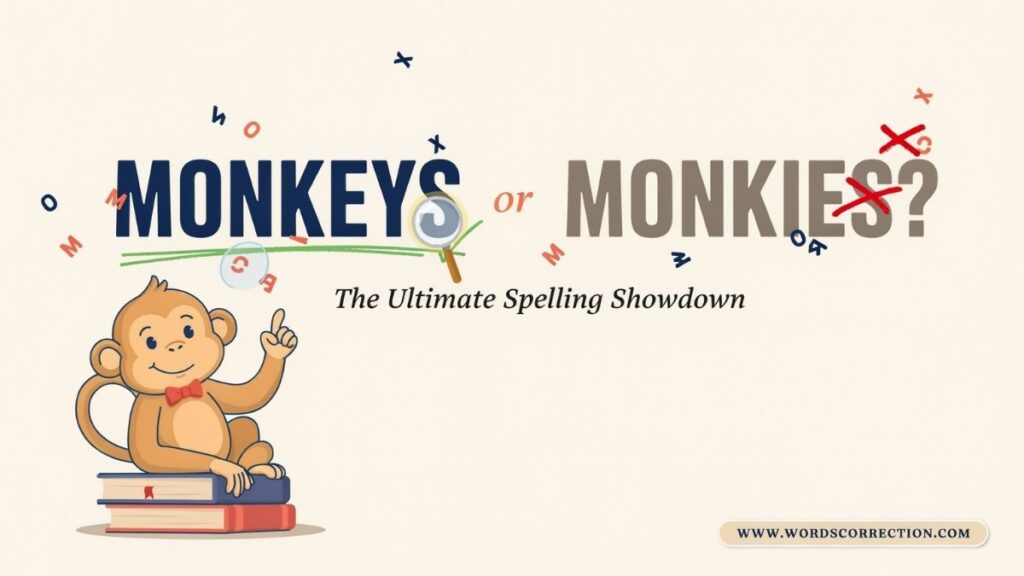
English spelling can sometimes be confusing, especially when two words look almost the same. One common example is Monkeys or monkies. Both spellings may look correct, but only “monkeys” is right. Many people make this mistake because they are unsure how to change words ending in the letter “y” into plurals. The good news is that the rule is simple and easy to remember. In this article, you’ll learn the correct spelling of monkeys, understand why “monkies” is wrong, and discover a few easy tips to avoid similar mistakes in your schoolwork, blog posts, and everyday writing.
Monkeys or Monkies The Quick Answer
Monkeys is the correct plural form of monkey. Monkies is a common misspelling and isn’t accepted as the standard plural in American or British English.
A singular noun refers to one person, animal, place, or thing. A plural noun generally refers to more than one. To make monkey plural, simply add the suffix s.
- Singular: A monkey is sitting on a branch.
- Plural: Three monkeys are sitting on a branch.
- Incorrect: Three monkies are sitting on a branch.
The explanation is simple: monkey ends in a vowel, e, followed by y. Under the standard English pluralization rule, nouns ending in a vowel plus y generally take s without changing the final y.
Here’s a quick reference
| Form | Correct? | Usage |
|---|---|---|
| Monkey | Yes | Singular noun |
| Monkeys | Yes | Plural noun |
| Monkies | No, not as the standard plural | Common misspelling |
| Monkey’s | Yes | Singular possessive |
| Monkeys’ | Yes | Plural possessive |
The easiest way to remember the correct form is to think of one monkey and two monkeys. The y stays exactly where it is.
Learn the difference between more words people mix up
Happy New Year or Happy New Years Which Is Correct?
Why Is It Monkeys and Not Monkies?
The difference comes down to how English forms plural nouns. Although many nouns ending in y change to ies, that rule generally applies when a consonant comes immediately before the final y. When a vowel comes before y, regular nouns usually take s.
Look closely at the word monkey
- The final three letters are k, e, and y.
- The letter e is a vowel.
- Because y follows a vowel, the noun takes s to form its plural.
The correct formation is straightforward
Monkey + s = monkeys
Writing monkies applies the wrong pluralization rule. It treats monkey as though it ended in a consonant followed by y, as in city or baby. However, the letter immediately before the final y is a vowel, so that pattern doesn’t apply.
Words Ending in a Vowel Plus Y
When a regular noun ends in a vowel followed by y, you generally keep the y and add s.
| Singular | Plural | Example Sentence |
|---|---|---|
| Monkey | Monkeys | The monkeys climbed the trees. |
| Donkey | Donkeys | The donkeys grazed in the field. |
| Boy | Boys | The boys played soccer. |
| Toy | Toys | The children put away their toys. |
| Key | Keys | She placed the keys on the table. |
| Turkey | Turkeys | The turkeys walked across the farm. |
| Day | Days | We spent three days by the lake. |
Notice the consistent pattern. None of these words changes its final y. Instead, each noun retains its original spelling and adds s.
Words Ending in a Consonant Plus Y
Now consider nouns that end in a consonant followed by y. These words generally change y to i and add es.
| Singular | Plural | Example Sentence |
|---|---|---|
| City | Cities | Several cities hosted the event. |
| Baby | Babies | The babies slept peacefully. |
| Puppy | Puppies | The puppies played in the garden. |
| Party | Parties | They attended two birthday parties. |
| Country | Countries | The countries signed an agreement. |
| Story | Stories | She told us two funny stories. |
Compare monkey with baby. In monkey, the letter before y is the vowel e, so you add s. In baby, the letter before y is the consonant b, so you change y to i and add es.
This distinction explains one of the most common English spelling patterns. Rather than memorizing every plural individually, check the letter immediately before the final y.
Learn the difference between everyday English mistakes
Grey or Gray Which Spelling Is Correct?
The Meaning and Origin of the Word Monkey
Understanding the word itself provides useful context, although its origin doesn’t determine its plural spelling.
A monkey is a primate, a group of mammals that also includes apes, lemurs, and humans. Many monkeys have grasping hands and feet and use their limbs to climb, handle food, and move through their environments. Many species also have tails, although their physical characteristics vary considerably.
The word monkey has been used in English for centuries. Its precise origin remains uncertain, and historical dictionaries discuss possible connections to older European words and names.
For the spelling question, however, the essential point is how modern English forms the plural. Monkey refers to one animal, while monkeys refers to more than one.
Monkey and Monkeys Singular and Plural Meaning
The difference between monkey and monkeys is grammatical. Both words refer to the same type of animal, but they indicate different numbers.
Consider these examples
- Monkey: A monkey escaped from its enclosure.
- Monkeys: Several monkeys gathered near the feeding area.
- Monkey: The monkey ate a piece of fruit.
- Monkeys: The monkeys ate pieces of fruit.
In the first and third examples, monkey refers to one animal. In the other examples, monkeys refers to multiple animals.
The noun’s number also affects the verb. You would write, “The monkey is climbing,” but “The monkeys are climbing.” Understanding singular and plural forms together helps you avoid errors in both spelling and grammar.
Learn the difference between commonly misused words
To That Effect or To That Affect Which Is Correct?
Monkeys vs Monkies in American and British English
One common question is whether the spelling changes depending on where you write. It doesn’t.
Both American and British English use monkeys as the plural of monkey. Neither variety uses monkies as the standard plural form.
Some English words have different regional spellings. For example, American English generally uses color, while British English generally uses colour. Similarly, organize and organise follow different regional conventions, although preferences can vary among British publishers.
Monkeys doesn’t follow that pattern. Its plural spelling remains the same across these varieties of English.
| Context | Correct Spelling | Example |
|---|---|---|
| American English | Monkeys | The monkeys live in a protected forest. |
| British English | Monkeys | The monkeys live in a protected forest. |
| Australian English | Monkeys | The monkeys live in a protected forest. |
| Academic writing | Monkeys | Researchers studied the monkeys. |
| Professional writing | Monkeys | The report describes several monkeys. |
What Is the Plural of Monkey in British English?
The plural of monkey in British English is monkeys. British spelling conventions don’t change this noun to monkies.
For example, a British wildlife article might say, “The monkeys spend much of their time in the trees.” An American wildlife article would use the same spelling.
If you’re learning English as a second language, there’s no need to memorize a separate British version. The same pluralization rule applies in both varieties.
What Is the Plural of Monkey in American English?
American English also uses monkeys as the plural form.
You might encounter monkies in informal posts, online comments, or personal messages. However, seeing a spelling mistake online doesn’t make it an accepted alternative.
For schoolwork, business writing, publications, and other formal contexts, use monkeys. The same rule applies when proofreading content for an international audience.
Learn the difference between basic English word mistakes
Whose or Who’s What’s the Difference?
Monkey Spelling Rules How to Form Plurals Correctly
The easiest way to understand the plural of monkey is to learn the broader rules for regular plural nouns in English.
Most regular nouns form their plurals by adding s or es. Nouns ending in y require a closer look because the letter immediately before y generally determines which spelling pattern applies.
Rule One Add S to Words Ending in a Vowel Plus Y
When a regular noun ends in a vowel followed by y, you generally keep the y and add s.
The five traditional vowel letters in English are a, e, i, o, and u. In words such as monkey, donkey, and turkey, the final y follows a vowel.
Examples include
- Monkey becomes monkeys.
- Donkey becomes donkeys.
- Turkey becomes turkeys.
- Boy becomes boys.
- Toy becomes toys.
- Key becomes keys.
- Day becomes days.
You’ll see the same pattern in everyday sentences:
“The boy collected his toys.”
“The farmer fed the donkeys.”
“The monkeys played in the branches.”
This rule helps you solve several spelling questions without memorizing each word separately. Once you know why monkeys is correct, you can apply the same pattern to donkey, turkey, and other similar nouns.
Rule Two Change Y to IES After a Consonant
When a regular noun ends in a consonant followed by y, you generally replace y with i and add es.
For example
- Baby becomes babies.
- City becomes cities.
- Puppy becomes puppies.
- Lady becomes ladies.
- Family becomes families.
- Library becomes libraries.
The resulting ending is ies, which explains why these words look different from monkeys.
Consider this sentence
“The family visited three cities and bought toys for the babies.”
Both cities and babies follow the consonant-plus-y pattern. Toys, however, follows the vowel-plus-y pattern.
To choose the correct ending, examine the letter immediately before the final y. Don’t focus only on the last two letters; look at the letter that comes before y.
Learn the difference between confusing more English words step by step
Sent or Send Which one Is Correct?
Rule Three Recognize Irregular Plurals
English spelling follows patterns, but not every noun uses the same pluralization rule. Some nouns have irregular plurals, while others retain the same form in both the singular and plural.
| Singular | Plural | Pattern |
|---|---|---|
| Child | Children | Irregular plural |
| Mouse | Mice | Irregular plural |
| Sheep | Sheep | Same form |
| Fish | Fish or fishes | Depends on context |
| Monkey | Monkeys | Regular plural |
These examples show why it’s important to identify the specific noun before applying a spelling rule.
Fortunately, monkey is a regular noun. You don’t need an irregular form or a special exception to make it plural. Simply add s.
Learn the difference between often confused words
Gopher or Gofer Which Spelling Is Correct?
Is Monkies a Word?
The question “Is monkies a word?” requires a little clarification.
People do write monkies, and readers can often understand what they mean. However, it isn’t the standard plural spelling of monkey. In ordinary edited English, the correct form is monkeys.
This distinction matters because a spelling can appear in real-world writing without being accepted as standard.
For example, a social media post might say, “The monkies escaped again.” Most readers would understand the intended meaning, but a proofreader would normally correct the sentence to “The monkeys escaped again.”
The same principle applies to other common English spelling mistakes. Readers may understand a misspelled word, but that doesn’t make the spelling correct.
If you encounter monkies in a document, consider the context. In ordinary prose, it should generally be corrected to monkeys. If it appears intentionally as a name, brand, fictional term, or quoted error, preserve it when the original wording matters.
Why Does Monkies Look Correct to Some People?
The confusion comes from a familiar English spelling pattern. Many students learn that nouns ending in a consonant plus y change to ies in the plural.
Common examples include
- Baby becomes babies.
- City becomes cities.
- Puppy becomes puppies.
After learning this rule, it’s easy to apply it to monkey and assume the plural should be monkies. The spelling looks plausible because it resembles familiar words.
However, the rule depends on the word’s actual structure. The final y in monkey follows the vowel e, so the standard plural takes s.
This is an example of overgeneralization: applying a rule learned from certain words to another word that follows a different pattern.
Once you recognize the distinction, the correct spelling becomes much easier to remember.
Learn the difference between confusing word pairs
Nevermind or Never Mind Which Spelling Is Correct?
Monkey, Monkey’s, Monkeys, and Monkeys’ What’s the Difference?
Plural spelling is only part of the picture. Apostrophes also matter because monkey’s and monkeys’ have different grammatical functions.
These forms can look confusing, especially when you’re writing quickly. Each one, however, has a specific purpose.
| Form | Grammatical Function | Example |
|---|---|---|
| Monkey | Singular noun | The monkey is sleeping. |
| Monkey’s | Singular possessive | The monkey’s tail is long. |
| Monkeys | Plural noun | The monkeys are sleeping. |
| Monkeys’ | Plural possessive | The monkeys’ enclosure is clean. |
Monkey’s The Singular Possessive
Use monkey’s when something belongs to, relates to, or is associated with one monkey.
Examples
- The monkey’s tail helped it balance.
- The monkey’s food was placed near the enclosure.
- The monkey’s behavior surprised the visitors.
In each example, the apostrophe comes before the s because the noun is singular.
Monkeys’ The Plural Possessive
Use monkeys’ when something belongs to or is associated with multiple monkeys.
Examples
- The monkeys’ enclosure has several climbing structures.
- The monkeys’ food was prepared by the zookeeper.
- The monkeys’ behavior changed after the rain.
Here, the noun is already plural. You add an apostrophe after the existing s to show possession.
Monkeys The Ordinary Plural
When you simply want to refer to more than one monkey, you don’t need an apostrophe.
Correct: The monkeys climbed the trees.
Incorrect: The monkey’s climbed the trees.
The second sentence incorrectly uses a possessive form where an ordinary plural noun belongs. This is a common punctuation mistake in English writing.
Remember the distinction: monkeys means more than one animal, monkey’s indicates singular possession, and monkeys’ indicates plural possession.
Learn the difference between tricky grammar more words
Per Se or Per Say Which Spelling Is Correct?
Plural of Monkey and Donkey Comparing Similar Words
The plural of monkey follows the same general rule as the plural of donkey. Both nouns end in a vowel plus y, so both take s.
- One monkey, two monkeys.
- One donkey, two donkeys.
Turkey follows the same pattern. So do key, boy, and toy.
These comparisons make the rule easier to remember because you can apply it to several familiar words rather than memorizing one answer in isolation.
Monkey vs Donkey
Compare the two words:
| Singular | Correct Plural | Incorrect Plural |
|---|---|---|
| Monkey | Monkeys | Monkies |
| Donkey | Donkeys | Donkies |
Both words retain their final y when forming the plural. The vowel immediately before y explains why.
Turkey vs Baby
Now compare turkey with baby:
| Singular | Correct Plural | Reason |
|---|---|---|
| Turkey | Turkeys | Vowel + y |
| Baby | Babies | Consonant + y |
Although both words end in y, the preceding letters differ. In turkey, the final y follows the vowel e. In baby, it follows the consonant b.
This comparison highlights the central principle: the spelling depends on the letter immediately before the final y, not simply on the presence of y at the end of the word.
Learn the difference between commonly mixed-up more words
Trys or Tries Which is Correct Spelling?
Monkeys in Sentences Practical Grammar Examples
Seeing the correct form in context can make it easier to remember. The following examples show how monkeys works in everyday, academic, and professional writing.
Everyday Examples
- The monkeys played in the trees.
- We saw several monkeys at the zoo.
- Two monkeys shared a piece of fruit.
- The monkeys gathered near the water.
- Many monkeys live in tropical and subtropical regions.
Each sentence uses monkeys as a plural noun. None requires an apostrophe.
Academic and Scientific Examples
- Researchers observed the monkeys during the study.
- Some monkeys use tools to access food.
- The researchers compared the behavior of different monkey species.
- Several monkeys displayed similar responses to the test.
In scientific writing, precise language matters. Authors should distinguish between a single monkey, multiple monkeys, and a particular species when that distinction affects the meaning.
The spelling rule itself remains unchanged. Academic writing uses monkeys just as everyday conversation does.
Professional and Online Writing Examples
Correct spelling helps readers focus on your message rather than become distracted by avoidable errors.
| Context | Example |
|---|---|
| The monkeys will be moved to their new enclosure tomorrow. | |
| News article | The monkeys were spotted near the edge of the forest. |
| Website | Learn about different types of monkeys and their habitats. |
| School assignment | Monkeys are primates with varied social behaviors. |
| Social media | The monkeys were full of energy this morning. |
| Research report | The study examined how the monkeys responded to their environment. |
Whether you’re writing a casual message or a formal report, the standard plural spelling remains the same.
Learn the difference between confusing more English words
Accel or Excel Which Spelling Is Correct?
Common Mistakes When Spelling Monkeys
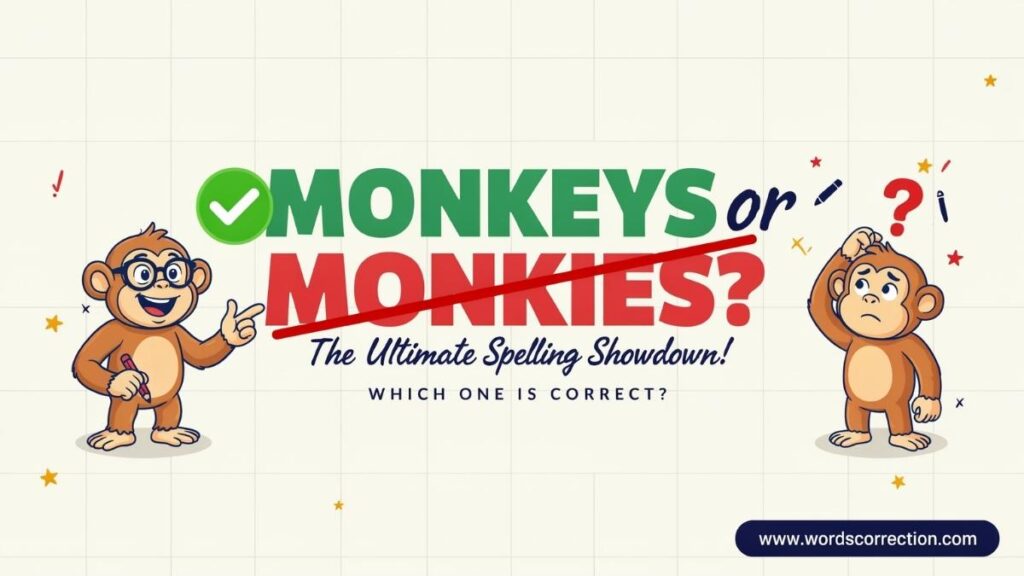
Even though the rule is simple, a few errors appear regularly in writing. Recognizing them can help you proofread more effectively.
Mistake Writing Monkies
The most direct error is replacing the final y with i and adding es.
Incorrect: The monkies climbed the fence.
Correct: The monkeys climbed the fence.
To avoid this mistake, remember that monkey ends in a vowel plus y.
Mistake Applying the IES Rule to Every Word Ending in Y
A common misconception is that all nouns ending in y must change to ies.
That’s not true.
- Monkey becomes monkeys.
- City becomes cities.
- Donkey becomes donkeys.
- Baby becomes babies.
Check the letter immediately before the final y before choosing the plural ending.
Mistake Adding an Apostrophe to an Ordinary Plural
Apostrophes don’t normally form plural nouns in English.
Incorrect: The monkey’s are eating.
Correct: The monkeys are eating.
The apostrophe belongs in monkey’s when you’re showing possession, not when you’re simply referring to multiple monkeys.
Mistake Assuming British English Uses Monkies
There is no standard British spelling that changes monkeys to monkies. Both American and British English use monkeys.
If your spellchecker flags monkies, don’t assume you’ve selected the wrong regional dictionary. Check the spelling itself.
Learn the difference between tricky words and use them correctly
Authorised or Authorized Which Spelling Is Correct?
How to Remember the Correct Plural of Monkey
If you often confuse monkeys or monkies, use a simple memory trick rather than trying to memorize the word in isolation.
Think of the word key.
The plural of key is keys, not keies. Similarly, the plural of monkey is monkeys, not monkies.
Both words end in a vowel followed by y, so both take s.
Another useful method is to remember these contrasting pairs:
- Monkey becomes monkeys.
- Baby becomes babies.
Ask yourself one question: Is the letter immediately before the final y a vowel or a consonant?
If it’s a vowel, regular nouns generally take s. If it’s a consonant, they generally change y to ies.
This quick check is especially helpful for students, language learners, and anyone proofreading English text.
Practice Session about Monkeys or Monkies
- The children watched three _____ swinging from the trees.
- Which spelling is correct: monkeys or _____?
- One monkey, two _____.
- The _____ were eating bananas at the zoo.
- To make “monkey” plural, add the letter _____.
- The word “monkey” ends with a vowel followed by the letter _____.
- One donkey, two _____.
- One baby, two _____.
- One toy, two _____.
- One key, two _____.
- The _____ tail was long. (The tail belongs to one monkey.)
- The _____ habitat was protected. (The habitat belongs to several monkeys.)
- We saw a playful _____ climbing a branch. (One animal)
- The zookeeper fed five _____.
- The correct plural spelling is “monkeys,” not “_____.”
- When a noun ends in a vowel followed by “y,” add _____ to form the plural.
- When a noun ends in a consonant followed by “y,” change “y” to “i” and add _____.
- The plural of “lady” is _____.
- The plural of “boy” is _____.
- The plural of “turkey” is _____.
- The _____ were playing near the rocks. (More than one monkey)
- In “the monkey’s food,” the food belongs to _____ monkey.
- In “the monkeys’ food,” the food belongs to _____ monkeys.
- In both American and British English, the correct plural is _____.
- A spell checker may suggest “monkeys” as the correction for _____.
Answers
- monkeys
- monkies
- monkeys
- monkeys
- s
- y
- donkeys
- babies
- toys
- keys
- monkey’s
- monkeys’
- monkey
- monkeys
- monkies
- s
- es
- ladies
- boys
- turkeys
- monkeys
- one
- multiple
- monkeys
- monkies
Here’s a trusted source for clear word meanings:
Cambridge Dictionary
FAQ’s
Which spelling is correct monkeys or monkies?
Monkeys is the correct spelling. “Monkies” is a common spelling error and should be avoided in standard English writing.
What is the plural of monkey?
The plural of “monkey” is monkeys. Simply add the letter “s” to the singular form.
Why is monkies considered incorrect?
“Monkies” is incorrect because “monkey” ends with a vowel followed by “y.” Under this spelling rule, you keep the “y” and add “s.”
How do you spell monkeys correctly?
The correct spelling is monkeys, written M-O-N-K-E-Y-S. The “y” remains unchanged.
What is the standard plural form of monkey in English?
The standard plural form is monkeys. It refers to two or more animals of this type.
Should the letter y change to i in the word monkey?
No. Because a vowel comes before the final “y,” you keep the “y” and add “s” to form “monkeys.”
What spelling rule applies to the plural of monkey?
When a noun ends in a vowel followed by “y,” add “s” to make it plural. For example, “monkey” becomes “monkeys,” and “donkey” becomes “donkeys.”
Is monkies an accepted alternative spelling?
No. “Monkies” is not an accepted standard spelling of the plural of “monkey.” The correct form is “monkeys.”
How does the meaning of monkey differ from monkeys?
“Monkey” refers to one animal, while “monkeys” refers to more than one. The difference is simply the number of animals being discussed.
Is the plural of monkey different in American and British English?
No. Both American and British English use monkeys. There is no regional spelling difference for this word.
How should you write the plural of monkey in scientific writing?
Use monkeys in scientific writing, research papers, and educational materials. The spelling follows the same standard English rule.
Is monkies acceptable in school assignments?
No. Students should use “monkeys” in school assignments, examinations, and essays. Writing “monkies” may be marked as a spelling error.
What is an easy way to remember the spelling of monkeys?
Remember that “monkey” has the vowel “e” before the final “y.” Keep the “y” and add “s” to form “monkeys.”
What is the singular possessive form of monkey?
The singular possessive form is monkey’s. For example, “The monkey’s tail is long” indicates that the tail belongs to one monkey.
What is the plural possessive form of monkeys?
The plural possessive form is monkeys’. For example, “The monkeys’ habitat is protected” indicates that the habitat belongs to or is associated with multiple monkeys.
When should you use monkey’s instead of monkeys?
Use “monkey’s” to show possession by one monkey. Use “monkeys” when referring to more than one animal without indicating ownership.
Is monkey a regular or irregular plural noun?
“Monkey” forms a regular plural because you add “s” to make “monkeys.” It does not require an irregular plural form.
Are there any other standard plural forms of monkey?
No. Monkeys is the standard plural form in modern English. “Monkies” is a misspelling, not an accepted alternative.
Why do writers confuse monkeys with monkies?
Writers may confuse the two forms because words such as “baby” change to “babies” in the plural. However, “monkey” follows a different rule because a vowel appears before the final “y.”
What are the plural forms of monkey and donkey?
The plural forms are monkeys and donkeys. Both words end in a vowel followed by “y,” so you add “s” without changing the final letter.
Will a spell checker identify monkies as an error?
Many spell checkers flag “monkies” and suggest “monkeys” as the correction. However, spell checkers can vary, so understanding the spelling rule is useful.
Can the word monkey be used as a verb?
Yes. In informal English, “monkey around” means to fool around or behave playfully. For example, “Stop monkeying around and finish your homework.”
What is the difference between monkeys and apes?
Monkeys and apes are different groups of primates. Most monkeys have tails, while apes do not. They also differ in several anatomical and evolutionary characteristics.
Is monkeys appropriate for formal and academic writing?
Yes. “Monkeys” is correct in academic papers, professional reports, educational materials, business documents, and everyday communication.
How can I stop making the monkeys or monkies spelling mistake?
Practice writing “monkey” and “monkeys” in complete sentences. Remember the vowel-plus-“y” rule, and use a spell checker when needed. Regular practice will help you spell the word correctly with confidence.
Learn the difference between similar English words the easy way
Manuel or Manual An Easy Guide to the Correct Word
Final Thoughts
Spelling doesn’t have to feel like a jungle full of confusing rules! When choosing between monkeys or monkies, remember that “monkeys” is the correct spelling, while “monkies” is a common mistake. The rule is easy to understand: when a noun ends in a vowel followed by “y,” simply add “s” to form the plural. Since “monkey” ends in “e” followed by “y,” its plural is “monkeys.” In contrast, words such as “baby” become “babies” because a consonant comes before the “y.” Keep this simple rule in mind, and you’ll avoid this common spelling mistake and write with greater confidence. After all, monkeys belong in the jungle, but “monkies” should stay out of your writing.

Stella AJS is an experienced blogger and dedicated English language writer at Words Correction. She turns confusing grammar, word meanings, spelling, and usage into clear, practical insights that readers can easily understand and apply. With a passion for precise and engaging writing, Stella helps readers avoid common language mistakes, strengthen their vocabulary, and communicate with greater clarity and confidence.




