
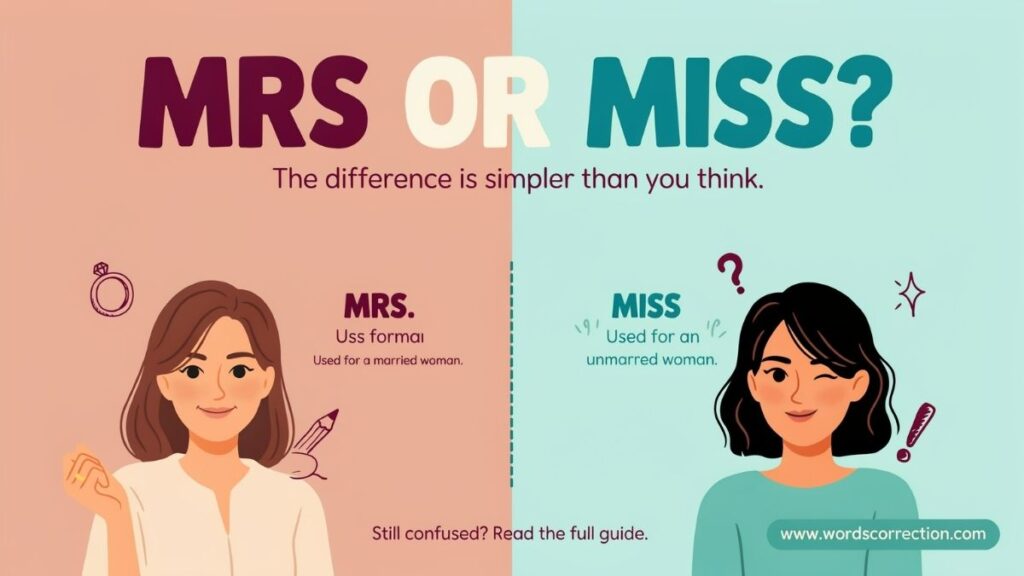
Choosing between Mrs. and Miss can be confusing, especially when writing a formal letter, email, or invitation. Using the wrong title may seem like a small mistake, but it can affect how politely and professionally you address someone. The good news is that learning the difference is simple. Understanding Mrs or Miss What’s the Difference? will help you choose the correct title with confidence. In this guide, you’ll learn what Mrs. and Miss mean, when to use each title, and how to avoid common mistakes. By the end, you’ll know how to address women clearly, correctly, and respectfully.
Mrs vs Miss The Quick Answer
The easiest way to understand Mrs. or Miss meaning is to look at the traditional relationship between each title and a woman’s marital status.
- Mrs. Traditionally identifies a married woman or a woman who prefers this title.
- Miss Traditionally identifies an unmarried woman or girl.
- Ms. Addresses a woman without indicating whether she’s married or unmarried.
These are courtesy titles, also called honorifics. They appear before a person’s name to show respect or follow a particular social convention.
For example, if three women introduce themselves as Mrs. Taylor, Miss Taylor, and Ms. Taylor, their titles traditionally communicate different things. Mrs. Taylor is associated with marriage, Miss Taylor with being unmarried, and Ms. Taylor’s marital status remains unspecified.
However, these conventions aren’t strict rules about every woman’s identity. A married woman may prefer Ms., and an unmarried woman may prefer Mrs. in some circumstances. A person’s preferred title matters more than assumptions based on marital status.
Mrs vs Miss vs Ms At a Glance
| Feature | Mrs. | Miss | Ms. |
|---|---|---|---|
| Traditional meaning | Married woman | Unmarried woman or girl | Woman of any marital status |
| Indicates marital status? | Traditionally, yes | Traditionally, yes | No |
| Common use | Formal and personal address | Girls, young women, or women who prefer it | Professional and formal communication |
| American spelling | Mrs. | Miss | Ms. |
| Common American pronunciation | MISS-iz | MISS | MIZ |
| British punctuation | Mrs | Miss | Ms |
| Suitable when marital status is unknown? | If preferred | If preferred | Often a practical default |
The table summarizes traditional usage rather than rules that everyone must follow. Individual preferences and organizational style guides can differ.
Learn the difference between more words people mix up
Cannot or Can Not which one is Correct Spelling?
What Does Mrs Mean?
The title Mrs. traditionally refers to a married woman. It’s one of the most familiar courtesy titles in English and remains common in formal letters, invitations, introductions, and personal correspondence.
When someone writes Mrs. before a surname, they’re following a naming convention that has historically connected a woman’s title to her marital status. For example, Mrs. Johnson traditionally refers to a married woman whose surname is Johnson.
However, marriage doesn’t automatically determine which title a woman must use. Some married women prefer Ms. because they don’t want their title to communicate personal information. Others continue to use Mrs. because it reflects their identity, family tradition, or personal preference.
What Does Mrs Stand For?
Mrs. is historically connected to the word mistress, an older English term once used as a respectful form of address for a woman. Over time, the word developed different social meanings, and Mrs. became associated particularly with married women.
Today, the title functions as a courtesy title rather than a description of a woman’s role in a household. When you see Mrs. before a name, you shouldn’t assume anything beyond its traditional association unless the person has shared more information.
For example
- Mrs. Emily Carter
- Mrs. Carter
- Dear Mrs. Carter,
Each form can work in an appropriate context. The first uses a full name, the second uses a surname, and the third is a formal written greeting.
How Do You Pronounce Mrs?
In American English, Mrs. is usually pronounced “MISS-iz.” The pronunciation doesn’t closely match the way the abbreviation looks, which can make it confusing for English learners.
Although Mrs. contains the letters M, R, and S, you shouldn’t pronounce it as three separate letters. It’s a conventional title with its own established spoken form.
Here are the common pronunciations of the three titles
- Miss — MISS
- Ms. — MIZ
Notice that Mrs. and Miss begin with a similar sound, while Ms. usually ends with a voiced Z sound. Mrs. also has an additional syllable.
When Should You Use Mrs?
Use Mrs. when a woman identifies herself by that title or when you have a reliable reason to know that she prefers it.
Common situations include
- Formal correspondence: Addressing a letter to a woman who uses Mrs.
- Wedding invitations: Following the recipient’s preferred title or the event’s established invitation conventions.
- Professional communication: Using Mrs. when a client, customer, teacher, or colleague has provided that title.
- Personal introductions: Introducing someone using the title she has asked others to use.
For example, if a customer signs an email as Mrs. Olivia Bennett, replying with “Dear Mrs. Bennett” is appropriate in a formal exchange.
On the other hand, don’t automatically switch to Mrs. just because you learn that a woman is married. If she uses Ms. professionally, respect that choice.
Learn the difference between everyday English mistakes
Nevermind or Never Mind Which Spelling Is Correct?
What Does Miss Mean?
It is traditionally used before the name of an unmarried woman or girl. It remains common in schools, certain formal introductions, and situations where a woman specifically prefers this title.
The meaning of Miss is mainly traditional: the title has historically been associated with unmarried status, especially in contrast with Mrs. However, the title doesn’t tell you everything about a person’s age, relationship status, or preferred form of address.
For example, Miss Sarah Williams could refer to an unmarried adult woman, a young woman, or a girl. The name alone doesn’t tell you which description applies.
What Does Miss Mean Before a Name?
When Miss appears before a name, it acts as a courtesy title. It’s a complete word rather than an abbreviation that requires a period.
Consider these examples
- Miss Sarah Williams
- Miss Williams
- Dear Miss Williams,
All three forms can be correct. The first uses a full name, the second uses the surname, and the third works as a formal salutation when the recipient uses Miss.
Traditionally, Miss was often used for unmarried women of different ages. In contemporary English, however, some adults find it too closely tied to marital status or youth. Others prefer it and continue to use it comfortably.
How Do You Pronounce Miss?
Miss is pronounced “MISS,” with a short vowel sound. It has one syllable and ends with an unvoiced S sound.
This pronunciation distinguishes Miss from Ms., which usually sounds like “MIZ,” and Mrs., which typically sounds like “MISS-iz.”
The distinction matters when speaking to someone for the first time. Even if two titles look similar on paper, they can sound noticeably different in conversation.
When Should You Use Miss?
Miss is appropriate when a woman prefers it or when the context supports its traditional use.
Common examples include
- School settings: A student may call a teacher Miss as a customary form of address.
- Formal introductions: Use Miss when introducing a woman who uses that title.
- Personal correspondence: Address a letter to Miss followed by the recipient’s surname when that form is appropriate.
- Girls and young women: Miss is a traditional title for girls and may also suit young women who prefer it.
For instance, if a school communicates with a teacher who uses Miss Williams, addressing her as “Dear Miss Williams” follows her preferred form of address.
Still, age shouldn’t be the only factor in your decision. Not every young woman prefers Miss, and not every unmarried woman wants others to know her marital status.
Learn the difference between commonly misused words
Per Se or Per Say Which Spelling Is Correct?
What Does Ms Mean, and How Is It Different From Mrs and Miss?
Ms. is a courtesy title that doesn’t identify a woman’s marital status. It offers a respectful way to address a woman without classifying her as married or unmarried.
This makes Ms. especially useful in professional communication, formal correspondence, and situations where you don’t know which title someone prefers.
Unlike Mrs. and Miss, Ms. doesn’t traditionally depend on marriage. A married woman, an unmarried woman, a divorced woman, or a widow may use Ms. if she chooses.
Is Ms Used for Married or Unmarried Women?
Ms. can be used for either. That’s its main advantage over the traditional distinction between Mrs. and Miss.
For example, imagine a company is preparing invitations for a conference. The organizers know the names of the female attendees but don’t know their marital status or preferred titles.
Using Ms. followed by each attendee’s surname can be a practical option when a title is necessary. It avoids guessing personal details that aren’t relevant to the event.
However, Ms. isn’t mandatory for every woman. If someone has explicitly requested Mrs. or Miss, use that title instead.
How Do You Pronounce Ms?
Ms. is generally pronounced “MIZ.” The final consonant has a voiced Z sound rather than the unvoiced S sound at the end of Miss.
The written form can look deceptively simple, but the pronunciation distinguishes it from the other two titles.
Remember these three forms:
| Title | Pronunciation | Traditional association |
|---|---|---|
| Mrs. | MISS-iz | Married woman |
| Miss | MISS | Unmarried woman or girl |
| Ms. | MIZ | No marital-status distinction |
Why Is Ms Common in Professional Communication?
Professional communication often works best when it avoids unnecessary assumptions about someone’s personal life.
Ms. offers that neutrality. It lets you address a woman respectfully without making her marital status part of the interaction.
For example, “Dear Ms. Rivera” works in a business email whether Rivera is married, unmarried, divorced, or widowed. It also avoids the need to investigate personal details that have no bearing on the message.
That said, professional etiquette still depends on context. If a woman uses Dr. as her professional title, for example, that title may be more appropriate than Mrs., Miss, or Ms.
Learn the difference between similar English words the easy way
Sent or Send Which one Is Correct?
Mrs vs Miss vs Ms Key Differences
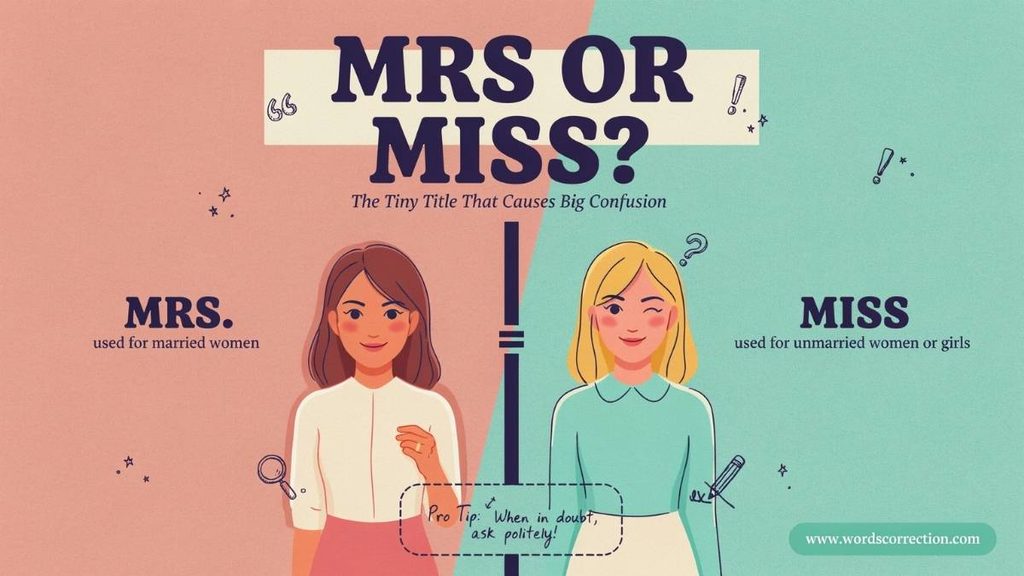
Understanding the difference between Mrs. and Miss becomes easier when you compare the titles by meaning, context, and social expectations.
The most important distinction is that Mrs. and Miss have traditional associations with marital status, while Ms. doesn’t. The titles can also differ in how people perceive them, particularly in formal or professional settings.
| Question | Mrs. | Miss | Ms. |
|---|---|---|---|
| What does it traditionally mean? | Married woman | Unmarried woman or girl | Woman of any marital status |
| Does it reveal marital status? | Traditionally, yes | Traditionally, yes | No |
| Can an adult use it? | Yes | Yes | Yes |
| Can a married woman choose it? | Yes | Yes, if she prefers it | Yes |
| Is it suitable for a formal letter? | Yes, when appropriate | Yes, when appropriate | Yes |
| Is it useful when marital status is unknown? | If preferred | If preferred | Often |
| Does it require a period in American English? | Usually yes | No | Usually yes |
These titles aren’t interchangeable in every situation. The most suitable option depends on the person’s preference, the context, and any applicable style rules.
Mrs vs Miss The Main Difference
The traditional difference between Mrs. and Miss is marital status.
Mrs. has historically identified a married woman, while Miss has traditionally identified an unmarried woman or girl. In older social conventions, this distinction was often treated as an important part of a woman’s formal identity.
Modern usage is more flexible. Women can choose the titles that suit them, and many prefer not to have their marital status reflected in how others address them.
Ms vs Mrs Which One Should You Choose?
The difference between Ms. and Mrs. is that Mrs. traditionally signals marriage, while Ms. doesn’t.
Suppose you’re writing to a married customer who signs her messages Ms. Taylor. You should address her as Ms. Taylor rather than changing her title to Mrs. Taylor based on her marital status.
Conversely, if a customer consistently uses Mrs. Taylor and prefers that title, there’s no reason to replace it with Ms.
The guiding principle is simple: choose the title the person uses rather than the one you think her marital status requires.
Is Ms the Same as Miss?
No. Although the spellings look similar, Ms. and Miss have different meanings and pronunciations.
Miss traditionally refers to an unmarried woman or girl. Ms. is neutral about marital status and is generally pronounced with a final Z sound.
Confusing the two can create awkward moments in conversation or written communication. When you’re unsure which title to use, remember that Ms. is often the more neutral option.
Learn the difference between basic English word mistakes
Trys or Tries Which is Correct Spelling?
How to Choose Between Mrs, Miss, and Ms
Choosing the correct title for a woman doesn’t have to be complicated. Start with her stated preference, consider the situation, and follow the relevant style conventions if you’re writing for an organization.
If you don’t know her preference, avoid making assumptions based on age, appearance, surname, or relationship status. In many cases, Ms. provides a sensible default. In other situations, you can simply use her full name without a courtesy title.
Which Title Should You Use for a Married Woman?
For a married woman, both Mrs. and Ms. can be appropriate. The best choice depends on what she prefers.
Use Mrs. if she identifies herself that way. Choose Ms. if she prefers a title that doesn’t communicate marital status.
For example, consider two fictional colleagues:
- Mrs. Lauren Brooks uses Mrs. in formal correspondence and on her professional stationery.
- Ms. Rachel Morgan uses Ms. in business emails, even though she’s married.
Both choices are correct. Marriage doesn’t require a woman to adopt Mrs.
Which Title Should You Use for an Unmarried Woman?
Miss and Ms. are both options for an unmarried woman.
Miss follows the traditional unmarried-woman convention. Ms. avoids indicating marital status and is widely useful in modern professional communication.
If an unmarried adult woman introduces herself as Miss Adams, use Miss Adams. If she signs her emails Ms. Adams, follow that preference instead.
The same principle applies to girls and younger women, although families, schools, and local customs may influence which title people use.
Which Title Should You Use When You Don’t Know a Woman’s Marital Status?
When you need a courtesy title but don’t know the recipient’s marital status or preference, Ms is often the safest practical choice in American English.
It doesn’t require you to guess whether someone is married. It also works in professional and formal contexts where respectful language matters.
Consider these options
- Dear Ms. Parker: A neutral, formal greeting.
- Dear Jordan Parker: A suitable alternative when a title isn’t necessary.
- Hello Jordan: A friendly option for less formal communication.
If you’re writing a legal document, completing an official form, or following an organization’s instructions, use the information and format that the process requires.
Which Title Should You Use in a Professional Email?
In business emails, the goal is to address the recipient respectfully without introducing unnecessary personal assumptions.
If you know the person’s preferred title, use it. If you don’t, Ms. is usually a practical option when you know the recipient uses a female courtesy title and a formal greeting is appropriate.
Here are some examples:
| Situation | Suggested greeting |
|---|---|
| Recipient prefers Mrs. | Dear Mrs. Carter, |
| Recipient prefers Miss | Dear Miss Carter, |
| Recipient prefers Ms. | Dear Ms. Carter, |
| Preference is unknown | Dear Ms. Carter, |
| A neutral greeting is preferred | Dear Taylor Carter, |
| The relationship is informal | Hello Taylor, |
For a professional email, you can also avoid the title altogether. “Hello Taylor” often sounds natural in contemporary workplaces, especially when colleagues regularly communicate by email.
The key is to match the level of formality to the relationship and setting.
Learn the difference between often confused words
Accel or Excel Which Spelling Is Correct?
Mrs or Miss in American English vs British English
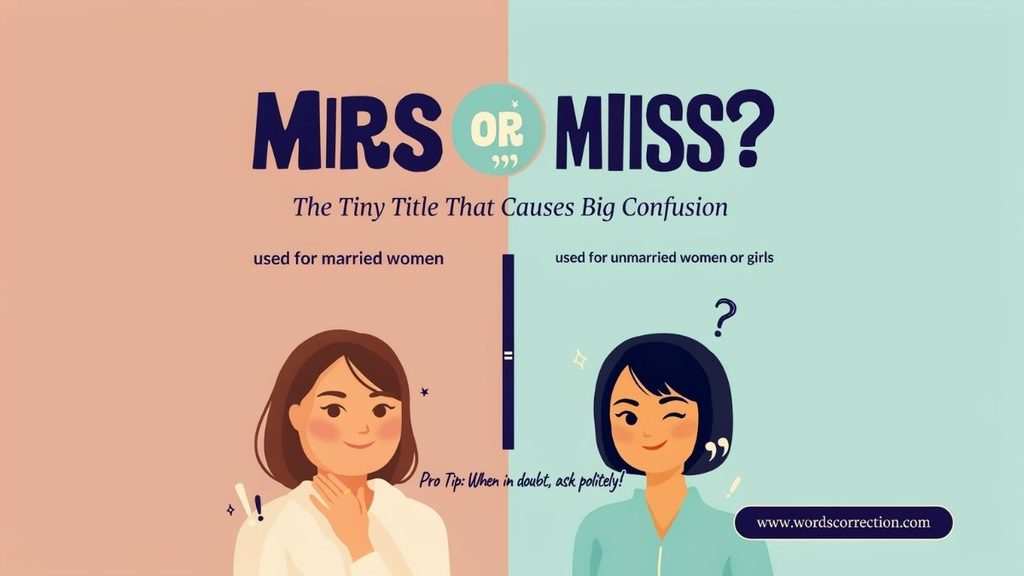
Both generally follow the same traditional meanings for Mrs., Miss, and Ms. The most noticeable difference is punctuation.
American English commonly uses periods after abbreviations such as Mrs. and Ms. British English often omits those periods, particularly when the abbreviation ends with the same letter as the full word.
American English Mrs, Miss, and Ms
In American English, the standard written forms are:
- Mrs.
- Miss
- Ms.
Mrs and Ms typically take periods because they’re treated as abbreviations. Miss doesn’t usually take a period because it’s a complete word rather than a shortened form.
Examples include
- Dear Mrs. Thompson,
- Dear Miss Thompson,
- Dear Ms. Thompson,
These forms are common in American formal correspondence, although a publication or organization may follow a specific house style.
British English Mrs, Miss, and Ms
In British English, the corresponding forms commonly appear without periods:
- Mrs
- Miss
- Ms
Examples include
- Dear Mrs Thompson,
- Dear Miss Thompson,
- Dear Ms Thompson,
This reflects a common British convention of omitting periods from certain titles and abbreviations that end with the final letter of the complete word.
However, British usage isn’t completely uniform. Individual publications, institutions, and writers may follow different style rules. Some international organizations also adopt a single style regardless of location.
American vs British English Comparison Table
| Feature | American English | British English |
|---|---|---|
| Married woman’s traditional title | Mrs. | Mrs |
| Traditional title for an unmarried woman | Miss | Miss |
| Marital-status-neutral title | Ms. | Ms |
| Period after Mrs. | Usually included | Commonly omitted |
| Period after Miss | Not used | Not used |
| Period after Ms. | Usually included | Commonly omitted |
| Example | Dear Mrs. Brown, | Dear Mrs Brown, |
Neither convention is inherently more correct. The important thing is to use a consistent style within the same document.
If you’re writing an article for an American audience, use American punctuation. For a British publication, follow its preferred conventions.
Learn the difference between confusing word pairs
Authorised or Authorized Which Spelling Is Correct?
Common Mistakes When Using Mrs, Miss, and Ms
Even experienced writers sometimes confuse these titles. Most mistakes happen when people rely on assumptions instead of checking the preferred form of address.
Assuming Every Married Woman Uses Mrs
Marriage doesn’t determine a woman’s preferred title.
Some married women use Mrs., while others prefer Ms. for personal, professional, or practical reasons. Automatically changing a woman’s title because she’s married can disregard her stated preference.
Better approach: Use the title she provides or asks you to use.
Using Miss When Someone Prefers Ms
Miss and Ms. aren’t interchangeable. Miss traditionally identifies an unmarried woman or girl, while Ms. doesn’t reveal marital status.
Using Miss for an adult who prefers Ms. can sound outdated or overly personal in some professional settings.
Better approach: Check the person’s email signature, professional profile, or stated preference before choosing a title.
Adding a Period After Miss
In standard American English, Miss is written without a period. It’s a complete word rather than a conventional abbreviation.
Correct: Miss Anderson
Incorrect in standard American usage: Miss. Anderson
Mrs. and Ms. commonly take periods in American English, which is why writers sometimes apply the same punctuation to Miss by mistake.
Mixing American and British Punctuation
Mixing styles can make a document look inconsistent.
For example, writing “Mrs Smith” in one paragraph and “Ms. Johnson” in another may be appropriate if you’re quoting sources that use different conventions. However, it’s usually better to follow one style throughout original writing.
Better approach: Choose American or British English according to your audience and apply the convention consistently.
Using the Wrong Surname or Title
A title should appear with the correct name. Using an outdated surname or an incorrect title can make a formal message feel careless.
For instance, if someone signs her email “Ms. Natalie Reed,” don’t automatically address her as Mrs. Reed or use a surname you found in an older record.
Better approach: Use the person’s current name and preferred title, especially in professional correspondence.
Confusing Ms With Miss in Formal Correspondence
Although the two spellings differ by only one letter, their meanings and pronunciations aren’t the same.
Miss traditionally carries an unmarried-status association. Ms. is neutral about marital status.
Better approach: Remember that Ms. is pronounced “MIZ,” while Miss is pronounced “MISS.”
Learn the difference between tricky grammar more words
Manuel or Manual An Easy Guide to the Correct Word
Mrs or Miss Examples in Everyday Writing
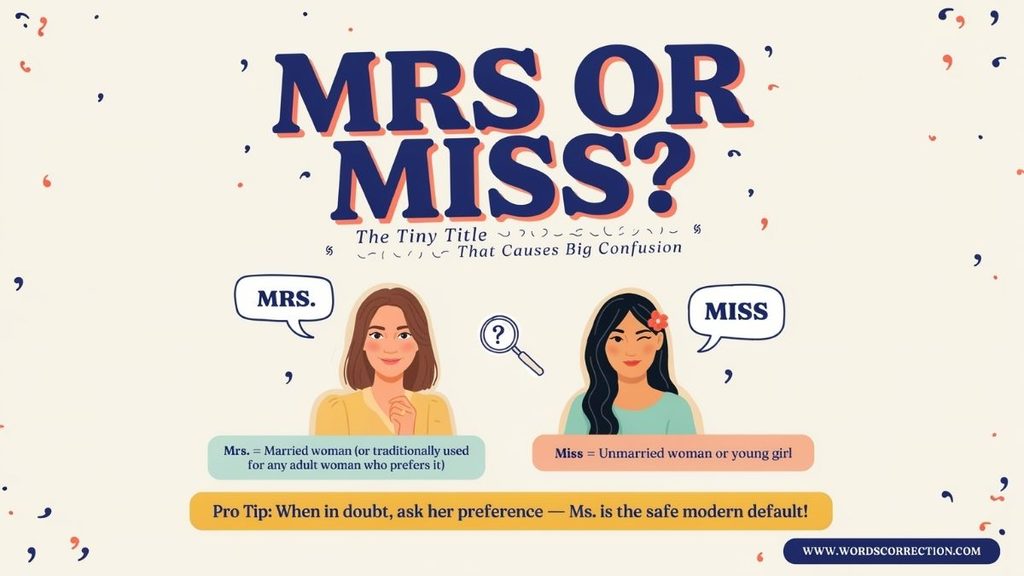
The easiest way to understand proper use of Mrs. and Miss is to see how the titles work in realistic situations.
The following examples use fictional names and illustrate common conventions rather than universal rules.
Mrs and Miss in Emails and Business Letters
In formal email correspondence, the title should reflect the recipient’s preference whenever possible.
Example: Using Mrs
Dear Mrs. Wilson,
Thank you for confirming your appointment. Your meeting is scheduled for Tuesday at 10 a.m.
Best regards,
Alex Morgan
Example: Using Miss
Dear Miss Wilson,
Thank you for your inquiry. The requested information is attached for your review.
Sincerely,
Alex Morgan
Example: Using Ms
Dear Ms. Wilson,
Thank you for your interest in our services. Please let us know if you have any questions.
Best regards,
Alex Morgan
All three greetings can be correct when they match the recipient’s preferred title.
Mrs and Miss on Wedding Invitations
Wedding invitations sometimes follow traditional naming conventions, particularly when the couple wants a formal presentation.
However, invitation etiquette varies by family, culture, and personal preference. A woman doesn’t have to use Mrs. simply because she’s married or getting married.
For a contemporary invitation, using each guest’s preferred title and full name is often the most respectful approach.
If you’re unsure, ask the guest how she would like her name written. This is especially helpful when the invitation involves a blended family, a professional title, or a name change.
Mrs and Miss in Schools and Educational Settings
Schools in some English-speaking communities traditionally use Miss or Mrs. when addressing female teachers. For example, students might call a teacher Miss Brown or Mrs. Brown.
These conventions vary by school and region. Some teachers prefer Ms., while others use a professional title such as Dr.
The most reliable approach is to follow the school’s customary form of address or the teacher’s stated preference. Don’t assume that a teacher’s marital status determines the title students should use.
Mrs and Miss in News Articles and Formal Documents
News organizations and institutions often use style guides to decide how to refer to people.
Some publications use courtesy titles in particular types of reporting, while others generally refer to adults by their surnames after the first mention. Formal documents may follow their own rules for names, titles, and personal information.
For example, a news article might introduce someone as Ms. Carter and refer to her as Carter later in the story. Another publication might use her full name throughout.
The important distinction is between an organization’s editorial convention and an individual’s preferred title. A style guide can govern the publication’s writing, but it shouldn’t be treated as proof of someone’s marital status or identity.
Learn the difference between commonly mixed-up more words
Gopher or Gofer Which Spelling Is Correct?
The History and Origin of Mrs, Miss, and Ms
The difference between Mrs. and Miss makes more sense when you understand how English titles developed. These forms of address reflect older social conventions, but their meanings have changed over time.
Where Did Mrs Come From?
Mrs. developed from mistress, which historically served as a respectful title for a woman. In earlier English usage, mistress didn’t necessarily carry the negative or romantic associations that the word can have today.
Over time, English speakers developed shortened forms of address. Mrs. became particularly associated with married women, while Miss developed as a separate title traditionally associated with unmarried women and girls.
This history explains why Mrs. doesn’t look or sound like a straightforward abbreviation of a modern English word. Its spelling and pronunciation reflect historical changes in the language.
How Did Miss Become a Title for Unmarried Women?
Miss emerged as a shortened form of mistress. As social conventions developed, English speakers increasingly used Miss to distinguish unmarried women from married women addressed as Mrs.
For generations, this distinction appeared in schools, formal letters, social introductions, and other settings where courtesy titles were common.
However, the traditional distinction also meant that women’s titles often communicated information about their personal lives in ways that men’s titles did not. This convention gradually became less suitable for many professional and social situations.
Why Did Ms Become Popular?
Ms. gained wider recognition as a marital-status-neutral title during the 20th century, particularly as women’s roles in professional and public life changed.
The title offered a straightforward alternative to choosing between Mrs. and Miss. Instead of identifying a woman as married or unmarried, Ms. allowed people to address her respectfully without making that distinction.
Today, Ms. is widely used in business, government, education, journalism, and everyday correspondence. It doesn’t replace Mrs. or Miss in every situation, but it gives women another choice.
The development of Ms. illustrates a broader change in naming conventions: a person’s title can express personal preference without having to disclose marital status.
Learn the difference between confusing more English words
Monkeys or Monkies Which Spelling Is Correct?
Practice Session Mrs or Miss
Fill in the blanks
1. My teacher is married. Her name is Sarah Brown. ______ Brown is very kind.
2. ______ Emily is my unmarried English teacher.
3. I sent a birthday card to ______ Smith, who is married.
4. ______ Jones is an unmarried woman who teaches us English.
5. Please give this letter to ______ Wilson, who is married.
6. ______ Taylor is an unmarried woman working at our school.
7. We visited ______ Davis at her home. She is married.
8. ______ Lily is an unmarried girl in my class.
9. The principal introduced ______ Miller, a married woman, to the students.
10. ______ Anna is an unmarried teacher at our school.
11. I met ______ Johnson, a married woman, at the meeting.
12. ______ Sophia is an unmarried woman who works in the library.
13. The invitation was sent to ______ Clark, who is married.
14. ______ Emma is an unmarried woman attending the event.
15. Our school welcomed ______ Anderson, a married teacher.
16. ______ Olivia is an unmarried student in my class.
17. I spoke to ______ Thomas, who is married, after the meeting.
18. ______ Grace is an unmarried woman from our neighborhood.
19. The letter was addressed to ______ White, a married woman.
20. ______ Mia is an unmarried teacher at the school.
21. We invited ______ Harris, who is married, to dinner.
22. ______ Chloe is an unmarried woman working in the office.
23. The students thanked ______ Martin, their married teacher.
24. ______ Isabella is an unmarried woman who joined our team.
25. I introduced ______ Robinson, a married woman, to my family.
Answers
- Mrs.
- Miss
- Mrs.
- Miss
- Mrs.
- Miss
- Mrs.
- Miss
- Mrs.
- Miss
- Mrs.
- Miss
- Mrs.
- Miss
- Mrs.
- Miss
- Mrs.
- Miss
- Mrs.
- Miss
- Mrs.
- Miss
- Mrs.
- Miss
- Mrs.
Here’s a trusted source for clear word meanings:
Cambridge Dictionary
FAQ’s
What is the main difference between Mrs and Miss?
Mrs. traditionally refers to a married woman, while Miss traditionally refers to an unmarried woman. The choice usually depends on the woman’s preference and the context in which the title is used.
Does Miss always mean an unmarried woman?
Traditionally, Miss identifies an unmarried woman or girl. However, some women continue to use Miss regardless of changes in their marital status because it suits their personal preference.
Can a married woman use Miss?
Yes, a married woman can choose to use Miss if she prefers that title. Although Miss traditionally indicates an unmarried woman, adults can select the form of address that feels right to them.
Can an unmarried woman use Mrs?
Yes, an unmarried woman can choose to use Mrs. if that is her preferred title. However, Mrs. is traditionally associated with married women, so some people may interpret it as indicating marriage.
Is Mrs used for a woman who is divorced?
A divorced woman may continue using Mrs. or switch to Miss or Ms. The appropriate title depends on her preference, personal circumstances, and how she wants to be addressed.
Should I use Mrs, Miss, or Ms if I do not know a woman’s marital status?
Ms. is generally the safest choice when a woman’s marital status is unknown. It does not indicate whether she is married or unmarried and is widely accepted in professional and formal communication.
Is Ms more professional than Mrs or Miss?
Ms. is often useful in professional settings because it does not reveal or imply marital status. However, Mrs. and Miss are also appropriate when they reflect the person’s preferred title.
What title should I use for a woman in a business email?
Use the title the recipient provides or prefers. If you do not know her preference, Ms. followed by her last name is usually an appropriate starting point.
How do you address a female teacher if you do not know her marital status?
Use Ms. followed by the teacher’s last name unless the school or teacher specifies another form of address. You can also use the title listed in the school’s official directory.
Should I use Miss or Ms for a teenage girl?
Miss is traditionally used for girls and unmarried young women. Ms. may be more suitable in formal settings or when the individual’s preferred title is unknown.
What title should I use for a woman who has never married but is older?
Ms. is often a suitable choice because it does not suggest an age or marital status. However, if she prefers Miss, it is appropriate to use that title.
Can a woman use Mrs without changing her last name after marriage?
Yes, a woman can use Mrs. while keeping her original last name. Using a spouse’s last name is not a requirement for choosing the title Mrs.
Does Mrs mean a woman has taken her husband’s last name?
No. Mrs. traditionally indicates a married woman, but it does not require her to use her husband’s last name. A married woman may keep her birth surname or use another surname.
What title should I use for a woman whose spouse has died?
A widowed woman may continue using Mrs. or choose Ms. or Miss, depending on her preference. It is best to use the title she currently uses rather than assume which one she wants.
Is Miss appropriate when addressing a female customer?
Miss can be appropriate if the customer uses that title or prefers it. When her preference is unknown, Ms. is generally a more neutral and professional option.
How should I write Mrs or Miss on a formal invitation?
Use the title the recipient normally uses. For a woman who prefers Mrs., write Mrs. followed by her chosen surname. For someone who prefers Miss, use Miss followed by her surname.
Do Mrs. and Miss have different pronunciations?
Yes. Mrs. is commonly pronounced “MISS-iz,” while Miss is pronounced “miss.” The written abbreviation Mrs. does not sound like the word Miss when spoken.
Why is Mrs pronounced Missus instead of M-R-S?
Mrs. developed from the historical word “mistress,” which was once used as a general title for a woman. Over time, its pronunciation evolved into “missus,” while its spelling remained an abbreviation.
Is Mrs always written with a period?
In American English, Mrs. usually takes a period because it is treated as an abbreviation. In British English, the period is often omitted when the abbreviation does not end with the final letter of the full word.
Is Miss an abbreviation?
No. Miss is a complete title rather than an abbreviation, so it is generally written without a period in both American and British English.
What is the plural form of Mrs.?
The plural form of Mrs. is uncommon in everyday writing. When referring to multiple women, writers often use their individual names or a phrase such as “the married women” to avoid an awkward plural construction.
Can Mrs or Miss be used with a first name?
Yes, but the convention depends on the situation. In some schools, workplaces, and service settings, a title followed by a first name is common. In formal correspondence, the title is usually followed by the last name.
Should I use Mrs or Ms on a job application?
Use the title you prefer if the application asks for one. If the field is optional, you can often leave it blank. Ms. is a neutral option when you do not want to indicate your marital status.
Are Mrs and Miss used the same way in every English-speaking country?
No. Usage varies by country, region, institution, and social context. American and British English also differ in punctuation conventions, so follow the style guide or local custom relevant to your audience.
What should I do if I use the wrong title for someone?
Politely correct yourself and use the person’s preferred title going forward. A brief apology is usually enough. Avoid making assumptions about marital status or explaining the mistake at length.
Learn the difference between tricky words and use them correctly
Signalling vs Signaling Which Spelling Is Correct?
Conclusion
Knowing the difference between Mrs and Miss helps you address women correctly and confidently. Traditionally, Mrs. is used for a married woman, while Miss is used for an unmarried woman or girl. Although the distinction seems simple, using the wrong title can lead to an awkward moment in a professional email, formal letter, or everyday conversation. The good news is that avoiding this common mistake is easy once you understand the basic rules. When in doubt, remember that personal preference matters, too. Choosing the right title shows respect, attention to detail, and good manners. After all, grammar should make communication easier, not turn a simple greeting into a guessing game.

Stella AJS is an experienced blogger and dedicated English language writer at Words Correction. She turns confusing grammar, word meanings, spelling, and usage into clear, practical insights that readers can easily understand and apply. With a passion for precise and engaging writing, Stella helps readers avoid common language mistakes, strengthen their vocabulary, and communicate with greater clarity and confidence.




