
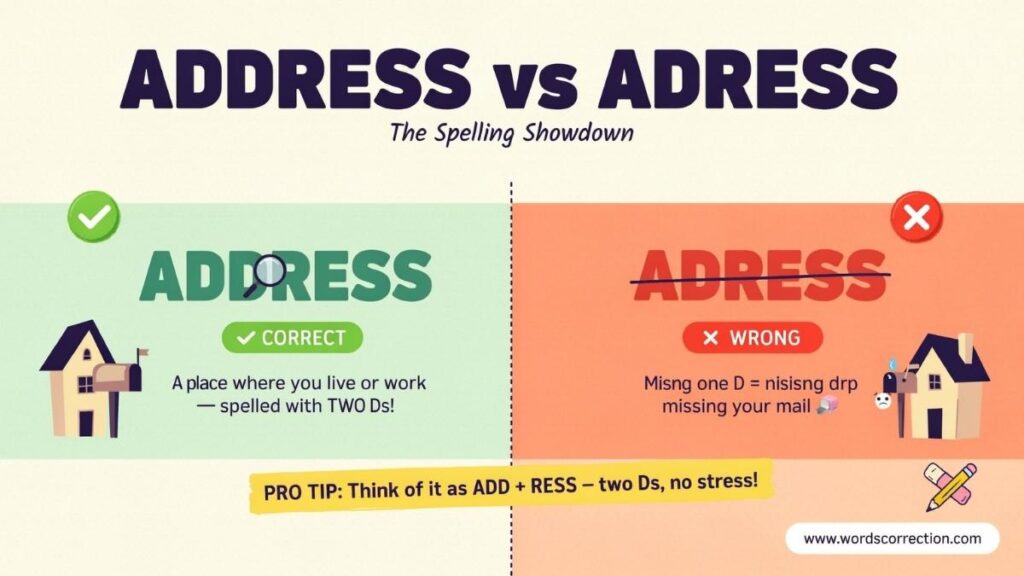
Address vs Adress is a common spelling confusion that can turn a simple writing task into an unexpected grammar puzzle. Although both forms may look familiar, only one is correct in standard English address. A missing letter might seem like a small mistake, but it can affect the clarity and professionalism of your writing. Whether you’re composing a business email, completing an online form or improving your grammar skills knowing the correct spelling matters. Fortunately, there’s no complicated rule to memorize or spelling mystery to solve. In this guide, you’ll learn the difference between address and adress explore common mistakes and practice using the word correctly with confidence.
Address vs Adress Quick Answer
Address is the correct English spelling. Adress is incorrect. Both American and British English use address with two Ds and two Ss.
| Spelling | Correct? | Explanation |
|---|---|---|
| Address | Yes | Standard English spelling |
| Adress | No | Missing one D |
| Addresses | Yes | Plural noun or third-person singular verb |
| Addressed | Yes | Past tense or past participle |
| Addressing | Yes | Present participle or gerund |
Consider these examples
- Correct: Please confirm your mailing address before placing the order.
- Incorrect: Please confirm your mailing adress before placing the order.
The difference is just one letter, but accuracy matters. Whether you’re completing a job application, sending a business email, or entering delivery details, always use address.
Address vs Adress at a Glance
Remember this simple spelling pattern:
A + DD + R + E + SS = ADDRESS
The word contains eight letters, including two consecutive Ds and two consecutive Ss. The incorrect form, adress, contains only seven letters because it leaves out one D.
Once you remember this pattern, you’ll find it easier to answer the question, “Is it address vs adress?” without hesitation.
Learn the difference between confusing more English words
Manuel or Manual An Easy Guide to the Correct Word
What Does Address Mean in English?
The word address has several meanings. Its definition depends on the context in which you use it.
In everyday English, address most often refers to location details. It can also describe a formal speech or the act of speaking to someone or dealing with a particular issue.
Address Definition as a Noun
As a noun, address can refer to a place, a communication destination, or a formal speech.
A physical or mailing address
A physical address identifies a particular place, such as a house, apartment, office, or business. A mailing address provides the details needed to deliver letters and packages.
Example: The courier delivered the package to my home address.
A residential address identifies where someone lives, while a business address identifies a workplace or commercial property. A postal address provides the information needed to direct mail to its intended recipient.
An email address
An email address identifies a destination for sending and receiving electronic messages. It typically consists of a username, the @ symbol, and a domain name.
Example: Please send the invoice to my email address.
Unlike a physical address, an email address directs electronic communication rather than physical deliveries.
A formal speech
Address can also mean a speech delivered to an audience, often during an important event or occasion.
Example: The principal delivered an address to the graduating students.
This meaning frequently appears in education, politics, public speaking, and formal events.
A manner of speaking or treating someone
In certain contexts, address refers to the way someone speaks to another person or treats them through their choice of words.
Example: The teacher appreciated the student’s respectful address.
This usage is relatively formal. In everyday conversation, people are more likely to say “the way someone speaks.”
Address Definition as a Verb
As a verb, address describes an action. Depending on the context, it can mean speaking to someone, directing a message to a recipient, or dealing with a problem.
Consider these examples
- Speaking to an audience: The mayor addressed the crowd.
- Dealing with a problem: The company addressed the customer’s complaint.
- Writing to a recipient: She addressed the envelope to her colleague.
- Discussing a concern: We need to address the spelling error before publishing the article.
Although the meaning changes with the context, the spelling remains the same.
What Does Adress Mean?
People who search for the meaning of adress are usually looking for the definition of address.
In standard English, adress is not an accepted alternative spelling of address. It is generally a spelling error rather than a separate English word with an established meaning.
You might encounter the same letter sequence in a username, brand name, or word from another language. Such uses depend on their specific context and do not change the standard English spelling.
For ordinary English writing, use address.
Learn the difference between commonly mixed-up more words
Gopher or Gofer Which Spelling Is Correct?
Why Is Address Spelled With Two Ds?
Understanding the spelling of address starts with its letter pattern and history. English contains many words with repeated consonants, and address is one of them.
The correct spelling is
- A: First letter
- DD: Two consecutive Ds
- R: One R
- E: One E
- SS: Two consecutive Ss
Together, these letters form A-D-D-R-E-S-S, an eight-letter word.
The misspelling adress omits the second D. Although the shorter form may seem reasonable when typing quickly, it does not follow standard English spelling conventions.
The Origin and History of Address
The history of address helps explain how the word developed its modern meanings.
English adopted address through French, particularly the verb adresser, which means to direct or guide something toward a destination. Its deeper linguistic history connects it with Latin roots associated with directing or making something straight, including the prefix ad-, which can express direction toward something.
Over time, address developed several related meanings. Address someone meant to direct words toward that person. To address a letter meant to identify its intended recipient. To address a problem came to mean giving attention to an issue so it could be resolved.
These meanings share a general idea: directing something toward a person, place, audience, or concern.
For example
- You address a letter to its recipient.
- You address an audience by speaking to its members.
- You address a problem by giving it attention.
The spelling reflects the word’s established form in English. Writers cannot shorten it simply because the shorter version looks familiar.
Why Is Adress Incorrect in English?
Standard English dictionaries recognize address as the correct spelling for these meanings, not adress.
The mistake often occurs when writers remember the sound of the word but forget one of its repeated letters. English spelling does not always make every letter obvious from pronunciation alone.
However, the standard spelling remains consistent. Removing one D does not create an accepted alternative; it creates a spelling error.
Learn the difference between tricky grammar more words
Monkeys or Monkies Which Spelling Is Correct?
Address vs Adress in American and British English
Some English words have different spellings depending on the region. For example, American English generally uses color, while British English generally uses colour. Similarly, center is common in American English, while centre is standard in British English.
Address is not one of those words. American and British English use the same spelling.
| Feature | American English | British English |
|---|---|---|
| Correct spelling | Address | Address |
| Incorrect spelling | Adress | Adress |
| Common term for delivery details | Mailing address | Postal address |
| Electronic contact | Email address | Email address |
| Past-tense form | Addressed | Addressed |
| Plural form | Addresses | Addresses |
The expressions mailing address and postal address may differ by regional preference, but the spelling of address remains unchanged.
Is Adress Correct in American English?
No. Address is the standard American English spelling. Writing adress in a business letter, school assignment, online form, or professional report is considered a spelling error.
Examples
- Correct: Please update your billing address.
- Incorrect: Please update your billing adress.
Is Adress Correct in British English?
No. British English follows the same spelling rule.
Examples
- Correct: Please enter your postal address.
- Incorrect: Please enter your postal adress.
An unfamiliar spelling is not necessarily a regional variation. In this case, however, adress is not the standard British spelling.
Learn the difference between confusing word pairs
Signalling vs Signaling Which Spelling Is Correct?
Address Pronunciation How Do You Say It?
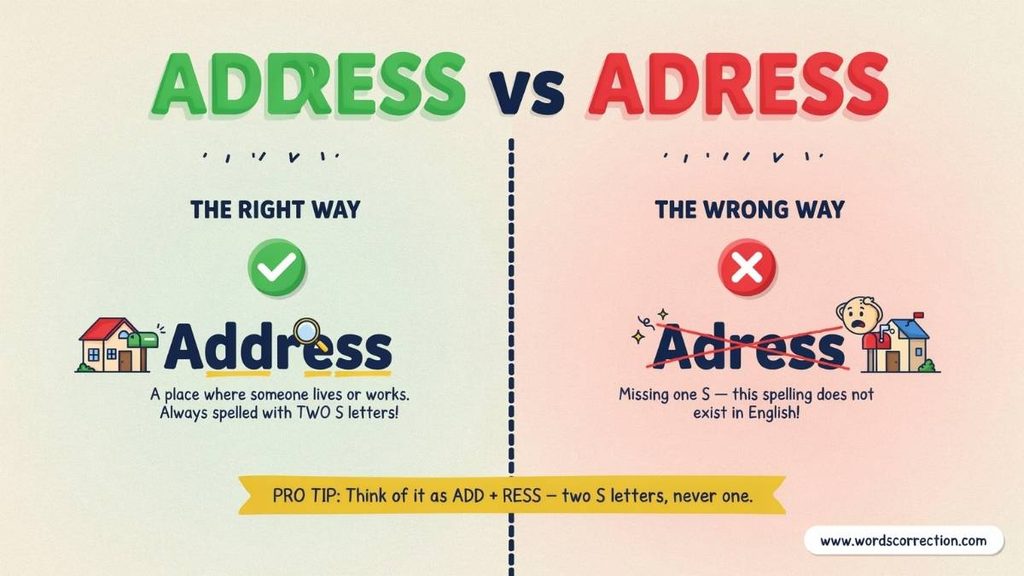
Although address has one standard spelling, its pronunciation can vary according to its grammatical role and the speaker’s accent.
In many American English varieties, the noun commonly takes stress on the first syllable, while the verb often takes stress on the second.
| Use | Common pronunciation pattern | Example |
|---|---|---|
| Noun | AD-dress | What is your mailing address? |
| Verb | uh-DRESS | We need to address the complaint. |
These are common patterns rather than strict rules for every speaker. Some people use the same stress pattern for both forms.
The important point is that pronunciation does not change the spelling. Whether you mean a location or the act of dealing with an issue, you still write address.
Does Pronunciation Explain the Adress Spelling Mistake?
Pronunciation can contribute to spelling confusion, but it does not make the incorrect form acceptable.
In ordinary speech, the two consecutive Ds do not necessarily sound like two separate consonants. A listener may hear a single D sound and assume that the written word needs only one D.
English contains many words with repeated consonants, including letter, common, summer, and success. Their repeated letters are part of their established spellings, even when speakers do not pronounce each letter separately.
For this reason, learning address as a complete spelling pattern is more reliable than trying to reconstruct its spelling from sound alone.
Learn the difference between often confused words
Sent or Send Which one Is Correct?
Address vs Adress Examples in Everyday Writing
Examples make spelling rules easier to remember because they show how a word works in real situations. The following sentences demonstrate the main uses of address in personal, professional, and formal communication.
Address in Emails and Online Forms
Digital communication often requires an accurate email or physical address. A typo can cause confusion or prevent a message from reaching its intended destination.
Examples
- Please verify your email address before submitting the form.
- The customer entered the wrong delivery address.
- I sent the confirmation to your business email address.
- Make sure your billing address matches the information on file.
Writing tip: Double-check addresses when completing online forms. A spelling mistake in a sentence may be easy to correct, but an incorrect email address or delivery detail can interfere with communication.
Address in Professional and Formal Writing
In the workplace, address often appears when people discuss responsibilities, concerns, or formal communication.
Examples
- The manager addressed the team’s concerns during the meeting.
- Please address the errors in the final report.
- The letter was addressed to the department director.
- The organization plans to address customer complaints more quickly.
These examples show how address can describe directing communication or dealing with an issue.
Address in News and Public Speaking
News articles and formal reports often use address when discussing speeches or public statements.
Examples
- The president delivered an address to the nation.
- The speaker addressed the audience before the ceremony.
- Her address focused on education and economic growth.
- The report addresses several concerns raised by local residents.
The first and third examples use address as a noun. The second and fourth use it as a verb.
Address in Everyday Conversation
You don’t need to write formal documents to use the word correctly. It appears in ordinary conversation, too.
Examples
- What’s your new address?
- I forgot to update my home address.
- We should address this misunderstanding before it gets worse.
- Can you address the group while I prepare the presentation?
These examples demonstrate why context matters. The same word can refer to a location in one sentence and an action in another.
Learn the difference between basic English word mistakes
Peak or Peek What’s the Difference?
Address vs Adress Common Spelling Mistakes
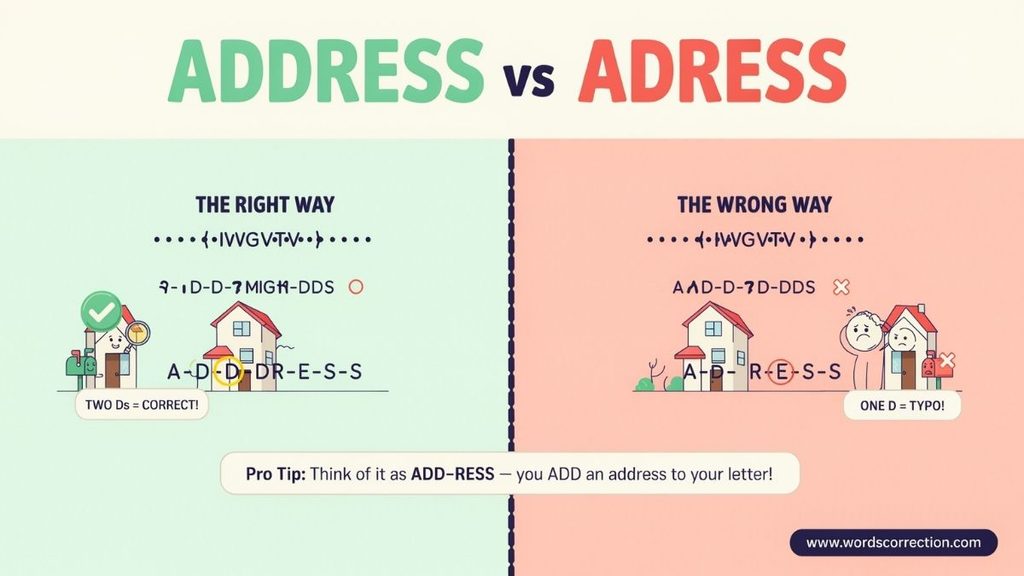
The most common error is adress, but other mistakes can occur when writers confuse spelling, word endings, or grammatical forms.
Address vs Adress
This is the main distinction covered in this article.
- Address: Correct standard English spelling.
- Adress: Incorrect spelling when intended to mean address.
Example: Please confirm the address before sending the package.
Address vs Addres
Addres omits the final S. It is incorrect when the intended word is address.
Example: The company changed its office address.
Address vs Addresse
Adding an unnecessary E at the end creates another spelling error.
The correct spelling is address, not addresse, when referring to a location or using the verb.
Address vs Addresses
Both forms are correct, but they serve different grammatical purposes.
Addresses can be the plural of the noun address:
- The database contains 500 addresses.
It can also be the third-person singular form of the verb:
- She addresses customer concerns every morning.
The context determines which meaning applies.
Address vs Addressed
Addressed is the past-tense and past-participle form of the verb.
- Present: The manager addresses the issue.
- Past: The manager addressed the issue yesterday.
Adding -ed does not correct a misspelling of the base form. The correct starting point is address.
Address vs Addressing
Addressing describes an ongoing action or functions as a gerund.
- The team is addressing the problem.
- Addressing customer feedback requires patience.
The double D remains in place.
Quick Grammar Reference
| Form | Grammatical use | Example |
|---|---|---|
| Address | Base verb or singular noun | Please address the concern. |
| Addresses | Plural noun or singular verb | She addresses the issue. |
| Addressed | Past tense or past participle | They addressed the problem. |
| Addressing | Present participle or gerund | We are addressing the error. |
| Address’s | Possessive form | The address’s format was unusual. |
A useful distinction address’s shows possession, while addresses usually indicates a plural noun or a verb form. For example, “The addresses are correct” uses the plural, while “The address’s format is correct” uses the possessive.
Learn the difference between commonly misused words
Mrs or Miss What’s the Difference?
Why Do People Misspell Address as Adress?
Even familiar words can cause spelling mistakes. The error often results from typing habits, uncertainty about repeated letters, or the way people learn English vocabulary.
Typing Too Quickly
When you type quickly, your fingers may skip a letter without you noticing. Because adress looks similar to address, the error can slip into an email, document, or online form.
For example, you might type, “Please confirm your adress,” while concentrating on the rest of the message. Without proofreading, the missing D may go unnoticed.
Solution: Pause briefly before submitting important written communication. A quick spelling check can catch errors that might otherwise escape your attention.
Uncertainty About Double Consonants
English contains many words with repeated letters, including address, letter, success, necessary, and committee. However, English spelling conventions are not always easy to predict from pronunciation.
Some writers remember the sound but forget the letter pattern. Others assume that a repeated consonant is unnecessary.
The best approach is to learn the standard spelling of frequently used words rather than relying entirely on sound.
Autocorrect Doesn’t Catch Every Error
Spell-checkers and autocorrect tools can help identify spelling mistakes, but they are not perfect. Their performance depends on the software, language settings, dictionary, and context.
A tool may flag adress immediately. Another may overlook it in a username, specialized field, or passage that has not been checked properly.
For professional writing, combine digital tools with a manual review. Never assume that a document is error-free simply because the software did not flag anything.
Seeing the Incorrect Spelling Online
Repeated exposure can make an error look familiar. If you encounter adress several times on websites, social media, or informal messages, you may begin to question which form is correct.
Familiarity, however, is not the same as accuracy. The standard English spelling remains address, regardless of how often the incorrect form appears online.
Learn the difference between everyday English mistakes
Todays or Today’s Which Is Correct?
How to Remember the Spelling of Address
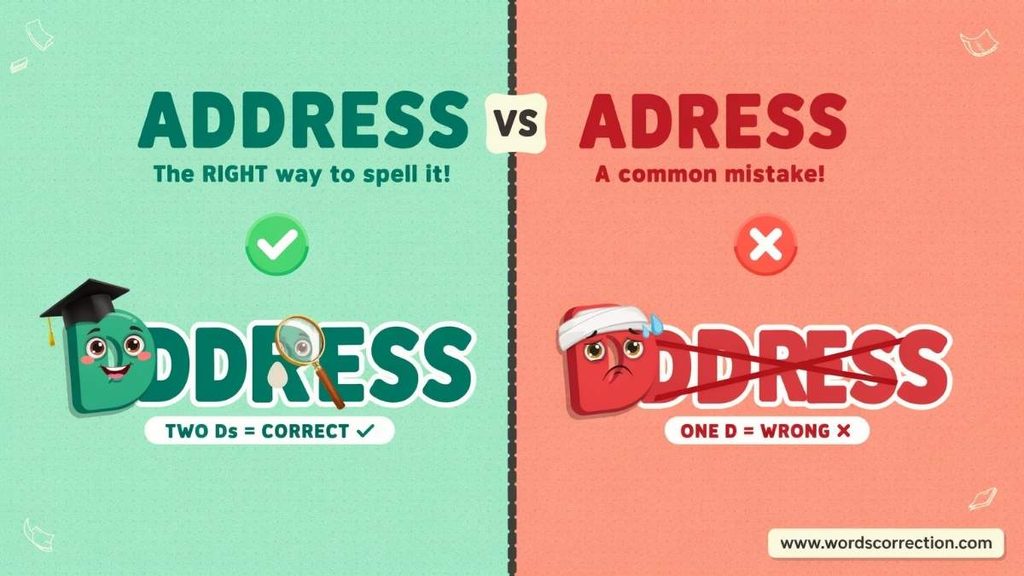
You don’t need complicated spelling rules to remember this word. A few simple techniques can help you get it right consistently.
Remember the Double D and Double S
The most reliable spelling tip is to memorize the complete letter pattern:
A-D-D-R-E-S-S
There are two Ds and two Ss. If you leave out either repeated consonant, check the word again.
Use a Simple Mnemonic
A mnemonic is a memory aid that helps you recall information.
Try this sentence:
“My address has two Ds and two Ss.”
A short reminder is easier to recall than a long explanation when you’re writing quickly.
You can also connect the word with a familiar situation:
“I need my address to receive my package.”
Practicing the correct spelling in a complete sentence helps connect the letters with their meaning.
Practice With Related Word Forms
Learning related forms reinforces the spelling pattern:
- Address
- Addresses
- Addressed
- Addressing
Each form retains the original double D. Once you recognize that pattern, you can apply it whenever you use the word.
Check the Word Before Sending Important Messages
Pay particular attention to spelling when writing:
- Job applications and resumes
- Business emails
- Customer records
- Mailing labels
- Online registration forms
- Reports and articles
A spelling error may not always change the intended meaning, but accurate spelling improves readability and professionalism. In an email or postal address, exact details matter even more because an error can affect delivery.
Learn the difference between more words people mix up
Fulfilment or Fulfillment Which Spelling Is Correct?
Address vs Location What’s the Difference?
Although address and location are related, they do not mean exactly the same thing.
A location is a place or position. An address is a set of details used to identify or direct someone to a particular destination.
For example, a park can be a location. Its street address provides more specific information about where visitors can find it.
| Term | Meaning | Example |
|---|---|---|
| Location | A place or position | The meeting location is downtown. |
| Street address | Details identifying a place along a street | The office address is 125 Main Street. |
| Mailing address | Details used to receive physical mail | Send the documents to my mailing address. |
| Email address | An identifier used for electronic messages | Contact me at my email address. |
A location does not always have a conventional street address. A remote campsite, a point in a national park, or a place identified by geographic coordinates can have a location without a standard mailing address.
Likewise, an address does not necessarily tell you everything about a place. It may identify a building or delivery point without explaining what the location looks like or how to reach it.
What Is the Correct Way to Write an Address?
The correct format depends on the country and the purpose of the address. For a typical US mailing address, the following structure is common.
Example of a US mailing address
Jordan Smith
125 Main Street, Apartment 4B
Austin, TX 78701
This is a fictional example for illustration only.
A standard US mailing address generally includes:
- The recipient’s name
- The street address, including an apartment or unit number when applicable
- The city, state abbreviation, and ZIP code
The exact format may differ for international mail, business addresses, and other destinations. Follow the destination country’s postal guidelines when preparing an actual shipment.
Regardless of the format, address is the correct spelling.
Learn the difference between tricky English words with easy explanations
Amid or Amidst What Is the Difference?
Practice Session fill in the blanks
- The correct spelling is __________ not adress.
- Please enter your email __________ to receive the confirmation message.
- The manager __________ the customer’s complaint during yesterday’s meeting.
- The company maintains several office __________ across the country.
- We are __________ the spelling errors in the final document.
- Double-check your mailing __________ before sending the package.
- The guest speaker delivered a formal __________ at the graduation ceremony.
- The teacher __________ the students before the examination began.
- An IP __________ helps identify a device on a network.
- The sender included a return __________ on the envelope.
- The past-tense form of address is __________.
- The plural form of address is __________.
- The company plans to __________ the customer’s concerns promptly.
- A billing __________ may differ from a shipping address.
- The word address contains two Ds and two __________.
- A residential address identifies the place where a person __________.
- The courier could not deliver the package because the delivery __________ was incorrect.
- In computing, a memory __________ identifies a specific location in computer memory.
- The word address can function as both a noun and a __________.
- The presenter is __________ the audience about the upcoming event.
- An email address typically includes a username, the @ symbol, and a __________ name.
- Remember to include the apartment number when writing the street __________.
- The organization __________ several important issues during the meeting.
- The misspelling __________ omits one D from the correct word.
- To remember the correct spelling, remember that address contains two Ds and two __________.
Answers
- Address
- Address
- Addressed
- Addresses
- Addressing
- Address
- Address
- Addressed
- Address
- Address
- Addressed
- Addresses
- Address
- Address
- Ss
- Lives
- Address
- Address
- Verb
- Addressing
- Domain
- Address
- Addressed
- Adress
- Ss
Here’s a trusted source for clear word meanings:
Cambridge Dictionary
FAQ’s
What Is the Plural Form of Address?
The plural form of address is addresses. It refers to more than one location, contact detail, or formal speech. For example, “The company operates from three different addresses.”
Is Address a Noun or a Verb?
Address functions as both a noun and a verb. As a noun, it can refer to a location or a formal speech. As a verb, it means speaking to someone, directing communication, or dealing with an issue.
How Do You Spell Address in the Past Tense?
The past-tense form of address is addressed. For example, “The manager addressed the team’s concerns during the meeting.” The word retains its two Ds and two Ss.
What Is the Present Tense of Address?
The base form is address. Use addresses when the subject is he, she, or it. For example, “She addresses customer complaints promptly.”
What Is the Difference Between Addressing and Addressed?
Addressing describes an ongoing action, while addressed generally refers to a completed action. For example, “We are addressing the issue” describes an action in progress, whereas “We addressed the issue yesterday” describes a completed action.
Is Address a Countable Noun?
Yes, address is a countable noun when it refers to a location or a formal speech. You can use it in singular or plural form, such as “one address” or “several addresses.” For example, “The form contains two addresses.”
What Does It Mean to Address Someone?
To address someone means to speak or write directly to that person. It can also involve using an appropriate title or form of reference. For example, “The presenter addressed the guests before the ceremony.”
What Does Address Mean in Business?
In business, address often means responding to a concern, resolving an issue, or communicating with a person or group. For example, “The company addressed the client’s concerns before finalizing the agreement.”
What Does It Mean to Address an Envelope?
To address an envelope means to write the recipient’s name and delivery details on it. You can also include a return address so the postal service can return the envelope if delivery is unsuccessful.
What Does Address Mean in Computing?
In computing, an address identifies a location or destination within a digital system. Common examples include email addresses, memory addresses, and IP addresses. Each serves a different purpose in digital communication or data processing.
What Is an IP Address?
An IP address is a numerical identifier assigned to a device or network interface for communication over an Internet Protocol network. It helps direct network traffic to the appropriate destination. The two main versions are IPv4 and IPv6.
What Is a Memory Address?
A memory address identifies a specific location in a computer’s memory. Computer systems use memory addresses to access stored data and instructions, depending on the system’s architecture and programming environment.
What Is a Return Address?
A return address identifies the sender of a letter or package. It allows the postal service to return the item if it cannot be delivered. A return address typically includes the sender’s name and mailing details.
What Is a Billing Address Used For?
A billing address is associated with a payment method or billing account. Businesses may use it to verify payment details, prepare invoices, and maintain account records. It may differ from the shipping address used to deliver an order.
What Is a Shipping Address Used For?
A shipping address specifies where a package should be delivered. It may identify a home, office, business, or another location that accepts deliveries. The shipping address can differ from the billing address.
What Is a Residential Address?
A residential address identifies a person’s place of residence. Depending on the location, it may include a building number, street name, apartment number, city, state or region, postal code, and country.
What Is a Business Address?
A business address identifies a company’s office, store, or other business premises. Businesses may use it for correspondence, deliveries, customer visits, and official records. Some organizations maintain separate addresses for different purposes.
What Is a Street Address?
A street address identifies a property or location along a street or road. It typically includes a building number and street name, along with an apartment or unit number when necessary. For example, “125 Main Street, Apartment 4B” is a fictional street address.
Can One Property Have More Than One Address?
Yes, a property can have different addresses for different purposes. For example, a building may have a street address and a separate mailing address. Large residential complexes and commercial properties may also use individual addresses or unit numbers.
Why Is Accurate Address Information Important?
Accurate address information helps letters, packages, invoices, and other communications reach the intended destination. Errors in street names, building numbers, or postal codes can lead to delays, failed deliveries, or returned mail. Reviewing the details before submitting them can help prevent these problems.
What Should I Do If My Address Changes?
Update your address with relevant organizations, including your postal service, bank, employer, subscription providers, and delivery accounts. Depending on your circumstances, you may also need to notify government agencies or other service providers.
Can an Address Include an Apartment or Unit Number?
Yes. An address can include an apartment, suite, floor, or unit number to identify a specific space within a larger building. Include these details whenever they are necessary for accurate delivery or identification.
What Is the Difference Between an Address and an Address Line?
An address is the complete set of details used to identify a destination. An address line is an individual field or line used to enter part of that information on a form. For example, the first line may contain the street address, while the second may include an apartment or suite number.
Why Do Online Forms Have Address Line 1 and Address Line 2?
Address Line 1 typically contains the primary street address, including the building number and street name. Address Line 2 is generally used for additional details, such as an apartment, suite, or unit number. Because formats vary, follow the instructions provided on the form.
How Can I Check Whether an Address Is Valid?
Verify the street name, building or unit number, city, region, and postal code. For mailing addresses, use an address-validation tool provided by the relevant postal service when available. Remember that a correctly formatted address does not necessarily confirm that the location exists or can receive deliveries.
Learn the difference between confusing more English words step by step
Bare or Bear What’s the Difference?
Conclusion
Address vs Adress is a simple yet important step toward improving your spelling and writing skills. When comparing Address vs Adress, remember that address is the correct spelling in standard English, while adress is a common spelling mistake. Although the difference is just one letter, it can affect the clarity and professionalism of your writing.
Learning Address vs Adress helps you avoid errors in emails, online forms, business documents, and everyday communication. With regular practice, you’ll find the Address vs Adress spelling rule easier to remember and apply. Whenever you’re unsure about Address vs Adress, recall the two Ds and two Ss in the correct spelling. Mastering Address vs Adress is a small step toward clearer more confident writing. After all, good grammar doesn’t need a forwarding address.

Stella AJS is an experienced blogger and dedicated English language writer at Words Correction. She turns confusing grammar, word meanings, spelling, and usage into clear, practical insights that readers can easily understand and apply. With a passion for precise and engaging writing, Stella helps readers avoid common language mistakes, strengthen their vocabulary, and communicate with greater clarity and confidence.




