Confusing sole vs soul is a common English mistake, especially because these two words sound exactly alike. The tricky part is that they have completely different meanings. Sole can mean “only,” or it can refer to the bottom of your foot or shoe. Soul, on the other hand, usually refers to a person’s spirit, inner self, or deepest feelings. Mixing them up can make a sentence sound funny or even change its meaning. The good news is that the difference is easy to learn. This guide explains sole vs soul in simple language with clear meanings, useful examples, and easy tips to help you use each word correctly.
Sole vs Soul What Is the Difference?
The sole and soul difference is mainly a matter of meaning and spelling. Although the two words sound identical, they belong to different semantic groups and serve different purposes in English.
Sole can function as a noun, adjective, or verb.
A noun, it can refer to:
- The bottom of the foot
- The bottom of a shoe
- A type of flatfish
An adjective, it means:
- Only
- Single
- One and no other
As a verb, sole means to put a new sole on a shoe or other piece of footwear.
Soul, on the other hand, is primarily a noun. It can refer to:
- The spiritual part of a person
- A person’s inner self
- Someone’s emotional or essential nature
- A person in certain expressions
- A quality of deep feeling or emotional expression
- A musical genre and cultural tradition
| Word | Meaning | Part of Speech | Example |
| sole | Bottom of the foot | Noun | The sole of my foot hurts. |
| sole | Bottom of a shoe | Noun | The sole of the boot is worn. |
| sole | Only or single | Adjective | She was the sole survivor. |
| sole | A type of flatfish | Noun | We ordered grilled sole. |
| sole | Put a new sole on footwear | Verb | The cobbler soled the boots. |
| soul | Spiritual or inner self | Noun | The music touched her soul. |
| soul | A person | Noun | Not a soul was there. |
| soul | Emotional or essential nature | Noun | The performance had soul. |
In short, if you’re asking about sole vs soul which one is correct, the answer depends entirely on what you want to say.
What Does Sole Mean?
The sole meaning depends on how the word appears in a sentence. It has several distinct meanings, but most are easy to recognize from context.
Learn the difference between confusing more English words
Pair or Pare what’s the difference?
Sole Meaning The Bottom of the Foot
The most familiar physical meaning of sole is the underside or bottom of the foot.
The sole is the part of your foot that normally faces the ground when you stand or walk.
For example:
- The sole of my foot hurts after the long hike.
- She stepped on a sharp piece of glass with the sole of her foot.
- The athlete developed a blister on the sole of his foot.
This is the sole meaning bottom of foot that appears frequently in health, sports, footwear, and everyday conversations.
The word doesn’t refer to the entire foot. It specifically identifies the underside.
Sole Meaning The Bottom of a Shoe
Sole also describes the bottom part of a shoe, boot, sandal, or other type of footwear.
For example:
- The sole of my shoe is starting to wear out.
- These boots have thick rubber soles.
- The repair shop replaced the sole of the boot.
If you’re talking about the shoe sole, the spelling is always sole, not soul.
A useful association is:
Sole → shoe → ground
The sole of a shoe is the part that usually meets the ground.
Sole as “Only”
Here’s another important meaning. As an adjective, sole means only, single, or one and no other.
For example:
- She was the sole survivor.
- His sole purpose was to help the community.
- He is the sole owner of the property.
- The manager has sole responsibility for the project.
- Safety was the sole reason for the change.
In each sentence, sole means that there is no other person, purpose, reason, or responsible party.
This makes sole as only one of the most useful distinctions to remember.
If you can replace the word with only and the sentence still makes sense, sole is probably the correct choice.
For example:
She was the sole winner.
can become:
She was the only winner.
The meaning remains essentially the same.
Learn the difference between commonly mixed-up more words
Maximise or Maximize which one is correct?
Sole Purpose and Sole Responsibility
The adjective sole appears frequently in formal and professional English.
Common expressions include:
- sole purpose
- sole reason
- sole owner
- sole survivor
- sole responsibility
- sole authority
- sole beneficiary
- sole provider
- sole source
For example:
The sole purpose of the meeting was to review the annual budget.
Here, sole purpose means the only purpose.
Likewise:
The director has sole responsibility for approving the final report.
This means the director alone holds that responsibility.
Sole as a Type of Fish
There is another completely different sole word meaning: a type of flatfish.
Sole are flat-bodied fish found in marine environments. The word also appears on restaurant menus, especially in dishes such as Dover sole.
For example:
- The chef prepared grilled sole with lemon.
- Fresh sole was served with roasted vegetables.
- The restaurant specializes in several types of seafood, including sole.
This meaning has no connection to the spiritual meaning of soul.
Sole as a Verb
Although less common, sole can also function as a verb.
To sole a shoe means to put a new sole on it.
For example:
The cobbler soled my old hiking boots.
This use is more likely to appear in discussions about shoe repair than in ordinary conversation.
Learn the difference between tricky grammar more words
Invision or Envision Which Is Correct?
What Does Soul Mean?
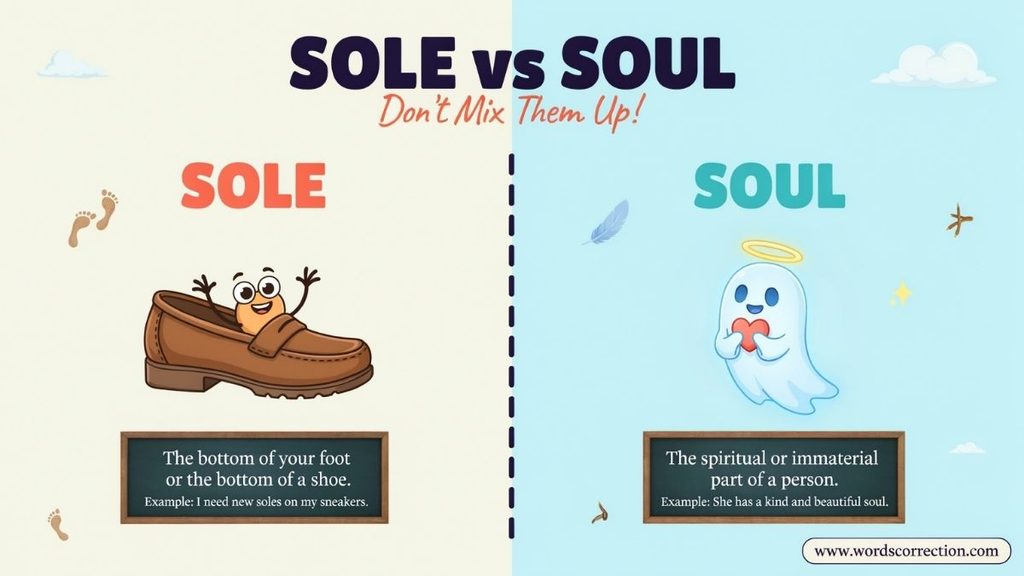
The soul meaning centers on a person’s spiritual, emotional, or inner nature.
Unlike sole, which has several concrete meanings, soul is strongly associated with ideas about identity, consciousness, spirituality, and human experience.
Soul as Spirit
The most traditional meaning of soul refers to the spiritual part of a person.
In religious and philosophical discussions, the soul may be understood as the nonphysical part of a human being.
For example:
- The story explores the relationship between the body and the soul.
- Many religious traditions have different ideas about the human soul.
- The prayer asked for peace for his soul.
- The novel examines questions about life, death, and the soul.
The exact human soul meaning varies across cultures, religions, and philosophical traditions. English uses the word broadly, so its interpretation depends heavily on context.
Soul as the Inner Self
Soul doesn’t always carry a specifically religious meaning.
In everyday and literary English, it can describe someone’s inner self, emotional nature, character, or deepest identity.
For example:
The experience changed her soul.
Here, the speaker may not be making a religious claim. Instead, the sentence suggests that the experience deeply changed her as a person.
You can also say:
- He poured his soul into the painting.
- The music touched my soul.
- Her writing reveals her emotional depth.
- The experience reached into his inner self.
In these examples, soul represents something deeper than appearance or physical existence.
Soul as a Person
In certain expressions, soul can simply mean a person.
Consider:
Not a soul was in the building.
This means:
Not a single person was in the building.
Other examples include:
- Every soul deserves respect.
- That poor soul had nowhere to go.
- She is a kind soul.
- We didn’t see another soul all evening.
This usage can sound warm, sympathetic, dramatic, or literary depending on the context.
Soul in Music and Culture
The word soul also has an important cultural and musical meaning.
Soul music developed from African American musical traditions and became particularly influential in the United States during the mid-20th century. The term is also used more broadly to describe music or performances that communicate strong emotion and feeling.
For example:
- She listens to classic soul music.
- His voice has a lot of soul.
- The performance was powerful and full of emotion.
The word can therefore describe both a musical tradition and the emotional quality of a performance.
Are Sole and Soul Homophones?
Yes. Sole and soul are homophones.
A homophone is a word that has the same pronunciation as another word but a different spelling and meaning.
English has many familiar examples:
- to / too / two
- there / their / they’re
- right / write
- flower / flour
- sole / soul
These are words that sound alike, but their written forms and meanings differ.
That creates a particular problem for English learners. When you hear the word, you can’t determine the spelling from pronunciation alone.
For example, if someone says:
“The sole was damaged.”
You need context to know whether they mean a shoe sole, a foot, or something else.
If someone says:
“The song touched my soul.”
The context makes the intended meaning obvious.
Learn the difference between confusing word pairs
Families or Familys which one is correct?
How Do You Pronounce Sole and Soul?
One reason these words cause confusion is simple sole and soul are pronounced the same in standard English.
In American English, both are commonly represented as /soʊl/. In British English, dictionaries commonly use /səʊl/.
The spelling changes. The pronunciation does not.
| Word | American English | British English | Same Sound? |
| sole | /soʊl/ | /səʊl/ | Yes |
| soul | /soʊl/ | /səʊl/ | Yes |
So, if you’re searching for sole vs soul pronunciation, there’s no useful pronunciation difference to help you choose between them.
The surrounding words provide the clue.
Sole vs Soul Examples
The easiest way to understand sole vs soul examples is to compare the words in similar sentences.
| Sentence | Correct Word | Meaning |
| The sole of my foot hurts. | Sole | Bottom of the foot |
| The sole of the shoe is damaged. | Sole | Bottom of footwear |
| She was the sole survivor. | Sole | Only survivor |
| He is the sole owner. | Sole | Only owner |
| The restaurant served grilled sole. | Sole | Flatfish |
| The music touched my soul. | Soul | Inner or spiritual self |
| The poem explores the human soul. | Soul | Spiritual or inner nature |
| Not a soul was there. | Soul | Person |
| She put her heart and soul into the project. | Soul | Deep emotional commitment |
| He is a kind soul. | Soul | Person or character |
These sole and soul examples show why you can’t choose the spelling based on pronunciation. You have to understand the intended meaning.
Sole vs Soul for “Only”?
If you’re wondering about sole vs soul for only, the correct answer is sole.
Use sole when you mean only, single, or one and no other.
Correct:
She was the sole applicant.
Incorrect:
She was the soul applicant.
Correct:
This is the company’s sole purpose.
Incorrect:
This is the company’s soul purpose.
The mistake happens because the words sound identical. However, once you connect sole with “only,” the distinction becomes much easier.
Sole Meaning Only Person
The same rule applies when referring to one person who occupies a unique position.
For example:
Maria was the sole person responsible for the project.
This means Maria was the only person responsible.
Similarly:
He was the sole witness.
means:
He was the only witness.
Sole Survivor
Sole survivor is another common expression.
It means the only person who survived an event.
For example:
She became the sole survivor of the accident.
The correct word is sole because the meaning is “only.”
Writing soul survivor would be incorrect if you intend to describe the only survivor.
Learn the difference between often confused words
Allie or Ally Difference And Usage
Sole vs Soul Purpose Which Is Correct?
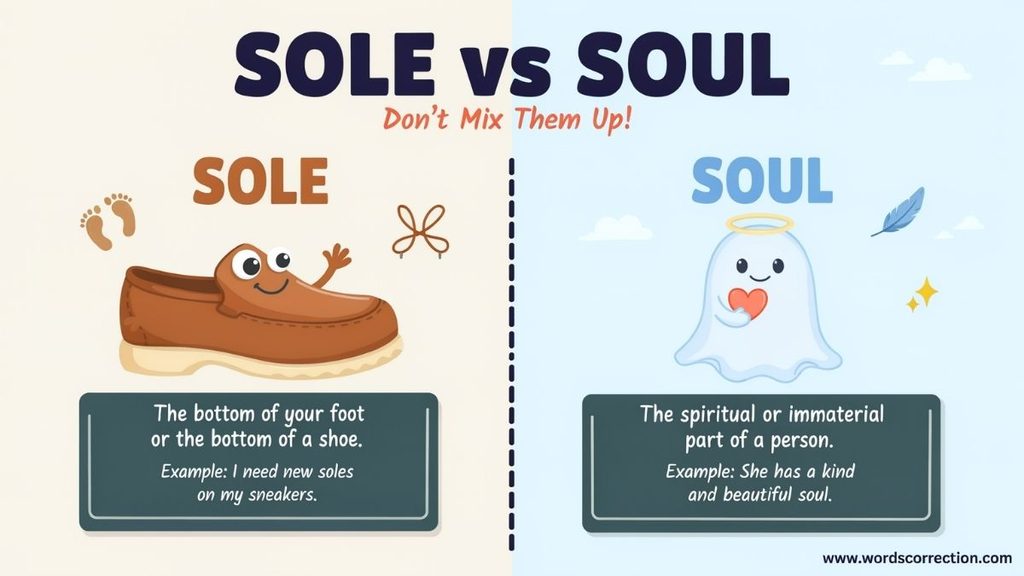
The correct phrase is sole purpose when you mean only purpose.
For example:
The sole purpose of this policy is to protect customers.
You could rewrite the sentence as:
The only purpose of this policy is to protect customers.
The meaning stays the same.
By contrast, soul purpose is not the standard expression when you mean “only purpose.”
This is one of the most common spelling mistakes involving these homophones.
Learn the difference between commonly confused more words in English
Slushy Vs Slushie Which Spelling is Correct?
How Do You Use Sole in a Sentence?
If you’re wondering how do you use sole in a sentence, first determine which meaning you need.
Sole Meaning the Bottom of the Foot
The sole of her foot was sore after the long walk.
Sole Meaning the Bottom of a Shoe
The sole of his hiking boot was badly damaged.
Sole Meaning Only
She was the sole candidate who met all the requirements.
Sole Meaning a Fish
The chef served fresh sole with vegetables.
Sole as a Verb
The shoemaker soled the customer’s boots.
Each sentence uses sole differently, but the context makes the meaning clear.
How Do You Use Soul in a Sentence?
The word soul usually appears when discussing spirituality, emotions, inner identity, character, or people.
Soul as Spirit
He believed that every human being has a soul.
Soul as Inner Self
The experience changed her soul.
Soul as Emotion
The singer put her soul into the performance.
Soul as a Person
There wasn’t a soul on the street.
Soul in Music
His collection includes some of the greatest soul records of the 1960s.
The key is to look beyond the sound and focus on the meaning.
Learn the difference between basic English word mistakes
Happend or Happened Which Spelling Is Correct?
Common Mistakes With Sole and Soul
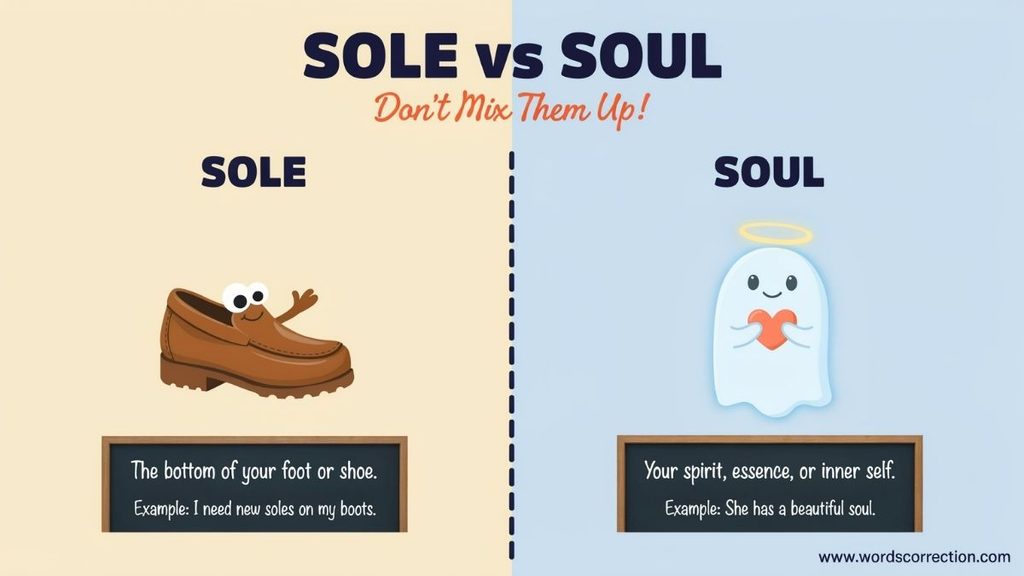
Because these words are homophones, writers often use one when they mean the other.
Mistake Soul Purpose
Incorrect
The soul purpose of the meeting was to discuss the budget.
Correct
The sole purpose of the meeting was to discuss the budget.
The sentence means the only purpose, so sole is required.
Mistake Soul Survivor
Incorrect
She was the soul survivor.
Correct
She was the sole survivor.
The person was the only survivor, so use sole.
Mistake Soul of the Shoe
Incorrect
The soul of my shoe is worn out.
Correct
The sole of my shoe is worn out.
The sentence refers to the bottom of footwear.
Mistake Sole When You Mean Spirit
Incorrect
The experience touched his sole.
Correct
The experience touched his soul.
The sentence refers to his emotional or inner self.
Learn the difference between commonly misused words
Steel or Steal which one is correct?
When Should You Use Sole vs Soul?
Knowing when to use sole vs soul becomes much easier when you sort the meanings into two groups.
Use sole when the word means
- Bottom of the foot
- Bottom of a shoe
- Only
- Single
- One and no other
- A type of fish
- Putting a new sole on footwear
Use soul when the word means
- Spirit
- Inner self
- Spiritual essence
- Emotional nature
- Deep character
- A person in certain expressions
- Soul music or its cultural qualities
A quick decision table can help:
| If you’re talking about… | Use |
| Bottom of the foot | sole |
| Bottom of a shoe | sole |
| Only one | sole |
| Sole responsibility | sole |
| Sole purpose | sole |
| Sole survivor | sole |
| A flatfish | sole |
| Spiritual part of a person | soul |
| Inner self | soul |
| Emotional nature | soul |
| A person in “not a…” | soul |
| Soul mate | soul |
| Soul music | soul |
Learn the difference between everyday English mistakes
Principal or Principle Don’t Mix Them Up
Sole and Soul Origin and Etymology
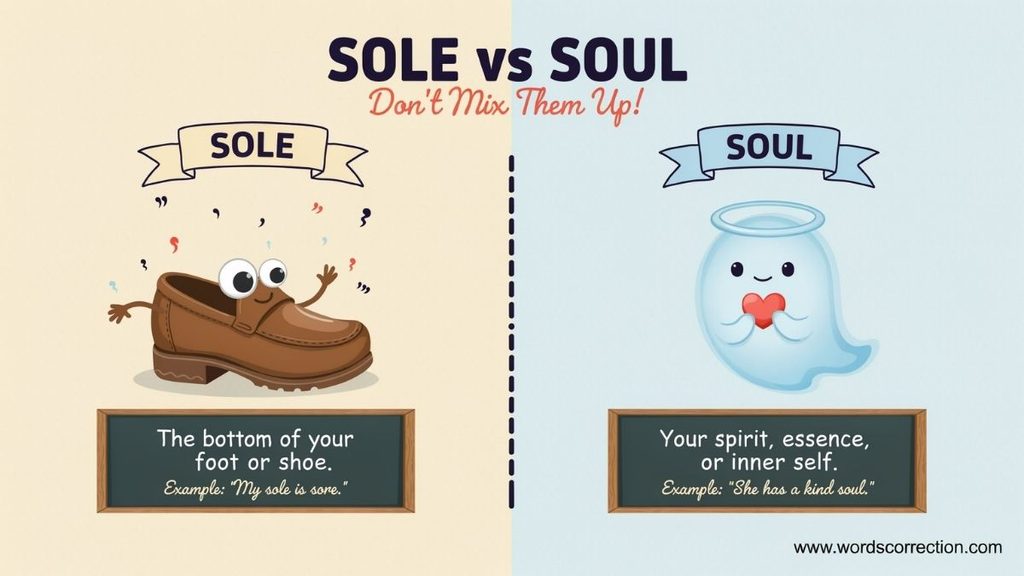
Although sole and soul sound alike today, they have different historical backgrounds.
The word sole, when referring to the bottom of the foot, developed through French from Latin and has a long connection with feet, footwear, and sandals. The fish sense developed separately but became associated with the fish’s flat shape.
The adjective sole, meaning “only,” also has a different history and ultimately traces back to Latin ideas connected with being alone or singular.
Soul has its own Germanic history. It developed through Old English and Middle English forms associated with the spiritual or life-giving part of a person.
These separate origins help explain why two words can eventually end up with the same pronunciation while retaining completely different meanings and spellings.
English is full of such historical surprises.
Sole vs Soul in British and American English
There is no major spelling difference between American and British English for these words.
Both varieties use:
- sole
- soul
The pronunciation can differ slightly by accent, but the spelling remains unchanged.
This means you don’t need to choose one spelling based on whether you’re writing for an American or British audience.
The real issue is meaning, not regional spelling.
Sole and Soul in Formal Writing
Sole appears frequently in professional, legal, academic, and business writing because it provides a precise way to express exclusivity.
For example:
- sole authority
- sole responsibility
- sole ownership
- sole beneficiary
- sole purpose
- sole source
- sole provider
Consider:
The board retains sole authority over the final decision.
The word sole clearly establishes that no other party shares that authority.
Soul appears more often in personal, literary, artistic, religious, and emotional writing.
For example:
The novel explores the relationship between identity, memory, and the human soul.
Or:
The singer’s performance had remarkable emotional depth and soul.
Both words work well in formal writing when the meaning calls for them. The key is choosing the word that fits the context.
Learn the difference between more words people mix up
Programme or Program Spelling Guide
A Simple Case Study One Sound, Two Meanings
Consider these two sentences:
The sole of his shoe was damaged.
The experience changed his soul.
The sentences contain words that sound identical, but the meanings are worlds apart.
In the first sentence, sole refers to a physical object. You could touch it, inspect it, or replace it.
In the second, soul refers to something abstract and deeply personal. It represents the person’s inner or spiritual nature.
Now consider a third sentence:
He was the sole survivor.
Here, sole has nothing to do with shoes. It means only.
These three examples demonstrate why memorizing one definition isn’t enough. The word sole itself has several meanings.
Learn the difference between tricky words and use them correctly
Fair or Fare which is correct?
How to Remember the Difference Between Sole and Soul
A simple memory trick can make the distinction easier.
Think of SOLE as connected to SHOES and ONLY.
- sole of the foot
- sole of a shoe
- sole survivor
- sole purpose
- sole owner
Then think of SOUL as connected to SPIRIT and INNER SELF.
- human soul
- soul mate
- soul-searching
- heart and soul
- kind soul
A memorable sentence can make the difference even easier:
Your sole touches the ground, while your soul represents what lies within you.
The trick isn’t a grammatical rule. It’s simply a mental shortcut that links each spelling with its most recognizable meanings.
Sole vs Soul Practice Session
Fill in the Blanks
- The ______ of her shoe was completely worn out.
- He believes that every person has a unique ______.
- She was the ______ owner of the property.
- The ______ purpose of this meeting is to solve the problem.
- The hikers were careful to protect the ______ of their feet from sharp rocks.
- Not a single ______ was left in the empty building.
- He repaired the broken ______ of my boot.
- Music can touch the ______ in ways that words sometimes cannot.
- She was the ______ survivor of the accident.
- The company became his ______ responsibility after his business partner left.
- The poem explores the deepest emotions of the human ______.
- He was the ______ person allowed to access the records.
- The rough surface damaged the ______ of my shoes.
- She poured her heart and ______ into the project.
- Cost was not the ______ reason for rejecting the proposal.
- The fisherman caught a large ______ near the coast.
- The story speaks about the human ______ and its search for meaning.
- He became the ______ witness to the incident.
- The ______ of the shoe needs to be replaced before you wear it again.
- Her kindness showed the warmth of her ______.
- The manager had ______ authority over the final decision.
- There wasn’t a ______ in the room when we arrived.
- The ______ of his left shoe had separated from the upper part.
- Many people describe a ______ as the spiritual part of a person.
- She was the ______ candidate who met all the requirements.
Answer Key
- sole
- soul
- sole
- sole
- sole
- soul
- sole
- soul
- sole
- sole
- soul
- sole
- sole
- soul
- sole
- sole
- soul
- sole
- sole
- soul
- sole
- soul
- sole
- soul
- sole
Here’s a trusted source for clear more words Comparison:
Grammar Update
FAQs
What is the difference between sole and soul?
Sole and soul are homophones, so they sound alike but have different meanings. Sole can mean “only” or the bottom of a foot or shoe, while soul usually refers to a person’s spirit or inner self.
Which is correct, sole or soul?
Both sole and soul are correct words, but they are used in different contexts. Use sole for meanings related to “only,” feet, shoes, or certain fish. Use soul when referring to a person’s spirit, inner nature, or a person in certain expressions.
Is sole or soul used for only?
Use sole when you mean “only” or “one and no other.” For example, “She was the sole owner of the business” means she was the only owner.
Is it sole purpose or soul purpose?
The correct expression is sole purpose when you mean “the only purpose.” For example, “The sole purpose of this meeting is to review the report.”
Is it sole reason or soul reason?
The correct phrase is sole reason. It means the only reason. For example, “Money wasn’t the sole reason for his decision.”
Is it sole survivor or soul survivor?
The correct expression is sole survivor. It means the only person who survived a particular event. Soul survivor doesn’t have this standard meaning.
Can soul mean a person?
Yes. Soul can refer to a person, particularly in expressions such as “not a soul was there.” In this usage, it emphasizes an individual as a living person.
Can sole describe a person?
Yes, but sole doesn’t mean “person” by itself. In a phrase such as sole person, it means the only person in a particular situation.
What does sole person mean?
Sole person means the only person involved in a particular activity, position, responsibility, or situation. For example, “He was the sole person authorized to sign the document.”
Does sole mean alone?
Sole can express a meaning similar to alone when it means “the only one.” For example, “She was the sole witness” means she was the only witness.
What does sole mean in English?
In English, sole has several meanings. It can mean only, refer to the bottom of a foot, describe the bottom of a shoe, or name a type of flatfish.
What does soul mean in English?
In English, soul commonly refers to the spiritual or nonphysical part of a person. It can also describe someone’s deepest feelings or inner character and can refer to a person in certain expressions.
What are the main meanings of sole?
The main meanings of sole include the bottom of the foot, the bottom part of a shoe, and only or exclusive. Sole can also refer to a type of fish and can function as a verb related to footwear.
What is the sole of the foot?
The sole of the foot is the underside of the foot that makes contact with the ground when you stand or walk. It includes the skin and structures beneath the foot.
What is the sole of a shoe?
The sole of a shoe is the part attached to the bottom of the footwear that contacts the ground. It provides protection, support, and traction.
What does soul mean when referring to a person?
When soul refers to a person, it can emphasize that individual’s life, presence, or humanity. For example, “Not a soul was in the building” means there wasn’t a single person there.
Are sole and soul homophones?
Yes. Sole and soul are homophones because they have the same pronunciation in standard English but different spellings and meanings.
How do you remember the difference between sole and soul?
A simple memory trick is SOLE = shoe or only and SOUL = spirit. Think of the “sole” of a shoe and the “soul” inside a person.
How do you pronounce sole and soul?
Sole and soul are pronounced the same in standard English. They share the same basic vowel and ending sound, which is why English learners often confuse their spellings.
What is another word for sole when it means “only”?
Depending on the sentence, alternatives for sole can include only, single, lone, exclusive, or one. For example, “the sole winner” can be rewritten as “the only winner.”
What is another word for soul?
Depending on the context, possible alternatives for soul include spirit, inner self, essence, psyche, or inner being. These words aren’t always interchangeable because each can carry a slightly different meaning.
What is the opposite of sole?
When sole means “only,” its opposite depends on the context. Possible contrasts include shared, joint, multiple, collective, or several. For example, the opposite of a “sole owner” could be joint owners.
What is the origin of the word sole?
English has more than one word spelled sole, and these words have different histories. The adjective sole, meaning “only,” developed through French from the Latin solus, meaning “alone” or “only.” The word for the bottom of the foot has a separate origin.
Why are sole and soul commonly confused?
Sole and soul are commonly confused because they sound identical while their spellings and meanings differ. Remembering the context helps: sole relates to “only” or the bottom of a foot or shoe, while soul relates primarily to spirit or inner self.
Conclusion
Understanding sole vs soul is easier than it first appears. Although these words sound the same, they have completely different meanings and uses. Sole can mean “only,” or it can refer to the bottom of a foot or shoe. Soul usually refers to a person’s spirit, inner self, or deepest feelings. Confusing them can turn an ordinary sentence into an unexpected grammar joke. For example, sole purpose means “the only purpose,” while soul purpose changes the meaning completely. A simple memory trick can help think of sole with shoes and “only,” and soul with spirit and feelings. With this distinction in mind, you can use both words accurately and confidently.

Stella AJS is an experienced blogger and dedicated English language writer at Words Correction. She turns confusing grammar, word meanings, spelling, and usage into clear, practical insights that readers can easily understand and apply. With a passion for precise and engaging writing, Stella helps readers avoid common language mistakes, strengthen their vocabulary, and communicate with greater clarity and confidence.