

Choosing between organiser or organizer can be confusing, especially when both spellings look correct. The difference isn’t about grammar or meaning; it mainly depends on the type of English you use. American English generally prefers “organizer,” while British English commonly uses “organiser.” This small spelling difference can cause mistakes in articles, emails, assignments, and professional writing. The good news is that the choice is easy once you understand the regional rule. This guide explains the meaning, spelling, usage, pronunciation, and differences between organiser and organizer. By the end, you’ll know which form to use and how to avoid common spelling mistakes with confidence.
Organiser or Organizer Quick Answer
The short answer is simple:
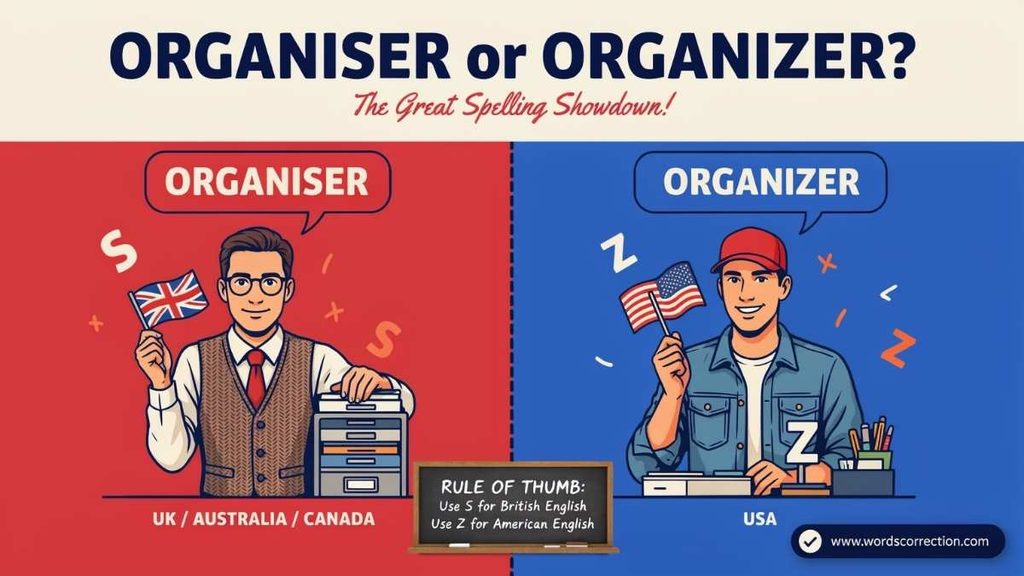
Organizer is the standard American English spelling.
Organiser is the common British English spelling.
Both words describe a person who arranges or coordinates something. They can also describe an object that helps keep things arranged, such as a desk organizer or drawer organizer.
| Feature | American English | British English |
| Main spelling | organizer | organiser |
| Verb | organize | organise |
| Past form | organized | organised |
| Noun | organization | organisation |
| Plural | organizers | organisers |
| Event example | event organizer | event organiser |
Therefore, if you’re writing for an American audience, choose organizer. If you’re following British English conventions, organiser is usually the better choice.
Organizer Meaning and Definition
The organizer meaning depends slightly on context, but the central idea is always related to arranging, coordinating, or bringing order to something.
An organizer can be a person who plans an event, manages an activity, coordinates a group, or arranges a project. For example:
The event organizer contacted all the speakers before the conference.
Here, organizer means the person responsible for planning and coordinating the event.
The word can also describe a physical object designed to keep items in order:
I bought a desk organizer for my pens, notebooks, and office supplies.
In this example, organizer refers to a storage product rather than a person.
The organiser meaning and organiser definition are exactly the same. The British spelling doesn’t create a different meaning.
For example:
The event organiser contacted all the speakers before the conference.
The role hasn’t changed. Only the spelling has.
Learn the difference between more words people mix up
Invision or Envision Which Is Correct?
Organizer vs Organiser What Is the Difference?
The main organizer vs organiser difference is regional spelling.
American English generally prefers organizer, while British English commonly uses organiser. Both forms come from the same verb and describe the same concept.
The difference becomes clearer when you compare the related forms. An American writer might use organize, organized, organizing, organization, and organizer. A British writer commonly uses organise, organised, organising, organisation, and organiser.
For example, an American publication might say:
The organization organized the conference with help from several local organizers.
A British publication might write:
The organisation organised the conference with help from several local organisers.
The meaning remains unchanged. The spelling system has simply changed.
Organizer Spelling vs Organiser Spelling
The organizer spelling uses -izer:
organizer
The organiser spelling uses -iser:
organiser
The easiest way to remember this difference is to start with the verb.
In American English:
organize → organizer
In British English:
organise → organiser
The same pattern appears in the plural:
organizers / organisers
It also appears in compound words such as:
co-organizer / co-organiser
This connection makes the spelling much easier to remember than treating organizer and organiser as two completely separate words.
Organizer American English and Organiser British English
If you’re asking whether organizer is American or British, the standard answer is American English.
For example:
The organizer will send the final schedule tomorrow.
This spelling fits naturally with other American forms such as organize and organization.
If you’re asking whether organiser is British or American, the usual answer is British English.
For example:
The organiser will send the final schedule tomorrow.
This spelling follows the common British pattern of organise and organisation.
However, British English isn’t completely uniform in its treatment of -ize and -ise. Some British dictionaries and style traditions accept or prefer certain -ize forms. For this particular word, though, organiser remains a familiar and widely used British spelling.
Learn the difference between everyday English mistakes
Families or Familys which one is correct?
British English Spelling and American English Spelling
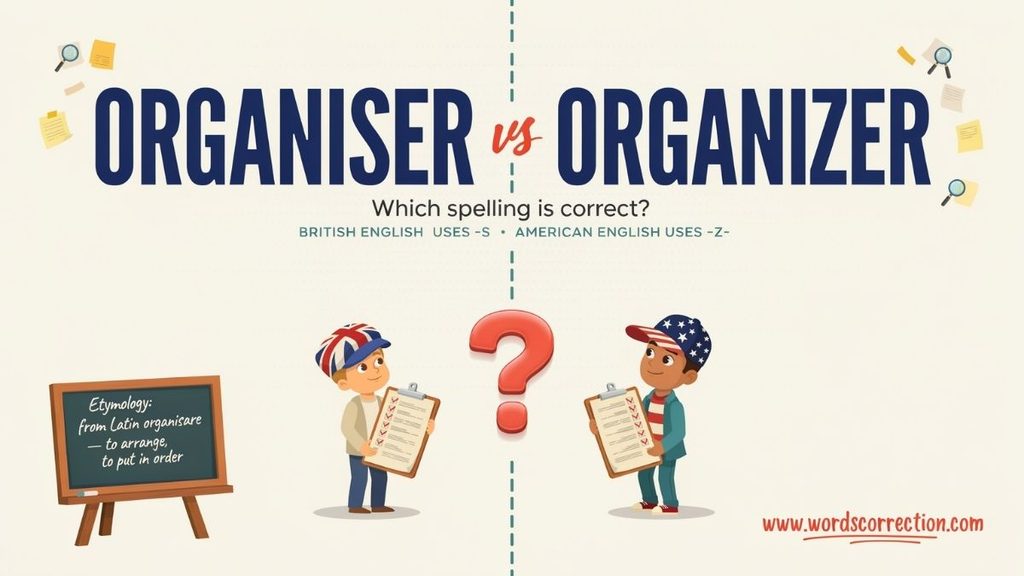
The difference between British English and American English goes beyond organizer and organiser. Several familiar words have different regional spellings.
| American English | British English |
| color | colour |
| center | centre |
| organize | organise |
| organization | organisation |
| organizer | organiser |
These are examples of English spelling differences that developed over time.
The two varieties remain mutually understandable. A British reader will understand organizer, and an American reader will understand organiser. The difference usually matters most when you’re expected to follow a particular style guide or regional standard.
For professional writing, consistency is more important than trying to use both forms.
Why Does English Use Organizer and Organiser?
The spelling difference comes from the broader history of English.
English developed through centuries of contact with other languages, including Latin, French, Germanic languages, and others. As English evolved, different regions developed their own spelling preferences.
The -ize/-ise distinction is one example.
American English generally favors -ize in words such as organize. British English commonly uses -ise in the same word.
That gives us:
organize → organizer
and
organise → organiser
The difference isn’t caused by a difference in meaning. It is simply a spelling variation that became associated with different English-speaking regions.
Learn the difference between commonly misused words
Allie or Ally Difference And Usage
The Origin of Organizer and Organiser
The word ultimately comes from roots associated with arranging separate parts into an organized or functioning whole.
Over time, English developed the verb organize, meaning to arrange or coordinate something. The suffix -er can then be added to indicate a person or thing that performs an action.
This gives us:
organize + er = organizer
The British spelling follows the same structure:
organise + er = organiser
The words therefore share the same linguistic foundation. Their spelling reflects different regional conventions.
Why Do We Have -Ize and -Ise?
The -ize and -ise distinction appears in many English words.
For example:
| American English | British English |
| organize | organise |
| recognize | recognise |
| realize | realise |
| apologize | apologise |
| specialize | specialise |
This pattern helps explain why we have organizer and organiser.
However, it’s important not to treat the pattern as an absolute rule for every English word. British spelling has several conventions and historical exceptions, and different dictionaries or style guides may make different choices.
For the word organizer, the practical distinction remains straightforward: use organizer in American English and organiser in the common British form.
Learn the difference between basic English word mistakes
Happend or Happened Which Spelling Is Correct?
Organizer or Organiser for an Event
One of the most common uses of the word is event organizer.
An event organizer is a person responsible for planning, coordinating, or managing an event. Depending on the event, this person may arrange the venue, communicate with speakers, manage registration, coordinate staff, handle schedules, or oversee other practical details.
For example:
The event organizer announced the final schedule on Monday.
In British English:
The event organiser announced the final schedule on Monday.
Both sentences are correct within their respective spelling conventions.
You may also see related terms such as event planner, event coordinator, and event manager. These roles can overlap, although their responsibilities may differ depending on the organization or event.
Professional Organizer vs Professional Organiser
A professional organizer is someone who helps individuals or businesses create better systems for managing spaces, belongings, documents, schedules, or information.
In British English, the usual form is professional organiser.
A professional organizer might help a client organize a home office, declutter a closet, arrange paperwork, improve storage, or create a system for managing everyday items.
For example:
The professional organizer created a simple storage system for the family’s home office.
The British version would be:
The professional organiser created a simple storage system for the family’s home office.
Again, the meaning remains the same.
Learn the difference between often confused words
Steel or Steal which one is correct?
Home Organizer and Home Organiser
A home organizer can refer to either a person who helps organize a home or a product designed to improve household storage.
For example:
The home organizer helped the family create a better system for storing their belongings.
The term can also describe a storage product:
This home organizer has separate compartments for shoes and accessories.
In British English, you’ll commonly see home organiser instead.
A good home organization system isn’t simply about making a room look tidy. It should also make everyday items easier to find and use.
Learn the difference between commonly confused more words in English
Mistery vs Mystery Which Is Correct?
Organizer as a Storage Device
The word organizer can describe many physical storage products.
A desk organizer, for example, might have separate sections for pens, pencils, scissors, paper clips, and notebooks. A drawer organizer might divide a large drawer into smaller compartments.
These products are designed to provide structure and make storage more efficient.
Common examples include desk organizers, drawer organizers, paper organizers, closet organizers, and storage organizers.
The British forms are desk organiser, drawer organiser, paper organiser, closet organiser, and storage organiser.
For example:
The drawer organizer keeps kitchen utensils separated by type.
British English:
The drawer organiser keeps kitchen utensils separated by type.
Desk Organizer vs Desk Organiser
A desk organizer is a storage product designed to keep office supplies arranged.
It can contain pens, pencils, notebooks, scissors, sticky notes, and other small items.
For example:
The desk organizer keeps all my writing supplies within easy reach.
In British English:
The desk organiser keeps all my writing supplies within easy reach.
This is a good example of how the same word can describe an everyday object while retaining the same regional spelling difference.
Learn the difference between confusing word pairs
Principal or Principle Don’t Mix Them Up
Drawer Organizer vs Drawer Organiser
A drawer organizer divides a drawer into separate sections.
It can be useful in kitchens, bedrooms, bathrooms, offices, and workshops.
For example:
The drawer organizer keeps the utensils separated and easy to find.
The British spelling is:
The drawer organiser keeps the utensils separated and easy to find.
The difference is once again limited to spelling.
Digital Organizer vs Digital Organiser
An organizer doesn’t have to be a physical object.
A digital organizer can refer to software or a digital system that helps manage information, schedules, appointments, tasks, contacts, notes, or reminders.
A digital organizer might function as a calendar, task manager, scheduling tool, or digital planner.
For example:
She uses a digital organizer to keep track of appointments and deadlines.
The British form is:
She uses a digital organiser to keep track of appointments and deadlines.
As technology has changed, the word organizer has expanded beyond paper products and physical storage.
Learn the difference between tricky grammar more words
Programme or Program Spelling Guide
Personal Organizer and Personal Organiser
A personal organizer traditionally refers to a planner used to manage appointments, tasks, notes, contacts, and other personal information.
A paper organizer may contain calendar pages, address sections, reminder pages, and space for notes.
Today, the same concept can exist digitally through calendar applications and personal planning tools.
For example:
My personal organizer helps me keep track of meetings and appointments.
In British English, the spelling is generally:
My personal organiser helps me keep track of meetings and appointments.
The meaning remains unchanged.
Organizer Pronunciation and Organiser Pronunciation
The organizer pronunciation and organiser pronunciation are essentially the same.
The spelling changes, but the pronunciation does not normally change simply because one form uses z and the other uses s.
Accent can naturally affect pronunciation. American, British, Australian, and other English accents may pronounce parts of the word slightly differently. However, organizer and organiser aren’t two words with different meanings or fundamentally different pronunciations.
Organizer Plural and Organiser Plural
The plural forms are straightforward.
The organizer plural is organizers.
The organiser plural is organisers.
For example:
Several organizers attended the meeting.
British English:
Several organisers attended the meeting.
The same spelling difference appears in compound forms:
co-organizers / co-organisers
There is no unusual plural rule to remember. Simply add -s to the appropriate regional spelling.
Learn the difference between commonly mixed-up more words
Fair or Fare which is correct?
Co-Organizer Meaning and Co-Organiser Meaning

The co-organizer meaning is a person who organizes something jointly with another person or group.
For example:
Sarah was a co-organizer of the charity event.
This means Sarah shared responsibility for organizing the event.
The British spelling is co-organiser:
Sarah was a co-organiser of the charity event.
A co-organizer may share tasks such as planning, scheduling, communication, promotion, budgeting, or event management.
The prefix co- simply indicates that the responsibility is shared.
Organizer Synonyms and Organiser Synonyms
The best organizer synonyms depend on the context.
When organizer refers to a person who arranges an event or activity, words such as coordinator, planner, facilitator, event manager, and event planner may work.
However, these words don’t always have exactly the same meaning.
For example, an event planner may focus on developing the event before it happens. An event coordinator may concentrate more on logistics and communication. An event manager may have broader operational responsibilities.
When organizer refers to an object, suitable alternatives might include holder, container, tray, compartment, storage system, or storage solution.
Context should always guide your choice.
Learn the difference between confusing more English words
Slushy Vs Slushie Which Spelling is Correct?
Common Mistakes With Organizer and Organiser

One of the biggest mistakes is mixing regional spellings in the same piece of writing.
Consider this sentence
The organizer will organise the conference.
The sentence is understandable, but it combines the American spelling organizer with the British spelling organise.
If you’re using American English, write:
The organizer will organize the conference.
If you’re using British English, write:
The organiser will organise the conference.
The same issue can happen with organization and organisation.
For example, an American English sentence would use:
The organization organized the event.
A British English version would use:
The organisation organised the event.
Consistency makes your writing look more polished and professional.
Organizer vs Organiser in Different Countries
The choice between organizer and organiser can vary by country.
American English strongly favors organizer. British English commonly uses organiser. Australian and New Zealand English generally follow British spelling conventions for this type of word, so organiser is common there as well.
Irish English also commonly uses British-style spelling, including organiser.
Canadian English can be more complicated because Canadian spelling contains influences from both British and American English. The preferred form can vary according to the word, publication, institution, or style guide.
For international writing, always check the expectations of your target audience rather than assuming that one spelling works everywhere.
How to Choose Between Organizer and Organiser
If you’re still wondering should I use organizer or organiser, start by identifying your audience.
If you’re writing for readers in the United States, use organizer. you’re writing according to British English conventions, use organiser.
Next, check the spelling of related words in your document. If you’ve already written organization, organized, and organizing, you’ll probably want organizer. If you’ve used organisation, organised, and organising, organiser will keep the style consistent.
Finally, follow any style guide provided by your employer, client, school, publisher, or organization. A style guide should take priority over personal preference.
The goal isn’t to prove that one spelling is better. The goal is to use the spelling that fits your audience and keep it consistent.
Learn the difference between tricky words and use them correctly
Sole vs Soul which is correct?
Organizer vs Organiser Comparison Table
| Feature | Organizer | Organiser |
| English variety | American English | Common British English |
| Meaning | Person or organizing tool | Person or organizing tool |
| Pronunciation | Essentially the same | Essentially the same |
| Verb | organize | organise |
| Past tense | organized | organised |
| -ing form | organizing | organising |
| Related noun | organization | organisation |
| Plural | organizers | organisers |
| Event phrase | event organizer | event organiser |
| Storage phrase | desk organizer | desk organiser |
| Joint role | co-organizer | co-organiser |
Practice Sessions
Fill in the Blanks
Choose organizer or organiser to complete each sentence.
- The event ________ planned the conference.
- She works as a professional ________.
- The British event ________ called the speakers.
- I bought a new desk ________.
- The community ________ arranged the meeting.
- The conference ________ sent an email.
- The home ________ created a storage system.
- Several ________ attended the meeting.
- The charity ________ contacted the volunteers.
- He works as an event ________.
- The drawer ________ keeps everything tidy.
- The digital ________ manages appointments.
- The festival ________ announced the schedule.
- Two co-________ planned the event.
- The office ________ holds stationery.
- The personal ________ tracks appointments.
- The project ________ created the schedule.
- The British festival ________ welcomed visitors.
- The American event ________ confirmed the venue.
- The professional ________ helped with decluttering.
- The community ________ planned the campaign.
- The storage ________ has several compartments.
- The conference ________ coordinated the speakers.
- The charity event had three ________.
- The event ________ managed the entire program.
Answers
- organizer
- organizer
- organiser
- organizer
- organizer
- organizer
- organizer
- organizers
- organizer
- organizer
- organizer
- organizer
- organizer
- organizers
- organizer
- organizer
- organizer
- organiser
- organizer
- organizer
- organizer
- organizer
- organizer
- organizers
- organizer
Here’s a trusted source for clear more words Comparison:
Grammar Update
FAQ’s
What Is the Difference Between an Organizer and a Host?
A host usually welcomes guests, presents an event, or represents it publicly, while an organizer handles the planning and coordination behind the event. One person can perform both roles, but their responsibilities may differ.
What Does an Event Organizer Do?
An event organizer plans and coordinates an event from preparation to completion. Their work may include arranging the venue, managing schedules, coordinating vendors, communicating with attendees, and overseeing logistics.
What Is a Professional Organizer?
A professional organizer helps individuals or businesses create practical systems for managing spaces, belongings, paperwork, schedules, or information. They may specialize in homes, offices, decluttering, or digital organization.
What Is a Personal Organizer?
A personal organizer is a planner or organizational system used to manage appointments, tasks, reminders, schedules, contacts, and notes. It can be a paper planner or a digital tool.
What Are the Different Types of Organizers?
Common types include event organizers, professional organizers, community organizers, home organizers, office organizers, digital organizers, and personal organizers. Organizer can also refer to physical storage products such as desk and drawer organizers.
What Is a Community Organizer?
A community organizer brings people together around shared goals or local issues. Their work may involve coordinating volunteers, planning activities, communicating with community members, and developing local initiatives.
What Is a Home Organizer?
A home organizer helps people create practical systems for arranging belongings and maintaining an orderly living space. The role may include decluttering, storage planning, room organization, and developing routines.
What Is an Office Organizer?
An office organizer can refer to a person who improves workplace organization or a product used to store office supplies. In professional settings, the term may involve organizing documents, workspaces, schedules, or administrative systems.
What Is a Digital Organizer?
A digital organizer is a software-based tool used to manage tasks, appointments, reminders, notes, contacts, schedules, or files. Digital calendars and task-management applications are common examples.
What Is a Desk Organizer Used For?
A desk organizer keeps small office supplies arranged and accessible. It may have compartments for pens, pencils, notebooks, scissors, paper clips, and other frequently used items.
What Is a Drawer Organizer?
A drawer organizer is a storage product that divides a drawer into separate compartments. It is commonly used for utensils, clothing accessories, office supplies, cosmetics, and other small items.
What Does an Organizer Do at an Event?
An organizer coordinates the practical details of an event. Depending on the event, this can include managing the schedule, communicating with participants, coordinating suppliers, preparing the venue, and handling unexpected problems.
What Skills Does an Organizer Need?
An effective organizer needs planning, communication, time-management, coordination, problem-solving, and attention-to-detail skills. Flexibility is also important because plans can change quickly.
What Makes Someone a Good Organizer?
A good organizer creates clear systems, prioritizes important tasks, meets deadlines, communicates effectively, and keeps track of details. They also know how to adapt when circumstances change.
What Are the Main Duties of an Organizer?
An organizer may plan activities, coordinate people, create schedules, manage resources, communicate with participants, monitor deadlines, and resolve logistical problems. Duties vary according to the type of organizing involved.
What Is Another Word for Organizer?
Depending on the context, alternatives include coordinator, planner, facilitator, administrator, event manager, and scheduler. The best choice depends on the person’s specific responsibilities.
What Is a Professional Organizer Called?
A professional organizer may also be called an organization consultant, organizing consultant, home organization specialist, or professional decluttering specialist. The appropriate title depends on their services.
How Do You Become a Professional Organizer?
You can start by developing skills in organization, planning, communication, time management, and client service. Practical experience in home organization, administration, event planning, or decluttering can also provide a useful foundation.
Can You Make a Living as a Professional Organizer?
Yes. Professional organizers can earn income by offering services such as home decluttering, office organization, paperwork management, storage planning, and digital organization. Income depends on location, experience, services, and client demand.
Are Professional Organizers in Demand?
Professional organizing services can appeal to people who need help with decluttering, moving, downsizing, improving storage, or creating efficient workspaces. Demand varies by location, specialization, and target market.
What Are the Qualities of an Organized Person?
An organized person typically manages time well, prioritizes responsibilities, keeps track of important information, and maintains practical systems. Being organized involves more than keeping things tidy; it also means making tasks easier to manage.
What Habits Do Highly Organized People Have?
Highly organized people often plan ahead, prioritize tasks, use consistent systems, review their schedules, and deal with important responsibilities before they become urgent. They also regularly remove unnecessary clutter.
What Is the Difference Between an Organizer and a Coordinator?
An organizer generally focuses on bringing an activity, project, or event together, while a coordinator often focuses on making sure people, schedules, and resources work together smoothly. In many workplaces, the responsibilities overlap.
What Is a Good Name for Someone Who Organizes Events?
Common professional titles include event organizer, event planner, event coordinator, event manager, and event producer. The most suitable title depends on the person’s responsibilities and the type of event.
What Is a Professional Way to Say “Organize”?
Professional alternatives to organize include coordinate, arrange, structure, manage, plan, administer, streamline, and facilitate. The best alternative depends on the context and the specific responsibility being described.
Conclusion
The organiser or organizer question may seem like a small spelling issue, but that one letter reflects the variety of English you’re using. “Organizer” is the standard spelling in American English, while “organiser” is commonly used in British English. Both forms are correct and have the same meaning. The key is to use the spelling that matches your audience and remain consistent throughout your writing. Once you understand this simple regional difference, there’s no need to let one letter cause unnecessary confusion. Whether you’re planning an event, managing a schedule, or organizing your desk, choose the appropriate spelling and write with confidence.

Stella AJS is an experienced blogger and dedicated English language writer at Words Correction. She turns confusing grammar, word meanings, spelling, and usage into clear, practical insights that readers can easily understand and apply. With a passion for precise and engaging writing, Stella helps readers avoid common language mistakes, strengthen their vocabulary, and communicate with greater clarity and confidence.




