
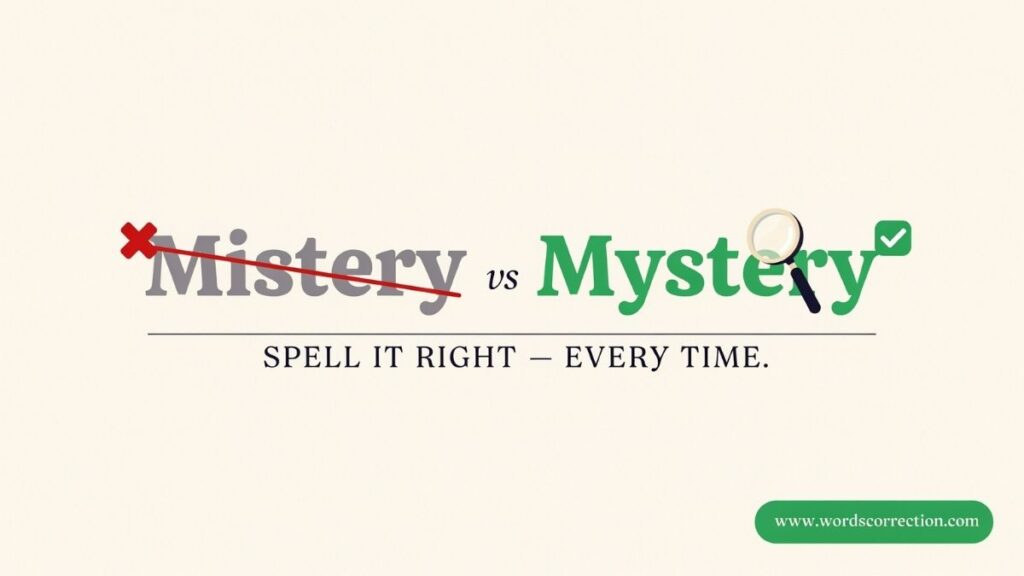
Mistery vs mystery? Many people get confused when choosing between these two spellings because they look almost identical. English spelling can sometimes feel like a small detective case, especially when one missing letter changes the whole word. The good news is that this one is easy to solve mystery is the correct spelling in modern English, while mistery is a common spelling mistake. In this guide, you will learn the difference between mistery vs mystery, understand the meaning and pronunciation of mystery, learn its plural form, and see clear examples of correct usage. By the end, this spelling mystery will be no mystery at all.
Mystery Is the Correct Spelling
The answer is simple:
Mystery is the correct spelling. Mistery is not the standard modern spelling.
| Spelling | Status | Meaning | Example |
| mystery | Correct | Something unknown, unexplained, secret, or puzzling | The disappearance remains a mystery. |
| mistery | Incorrect in modern standard English | Usually intended to mean mystery | The disappearance remains a mistery. |
Therefore, if you’re comparing mystery vs mistery, always choose mystery in standard English.
For example:
- Correct: The reason for his sudden departure remains a mystery.
- Incorrect: The reason for his sudden departure remains a mistery.
The confusion often comes from pronunciation. When spoken naturally, the word doesn’t clearly reveal every letter in its spelling. That can make mistery look reasonable even though it isn’t the accepted form.
What Does Mystery Mean?
The mystery meaning in English centers on something that remains unknown, unexplained, difficult to understand, or hidden.
Mystery is primarily a noun. It can describe an unanswered question, an unexplained event, a secret, a puzzling person or situation, or a type of fictional story.
A concise mystery definition in English is:
A mystery is something that is unknown, unexplained, secret, puzzling, or difficult to understand.
The word can also refer to a story, film, or book built around an unexplained event, investigation, or crime.
Learn the difference between confusing more English words
Pair or Pare what’s the difference?
Mystery as Something Unexplained
A mystery can be an event that has no obvious explanation.
Suppose an old clock stops at exactly the same time every night, yet nobody can determine why. Until someone finds the answer, the strange event remains a mystery.
Examples include:
- The cause of the strange sound remains a mystery.
- Scientists are investigating the mystery behind the phenomenon.
- The disappearance became an unsolved mystery.
In this sense, mystery is closely related to the ideas of unknown, unexplained, and uncertainty.
Mystery as a Secret
The word can also describe information that remains hidden or unknown.
For example:
Her sudden departure remains a mystery to her colleagues.
Here, the people involved don’t know why she left.
There is an important distinction between a mystery and a secret, though. A secret usually involves information that someone deliberately keeps hidden. A mystery can remain unknown simply because nobody has discovered the answer.
Mystery as a Puzzling Situation
You can describe something difficult to understand as a mystery.
Why the computer works perfectly when the technician arrives is a mystery.
This use is common in everyday conversation. It can describe anything from a complicated problem to an unusual human behavior.
The phrase a mystery to me is particularly common:
Why he made that decision is a mystery to me.
Mystery as a Type of Story
A mystery story revolves around an unanswered question.
The central mystery might involve:
- A murder
- A disappearance
- A theft
- A secret identity
- A suspicious event
- A hidden motive
- Missing evidence
A detective, investigator, journalist, or other character may gather clues and attempt to uncover the truth.
This is why mystery novel, mystery book, and detective story are common terms.
Learn the difference between commonly mixed-up more words
Maximise or Maximize which one is correct?
The Origin of the Word Mistery vs Mystery
The history of mystery is much older than modern English.
The word ultimately traces back to the Greek mystērion, a term associated with a secret or sacred rite. It passed into Latin as mysterium and later entered French and Middle English before developing into its modern English form.
Historical English included forms such as misterie.
Over centuries, English spelling gradually became standardized, and mystery emerged as the modern form.
This history matters because it explains why mistery should not be treated simply as a shortened version of mystery. The word has a long linguistic history, and its spelling developed through several languages.
A simplified path looks like this:
Greek → Latin → French → Middle English → Modern English
The meaning also evolved. Earlier uses were strongly connected with secrets and sacred knowledge. Modern English expanded the word to include unexplained events, puzzling situations, hidden information, and a popular literary genre.
Is Mistery a Word?
If you’re asking is mistery a word, the practical answer is no, not as the standard modern spelling of mystery.
You may encounter the spelling in different circumstances, including:
- Typographical errors
- Historical texts
- Reproductions of older spelling
- Names or titles
- Informal writing
However, none of these makes mistery the standard modern spelling.
So, if you’re wondering is mistery a correct word, is mistery an English word, or is mistery spelled correctly, the answer remains the same: use mystery in modern standard English.
Is Mistery an Archaic Spelling?
This question requires some historical context.
Older English contained forms related to the modern word, including misterie. Historical spelling was much less standardized than modern English, so words could appear in forms that look unusual today.
However, that doesn’t mean mistery should be used as an accepted archaic alternative in modern writing.
The distinction is important:
- Historical usage: Older forms existed.
- Modern standard English: Mystery is the accepted spelling.
- Formal writing: Use mystery.
- Historical quotations: Preserve the original spelling when appropriate.
Therefore, searches for mistery obsolete spelling, mistery archaic spelling, or mistery historical spelling should be understood in their historical context rather than as evidence that mistery is a modern alternative.
Is Mistery British or American English?
Neither.
Both British and American English use mystery.
| Variety | Standard spelling |
| American English | mystery |
| British English | mystery |
| Canadian English | mystery |
| Australian English | mystery |
There is no British spelling rule that changes mystery to mistery.
So, if someone tells you that mistery is the British version, that claim is incorrect.
Learn the difference between tricky grammar more words
Invision or Envision Which Is Correct?
Why Do People Spell Mystery vs Mistery?
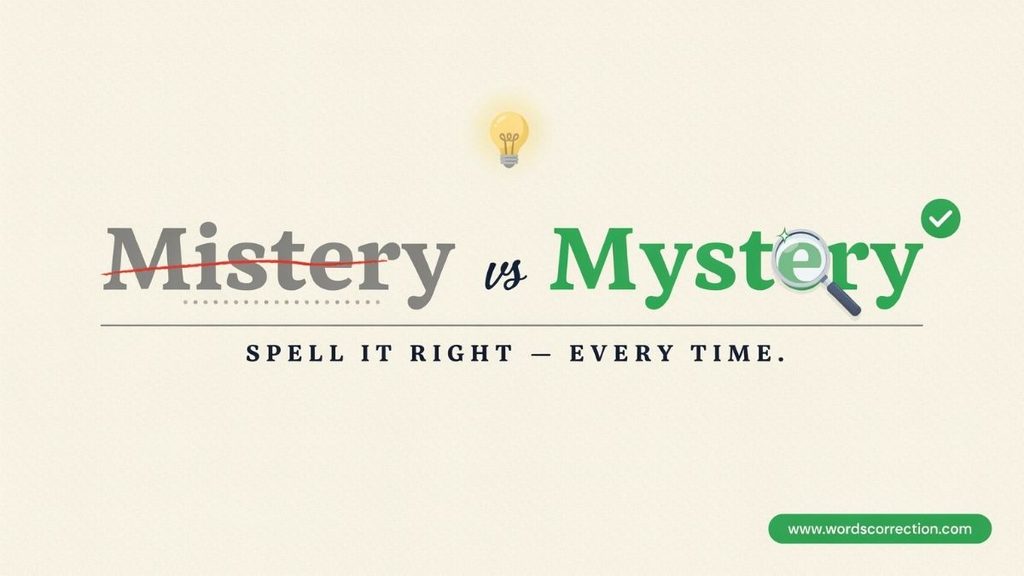
The mistake is understandable because mistery looks like it could be a legitimate English word.
One reason is the familiar word mister. Since mister is a common English word, writers may unconsciously connect it with the ending -y.
Pronunciation can also contribute to the confusion. English spelling frequently preserves historical forms that aren’t obvious from modern pronunciation.
The best approach is to remember the word visually:
MYST + ERY = MYSTERY
The opening myst- also appears in related words such as:
- mystery
- mysterious
- mysteriously
- mystify
- mystification
Recognizing this word family makes the correct spelling easier to remember.
Common Mistakes With Mistery vs Mystery
Mistake Writing Mistery
This is the main spelling error.
Incorrect: The case remains a mistery.
Correct: The case remains a mystery.
If you remember only one thing from this article, remember that mystery begins with MYST-.
Mistake Writing Mysterys
The plural of mystery is mysteries, not mysterys.
Correct:
The detective investigated several mysteries.
The spelling changes from -y to -ies.
This pattern also appears in words such as:
- story → stories
- city → cities
- country → countries
- family → families
- mystery → mysteries
Mistake Confusing Mystery With Mysterious
Although these words belong to the same family, they serve different grammatical functions.
| Word | Part of speech | Meaning | Example |
| mystery | Noun | Something unexplained or unknown | The case is a mystery. |
| mysterious | Adjective | Strange or difficult to explain | A mysterious visitor arrived. |
| mysteriously | Adverb | In a mysterious way | The package mysteriously disappeared. |
Understanding the difference helps with both grammar and word choice.
Mistake Spelling by Sound
English pronunciation doesn’t always provide a reliable spelling guide.
You can hear a word correctly and still spell it incorrectly. Mystery is a good example because its spoken form does not make every written letter obvious.
For that reason, memorizing the spelling pattern is more reliable than trying to reconstruct the word from pronunciation.
Learn the difference between confusing word pairs
Families or Familys which one is correct?
Mystery vs Mysterious vs Mysteriously
These three related forms are worth learning together.
Mystery
Mystery is a noun.
The disappearance remains a mystery.
It names the unknown thing, unanswered question, or puzzling situation.
Mysterious
Mysterious is an adjective.
The detective received a mysterious message.
It describes something that seems strange, unexplained, or difficult to understand.
Mysteriously
Mysteriously is an adverb.
The evidence mysteriously disappeared.
It explains how something happened.
Once you recognize the myst- word family, these forms become much easier to distinguish.
Learn the difference between often confused words
Allie or Ally Difference And Usage
Mystery Plural What Is the Correct Form?
The answer to what is the plural of mystery is mysteries.
The transformation is:
mystery → mysteries
Examples:
- one mystery
- two mysteries
- an unsolved mystery
- several unsolved mysteries
The spelling follows the standard English pattern in which a noun ending in consonant + y changes the y to ies when pluralized.
Therefore:
Mysterys is incorrect.
Mysteries is correct.
Mystery Synonyms
The best mystery synonym depends on the context.
| Synonym | Meaning or typical use |
| Enigma | Something difficult to understand |
| Puzzle | A problem that requires thought |
| Riddle | A question or problem designed to be solved |
| Secret | Information deliberately kept hidden |
| Unknown | Something not known |
| Conundrum | A difficult or confusing problem |
| Uncertainty | A lack of certainty |
| Question | Something that remains unresolved |
| Intrigue | Something that creates curiosity |
| Puzzlement | Confusion about something |
| Obscurity | Something unclear or little known |
| Perplexity | A state of deep confusion |
These words aren’t perfect substitutes in every sentence.
For example, an enigma may describe a person whose behavior is difficult to understand. A secret, by contrast, usually involves information intentionally concealed.
Choosing the right synonym depends on what kind of mystery you mean.
Learn the difference between basic English word mistakes
Happend or Happened Which Spelling Is Correct?
Mistery vs Mystery in Different Contexts
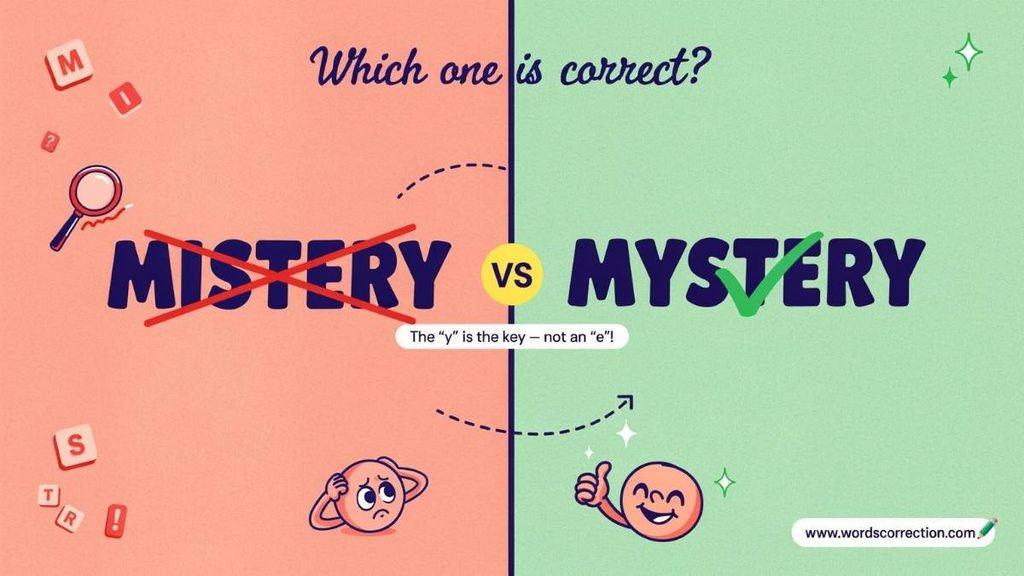
Mystery in Everyday Conversation
In ordinary conversation, mystery usually describes something that lacks an obvious explanation.
Why the printer works perfectly whenever someone calls a technician is a mystery.
The word can also appear in common expressions:
- It’s a mystery to me.
- The whole thing remains a mystery.
- That’s one of life’s little mysteries.
- The answer is still a mystery.
These expressions are useful because they show how naturally the word fits into everyday English.
Mystery in Literature
The mystery genre is built around questions that need answers.
A mystery novel may involve a detective investigating a crime, but the genre is broader than murder investigations.
A story can revolve around:
- A missing person
- A stolen object
- A hidden identity
- A suspicious death
- A secret inheritance
- An unexplained event
- A forgotten past
A good mystery book gives readers clues while withholding enough information to preserve suspense.
That balance creates the genre’s appeal. The reader isn’t simply watching the investigation; the reader is solving the puzzle too.
Mystery in Movies and Television
Mystery works especially well on screen because filmmakers can control what viewers know.
A director might reveal a clue early while hiding its significance. Another scene may introduce a suspicious character or create an apparent contradiction.
The result is intrigue.
Viewers keep watching because they want to answer the central question.
Mystery in Religion
The word also has an important religious meaning.
In religious contexts, mystery can refer to a divine truth, sacred reality, or spiritual matter that has been revealed but cannot be fully understood through ordinary human reasoning.
This meaning is closely connected to the word’s historical association with hidden or sacred knowledge.
Consequently, the mystery meaning in the Bible may differ from the meaning used in a detective story.
Mystery as an Atmosphere
Mystery can also describe a mood rather than a specific unanswered question.
Consider this sentence:
The abandoned house had an air of mystery.
Nothing in the sentence says that a crime occurred. Instead, the setting creates a feeling of secrecy, uncertainty, and intrigue.
That is another reason the word has such a broad range of uses.
Mystery Box Meaning
A mystery box contains items that aren’t revealed to the buyer or participant in advance.
The appeal is built around surprise.
For example:
The children opened the mystery box to discover what was inside.
The phrase can appear in games, entertainment, retail products, promotions, and other situations where the contents remain unknown until the box is opened.
The basic concept is simple:
Known: There is a box.
Unknown: What is inside it.
That unknown element creates the mystery.
Learn the difference between commonly misused words
Steel or Steal which one is correct?
Mystery Shopper Meaning

A mystery shopper is someone hired to evaluate a business while posing as an ordinary customer.
A company may use mystery shoppers to assess:
- Customer service
- Employee behavior
- Store conditions
- Waiting times
- Product availability
- Compliance with company procedures
The shopper typically completes a normal-looking purchase or interaction and later provides feedback.
The term mystery shopper comes from the fact that employees usually don’t know the customer’s real purpose.
Mystery Pronunciation
If you’re searching for mystery pronunciation, the word is commonly pronounced approximately as:
American English: /ˈmɪs.tɚ.i/
British English: /ˈmɪs.tər.i/
The first syllable receives the main stress.
A simple pronunciation guide is:
MYS-ter-y
If you’re wondering how to pronounce mystery, focus on the opening sound and avoid trying to pronounce every letter as strongly as it appears on the page.
The spelling and pronunciation don’t correspond perfectly, which is one reason the word can cause spelling mistakes.
Learn the difference between everyday English mistakes
Principal or Principle Don’t Mix Them Up
Pronunciation in English Mistery vs Mystery
The pronunciation is broadly similar in both major varieties of English, although the middle sound differs slightly.
British English typically uses a clearer r-free ending in accents where post-vocalic r is not pronounced. American English commonly retains the r-colored sound in the middle syllable.
These pronunciation differences do not affect the spelling.
So, regardless of how you pronounce it, the written form remains:
mystery
Not:
mistery
Mystery Dictionary Definition
A standard mystery dictionary definition focuses on something that is difficult to explain, understand, identify, or solve.
The word can refer to:
- Something unknown
- Something unexplained
- A secret
- A puzzling situation
- An unanswered question
- A fictional story involving investigation
A concise mystery definition is:
Something that remains unknown, unexplained, puzzling, secret, or difficult to understand.
The exact meaning depends on context.
For instance, an unsolved mystery refers to an unresolved question, while a mystery novel refers to a type of fictional work.
Meaning in Life Mistery vs Mystery
The phrase mystery of life usually refers to the deeper questions surrounding human existence.
People may use it when discussing:
- The purpose of existence
- Human consciousness
- Mortality
- The origin of life
- The meaning of existence
- Questions about what happens after death
Here, mystery doesn’t necessarily imply a problem that can be solved through investigation.
Instead, it can express the idea that some questions remain uncertain or beyond complete human understanding.
That is why mystery meaning in life often has a philosophical or spiritual tone.
Mystery Meaning in the Bible
The phrase mystery meaning in the Bible requires context because biblical usage can differ from everyday English.
In biblical writing, mystery can refer to a divine truth or purpose that was once hidden and later revealed.
The word therefore carries the idea of something previously unknown becoming known through revelation.
That differs from a detective mystery, where investigators gather evidence to discover an answer.
The underlying connection, however, remains clear: in both cases, the word involves knowledge that is hidden, unknown, or not immediately understood.
Learn the difference between more words people mix up
Programme or Program Spelling Guide
Is There a “Mistery” Legal Meaning?
There is no standard modern mistery legal meaning that makes mistery a separate legal term.
If the spelling appears in a legal document, the surrounding context should be examined. It could be:
- A typographical error
- A historical quotation
- A proper name
- A transcription issue
- A specialized reference unrelated to the standard noun
The mere appearance of an unusual spelling doesn’t establish a separate dictionary meaning.
In ordinary legal, academic, and professional writing, use mystery when that is the intended word.
Mystery vs Mistery Which Spelling Is Correct?
If you’re asking mystery or mistery which is correct, the answer is:
Mystery.
If you’re asking mystery or mistery which spelling is correct, the answer remains the same.
The standard spelling is:
M-Y-S-T-E-R-Y
The incorrect form is:
M-I-S-T-E-R-Y
A quick visual comparison makes the difference obvious:
| Correct | Incorrect |
| mystery | mistery |
| mysteries | mysterys |
| mysterious | misterious |
The safest strategy is to remember the MYST- beginning.
Learn the difference between tricky English words with easy explanations
Fair or Fare which is correct?
How to Remember the Correct Spelling Mistery vs Mystery
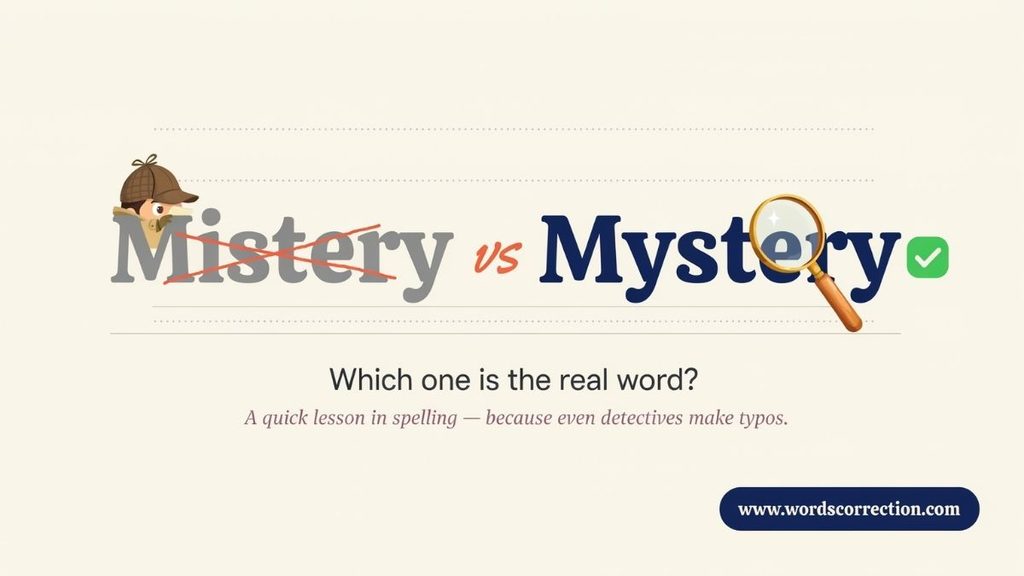
A few simple memory tricks can make how to spell mystery much easier.
Remember “MYST”
Think:
MYST + ERY
The first four letters are MYST, not MIST.
Remember the Word Family
Connect mystery with:
- mysterious
- mysteriously
- mystify
- mystification
The shared myst- pattern reinforces the spelling.
Remember the Phrase
Use this simple reminder:
A mystery starts with MYST.
It’s short, memorable, and useful whenever the spelling slips your mind.
Examples of Mystery in a Sentence
Here are several examples that show the word in different contexts:
- The disappearance remains an unsolved mystery.
- The detective finally solved the mystery.
- Her sudden decision was a mystery to everyone.
- The ancient structure remains an ancient mystery.
- The novel is an engaging detective mystery.
- Nobody knows what caused the strange event, so it remains a mystery.
- The journalist investigated the mystery case.
- The movie combines suspense with a classic mystery story.
- Several historical mysteries remain unanswered.
- The abandoned building created an atmosphere of mystery and intrigue.
These examples demonstrate how flexible the word can be.
Learn the difference between confusing more English words step by step
Slushy Vs Slushie Which Spelling is Correct?
Mystery vs Mistery Final Comparison
| Question | Answer |
| Which spelling is correct? | Mystery |
| Is mistery a standard modern English word? | No |
| Is mystery used in British English? | Yes |
| Is mystery used in American English? | Yes |
| What is the plural of mystery? | Mysteries |
| What adjective comes from mystery? | Mysterious |
| What adverb comes from mysterious? | Mysteriously |
| What does mystery mean? | Something unknown, unexplained, secret, or puzzling |
| What is a mystery synonym? | Enigma, puzzle, riddle, secret, unknown, and others |
| How do you spell mystery? | M-Y-S-T-E-R-Y |
Practice Session Mistery vs Mystery
Fill in each blank with the correct word.
- The reason for his sudden disappearance remains a __________.
- The detective is investigating several unsolved __________.
- The old house has a __________ atmosphere.
- The package __________ appeared on the doorstep overnight.
- Nobody knows who sent the letter, so its sender remains a __________.
- The detective finally solved the __________ after weeks of investigation.
- Her sudden decision was __________ to everyone in the office.
- The missing painting has become an unsolved __________.
- The strange noise remains a __________ to the residents.
- The word should be spelled __________, not “mistery.”
- The plural form of “mystery” is __________.
- The detective discovered several important clues while investigating the __________.
- The abandoned building created an air of __________.
- His behavior was so __________ that nobody could explain it.
- The truth behind the ancient artifact remains a __________.
- The investigator carefully examined the evidence before announcing his conclusion.
- The novel is based on a complex detective __________.
- Why the machine suddenly stopped working is a __________ to the engineers.
- The disappearance of the ship remains one of the region’s greatest __________.
- The visitor gave the police a __________ message with no explanation.
- The detective hoped to __________ the mystery before the end of the day.
- The meaning of the ancient symbol remains __________.
- The children were excited to open the __________ box.
- The detective found a clue that helped unravel the __________.
- Remember: the correct spelling is __________, not “mistery.”
Answer Session
- mystery
- mysteries
- mysterious
- mysteriously
- mystery
- mystery
- mysterious
- mystery
- mystery
- mystery
- mysteries
- mystery
- mystery
- mysterious
- mystery
- mystery
- mystery
- mystery
- mysteries
- mysterious
- solve
- unknown
- mystery
- mystery
- mystery
Here’s a trusted source for clear more words Comparison:
Grammar Update
FAQs about Mistery vs Mystery
Can mystery be used as an adjective?
No. Mystery is primarily a noun. The adjective is mysterious, which describes something strange, unexplained, secretive, or difficult to understand.
What is the difference between mystery and mysterious?
Mystery is a noun that refers to something unknown, unexplained, or puzzling. Mysterious is an adjective used to describe something that appears strange or difficult to explain.
What is the adverb form of mystery?
There is no standard adverb formed directly from mystery. Its related adjective is mysterious, and the corresponding adverb is mysteriously. For example, “The package mysteriously disappeared.”
Can mystery refer to a person?
Yes. Mystery can describe a person whose identity, motives, background, or behavior is difficult to understand. For example, “The new visitor remains a mystery to the staff.”
Can mystery be used as a verb?
No. Mystery is normally used as a noun, not a verb. Depending on the context, words such as mystify, puzzle, baffle, or confuse can express a similar idea.
What is the difference between a mystery and a riddle?
A riddle is usually a question or puzzle that requires reasoning to solve. A mystery has a broader meaning and can involve an unexplained event, hidden information, unknown identity, or unanswered question.
What is the difference between a mystery and an enigma?
Both words describe something difficult to understand. Enigma often emphasizes something particularly puzzling or difficult to interpret, while mystery can refer to something unknown, secret, unexplained, or a type of fictional story.
Can mystery be used in formal writing?
Yes. Mystery is appropriate in formal, academic, professional, literary, and everyday writing. For example, “The cause of the unusual phenomenon remains a mystery.”
Is mystery a countable noun?
Yes. When mystery refers to a specific unexplained event or problem, it can be countable. For example, “The investigators solved three separate mysteries.” It can also refer more generally to the quality of being unknown or unexplained.
What is the opposite of mystery?
The most suitable opposite depends on the context. Possible opposites include certainty, knowledge, clarity, explanation, and fact. For example, an unexplained mystery may be replaced by a clear explanation once the facts are known.
What is the difference between a mystery and the mystery?
A mystery refers to one unspecified mystery, while the mystery refers to a particular mystery that has already been identified or discussed.
For example:
- “The disappearance is a mystery.”
- “The detective finally solved the mystery.”
What words commonly go with mystery?
Common combinations include unsolved mystery, mystery case, mystery story, mystery novel, mystery guest, mystery box, mystery shopper, and mystery illness. The appropriate phrase depends on the context.
What does solve the mystery mean?
Solve the mystery means to discover the answer to something that was previously unknown or unexplained. In a detective story, for example, investigators may solve a mystery by examining evidence and identifying what happened.
What does remain a mystery mean?
Remain a mystery means that something is still unknown, unexplained, or unresolved. For example, “The reason for her sudden departure remains a mystery.”
What does a mystery to me mean?
A mystery to me means that the speaker does not understand or know the reason for something.
For example:
Why the computer stopped working is a mystery to me.
Can mystery describe something positive?
Yes. Mystery can create a sense of curiosity, wonder, excitement, or intrigue. For example, an unexplored place may be described as having an appealing sense of mystery.
What is the mystery genre?
The mystery genre is a type of fiction centered on an unanswered question, unexplained event, crime, or hidden truth. Characters typically follow clues and investigate the situation to discover the answer.
What makes a good mystery story?
A strong mystery usually includes a compelling central question, meaningful clues, believable characters, uncertainty, and a satisfying resolution. Effective mysteries reveal enough information to keep readers engaged without making the answer obvious too soon.
Are mystery and mysterious related words?
Yes. Mystery, mysterious, and mysteriously belong to the same word family. However, they have different grammatical functions: mystery is a noun, mysterious is an adjective, and mysteriously is an adverb.
How can you avoid confusing mystery with mysterious?
Use mystery when you are naming an unknown, unexplained, or puzzling thing. Use mysterious when you are describing something that seems strange or difficult to explain.
Conclusion
Choosing between mistery and mystery does not have to be a mystery itself. The correct spelling is mystery, while mistery is an incorrect spelling in modern English. The easiest way to remember it is to keep MYST at the beginning of the word.
Also remember the related forms: mysteries is the plural, mysterious describes something strange or hard to explain, and mysteriously tells how something happens. These small differences can help you avoid common spelling and grammar mistakes.
So, whether you are writing about a strange event, an unsolved case, or a detective story, use mystery. Once you remember the spelling, this little language puzzle is solved!

Stella AJS is an experienced blogger and dedicated English language writer at Words Correction. She turns confusing grammar, word meanings, spelling, and usage into clear, practical insights that readers can easily understand and apply. With a passion for precise and engaging writing, Stella helps readers avoid common language mistakes, strengthen their vocabulary, and communicate with greater clarity and confidence.




