
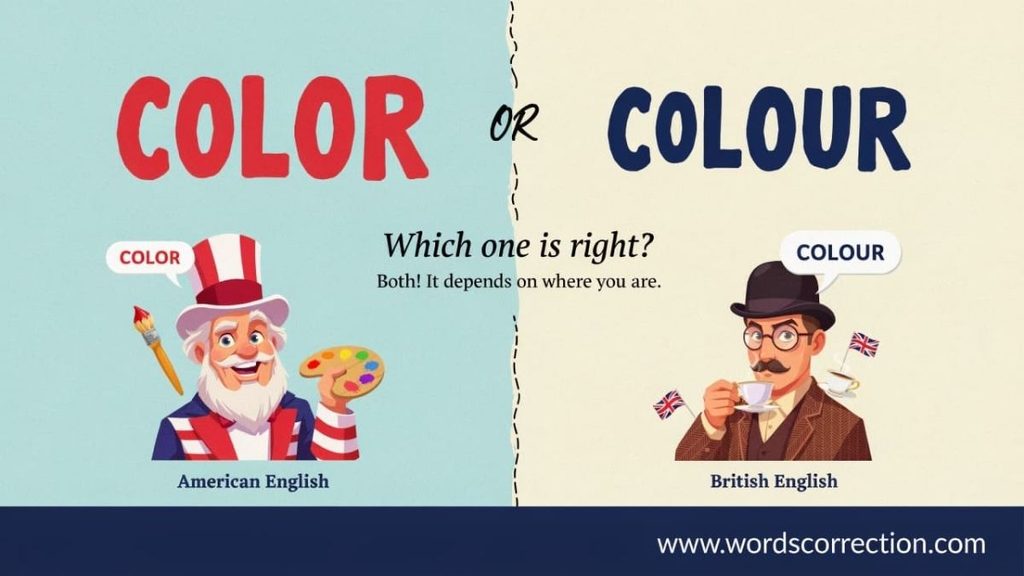
The words color and colour look almost the same, but which spelling should you use? This small difference often confuses students, bloggers, and even professional writers. The good news is that both spellings are correct. The right choice depends on whether you follow American or British English. American English uses color, while British English uses colour. Mixing these spellings can lead to mistakes in your writing. This practice session will help you understand the difference, learn the correct spelling rules, and test your knowledge with 25 fill in the blank questions and answers.
Quick Answer Color or Colour?
Color is the standard American English spelling, while colour is the standard British English spelling. Both are correct, and neither changes the word’s meaning.
The choice depends on your audience and the spelling conventions you follow.
| Question | Answer |
| Which spelling is correct: color or colour? | Both are correct. |
| Is color American or British? | American English. |
| Is colour British or American? | British English. |
| Which spelling is used in the United States? | Color |
| Which spelling is used in the United Kingdom? | Colour |
| Do color and colour mean the same thing? | Yes. |
| Are they pronounced differently? | Generally, no. |
| What is the plural of color? | Colors |
| What is the plural of colour? | Colours |
For example
- American English: The color of the sky changed at sunset.
- British English: The colour of the sky changed at sunset.
Both sentences are grammatically correct. Only the spelling differs.
Color vs Colour What Is the Difference?
The main difference between color and colour is regional spelling, not meaning, grammar, or pronunciation. American English generally drops the letter u in this word, while British English retains it.
This difference belongs to a broader pattern of English spelling variations. Consider favorite and favourite, honor and honour, or neighbor and neighbour. These pairs follow a similar American-versus-British spelling pattern.
| Feature | Color | Colour |
| English variety | American English | British English |
| Meaning | A visual quality or hue | A visual quality or hue |
| Standard spelling | United States | United Kingdom |
| Plural | Colors | Colours |
| Past tense or participle | Colored | Coloured |
| Present participle | Coloring | Colouring |
| Adjective | Colorful | Colourful |
| General pronunciation | Usually the same | Usually the same |
Learn the difference between more words people mix up
Don’ts or Don’t’s Which Spelling Is Correct?
What Is the Difference Between Color and Colour in Meaning?
There is no difference in meaning between the two spellings. Both refer to the visual appearance of something, such as the red of an apple, the blue of the ocean, or the green of a leaf.
The word also appears in figurative expressions. For instance, a writer might add color to a story by including vivid details. Someone might describe a lively person as having a colorful personality. British writers use the same expressions with the spellings colour and colourful.
Changing the spelling doesn’t change the idea.
Color Definition and Colour Definition
Color or colour is a noun that commonly describes the visual quality of an object as people perceive it through light. It can refer to hues such as red, blue, yellow, and green, as well as variations in brightness and saturation.
The word also functions as a verb in expressions such as color a picture or colour your hair. As a figurative noun, it can describe liveliness, character, or distinctive detail.
Examples include
- Physical appearance: Her dress was a deep shade of blue.
- Art and design: The designer chose warm colors for the living room.
- Figurative language: The eyewitness added color to the account with specific details.
- Verb usage: The children colored the pictures in their books.
Although these examples show different uses, the spelling convention stays the same throughout a piece of writing.
Why Do Color and Colour Have Different Spellings?
The color or colour spelling difference developed through the history of English. It reflects changes in spelling conventions, the influence of dictionaries, and the gradual development of distinct American and British writing standards.
The extra u in colour is not a modern British invention. It reflects an older spelling tradition that remained common in Britain while American English increasingly adopted simplified forms.
The Origin of the Word Color
The English word color comes through Old French forms, including colour, from the Latin word color, meaning color or complexion. The word entered English centuries ago, and its spelling varied as the language developed.
Before spelling became standardized, writers often used different spellings for the same word. Printing practices, regional habits, and individual preferences all contributed to this variation.
Over time, dictionaries and educational systems helped establish preferred spellings. However, American and British English did not settle on exactly the same conventions.
Learn the difference between everyday English mistakes
Appendix or Appendices Which one Is Correct?
Noah Webster and American Spelling Reform
Noah Webster, an American lexicographer and spelling reformer, played an important role in establishing American spelling conventions. He believed American English could benefit from a more regular and distinctive spelling system.
His dictionaries promoted forms such as color, honor, and labor, which differed from the British forms colour, honour, and labour.
Webster’s influence was significant, but he did not create every spelling difference between American and British English. Some simplified spellings existed before his dictionaries gained influence, and English spelling had already developed several competing forms.
His work helped popularize a consistent American standard. As schools, publishers, and institutions adopted these conventions, spellings without the u became firmly established in the United States.
Samuel Johnson and British Dictionary Traditions
Samuel Johnson’s A Dictionary of the English Language, published in 1755, helped standardize British English spelling and vocabulary. It documented established forms and influenced later writers, publishers, and educators.
Johnson’s dictionary appeared before Webster’s major American dictionary work. However, Johnson alone did not invent or establish every British spelling convention.
The development of standard English involved many writers, printers, dictionary makers, and institutions over several generations. British spellings such as colour persisted through this process, while American spelling standards increasingly favored color.
Why Does British English Use Colour Instead of Color?
British English retained the u in colour as part of its established spelling tradition. American English adopted color as its standard form through a combination of historical variation and spelling reform.
Neither spelling is inherently more correct. Each reflects the conventions of a particular variety of English.
British English did not simply add an unnecessary letter, and American English did not make a spelling mistake by removing it. Both forms developed into accepted regional standards.
Color or Colour Around the World
English is used across many countries, and spelling conventions vary by region. While the United States generally uses color, countries influenced by British English commonly retain colour.
Still, regional patterns should not be treated as absolute rules for every organization, publication, or product name. Local style guides and official names can affect individual choices.
Color or Colour in the USA
In the United States, color is the standard spelling. American dictionaries, schools, newspapers, and most US publishers use this form.
You should generally write color, colors, colored, coloring, and colorful when following American English spelling rules.
Examples
- The artist mixed several colors to create a new shade.
- Please choose a color for the background.
- The company introduced colorful packaging.
- She bought a coloring book for her nephew.
The spelling colour may appear in imported titles, quotations, brand names, or material written for a British audience. However, color is the usual choice in standard American writing.
Color or Colour in the UK
In the United Kingdom, colour is the standard spelling. British English dictionaries and most UK educational and publishing conventions favor the form with the u.
Examples include
- The artist mixed several colours.
- Please choose a colour for the background.
- The company introduced colourful packaging.
- She bought a colouring book for her nephew.
The British spelling also appears in many Commonwealth English varieties, although individual countries have their own language conventions.
Color or Colour in Canada
Canadian English generally uses colour, along with related forms such as favourite, honour, and neighbour. Canadian spelling reflects a mixture of British traditions and American influence.
That doesn’t mean Canadian English always follows British spelling. Canadian conventions differ from both British and American English in several areas, and usage can vary by institution and context.
For example, a Canadian government document may follow a Canadian style guide, while a company writing for US customers may adopt American spellings for consistency.
If you’re writing for a Canadian audience, use a reputable Canadian dictionary or the style guide required by your organization.
Color or Colour in Australia
Australian English generally uses colour. Australian schools, publishers, and many government organizations follow this spelling convention.
Common forms include
- Colour
- Colours
- Coloured
- Colouring
- Colourful
For example: The artist selected warm colours for the exhibition.
Australian English shares many spelling conventions with British English, although it also has distinctive vocabulary and usage preferences.
Color or Colour in New Zealand
New Zealand English generally follows the British spelling pattern and uses colour. The same convention applies to common related forms, including favourite, honour, and neighbour.
For writers targeting New Zealand readers, colour is the expected standard form in ordinary prose unless a specific publication or official name requires otherwise.
Color or Colour in Europe
The answer to color or colour in Europe depends on the language and context. Europe is not a single English-speaking spelling system.
In the United Kingdom, colour is standard. In other European countries, English is often used as a second or additional language, and writers may follow British English, American English, or an institutional style guide.
For example, a European university might require British English in one department while an international technology company uses American English across its website. Both choices can be appropriate if the organization applies its preferred style consistently.
When writing for European readers, don’t assume every country follows the same English spelling convention. Check the expectations of your audience or publisher.
Learn the difference between commonly misused words
Skillset or Skill Set Which Spelling Is Correct?
Regional Spelling Comparison
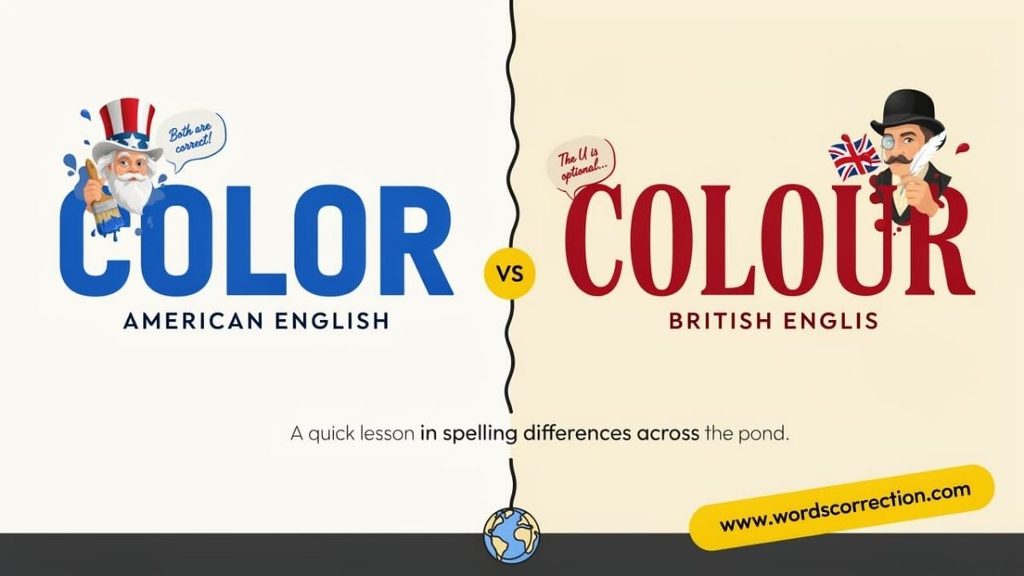
| Country or region | Usual spelling | Important note |
| United States | Color | Standard American English |
| United Kingdom | Colour | Standard British English |
| Canada | Colour | Canadian English generally retains the u |
| Australia | Colour | Standard Australian English |
| New Zealand | Colour | Standard New Zealand English |
| Other European countries | Varies | Depends on the English variety or style guide |
What Is the Plural of Color or Colour?
The plural of color is colors, while the plural of colour is colours. Both follow the regular English rule of adding s to form the plural of this noun.
Examples:
- American English: The colors of the autumn leaves were beautiful.
- British English: The colours of the autumn leaves were beautiful.
The spelling difference also appears in related word forms.
| Word form | American English | British English |
| Singular noun | Color | Colour |
| Plural noun | Colors | Colours |
| Past tense or participle | Colored | Coloured |
| Present participle | Coloring | Colouring |
| Adjective | Colorful | Colourful |
| Negative adjective | Colorless | Colourless |
| Verb meaning to remove color | Discolor | Discolour |
These forms follow the same general regional pattern. However, not every English word has an equivalent American and British spelling that differs in exactly the same way.
Colored or Coloured?
Both forms describe something that has been given color or has a particular color. American English uses colored, while British English usually uses coloured.
For example:
- American English: The children used colored pencils.
- British English: The children used coloured pencils.
The choice doesn’t change the sentence’s meaning. Writers should also consider context because some expressions involving colored have historical or social meanings that require care. In ordinary descriptions of objects, the regional spelling rule is straightforward.
Coloring or Colouring?
American English uses coloring, while British English uses colouring. Both can refer to the act of applying color or to the process by which something develops its color.
Examples
- American English: Coloring books help children practice using crayons.
- British English: Colouring books help children practice using crayons.
In technical, medical, or scientific contexts, use the terminology preferred by the relevant field or publication. Regional spelling conventions still matter, but specialized terminology may have additional rules.
Colorful or Colourful?
The American adjective is colorful, while the British adjective is colourful. Both describe something vivid, varied, lively, or rich in color.
For example:
- American English: The garden was full of colorful flowers.
- British English: The garden was full of colourful flowers.
The word can also describe a lively personality or an event filled with unusual experiences. In either variety, the intended meaning comes from the context rather than the presence or absence of the letter u.
Learn the difference between commonly misused words
Wellbeing or Well-Being Which Spelling Is Correct?
Do Color and Colour Have the Same Pronunciation?
Yes. Color and colour are generally pronounced the same way within a given accent. The additional u in the British spelling does not add another syllable or normally create a different sound.
In many American and British accents, the word has two syllables. The precise vowel sounds can vary with accent, just as they can for many other English words.
The spelling difference is therefore mainly visual rather than phonetic.
For learners of English, the practical lesson is simple: don’t assume every spelling difference between American and British English changes pronunciation. Compare favorite and favourite, for example. Their extra letter also does not normally create an additional syllable.
Color or Colour in Writing Which Spelling Should You Choose?
Choosing between color and colour becomes easy once you identify your audience. The most useful rule is to follow the English variety expected by your reader, teacher, employer, or publisher.
When to Use Color
Use color when writing in standard American English, including:
- School assignments that require American English.
- US business reports and professional emails.
- American publications and news articles.
- Websites aimed primarily at US customers.
- Marketing materials written for an American audience.
For example, a US-based design company would typically write, “Choose your favorite color for the new product.”
When to Use Colour
Use colour when writing in standard British English or when the relevant regional convention calls for it, including:
- UK academic assignments.
- British publications and newspapers.
- Business documents intended for a British audience.
- Australian or New Zealand content that follows local spelling conventions.
- Canadian writing that follows Canadian spelling standards.
For example, a British design company might write, “Choose your favourite colour for the new product.”
Learn the difference between basic English word mistakes
Chose or Choose What’s the Difference?
Which Spelling Is Preferred in Academic Writing?
Neither spelling is universally preferred in academic writing. The required style guide, institution, journal, or instructor determines the appropriate choice.
An American university will often expect American English, while a British university may expect British English. International journals can have their own editorial policies.
Before submitting an assignment or manuscript, check:
- The institution’s language and style guidelines.
- The publisher’s instructions for authors.
- The spelling settings required by the editor or word processor.
- Whether the document already uses a consistent English variety.
A correct spelling can still look out of place if it conflicts with the document’s chosen style. Consistency makes your writing appear more polished and professional.
Which Spelling Should You Use for an International Audience?
For international content, choose a spelling system deliberately rather than switching between regional forms at random.
If your organization has an established house style, follow it. If not, consider your primary audience and the spelling conventions most familiar to those readers.
For example, a website serving customers in the United States may use American English throughout its pages. A separate localized version for the United Kingdom may use British English instead.
This process is known as language localization. It involves adapting content to a specific audience and can include spelling, vocabulary, dates, measurements, and other regional preferences.
You don’t need to create separate versions for every country. The right approach depends on your readers, the purpose of the content, and your available resources.
Learn the difference between often confused words
Leafs or Leaves Which one Is Correct?
Color or Colour in Brand Names and Proper Nouns
Proper nouns require special care because their official spelling takes priority over general regional spelling rules. A brand, organization, product, book, or artwork may use color or colour regardless of the variety of English in the surrounding text.
For example, the American software company Adobe uses the product name Adobe Color. A writer discussing that product should preserve its official name rather than changing it to Adobe Colour merely to match British spelling conventions.
The same principle applies to company names, registered product names, official titles, and direct quotations.
Follow these guidelines
- Preserve official names: Don’t alter a brand’s established spelling.
- Keep quotations accurate: Retain the spelling used in the original source unless you clearly indicate an editorial change.
- Follow the surrounding style: Use the preferred regional spelling in your own descriptive text.
- Check official sources: When a name’s spelling is uncertain, consult the organization’s website or official documentation.
For example, a British article can discuss Adobe Color while using colour in its ordinary prose. That’s not an inconsistency because the product name has its own established spelling.
Learn the difference between confusing word pairs
Loosing or Losing Which Spelling Is Correct?
Common Mistakes When Using Color or Colour
Although the rule is simple, writers sometimes mix regional forms or assume one spelling is always correct. Avoiding these common mistakes will help you produce clearer, more consistent content.
Mixing American and British Spellings
One common mistake is writing colorful in one paragraph and colouring in another without a specific reason.
A document that follows American English should generally use color, colors, colored, coloring, and colorful. A document following British English should generally use the corresponding forms with the u.
Assuming One Spelling Is Universally Correct
Neither form is wrong in every context. Color is standard American English, and colour is standard British English.
Calling one universally incorrect ignores the way English spelling conventions differ across regions.
Changing an Official Name
Writers sometimes change a brand or product name to fit the spelling system used in the rest of the article. That can make the name inaccurate.
Keep official names intact, even when their spelling differs from the surrounding text.
Using the Wrong Spell-Checker Language
A spell-checker configured for American English may flag colour as an error. A British English checker may flag color instead.
That doesn’t automatically mean the word is misspelled. The software may simply use a different regional dictionary.
Choose the correct language setting before proofreading. This small step can prevent unnecessary corrections and save time.
Learn the difference between tricky grammar more words
Mangoes or Mangos Which Spelling Is Correct?
Treating Every English Spelling Difference as the Same Rule
The -or and -our pattern covers words such as color/colour and honor/honour. However, American and British spelling differences also involve other patterns, including center/centre and organize/organise in many style systems.
Learn the relevant pattern for each word rather than assuming one rule explains every regional spelling difference.
Is Color or Colour More Common Worldwide?
Neither spelling can be declared universally more correct because both serve different regional standards. Determining which is more common worldwide requires a clearly defined source, such as a particular text collection, search dataset, or publication database.
The answer may change depending on whether the material comes from American books, British newspapers, international websites, academic journals, or social media.
For practical writing purposes, worldwide frequency is less important than audience expectations. If you’re writing for American readers, use color. If you’re writing for British readers, use colour.
Search engines may display pages using both spellings. That doesn’t mean you should repeat both forms throughout an article to target different searches. Instead, use your primary spelling consistently and mention the alternative naturally when explaining the difference.
Color or Colour A Simple Memory Trick
Here’s an easy way to remember the difference: color without the u is used in the US.
For British English, remember that colour retains the u. You can apply the same basic pattern to words such as favorite/favourite, honor/honour, and neighbor/neighbour.
Try these quick examples:
- Writing for a US school? Choose color.
- Writing for a UK newspaper? Choose colour.
- Writing for a Canadian organization? Check its preferred Canadian spelling conventions.
- Writing a product name? Preserve the official spelling.
The trick is useful, but audience and context still determine the best choice.
Learn the difference between commonly mixed-up more words
Each Other or Eachother Which Spelling Is Correct?
Real Example Sentences Color or Colour in a Sentence
Comparing examples makes the spelling difference easier to recognize. Each pair below communicates the same idea in American and British English.
Everyday Descriptions
| American English | British English |
| Her favorite color is green. | Her favourite colour is green. |
| The car comes in several colors. | The car comes in several colours. |
| He wore a colorful jacket. | He wore a colourful jacket. |
Art and Design
| American English | British English |
| The artist used bright colors. | The artist used bright colours. |
| Choose a color palette for the room. | Choose a colour palette for the room. |
| The coloring creates a dramatic effect. | The colouring creates a dramatic effect. |
Education and Professional Writing
| American English | British English |
| The students colored their drawings. | The students coloured their drawings. |
| Please select your preferred color. | Please select your preferred colour. |
| The report includes a colorful chart. | The report includes a colourful chart. |
Figurative Expressions
| American English | British English |
| The details added color to the story. | The details added colour to the story. |
| She has a colorful personality. | She has a colourful personality. |
Notice that the meaning and sentence structure remain the same. The spelling changes to match the regional convention.
Learn the difference between confusing more English words
Patient or Patience what’s the Difference?
Similar American and British Spelling Differences
The color or colour difference is part of a larger group of English spelling variations. Recognizing these patterns can help you proofread more effectively, especially when writing for readers in another country.
| American English | British English |
| Color | Colour |
| Favorite | Favourite |
| Honor | Honour |
| Humor | Humour |
| Labor | Labour |
| Neighbor | Neighbour |
| Flavor | Flavour |
| Center | Centre |
| Theater | Theatre |
| Traveling | Travelling |
| Traveled | Travelled |
These pairs illustrate several different patterns, not just the addition or removal of u. For instance, center/centre involves a different letter order, while traveling/travelling reflects a common difference in consonant doubling.
There are also variations within British English style conventions. Some British dictionaries and style guides prefer -ise endings, while others accept or prefer -ize in many words. Therefore, consult the specific style guide you’re following instead of assuming every British writer uses identical spellings.
Practice Session Color or Colour
Fill in the blanks
- The American spelling of the word is ______.
- In British English, the sky is described as blue in ______.
- My favorite ______ is green.
- She painted her bedroom a light ______.
- The American spelling of the color between black and white is ______.
- In British English, the elephant has ______ skin.
- The Canadian spelling of this word is usually ______.
- The American spelling of the word for a shade between black and white is ______.
- The artist used many bright ______ in her painting.
- The shop sells ______ pencils in different shades.
- The American spelling of the word meaning full of color is ______.
- The garden looked ______ in the spring sunshine.
- The American spelling of the action of adding color is ______.
- She enjoys ______ pictures in her free time.
- The walls were painted in warm ______.
- The American spelling of the past-tense form is ______.
- The artist chose a ______ shade of blue.
- The British spelling of the word meaning a favorite shade is ______.
- The car was painted dark ______.
- The American spelling of the word used in “a ______ photograph” is ______.
- The British spelling of “coloring book” is ______ book.
- The American spelling of “colourful flowers” is ______ flowers.
- In Australia, the standard spelling is generally ______.
- In the United States, a school may teach children to spell the word ______.
- To keep your writing consistent, use either American or British spelling of ______ throughout your article
Answers
- color
- colour
- color
- colour
- gray
- grey
- colour
- gray
- colors
- coloured
- colorful
- colourful
- coloring
- colouring
- colours
- colored
- colorful
- colour
- grey
- gray
- colouring
- colorful
- colour
- gray
- color or colour
Here’s a trusted source for clear more words Comparison:
Grammar Update
FAQs
Is it spelled color or colour in American English?
Color is the standard spelling in American English. Colour is the preferred spelling in British English and many other English-speaking regions.
Is it spelled color or colour in Canada?
Colour is the standard spelling in Canadian English, although some organizations and technical contexts follow American spelling conventions.
Is it gray or grey in British English?
Grey is the standard spelling in British English, while gray is the preferred spelling in American English.
Which is correct gray hair or grey hair?
Both gray hair and grey hair are correct. Use gray hair in American English and grey hair in British English.
Why do Americans spell gray differently?
Americans generally use gray because American English spelling reforms, popularized by Noah Webster, helped establish distinct spelling conventions in the United States.
How do Australians spell grey?
Australians generally use grey, following British English spelling conventions.
How are gray and grey pronounced?
Gray and grey are pronounced the same way in standard English. The difference is in spelling, not pronunciation.
Is it dark gray or dark grey?
Both spellings are correct. Dark gray is standard in American English, while dark grey is preferred in British English and many other varieties that follow British spelling conventions.
Do gray and grey have the same meaning?
Yes, gray and grey have the same meaning. Both refer to a color between black and white, with different shades ranging from light to dark.
Is gray technically black?
No, gray is a separate color from black. Although dark gray can appear almost black, it is generally distinguishable from true black.
Is a car gray or grey?
Both spellings are correct. Gray car is standard in American English, while grey car is preferred in British English and many Commonwealth countries.
How do you spell light gray in British English?
The standard British English spelling is light grey. In American English, the correct spelling is light gray.
What is the difference between gray and grey in writing?
There is no difference in meaning between gray and grey. The choice depends on regional spelling conventions, the intended audience, and the applicable style guide.
Is grey an incorrect spelling in American English?
No, grey is a recognized English spelling. However, gray is the standard spelling in American English.
Is gray an incorrect spelling in British English?
No, gray is a valid English spelling. However, grey is the conventional spelling in British English.
Should I use gray or grey in academic writing?
Use the spelling required by your institution, publisher, or academic style guide. If no specific requirement exists, choose the form appropriate for your audience and use it consistently.
Is gray or grey more common worldwide?
Both spellings are widely used, depending on the region. Gray is standard in American English, while grey is common in British English and many Commonwealth countries.
Do color and grey follow the same American and British spelling rules?
Yes. American English generally uses color and gray, whereas British English generally uses colour and grey.
Is it blue-gray or blue-grey?
Both spellings are correct. Blue-gray is commonly used in American English, while blue-grey is generally preferred in British English.
Is it spelled grayish or greyish?
Both spellings are correct. Grayish is standard in American English, while greyish is preferred in British English.
How do you spell charcoal gray in British English?
The standard British English spelling is charcoal grey. In American English, the preferred spelling is charcoal gray.
Is gray a noun or an adjective?
Gray can function as both a noun and an adjective. As a noun, it identifies a color; as an adjective, it describes something that has that color.
Can I use both gray and grey in the same article?
It is best to use one spelling consistently throughout an article. Choose gray for an American audience or grey for a British audience, unless a particular style guide requires otherwise.
Why does English have two spellings for gray?
The difference developed through regional spelling conventions. American English standardized gray, while British English retained grey as its conventional spelling.
Which spelling should I use for an international audience: gray or grey?
Choose the spelling that best matches your primary audience. Use gray for readers in the United States and grey for readers in the United Kingdom and many Commonwealth countries. Follow the relevant publication style guide when applicable.
Learn the difference between tricky words and use them correctly
In Person vs In-Person When to Use the Hyphen
Conclusion
Choosing between color and colour doesn’t have to be confusing. Both spellings are correct, but American English uses color, while British English uses colour. The same rule applies to related words such as gray and grey, colorful and colourful, and coloring and colouring. To avoid spelling mistakes, choose the spelling style that matches your audience and use it consistently throughout your writing.
Now that you’ve completed the 25 fill-in-the-blank questions, check your answers and review any mistakes. With a little practice, you’ll remember the differences and write with greater confidence. After all, good spelling should make your writing clearer, not turn it into a guessing game.

Stella AJS is an experienced blogger and dedicated English language writer at Words Correction. She turns confusing grammar, word meanings, spelling, and usage into clear, practical insights that readers can easily understand and apply. With a passion for precise and engaging writing, Stella helps readers avoid common language mistakes, strengthen their vocabulary, and communicate with greater clarity and confidence.




