The difference between in person vs in-person can be confusing, especially when one small hyphen changes how a phrase works. Although both forms are correct, they serve different purposes in a sentence. Using the wrong form can make your writing unclear or grammatically incorrect. The good news is that the rule is simple to understand. In this guide, you’ll learn the meaning of “in person” and “in-person,” discover when to use each form, and explore clear examples to avoid common mistakes. By the end, you’ll know how to use both forms correctly in everyday and professional writing.
In Person vs In-Person The Main Difference
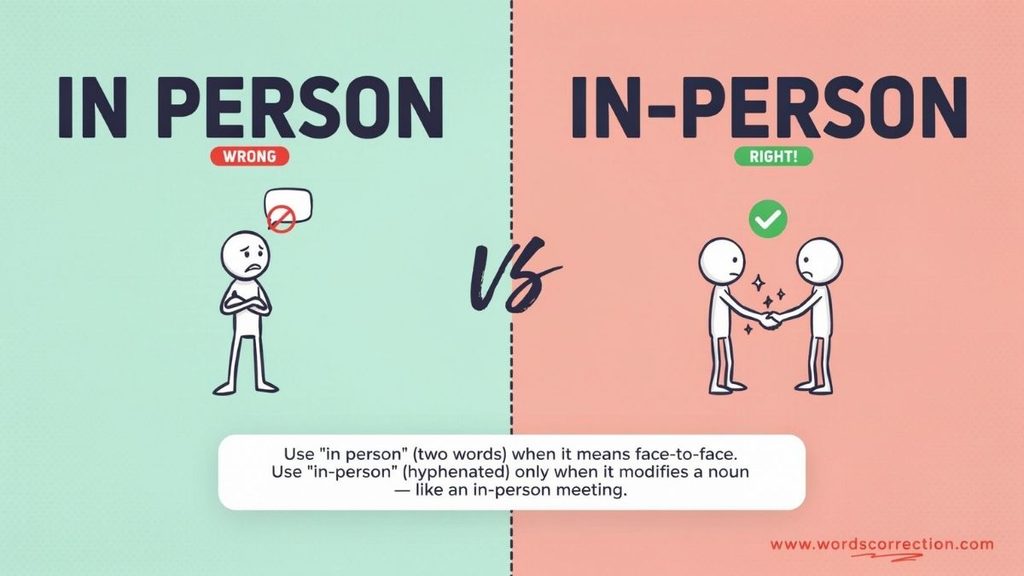
The primary difference between “in person” and “in-person” lies in their grammatical function. Both expressions describe physical presence, but writers use them differently depending on the sentence structure.
“In person” is an open phrase consisting of two words. It commonly functions as an adverbial phrase that explains how someone performs an action or participates in an event.
“In-person” is a hyphenated compound adjective. It describes a noun by indicating that a meeting, appointment, event, or activity involves physical attendance rather than remote participation.
Consider these examples
- Without a hyphen: “I’d prefer to discuss the issue in person.”
- With a hyphen: “I’d prefer an in-person discussion.”
The first sentence explains how the speaker wants to discuss the issue. The second describes the type of discussion the speaker prefers.
The basic meaning remains the same. The hyphen doesn’t create an entirely different meaning; instead, it helps readers understand how the words function together.
In Person vs In-Person Quick Comparison
| Feature | In person | In-person |
| Spelling | Two separate words | Two words joined by a hyphen |
| Common grammatical role | Adverbial phrase | Compound adjective |
| Typical use | Describes an action or manner of attendance | Describes a noun |
| Example | We spoke in person. | We had an in-person conversation. |
| Common context | Describes how someone participates | Identifies the type of meeting or activity |
| Meaning | Physically present | Involving physical presence |
The easiest way to remember the distinction is to examine how the expression functions in the sentence. If you’re describing a meeting, interview, class, or appointment, the hyphenated form is usually appropriate before the noun. If you’re explaining how someone attends, speaks, or meets, use the two-word form.
What Does “In Person” Mean?
The phrase “in person” means being physically present somewhere or interacting directly with someone rather than communicating through a phone call, video conference, written message, or intermediary.
For example, if a manager asks an employee to discuss a project in person, the manager wants a direct conversation rather than an email or virtual meeting. Similarly, if a school requires a student to appear in person for an examination, the student must attend at the designated location.
The phrase appears in everyday conversation, business communication, education, healthcare, public services, and legal settings.
Consider these examples:
- “I’d like to meet the new director in person.”
- “You must submit your identification in person.”
- “The doctor asked me to attend the consultation in person.”
- “Although we had exchanged emails for months, we had never spoken in person.”
- “Applicants may need to appear in person to verify their identities.”
In each sentence, the phrase emphasizes physical attendance or direct interaction.
In Person vs In-Person Meaning and Definition
The meaning of “in-person” is closely related to that of “in person.” Both expressions refer to physical presence rather than remote communication or participation.
The difference is grammatical rather than semantic. The open phrase generally describes an action, while the hyphenated form describes a person, event, or activity associated with physical attendance.
For example:
- “The instructor will teach the class in person.”
- “The instructor will lead an in-person class.”
Both sentences indicate that the instructor will teach students who are physically present in a shared location. The first explains how the instructor will teach. The second identifies the type of class.
The phrase doesn’t necessarily mean that two people must stand directly face-to-face throughout an interaction. Someone can attend a conference in person, for example, without speaking directly to every other attendee.
Learn the difference between confusing more English words
Complimented or Complemented Which is Correct Spelling?
When to Use “In Person” Without a Hyphen
Use “in person” without a hyphen when the phrase functions as an adverbial expression, particularly when it modifies a verb. It tells readers how someone performs an action or participates in an event.
This construction commonly appears with verbs such as meet, attend, speak, appear, register, and deliver.
Use “In Person” After an Action Verb
When you describe an action performed through physical attendance, keep the phrase open.
Examples include:
- “We need to meet in person before making a final decision.”
- “She attended the conference in person.”
- “The applicant must appear in person for the interview.”
- “I’d rather speak with the customer in person.”
- “You can register online or in person.”
- “The author delivered the presentation in person.”
Each example describes an action. The phrase explains the manner or circumstances in which that action occurs.
A useful test is to ask, “How does the person perform this action?” If the answer is “in person,” the open form is generally correct.
For instance, how did the team resolve the disagreement? They resolved it in person. The phrase modifies the action of resolving the disagreement rather than describing a noun.
Use “In Person” at the End of a Sentence
The open form also works naturally at the end of a sentence.
Consider these examples:
- “We finally met in person.”
- “The manager wants to interview you in person.”
- “You can collect your documents in person.”
- “The speaker will attend the event in person.”
- “The two researchers discussed their findings in person.”
The position at the end of a sentence doesn’t create a special hyphenation rule. The phrase remains open because it functions adverbially.
You can also place it elsewhere when the sentence structure allows it.
“In person, the candidate made a stronger impression than she had during the video interview.”
Here, the phrase introduces a comparison involving the candidate’s physical presence. No hyphen is necessary.
Use “In Person” When Comparing Physical and Online Participation
The open form frequently appears in sentences that compare different ways to attend an event or complete a task.
For example:
- “Students can attend the workshop online or in person.”
- “You may submit your application electronically or in person.”
- “The consultation is available by phone, by video, or in person.”
- “Employees can complete the training remotely or in person.”
These examples illustrate the difference between in-person and online participation. The phrase describes the method of participation rather than modifying a noun directly.
The presence of words such as “online,” “remotely,” or “virtually” doesn’t determine whether you need a hyphen. The grammatical role of “in person” does.
Learn the difference between commonly mixed-up more words
Don’ts or Don’t’s Which Spelling Is Correct?
When to Use “In Person vs In-Person” With a Hyphen
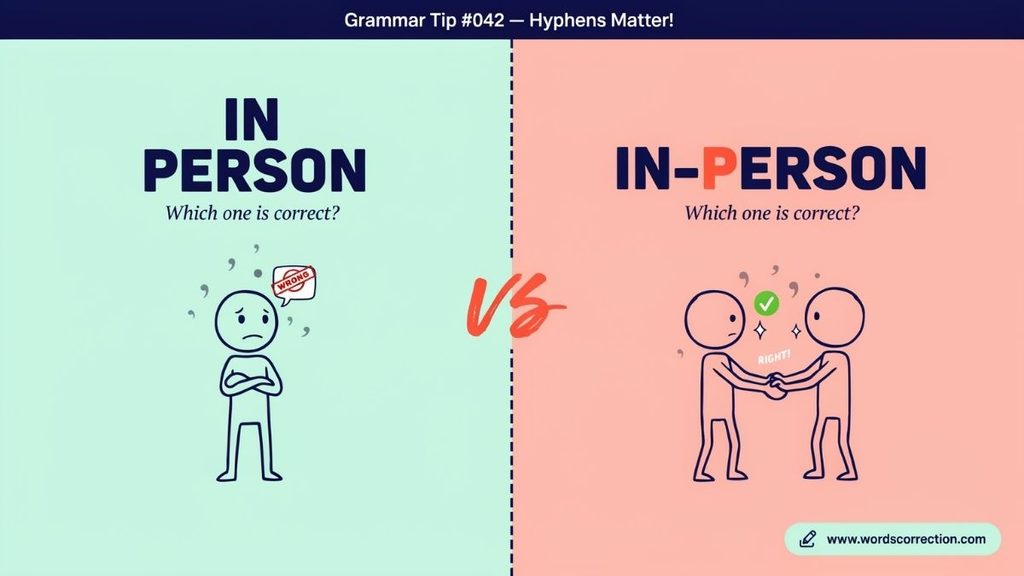
Use “in-person” with a hyphen when the expression functions as a compound adjective that describes a noun. In this construction, the words work together to communicate a single idea: the event or activity involves physical attendance.
The hyphen helps readers recognize the compound modifier as one descriptive unit.
Use “In-Person” Before a Noun
The hyphenated form is especially common before nouns associated with meetings, appointments, interviews, classes, and professional activities.
Examples include
- In-person meeting: “We scheduled an in-person meeting for Thursday.”
- In-person interview: “The company invited three applicants to an in-person interview.”
- In-person appointment: “Please arrive 10 minutes before your in-person appointment.”
- In-person training: “New employees must complete an in-person training session.”
- In-person class: “The college offers an in-person class twice a week.”
- In-person consultation: “The specialist recommended an in-person consultation.”
- In-person event: “The organization plans to host an in-person event next month.”
In every example, “in-person” describes the noun that follows it.
The phrase acts as a single compound modifier. Instead of simply mentioning a meeting, the writer specifies that it will take place with participants physically present.
Why Is “In-Person” Hyphenated?
A hyphen connects words that work together as a compound modifier. In this case, it signals that “in” and “person” jointly describe the following noun.
Compare these sentences
- “The company arranged an in-person interview.”
- “The company interviewed the applicant in person.”
The first sentence uses “in-person” to describe the interview. The second uses “in person” to explain how the company conducted the interview.
Without the hyphen, a phrase such as “in person interview” can look awkward and may briefly confuse readers. Standard edited American English generally uses “in-person interview” because the expression functions as a compound adjective before the noun.
However, don’t assume that every phrase containing “in” and “person” requires a hyphen. The hyphen belongs to the compound-adjective construction, not to the expression in every grammatical position.
Learn the difference between tricky grammar more words
Appendix or Appendices Which one Is Correct?
Is “In-Person” Always Hyphenated?
In ordinary edited American English, use the hyphen when “in-person” functions as a compound adjective before a noun.
When the expression functions adverbially, use “in person” instead.
| Sentence | Correct form | Reason |
| We met in person. | In person | Describes how the meeting happened |
| We held an in-person meeting. | In-person | Describes the noun “meeting” |
| She interviewed the candidate in person. | In person | Modifies the verb “interviewed” |
| She conducted an in-person interview. | In-person | Modifies the noun “interview” |
| They prefer in-person training. | In-person | Describes the noun “training” |
| They prefer to train in person. | In person | Describes how the training takes place |
Some compound modifiers can appear after a noun in other constructions, and hyphenation conventions may vary by style guide. For this expression, however, the open adverbial form and the hyphenated pre-noun adjective form provide a reliable standard rule.
In Person vs In-Person Examples Compared
Sometimes a grammar rule becomes easier to understand when you see the same idea expressed in two different ways. The following examples show how sentence structure determines the correct form.
In-Person vs in Person meeting
- Correct: “Let’s meet in person next week.”
- Correct: “Let’s schedule an in-person meeting next week.”
In the first sentence, “in person” describes the act of meeting. In the second, “in-person” describes the meeting itself.
In-Person Interview vs Interview in Person
- Correct: “The hiring manager will interview the candidate in person.”
- Correct: “The hiring manager will conduct an in-person interview.”
Both sentences refer to a hiring conversation involving physical attendance. Their grammatical structures differ, so their hyphenation differs too.
In-Person Class vs Attend Class in Person
- Correct: “I prefer to attend class in person.”
- Correct: “I prefer an in-person class.”
The first sentence describes the student’s attendance. The second describes the type of class.
In-Person Training vs Train in Person
- Correct: “The consultant will train our staff in person.”
- Correct: “The consultant will provide in-person training.”
The open form modifies an action, while the hyphenated form modifies a noun.
In-Person Appointment vs Attend an Appointment in Person
- Correct: “You must attend the appointment in person.”
- Correct: “You must book an in-person appointment.”
These sentences are particularly useful in healthcare, government services, and other settings where physical attendance may be required.
The broader lesson is simple: don’t choose the spelling based on meaning alone. Choose it based on the phrase’s role in the sentence.
Learn the difference between confusing word pairs
Skillset or Skill Set Which Spelling Is Correct?
In Person vs In-Person? A Comparison Table
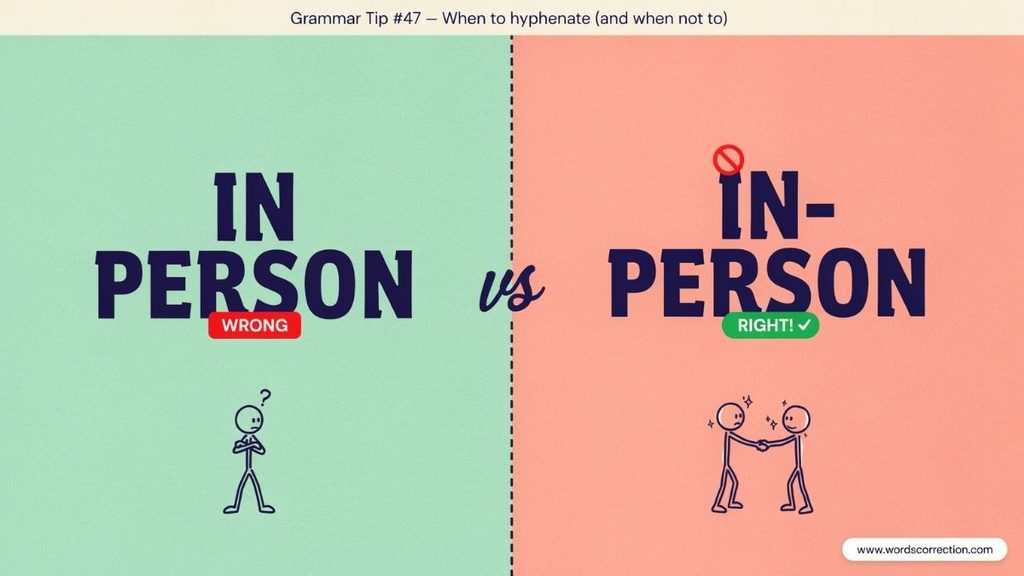
Use this table as a quick reference when editing an email, report, assignment, or article.
| Intended meaning | Correct example | Incorrect or less appropriate form |
| Meet physically | We should meet in person. | We should meet in-person. |
| A meeting involving physical attendance | We scheduled an in-person meeting. | We scheduled an in person meeting. |
| Attend physically | She attended in person. | She attended in-person. |
| An interview conducted physically | He has an in-person interview. | He has an in person interview. |
| Participate physically in a class | I prefer to participate in class in person. | I prefer to participate in class in-person. |
| Training conducted with physical attendance | The company offers in-person training. | The company offers in person training. |
| One-word spelling | Use “in person” or “in-person,” depending on context. | “Inperson” |
The table reflects standard American English usage. Readers may encounter inconsistent hyphenation in informal writing, but conventional edited prose should preserve the distinction between the adverbial phrase and the compound adjective.
Is “Inperson” One Word Correct?
No. “Inperson” is not the standard spelling in conventional English usage.
The accepted forms are “in person” vs “in-person.” Writers should choose between them according to the phrase’s grammatical function.
Common mistakes include
- Incorrect: “We need to discuss this inperson.”
Correct: “We need to discuss this in person.” - Incorrect: “The school offers inperson classes.”
Correct: “The school offers in-person classes.” - Incorrect: “She requested an inperson interview.”
Correct: “She requested an in-person interview.”
Although English contains many closed compound words, that doesn’t mean writers can combine any two words that frequently appear together. Standard spelling depends on established usage and grammatical convention.
When you’re unsure about a spelling, consult a reputable dictionary to verify the accepted form and its meaning.
Learn the difference between often confused words
Wellbeing or Well-Being Which Spelling Is Correct?
Common Mistakes When Using In Person vs In-Person
Even experienced writers sometimes overlook small hyphenation errors. Fortunately, the most common problems are easy to correct.
Adding a Hyphen After the Verb
Incorrect: “We discussed the contract in-person.”
Preferred in standard American English “We discussed the contract in person.”
The phrase modifies the verb “discussed.” It explains how the conversation took place, so the open form is appropriate.
Learn the difference between confusing more English words step by step
Patient or Patience what’s the Difference?
Leaving Out the Hyphen Before a Noun
Less appropriate in conventional edited prose “The company arranged an in person interview.”
Correct: “The company arranged an in-person interview.”
The compound adjective directly precedes the noun “interview.” The hyphen connects the words into a single modifier.
Writing the Phrase as One Word
Incorrect “Applicants must appear inperson.”
Correct “Applicants must appear in person.”
The same correction applies to the adjective: write “in-person appointment,” not “inperson appointment.”
Assuming the Hyphen Changes the Meaning
The hyphen generally changes the grammatical role rather than the core meaning.
“Let’s talk in person” and “Let’s have an in-person conversation” both suggest direct physical interaction. The difference lies in sentence structure.
Applying a Rule Without Checking the Sentence
A common mistake is to assume that “in-person” always needs a hyphen because the words appear together. That approach creates errors.
Instead, identify the phrase’s function
- If it describes an action, use “in person.”
- If it describes a noun as a compound adjective, use “in-person.”
This quick check works in most everyday writing situations.
The Noun Test An Easy Way to Remember the In-Person Hyphen Rule
A simple noun test can help you decide whether to use a hyphen.
Look at the words immediately following the expression. If “in-person” directly describes a noun, the hyphenated form is generally appropriate.
For example
- An in-person meeting: “In-person” describes “meeting.”
- An in-person appointment: “In-person” describes “appointment.”
- An in-person interview: “In-person” describes “interview.”
- An in-person class: “In-person” describes “class.”
Now consider these examples
- “We held the meeting in person.”
- “The candidate appeared in person.”
- “She prefers to attend class in person.”
In these sentences, the phrase doesn’t act as an adjective directly modifying a noun. It describes how the action takes place.
Learn the difference between basic English word mistakes
Chose or Choose What’s the Difference?
A More Reliable Two-Step Test
The noun test is helpful, but checking the complete sentence is even better.
Step one Identify the word or phrase being modified.
Ask whether the expression describes a noun or explains an action.
Step two Choose the appropriate form.
- Noun modifier “in-person meeting”
- Adverbial expression: “meet in person”
For example, compare “The doctor recommended an in-person consultation” with “The doctor recommended that we consult in person.”
The first describes the consultation. The second describes how the consultation should occur.
This method focuses on sentence structure instead of relying on a rule that might not apply to every construction.
Learn the difference between commonly misused words
Leafs or Leaves Which one Is Correct?
In Person vs In-Person in Professional Writing
Professional communication often uses both forms, especially when discussing appointments, meetings, interviews, and training sessions. Correct usage makes instructions easier to read and helps maintain a consistent editorial style.
Workplace Emails and Meeting Invitations
Use “in-person” when describing the meeting in an invitation:
“Please join us for an in-person planning meeting on Tuesday at 10 a.m.”
Use “in person” when describing attendance:
“Please attend the planning meeting in person.”
Both sentences communicate the same attendance requirement, but their grammatical structures differ.
Job Postings and Interviews
Employers frequently distinguish between remote and in-person work arrangements.
For example
“This position requires occasional in-person client meetings.”
The adjective describes the meetings. By contrast, “Candidates must interview in person” describes how candidates must participate in the interview process.
Training and Education
Schools and employers may offer online, hybrid, and in-person learning options.
- “The company offers in-person training for new employees.”
- “Employees must complete the final assessment in person.”
- “Students can choose between online courses and in-person classes.”
- “Students must attend the final examination in person.”
These examples show why the distinction matters in practical writing. Correct hyphenation makes sentences clearer without adding unnecessary words.
Learn the difference between everyday English mistakes
Loosing or Losing Which Spelling Is Correct?
In Person vs Face-to-Face Are They the Same?
The expressions “in person” and “face-to-face” often overlap, but they aren’t always identical.
“In person” emphasizes physical presence. It contrasts with remote participation, such as attending through a video call or communicating by email.
“Face-to-face” emphasizes direct interaction between people. It often suggests that participants can see and speak to one another directly.
Consider these examples:
- “I met the author in person at the conference.” This emphasizes physical attendance.
- “I had a face-to-face conversation with the author.” This emphasizes direct interaction.
- “The company held an in-person conference.” This means participants attended physically.
- “The two managers had a face-to-face discussion.” This highlights their direct conversation.
An event can take place in person without every attendee engaging in a face-to-face conversation. For instance, hundreds of people may attend a lecture in person, but most won’t speak directly to the presenter.
Likewise, a face-to-face conversation may occur during an in-person event, but the expressions emphasize different aspects of the experience.
Choose the phrase that communicates your intended meaning. Use “in person” when physical attendance matters and “face-to-face” when direct interaction is the focus.
In Person vs Online Which Expression Should You Use?
The choice between in-person and online participation affects how people understand an event, appointment, or service.
An in-person activity takes place with participants physically present at a location. An online activity happens through a digital platform or internet connection.
Compare these examples:
| In-person participation | Online participation |
| An in-person meeting in a conference room | A virtual meeting on a video platform |
| An in-person class at a school | An online class conducted remotely |
| An in-person medical appointment | A virtual consultation |
| An in-person job interview at an office | A video interview |
| In-person training at a workplace | Remote training through an online platform |
The distinction can matter for scheduling, accessibility, travel, and participation requirements.
For example, an invitation might state, “The workshop is available both online and in person.” Here, “in person” is an adverbial phrase that contrasts with “online.”
Alternatively, an organization might advertise “online and in-person workshops.” In this sentence, “in-person” functions as a compound adjective describing “workshops.”
Both structures are grammatically sound.
Learn the difference between more words people mix up
Mangoes or Mangos Which Spelling Is Correct?
In Person vs In-Person in American English and Style Guides
In standard American English, the distinction between “in person”vs “in-person” is well established. However, professional editors also consider consistency, readability, and the style guide governing a particular document.
Dictionaries help establish accepted spelling and meaning, while editorial style guides provide rules for consistency across publications.
The Associated Press Stylebook is widely used in journalism and professional communications. The Chicago Manual of Style provides guidance for book publishing, academic writing, and other editorial work.
When a specific style-guide rule matters, consult the current edition rather than relying on an unverified claim about what the guide requires.
For ordinary writing, the practical distinction remains straightforward:
- Write “in person” when the phrase functions adverbially.
- Write “in-person” when it functions as a compound adjective before a noun.
- Follow your organization’s style guide if it specifies a different convention for a particular context.
Should “In-Person” Be Capitalized in a Title?
Capitalization depends on the title style you’re using. The hyphen itself doesn’t determine which letters receive capital letters.
For example:
- Title case: “In-Person Meetings: A Practical Guide”
- Sentence case: “In-person meetings: A practical guide”
- Ordinary sentence: “We scheduled an in-person meeting.”
In title case, many styles capitalize both parts of a hyphenated expression, but conventions vary according to the style guide and the words involved. Sentence case generally capitalizes only the first word and proper nouns.
For consistent publishing, choose one title style and apply it throughout the article.
Other Ways to Say “In Person”
Several expressions can replace “in person,” but each carries a slightly different emphasis. Choose a substitute based on context rather than treating every option as an exact synonym.
| Alternative | Meaning or emphasis | Example |
| Face-to-face | Direct interaction between people | We discussed the proposal face-to-face. |
| Personally | An individual’s direct involvement | The director personally delivered the announcement. |
| Physically present | Explicitly present at a location | All applicants must be physically present. |
| On-site | At a particular workplace or location | The company provides on-site training. |
| In attendance | Present at an event | More than 100 guests were in attendance. |
| Directly | Without an intermediary, depending on context | Please contact the supervisor directly. |
These expressions aren’t interchangeable in every sentence. For example, “personally” can suggest individual responsibility rather than physical presence, while “on-site” emphasizes a particular location.
If your goal is to contrast physical participation with online attendance, “in person” is often the clearest choice.
Practice Session In Person vs In-Person
Fill in the blanks
- We arranged an __________ meeting with the manager.
- I prefer to discuss important matters __________.
- She attended an __________ interview yesterday.
- You must submit the documents __________.
- The company offers __________ training sessions.
- We finally met __________ after months of online conversations.
- He scheduled an __________ appointment with his doctor.
- The students attended the workshop __________.
- Our school organizes __________ classes every semester.
- I would rather speak to the supervisor __________.
- They conducted an __________ consultation.
- The applicant came __________ to complete the registration.
- We are planning an __________ event for next week.
- She wanted to thank her teacher __________.
- The university requires an __________ assessment.
- He visited the office __________ to resolve the issue.
- The organization provides __________ support to new employees.
- I met the author __________ at the book launch.
- They arranged an __________ discussion with the client.
- You can register for the course __________.
- We attended an __________ seminar on communication.
- The director spoke to the employees __________.
- She has an __________ examination tomorrow.
- Please visit the office __________ if you need assistance.
- The school is introducing more __________ learning opportunities.
Answers
- In-person
- In person
- In-person
- In person
- In-person
- In person
- In-person
- In person
- In-person
- In person
- In-person
- In person
- In-person
- In person
- In-person
- In person
- In-person
- In person
- In-person
- In person
- In-person
- In person
- In-person
- In person
- In-person
Here’s a trusted source for clear more words Comparison:
Grammar Update
FAQ’s About In Person vs In-Person
What is the difference between in person vs in-person?
“In person” is an adverbial phrase that describes how an action takes place, while “in-person” is a compound adjective that describes a noun. For example, “We met in person” and “We scheduled an in-person meeting.”
When should you hyphenate “in person”?
Use a hyphen when “in-person” functions as a compound adjective before a noun, as in “an in-person interview.” When the phrase describes how an action occurs, write “in person” without a hyphen.
Is in-person meeting grammatically correct?
Yes, “in-person meeting” is grammatically correct. The hyphen connects “in” and “person” to form a compound adjective describing the noun “meeting.”
Should I write attend in person vs in-person?
Write “attend in person” because the phrase follows the verb “attend” and describes how someone participates. For example, “You must attend the orientation in person.”
Is in-person always hyphenated?
No, “in-person” is not always hyphenated. Use the hyphenated form when it functions as a compound adjective, such as “in-person training.” Use “in person” without a hyphen when it functions as an adverbial phrase, such as “We completed the training in person.”
Can in person be used at the beginning of a sentence?
Yes, “in person” can begin a sentence. For example, “In person, the building looks much larger than it does in photographs.” Capitalize the first word because it begins the sentence, not because it is part of the phrase.
Is in-person interview correct?
Yes, “in-person interview” is correct because “in-person” describes the noun “interview.” For example, “The company invited me to an in-person interview.”
Should in-person training have a hyphen?
Yes, “in-person training” uses a hyphen because “in-person” functions as a compound adjective modifying “training.” For example, “Employees must complete an in-person training session.”
Is meet in-person correct?
In standard usage, write “meet in person” without a hyphen. Here, “in person” describes how the meeting takes place rather than modifying a noun directly.
Is in person one word or two words?
“In person” consists of two words. When used as a compound adjective before a noun, it is generally written with a hyphen as “in-person,” not as one unhyphenated word.
Why is in-person hyphenated before a noun?
The hyphen connects “in” and “person” so they function together as a compound adjective. In “an in-person appointment,” the hyphen makes it clear that the two words jointly describe the appointment.
What is an example of in person in a sentence?
An example is “I prefer to discuss important matters in person.” The phrase “in person” explains how the discussion takes place and does not require a hyphen.
What is an example of in-person in a sentence?
An example is “We arranged an in-person consultation with the specialist.” The hyphen connects the words because they work together to describe the noun “consultation.”
Is in-person class or class in person correct?
Both expressions are correct, depending on the sentence. Use “in-person class” when the phrase modifies the noun, as in “I enrolled in an in-person class.” Use “class in person” when the phrase follows the noun in a sentence, as in “I prefer to take the class in person.”
Is in person formal or informal?
“In person” is appropriate in both formal and informal communication. It is commonly used in professional emails, business meetings, academic writing, and everyday conversation.
What is another way to say in person?
Depending on the context, alternatives include “face-to-face,” “personally,” and “physically present.” For example, “We discussed the issue in person” could become “We discussed the issue face-to-face.” These expressions are similar but may not be interchangeable in every sentence.
Is face-to-face hyphenated?
Yes, “face-to-face” is commonly hyphenated when it functions as an adjective or adverb, as in “a face-to-face meeting” or “They spoke face-to-face.” The hyphens connect the words into a single expression.
What is the difference between in-person and face-to-face?
“In-person” generally indicates that someone attends or participates physically rather than remotely. “Face-to-face” emphasizes direct interaction between people. For example, an in-person lecture may involve a teacher addressing a room, while a face-to-face conversation emphasizes direct communication.
Should in-person be capitalized in a title?
Capitalization depends on the title style. In title case, “In-Person Meeting” is appropriate when both words are capitalized according to the selected style. In sentence case, write “In-person meeting,” capitalizing only the first word and any proper nouns.
Does AP Style use a hyphen in in-person?
The standard compound-adjective form is “in-person,” as in “an in-person event.” For publication-specific requirements, consult the current Associated Press Stylebook, especially if your organization follows AP style consistently.
Can in person describe an interview?
Yes, “in person” can describe how an interview takes place. For example, “The recruiter asked me to attend the interview in person.” When the phrase appears before the noun, use “in-person interview.”
Is in-person appointment correct?
Yes, “in-person appointment” is correct because the hyphenated phrase describes the type of appointment. For example, “The clinic offers both virtual consultations and in-person appointments.”
Is in-person a compound adjective?
Yes, “in-person” functions as a compound adjective when it modifies a noun. In the sentence “She attended an in-person workshop,” the hyphenated expression describes the workshop.
Is in person an adverbial phrase?
Yes, “in person” can function as an adverbial phrase that describes how an action occurs. For example, “The documents must be submitted in person.” The phrase explains the method of submission and is written without a hyphen.
How can you remember when to use in person vs in-person?
Use this simple rule: hyphenate “in-person” when it describes a noun, and write “in person” without a hyphen when it describes an action. For example, “an in-person meeting” uses a hyphen, while “We met in person” does not.
Learn the difference between tricky English words with easy explanations
Each Other or Eachother Which Spelling Is Correct?
Conclusion
Understanding the difference between in person vs in-person is easier than it seems. The rule is simple: use “in person” when describing how an action takes place, as in “We met in person.” Use “in-person” when the phrase describes a noun, as in “an in-person meeting.” Although the hyphen may look like a small detail, it plays an important role in clear, correct writing. By remembering this simple rule and practicing with examples, you can avoid common grammar mistakes and communicate more professionally. With a little attention, choosing the correct form will become second nature, and that tiny hyphen will no longer cause confusion.

Stella AJS is an experienced blogger and dedicated English language writer at Words Correction. She turns confusing grammar, word meanings, spelling, and usage into clear, practical insights that readers can easily understand and apply. With a passion for precise and engaging writing, Stella helps readers avoid common language mistakes, strengthen their vocabulary, and communicate with greater clarity and confidence.