
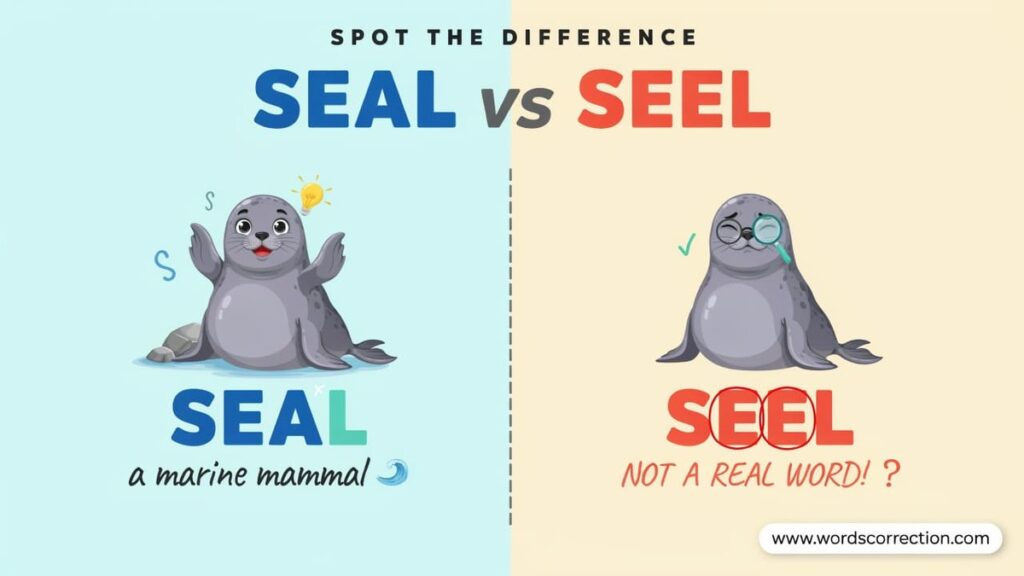
The words seal vs seel sound exactly alike, but they have very different meanings and uses. This makes seal vs seel an easy pair to confuse, especially when writing. Seal is a common word used for a marine animal, closing a package, or finalizing an agreement. Seel on the other hand is a rare historical word related to an old falconry practice. Using the wrong spelling can create confusion and weaken your writing. Understanding their meanings, differences and examples will help you use each word correctly and avoid common spelling mistakes.
What Is the Difference Between Seal vs Seel?
The main difference between seal vs seel lies in their meanings and everyday usage. Both words share the same pronunciation, /siːl/, but they serve different purposes.
Seal is a common English noun and verb. As a noun, it can refer to a marine mammal, an official stamp, or a device that prevents air or liquid from escaping. As a verb, it means to close something securely, prevent leakage, or finalize an agreement.
Seel is a rare and specialized verb. Historically, it referred to sewing or stitching a hawk’s or falcon’s eyelids shut as part of traditional falconry. The word also appears in older English with meanings associated with closing or blinding the eyes.
Here’s a quick comparison
| Feature | Seal | Seel |
|---|---|---|
| Pronunciation | /siːl/ | /siːl/ |
| Part of speech | Noun and verb | Primarily verb |
| Main meaning | To close, secure, authenticate, or describe a marine mammal | To sew shut a bird’s eyelids |
| Modern usage | Very common | Extremely rare |
| Context | Everyday, professional, technical, and legal English | Historical and specialized vocabulary |
| Example | Please seal the envelope. | The falcon was seeled. |
The easiest way to remember the distinction is simple: use seal for ordinary communication and reserve seel for its specific historical meaning.
Seal Meaning and Definition
The word seal has several established meanings. Its exact definition depends on how someone uses it in a sentence.
As a noun, it can describe an aquatic animal, an official mark, or a protective closure. As a verb, it commonly means to close something tightly or make an agreement final.
For example
- The seal rested on a rock near the shore.
- The company placed its official seal on the document.
- Please seal the package before shipping it.
- The two business partners finally sealed the deal.
Notice how the spelling remains the same even though the meaning changes. That’s because seal functions as both a noun and a verb.
Seel Meaning and Definition
Seel is a genuine but uncommon English word. Its historical meaning comes from traditional falconry, where falconers sewed shut the eyelids of a hawk or falcon to keep the bird calm during handling and training.
This practice belongs to the history of falconry rather than ordinary modern communication. The word also appears in older literary language with meanings connected to closing or blinding the eyes.
For example
- The historical account described how the falconer seeled the bird’s eyes.
- The old text used seel to describe the closing of the eyes.
You probably won’t need this word in an ordinary email, school assignment, business conversation, or household instruction. However, recognizing it can help when reading historical literature or specialized writing about birds of prey.
Seal vs Seel at a Glance
Remember these essential points:
- Seal: A common modern English word with several established meanings.
- Seel: A rare historical verb associated with falconry.
- Pronunciation: Both words sound alike.
- Spelling: Their different letters represent separate words with different meanings.
- Everyday choice: Use seal unless the specific historical meaning of seel applies.
Learn the difference between tricky words and use them correctly
Coaches or Coach’s Which Spelling Is Correct?
How to Use Seal Correctly
The word seal appears in everyday conversations, business documents, legal writing, packaging instructions, and discussions about wildlife. Its versatility makes it useful in many situations.
Depending on the sentence, seal can function as a noun or a verb. Understanding these grammatical roles will help you avoid common spelling mistakes and choose the correct meaning.
Seal as a Noun Meaning a Marine Animal
One of the most recognizable meanings of seal refers to a marine mammal that lives in coastal waters, oceans, and icy environments.
Seals belong to a group of marine mammals called pinnipeds, which also includes sea lions and walruses. These carnivorous mammals have streamlined bodies, thick layers of blubber, and flippers that help them swim efficiently.
Unlike fish, seals breathe air through their lungs. They spend much of their lives in the water but regularly come onto land or ice to rest, give birth, and care for their young.
Some familiar types include
- Harbor seal: Commonly found along coastal waters of the North Pacific and North Atlantic.
- Leopard seal: A powerful Antarctic predator known for its spotted coat and large jaws.
- Harp seal: Recognizable by the dark, harp-shaped markings on the backs of adults.
- Elephant seal: A particularly large seal species. Adult males develop a distinctive enlarged nose.
Examples of seal as a noun
- A harbor seal rested on the sandy beach.
- We watched a group of seals swimming near the rocks.
- The leopard seal hunted penguins in Antarctic waters.
- A baby seal followed its mother into the ocean.
In each sentence, seal identifies an animal rather than an action.
Seal vs Sea Lion What’s the Difference?
Although people sometimes use the terms interchangeably, seals and sea lions aren’t exactly the same. Both belong to the pinniped group, but they have noticeable physical and behavioral differences.
| Feature | True Seals | Sea Lions |
|---|---|---|
| External ears | No visible ear flaps | Small external ear flaps |
| Front flippers | Generally shorter | Longer and larger |
| Movement on land | Scoot on their bellies | Can walk using all four flippers |
| Swimming | Mainly use rear flippers for propulsion | Mainly use front flippers |
| Sounds | Generally quieter | Often bark loudly |
| Social behavior | Varies by species | Often gather in large groups |
For example, a harbor seal usually moves across a beach by wriggling on its belly. A California sea lion can rotate its hind flippers underneath its body and move around on all fours.
Both animals are marine mammals, but their physical adaptations make them relatively easy to distinguish once you know what to look for.
Learn the difference between similar English words the easy way
Grimey or Grimy Which Spelling Is Correct?
Seal as a Noun Meaning an Official Mark or Stamp
A seal can also refer to an official mark placed on a document to establish its authenticity, authority, or approval.
Historically, people used wax seals to authenticate letters and important records. A person would press a distinctive design into softened wax, often using a signet ring or specially designed stamp. The resulting impression helped identify the sender and showed whether someone had opened or altered the document.
Today, official seals still appear in government, legal, educational, and institutional settings.
Common examples include
- Government seals on official publications.
- University seals on certificates and diplomas.
- Corporate seals on certain legal documents.
- Notarial seals used to authenticate notarized records.
- Wax seals on invitations and ceremonial letters.
Examples in sentences
- The university placed its official seal on the graduation certificate.
- The document carries the state seal.
- The notary applied an official seal to the paperwork.
- A red wax seal decorated the wedding invitation.
Official Seal Meaning Seal vs Photocopy
An official seal and a photocopy serve different purposes.
An official seal provides an identifying or authentication mark. A photocopy simply reproduces the appearance of an existing document or image.
For instance, a photocopy of a certificate may show an institution’s seal. However, reproducing that seal doesn’t automatically make the copy an officially authenticated original.
The distinction matters in legal and administrative situations where authorities require verified documents.
Wax Seal Definition
A wax seal is a decorative or identifying impression created by pressing a design into softened sealing wax.
Traditionally, people used wax seals to close letters and protect private correspondence. Today, they’re also popular for wedding invitations, certificates, gift packaging, and decorative stationery.
A wax seal can communicate tradition, identity, and authenticity. However, a decorative wax impression doesn’t automatically provide legal authentication.
Learn the difference between commonly confused more words in English
Visualization or Visualisation Which Spelling Is Correct?
Seal as a Noun Meaning a Closure or Protective Barrier
In mechanical, industrial, and household contexts, a seal refers to a material or device that prevents unwanted substances from passing through an opening.
For example, refrigerators use rubber door seals to keep cold air inside. Water bottles use protective seals to prevent leaks. Engines contain specialized seals that help control the movement of oil and other fluids.
A properly fitted seal can prevent
- Water leakage.
- Air escaping from a container.
- Dust entering sensitive equipment.
- Oil leaking from mechanical parts.
- Contamination of packaged products.
Common types of seals include
| Type of Seal | Common Purpose |
|---|---|
| Rubber seal | Prevents air or water leakage |
| Waterproof seal | Keeps water from entering an area |
| Airtight seal | Prevents air from entering or escaping |
| Oil seal | Controls oil leakage in machinery |
| Tamper-evident seal | Shows whether packaging has been opened |
| Door seal | Reduces drafts and prevents unwanted air movement |
Examples in sentences
- The refrigerator door needs a new rubber seal.
- Check the bottle’s protective seal before opening it.
- The mechanic replaced the damaged oil seal.
- This container has an airtight seal.
In these examples, seal names the protective component rather than the action of closing something.
Seal as a Verb Meaning to Close or Secure
When seal functions as a verb, it means to close an opening securely so that nothing can easily enter or escape.
This meaning appears frequently in everyday instructions. You might seal an envelope before mailing a letter, seal a jar after preparing food, or seal a package before shipping it.
Consider these examples
- Please seal an envelope before putting it in the mailbox.
- She used tape to seal a package.
- He tightened the lid to seal the jar.
- Workers applied a waterproof coating to seal the roof.
- The laboratory technician sealed the container to prevent contamination.
Notice that the verb describes an action that creates a secure closure or protective barrier.
How to Seal an Envelope
Sealing an envelope means closing its flap so the contents remain inside during handling and delivery.
The process is straightforward
- Place your letter or document inside the envelope.
- Fold the envelope flap along its crease.
- Moisten the adhesive strip if required.
- Press the flap firmly against the envelope.
- Check that the edges remain closed.
Correct: Please seal the envelope before mailing it.
Incorrect: Please seel the envelope before mailing it.
The second sentence uses the rare historical spelling where the ordinary verb is required.
Learn the difference between confusing more English words step by step
Follow Up vs Follow-Up Which Is Correct?
Seal a Package, Letter, or Jar
The same spelling applies to other everyday objects.
- Seal a package: Close the packaging with tape, adhesive, or another fastening method.
- Seal a letter: Close the envelope containing the letter.
- Seal a jar: Secure the lid to protect the contents.
- Seal something tightly: Close it firmly to prevent leakage or exposure.
For example
“Make sure you seal the jar tightly before placing it in the refrigerator.”
Here, seal describes the action of securing the jar’s opening.
Seal as a Verb Meaning to Make Official or Final
Another important meaning of seal involves confirming, approving, or finalizing something.
In business and professional communication, people often use the word when an agreement becomes official or a decision reaches a final stage.
For example
- The companies sealed the agreement after several negotiations.
- Her signature sealed the contract.
- The final goal sealed the team’s victory.
- The handshake helped seal the deal.
This usage also appears in expressions such as seal the deal and seal someone’s fate.
Unlike physical sealing, this meaning is figurative. Nobody needs wax, glue, or an envelope. The word describes an action that makes something final or decisive.
Learn the difference between tricky English words with easy explanations
Omelet or Omelette Which Spelling Is Correct?
When Is Seel Actually Correct?
Although seel looks like a spelling mistake, it has a legitimate place in English dictionaries.
Its main historical meaning belongs to falconry, the traditional practice of training and handling birds of prey. The word also appears in older English literature and historical dictionaries.
Understanding its background helps explain why it exists and why modern writers rarely use it.
Seel in Falconry
Falconry is the traditional practice of training birds of prey, particularly falcons and hawks, to hunt.
Historically, some falconers used a technique called seeling. It involved sewing the eyelids of a bird temporarily closed with fine threads to keep it calm during certain stages of handling and training.
The verb seel describes this historical practice.
For example
- The historical falconry manual described how a falconer seeled a young hawk.
- The old account discussed the practice of seeling birds during training.
This technique belongs to the history of falconry. It shouldn’t be confused with ordinary modern bird training or presented as a routine contemporary practice.
The word’s origin also provides an interesting detail. Its historical development traces through Middle French to Latin cilium, meaning eyelid.
Seel as an Archaic English Verb
Beyond falconry, historical English used seel to mean closing or blinding the eyes.
Writers sometimes used the word figuratively to describe darkness, death, or the loss of sight.
For example, William Shakespeare used the related form seeling in Macbeth:
Come, seeling night,
Scarf up the tender eye of pitiful day.
The passage uses the idea of covering or closing the eyes of daylight to describe the arrival of darkness.
This is a literary use rather than an example of everyday modern English. Readers may encounter similar forms in older poetry and historical texts.
Seel vs Seal Why the Meanings Are Not Interchangeable
The two spellings may sound identical, but their definitions don’t overlap in ordinary modern usage.
Consider the following distinctions
| Intended Meaning | Correct Word | Incorrect Word |
|---|---|---|
| Close an envelope | Seal | Seel |
| Secure a package | Seal | Seel |
| Authenticate a document | Seal | Seel |
| Describe a marine mammal | Seal | Seel |
| Sew a falcon’s eyelids shut in historical falconry | Seel | Seal, when the specialized term is intended |
| Describe the historical closing of someone’s eyes | Seel | Seal, when the archaic verb is intended |
The key is context. A sentence about packaging, business agreements, official documents, or marine animals needs seal. A historical discussion of falconry may require seel.
Learn the difference between more words people mix up
Dieing or Dying Which Spelling Is Correct?
Seal vs Seel Correct and Incorrect Examples
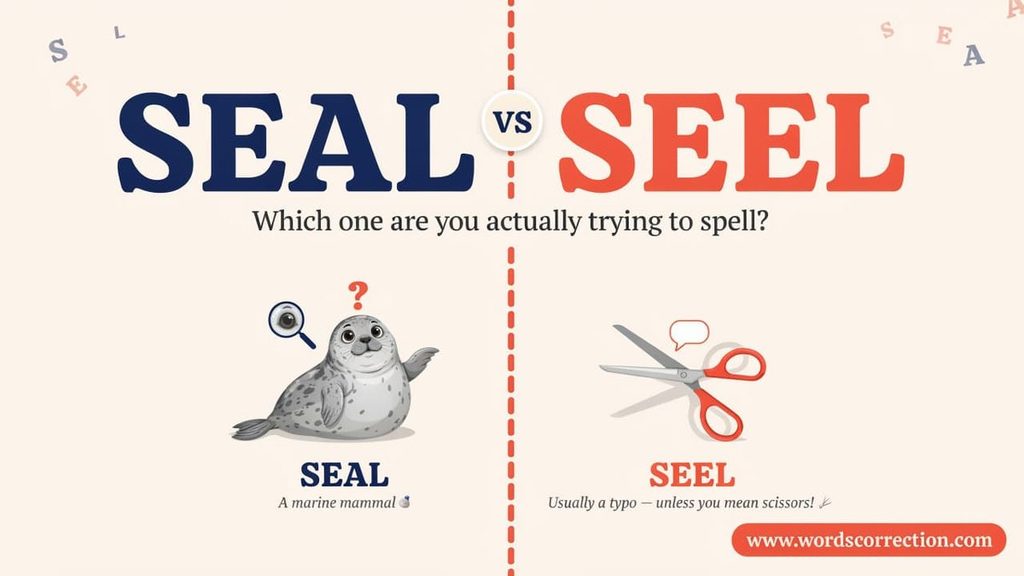
Sometimes, the easiest way to understand a spelling difference is to see how each word works in a real sentence. Although seal vs seel sound alike, their written forms communicate different meanings.
Let’s look at examples that show when each spelling is appropriate.
Examples of Seal Used Correctly
The following sentences demonstrate the most common uses of seal as a noun and verb.
| Example Sentence | Meaning |
|---|---|
| Please seal the envelope before mailing it. | Close the envelope securely. |
| The company sealed the agreement yesterday. | Finalized the agreement. |
| A harbor seal appeared near the fishing boat. | Refers to a marine animal. |
| The certificate carries an official seal. | Refers to an authentication mark. |
| The mechanic replaced the engine’s oil seal. | Refers to a protective component. |
| She used tape to seal the cardboard box. | Closed the package securely. |
| The government sealed the restricted area. | Prevented people from entering. |
| The new coating will seal the wooden floor. | Protects the surface. |
These examples show why seal is such a versatile word. Its meaning changes with the context, but its spelling remains the same.
Examples of Seel Used Correctly
Unlike seal, seel rarely appears in modern writing. Its appropriate use generally requires a historical or specialized context.
Examples include
- The falconer seeled the young hawk’s eyelids during the historical training procedure.
- The manuscript described the traditional practice of seeling a bird of prey.
- The poet used the word seel to describe the closing of the eyes.
These sentences demonstrate the specialized meaning of the word. They’re appropriate for discussions about historical falconry, older literature, and archaic English vocabulary.
Seal vs Seel Incorrect vs Correct Examples
A small spelling change can make a sentence confusing or incorrect. The following examples show common mistakes and their corrections.
| Incorrect Sentence | Correct Sentence | Explanation |
|---|---|---|
| Please seel the envelope. | Please seal the envelope. | Use seal to close an envelope. |
| We need to seel the package. | We need to seal the package. | Seal means to close securely. |
| They finally seeled the deal. | They finally sealed the deal. | Sealed is the past tense of seal. |
| The company placed its official seel on the document. | The company placed its official seal on the document. | An authentication mark is a seal. |
| The fridge needs a new rubber seel. | The fridge needs a new rubber seal. | A protective closure is a seal. |
An important grammar point: The past tense of seal is sealed, not seeled. Its present participle is sealing, not seeling.
For example
- Present: I seal the container.
- Past: I sealed the container.
- Present participle: I am sealing the container.
By contrast, the specialized verb seel has the forms seeled and seeling. These forms belong to its rare historical usage.
Learn the difference between everyday English mistakes
Photostat or Photostate Which one Is Correct?
Common Expressions and Phrases With Seal
The word seal appears in several familiar English expressions. Learning these phrases will help you understand its figurative meanings and use them naturally in conversation.
Seal the Deal
Seal the deal means to complete an agreement or make a successful arrangement final.
People commonly use this expression in business, sales, negotiations, and everyday situations.
Examples
- The final discount helped the salesperson seal the deal.
- Their handshake sealed the deal.
- She impressed the interview panel and sealed the deal with a strong final answer.
The expression doesn’t refer to physically closing a document. Instead, it describes the moment an agreement becomes certain or successful.
Seal of Approval
A seal of approval means official or personal acceptance, endorsement, or recognition.
For example
- The new product received the company’s seal of approval.
- Her parents gave the wedding plans their seal of approval.
- The safety organization awarded the equipment its seal of approval.
The expression can describe formal certification or someone’s positive opinion.
Seal an Envelope
To seal an envelope means to close its flap so the contents remain inside.
Examples
- Seal the envelope before placing the stamp.
- She sealed the invitation and wrote the recipient’s address.
- He forgot to seal the envelope before sending the letter.
This is one of the clearest examples of the difference between seal vs seel.
Under Seal
The expression under seal generally refers to something officially secured, protected, or kept confidential, especially in legal contexts.
For example
- The court kept certain documents under seal.
- The confidential records remained under seal until further notice.
Its exact legal meaning depends on the jurisdiction and situation.
My Lips Are Sealed
When someone says my lips are sealed, they mean they won’t reveal a secret or share confidential information.
Examples
- Don’t worry about the surprise party. My lips are sealed.
- She promised to keep the information private. Her lips are sealed.
The expression uses sealed figuratively to suggest that someone’s mouth is securely closed.
Seal Off
Seal off means to block access to an area or prevent people from entering or leaving it.
Examples
- Police sealed off the street after the accident.
- Workers sealed off the damaged section of the building.
- The authorities sealed off the contaminated area.
In each case, the phrase describes restricting access or movement.
Learn the difference between commonly misused words
Pricy or Pricey Which Spelling Is Correct?
Why Do People Confuse Seal vs Seel?
Even experienced English speakers sometimes struggle with words that sound alike but have different spellings. The confusion between seal vs seel comes from several features of English pronunciation and spelling.
They Sound the Same
Both words have the same pronunciation: /siːl/.
The long vowel sound /iː/ appears in many English words, including:
- Feel
- Peel
- Wheel
- Meal
- Steel
- Seal
Because seal vs seel sound identical, listeners can’t identify the correct spelling from pronunciation alone.
You need context to make the right choice.
English Has Several Spellings for the Same Sound
English spelling doesn’t always follow a consistent pattern.
The same vowel sound can appear in different letter combinations. Consider these examples
| Word | Pronunciation |
|---|---|
| Seal | /siːl/ |
| Seel | /siːl/ |
| Feel | /fiːl/ |
| Field | /fiːld/ |
| Receive | /rɪˈsiːv/ |
These examples demonstrate why spelling words based only on their sounds can cause problems.
However, that doesn’t mean you can freely exchange different spellings. Each established word has its own accepted written form.
Seel Looks Like a Possible Alternative Spelling
At first glance, seel looks like a reasonable alternative to seal. Both contain four letters and end with the same consonant.
Someone who isn’t familiar with the word’s historical meaning might assume that the difference is simply stylistic.
It isn’t.
The two spellings represent separate vocabulary items with different meanings. The correct choice depends on what you’re trying to communicate.
Spellcheck May Not Catch the Mistake
Another reason for confusion involves spelling and grammar tools.
A spellchecker may recognize seel as a valid dictionary word. Consequently, it might not flag the word even when someone uses it incorrectly.
For example
“Please seel the envelope.”
The sentence contains a real English word, but it doesn’t use that word correctly.
This illustrates an important distinction:
- Spelling accuracy: Is the written word recognized?
- Contextual accuracy: Does the word express the intended meaning?
A sentence can pass a basic spelling check and still contain the wrong word.
Learn the difference between basic English word mistakes
Encode vs Incode Which Is Correct?
Seal vs Seel Common Grammar and Spelling Mistakes
Understanding the difference requires more than memorizing two definitions. You also need to recognize how each word behaves grammatically.
Here are mistakes worth avoiding.
Using Seel Instead of Seal
This is the most common error.
People sometimes write seel when they mean to close something or make an agreement final.
Remember:
- Seal a package.
- Seal an envelope.
- Seal a document.
- Seal the deal.
Confusing Seal the Deal With Other Expressions
The expression seal the deal is well established in modern English.
Writing seel the deal changes the spelling incorrectly because the expression refers to finalizing an agreement, not the historical falconry meaning.
Forgetting That Seal Can Be a Noun or a Verb
Some writers associate seal only with the marine animal. However, it has several grammatical and contextual uses.
Compare
- Noun: The seal swam toward the boat.
- Noun: The certificate has an official seal.
- Noun: The refrigerator needs a new seal.
- Verb: Please seal the container.
- Verb: They sealed the agreement.
Recognizing the part of speech makes word selection easier.
Assuming Seel Is Always a Spelling Mistake
Although seel is inappropriate in most everyday sentences, it isn’t universally incorrect.
Historical dictionaries recognize its falconry meaning and older uses related to closing or blinding the eyes.
Therefore, calling it a completely nonexistent word would be inaccurate.
Watching the Past-Tense Forms
The past tense provides another useful spelling clue.
| Word | Present | Past Tense | Present Participle |
|---|---|---|---|
| Seal | Seal | Sealed | Sealing |
| Seel | Seel | Seeled | Seeling |
For ordinary writing, you’ll almost always need sealed and sealing.
Learn the difference between often confused words
Conex or Connex What Is the Difference?
How to Remember the Difference Between Seal vs Seel
A simple memory trick can save you from making the same spelling mistake repeatedly.
Instead of memorizing complicated dictionary explanations, connect each word with its main meaning.
Associate Seal With Security and Closure
Think of the letter A in seal as standing for airtight.
A seal closes an opening, protects a container, authenticates a document, or helps finalize an agreement.
Remember these common combinations
- Airtight seal
- Official seal
- Wax seal
- Rubber seal
- Seal an envelope
- Seal the deal
These everyday expressions will help you remember the standard spelling.
Remember Seel Through Its Falconry Meaning
Connect seel with its historical association with falconry.
When you encounter this word in an older book or specialized text, consider whether the writer is discussing the historical practice of closing a bird’s eyelids.
That context makes the unusual spelling easier to understand.
Use Context Instead of Sound
Since both words sound alike, pronunciation won’t help you decide which spelling to use.
Instead, ask yourself
- Am I talking about closing something? Use seal.
- Am I describing a marine animal? Use seal.
- Am I referring to an official mark? Use seal.
- Am I discussing historical falconry? Seel may be correct.
The golden rule: Choose a word based on its meaning, not just how it sounds.
Practice Session About Seal vs Seel
Complete each sentence with the correct word or phrase.
- The correct spelling for closing an envelope is __________.
- We need to __________ the deal before the deadline.
- A __________ is a marine mammal that lives in oceans and coastal waters.
- The word __________ is an archaic English term associated with traditional falconry.
- The correct spelling is “seal,” not “__________,” when referring to closing a package.
- Please __________ the jar tightly to prevent air from entering.
- An official __________ can be used to authenticate an important document.
- The phrase “__________ of approval” refers to an official sign of acceptance.
- The word “seal” can function as both a noun and a __________.
- A young seal is commonly known as a __________.
- An adult female seal is commonly called a __________.
- Walruses belong to the biological family __________.
- True seals belong to the family __________.
- Sea lions have visible external __________ flaps.
- Polar bears and orcas are natural predators of __________.
- A group of walruses is commonly called a __________.
- Baby walruses are known as __________.
- The scientific name of the walrus is __________.
- The expression “seal the deal” means to __________ an agreement.
- The historical word “seel” is associated with the practice of closing a falcon’s __________.
- Unlike true seals, sea lions can rotate their hind __________ forward when moving on land.
- The word “seal” can refer to an animal, an official mark, or a closing __________.
- Great white sharks and __________ are among the natural predators of elephant seals.
- A walrus is easily recognized by its long __________ and prominent whiskers.
- In standard modern English, __________ is the correct spelling for the action of closing something securely.
Answers
- Seal
- Seal
- Seal
- Seel
- Seel
- Seal
- Seal
- Seal
- Verb
- Pup
- Cow
- Odobenidae
- Phocidae
- Ear
- Walruses
- Herd
- Calves
- Odobenus rosmarus
- Finalize
- Eyelids
- Flippers
- Mechanism
- Orcas
- Tusks
- Seal
Here’s a trusted source for clear word meanings:
Cambridge Dictionary
FAQs
Is it seal the deal or seel the deal?
The correct expression is “seal the deal.” It means to finalize an agreement, complete a negotiation, or make an arrangement official. The spelling “seel the deal” is incorrect in modern English.
How do you spell seal when referring to closing something securely?
The correct spelling is “seal.” It is used as a verb to describe closing something tightly or protecting it from being opened, damaged, or exposed. For example, you can seal an envelope, package, or container.
What are the two main meanings of the word seal?
The word “seal” has several meanings. Its two most common meanings refer to a marine mammal and the action of closing or securing something. It can also describe an official mark or stamp used to authenticate documents.
Are there different accepted spellings of the word seal?
“Seal” is the standard spelling in modern English. Although “seel” is a historical English word, it has a different meaning and is not an alternative spelling for the marine animal or the action of closing something.
Which spelling is correct seal vs seel?
“Seal” is the correct spelling when referring to the marine mammal, an official mark, or the action of closing something securely. “Seel” is an obsolete or extremely rare historical term associated with falconry.
What is the difference between seal vs seel?
“Seal” is a commonly used English noun and verb that refers to a marine mammal, an official mark, or the act of closing something securely. In contrast, “seel” is an archaic verb historically associated with stitching a falcon’s eyelids closed in traditional falconry.
What is the historical meaning of the word seel?
Historically, “seel” referred to the practice of sewing or stitching a falcon’s eyelids closed as part of traditional falconry. The term is rarely encountered in contemporary English and is primarily found in historical or specialized contexts.
What is a female seal called?
A female seal is commonly called a cow, while an adult male is called a bull. A young seal is known as a pup. These terms help distinguish seals according to their age and sex.
Why is a walrus classified separately from a true seal?
A walrus belongs to the family Odobenidae, whereas true seals belong to the family Phocidae. Although both are pinnipeds, walruses have distinctive features, including long tusks, prominent whiskers, and large bodies.
Why should people avoid touching wild walruses?
People should avoid touching wild walruses because these powerful marine mammals may react defensively when disturbed. Human contact can also cause unnecessary stress and interfere with their natural behavior. Maintaining a safe distance helps protect both people and wildlife.
Can walruses and seals interbreed?
No. Walruses and true seals belong to different biological families and are not known to interbreed. Despite sharing the pinniped group, their genetic and reproductive differences distinguish them as separate animal groups.
What is a female walrus called?
An adult female walrus is called a cow, while an adult male is known as a bull. Their offspring are commonly referred to as calves.
Can seals and sea lions reproduce with each other?
True seals and sea lions belong to different biological families, and natural interbreeding between them is not known. Their genetic and reproductive differences make them distinct groups of marine mammals.
Which predators hunt elephant seals?
Great white sharks and orcas are among the primary natural predators of elephant seals. They may prey on elephant seals at different stages of life, particularly younger or vulnerable individuals.
Why do sea lions hiss at humans?
Sea lions may hiss when they feel threatened, uncomfortable, or disturbed. This sound is a defensive warning that communicates their need for space. People should avoid approaching or provoking these wild animals.
How can you distinguish a sea lion from a true seal?
Sea lions have visible external ear flaps, longer front flippers, and the ability to rotate their hind flippers forward when moving on land. True seals lack external ear flaps and generally move on land by wriggling their bodies.
What are the natural predators of walruses in the Arctic?
Polar bears and orcas are the primary natural predators of walruses. Although adult walruses are difficult prey because of their considerable size and defensive tusks, younger and more vulnerable individuals may face greater risks.
Which animals are most closely related to seals?
Seals are closely related to sea lions and walruses, as all three belong to the pinniped group. These marine mammals share an evolutionary ancestry and belong to the order Carnivora.
What is a group of walruses called?
A group of walruses is commonly called a herd. Walruses are social animals that often gather in large groups on beaches, ice floes, and coastal resting areas.
Can walruses develop social relationships with humans?
Walruses primarily form social relationships with members of their own species. Those living in managed care may become familiar with their human caretakers, but these interactions differ from their natural social relationships with other walruses.
What are baby walruses called?
Baby walruses are called calves. They depend on their mothers for nourishment, protection, and care during their early stages of development.
Do walruses mate for life?
No. Walruses do not generally form lifelong mating pairs. Their breeding behavior is seasonal, and males compete for access to females during the mating period.
What are some alternative names or common descriptions of walruses?
Walruses are commonly described as tusked pinnipeds or Arctic marine mammals. Their scientific name is Odobenus rosmarus. These descriptions refer to their distinctive physical characteristics and natural habitat.
Are walruses naturally aggressive toward humans?
Walruses are wild animals and are not necessarily aggressive toward humans. However, they can become defensive when threatened, approached too closely, or disturbed. Their large size and powerful tusks make it important to observe them from a safe distance.
What are the main natural enemies of walruses?
Polar bears and orcas are the main natural enemies of walruses. These predators generally target vulnerable individuals, including young walruses. Adult walruses can defend themselves using their considerable strength, body size, and tusks.e ordinary verb for closing an envelope is seal.
Learn how to use confusing more words correctly
Encorporate vs Incorporate Which Spelling Is Correct?
Conclusion
Understanding the difference between seal vs seel is easy once you know how each word is used. “Seal” is the correct choice in everyday English when referring to a marine animal, closing a package, securing a container, or finalizing an agreement. “Seel,” by contrast, is a rare historical word associated with an old falconry practice. Although the two words sound identical, their meanings are quite different, so you shouldn’t use them interchangeably. Remember, if you’re sealing an envelope or closing a deal, “seal” is the word you need. Knowing this small spelling difference will help you avoid confusion and keep your writing clear, accurate, and professional.

Stella AJS is an experienced blogger and dedicated English language writer at Words Correction. She turns confusing grammar, word meanings, spelling, and usage into clear, practical insights that readers can easily understand and apply. With a passion for precise and engaging writing, Stella helps readers avoid common language mistakes, strengthen their vocabulary, and communicate with greater clarity and confidence.




