
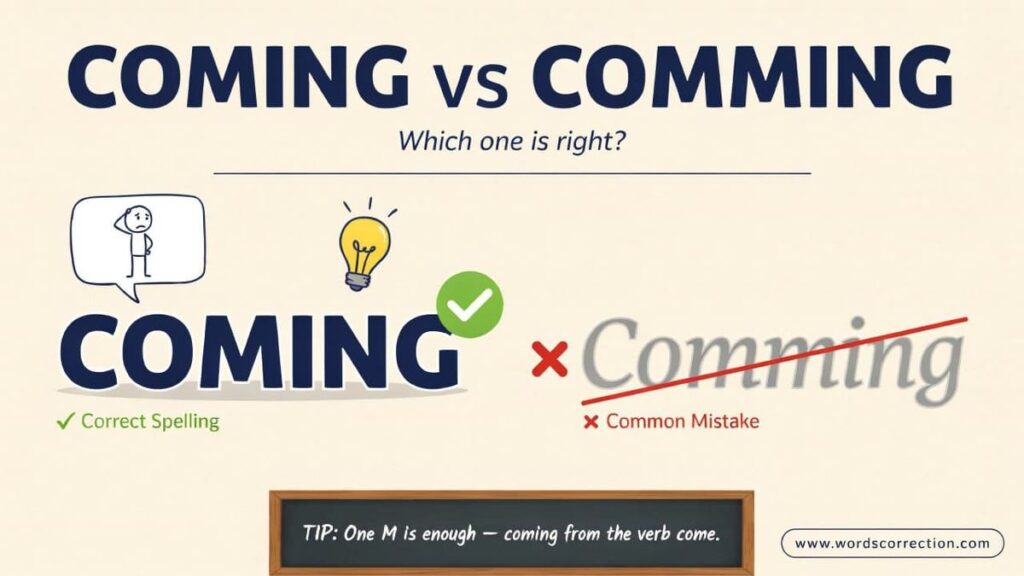
The difference between Comming vs Coming may seem small, but one extra letter can turn a correct word into a spelling mistake. This common confusion can happen to anyone, even careful writers. So, which spelling should you use, and why does “coming” have just one “m”? In this guide, we’ll explain Comming vs Coming, explore the simple grammar rule behind the correct spelling, and provide clear examples of how to use “coming” in everyday sentences. By understanding Comming vs Coming, you’ll learn why “comming” is incorrect and how to avoid this common spelling mistake with confidence.
Comming vs Coming The Quick Answer
The correct spelling is coming, with one M. Comming, with two M’s, is a common spelling mistake and is not an accepted alternative in standard English.
The difference comes from how English forms present participles. When you add the suffix -ing to a verb ending in a silent E, you generally remove the final E before attaching the suffix.
For example
- Come → Coming
- Make → Making
- Write → Writing
- Take → Taking
Therefore, the correct spelling is coming, not comming.
Consider these sentences
- Correct: She is coming to the office tomorrow.
- Incorrect: She is comming to the office tomorrow.
The pronunciation doesn’t change between these two written forms in ordinary speech. However, standard written English requires the correct spelling.
| Spelling | Status | Explanation |
|---|---|---|
| Coming | Correct | Standard spelling with one M |
| Comming | Incorrect | Common misspelling with two M’s |
Quick fact: The base verb come contains one M. Adding -ing doesn’t require you to double that consonant.
Learn the difference between confusing more English words
Grimey or Grimy Which Spelling Is Correct?
What Does Coming Mean?
The word coming is the present participle of the verb come. It generally describes movement toward a person, place, or destination. It can also refer to something approaching or expected to happen in the future.
Its exact meaning depends on the sentence and grammatical context.
For example
- “My brother is coming home.” Here, coming describes movement toward home.
- “The coming winter may be unusually cold.” In this sentence, coming describes a future period.
- “The coming of spring brings warmer weather.” Here, the word refers to the arrival or beginning of something.
Let’s examine its main grammatical uses.
Coming as a Verb
The most common use of coming appears in continuous verb forms. It describes an action happening now, an action that was happening at a particular time in the past, or an action expected to be happening in the future.
Examples
- The bus is coming down the road.
- My parents are coming to visit us.
- She was coming home when it started raining.
- They will be coming to the meeting later.
In these examples, coming describes movement or an approaching action.
It usually appears with an auxiliary verb such as am, is, are, was, were, or will be when forming continuous tenses.
Coming as an Adjective
Coming can also function as an adjective. In this role, it describes something approaching, expected, or about to happen.
You’ll often see it before nouns referring to future events, periods, or developments.
Examples
- The coming year will bring several opportunities.
- We need to prepare for the coming winter.
- She has big plans for the coming months.
- The coming election has attracted public attention.
Notice that coming doesn’t describe physical movement in these sentences. Instead, it tells readers that something belongs to the approaching future.
Coming vs Upcoming: Both words can describe future events. However, upcoming often sounds more natural when referring to scheduled events, such as an upcoming conference or examination. Coming works in broader expressions such as the coming years or the coming generation.
Coming as a Noun or Gerund
Although coming usually functions as a verb form, it can also work as a gerund. A gerund is an -ing verb form that functions as a noun.
For example
- Coming here every morning takes time.
- Her coming surprised everyone.
- The coming of spring marks a change in the weather.
The first sentence, coming acts as the subject of the sentence. In the second, it refers to someone’s arrival. In the third, it describes the arrival or beginning of a season.
These examples show why understanding context matters when studying the meaning of coming.
Learn the difference between commonly mixed-up more words
Visualization or Visualisation Which Spelling Is Correct?
Why Is Coming Spelled With One M?
The main reason coming has one M is the silent E spelling rule.
English generally removes a verb’s final silent E before adding the suffix -ing. Since come ends in a silent E, you remove that letter and attach -ing.
The word formation looks like this
Come + ing = Coming
Here’s the process
- Start with the base verb come.
- Identify the final silent E.
- Remove the silent E.
- Add the suffix -ing.
- Keep the original single M.
The result is coming.
This rule applies to many English verbs ending in a silent E.
| Base verb | Correct -ing form | Spelling change |
|---|---|---|
| Come | Coming | Drop silent E |
| Make | Making | Drop silent E |
| Write | Writing | Drop silent E |
| Take | Taking | Drop silent E |
| Drive | Driving | Drop silent E |
| Dance | Dancing | Drop silent E |
| Hope | Hoping | Drop silent E |
| Give | Giving | Drop silent E |
The important point is that removing the silent E doesn’t automatically mean doubling the consonant before it.
For example, come becomes coming, not comming. The spelling rule removes the E and adds -ing. It doesn’t add another M.
Understanding the Difference Between Silent E and Double Consonant Rules
One reason people make the comming spelling mistake is that they remember another English spelling rule: doubling the final consonant before adding -ing.
That rule is valid. However, it applies to different types of verbs.
Many short, one-syllable verbs ending in a consonant-vowel-consonant pattern double their final consonant before adding -ing.
Examples
- Run → Running
- Sit → Sitting
- Swim → Swimming
- Stop → Stopping
- Plan → Planning
- Shop → Shopping
Compare these words with verbs that end in a silent E
- Come → Coming
- Make → Making
- Write → Writing
- Hope → Hoping
- Ride → Riding
The difference becomes easier to understand when you look at the base words.
| Spelling pattern | Base verb | Correct form |
|---|---|---|
| Silent E removal | Come | Coming |
| Silent E removal | Make | Making |
| Silent E removal | Write | Writing |
| Final consonant doubling | Run | Running |
| Final consonant doubling | Sit | Sitting |
| Final consonant doubling | Swim | Swimming |
| Final consonant doubling | Plan | Planning |
Remember: Running doubles N because it follows the consonant-doubling pattern. Coming keeps one M because it follows the silent E pattern.
Learn the difference between tricky grammar more words
Follow Up vs Follow-Up Which Is Correct?
Why Is Comming Incorrect?
The spelling comming is incorrect because it does not follow the standard English word-formation rule for the verb come. When comparing Comming vs Coming, it is important to understand that the base word is come, not comm.
To form its present participle, you remove the final silent e and add -ing without doubling the letter m. This spelling rule explains why coming is correct rather than comming.
Therefore, when discussing Comming vs Coming, remember that standard English dictionaries recognize coming as the correct spelling, while comming is a common spelling mistake.
Is Comming a Real Word?
In standard modern English, comming is not an accepted spelling of the present participle of come. It’s generally treated as a typographical or spelling error.
You may encounter it in
- Informal text messages.
- Social media comments.
- Unedited online posts.
- Student assignments.
- Emails written in a hurry.
However, seeing a spelling online doesn’t make it grammatically or orthographically correct.
If you encounter comming in a sentence, the intended word is almost certainly coming.
What Does Comming Mean?
The comming definition is straightforward: there is no standard English definition for comming as the ordinary form of come.
People who search for the meaning of comming usually want to understand the correct word, coming.
For example
- Incorrect: Are you comming to dinner?
- Correct: Are you coming to dinner?
The second sentence uses the accepted spelling and communicates the intended meaning.
When Did Comming Change to Coming?
There is no established historical spelling change in which standard English replaced comming with coming.
The correct spelling follows the established spelling pattern of the verb come. The double-M form is generally an error rather than an older standard spelling that was officially replaced.
Therefore, it’s more accurate to describe comming as a recurring spelling mistake than to suggest that the word changed from one accepted form to another.
Learn the difference between confusing word pairs
Omelet or Omelette Which Spelling Is Correct?
How to Use Coming Correctly in a Sentence
Knowing the correct spelling is only half the job. You also need to understand when to use coming in everyday English.
The word appears in several grammatical structures. Let’s look at the most useful ones.
Coming in Continuous Verb Forms
The present participle coming works with auxiliary verbs to form continuous tenses.
Present Continuous Tense
Use am, is, or are with coming to describe an action happening now or around the present time.
Examples
- I am coming home now.
- She is coming to the party.
- They are coming with us.
- The train is coming into the station.
Past Continuous Tense
Use was or were with coming to describe an action that was in progress at a particular time in the past.
Examples
- I was coming home when you called.
- They were coming toward the house.
- She was coming to the office when the accident happened.
Future Continuous Tense
Use will be with coming to describe an action expected to be in progress at a future time.
Examples
- We will be coming to your office tomorrow.
- They will be coming back next week.
- She will be coming home later tonight.
In all three tenses, the spelling remains exactly the same: coming.
Coming in Other Verb Constructions
You can also use coming after certain verbs and prepositions.
For example
- I look forward to coming home.
- She kept coming back to the same question.
- He avoided coming into the room.
- They started coming to the gym regularly.
One useful grammar detail deserves attention: when coming follows a preposition, it generally functions as a gerund.
For example, in “I look forward to coming home,” the word to is a preposition rather than part of an infinitive. That’s why coming is correct instead of come.
Coming as an Adjective
When coming describes an approaching event or period, it functions as an adjective.
Examples
- We have several important meetings in the coming week.
- The coming months will be busy.
- She is preparing for the coming school year.
- The coming generation will face different challenges.
This usage is common in newspapers, business writing, announcements, and everyday conversations.
Coming in Participial Phrases
You can also use coming in a participial phrase to provide additional information about a person or thing.
Examples
- Coming from a small town, she appreciated the opportunities in the city.
- The students coming from overseas need accommodation.
- Coming around the corner, he noticed the new restaurant.
These phrases add information without requiring a separate sentence.
Learn the difference between often confused words
Dieing or Dying Which Spelling Is Correct?
Coming vs Come vs Came Understanding the Different Forms
The words come, coming, and came belong to the same verb family. However, they serve different grammatical purposes.
The verb come is irregular. Its past tense doesn’t follow the usual pattern of adding -ed.
Here’s how the three forms differ
| Verb form | Grammatical role | Example |
|---|---|---|
| Come | Base form | Please come inside. |
| Came | Simple past tense | She came yesterday. |
| Coming | Present participle or gerund | She is coming today. |
When to Use Come
Use come as the base form of the verb.
Examples
- Please come here.
- I want to come with you.
- They come to work early.
- She will come tomorrow.
When to Use Came
Use came when describing an action that happened in the past.
Examples
- He came home late last night.
- My friends came to visit us.
- The package came yesterday.
When to Use Coming
Use coming when describing an ongoing action, an approaching event, or a gerund construction.
Examples
- She is coming to the office.
- The coming holidays will be exciting.
- Coming here every day requires patience.
Grammar tip: Don’t confuse come with coming. After modal verbs such as will, can, and should, use the base form.
- Correct: She will come tomorrow.
- Incorrect: She will coming tomorrow.
Learn the difference between basic English word mistakes
Photostat or Photostate Which one Is Correct?
Common Expressions and Phrases With Coming
The word coming appears in many everyday English expressions. Understanding these phrases helps you recognize its meaning in different situations.
Coming Soon Meaning
Coming soon means that something will become available, arrive, or happen in the near future.
It’s commonly used in advertising, entertainment, product announcements, and business communication.
Examples
- Our new website is coming soon.
- The movie is coming soon to theaters.
- A new collection is coming soon.
- Registration for the course is coming soon.
The phrase doesn’t usually provide an exact date. It simply tells the audience to expect something in the near future.
Coming Up
Coming up refers to something approaching, scheduled, or about to happen.
Examples
- My birthday is coming up next month.
- We have an important examination coming up.
- What’s coming up on television tonight?
- The next meeting is coming up on Friday.
Coming Along
Coming along can describe progress or movement with someone.
Examples
- Your English is coming along nicely.
- How is your new project coming along?
- Are you coming along with us?
- The construction work is coming along well.
The meaning depends on the context. It can refer to improvement, development, or accompanying someone.
Coming From
Coming from can describe someone’s origin, the source of something, or the reason behind a statement.
Examples
- She is coming from London.
- Where is that sound coming from?
- I understand where you’re coming from.
- The message is coming from the manager.
Coming of Age
The expression coming of age describes the process of reaching adulthood or developing greater maturity.
It’s also used in literature and film to describe stories about personal growth and the transition from childhood to adulthood.
Examples
- The movie tells a coming-of-age story.
- He experienced several challenges while coming of age.
- Coming of age brings new responsibilities.
Learn the difference between commonly misused words
Pricy or Pricey Which Spelling Is Correct?
Comming vs Coming Correct and Incorrect Examples
The easiest way to understand the difference between comming vs coming is to compare incorrect sentences with their corrected versions.
| Incorrect sentence | Correct sentence |
|---|---|
| She is comming home. | She is coming home. |
| Are you comming with us? | Are you coming with us? |
| My brother is comming tomorrow. | My brother is coming tomorrow. |
| The bus is comming now. | The bus is coming now. |
| They are comming to the meeting. | They are coming to the meeting. |
| A new product is comming soon. | A new product is coming soon. |
| He is comming from work. | He is coming from work. |
| The holidays are comming. | The holidays are coming. |
Coming Sentence Examples in Everyday Situations
Here are additional examples showing how to use the correct spelling naturally.
At Home
- Mom is coming back from the market.
- My cousins are coming over tonight.
- Dinner is coming to the table.
At Work
- The manager is coming to the office.
- We have an important deadline coming up.
- Several new employees are coming next week.
In Education
- The examination is coming soon.
- Students are coming to the classroom.
- The coming semester will include new subjects.
In Professional Communication
- Thank you for coming to the meeting.
- We appreciate you coming to our event.
- More information about the upcoming project is coming soon.
These examples demonstrate that the correct spelling doesn’t change with the situation. Whether you’re writing a casual message or a formal email, use coming with one M.
Learn the difference between everyday English mistakes
Encode vs Incode Which Is Correct?
Why Do People Confuse Comming With Coming?
Even though coming follows a straightforward spelling rule, people still write comming. Several factors explain this common error.
Confusion About Consonant Doubling
English has many words that double their final consonants before adding -ing.
For example
- Run → Running
- Swim → Swimming
- Sit → Sitting
- Stop → Stopping
Because learners see these patterns frequently, they sometimes apply the same rule to come.
However, come ends in a silent E. That changes the spelling process.
Overgeneralizing the -ing Spelling Rule
The suffix -ing doesn’t follow one universal spelling pattern. Some verbs drop their final E, while others double their final consonants.
When someone learns only one pattern, they may apply it incorrectly to other words.
For example
- Correct: Making
- Incorrect: Makeing
- Correct: Running
- Incorrect: Runing
- Correct: Coming
- Incorrect: Comming
Learning the base verb first helps prevent these mistakes.
The Spoken Word Doesn’t Reveal the Difference
Another reason for this error is pronunciation.
In ordinary English speech, coming and the misspelled form comming would normally be pronounced the same way.
Because the extra M doesn’t create a separate sound, listeners cannot identify the spelling mistake through pronunciation alone.
You need to recognize the correct written form.
Visual Similarity to Words With Double Consonants
Words such as swimming, running, and planning may influence how people spell coming.
The repeated consonants create a visual pattern. When writers try to reproduce that pattern in another word, they may accidentally add an unnecessary M.
However, spelling depends on the structure of the base word, not simply on how another word looks.
Fast Typing and Autocorrect
Typing quickly can introduce extra letters, especially when you’re writing on a phone or keyboard.
Autocorrect and grammar checkers can catch many common spelling errors. Still, they aren’t perfect. Some tools may miss unusual typos or behave differently depending on their dictionaries and settings.
For important writing, proofread the final version instead of relying entirely on automatic corrections.
Learn the difference between more words people mix up
Conex or Connex What Is the Difference?
Comming vs Coming in British and American English
One common question is whether British and American English use different spellings of coming.
The answer is no.
Coming is the correct spelling in both American English and British English. Neither variety uses comming as an accepted alternative.
| English variety | Correct spelling | Incorrect spelling |
|---|---|---|
| American English | Coming | Comming |
| British English | Coming | Comming |
| Canadian English | Coming | Comming |
| Australian English | Coming | Comming |
Some English words have different British and American spellings.
For example
- Color (American) / Colour (British)
- Center (American) / Centre (British)
- Traveling (American) / Travelling (British)
However, coming doesn’t belong to that group.
You should use the same spelling regardless of whether you’re writing for an American, British, Canadian, or Australian audience.
Comming vs Coming Quick Comparison Table
This table summarizes the most important differences between the two spellings.
| Feature | Coming | Comming |
|---|---|---|
| Spelling status | Correct | Incorrect |
| Number of M’s | One | Two |
| Base word | Come | Intended to be come |
| Word formation | Come + ing = Coming | Incorrect formation |
| Meaning | Arrival, movement, or approach | No standard meaning |
| Grammar | Present participle, gerund, adjective | Not a standard form |
| American English | Accepted | Misspelling |
| British English | Accepted | Misspelling |
| Dictionary usage | Standard word | Common spelling error |
The distinction is straightforward: coming is the accepted spelling, while comming is an incorrect variation.
Learn the difference between tricky English words with easy explanations
Encorporate vs Incorporate Which Spelling Is Correct?
Easy Ways to Remember the Correct Spelling of Coming
Remembering the correct spelling becomes easier when you connect it to the base verb and its spelling pattern.
Here are some practical techniques.
Remember the Silent E Rule
The easiest trick is to remember that come loses its final E before adding -ing.
Come → Coming
You don’t need another M because the original consonant stays single.
Connect Coming With Come
Whenever you’re unsure about the spelling, return to the base word.
Ask yourself:
“What is the original verb?”
The answer is come. Once you identify the root verb, the correct spelling becomes easier to work out.
Compare Coming With Running
Use these two words as a quick spelling comparison:
- Run → Running
- Come → Coming
Running doubles N because it follows the consonant-doubling rule. Coming drops its silent E and keeps one M.
This comparison helps you remember that not every verb follows the same pattern.
PPractice With Short Sentences
Writing a few short sentences can reinforce the correct spelling of Comming vs Coming and help you remember the difference.
Try these examples:
- I am coming home.
- Are you coming today?
- She is coming with me.
- The new season is coming soon.
- My friends are coming tomorrow.
Repeated exposure to correct examples helps you recognize coming more quickly and avoid the common misspelling comming in everyday writing.
Practice Session about Comming vs Coming
Instructions: Choose the correct word Comming vs Coming to complete each sentence.
1. She is ______ to visit us tomorrow.
2. The new movie is ______ soon.
3. I am ______ home right now.
4. They will ______ to our office next week.
5. He is ______ to the meeting today.
6. I visited my friend ______.
7. We have a ______ meeting tomorrow.
8. I ______ arrive at the office tomorrow.
9. She ______ be visiting London next month.
10. I will try ______ come to the event.
11. We ______ in London yesterday.
12. I arrived ______ home late last night.
13. They arrived ______ London in the morning.
14. My parents are ______ town today.
15. She lives ______ Pakistan.
16. I will be arriving ______ at 6 p.m.
17. I have ______ to London twice.
18. I ______ in London.
19. My office is ______ Main Street.
20. I ______ lived in this village for five years.
21. ______ do you live?
22. She ______ coming to the office today.
23. They ______ be ready tomorrow.
24. He ______ to visit his relatives next week.
25. We are looking forward to ______ you soon.
Answers
- Coming
- Coming
- Coming
- Come
- Coming
- Yesterday
- Tomorrow’s
- Will
- Will
- To
- Arrived
- Home
- In
- In
- In
- Home
- Been
- Live
- On
- Have
- Where
- Is
- Will
- Will come
- Seeing
Here’s a trusted source for clear word meanings:
Cambridge Dictionary
FAQs
What is the difference between comming vs coming?
Coming is the correct spelling of the present participle of the verb come. Comming is an incorrect spelling that results from adding an unnecessary extra “m.” For example, “She is coming home” is correct.
Is it spelled Comming vs Coming?
The correct spelling is coming, with a single “m.” The spelling comming, with two “m’s,” is incorrect and should be avoided in standard English writing.
Is it correct to say comming soon or coming soon?
The correct expression is “coming soon.” It indicates that something will happen, become available, or be released in the near future. “Comming soon” is a spelling error.
Is I am coming grammatically correct?
Yes, “I am coming” is grammatically correct. It uses the present continuous tense to describe movement toward a particular place or an action expected to happen shortly.
What are some alternatives to saying I’m coming?
Several expressions can replace “I’m coming,” depending on the context. Common alternatives include “I’m on my way,” “I’ll be there soon,” “I’m heading over,” and “I’ll arrive shortly.”
Is I will come tomorrow grammatically correct?
Yes, “I will come tomorrow” is grammatically correct. It uses the simple future tense to express an intention, decision, or expectation to visit or arrive the following day. This is a correct example of Comming vs Coming usage in everyday English.
Is it grammatically correct to say on yesterday?
No, “on yesterday” is generally incorrect in standard English. The word “yesterday” functions as a time expression without requiring a preposition. The correct sentence is “I visited my friend yesterday.”
Is tomorrow’s meeting grammatically correct?
Yes, “tomorrow’s meeting” is grammatically correct. The possessive form “tomorrow’s” identifies a meeting scheduled for the following day. For example, “We will discuss this matter during tomorrow’s meeting.”
Which is correct I will be coming or I will come?
Both expressions are grammatically correct, but they have slightly different uses. “I will come” directly expresses a future action, while “I will be coming” often refers to an expected arrangement or future activity.
Which is correct I will visit or I will be visiting?
Both are correct in standard English. “I will visit” describes a future action, while “I will be visiting” emphasizes an expected or planned activity. The appropriate choice depends on the sentence’s context.
Is it correct to say I will try and come?
Yes, “I will try and come” is acceptable in conversational English. However, “I will try to come” is often preferred in formal writing because it provides a more direct and conventional expression of intention.
Which is correct I will arrive or I arrived?
Both expressions are correct, but they refer to different time frames. “I will arrive” describes a future action, whereas “I arrived” describes an action that has already happened.
Is I arrived home grammatically correct?
Yes, “I arrived home” is grammatically correct. In this sentence, “home” functions as an adverb of direction, so an additional preposition is unnecessary. For example, “I arrived home late last night.”
Is will be grammatically correct?
Yes, “will be” is a grammatically correct verb construction used to describe a future state, condition, or situation. It normally follows a subject, as in “She will be happy” or “They will be ready tomorrow.”
Do you arrive in or at a city?
Use “in” when referring to arriving in a city or country. For example, “We arrived in London yesterday.” Use “at” when referring to a specific location, such as an airport, station, or building.
Is it correct to say at town or in town?
“In town” is the standard expression when referring to being within a town or its central area. For example, “My parents are in town today.” The expression “at town” is generally incorrect in this context.
Which is correct arriving home or arriving at home?
“Arriving home” is the more natural and standard expression. The word “home” does not require the preposition “at” when describing movement toward one’s residence. For example, “I will be arriving home at 6 p.m.”
Which is correct I arrived at London or I arrived in London?
“I arrived in London” is correct because the preposition “in” is used with cities. The phrase “arrived at London” is generally incorrect when referring to reaching the city itself.
Should you use in or at before a country name?
Use “in” when referring to being located within a country. For example, “She lives in Pakistan” or “They are travelling in Canada.” The preposition “at” is not normally used directly before a country name to describe location.
Is it grammatically correct to say I have been to?
Yes, “I have been to” is grammatically correct when discussing a previous visit or travel experience. For example, “I have been to London twice” indicates that the speaker has visited London on two occasions.
Which is correct I am living in London or I live in London?
Both sentences are grammatically correct. “I live in London” generally describes a permanent or long-term residence, while “I am living in London” often emphasizes a temporary living arrangement or current situation.
Should you say I live in a village or I live at a village?
“I live in a village” is correct because the preposition “in” indicates residence within a geographical area. The expression “I live at a village” is not standard when describing someone’s place of residence.
Should you use in or on before a street?
Use “on” when referring to a location along a street. For example, “My office is on Main Street.” Use “in the street” when describing something situated within the street area, such as “There are several children playing in the street.”
Which is correct I have lived or I lived?
Both expressions are grammatically correct, but their tense and meaning differ. “I have lived” is the present perfect tense and connects a past situation or experience to the present. “I lived” is the simple past tense and generally describes a completed situation in the past.
Is Where do you live? grammatically correct?
Yes, “Where do you live?” is grammatically correct. It is a present simple question used to ask someone about their current place of residence. The sentence follows the correct question structure question word + auxiliary verb + subject + main verb.
Learn the difference between confusing more English words step by step
Seal vs Seel What Is the Difference?
Conclusion
The difference between Comming vs Coming comes down to one small but important detail: the letter “m.” The correct spelling is coming, with just one “m.” It follows a simple spelling rule: when you add “-ing” to come, you drop the silent “e” and keep the remaining letters. In contrast, “comming” is an incorrect spelling and has no place in standard English.
Understanding Comming vs Coming will help you avoid this common spelling mistake in your writing. Although the difference may seem minor, using the correct spelling makes your sentences clearer and more professional. So, always choose coming over comming one “m” is all it needs.

Stella AJS is an experienced blogger and dedicated English language writer at Words Correction. She turns confusing grammar, word meanings, spelling, and usage into clear, practical insights that readers can easily understand and apply. With a passion for precise and engaging writing, Stella helps readers avoid common language mistakes, strengthen their vocabulary, and communicate with greater clarity and confidence.




