
English spelling can be confusing, especially when two words look almost the same. A single letter can turn a correct sentence into a spelling mistake. That’s the case with encorporate vs incorporate. You may wonder whether “encorporate” is another accepted spelling or simply a common error. The answer is simple “incorporate” is the correct spelling in standard English. Whether you’re writing a business email, working on an academic paper, or explaining how different ideas fit together, using the right word makes your writing clearer and more professional. Let’s explore the meaning, spelling, and proper use of “incorporate” so you can avoid this common mistake.
Encorporate vs Incorporate The Quick Answer
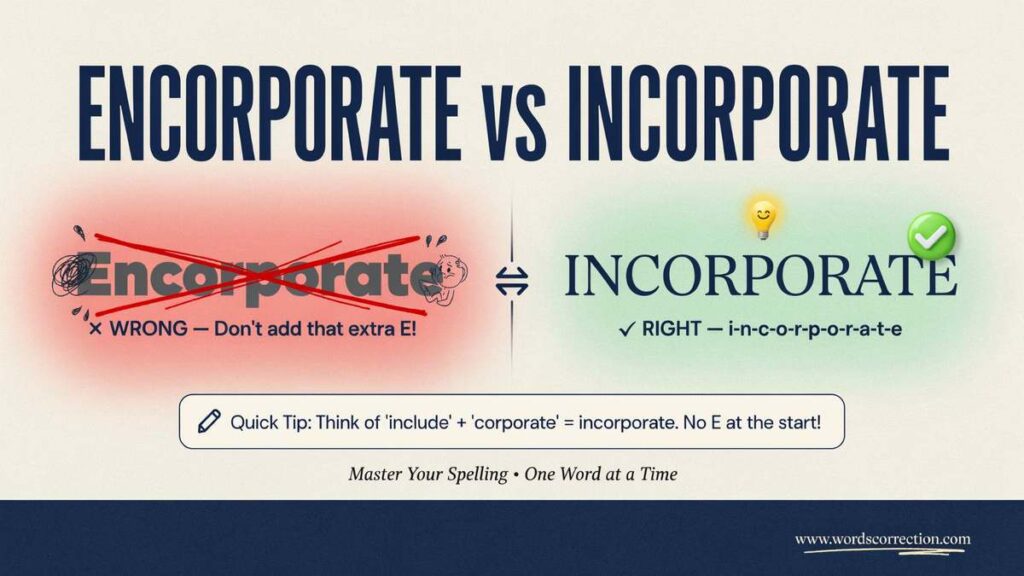
The correct spelling is incorporate, not encorporate. Standard English dictionaries recognize incorporate as a verb meaning to include something as part of a larger whole, combine separate elements, or legally form a corporation.
Although encorporate may look like a reasonable spelling, it isn’t a standard English word. You shouldn’t use it in formal writing, professional communication, academic assignments, or everyday messages.
Here’s the difference at a glance
| Feature | Incorporate | Encorporate |
|---|---|---|
| Spelling | Correct | Incorrect |
| Dictionary status | Standard English word | Nonstandard misspelling |
| Part of speech | Verb | Not a standard English verb |
| Meaning | Include, combine, or form a corporation | No established standard meaning |
| Professional usage | Accepted | Avoid |
| Example | We should incorporate your suggestions. | We should encorporate your suggestions. |
Correct: The company plans to incorporate new technology into its services.
Incorrect: The company plans to encorporate new technology into its services.
The first sentence uses the standard spelling. The second contains a spelling error.
If you remember only one thing from this comparison, remember this: incorporate begins with “in,” not “en.”
What Is the Difference Between Encorporate vs Incorporate?
The main difference between encorporate vs incorporate is spelling and standard usage. Incorporate is a recognized English verb with several related meanings. Encorporate is an incorrect spelling that has no established meaning in standard English.
The confusion often happens because English contains many words beginning with both “in” and “en.” For example, include, involve, and instruct begin with “in,” while enclose, enrich, and encourage begin with “en.”
Because both beginnings appear frequently in English vocabulary, writers sometimes choose the wrong one when spelling an unfamiliar word.
However, the two spellings aren’t interchangeable.
Consider these examples
- Correct: The teacher asked students to incorporate research into their essays.
- Incorrect: The teacher asked students to encorporate research into their essays.
- Correct: The restaurant incorporates fresh ingredients into its recipes.
- Incorrect: The restaurant encorporates fresh ingredients into its recipes.
The intended meaning remains understandable when someone writes encorporate, but that doesn’t make the spelling correct.
Encorporate vs Incorporate Meaning Comparison
The following table summarizes the essential distinction
| Question | Answer |
|---|---|
| Is incorporate a real word? | Yes. |
| Is encorporate a real English word? | No, not in standard English. |
| Can both spellings be used? | No. |
| Does incorporate have multiple meanings? | Yes. |
| Is encorporate a recognized alternative spelling? | No. |
Understanding this distinction helps you avoid a small but noticeable mistake in your writing.
Learn the difference between confusing more English words
Realize vs Realise What Is the Difference?
What Does Incorporate Mean?
The meaning of incorporate depends on the context. Generally, the word describes the act of bringing something into a larger whole so that it becomes part of it.
For example, a teacher might incorporate visual materials into a lesson. A designer might incorporate natural colors into a room. A company might incorporate customer feedback into its next product update.
In each situation, something new becomes part of an existing structure, system, or plan.
Incorporate Meaning: To Include Something
The first common meaning of incorporate is to include something as part of a larger group, activity, document, or system.
This usage appears frequently in education, business, writing, and everyday communication.
For example
- The writer incorporated several statistics into the report.
- The teacher incorporated group activities into the lesson.
- We should incorporate your suggestions into the final proposal.
- The manager incorporated customer feedback into the company’s strategy.
Notice that the added material becomes part of something that already exists.
For instance, when a writer incorporates research into an article, the research supports the article’s content rather than remaining a separate document.
Simple explanation: To incorporate something means to add it to something else so that it becomes part of the whole.
Incorporate Meaning: To Combine or Blend
Another important meaning is to combine separate elements into one organized or connected result.
This meaning appears in cooking, art, design, technology, and project management.
Consider a cooking example. A recipe might instruct you to incorporate melted butter into a mixture. This means combining the butter with the other ingredients until the mixture becomes consistent.
Other examples include
- The architect incorporated traditional features into the modern building.
- The designer incorporated several colors into the final artwork.
- The software combines several tools into one platform.
- The chef incorporated local spices into the recipe.
The word doesn’t always describe mixing physical ingredients. You can also incorporate ideas, methods, values, features, and information.
Incorporate Meaning in Business and Law
In business, incorporate has a more specific legal meaning.
To incorporate a business means to establish a corporation as a separate legal entity under applicable laws and registration requirements.
A corporation generally has a legal identity separate from its owners. Depending on the jurisdiction and business structure, incorporation can affect
- Legal responsibility and liability.
- Ownership and shareholding.
- Tax obligations.
- Business continuity.
- Recordkeeping and reporting requirements.
- The company’s ability to enter contracts and own property.
For example
“The founders decided to incorporate their technology startup before bringing in investors.”
This means they chose to establish the business as a corporation rather than continue operating under an unincorporated structure.
Business incorporation requirements differ by country and state. In the United States, businesses commonly incorporate by filing the required formation documents with the appropriate state authority.
It’s important to distinguish this legal meaning from the general meaning of including something. Incorporating a business isn’t simply adding an item to a list. It involves establishing a particular legal structure.
Incorporate Meaning To Embody a Quality
Incorporate can also describe making an idea, characteristic, or quality part of something’s identity.
For example
- Her leadership style incorporates honesty and accountability.
- The new school curriculum incorporates practical learning.
- The building incorporates environmentally friendly design principles.
- His presentation incorporated humor without losing its professional tone.
In these examples, the word describes how certain qualities or principles form part of a larger concept.
This usage is especially common in professional, academic, and descriptive writing.
Learn the difference between commonly mixed-up more words
Coaches or Coach’s Which Spelling Is Correct?
Is Encorporate a Real Word?
No. Encorporate vs Incorporate is a common spelling comparison, but encorporate isn’t a standard English word or an accepted spelling of incorporate.
When comparing Encorporate vs Incorporate, you’ll find that only incorporate is the correct spelling in standard English.
If you’re searching for an encorporate definition, you won’t find an established meaning comparable to the one for incorporate. In the Encorporate vs Incorporate comparison, encorporate generally appears as a spelling error rather than an independent vocabulary word.
The same applies to its meaning. Although readers may understand what someone intends when they use encorporate, the spelling itself is incorrect. Understanding Encorporate vs Incorporate helps you avoid this common spelling mistake and use the correct word confidently.
Why Is Encorporate Considered Incorrect?
English spelling doesn’t always follow predictable sound patterns. Some words sound similar but have different spellings and origins.
In this case, writers sometimes replace the first two letters of incorporate with “en.” However, standard English dictionaries and writing conventions recognize incorporate as the correct spelling.
Here are a few practical examples
| Incorrect spelling | Correct spelling |
|---|---|
| Encorporate | Incorporate |
| Encorporated | Incorporated |
| Encorporating | Incorporating |
| Encorporation | Incorporation |
These corrections apply when the writer intends to use the incorporate word family. They don’t mean that every English word beginning with “en” is incorrect. Words such as encourage, enrich, and enclose are perfectly valid.
Learn the difference between tricky grammar more words
Grimey or Grimy Which Spelling Is Correct?
Why Is Incorporate Spelled With “In” Instead of “En”?
The spelling becomes easier to remember when you understand the word’s history.
The English word incorporate comes from the Latin verb incorporare. Its formation involves the prefix in- and a word element related to corpus, meaning “body.”
The underlying idea involves bringing something into a body or forming it into a unified whole.
This Latin connection explains why the standard English spelling begins with “in.”
Understanding the Incorporate Word Origin
The word’s historical development can be summarized as follows
| Word element | Origin or meaning |
|---|---|
| In- | Latin prefix associated with putting or bringing into in this formation |
| Corpus | Latin word meaning body |
| Incorporare | Latin verb meaning to embody or form into a body |
| Incorporate | Modern English verb |
The word’s development reflects its modern meanings. When you incorporate something into a larger whole, you bring it into an existing structure.
For example, incorporating a new feature into an application means making that feature part of the application.
Similarly, incorporating a business means establishing it as a corporate legal entity.
The Connection Between Incorporate, Corporate, and Corporation
Several related English words share the same Latin root.
- Incorporate: To include, combine, or legally form a corporation.
- Corporate: Relating to a corporation or business organization.
- Corporation: A legal entity recognized under applicable law.
- Incorporation: The process or result of forming a corporation or combining elements into a whole.
This word family provides a useful spelling reminder. If you can spell corporation and corporate, you have a helpful clue for remembering incorporate.
Learn the difference between confusing word pairs
Visualization or Visualisation Which Spelling Is Correct?
How to Pronounce Incorporate Correctly
Correct spelling is important, but pronunciation can also help you recognize and remember a word. The standard American English pronunciation of incorporate has four syllables, with the primary stress on the second syllable.
American English IPA: /ɪnˈkɔːr.pə.reɪt/
The pronunciation may vary slightly across English accents. However, the spelling remains the same.
Syllable Breakdown
You can divide incorporate into four syllables:
In – cor – po – rate
The second syllable receives the primary stress.
A few pronunciation points can help
- Start with the short vowel sound in the first syllable.
- Give the second syllable the strongest emphasis.
- Pronounce the remaining syllables smoothly.
- Avoid adding an extra syllable or changing the word’s ending.
Common Pronunciation Mistakes
Some speakers pronounce unfamiliar words according to how they think the words should look. This can create confusion between spelling and sound.
Common mistakes include
- Placing stress on the wrong syllable.
- Pronouncing the first syllable as though the word begins with “en.”
- Skipping a syllable when speaking quickly.
- Confusing incorporate with corporate.
Remember that pronunciation doesn’t determine spelling by itself. English contains many words whose spellings aren’t immediately obvious from their sounds. When you’re unsure, check a reliable dictionary rather than guessing.
Learn the difference between often confused words
Follow Up vs Follow-Up Which Is Correct?
How to Use Incorporate Correctly in a Sentence
Knowing the definition is only half the job. You also need to understand how incorporate works in English grammar.
Incorporate is primarily a transitive verb. This means it normally takes a direct object: the thing being included, combined, or made part of something else.
For example
“The designer incorporated natural materials into the room.”
Here
- Subject: The designer
- Verb: Incorporated
- Direct object: Natural materials
- Prepositional phrase: Into the room
This structure makes the sentence clear and grammatically complete.
Incorporate Something Into Something
The construction incorporate something into something is one of the most common ways to use this verb.
Use it when you want to explain that an element becomes part of a larger system, document, plan, or object.
Examples
- The editor incorporated additional research into the article.
- We incorporated the latest changes into the proposal.
- The company incorporated customer feedback into its product design.
- The teacher incorporated creative activities into the classroom schedule.
This construction works especially well when you want to emphasize where the added element goes.
Writing tip: When describing the addition of a new element to an existing structure, “incorporate into” is usually a natural choice.
Incorporate Something In Something
The preposition “in” can also follow incorporate, although its suitability depends on the sentence.
For example
- The report incorporates several important details in its conclusion.
- The designer incorporated traditional patterns in the final collection.
Both constructions can work. However, into often communicates the process of adding something more clearly.
Compare
- She incorporated new examples into the lesson.
- The lesson incorporates new examples in its final section.
The first sentence emphasizes the act of adding examples. The second identifies where the examples appear.
Incorporate Something With Something
The preposition “with” can appear when describing how one element is combined with another.
Examples
- The chef incorporated fresh herbs with the other ingredients.
- The designer incorporated wood with metal to create a modern look.
- The researcher incorporated survey results with previously collected data.
However, don’t choose a preposition simply because it sounds familiar. Consider the relationship between the two elements.
In many situations, “combine X with Y” sounds more natural than “incorporate X with Y.” The best choice depends on what you’re trying to express.
Incorporate in Active and Passive Voice
You can use incorporate in both active and passive constructions.
Active voice places the person or thing performing the action at the center of the sentence.
Examples
- The manager incorporated employee suggestions into the policy.
- The writer incorporated expert opinions into the article.
- The designer incorporated sustainable materials into the project.
Passive voice places greater emphasis on the element receiving the action.
Examples
- Employee suggestions were incorporated into the policy.
- Expert opinions were incorporated into the article.
- Sustainable materials were incorporated into the project.
Both forms are grammatically correct.
However, active voice often sounds more direct and engaging. Passive voice can be useful in academic reports, technical descriptions, and situations where the action matters more than the person performing it.
Incorporate as a Transitive Verb
A transitive verb takes a direct object. Incorporate generally follows this pattern.
Consider
“The company incorporated new security features.”
The direct object is “new security features.” It tells readers what the company added.
Here are additional examples
| Sentence | Direct object |
|---|---|
| She incorporated feedback into her presentation. | Feedback |
| The chef incorporated garlic into the sauce. | Garlic |
| They incorporated new rules into the policy. | New rules |
| The designer incorporated natural light into the building. | Natural light |
The verb can also appear without an explicitly stated object in certain established business or legal contexts.
For example
“The founders decided to incorporate.”
Here, the context makes it clear that the founders intend to establish a corporation.
This doesn’t mean incorporate never takes an object. Its usual grammatical pattern remains transitive.
Learn the difference between basic English word mistakes
Omelet or Omelette Which Spelling Is Correct?
Correct Examples of Incorporate in Everyday English
The easiest way to understand a word is to see how people use it in different situations. The following incorporate example sentences demonstrate its meaning across several settings.
Incorporate in Everyday Conversations
In everyday English, incorporate can describe adding something to a routine, activity, or personal plan.
Examples
- I want to incorporate more reading into my daily routine.
- We should incorporate your idea into our weekend plans.
- She incorporated exercise into her morning schedule.
- He incorporated a few new habits into his lifestyle.
Although incorporate sounds slightly more formal than add, it’s perfectly natural in everyday conversations.
Incorporate in Emails and Professional Communication
Professional emails often involve suggestions, feedback, revisions, and changes. This makes incorporate a useful vocabulary choice.
Examples
- I’ll incorporate your feedback into the revised document.
- We have incorporated the requested changes into the proposal.
- Please incorporate the latest figures before submitting the report.
- The team will incorporate your recommendations into the next update.
These sentences sound professional without becoming unnecessarily complicated.
Incorporate in Academic Writing and School Assignments
Students and researchers often use incorporate when discussing evidence, references, research findings, and different viewpoints.
Examples
- Students should incorporate credible sources into their research papers.
- The researcher incorporated recent findings into the discussion.
- The essay incorporates historical evidence to support its argument.
- Teachers can incorporate practical activities into theoretical lessons.
In academic writing, the word often communicates that information has become part of a larger argument or explanation.
Incorporate in Business and Legal Documents
Business writing uses incorporate in two main ways: including something in an existing business process and legally forming a corporation.
Examples
- The company incorporated customer feedback into its marketing strategy.
- The founders decided to incorporate their startup.
- The organization incorporated new compliance requirements into its policies.
- The business was incorporated under the laws of its state.
In the last example, incorporated refers to the company’s legal status rather than the addition of information.
Incorporate in Cooking, Art, and Design
The word also works naturally when discussing physical ingredients, colors, textures, and creative elements.
Examples
- Incorporate the melted chocolate into the mixture.
- The artist incorporated recycled materials into the sculpture.
- The designer incorporated neutral colors into the living room.
- The chef incorporated fresh herbs into the sauce.
These examples show that incorporate isn’t limited to professional or academic writing.
Learn the difference between commonly misused words
Dieing or Dying Which Spelling Is Correct?
Encorporate vs Incorporate Incorrect and Correct Examples
Looking at incorrect and correct sentences side by side makes the spelling difference easier to recognize.
The following examples demonstrate how to correct the mistake without changing the intended meaning.
| Incorrect sentence | Correct sentence |
|---|---|
| We should encorporate these ideas into the plan. | We should incorporate these ideas into the plan. |
| The teacher encorporated group activities into the lesson. | The teacher incorporated group activities into the lesson. |
| Please encorporate the latest information. | Please incorporate the latest information. |
| The company wants to encorporate a new department. | The company wants to incorporate a new department. |
| She is encorporating customer feedback into her work. | She is incorporating customer feedback into her work. |
| The business was encorporated last year. | The business was incorporated last year. |
Notice that correcting the spelling doesn’t require changing the sentence structure. You simply replace the incorrect form with the correct one.
Case Study Correcting a Workplace Email
Imagine a marketing employee preparing an email for a project manager.
The original message reads
“Please encorporate the client’s suggestions into the final marketing proposal before Friday.”
The intended meaning is clear, but the spelling mistake makes the message look less polished.
A corrected version reads
“Please incorporate the client’s suggestions into the final marketing proposal before Friday.”
The correction improves the message without changing its tone or meaning.
The lesson: Even a small spelling mistake can distract readers from an otherwise professional message. A quick proofreading check can prevent that problem.
Learn the difference between everyday English mistakes
Photostat or Photostate Which one Is Correct?
Why Do People Misspell Incorporate as Encorporate?

English spelling can be tricky because the language combines words from several sources, including Latin, French, Greek, and Germanic languages.
Some words follow familiar spelling patterns. Others don’t. As a result, people sometimes write a word according to how they think it should look rather than how dictionaries spell it.
The encorporate spelling mistake usually comes from confusion between the prefixes “in-” and “en-.”
Confusion Between the Prefixes “In-” and “En-“
Both beginnings appear in many English words, but they aren’t interchangeable spelling choices.
Examples of words beginning with in
- Include
- Involve
- Inform
- Introduce
- Incorporate
Examples of words beginning with en
- Encourage
- Enclose
- Enrich
- Enable
- Enlarge
A writer familiar with several “en-” words might mistakenly apply that spelling pattern to incorporate.
However, spelling patterns don’t always transfer from one word to another. The correct spelling depends on the individual word’s history and established usage.
Pronunciation and Sound-Based Spelling
People often write words according to the sounds they hear.
This approach works for some simple English words but becomes unreliable when a word has an unfamiliar spelling or pronunciation.
Because the beginning of incorporate may sound less distinct in rapid speech, some writers mistakenly choose “en” instead of “in.”
The solution is simple: learn the standard spelling rather than relying entirely on sound.
Influence of Other Words Beginning With “En-“
English contains many familiar words with the prefix “en-.” This familiarity can influence how people spell less familiar vocabulary.
For example, someone who regularly uses encourage, enclose, and enrich might assume that encorporate follows a similar pattern.
However, each word has its own established spelling. Familiarity with one pattern doesn’t guarantee that it applies to another word.
Typing Errors and Autocorrect
Typing quickly can sometimes lead to spelling mistakes, especially when dealing with similar-looking words such as Encorporate vs Incorporate.
Autocorrect and spellcheck tools can identify many errors, but they aren’t always reliable. When checking Encorporate vs Incorporate, some tools may fail to flag unusual misspellings, particularly if the software doesn’t recognize the intended correction or the word appears in a specialized context.
To avoid confusion and improve spelling accuracy, follow these tips
- Use a reliable dictionary when you’re unsure about a word.
- Review unfamiliar words before submitting important documents.
- Add frequently used technical vocabulary to your personal dictionary when appropriate.
- Don’t assume that an unmarked word is automatically correct.
- Remember that Encorporate vs Incorporate has only one correct standard spelling: incorporate.
Understanding Encorporate vs Incorporate can help you recognize common typing errors and maintain clear, professional writing.
Learn the difference between more words people mix up
Pricy or Pricey Which Spelling Is Correct?
Incorporate vs Include, Integrate, Combine, and Blend
Several English words have meanings similar to incorporate. However, they don’t always communicate exactly the same idea.
Choosing the right synonym depends on the relationship between the elements you’re describing.
Incorporate vs Include
Both words can describe adding something to a larger group or collection.
However, include generally emphasizes that something is part of a group, while incorporate often suggests that the added element becomes part of a larger structure or system.
Compare
- Include: The report includes three research studies.
- Incorporate: The writer incorporated findings from three research studies into the report.
The first sentence identifies what the report contains. The second emphasizes how the writer brought the findings into the report.
This is the main difference between incorporate and include.
Incorporate vs Integrate
Integrate means combining separate parts so they work together as a unified system.
Although incorporate and integrate overlap, they emphasize slightly different ideas.
- Incorporate: Add something to an existing whole.
- Integrate: Connect different elements so they function together.
For example
- The school incorporated new technology into its classrooms.
- The school integrated new technology into its teaching system.
The first sentence emphasizes adding technology. The second suggests that technology became connected to the wider teaching process.
This explains the difference between incorporate and integrate in many practical situations.
Incorporate vs Combine
Combine means bringing two or more things together.
It doesn’t necessarily suggest that the elements become part of an existing structure.
For example
- Combine the flour and sugar in a bowl.
- Incorporate the flour into the mixture.
The first instruction describes bringing two ingredients together. The second describes adding an ingredient to an existing mixture.
Incorporate vs Blend
Blend usually means mixing elements until they become smooth, consistent, or visually harmonious.
It’s especially common in cooking, design, music, and other creative activities.
For example
- Blend the fruit until smooth.
- Incorporate the fruit into the yogurt.
The two verbs describe related actions, but their emphasis differs.
Comparison of Similar Words
| Word | Main meaning | Example |
|---|---|---|
| Incorporate | Add something to a larger whole | Incorporate feedback into the report. |
| Include | Make something part of a group | Include the latest figures. |
| Integrate | Connect elements into a working system | Integrate new software into the system. |
| Combine | Bring separate things together | Combine the ingredients. |
| Blend | Mix elements smoothly | Blend the colors together. |
| Merge | Join separate entities into one | Merge the two departments. |
| Absorb | Take something in | The company absorbed a smaller competitor. |
| Unite | Bring people or things together | Unite the two teams. |
Writing tip: Don’t choose a synonym simply because it sounds more sophisticated. Use the word that communicates your intended meaning most clearly.
Learn the difference between tricky English words with easy explanations
Encode vs Incode Which Is Correct?
Common Grammar Mistakes When Using Incorporate
Even when you know the correct spelling, you can still make grammatical mistakes. Understanding a few common problems will help you improve your sentences.
Using the Wrong Preposition
One frequent mistake involves choosing an unsuitable preposition.
For example
- Less natural: She incorporated the suggestions at the proposal.
- Better: She incorporated the suggestions into the proposal.
The preposition into works naturally because the suggestions become part of the proposal.
However, in can also work in sentences that describe where information appears.
For example
“The report incorporates several recommendations in its final section.”
The important point is to consider the meaning and structure of the sentence.
Confusing Incorporate With Incorporated
Incorporated is the past-tense and past-participle form of incorporate. It can also function as an adjective in business contexts.
Examples
- Present: The designer incorporates natural materials into her work.
- Past: The designer incorporated natural materials into her work.
- Present participle: The designer is incorporating natural materials into her work.
- Passive: Natural materials were incorporated into the design.
In business writing, you might see
“ABC Technologies is an incorporated company.”
Here, incorporated describes the company’s legal status.
Confusing Incorporating With Incorporation
These words belong to the same word family but serve different grammatical purposes.
- Incorporate: A verb.
- Incorporated: Past-tense or past-participle form.
- Incorporating: Present participle or gerund.
- Incorporation: Noun describing the act or process of incorporating.
Examples
- We plan to incorporate new features.
- The company incorporated the changes.
- She is incorporating additional information.
- The incorporation of new features improved the product.
Understanding these forms makes it easier to use the word correctly in different sentence structures.
Using Unnecessarily Complicated Sentences
Incorporate is useful in professional writing, but that doesn’t mean you should use it everywhere.
For example
“Please incorporate the information into the document.”
This sentence is perfectly natural.
However, if you’re simply telling someone to add a name to a list, saying “Please add the name to the list” is clearer.
Good writing isn’t about choosing the longest word. It’s about choosing the most accurate one.
Learn the difference between confusing more English words step by step
Conex or Connex What Is the Difference?
Easy Ways to Remember the Correct Spelling of Incorporate
If you regularly confuse encorporate with incorporate, a simple memory technique can help.
Connect Incorporate With Corporation
The easiest trick is to remember the relationship between these words:
- Incorporate
- Corporation
- Corporate
- Incorporation
They share the same historical root associated with the idea of a body or unified entity.
When you remember how to spell corporation, you have a useful clue for spelling incorporate.
Remember the First Two Letters
The word always begins with IN.
Think of this simple reminder:
IN + CORPORATE = INCORPORATE
This isn’t a complete linguistic breakdown of the word, but it’s an effective way to remember its spelling.
Practice With a Sentence
Repetition can make unfamiliar spellings easier to remember.
Try writing these sentences
- I want to incorporate more exercise into my routine.
- The company plans to incorporate new technology.
- Please incorporate my suggestions into the report.
- The founders decided to incorporate their business.
Each example reinforces the correct spelling in a different context.
Check the Word Family
When you aren’t sure how to spell a word, looking at its related forms can help.
For example
| Word | Correct spelling |
|---|---|
| Incorporate | I-N-C-O-R-P-O-R-A-T-E |
| Incorporated | I-N-C-O-R-P-O-R-A-T-E-D |
| Incorporating | I-N-C-O-R-P-O-R-A-T-I-N-G |
| Incorporation | I-N-C-O-R-P-O-R-A-T-I-O-N |
| Corporate | C-O-R-P-O-R-A-T-E |
| Corporation | C-O-R-P-O-R-A-T-I-O-N |
Notice that the word family consistently uses the “corpor” spelling.
Practice Session Encorporate vs Incorporate
Instructions: Fill in each blank with the correct word from the given options. Choose the answer that best completes each sentence.
1. The correct spelling is __________, not encorporate.
2. Incorporate means to __________ something into a larger whole.
3. The company decided to __________ customer feedback into its strategy.
4. Encorporate is considered an incorrect __________.
5. The word incorporate is commonly used as a __________.
6. Another word for incorporate is __________.
7. The opposite of incorporate is __________.
8. Businesses may __________ to become separate legal entities.
9. Incorporation can provide __________ liability protection.
10. Integrated and incorporated have __________ meanings.
11. Adding new ideas to a project is an example of __________.
12. The noun form of incorporate is __________.
13. A company becomes a separate legal entity through __________.
14. The word incorporated describes something that has been __________.
15. A synonym for incorporating is __________.
16. Companies must follow legal and __________ requirements after incorporation.
17. The word incorporate can mean to __________ different ideas.
18. The correct word begins with the letter __________.
19. Incorporation can help establish a formal business __________.
20. The opposite of integration is __________.
21. A company may incorporate new __________ into its operations.
22. The word incorporate is used in academic and __________ writing.
23. Including customer suggestions in a plan means __________ them.
24. One disadvantage of incorporation is additional administrative __________.
25. Incorporate is the __________ spelling in standard English.
Answers
- Incorporate
- Include
- Incorporate
- Spelling
- Verb
- Combine
- Exclude
- Incorporate
- Limited
- Similar
- Incorporation
- Incorporation
- Incorporation
- Included
- Integrating
- Regulatory
- Combine
- I
- Structure
- Separation
- Technology
- Professional
- Incorporating
- Costs
- Correct
Here’s a trusted source for clear word meanings:
Cambridge Dictionary
FAQs
Is it encorporated or incorporated?
Incorporated is the correct spelling in standard English. Encorporated is a common spelling mistake and is not recognized as a standard English word. Always use incorporated in professional, academic, and business writing.
How do you spell encorporate correctly?
The correct spelling is incorporate, beginning with the letter “I.” Encorporate is an incorrect spelling and should be avoided in formal communication.
What is a better word for incorporate?
Depending on the context, suitable alternatives to incorporate include include, combine, integrate, merge, unite, and assimilate. Each word describes bringing something together or making it part of a larger whole.
Are integrated and incorporated the same thing?
Integrated and incorporated have related meanings, but they are not always interchangeable. Integrated refers to combining elements so they function together, while incorporated means including something as part of a larger whole.
What is the opposite of incorporate?
Common antonyms of incorporate include exclude, separate, remove, detach, and isolate. The most appropriate opposite depends on the context in which the word is used.
What does incorporate mean?
Incorporate means to include, combine, or add something to a larger whole. In business terminology, it also refers to the legal process of establishing a company as a corporation.
What words can I use instead of incorporating?
Common alternatives to incorporating include adding, including, combining, integrating, merging, and introducing. The best replacement depends on the sentence and intended meaning.
How do you use the word incorporate?
The word incorporate is used when describing the process of adding something to an existing plan, system, group, or structure. For example: “The company decided to incorporate customer feedback into its new marketing strategy.”
What is another word for incorporation?
Depending on the context, synonyms for incorporation include integration, inclusion, combination, consolidation, and unification. In business terminology, incorporation specifically refers to legally establishing a corporation.
What can I use instead of incorporated?
Suitable alternatives to incorporated include included, combined, integrated, merged, united, and established. For a legally registered business, the expression “formed as a corporation” may be more appropriate.
What is the opposite of incorporation?
The opposite of incorporation can include separation, exclusion, division, and disintegration. In a business context, dissolution refers to the legal process of ending a corporation’s existence.
What is the exact meaning of incorporation?
Incorporation generally means combining or including something as part of a larger whole. In business law, it refers to the formal legal process of establishing a corporation as a separate entity.
What does incorporated mean in simple terms?
Incorporated means that something has been included or combined with something larger. When describing a business, it means the company has been legally established as a corporation.
What is an example of incorporation?
An example of incorporation is adding customer suggestions to an existing product development plan. In business, registering a company as a corporation is another example of incorporation.
What does it mean for a term to be incorporated?
When a term is incorporated into a document, agreement, or policy, it means that the term has been formally included as part of that material. Its legal significance depends on the wording and applicable regulations.
What is the advantage of being incorporated?
One of the main advantages of incorporation is limited liability, which generally separates shareholders’ personal assets from the company’s financial obligations. Other benefits may include business continuity, improved credibility, and easier ownership transfers.
What does it mean to have something incorporated?
Having something incorporated means including it as part of an existing structure, system, document, or organization. For example, a business may incorporate new technology into its daily operations to improve efficiency.
What is the legal definition of incorporation?
Incorporation is the legal process of registering a business as a corporation under applicable laws. This process generally establishes the company as a separate legal entity with its own rights, responsibilities, and obligations.
What is another word for incorporate?
Common synonyms for incorporate include include, integrate, combine, merge, unite, and assimilate. The most suitable alternative depends on the intended meaning and grammatical structure of the sentence.
What are the disadvantages of incorporation?
Some disadvantages of incorporation include higher formation costs, additional administrative responsibilities, ongoing regulatory compliance, and more complex reporting requirements. These challenges vary depending on the business structure and applicable laws.
What does incorporate mean in business?
In business, incorporate means legally establishing a company as a corporation. This process generally creates a separate legal identity for the business, distinguishing it from its owners and shareholders.
When should you use incorporate or encorporate?
You should always use incorporate because it is the correct spelling in standard English. Encorporate is a common misspelling and should not appear in professional documents, academic assignments, or business communication.
What is another word for incorporating?
Common alternatives to incorporating include adding, including, integrating, combining, merging, and introducing. For example, “incorporating new features” can be rewritten as “adding new features” without changing the intended meaning significantly.
What is the purpose of incorporating a business?
The primary purpose of incorporating a business is to establish it as a separate legal entity. This structure can provide limited liability protection, support business continuity, and create a formal framework for ownership and management.
What are the three disadvantages of incorporating?
Three common disadvantages of incorporating a business include:
Regulatory Requirements: Incorporated businesses must comply with applicable corporate laws, tax regulations, and reporting obligations.
Higher Costs: Registration fees, legal expenses, and ongoing administrative costs can increase the financial burden.
Additional Paperwork: Corporations must maintain proper records, prepare reports, and complete required documentation.
Conclusion
Understanding the difference between Encorporate vs Incorporate helps you avoid a common spelling mistake and maintain accuracy in your writing. The correct spelling is incorporate, which means to include something as part of a whole, combine different elements, or legally establish a company as a corporation.
In contrast, encorporate is not recognized as a standard English word and is generally considered a misspelling of incorporate. When comparing Encorporate vs Incorporate, remember that only incorporate is appropriate for professional, academic, and everyday writing.
Although the two words look similar, their spelling and usage are not interchangeable. Understanding Encorporate vs Incorporate will help you choose the correct form and communicate more clearly. Keep this simple distinction in mind to avoid spelling errors and make your writing more polished and professional.

Stella AJS is an experienced blogger and dedicated English language writer at Words Correction. She turns confusing grammar, word meanings, spelling, and usage into clear, practical insights that readers can easily understand and apply. With a passion for precise and engaging writing, Stella helps readers avoid common language mistakes, strengthen their vocabulary, and communicate with greater clarity and confidence.




