

English often turns simple word choices into surprisingly tricky decisions. If you’ve ever hesitated over fair or fare, you’re not alone. These words sound identical, but their meanings are distinctly different. Fair can describe something just, reasonable, or even a public event, while fare can mean a transportation cost, food, or the way someone performs or progresses. Using the wrong word can change your meaning and make an otherwise polished sentence look careless. In this guide to fair or fare, you’ll discover their meanings, differences, correct usage, common mistakes, and practical examples, helping you choose the right word with confidence every time.
Fair or Fare Quick Answer
If you’re wondering fair or fare which is correct, both words are correct. The right choice depends on what you want to say.
| Word | Main Meaning | Example |
| Fair | Just, reasonable, or equal | The teacher gave everyone a fair chance. |
| Fair | A public event | We went to the school fair. |
| Fair | Light in color | She has fair hair. |
| Fair | Pleasant or clear weather | We had fair weather all weekend. |
| Fare | Transportation cost | The bus fare is $2. |
| Fare | Food or cuisine | The restaurant serves traditional fare. |
| Fare | Perform or progress | How did you fare on the exam? |
Fair vs Fare at a Glance
A quick rule can help you make the right choice:
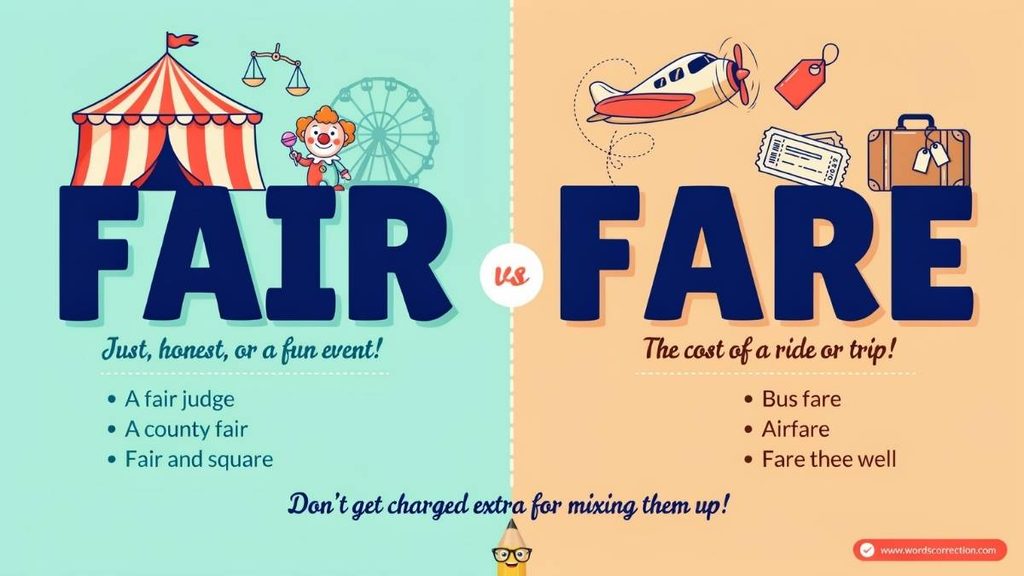
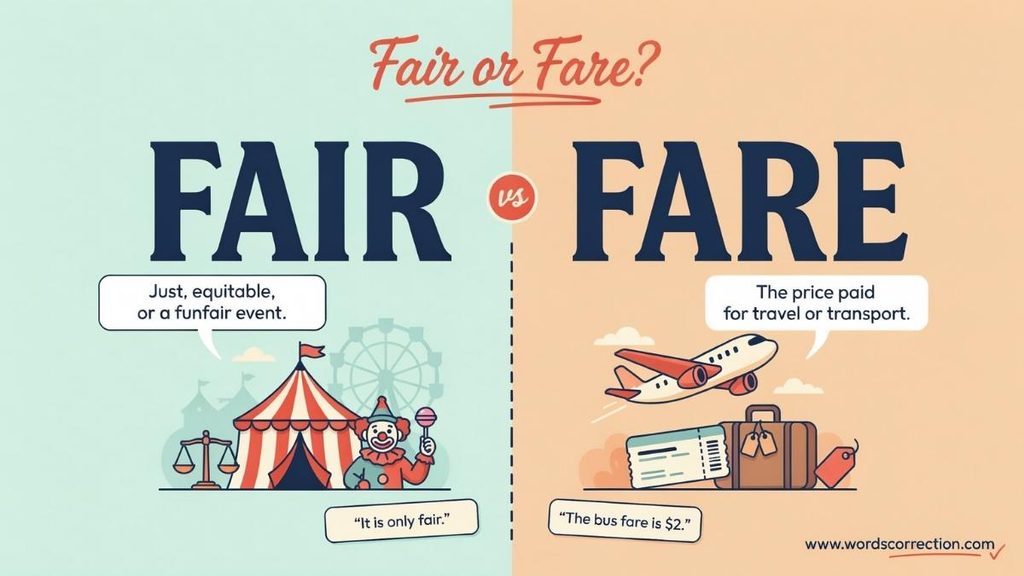
- Fair = just, reasonable, light, pleasant, or an event
- Fare = travel cost, food, or performance
For example:
- That’s not fair. Correct
- That’s not fare. Incorrect
- The train fare increased. Correct
- The train fair increased. Incorrect
- We attended a county fair. Correct
- We attended a county fare. Incorrect
- How did you fare in the competition? Correct
- How did you fair in the competition? Incorrect
The two words are fair or fare homophones, which means they sound alike but have different spellings and meanings.
Fair or Fare Meaning and Definition
Understanding the difference between fair and fare starts with their meanings.
What Does “Fair” Mean?
The word fair has several established meanings.
As an adjective, it can describe something just, reasonable, impartial, acceptable, light-colored, or moderately good. It can also describe pleasant weather.
For example:
- The judge made a fair decision.
- We negotiated a fair price.
- She has fair hair.
- The forecast says the weather will be fair.
- His performance was fair, but it wasn’t excellent.
As a noun, fair can describe a public event where people buy, sell, display, or enjoy things.
Examples include:
- school fair
- county fair
- state fair
- trade fair
- book fair
- craft fair
- job fair
The meaning depends heavily on context.
What Does “Fare” Mean?
Fare has three important everyday uses.
First, it means the money paid for transportation:
- bus fare
- train fare
- taxi fare
- airfare
- travel fare
Second, fare can mean food or cuisine, especially the particular type of food served.
For example:
The restaurant serves traditional Mexican fare.
Third, fare works as a verb meaning to perform, progress, manage, or get along in a particular situation.
For example:
How did you fare on your final exam?
In this sentence, fare means “How well did you do?”
Fair and Fare Are Homophones
One reason fair and fare cause so many spelling mistakes is that they are homophones.
Homophones are words that sound the same but have different spellings and meanings.
Other familiar English homophones include:
- to / too / two
- there / their / they’re
- hear / here
- right / write
- sea / see
Fair and fare belong to the same group of commonly confused English words.
In standard American English, both words are generally pronounced the same way. This means pronunciation doesn’t usually help you decide which spelling to use.
The solution is simple: focus on meaning rather than sound.
you mean justice, use fair.
If you mean transportation cost, use fare.
you mean performance, use fare.
If you mean a public event, use fair.
Learn the difference between confusing more English words
Tier or Teir Which One Is Right?
Fair Meaning, Uses, and Examples
The fair definition becomes easier to understand when you examine its different uses.
Fair as an Adjective
The most common use of fair describes something that is just, reasonable, or impartial.
Consider these examples:
- The referee made a fair decision.
- Everyone deserves a fair opportunity.
- The company offers a fair wage.
- We agreed on a fair price.
- The competition was fair.
Here, fair expresses the idea of reasonable treatment without an unfair advantage or unnecessary bias.
Fair Meaning “Reasonable”
Sometimes fair doesn’t mean perfectly equal. Instead, it means reasonable or acceptable under the circumstances.
For example:
The seller offered a fair price for the used laptop.
The buyer and seller might disagree about the exact value. Still, the price can be considered fair if it seems reasonable for what the product offers.
This meaning appears in common expressions such as:
- fair price
- fair deal
- fair offer
- fair wage
- fair share
- fair chance
A fair price doesn’t necessarily mean the cheapest price. It means the price seems reasonable for the product or service.
Fair Meaning “Equal”
Fair can also describe an appropriate or equal share.
Everyone should receive a fair share of the work.
Here, fair doesn’t necessarily mean that everyone performs exactly the same number of tasks. Instead, each person receives a reasonable portion of the responsibility.
This distinction matters because fair and equal aren’t always identical.
Equal treatment means everyone receives the same thing. Fair treatment means everyone receives appropriate treatment according to the circumstances.
Fair Meaning “Light”
Another established fair meaning relates to color.
You can describe someone’s hair, skin, or complexion as fair when it is pale or light in color.
Examples include:
- She has fair hair.
- He has a fair complexion.
- The child has fair skin.
This meaning has nothing to do with justice or equality.
Context tells you which meaning of fair applies.
Fair Weather
In weather-related language, fair traditionally describes pleasant, clear, or generally favorable conditions.
For example:
The forecast calls for fair weather tomorrow.
Here, fair means pleasant or favorable.
It doesn’t mean that the weather is somehow behaving according to a moral code. English simply uses the word to describe favorable conditions.
Fair Meaning “Average” or “Moderately Good”
Fair can also describe something that is neither very good nor very bad.
For example:
Her knowledge of French is fair.
This suggests that her French is adequate but not excellent.
You might also hear:
The patient’s condition is fair.
In this context, fair describes a condition that is moderate rather than excellent or critical.
Learn the difference between commonly mixed-up more words
Personel or Personnel Which is Correct?
Fair as a Noun The Meaning of a Public Event
A fair is a public event where people may buy and sell goods, display products, enjoy entertainment, participate in activities, or raise money.
When you’re asking fair or fare for an event, the answer is usually fair.
Common examples include:
- school fair
- county fair
- state fair
- craft fair
- book fair
- job fair
- trade fair
- street fair
The exact nature of a fair can vary. Some focus on entertainment and rides. Others focus on education, business, agriculture, food, crafts, or community activities.
School Fair or Fare?
The correct phrase is school fair when you mean a school event.
The students are organizing a school fair.
A school fair might include food stalls, games, performances, raffles, crafts, or educational activities.
School fare would normally refer to food rather than the event itself.
So:
- We attended the school fair. Correct
- We attended the school fare. Incorrect
County Fair and State Fair
In American English, county fair and state fair are established terms for large public events.
These events may feature:
- agricultural displays
- livestock competitions
- food vendors
- amusement rides
- games
- live entertainment
- craft exhibitions
- competitions
- commercial booths
For example:
The county fair attracts thousands of visitors every summer.
Here, fair clearly refers to an event.
Trade Fair
A trade fair is an event where businesses or industry professionals showcase products, services, and innovations.
Examples include:
- technology trade fair
- automotive trade fair
- book fair
- career fair
- job fair
- business trade fair
Again, the correct spelling is fair.
Fair or Fare for an Event?
If the word refers to an event, gathering, exhibition, or public celebration, use fair.
This answers the common question: is it fair or fare for an event?
Use:
The community is hosting a spring fair.
Not:
The community is hosting a spring fare.
The same rule applies when you’re asking about a carnival.
Fair or Fare for a Carnival?
Use fair when you’re describing a public entertainment event.
The children enjoyed the county fair.
A carnival and a fair can overlap in meaning. Both may include rides, games, food, music, and entertainment.
However, fare isn’t the correct spelling simply because an event involves food, tickets, or money.
Food Fair vs Food Fare
This is where the two words can both appear correctly in related contexts.
A food fair is an event centered around food.
The city hosted a food fair.
Food fare refers to food or cuisine.
The restaurant offers traditional food fare.
The first example describes an event. The second describes the food itself.
That small distinction explains why context matters so much with fair or fare.
Learn the difference between tricky grammar more words
Pair or Pare what’s the difference?
Fare Meaning, Uses, and Examples

The fare definition becomes much clearer when you connect the word with travel, food, and performance.
Fare as a Transportation Cost
The most familiar noun use of fare means the amount you pay to travel.
Examples include:
- bus fare
- train fare
- taxi fare
- cab fare
- airfare
- subway fare
- transit fare
Consider this sentence:
The bus fare has increased by 50 cents.
Here, fare means the transportation cost.
That’s why bus fare is correct and bus fair is incorrect when you’re talking about the price of a bus journey.
Bus Fare
I need enough money to pay the bus fare.
The fare is the payment required to take the journey.
Train Fare
The train fare is cheaper if you book in advance.
Again, fare refers to the cost of transportation.
Taxi Fare
The taxi fare was higher than expected.
The word describes the amount charged for the taxi journey.
Airfare
Airfare is the standard compound word used for the cost of air travel.
For example:
Airfare tends to rise during peak travel periods.
Remember that airfare is normally written as one word.
Fare as Food or Cuisine
Here’s a meaning of fare that often surprises English learners.
Fare can refer to food, meals, or a particular type of cuisine.
For example:
The restaurant serves traditional Mediterranean fare.
Here, fare means food or cuisine.
Common expressions include:
- local fare
- traditional fare
- regional fare
- vegetarian fare
- simple fare
- seasonal fare
Consider the difference between these sentences:
The fair featured local food vendors.
Here, fair means the event.
The restaurant served traditional local fare.
Here, fare means the food.
One letter changes the meaning completely.
Learn the difference between confusing word pairs
Maximise or Maximize which one is correct?
Fare as a Verb Perform, Progress, or Manage
The verb fare means to do, perform, progress, or manage in a particular situation.
This use often appears in formal or semi-formal English.
For example:
How did you fare on the test?
This means:
How well did you do on the test?
You can also say:
- She fared well in the interview.
- The team fared badly in the tournament.
- Small businesses fared better than expected.
- How will the new product fare in the market?
- The economy may fare better next year.
The verb often focuses on an outcome.
If something fares well, it performs successfully.
If something fares poorly, it struggles.
“How Did You Fare?”
This is one of the most useful expressions to remember.
How did you fare in the exam?
It means:
How did you do in the exam?
Therefore:
- How did you fare? Correct
- How did you fair? Incorrect
This is a common example of fair vs fare because pronunciation doesn’t reveal the spelling.
Fare Well vs Fair Well
The standard expression is:
Fare well.
For example:
I hope you fare well in your new position.
The expression uses the verb fare, meaning to do or progress.
A related word is:
Farewell
When used as a noun or interjection meaning goodbye, farewell is normally written as one word.
For example:
The team held a farewell dinner for the retiring manager.
The travel-related history of fare helps explain the connection. The word developed from an Old English term associated with traveling and making a journey.
Learn the difference between often confused words
Invision or Envision Which Is Correct?
The Origin of Fair and Fare
Although fair and fare sound alike today, they developed through different historical paths.
Origin of “Fair”
The adjective fair traces back to Old English and originally carried meanings associated with beauty, attractiveness, brightness, and pleasantness.
Over time, the word developed additional meanings. Its association with something good or proper contributed to later meanings connected with justice, impartiality, and reasonable treatment.
The noun fair, meaning a market or public gathering, developed through a separate historical path involving French and Latin.
That history helps explain why modern fair has several meanings that may seem unrelated at first:
- beautiful
- light-colored
- pleasant
- reasonable
- impartial
- acceptable
- public market or event
English vocabulary often develops this way. A single word can collect several meanings over hundreds of years.
Origin of “Fare”
Fare comes from an Old English word associated with traveling, going, journeys, and passages.
Its verbal history is particularly useful because the modern verb fare still describes how someone or something progresses.
The transportation sense eventually developed into the modern meaning of money paid for a journey.
The word also developed a noun sense referring to food and cuisine.
This gives you a useful memory connection:
Fare → journey → transportation cost
That isn’t the only meaning of fare, but it provides a practical way to remember one of its most common uses.
Learn the difference between basic English word mistakes
Families or Familys which one is correct?
Fair vs Fare Comparison Table
| Feature | Fair | Fare |
| Pronunciation | Usually the same as fare | Usually the same as fair |
| Main grammatical roles | Adjective, noun | Noun, verb |
| Justice | Yes | No |
| Equality | Yes | No |
| Reasonableness | Yes | No |
| Light color | Yes | No |
| Weather | Yes | No |
| Public event | Yes | No |
| Transportation cost | No | Yes |
| Food or cuisine | No | Yes |
| Performance or progress | No | Yes |
| Example | That isn’t fair. | The bus fare is high. |
The biggest fair and fare difference in English is therefore meaning, not sound.
Fair or Fare Common Mistakes

Knowing the definitions is only half the battle. You also need to recognize the mistakes that appear most often.
“The Bus Fair Is Too Expensive.”
Incorrect:
The bus fair is too expensive.
Correct:
The bus fare is too expensive.
Why?
Because fare means the price paid for transportation.
“That’s Not Fare!”
Incorrect:
That’s not fare!
Correct:
That’s not fair!
The speaker means that something is unjust, unreasonable, or unacceptable.
“We Enjoyed the Food Fair at the Festival.”
This sentence depends on what the writer means.
If the writer means an event featuring food:
We enjoyed the food fair at the festival.
That can be correct because fair can describe an event.
If the writer means the food itself:
We enjoyed the traditional food fare.
Here, fare means food or cuisine.
“How Did You Fair in the Test?”
Incorrect:
How did you fair in the test?
Correct:
How did you fare on the test?
The verb fare means to perform, progress, or do.
“The School Fare Starts at 10 a.m.”
If you mean the school event, write:
The school fair starts at 10 a.m.
If you’re describing food served at a school, fare could describe the food. However, it isn’t the normal word for the event.
Learn the difference between commonly misused words
Allie or Ally Difference And Usage
Fair or Fare in a Sentence
Seeing the words in context is one of the best ways to understand their differences.
Examples of “Fair”
- The referee made a fair decision.
- Everyone deserves a fair chance.
- That’s not fair.
- We agreed on a fair price.
- She has fair hair.
- The forecast predicts fair weather.
- We visited the county fair.
- The school fair raised money for new equipment.
- The competition was fair.
- He received his fair share of the profits.
Examples of “Fare”
- The bus fare is $2.
- Train fares have increased.
- We couldn’t afford the taxi fare.
- The restaurant serves traditional local fare.
- The hotel offers simple vegetarian fare.
- How did you fare in the interview?
- The company fared well during the difficult year.
- How will the new product fare in the market?
- I hope you fare well in your new job.
Sentence With Fair and Fare
You can use both words naturally in the same sentence:
The bus fare was reasonable, so it was fair for everyone to pay the same amount.
Here, fare means transportation cost while fair means reasonable or equitable.
Another example is:
We paid the train fare and then visited the spring fair.
The surrounding context makes the difference clear.
Learn the difference between everyday English mistakes
Happend or Happened Which Spelling Is Correct?
How to Use Fair and Fare
When you’re unsure which word to use, don’t rely on pronunciation. Ask yourself what the word means in the sentence.
Use “Fair” When You Mean:
- just
- impartial
- reasonable
- equal or appropriate
- acceptable
- light-colored
- pleasant weather
- a public event
- an exhibition or marketplace
Use “Fare” When You Mean:
- transportation cost
- the price of a journey
- food or cuisine
- how someone performs
- how something progresses
- how someone manages in a situation
This simple classification handles most fair or fare grammar questions.
How to Remember Fair vs Fare
A good memory trick connects spelling with meaning.
Remember “Fare” With Travel
Think:
Fare = travel payment
You pay a fare to ride a:
- bus
- train
- taxi
- subway
- airplane
When money changes hands for transportation, think fare.
Learn the difference between more words people mix up
Steel or Steal which one is correct?
Remember “Fare” With Performance
Think about the question:
How did you fare?
The answer describes performance or progress.
- I fared well.
- She fared poorly.
- They fared better than expected.
Remember “Fair” With Justice
Think:
Fair = fair treatment
If something is just, reasonable, or impartial, use fair.
Examples include:
- fair rules
- fair treatment
- fair competition
- fair price
- fair opportunity
Remember “Fair” With Events
If you’re going to an event, you probably need fair:
- school fair
- county fair
- trade fair
- book fair
- craft fair
A compact memory rule is:
Fair is about fairness or a fair event. Fare is about travel, food, or how things go.
Learn the difference between tricky words and use them correctly
Principal or Principle Don’t Mix Them Up
Fair or Fare Synonyms
Knowing synonyms can help you identify the intended meaning.
Synonyms for “Fair”
When fair means just or reasonable:
- just
- impartial
- equitable
- reasonable
- unbiased
- honest
- balanced
When fair refers to an event:
- exhibition
- market
- show
- gathering
- festival
These words aren’t always interchangeable. A fair, festival, and exhibition can overlap, but each carries its own typical meaning.
Synonyms for “Fare”
When fare means transportation cost:
- price
- cost
- charge
- payment
- ticket price
When fare means food:
- cuisine
- food
- meals
- provisions
the fare means perform or progress:
- perform
- do
- manage
- progress
- succeed
- get along
For example:
How did you fare?
can often be rephrased as:
How did you do?
Fair or Fare in Everyday Writing
The correct word doesn’t change simply because you’re writing an email, academic paper, business document, or social media post.
In Emails and Messages
Use fair when discussing treatment or decisions:
I think that’s a fair solution.
Use fare when discussing travel:
Could you tell me the train fare?
Use fare when discussing performance:
Let’s see how the new system fares.
In Academic Writing
Both words appear naturally in formal writing.
For example:
Researchers must ensure that participants receive fair treatment.
Another example:
The study examined how students fared under different testing conditions.
In Business Writing
Fair often appears with phrases such as:
- fair price
- fair competition
- fair market
- fair treatment
- fair opportunity
- fair wages
Fare appears frequently in travel-related business writing:
- airfare
- train fare
- transportation fare
It can also describe business or market performance:
The product fared well during its first quarter.
In Travel Writing
Fare is especially common in travel content.
For example:
Check the airfare before booking your flight.
The train fare includes a reserved seat.
However, fair can still appear naturally:
The weather remained fair throughout the trip.
On Social Media
Informal writing often produces homophone mistakes because people write words according to how they sound.
For example:
That’s not fair!
Not:
That’s not fare!
Likewise:
How did you fare?
Not:
How did you fair?
Learn the difference between similar English words the easy way
Programme or Program Spelling Guide
Fair or Fare British English vs American English
An important point is that fair and fare are not British-versus-American spelling variants.
Both American and British English use:
- fair
- fare
The spelling doesn’t change simply because the audience changes.
Pronunciation can vary between American and British English, but the meanings and spellings remain distinct.
British and American English can also differ in related travel vocabulary. For example, British English commonly uses return fare, while American English more often uses round-trip fare for the corresponding travel concept.
Comparison Table
| Meaning | American English | British English |
| Just or reasonable | fair | fair |
| Public event | fair | fair |
| Transportation cost | fare | fare |
| Food or cuisine | fare | fare |
| Performance or progress | fare | fare |
| Spelling | Same | Same |
So if you’re wondering about fair or fare spelling, don’t choose based on whether your audience speaks American or British English.
Choose based on meaning.
Fair or Fare Pronunciation
Because fair and fare are homophones, pronunciation can make the spelling problem worse.
In standard American English, the words are generally pronounced the same way. British pronunciation differs slightly in its vowel sound, but speakers still distinguish the words through context and spelling rather than pronunciation.
This means saying the word aloud won’t reliably tell you which spelling belongs on the page.
For writers and English learners, the best approach is simple:
Identify the meaning first.
If you mean justice, use fair.
you mean transportation cost, use fare.
If you mean performance, use fare.
you mean a public event, use fair.
Fair and Fare A Practical Case Study
Imagine a traveler named Maya planning a weekend trip.
She buys a train ticket and pays a fare.
Maya checked the train fare before booking.
When she arrives, she discovers that the city is holding a cultural fair.
She visited the cultural fair on Saturday.
At the fair, she buys traditional food.
The vendors offered delicious local fare.
Later, she discusses the price of the train ticket.
She thought the ticket price was fair.
Finally, her friend asks how the trip went.
“How did you fare?” the friend asks.
Maya can answer:
“I fared very well. The trip was great.”
This short scenario shows how both words can appear repeatedly while retaining completely different meanings.
| Context | Correct Word | Meaning |
| Train fare | fare | Transportation cost |
| Cultural fair | fair | Public event |
| Local fare | fare | Food |
| Fair price | fair | Reasonable |
| How did you fare? | fare | Perform or manage |
| Fair treatment | fair | Just or equitable |
Fair and Fare Common Collocations
Collocations are words that naturally appear together. Learning these combinations can make fair or fare word choice much easier.
Common “Fair” Collocations
- fair price
- fair deal
- fair chance
- fair treatment
- fair competition
- fair share
- fair wage
- fair trial
- fair rules
- fair weather
- school fair
- county fair
- state fair
- trade fair
- book fair
- craft fair
Common “Fare” Collocations
- bus fare
- train fare
- taxi fare
- airfare
- travel fare
- fare increase
- fare-paying passenger
- traditional fare
- local fare
- regional fare
- fare well
- fare badly
- fare better
- fare worse
Learning these common combinations can help you recognize the correct spelling more naturally.
Practice Session
Fill in each blank with fair or fare.
- The bus ______ was higher than expected.
- Everyone deserves a ______ opportunity.
- We visited the county ______ last weekend.
- How did you ______ in your new job?
- The teacher treated all students ______.
- The restaurant serves traditional Italian ______.
- The rules should be ______ to everyone.
- She wondered how her team would ______ in the competition.
- The train ______ increased this month.
- The school is holding a book ______ next Friday.
- It is not ______ to blame one person for the mistake.
- The company did not ______ well during the difficult period.
- We enjoyed the food at the summer ______.
- The taxi ______ was surprisingly expensive.
- The judge made a ______ decision.
- How did you ______ during the storm?
- The restaurant offers delicious local ______.
- He received a ______ chance to explain his actions.
- The children were excited to attend the school ______.
- The airline increased its ______ during the holiday season.
- She has a ______ complexion and blonde hair.
- I hope you ______ well in your new position.
- The festival offered a variety of traditional ______.
- It would be ______ to give everyone the same opportunity.
- We paid the entrance ______ before entering the event.
Answers
- fare
- fair
- fair
- fare
- fairly
- fare
- fair
- fare
- fare
- fair
- fair
- fare
- fair
- fare
- fair
- fare
- fare
- fair
- fair
- fare
- fair
- fare
- fare
- fair
- fare
Here’s a trusted source for clear more words Comparison:
Grammar Update
FAQs About Fair or Fare
What is the difference between fair and fare?
“Fair” generally describes something that is just, reasonable, or impartial, and it can also refer to a public event. “Fare” can mean the cost of transportation, a type of food, or how someone performs in a particular situation.
When should I use fair instead of fare?
Use “fair” when you mean just, reasonable, equal, light in color, or a public event such as a school or county fair.
When should I use fare instead of fair?
Use “fare” when referring to a transportation cost, a type of food, or someone’s performance or progress in a situation.
Is it fair enough or fare enough?
The correct expression is “fair enough.” It is commonly used to indicate that something is reasonable, acceptable, or understandable.
What does it’s only fair mean?
“It’s only fair” means that something is reasonable, justified, or appropriate given the circumstances.
How do you use fare in a sentence?
“Fare” can be used as either a noun or a verb. For example, “The bus fare increased this year” uses “fare” as a noun, while “She fared well in the interview” uses it as a verb.
What does fare mean?
“Fare” has several meanings. It can refer to a transportation cost, food or cuisine, or the way someone performs, progresses, or manages in a situation.
Is it Did you fare OK? or Did you fair OK?
The correct expression is “Did you fare OK?” Here, “fare” means to manage, perform, or get along in a particular situation.
What is another word for fare?
The appropriate synonym depends on the context. “Fare” can mean cost, price, fee, food, cuisine, perform, manage, or progress.
What does fare mean in a sentence?
In the sentence “How did you fare during the interview?”, “fare” means to perform, manage, or get along in that situation.
Is it food fare or food fair?
“Food fare” refers to food or cuisine, while “food fair” refers to an event where food is displayed, sold, or served. The correct choice depends on the intended meaning.
How can fair and fare be used in the same sentence?
For example “The bus fare was reasonable, so the price seemed fair to everyone.” Here, “fare” refers to the transportation cost, while “fair” means reasonable.
What is an example of fare referring to transportation?
An example is “The train fare increased during the holiday season.” In this sentence, “fare” refers to the amount paid for a journey.
What does simple fare mean?
“Simple fare” refers to basic, uncomplicated, or modest food that is usually prepared without elaborate ingredients or presentation.
Is it fare well or fair well?
The correct expression is “fare well.” It means to perform well, succeed, or manage successfully.
How is fare used as a verb?
As a verb, “fare” describes how someone or something performs, progresses, or manages in a particular situation. For example, “The team fared well in the competition.”
What are the main meanings of fair?
“Fair” can mean just or reasonable, impartial, light in color, favorable or moderate, or a public event such as a festival, carnival, or exhibition.
Is it fair lady or fare lady?
“Fair lady” is correct. In this expression, “fair” can describe a beautiful or attractive woman. “Fare lady” is not a standard English expression.
How do you use fare when talking about difficult situations?
“Fare” can describe how someone manages or performs during a difficult situation. For example, “How did you fare during the storm?”
Is it food fair or food fare?
Both expressions can be correct, but they have different meanings. “Food fair” refers to an event featuring food, while “food fare” refers to the food or cuisine itself.
Is it fair better or fare better?
The correct expression is “fare better.” It means to perform, progress, or manage better than before or compared with another person or situation.
What is the opposite of fare?
Because “fare” has several meanings, it does not have one universal opposite. When “fare” means to perform or manage, possible opposites include fail, struggle, or perform poorly.
Can fare refer to food?
Yes. “Fare” can refer to a particular type or style of food. For example, “The restaurant serves traditional Italian fare.”
What does fair food mean?
“Fair food” generally refers to food commonly served at fairs, carnivals, or similar public events. Examples may include fried foods, sweets, snacks, and other festival treats.
Can fair and fare be used interchangeably?
No. Although “fair” and “fare” are homophones and have the same pronunciation in standard English, they have different spellings and meanings. They should be used according to the context.
Conclusion
The difference between fair and fare may seem minor, but choosing the wrong word can quickly change the meaning of a sentence. Although these words sound alike, they serve very different purposes. Fair describes something just, reasonable, equal, or light in color, and it can also refer to a public event or festival. Fare commonly means the cost of transportation, food or cuisine, or the way someone performs or progresses.
A simple way to remember them is to connect fair with fairness and festivals, while fare relates to transportation, food, and performance. Once these distinctions become familiar, the confusion becomes much easier to avoid.
So, whether you’re writing about a bus fare, attending a school fair, or asking how someone fared in an exam, choosing the right word will keep your writing accurate, polished, and professional. After all, one small spelling choice can make a surprisingly big difference.

Stella AJS is an experienced blogger and dedicated English language writer at Words Correction. She turns confusing grammar, word meanings, spelling, and usage into clear, practical insights that readers can easily understand and apply. With a passion for precise and engaging writing, Stella helps readers avoid common language mistakes, strengthen their vocabulary, and communicate with greater clarity and confidence.




