

The difference between principal or principle can trip up even confident English writers. These two words look like grammatical twins, sound the same in standard American English, and often lead to spelling mistakes. Yet one letter separates a school leader from a moral rule, and confusing them can make an otherwise polished sentence lose its meaning. Whether you’re writing about a school principal, a loan principal, or an important principle, choosing the correct word matters. Fortunately, the distinction is easier to understand than it first appears. Once you learn what each word means and where it belongs, this common grammar confusion becomes much easier to recognize, remember, and avoid.
Principal or Principle What’s the Difference?
The difference between principal and principle comes down to meaning and grammatical use.
Principal can function as both a noun and an adjective. As an adjective, it means main, chief, primary, or most important. As a noun, it can refer to a person in charge, the original amount of money in a loan or investment, or a person represented by an agent.
Principle, on the other hand, is a noun. It generally means a basic rule, belief, standard, or fundamental truth that guides behavior, thought, or a system.
Here’s the distinction at a glance:
| Word | Main Meaning | Common Use | Example |
| Principal | Main or most important | General writing | Safety was the principal concern. |
| Principal | Person in charge | Education or business | The principal addressed the students. |
| Principal | Original amount of money | Loans or investments | She paid down the loan principal. |
| Principle | Rule or belief | Ethics or conduct | Honesty is an important principle. |
| Principle | Fundamental idea or law | Science or academics | The machine works according to a basic principle. |
So, if you’re asking what is the difference between principal and principle, remember the broad pattern:
Principal = main, person, or money.
Principle = rule, belief, or fundamental idea.
Principal Meaning
The principal meaning changes slightly depending on context, but the word consistently carries the idea of something being first, leading, or most important.
As an adjective, principal means main, chief, primary, or most important.
For example:
- The principal reason for the delay was bad weather.
- Her principal goal is to finish the project on time.
- The company’s principal objective is customer safety.
- The principal character drives the story forward.
Here, replacing principal with main works naturally.
The principal reason = the main reason.
That substitution provides a useful test when you’re unsure about principal spelling.
Principle Meaning
The principle meaning is quite different. A principle is usually a rule, belief, standard, or fundamental idea.
For example:
- Honesty is an important principle.
- The company operates according to strict ethical principles.
- The scientist explained the principle behind the experiment.
- She refused the offer on principle.
You cannot replace principle with main in these examples.
That’s your clue.
If the word describes a rule or belief, choose principle.
If it describes something main or most important, choose principal.
Learn the difference between more words people mix up
Palate or Palette Difference and Usage
Principal Meaning, Uses, and Examples
The word principal has several important meanings. Learning all of them can prevent confusion when you encounter it outside school-related writing.
Principal as an Adjective
When principal functions as an adjective, it means main or most important.
Consider these examples:
- The principal reason for the change was cost.
- The principal goal of the program is to improve safety.
- The principal objective of the meeting was to reach an agreement.
- Water was the principal source of the village’s income.
- The principal concern was protecting the children.
In each case, principal could be replaced by main, chief, or primary.
Related words include:
- main
- chief
- primary
- leading
- most important
However, the best principal or principle synonym depends on the sentence. Main often works better in casual writing, while principal can sound more formal.
Principal as a Noun
Principal as a noun has several distinct meanings.
The most familiar meaning in American English refers to the person who leads a school.
For example:
The principal welcomed the new students on the first day of school.
In this context, the word refers to a school administrator or person in charge.
Principal can also describe a person who plays a leading role in another setting.
For example:
The firm’s principals met with the investors.
In business and legal contexts, principal can also refer to a person or organization that authorizes another person to act on its behalf.
This meaning is more specialized, but it shows that principal isn’t limited to education.
Learn the difference between everyday English mistakes
Tomorrow’s or Tomorrows Usage and difference?
Meaning in School
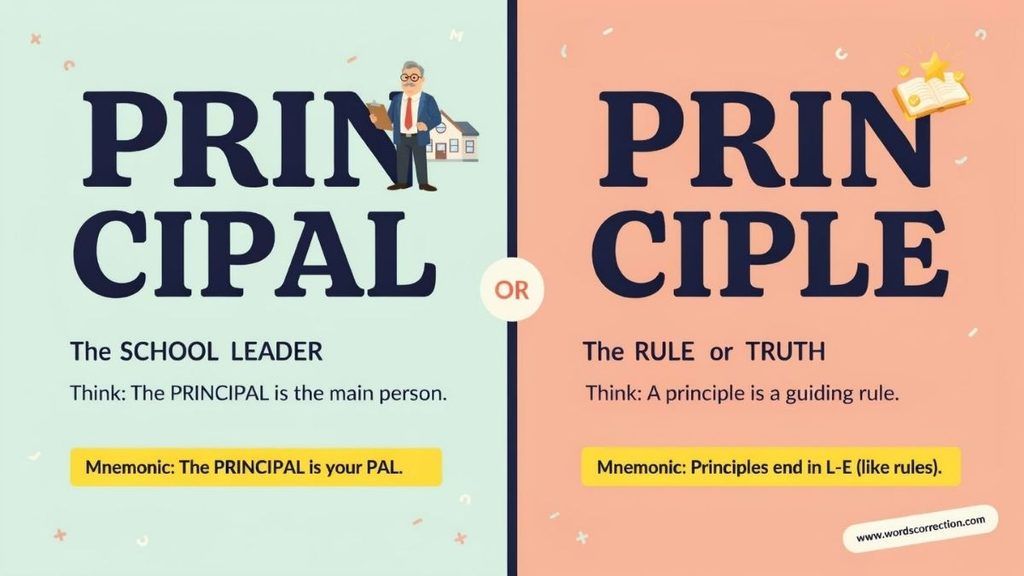
The principal meaning in school is straightforward: a school principal is the head administrator of a school.
In American English, principal is the standard spelling for this role.
You might see:
- school principal
- elementary school principal
- high school principal
- assistant principal
- principal’s office
- principal’s decision
The phrase principal of a school is also correct.
For example:
The principal of the school announced the new attendance policy.
The incorrect spelling school principle changes the meaning because principle refers to a rule, belief, or fundamental idea.
A useful memory sentence is:
The principal is your pal.
The rhyme isn’t a grammar rule. It’s simply a convenient principal spelling trick.
Principal in Finance
Here’s where the principal vs principle money question becomes especially important.
In finance, principal means the original amount of money borrowed or invested.
For a loan, the principal amount of a loan is the money borrowed from the lender before interest and other applicable costs are considered.
For example, suppose you borrow $20,000 to buy a car.
- Original loan principal: $20,000
- Interest: the lender’s charge for providing the money
- Repayments: amounts applied toward the loan’s costs, interest, and principal according to the loan terms
As you make payments, the outstanding loan principal generally decreases. The interest you pay is separate from the amount originally borrowed.
In investments, the term investment principal refers to the amount of money initially invested. The investment may then produce earnings, interest, dividends, or capital gains depending on the type of investment.
So, if you’re wondering what does principal mean in finance, think:
Principal = the original money borrowed or invested.
Interest = the cost or return associated with using or providing that money, depending on the financial context.
Learn the difference between commonly misused words
Tier or Teir Which One Is Right?
Principal Amount vs Interest
The distinction becomes clearer with a simple example.
Imagine that you borrow $10,000.
The $10,000 is the principal amount.
If the lender charges interest for allowing you to use that money, the interest is separate from the principal.
As you repay the loan, the outstanding principal balance can decrease. Because interest is often calculated using the remaining balance, reducing the principal can also reduce future interest costs, depending on the terms of the loan.
This is why the phrases interest and principal, principal payment, and principal balance appear so frequently in financial documents.
Principal in Business and Law
In business and law, principal can refer to a person or organization that authorizes another person to act on its behalf.
For example, imagine that a company hires an agent to negotiate a contract. The company may be the principal, while the person acting on the company’s behalf is the agent.
The meaning remains connected to the idea of a person or entity with authority or a leading position.
Learn the difference between basic English word mistakes
Personel or Personnel Which is Correct?
Principle Meaning, Uses, and Examples
Unlike principal, the word principle is a noun.
Its central idea is a rule, belief, standard, or fundamental concept.
Principle as a Rule or Standard
A principle can guide how someone behaves or how an organization operates.
For example:
Fairness is a basic principle of the organization’s hiring policy.
Here, principle means a standard or rule that guides decisions.
Other examples include:
- respect for others
- honesty
- fairness
- accountability
- equality
- responsibility
These can function as principles of ethics or personal values depending on the context.
Principle as a Moral Belief
A moral principle is a belief about what is right or wrong.
For example:
She refused to lie because honesty was one of her strongest principles.
A person can have personal principles, while a company can establish business principles that shape its policies and conduct.
Common examples include:
- Keep your promises.
- Treat people fairly.
- Tell the truth.
- Respect confidentiality.
- Take responsibility for mistakes.
A principle doesn’t always appear as a formal written rule. It can be an internal standard that influences decisions.
Principle in Science
A scientific principle describes a fundamental idea or law that helps explain how something works.
For example:
The engineer explained the principle behind the machine’s operation.
You may also encounter expressions such as:
- principles of physics
- principles of science
- fundamental principle
- scientific principle
- basic principle
In this context, principle doesn’t mean someone’s personal moral belief. It means a foundational concept or rule within a field of knowledge.
The word can also describe a basic truth or underlying concept in academic, technical, and professional writing.
Learn the difference between often confused words
Pair or Pare what’s the difference?
Common Expressions with Principle

Several expressions make principle easier to recognize.
In principle means something is acceptable or possible as an idea, even if practical details remain.
In principle, the proposal sounds reasonable.
On principle means someone acts according to a belief or standard.
He refused the money on principle.
Guiding principle refers to an idea that directs actions or decisions.
Transparency is the company’s guiding principle.
Basic principle means a foundational rule or idea.
The basic principle is simple: reduce waste before buying more.
Fundamental principle refers to an idea considered essential to a system.
Equality is a fundamental principle of the policy.
Principal vs Principle How to Remember the Difference
The fastest way to master principal vs principle is to connect each spelling with a meaning.
The “Principal Is Your Pal” Trick
The classic memory trick is:
The principal is your pal.
If you’re talking about the person who runs a school, think principal.
For example:
The principal called the student’s parents.
This trick works particularly well for remembering the principal school head meaning.
The E in Principle
A second memory trick connects the E in principle with ethics.
Think:
Principle → E → Ethics
If you’re talking about a moral rule, belief, or ethical standard, principle is usually the right choice.
For example:
Honesty is an important principle.
This is a memory device rather than the actual origin of the word.
The Money Trick
When money enters the sentence, pause and look for principal.
Remember:
Principal = the original money.
This applies to both loans and investments.
You may see:
- principal amount
- loan principal
- principal balance
- investment principal
- principal payment
- principal and interest
Ask One Simple Question
When you’re stuck between the two words, ask:
Is this about a main person, a main thing, or money?
→ Principal
Is this about a rule, belief, value, or fundamental idea?
→ Principle
That simple test handles most everyday situations.
Learn the difference between confusing word pairs
Maximise or Maximize which one is correct?
Principal vs Principle in Real-World Contexts
The distinction becomes much easier when you see the words in familiar situations.
School and Education
Correct:
The principal announced the new school schedule.
Incorrect:
The principle announced the new school schedule.
Why? Because you’re referring to the person in charge.
Now compare:
Respect is an important principle in the classroom.
Here, you’re referring to a value or standard.
Banking and Personal Finance
Correct:
The borrower made an extra payment toward the principal.
Incorrect:
The borrower made an extra payment toward the principle.
You’re talking about money, so principal is correct.
The same distinction applies to mortgages, personal loans, business loans, and many investment situations.
Business
Both words can appear in the same business discussion:
The principal of the company insisted that honesty was a guiding principle.
The first principal refers to a leading person. The second principle refers to a value.
That’s a perfect example of why principal and principle shouldn’t be treated as interchangeable spellings.
Ethics and Personal Values
Use principle when discussing beliefs and standards:
She wouldn’t compromise her principles for money.
Fairness is a central principle of the organization.
He made the decision on principle.
None of these sentences refers to a person in charge or money being borrowed.
Academic and Scientific Writing
Use principle when discussing foundational concepts:
The experiment demonstrates a basic scientific principle.
The course introduces the principles of economics.
Use principal when you mean main:
The principal objective of the study was to examine consumer behavior.
The context makes the distinction clear.
Principal vs Principle Examples
Looking at pairs of sentences is one of the best ways to understand principal vs principle examples that appear in everyday writing.
| Principal | Principle |
| The principal spoke to the parents. | Honesty is an important principle. |
| Safety was the principal concern. | Fairness is a basic principle. |
| She paid down the loan principal. | He acted according to his principles. |
| The principal of the school welcomed visitors. | The policy follows a clear principle. |
| The principal reason was cost. | The scientist explained the principle behind the process. |
| The company’s principal objective was growth. | Transparency became a guiding principle. |
The pattern becomes clear once you focus on meaning rather than spelling.
Learn the difference between tricky grammar more words
Invision or Envision Which Is Correct?
both in a Sentence

If you’re searching for principal or principle in a sentence, look at the word’s role and meaning.
Principal Sentence Examples
- The principal called an emergency meeting.
- Cost was the principal reason for the change.
- The company reduced its principal debt.
- She made an extra payment toward the principal amount.
- The principal character appears throughout the novel.
- The project has one principal objective.
- The principal role requires extensive experience.
- The principal concern was public safety.
Principle Sentence Examples
- Honesty is a valuable principle.
- The organization follows strong ethical principles.
- The machine demonstrates a basic scientific principle.
- She refused to compromise her principles.
- Equality is an important moral principle.
- The decision was made on principle.
- The idea works in principle.
- Respect is a guiding principle in the organization.
Principal or Principle in Special Terms
Some phrases are particularly useful because they show how context determines the spelling.
Principal Character
Principal character means the main or most important character in a story.
You could replace it with main character.
The novel’s principal character faces a difficult choice.
The word principal works because the character holds primary importance in the story.
Principal Bedroom
Principal bedroom is a legitimate real-estate term for the main bedroom in a home.
The house has three bedrooms, including a spacious principal bedroom.
The word is principal because the bedroom is the main or primary bedroom.
Principle bedroom would be incorrect because principle doesn’t mean main.
Principal Photography
it refers to the main phase of filmmaking when the planned scenes are recorded with the cast and crew.
Principal photography began in June.
Again, principal means main.
Principal Role
A principal role is a leading or major role.
She landed a principal role in the production.
The word connects to the idea of primary importance.
Principal Reason
A principal reason is the main reason.
The principal reason for the delay was a technical problem.
If you can substitute main, principal is usually the correct choice.
Principal Goal and Principal Objective
Both expressions refer to the main goal or objective.
The principal goal is to improve customer service.
The principal objective is to reduce operating costs.
These are examples of principal as an adjective.
Learn the difference between commonly mixed-up more words
Families or Familys which one is correct?
Principal vs Principle Common Mistakes
Because these words are commonly confused, mistakes tend to appear in predictable places.
Mistake “School Principle”
Incorrect:
The school principle addressed the students.
Correct:
The school principal addressed the students.
A school leader is a principal.
Mistake “Moral Principals”
Incorrect:
She refused to compromise her moral principals.
Correct:
She refused to compromise her moral principles.
Moral beliefs are principles.
Mistake “Pay Down the Principle”
Incorrect:
He made an extra payment toward the principle.
Correct:
He made an extra payment toward the principal.
Money borrowed or invested is principal.
Mistake “The Principle Reason”
Incorrect:
Cost was the principle reason.
Correct:
Cost was the principal reason.
Here, principal means main.
Mistake “A Person of Principal”
Incorrect:
She is a person of principal.
Correct:
She is a person of principle.
The expression person of principle describes someone who follows strong moral or ethical standards.
Learn the difference between confusing more English words
Allie or Ally Difference And Usage
Principal vs Principle Grammar and Word Forms
Understanding grammar gives you another way to separate these words.
Is Principal a Noun or Adjective?
Principal can be both a noun and an adjective.
As a noun:
The principal spoke to the students.
As an adjective:
The principal reason was cost.
As a noun, it identifies a person, financial amount, or other leading entity depending on context.
As an adjective, it describes something as main or most important.
Is Principle a Noun or Adjective?
Principle is a noun.
For example:
Honesty is a principle.
The principle is easy to understand.
The adjective form principled is different.
For example:
She is a principled leader.
Principled means guided by strong moral standards.
This distinction can help prevent another common spelling mistake:
- principle = rule or belief
- principled = guided by principles
- principal = main, person in charge, or money
Principal, Principally, Principle, and Principled
These related forms look similar but serve different purposes.
Principal means main, leading, a person in charge, or money.
Principally means mainly or chiefly.
The region is principally agricultural.
Principle means a rule, belief, or fundamental idea.
Principled describes someone or something guided by strong moral standards.
She took a principled position.
Knowing these forms makes the principal spelling and principle spelling distinction much easier to maintain.
Learn the difference between tricky words and use them correctly
Happend or Happened Which Spelling Is Correct?
The Origin of Principal and Principle
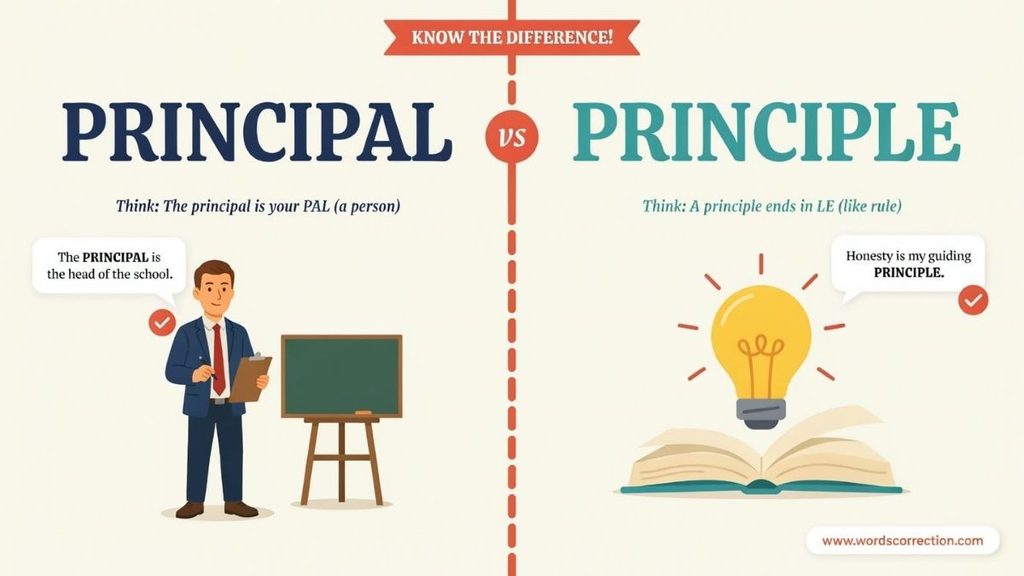
The two words are confusing for a good historical reason: they are related.
Principal comes through French from the Latin word principalis, which was connected with the idea of being first, chief, or foremost. Over time, English developed the word’s meanings around ideas of primary importance, leadership, and authority.
The financial meaning of principal developed from the idea of a principal sum, meaning the original or primary amount of money involved in a transaction.
The school-related meaning later developed for a person who holds the leading administrative position in a school.
Principle also comes from Latin roots associated with beginnings, foundations, and first things. In English, it developed meanings related to foundational truths, rules of conduct, and basic ideas.
The historical relationship explains why the words look so similar today.
However, their modern meanings are distinct.
You don’t need to memorize their Latin roots to use them correctly. Context remains the most useful guide.
Why the Spellings Are Different
Although both words developed from related historical roots, English eventually established them as separate words with different meanings.
The modern distinction is practical:
Principal is connected with what comes first in importance, a leading person, or a primary amount of money.
Principle is connected with a foundational rule, belief, or idea.
That distinction has remained stable in modern English.
Principal vs Principle Pronunciation
The principal and principle pronunciation is another reason people confuse these words.
In standard American English, the two words are generally pronounced the same way. They are therefore homophones: words that share a pronunciation while having different meanings and spellings.
When you hear the words aloud, you usually cannot determine the spelling from sound alone. You have to understand what the speaker means.
For example:
“The principal made a decision.”
The context indicates that principal refers to a person in authority.
Compare:
“Honesty is an important principle.”
Here, the context clearly indicates a rule or belief.
This is why you shouldn’t rely on pronunciation when choosing between these two words in writing. Focus on meaning and context.
Principal vs Principle A Practical Decision Guide
When you’re writing and suddenly wonder, “Is it principal or principle?”, use this checklist.
Choose Principal if you mean:
- a school leader
- a person in charge
- a leading person in business or law
- the main or most important thing
- the original amount borrowed
- the amount invested
- the balance of a loan
- a primary goal or objective
- a main reason
- a leading character or role
Choose Principle if you mean:
- a rule
- a belief
- a moral standard
- an ethical value
- a guideline
- a fundamental truth
- a scientific concept
- a basic idea
- a standard of behavior
- a foundation for a system
- a code of conduct
There’s the shortcut:
Main, person, or money? Principal.
Rule, belief, or fundamental idea? Principle.
Learn the difference between commonly confused more words in English
Steel or Steal which one is correct?
Principal vs Principle Quick Comparison
| Feature | Principal | Principle |
| Part of speech | Noun and adjective | Noun |
| Means “main”? | Yes | No |
| Can mean a school leader? | Yes | No |
| Can mean money borrowed? | Yes | No |
| Can mean a rule? | No | Yes |
| Can mean a moral belief? | No | Yes |
| Can describe a scientific idea? | Generally no | Yes |
| Common phrase | principal reason | basic principle |
| Finance phrase | loan principal | Not applicable |
| School phrase | school principal | Not applicable |
| Memory clue | Principal is your pal | Principle relates to rules and ethics |
Principal or Principle Quick Quiz
Try choosing the correct word before checking the answers.
The school ____ welcomed the new students.
Honesty is an important ____ in journalism.
She made an extra payment toward the loan ____.
The ____ reason for the cancellation was bad weather.
He refused to participate because it violated his personal ____.
Answers
Principal — a school leader.
Principle — a moral or professional standard.
Principal — the amount owed on the loan.
Principal — the main reason.
Principles — personal beliefs or standards.
If you got all five right, you’ve mastered the central distinction.
Practice Session
Fill in each blank with the correct word principal or principle.
- The school ______ welcomed the new students.
- Honesty is an important ______ in life.
- She paid part of the loan ______.
- The ______ reason for the delay was bad weather.
- He refused to compromise his ______.
- The bank explained how much ______ remained on the loan.
- The school ______ announced the new rules.
- Fairness is a basic ______ of good leadership.
- The ______ goal of the project is to improve efficiency.
- She acted according to her personal ______.
- The company reduced the ______ amount of the loan.
- The ______ of the college spoke at the ceremony.
- Respect for others is an important ______.
- This is the ______ reason for our decision.
- He strongly believes in the ______ of equality.
- The teacher introduced us to the school ______.
- Most of the payment went toward the loan ______.
- The ______ objective is to complete the project on time.
- She would not violate her moral ______.
- The ______ of the school met with the parents.
- The investor received interest in addition to the ______.
- The company follows a strict ______ of transparency.
- The ______ character in the story is a young scientist.
- We agreed with the proposal in ______.
- The ______ purpose of the meeting was to discuss the new policy.
Answer Session
- Principal
- Principle
- Principal
- Principal
- Principle
- Principal
- Principal
- Principle
- Principal
- Principle
- Principal
- Principal
- Principle
- Principal
- Principle
- Principal
- Principal
- Principal
- Principle
- Principal
- Principal
- Principle
- Principal
- Principle
- Principal
Here’s a trusted source for clear more words Comparison:
Grammar Update
Frequently Asked Questions
Here are answers to common questions about the correct use of principal and principle.
What is the difference between principal and principle?
Principal and principle are homophones, but they have different meanings. Principal can refer to a person in charge, something most important, or the original amount of money borrowed or invested. Principle refers to a rule, belief, standard, or fundamental idea.
Is it principle or principal when referring to money?
Use principal when referring to money. In finance, principal is the original amount borrowed, invested, or owed, excluding interest.
Is a person called a principal or a principle?
A person is called a principal. For example, the person who leads a school is the school principal.
What does the word principle mean?
Principle is a noun that refers to a basic rule, belief, value, or standard that guides someone’s behavior, decisions, or actions.
What does the word principal mean?
Principal can refer to a person in a position of authority, something that is most important, or the original amount of money involved in a loan or investment.
What is an easy way to remember principal and principle?
A useful memory trick is that a school principal can be your pal because pal appears at the end of principal. Principle refers to a rule, belief, or standard.
Can principal be used as both a noun and an adjective?
Yes. As a noun, principal can refer to a person in charge or an amount of money. As an adjective, it means main, primary, or most important.
Can principle be used as an adjective?
No. Principle is a noun. It refers to a rule, belief, value, standard, or fundamental idea.
What is an example of principal in a sentence?
“The school principal welcomed the new students.” In this sentence, principal refers to the person who leads the school.
What is an example of principle in a sentence?
“She refused to compromise her principles.” Here, principles refers to the beliefs or values that guide her behavior.
Is it correct to say “in principle” or “in principal”?
The correct expression is “in principle.” It means accepting or agreeing with an idea in general, even if there may be details to consider.
Is “I agree in principle” grammatically correct?
Yes. “I agree in principle” is correct when you generally agree with an idea, proposal, or approach without necessarily agreeing with every detail.
Is it “school principal” or “school principle”?
The correct phrase is “school principal.” It refers to the person responsible for leading or managing a school.
Is “college principal” correct?
Yes. College principal is correct when referring to the person who leads or manages a college or similar educational institution.
What are the different meanings of principal?
Principal has several meanings. It can refer to a person in charge, something that is primary or most important, or the original amount of money borrowed or invested.
What is another word for principal?
Depending on the context, synonyms for principal include chief, main, primary, leader, head, administrator, and director.
What is another word for principle?
Depending on the context, synonyms for principle include rule, belief, standard, guideline, value, ideal, and doctrine.
Are principal and principle pronounced the same?
Yes. Principal and principle are homophones, meaning they have the same pronunciation but different spellings and meanings.
Can principal mean “most important”?
Yes. When used as an adjective, principal means main, primary, chief, or most important.
Can principle refer to a moral belief?
Yes. A principle can be a moral belief or standard that influences how a person behaves and makes decisions.
What does “principal amount” mean?
The principal amount is the original amount of money borrowed, invested, or owed, before interest or additional earnings are included.
How is principal used when discussing a loan?
In a loan, principal refers to the amount originally borrowed. Payments toward the principal reduce the remaining balance of the loan.
How is principle used in everyday life?
Principle is commonly used to describe values, beliefs, or standards that guide a person’s choices and behavior, such as honesty, fairness, and responsibility.
Which is correct “principal reason” or “principle reason”?
“Principal reason” is correct when you mean the main or most important reason. For example, “The principal reason for the delay was bad weather.”
How can you tell whether to use principal or principle?
Use principal when referring to a person in charge, something that is main or most important, or money borrowed or invested. Use principle when referring to a rule, belief, value, or guiding standard.
Conclusion
The difference between principal or principle becomes much easier to understand once you separate their meanings. Although these words look and sound remarkably similar, they serve very different purposes. Principal refers to a person in charge, something that is most important, or the original amount of money in a loan or investment. Principle refers to a rule, belief, moral standard, or fundamental idea.
A simple way to remember the difference is this: principal = person, primary, or money; principle = rule, belief, or value. Your school has a principal, your loan has a principal, and your decisions may be guided by principles. Once this distinction becomes familiar, you can leave this common grammar mistake behind and write with greater accuracy and confidence.

Stella AJS is an experienced blogger and dedicated English language writer at Words Correction. She turns confusing grammar, word meanings, spelling, and usage into clear, practical insights that readers can easily understand and apply. With a passion for precise and engaging writing, Stella helps readers avoid common language mistakes, strengthen their vocabulary, and communicate with greater clarity and confidence.




