
Confusing steel or steal is a common English mistake, especially because both words sound exactly the same. However, their meanings are completely different. Steel refers to a strong metal used in buildings, bridges, tools, and countless everyday products, while steal means to take something without permission. One small letter creates a major difference, and choosing the wrong word can turn an ordinary sentence into an amusing misunderstanding. Understanding the steel or steal meaning helps you avoid these spelling and grammar mistakes with confidence. In this guide, you’ll learn their definitions, differences, pronunciation, and correct usage through clear explanations and practical examples.
Steel or Steal What’s the Difference?
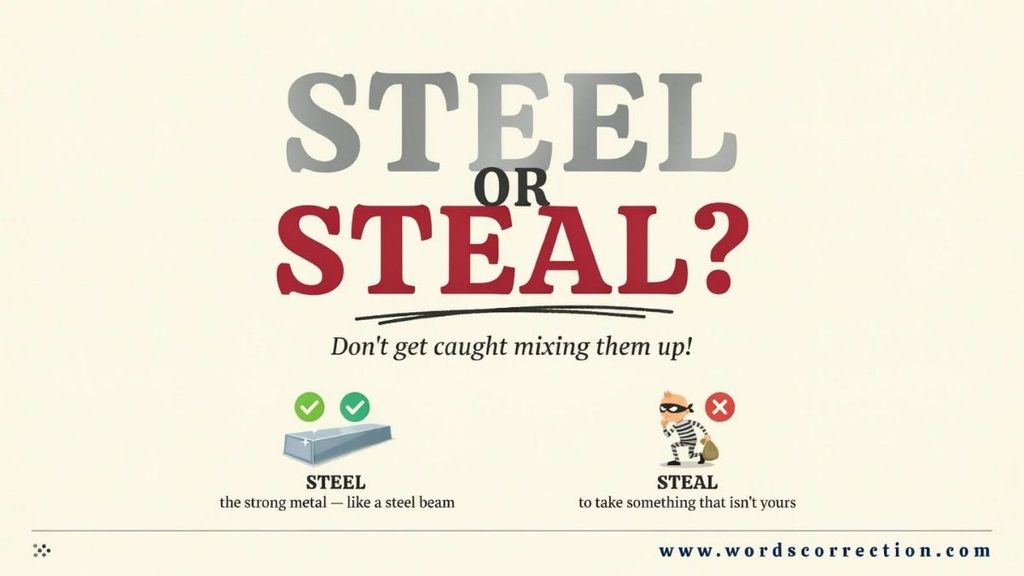
The simplest difference between steel and steal is this:
- Steel is mainly a noun referring to a strong metal alloy made primarily from iron and carbon. It can also function as a verb meaning to mentally prepare or strengthen yourself for something difficult.
- Steal is mainly a verb meaning to take something without permission or legal right. It can also function as a noun meaning a very good bargain.
The two words are normally pronounced the same. That makes steel and steal homophones: words that sound alike but have different spellings and meanings.
| Word | Main role | Main meaning | Example |
| steel | Noun | A strong metal alloy | The bridge uses a large amount of steel. |
| steel | Verb | To mentally prepare or strengthen | She steeled herself for the difficult meeting. |
| steel | Adjective | Made of or relating to steel | The building has a steel frame. |
| steal | Verb | To take something without permission | Someone tried to steal his phone. |
| steal | Noun | A great bargain | That jacket was a steal. |
In short, steel is connected with metal and strength, while steal is connected with taking, gaining, or obtaining something secretly or unfairly.
Steel Meaning and Definition
The steel meaning in English centers on a material known for strength, hardness, and versatility. In its most familiar form, steel is an alloy based on iron with carbon as an important component.
Steel appears in buildings, bridges, vehicles, machinery, tools, appliances, pipes, industrial equipment, and countless other products. Different types of steel have different properties, which makes the material useful in a wide range of industries.
Steel as a Noun
The most common use is steel as a noun.
Steel is used to make or reinforce countless products and structures. You encounter it in buildings, bridges, vehicles, machinery, tools, appliances, industrial equipment, and many other products.
For example:
- The workers installed a steel frame inside the building.
- The new steel bridge can support heavy traffic.
- The manufacturer produces steel products for construction.
- The machine contains several steel components.
- The knife has a durable steel blade.
The important point is that steel names a material. It is not simply another word for anything that is hard.
Steel Metal Meaning
The steel metal meaning refers to an engineered alloy whose properties make it useful for demanding applications.
Iron in its pure form is relatively soft compared with many steels. Adding carbon and controlling the material’s composition and processing can produce steels with different combinations of strength, hardness, toughness, ductility, and corrosion resistance.
That is why the word steel covers a large family of materials rather than one substance with identical properties.
Learn the difference between confusing more English words
Blackout or Backout which is correct?
Steel Definition and Examples
A practical steel definition is:
Steel is an iron-based alloy in which carbon is an important alloying element.
This definition explains why you see the word in technical fields such as construction, manufacturing, transportation, and engineering.
For example, a construction engineer may choose a particular grade of steel because a project requires a specific balance of strength and flexibility. A tool manufacturer may select another type because hardness and resistance to wear are more important.
Steel as a Verb
Here is where the word takes an interesting turn.
Steel as a verb means to strengthen, brace, or prepare someone mentally or emotionally for something difficult.
Consider this sentence:
She steeled herself before walking into the interview.
The sentence does not mean she turned herself into a piece of metal. Instead, she mentally prepared herself for a stressful situation.
This figurative meaning developed from qualities commonly associated with steel, including strength, firmness, and resistance.
Steel Yourself Meaning
The phrase steel yourself means to mentally prepare yourself to face something unpleasant, frightening, challenging, or emotionally difficult.
For example:
- He steeled himself for the bad news.
- She steeled herself before entering the courtroom.
- The team steeled itself for a difficult second half.
- I had to steel myself before making the phone call.
The expression often appears when someone expects a difficult experience and deliberately gathers courage or determination.
The past-tense form is steeled, not stealed.
That distinction matters. If you write “She stealed herself,” you have used an incorrect verb form. The correct sentence is:
She steeled herself for the conversation.
Learn the difference between commonly mixed-up more words
Stabilise or Stabilize Difference in Usage
Steal Meaning and Definition
The steal meaning in English is usually connected with taking something that belongs to someone else without permission.
The steal definition is broader than simply “take.” In many contexts, it involves taking property without the owner’s permission and intending to keep it, use it, or otherwise deprive the owner of it.
Steal as a Verb
Steal as a verb is the most common use.
You can steal something without permission, steal from someone, or steal something from someone.
Examples include:
- Someone tried to steal my bicycle.
- The thief stole money from the store.
- Someone stole her phone on the train.
- The company accused the employee of trying to steal confidential information.
- The player stole the ball from the opposing team.
The standard forms of the verb are important:
| Form | Example |
| Present | steal |
| Past | stole |
| Past participle | stolen |
| Present participle | stealing |
So you write:
- I steal it every day.
- I stole it yesterday.
- Someone has stolen my wallet.
- They are stealing equipment.
Notice that stole is the past tense. Stealed is not the standard past tense of steal.
To Steal Meaning
The to steal meaning is essentially “to take something without permission or right,” although the verb has several figurative and specialized uses.
The phrase to steal can apply to physical property:
Someone tried to steal the car.
It can also apply to things that are not physical objects:
The competitor tried to steal our customers.
The comedian stole the audience’s attention.
Someone stole my idea.
The word is therefore not limited to traditional theft. English also uses steal to describe taking attention, credit, opportunities, advantages, and other things.
Steal as a Noun
Steal as a noun has another useful meaning: a purchase that represents an unusually good bargain.
For example:
That laptop was a steal at $400.
Here, nobody committed a crime. The buyer simply got an excellent deal.
This is the a steal meaning.
You might hear:
- That price is a steal.
- I got these shoes for $20. They were a steal.
- The house was a steal compared with similar properties.
In this sense, steal means something like an unusually good bargain.
Learn the difference between tricky grammar more words
Palate or Palette Difference and Usage
both Side-by-Side Comparison
When you are deciding between these commonly confused words, look at the meaning before you look at the sound.
| Feature | Steel | Steal |
| Pronunciation | /stiːl/ | /stiːl/ |
| Main part of speech | Noun | Verb |
| Other parts of speech | Verb, adjective | Noun |
| Main meaning | Strong metal alloy | Take without permission |
| Figurative meaning | Strength or mental preparation | Gain attention, credit, or advantage |
| Past tense | steeled | stole |
| Past participle | steeled | stolen |
| Common phrase | steel yourself | steal the show |
| Bargain meaning | No | a steal |
| Material meaning | Yes | No |
This table captures the steel and steal difference in one glance.
Why Are Steel and Steal So Easy to Confuse?
The problem is not complicated grammar. It is sound.
They Sound the Same
The steel steal pronunciation is normally identical in standard English: /stiːl/.
That makes steel and steal homophones.
When someone says the word aloud, you usually cannot determine the spelling simply by listening. Context has to provide the missing information.
For example, if someone says:
The bridge needs more steel.
You understand the meaning from the subject.
If someone says:
Someone tried to steal the bridge equipment.
The context identifies the word again.
Their Spellings Differ by One Letter
The spelling difference is small:
steel → s-t-e-e-l
steal → s-t-e-a-l
The vowel combination changes, but the pronunciation remains the same.
That is why spelling mistakes involving these words are particularly easy to make. The ear does not provide much help.
Learn the difference between confusing word pairs
Tomorrow’s or Tomorrows Usage and difference?
Context Usually Reveals the Correct Word
Context is your best guide.
If the sentence discusses:
- metal
- buildings
- bridges
- tools
- machinery
- construction
- strength
you probably need steel.
If it discusses:
- taking property
- theft
- permission
- possessions
- crime
- money
- ideas
- attention
you probably need steal.
Think of context as the signpost that tells you which spelling belongs in the sentence.
Steel and Steal Pronunciation
The steel vs steal pronunciation is one of the easiest parts of this comparison because the two words normally sound identical.
Both are pronounced /stiːl/ in standard English.
The vowel sound is the long “ee” sound found in words such as see and green.
So, when asking how do you pronounce steel and steal, the answer is that they normally have the same pronunciation.
| Word | IPA |
| steel | /stiːl/ |
| steal | /stiːl/ |
The important difference is not pronunciation. It is spelling and meaning.
That is precisely why learners often search for steel vs steal pronunciation even though the pronunciation does not separate the words.
Learn the difference between often confused words
Tier or Teir Which One Is Right?
The Origins of Steel and Steal
The two words have separate histories despite their modern similarity.
Where “Steel” Comes From
The word steel has very old Germanic roots. The English word developed through earlier forms of the language and has been used for many centuries to describe the metal.
Over time, the word also developed figurative associations with hardness, strength, and firmness.
That helps explain expressions such as:
- nerves of steel
- a voice of steel
- steel yourself
The physical qualities of the material provided a natural metaphor for emotional toughness.
Where “Steal” Comes From
Steal also has Germanic roots, but its history is separate from steel. The word developed from older forms meaning to take something secretly or unlawfully.
Although steel and steal eventually became homophones in English, they did not originate as two spellings of the same word.
They followed separate linguistic paths.
Learn the difference between basic English word mistakes
Personel or Personnel Which is Correct?
Which Spelling Should You Use?
When asking steel or steal which is correct, neither spelling is universally correct. Both are legitimate English words. The right choice depends entirely on what you mean.
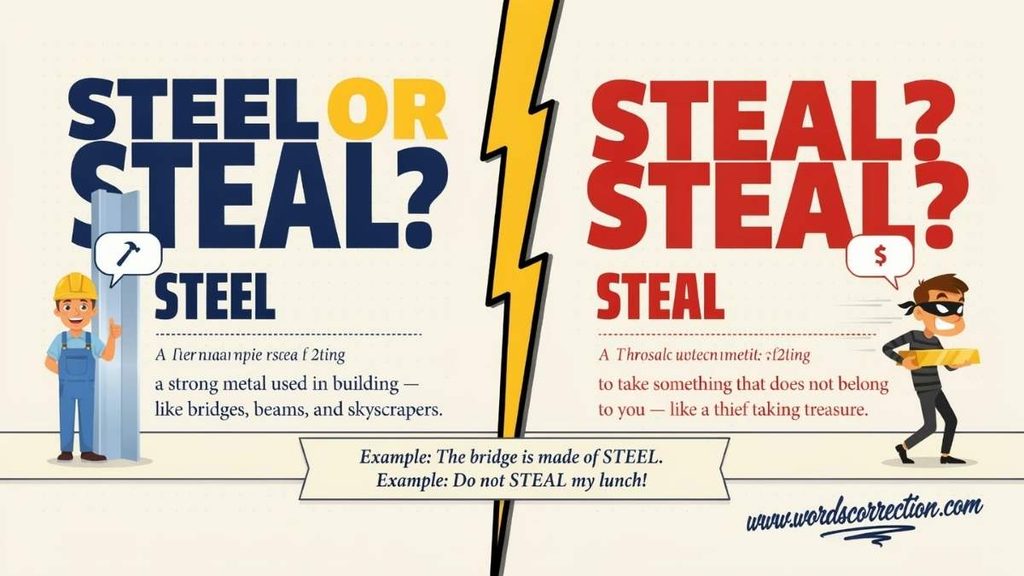
Use “Steel” for the Metal
Use steel when you are talking about the material.
Examples:
- The building has a steel frame.
- The workers reinforced the steel bridge.
- The factory produces steel products.
- The structure contains several tons of steel.
- The machine uses hardened steel tools.
Use “Steel” for Mental Strength
Use steel when you mean to prepare or strengthen yourself mentally.
Examples:
- She steeled herself for the interview.
- He steeled himself against criticism.
- They steeled themselves for a difficult journey.
Use “Steal” for Taking Something
Use steal when someone takes something without permission.
Examples:
- Someone tried to steal my car.
- The thief stole money from the register.
- Do not steal other people’s property.
- Someone stole the documents.
Use “Steal” for a Great Bargain
Use a steal when describing an unusually good deal.
Examples:
- This phone was a steal at that price.
- The furniture was a steal during the clearance sale.
- That used car looks like a steal.
Learn the difference between commonly misused words
Pair or Pare what’s the difference?
Steel or Steal in a Sentence
Seeing the words in complete sentences makes the steel or steal in a sentence distinction much clearer.
Steel Sentence Examples
- The architect designed the building with a strong steel frame.
- The bridge contains thousands of tons of steel.
- The factory produces specialized steel products.
- The knife has a durable steel blade.
- She steeled herself before delivering the difficult news.
- He needed to steel himself for the long negotiation.
Steal Sentence Examples
- Someone tried to steal my bicycle.
- The police recovered the stolen property.
- The player stole the ball during the final minute.
- She accused him of trying to steal her idea.
- The actor stole the show.
- I bought this jacket for $15, so it was a steal.
These examples of steel and steal show an important pattern: the surrounding words usually make the intended meaning obvious.
Learn the difference between everyday English mistakes
Maximise or Maximize which one is correct?
Common Mistakes With Steel and Steal
Writing “Steal” When You Mean the Metal
Incorrect:
The building has a steal frame.
Correct:
The building has a steel frame.
The noun refers to a material, so steel is required.
Writing “Steel” When You Mean Taking Something
Incorrect:
Someone tried to steel my phone.
Correct:
Someone tried to steal my phone.
Here, the action involves taking property without permission.
Confusing “Steel Yourself” With “Steal Yourself”
Incorrect:
She stole herself before the interview.
Correct:
She steeled herself before the interview.
The phrase steel yourself means to mentally prepare or strengthen yourself.
Using “Stealed” as the Past Tense
Incorrect:
Someone stealed my wallet.
Correct:
Someone stole my wallet.
The verb steal is irregular:
steal → stole → stolen
This is an important point in English grammar because the past forms do not simply add -ed.
Using “Steel” in “Steal the Show”
Incorrect:
The comedian steeled the show.
Correct:
The comedian stole the show.
To steal the show means to attract more attention than others or make a particularly strong impression.
Learn the difference between more words people mix up
Invision or Envision Which Is Correct?
Steel and Steal in Different Contexts
Words become easier to remember when you see where they naturally belong.
Construction and Manufacturing
The word steel dominates technical and industrial contexts.
You will see phrases such as:
- steel industry
- steel building
- steel bridge
- steel frame
- steel beam
- steel structure
- steel products
- stainless steel
- carbon steel
- steel tools
Here, steel refers to a material or something made from it.
Crime and Property
The word steal belongs in contexts involving unauthorized taking.
Common phrases include:
- steal money
- steal property
- steal a car
- steal a phone
- steal information
- steal someone’s belongings
- steal something without permission
The meaning centers on taking something that belongs to someone else without proper permission or authority.
Business and Shopping
Shopping introduces another important use:
That sofa was a steal.
Here, steal means a bargain rather than an act of theft.
The word can describe a purchase made at a remarkably low price or at a price much lower than expected.
Sports
Sports also use steal in several ways.
In baseball, a player can steal a base by advancing without getting there through a hit. In sports such as basketball, a player can steal the ball by taking possession from an opponent.
For example:
The shortstop stole second base.
The defender stole the ball and scored.
Neither sentence has anything to do with metal.
Emotional and Personal Situations
Steel appears in figurative expressions about determination.
For example:
She steeled herself for the result.
He showed nerves of steel during the crisis.
The connection is easy to understand: steel is associated with strength and toughness, so English uses it metaphorically for mental firmness.
Learn the difference between tricky English words with easy explanations
Families or Familys which one is correct?
Steel vs Steal Easy Ways to Remember the Difference
If you keep asking how can I remember steel vs steal, use meaning rather than pronunciation.
Remember “Steel” With Strength
Think:
Steel is strong.
The word steel is associated with strong metal, durable structures, and physical toughness.
You can also connect it with:
- steel beams
- steel bridges
- steel tools
- steel frames
- nerves of steel
- steel yourself
Remember “Steal” With Taking
Think:
Steal means take.
If someone takes your property without permission, they steal it.
You can connect steal with:
- steal money
- steal property
- steal a phone
- steal an idea
- steal the show
- steal a glance
The One-Line Rule
The easiest rule is:
Steel is strong; steal is taking.
It is not a complete dictionary definition, but it is a useful spelling shortcut.
Learn the difference between confusing more English words step by step
Allie or Ally Difference And Usage
Steel or Steal A Quick Grammar Guide

Understanding each word’s grammatical behavior makes the distinction even clearer.
Steel as a Noun
The workers ordered more steel.
Here, steel names a material.
Steel as a Verb
She steeled herself for the challenge.
Here, steeled describes an action involving mental preparation.
Steel as an Adjective
The factory installed a steel door.
Here, steel describes what the door is made from.
Steal as a Verb
They stole the equipment.
Here, stole is the past tense of steal.
Steal as a Noun
The laptop was a steal.
Here, steal refers to a bargain.
This is why the question is steel a noun or verb has more than one answer. It can be a noun, verb, and adjective. Likewise, is steal a verb or noun has two answers: it can function as either.
How to Use Steel and Steal Correctly
A useful way to decide when to use steel or steal is to ask one question:
What does the sentence mean?
If the sentence describes a metal, material, hardness, or mental preparation, choose steel.
If it describes taking, secretly gaining, unauthorized possession, attention, or a bargain, choose steal.
Consider these pairs:
| Incorrect | Correct | Why |
| The bridge uses steal beams. | The bridge uses steel beams. | The beams are made from metal. |
| Someone tried to steel my wallet. | Someone tried to steal my wallet. | The person tried to take property. |
| She stealed herself for the test. | She steeled herself for the test. | The phrase means mentally prepared. |
| The performer steeled the show. | The performer stole the show. | The performer attracted attention. |
| This car is steel at that price. | This car is a steal at that price. | The car is a great bargain. |
A Closer Look at “Steal”
The verb steal has more range than many learners realize.
It can describe literal theft:
Someone stole the painting.
It can describe taking something secretly:
She stole a glance at the clock.
It can describe gaining attention:
The young performer stole the show.
It can describe taking credit:
He stole credit for her work.
It can describe taking an advantage:
The team stole the victory in the final seconds.
It can even describe moving quietly:
The children stole out of the room.
This broader usage explains why steal appears in so many idioms and figurative expressions.
A Closer Look at “Steel”
The word steel also has more depth than its basic material definition suggests.
noun, it refers to the metal or objects associated with it.
verb, it describes strengthening or preparing someone mentally.
an adjective, it can describe something made from or related to steel.
That gives us three useful grammatical patterns:
Steel is strong.
The workers steeled themselves for the challenge.
The building has a steel frame.
The figurative verb is particularly useful because it turns a physical quality into an emotional metaphor.
Someone who steels themselves does not literally become metal. They develop the firmness or determination needed to face something difficult.
Steel or Steal in Everyday Writing
These words can appear in almost any type of writing, but the context changes.
In Emails
Please confirm whether the replacement parts require stainless steel.
Or:
Someone attempted to steal equipment from the warehouse.
In News Writing
The company announced plans to expand its steel production.
Or:
Police said the suspects attempted to steal several vehicles.
In Academic Writing
The study examines the properties of a particular steel alloy.
Or:
The experiment tested whether participants would attempt to steal a valuable object.
In Social Media
This jacket was a steal!
Or:
Those steel stairs look impressive.
The spelling does not change according to the platform. The meaning does.
Case Study How One Letter Changes the Sentence
Consider this sentence:
The workers installed a new ___ frame.
Which word belongs there?
Steel.
Why? A frame can be made from a metal material.
Now change the sentence:
Someone tried to ___ the frame.
The answer becomes:
Steal.
Now the sentence describes an action involving unauthorized taking.
The sound has not changed. The context has.
This simple comparison demonstrates the entire steel and steal difference.
Case Study “Steal Yourself” vs. “Steel Yourself”
Imagine someone has just received difficult news.
You might write:
She steeled herself before opening the letter.
This means she mentally prepared for what she expected to find.
Now consider:
She stealed herself before opening the letter.
The sentence contains an incorrect verb form because stealed is not the standard past tense of steel.
The correct forms are:
- steel
- steeled
- steeled
- steeling
By contrast:
- steal
- stole
- stolen
- stealing
This is a useful example of why learning the word family can prevent spelling errors.
Practice Session
Fill in the Blank
Choose the correct word steel, steal, stole, stolen, steeling, or stealing.
- The bridge is made of strong ______.
- Someone tried to ______ my bicycle.
- She ______ the money yesterday.
- The police recovered the ______ car.
- He had to ______ himself before giving the speech.
- The workers used ______ beams to build the building.
- It is wrong to ______ other people’s belongings.
- She was accused of ______ a phone.
- He is ______ himself for the difficult conversation.
- The knife is made of stainless ______.
- Someone tried to ______ my bag at the station.
- He ______ the book from the library.
- The company uses ______ to make its products.
- Never ______ something that does not belong to you.
- She found out that her wallet had been ______.
- He needed to ______ himself for the stressful meeting.
- The factory produces high-quality ______.
- The thief was caught ______ a car.
- She ______ the jewelry last night.
- The building has a strong ______ frame.
- They are ______ themselves for the upcoming challenge.
- He tried to ______ the customer’s money.
- The bridge contains several tons of ______.
- The police discovered that the painting had been ______.
- He had to ______ himself before hearing the difficult news.
Answers
- steel
- steal
- stole
- stolen
- steel
- steel
- steal
- stealing
- steeling
- steel
- steal
- stole
- steel
- steal
- stolen
- steel
- steel
- stealing
- stole
- steel
- steeling
- steal
- steel
- stolen
- steel
Here’s a trusted source for clear more words Comparison:
Grammar Update
FAQ’s
Here are concise answers to common questions about the spelling, meaning, pronunciation, and usage of steel and steal.
How do you spell “steal” as in “stolen”?
The correct spelling is “steal.” Its past-tense form is “stole,” and its past participle is “stolen.”
What does “steal” mean?
“Steal” means to take something that belongs to another person without permission or legal right. It can also describe obtaining something at an unusually low price.
What are the two main meanings of “steel”?
“Steel” is a strong metal alloy made primarily from iron and carbon. As a verb, “to steel” means to mentally prepare or strengthen yourself for something difficult.
Is it spelled “steel” or “steal”?
Both “steel” and “steal” are correctly spelled words, but they have different meanings. “Steel” refers to the metal or mental preparation, while “steal” refers to taking something without permission.
Which is correct, “steal” or “steel,” when referring to taking something?
“Steal” is correct when you mean taking something that does not belong to you without permission. For example, “Someone tried to steal my phone.”
Which is correct “I stole” or “I stold”?
“I stole” is correct. “Stole” is the simple past tense of “steal,” while “stold” is not a standard English word.
What is a formal alternative to “steal”?
Depending on the context, formal alternatives include “appropriate,” “misappropriate,” “take unlawfully,” and “take without permission.” The most suitable term depends on the situation.
Which is correct “steeling” or “stealing”?
Both words are correct, but they have different meanings. “Stealing” comes from “steal,” while “steeling” comes from “steel,” as in “steeling yourself for a challenge.”
Should I use “I steal” or “I stole”?
Use “I steal” for a present or habitual action and “I stole” for an action that happened in the past. For example, “I never steal” describes a general action, while “I stole the book” describes a past event.
What is a slang term for “steal”?
Common informal terms include “swipe,” “lift,” “snatch,” and “take.” The appropriate term depends on the context.
Does “steel” have a slang meaning?
“Steel” does not have one widely accepted slang meaning. In expressions such as “steel yourself,” it means to mentally prepare for something challenging.
What is another name for steel?
Steel is an iron-based metal alloy. Depending on its composition and use, common types include carbon steel, stainless steel, and alloy steel.
What does it mean to “steel yourself”?
To “steel yourself” means to mentally prepare yourself to face something difficult, unpleasant, or challenging.
What is “blue steel”?
“Blue steel” can refer to steel with a blue or blue-black surface appearance. The phrase can also refer to a distinctive facial expression popularized by the fictional character Derek Zoolander.
What does the word “steel” mean?
“Steel” is a strong metal alloy made primarily from iron and carbon. As a verb, it means to mentally strengthen or prepare yourself for something difficult.
What is the difference between “steel” and “steal”?
“Steel” refers to a strong metal or means to mentally prepare oneself, while “steal” means to take something without permission. Although they sound alike, they have different spellings and meanings.
What was the Old English word for steel?
Old English used the form “stēle” for steel. The modern English word developed from older Germanic terms associated with the metal.
Are “steel” and “steal” homophones?
Yes. “Steel” and “steal” are homophones because they have the same pronunciation but different spellings and meanings.
Is “blue steel” a type of steel?
“Blue steel” can describe steel with a blue or blue-black finish or surface treatment. The exact meaning depends on the context.
What is a homophone for “steal”?
“Steel” is the primary homophone of “steal.” Both words have the same pronunciation but different spellings and meanings.
Is “steel” a noun?
Yes. “Steel” is commonly used as a noun when it refers to the metal or material. For example, “The bridge is made of steel.” It can also function as a verb.
What is another word for steel?
There is no single synonym that works in every context. Depending on the meaning, related terms include “metal,” “alloy,” and “iron-based alloy.”
What is the opposite of “steal”?
Depending on the context, possible opposites of “steal” include “give,” “return,” “buy,” or “purchase.” The appropriate choice depends on the intended meaning.
What are some common expressions that use “steel”?
Common expressions include “steel yourself,” “heart of steel,” and “nerves of steel.” These expressions often describe courage, determination, or emotional strength.
Why are “steel” and “steal” often confused?
“Steel” and “steal” are often confused because they are pronounced identically. Their meanings and spellings are different, so the correct word must be chosen based on context.
Conclusion
The confusion between steel or steal may come down to one letter, but that letter makes all the difference. Steel refers to the strong metal used in buildings, bridges, tools, and many other products. Steal, on the other hand, means taking something without permission. They sound alike, but their meanings are worlds apart.
The easiest way to remember the difference is simple: steel is strong, while steal involves taking. When you understand the context, choosing the correct spelling becomes much easier. So, the next time you wonder about steel or steal, pause for a second and check the meaning. After all, confusing a piece of steel with an act of stealing is one mistake your sentence can do without.

Stella AJS is an experienced blogger and dedicated English language writer at Words Correction. She turns confusing grammar, word meanings, spelling, and usage into clear, practical insights that readers can easily understand and apply. With a passion for precise and engaging writing, Stella helps readers avoid common language mistakes, strengthen their vocabulary, and communicate with greater clarity and confidence.




