
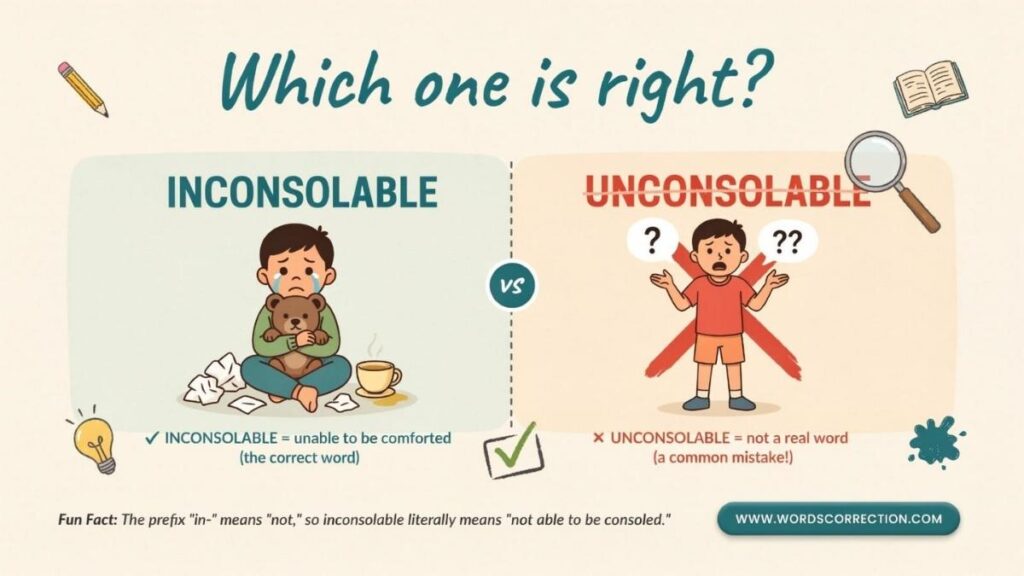
English loves to keep us guessing. Just when you think you’ve mastered a word, a tiny spelling difference appears and suddenly you’re questioning everything. That’s exactly what happens with inconsolable or unconsolable. Both forms can describe someone who is impossible to comfort, but they aren’t equally common or preferred in modern English. So, is one wrong, or is there more to the story? Don’t let this small spelling puzzle turn into a big writing headache. In this guide, we’ll clear up the confusion, explain what each word means, explore the correct usage, and provide simple examples so you can choose the right form with confidence.
Inconsolable or Unconsolable Quick Answer
Inconsolable is the standard and more common choice. Use it when you mean that someone cannot be comforted because of extreme sadness, grief, distress, or emotional suffering.
Unconsolable also exists and carries essentially the same meaning. Major dictionaries recognize it, but it is less frequent than inconsolable. Oxford specifically labels unconsolable as less frequent than inconsolable.
| Word | Meaning | Standard usage | Best choice? |
| Inconsolable | Unable to be comforted or consoled | Very common and established | Yes |
| Unconsolable | Unable to be comforted or consoled | Recognized but less frequent | Usually no |
The simplest rule is:
If someone cannot be consoled, describe them as inconsolable.
For example:
- Correct and preferred: She was inconsolable after her father’s death.
- Recognized but less common: She was unconsolable after her father’s death.
The first version is the one most readers will expect in polished modern English.
Inconsolable or Unconsolable Meaning
The inconsolable or unconsolable meaning is essentially the same: someone is so upset or distressed that ordinary attempts to comfort them don’t seem to work.
The word inconsolable describes an emotional state rather than simply saying that someone is sad. A person can feel sad and still accept comfort. Someone who is inconsolable is experiencing a much stronger emotional reaction.
For example, imagine a child losing a beloved pet. The child cries, refuses to be comforted, and remains deeply distressed even after receiving hugs and reassurance. Calling the child inconsolable communicates the intensity of that reaction.
Inconsolable Meaning
The inconsolable meaning is:
Unable to be comforted, consoled, or reassured because of intense emotional distress.
Merriam-Webster defines inconsolable as “incapable of being consoled” and gives disconsolate as a synonym. Oxford similarly defines it as being very sad and unable to accept help or comfort.
In everyday language, an inconsolable person may be:
- extremely upset
- deeply distressed
- overwhelmed with grief
- heartbroken
- devastated
- crying uncontrollably
- unable to accept comfort
- experiencing profound sadness
- grieving intensely
The word often appears in situations involving death, loss, heartbreak, tragedy, disappointment, or severe emotional pain.
Learn the difference between confusing more English words
Emerse or Immerse Correct Spelling and Use
What Does Inconsolable Mean?
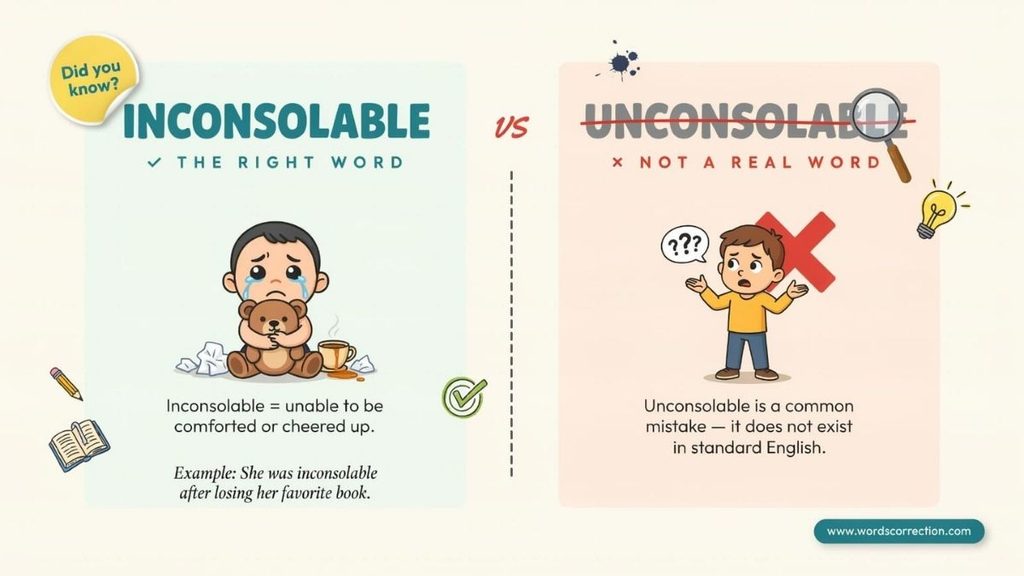
If you’re asking what does inconsolable mean in the simplest possible terms, it means:
So upset or distressed that you cannot be comforted.
For example:
After hearing the devastating news, Maria was inconsolable.
This sentence doesn’t merely tell you that Maria was sad. It suggests that her emotional pain was so intense that reassurance and comfort couldn’t ease it.
Inconsolable Definition
The inconsolable definition can be broken into two ideas:
- in- = not
- consolable = able to be consoled
So the basic sense is not able to be consoled.
That doesn’t mean a person will literally never recover. It describes their emotional condition at a particular time. Someone may be inconsolable for hours, days, or longer depending on the situation.
Unconsolable Meaning and Definition
The unconsolable meaning is essentially the same as the meaning of inconsolable: unable to be comforted or consoled.
So, if you’re searching for the unconsolable definition, the practical answer is:
Unconsolable means extremely upset or sad and unable to accept comfort.
Oxford lists unconsolable and defines it as very sad and unable to accept help or comfort. Its American English entry gives it as equivalent to inconsolable.
This creates an important distinction between meaning and preferred usage.
The meaning isn’t the main problem. Both words can communicate the same idea. The bigger question is which form sounds more conventional to modern English readers.
For most formal, educational, professional, and general-purpose writing, inconsolable is the better choice.
Learn the difference between commonly mixed-up more words
Lader or Ladder Which One Is Correct?
What Does Unconsolable Mean?
If you’re wondering what does unconsolable mean, think of it as another way of expressing the idea of being inconsolable.
For example:
The child was unconsolable after losing her favorite toy.
The intended meaning is clear. The child couldn’t be comforted.
Still, inconsolable would generally be the more natural choice:
The child was inconsolable after losing her favorite toy.
That’s the form that should usually appear in carefully edited writing.
Is Unconsolable a Word?
Yes. Unconsolable is a word.
This is where the answer becomes more interesting than a simple “correct versus incorrect” rule. Merriam-Webster includes unconsolable as an adjective and defines it as inconsolable. Oxford also includes it, with usage information showing that inconsolable is more frequent.
Therefore, saying that unconsolable is completely nonexistent would be inaccurate.
A better explanation is:
Unconsolable is a recognized but less frequent variant. Inconsolable is the standard and preferred choice for most modern English writing.
Is Inconsolable a Word?
Absolutely. Inconsolable is an established English adjective.
Merriam-Webster records its first known use in 1596, and Oxford traces the word to the late 16th century.
It remains widely used today in journalism, literature, conversation, and formal writing.
Why Is Inconsolable the Preferred Word?
Here’s where English gets a little mischievous.
At first glance, unconsolable seems perfectly logical. English has words such as unhappy, unable, uncomfortable, and unbearable. Why shouldn’t consolable become unconsolable?
The problem is that English vocabulary doesn’t always develop through perfectly predictable patterns.
Inconsolable has a long-established history. It comes from Latin inconsolabilis, which combines in- with consolabilis, meaning “consolable.”
In other words, the word wasn’t created recently by someone deciding which negative prefix sounded best. It has centuries of established usage behind it.
Console → Consolable → Inconsolable
The word family makes the relationship easier to see:
console → consolable → inconsolable
- Console = to comfort someone who is suffering.
- Consoled = comforted.
- Consolation = comfort given during sadness or difficulty.
- Consolable = capable of being consoled.
- Inconsolable = unable to be consoled.
The historical development supports this structure. Merriam-Webster traces inconsolable to Latin inconsolabilis, while Etymonline identifies the Latin elements in- and consolabilis.
Interestingly, Etymonline dates consolable to around 1721 and notes that it may have developed as a back-formation from inconsolable.
That historical detail explains why modern speakers shouldn’t assume that inconsolable was simply created by putting in- in front of an already common English word consolable.
Learn the difference between tricky grammar more words
Presence or Presense Which Spelling Is Correct?
The Origin of Inconsolable
The history of inconsolable goes back more than four centuries in English.
Merriam-Webster gives 1596 as the first known use. Etymonline places its origin in the 1590s and traces it to Latin inconsolabilis. Oxford likewise identifies the word as a late-16th-century formation from French or Latin.
The deeper root connects to the idea of soothing or comforting someone who is suffering.
The related verb console ultimately comes from Latin consolari, meaning to offer solace, encourage, comfort, or cheer. Oxford traces this through French and Latin and connects consolari with solari, meaning to soothe.
That history gives the modern word a surprisingly clear internal logic.
who is consoled receives comfort.
Someone who is consolable can receive that comfort.
Someone who is inconsolable cannot be comforted effectively at that moment.
Is Inconsolable or Unconsolable a British or American Difference?
No. The inconsolable vs unconsolable distinction isn’t simply a British English versus American English spelling difference.
Both forms appear in English-language dictionaries. However, inconsolable is more frequent and more firmly established as the conventional choice.
Oxford’s standard entry lists inconsolable and notes unconsolable as a less frequent form. Its American English entry also recognizes unconsolable as equivalent to inconsolable.
So you shouldn’t think:
American English = inconsolable
British English = unconsolable
That rule would be wrong.
Instead, think:
Inconsolable = preferred and more common
Unconsolable = recognized alternative, but less frequent
For US English
If you’re writing for an American audience, inconsolable is the safest and most natural choice.
It works well in:
- school assignments
- articles
- websites
- journalism
- business writing
- formal correspondence
- fiction
- everyday conversation
For UK English
The same basic recommendation applies.
British English also uses inconsolable, and Oxford identifies it as the more frequent form.
For Global English
When writing for an international audience, choosing the more widely established form reduces unnecessary friction.
That’s another reason inconsolable wins as the practical vocabulary choice.
How to Use Inconsolable Correctly
Inconsolable is an adjective. It describes a person or, in some contexts, their emotional state.
It often appears after a linking verb:
She was inconsolable after the loss.
It can also come directly before a noun:
The inconsolable child refused to leave her mother’s side.
The word is especially natural when the cause of distress involves loss or grief.
Oxford lists grief among the nouns that commonly occur with inconsolable.
Learn the difference between confusing word pairs
Gos or Goes Which One Is Right?
Common Expressions
You’ll often see phrases such as:
- inconsolable with grief
- inconsolable with sadness
- inconsolable after a loss
- inconsolable after the death of someone
- an inconsolable child
- an inconsolable baby
- inconsolable crying
- completely inconsolable
- emotionally inconsolable
- inconsolable grief
For example:
She was inconsolable with grief after losing her mother.
The inconsolable child continued crying despite every attempt to comfort him.
He was completely inconsolable after the final result.
Inconsolable in a Sentence
If you’re looking for inconsolable in a sentence, here are examples across several contexts.
Grief
She was inconsolable after her brother died.
This is one of the most typical uses. The word communicates profound sadness rather than ordinary disappointment.
Personal Loss
He became inconsolable after learning that his longtime friend had passed away.
Here, the word highlights the intensity of the emotional response.
Children
The inconsolable child cried for nearly an hour before finally calming down.
Children can become inconsolable when they’re frightened, hurt, exhausted, or experiencing a major emotional upset.
Disappointment
The young athlete was inconsolable after missing the winning shot.
The word doesn’t apply only to death or bereavement. Severe disappointment can also leave someone unable to accept comfort.
News Reporting
Family members described her as inconsolable after receiving the news.
Journalists frequently use the word when describing intense reactions to tragic events. Merriam-Webster’s current example collection includes usage involving death, sports losses, personal tragedy, and other forms of distress.
Learn the difference between often confused words
To or Too Clear Difference, Meaning and Usage
Inconsolable Examples
The following inconsolable examples show how the word changes slightly with context while keeping its central meaning.
| Situation | Example |
| Grief | She was inconsolable after her father’s death. |
| Heartbreak | He was inconsolable after the relationship ended. |
| Childhood distress | The inconsolable child wouldn’t stop crying. |
| Pet loss | She became inconsolable after losing her dog. |
| Major disappointment | The player was inconsolable after the defeat. |
| Tragedy | The family was inconsolable after hearing the news. |
| Severe sadness | He sat alone, inconsolable with grief. |
Notice the common thread. In every example, the person’s emotional reaction is too intense for ordinary comfort to relieve easily.
Inconsolable Synonyms
Looking for an inconsolable synonym depends on the exact emotional context.
Merriam-Webster’s thesaurus lists words including heartbroken, sad, unhappy, miserable, melancholy, upset, sorrowful, disconsolate, mournful, dejected, hopeless, forlorn, distressed, and despondent among related terms.
However, these words aren’t perfect substitutes in every sentence.
Learn the difference between basic English word mistakes
Inact or Enact Which Spelling Is Correct?
Useful Inconsolable Synonyms
- Heartbroken — deeply hurt by emotional loss.
- Devastated — severely affected by a shocking or painful event.
- Distraught — extremely upset and emotionally disturbed.
- Disconsolate — deeply unhappy or lacking comfort.
- Mournful — expressing sadness, especially after a loss.
- Despondent — having little hope or confidence.
- Sorrowful — feeling or expressing deep sadness.
- Forlorn — lonely, abandoned, or hopeless.
For example, heartbroken may fit a breakup particularly well, while inconsolable emphasizes the person’s inability to receive comfort.
That’s an important distinction.
Unconsolable Synonyms
Because unconsolable means essentially the same thing as inconsolable, its synonyms overlap.
Useful unconsolable synonyms include:
- heartbroken
- devastated
- distraught
- disconsolate
- sorrowful
- mournful
- despondent
- deeply distressed
- overwhelmed with grief
Still, if a sentence calls for the established adjective, switching from inconsolable to unconsolable doesn’t give you a meaningful difference in emotion. It mainly changes the word choice.
Learn the difference between commonly misused words
Maxxed or Maxed: Which Spelling Is Correct?
Inconsolable vs. Related Words
Not every strong emotional adjective means the same thing.
| Word | Meaning | Example |
| Inconsolable | Unable to be comforted | She was inconsolable after the loss. |
| Distraught | Extremely upset or distressed | He was distraught by the news. |
| Heartbroken | Deeply hurt by emotional loss | She was heartbroken after the breakup. |
| Devastated | Overwhelmed by a painful event | They were devastated by the tragedy. |
| Sad | Experiencing unhappiness | He felt sad after the argument. |
| Uncontrollable | Impossible to control | She had uncontrollable crying. |
| Despondent | Deeply discouraged or without hope | He became despondent after repeated failures. |
The difference between inconsolable and uncontrollable is especially important.
If someone is inconsolable, other people cannot comfort them.
If someone’s crying is uncontrollable, the crying itself cannot easily be stopped.
Those ideas can overlap, but they aren’t identical.
Common Mistakes in both
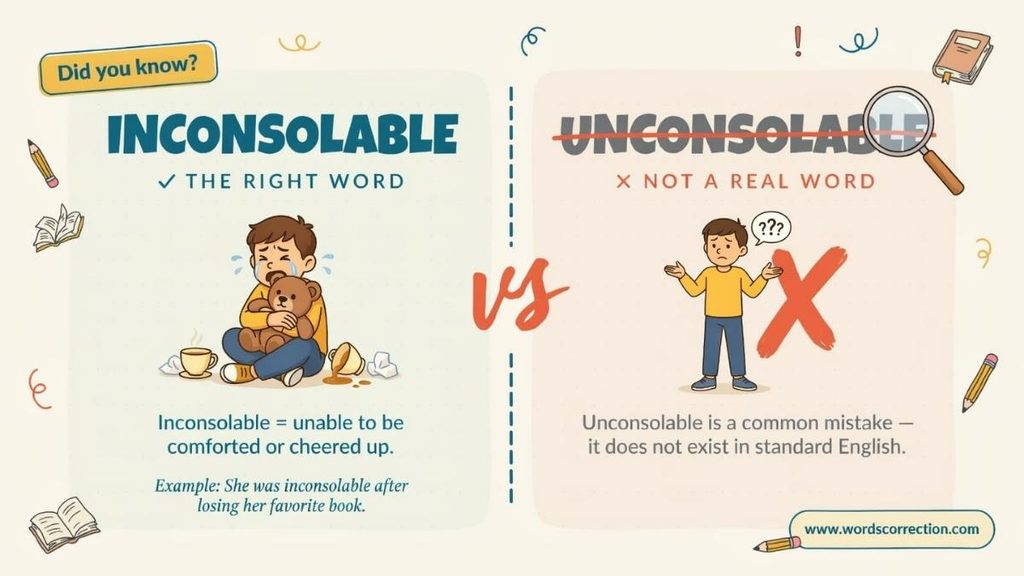
Mistake: Assuming “Unconsolable” Must Be Wrong
This is one of the biggest misunderstandings.
Because inconsolable is the preferred form, it’s tempting to call unconsolable completely incorrect. That’s too absolute.
Major dictionaries recognize unconsolable. Merriam-Webster gives it as a synonym of inconsolable, while Oxford lists it as a less frequent alternative.
The better advice is:
Use inconsolable as the standard and preferred form. Recognize unconsolable as an uncommon variant.
Mistake: Assuming It Is a Regional Spelling Difference
It isn’t a straightforward American-versus-British distinction.
Both forms occur in dictionaries that cover different varieties of English.
Mistake: Thinking the Prefix Must Be “Un-”
English prefixes can be deceptive.
Words such as unhappy and unable make un- look like the obvious negative prefix. However, English inherited words from different linguistic sources and developed multiple ways to express negation.
The history of inconsolable explains why in- belongs in the established form.
Mistake: Using Inconsolable for Every Kind of Sadness
A person who is mildly disappointed isn’t necessarily inconsolable.
Compare:
I was sad when the concert was canceled.
with:
She was inconsolable after the tragic news.
The second sentence signals a much stronger emotional reaction.
Learn the difference between everyday English mistakes
Unattentive or Inattentive Meaning and Usage
Case Study: Choosing the Right Word in Context
Consider three situations.
Situation one: A student receives a lower grade than expected. She feels disappointed but quickly moves on.
The best description might be upset, disappointed, or discouraged.
Situation two: A person loses a beloved family member and cannot stop crying despite receiving support from friends and relatives.
Inconsolable fits naturally.
Situation three: Someone writes unconsolable in a formal article.
The word isn’t meaningless. Readers can understand it, and dictionaries recognize it. However, inconsolable is the more conventional and frequent form.
This illustrates the real issue: good word choice isn’t always about whether readers can understand a word. It’s also about standard usage, frequency, context, and audience expectations.
Is Unconsolable Correct?
Yes, but with an important qualification.
Unconsolable is recognized as an English adjective meaning inconsolable. Merriam-Webster lists it directly, and Oxford includes it as an alternative form.
However, if you’re asking is unconsolable correct in the sense of “Is this the form I should normally use in polished writing?” then inconsolable is the better answer.
That distinction keeps the explanation accurate without pretending that dictionary-listed vocabulary doesn’t exist.
Is Inconsolable Correct?
Yes. Inconsolable is the correct and preferred spelling in standard modern English.
It is a well-established adjective with a history reaching back to the 16th century. Merriam-Webster records its first known use as 1596, and Oxford identifies it as a late-16th-century word.
So if you’re deciding between the two forms for an essay, article, email, report, or website, choose inconsolable.
Correct Spelling of Inconsolable
The correct spelling of inconsolable is:
I-N-C-O-N-S-O-L-A-B-L-E
A useful way to remember it is to connect it with console:
in + consolable = inconsolable
Don’t let the familiar negative prefix un- lure you into assuming that unconsolable is automatically the preferred spelling.
Correct Spelling of Unconsolable
The correct spelling of unconsolable, when the word is used, is:
U-N-C-O-N-S-O-L-A-B-L-E
It is a recognized form. However, its status differs from inconsolable in terms of frequency and conventional preference.
So there are two separate questions:
- Is unconsolable a recognized word? Yes.
- Is unconsolable the preferred form? Usually no.
That distinction is the heart of the inconsolable vs unconsolable question.
Inconsolable Pronunciation
The standard inconsolable pronunciation is represented by Merriam-Webster as:
/ˌɪn-kən-ˈsō-lə-bəl/
The main stress falls on the syllable associated with sole in the middle of the word. Merriam-Webster and Oxford both provide pronunciation information for the word.
The pronunciation has several syllables, so saying the word slowly at first can make it easier to recognize in conversation.
The related form unconsolable has its stress in a similar position, although the opening vowel changes because the word begins with un-.
Learn the difference between more words people mix up
Handle or Handel Correct Spelling, Meaning, and Usage
Why the Difference Matters in Formal English
Language is more than grammar. Word choice also signals familiarity with conventional usage.
When writing for a broad audience, choosing the more established form reduces the chance that readers will pause and wonder whether the word is unusual.
That’s why inconsolable is generally preferable in:
- academic writing
- professional documents
- journalism
- educational content
- SEO articles
- formal correspondence
- edited publications
- general-purpose writing
There may be contexts where unconsolable appears naturally, especially when reproducing a particular style or source. But when choosing the word yourself, inconsolable is the safer vocabulary choice.
Practice Session
Fill in the Blanks
Instructions: Fill in each blank with the correct word or phrase related to inconsolable and unconsolable.
- After hearing the heartbreaking news, she was completely __________.
- The child became __________ after losing his favorite toy.
- Inconsolable describes someone who cannot be __________.
- The mother was __________ with grief after the loss of her loved one.
- He was so distressed that his friends could not __________ him.
- The baby had been crying __________ for several minutes.
- In standard English, __________ is generally the more common form.
- Someone who is extremely sad and cannot be comforted may be described as __________.
- The family was __________ after receiving the tragic news.
- She remained __________ despite everyone’s efforts to comfort her.
- The word __________ means extremely upset and unable to be comforted.
- Inconsolable is commonly used when describing intense grief, sadness, or emotional __________.
- The grieving father was __________ after the funeral.
- The child was crying so intensely that he seemed completely __________.
- A person who can be comforted is not __________.
- The word inconsolable is an __________ that describes a person’s emotional state.
- After the sudden loss, she became __________ and could not stop crying.
- The nurse tried to __________ the distressed child.
- Unconsolable is much less __________ than inconsolable in standard English.
- If someone is too upset to accept comfort, they may be described as __________.
- Disconsolate is a related word that means extremely unhappy or unable to find __________.
- The grieving woman was __________ after learning about the loss.
- The phrase “crying __________” emphasizes that someone cannot stop crying.
- When choosing between the two forms, __________ is generally the safer choice for formal writing.
- In simple terms, inconsolable means too upset or sad to be __________.
Answer Session
- inconsolable
- inconsolable
- comforted
- inconsolable
- comfort
- inconsolably
- inconsolable
- inconsolable
- inconsolable
- inconsolable
- inconsolable
- distress
- inconsolable
- inconsolable
- inconsolable
- adjective
- inconsolable
- comfort
- common
- inconsolable
- comfort
- inconsolable
- inconsolably
- inconsolable
- comforted
Here’s a trusted source for clear more words Comparison:
Grammar Update
FAQs
Is “unconsolable” a word?
Yes, unconsolable is a recognized word that means unable to be comforted. However, inconsolable is the more common and preferred form in standard English.
What does “inconsolable” mean?
Inconsolable describes someone who is extremely upset, sad, or distressed and cannot be comforted or consoled.
Which is correct: “inconsolable” or “unconsolable”?
Both words can be used, but inconsolable is the standard and more widely used form. It is generally the better choice for formal, academic, and professional writing.
Does “inconsolable” mean sad?
Yes, but inconsolable conveys more than ordinary sadness. It describes a person whose grief, sadness, or distress is so intense that they cannot be comforted.
What’s another word for “inconsolable”?
Depending on the context, alternatives include distraught, devastated, heartbroken, grief-stricken, despondent, and sorrowful.
What are some synonyms for “crying inconsolably”?
Common alternatives include crying uncontrollably, sobbing uncontrollably, weeping bitterly, and being unable to stop crying.
What is the opposite of “inconsolable”?
Depending on the context, possible opposites include comforted, consoled, reassured, calm, and content.
How do you use “inconsolable” in a sentence?
Use inconsolable to describe someone experiencing overwhelming sadness or distress. For example: “She was inconsolable after hearing the heartbreaking news.”
How do you pronounce “inconsolable”?
Inconsolable is pronounced with the main stress on the second syllable. The word has four syllables in standard English.
What does “inconsolable” mean in Spanish?
In Spanish, inconsolable is also used to describe someone who cannot be comforted or consoled. The meaning is essentially the same as in English.
Is “inconscionable” a word?
Yes. Inconscionable is a word, but it has a different meaning from inconsolable. It generally describes something that is unreasonable, unfair, or unacceptable.
What does “disconsolate” mean?
Disconsolate means extremely unhappy, sorrowful, or unable to find comfort. It is closely related to inconsolable, although the two words are not always interchangeable.
What are some synonyms for “disconsolate”?
Depending on the context, synonyms include dejected, despondent, miserable, sorrowful, downcast, and distraught.
Can “inconsolable” describe a child?
Yes. Inconsolable can describe a child who is extremely upset or crying and cannot be comforted despite attempts to calm them.
Can “inconsolable” describe grief?
Yes. Inconsolable is commonly used to describe overwhelming grief, particularly after a significant loss.
What does it mean when someone is inconsolable?
When someone is inconsolable, they are experiencing such intense sadness, grief, or emotional distress that attempts to comfort them do not seem to help.
What is a sophisticated word for extremely sad?
Words such as despondent, distraught, devastated, sorrowful, and anguished can describe intense sadness. The best choice depends on the specific context.
What is the difference between “sad” and “inconsolable”?
Sad describes a general feeling of unhappiness. Inconsolable describes a much more intense emotional state in which a person cannot easily be comforted.
19. Can “inconsolable” describe emotions other than sadness?
Yes. Although it is most often associated with grief and sadness, inconsolable can describe overwhelming emotional distress more broadly.
What is the noun form related to “inconsolable”?
There is no commonly used direct noun form of inconsolable. Depending on the context, words such as grief, sadness, distress, sorrow, or despair may express the underlying feeling.
What adjective is related to “consolation”?
Consolatory is an adjective related to consolation. It describes something intended to provide comfort or consolation.
Is “inconsolable” considered standard English?
Yes. Inconsolable is a standard English adjective and is appropriate for everyday, formal, academic, and professional writing.
Is “unconsolable” less common than “inconsolable”?
Yes. Unconsolable is much less common than inconsolable. If you want the more conventional choice in standard English, inconsolable is generally preferred.
What does “inconsolable” mean in simple terms?
Inconsolable means so upset or sad that you cannot be comforted.
When should you use “inconsolable”?
Use inconsolable when you want to emphasize that someone is experiencing intense emotional distress and cannot be comforted. It is especially appropriate when describing grief, loss, overwhelming sadness, or persistent crying.
Conclusion: Inconsolable or Unconsolable
English has a remarkable talent for turning a simple spelling choice into a surprisingly confusing language puzzle. When it comes to inconsolable or unconsolable, however, the answer is fairly straightforward. Inconsolable is the more common and preferred form in modern English. It describes someone who is so deeply upset, distressed, or overcome with grief that they cannot be comforted.
Unconsolable is also recognized as a word and carries essentially the same meaning, but it is less frequent. Therefore, if you’re writing an essay, article, email, or professional document, inconsolable is the safer and more natural choice.
Remember the simple rule: if someone cannot be consoled, they are inconsolable. One small spelling mystery solved, and one less word to second-guess.

Stella AJS is an experienced blogger and dedicated English language writer at Words Correction. She turns confusing grammar, word meanings, spelling, and usage into clear, practical insights that readers can easily understand and apply. With a passion for precise and engaging writing, Stella helps readers avoid common language mistakes, strengthen their vocabulary, and communicate with greater clarity and confidence.




