Is it Happy New Year or Happy New Years? A tiny letter can turn a simple holiday greeting into a grammar puzzle! As the countdown begins and fireworks light up the sky, the last thing you want is to make a spelling mistake in your New Year message. Fortunately, getting it right is easier than finding the last piece of holiday cake. In this guide, you’ll learn which greeting is correct, understand the difference between year, years, and year’s, and avoid common grammar mistakes. You’ll also test your knowledge with simple fill in the blank exercises. By the end, you’ll welcome the New Year with confidence and correct grammar.
Happy New Year or Happy New Years The Quick Answer
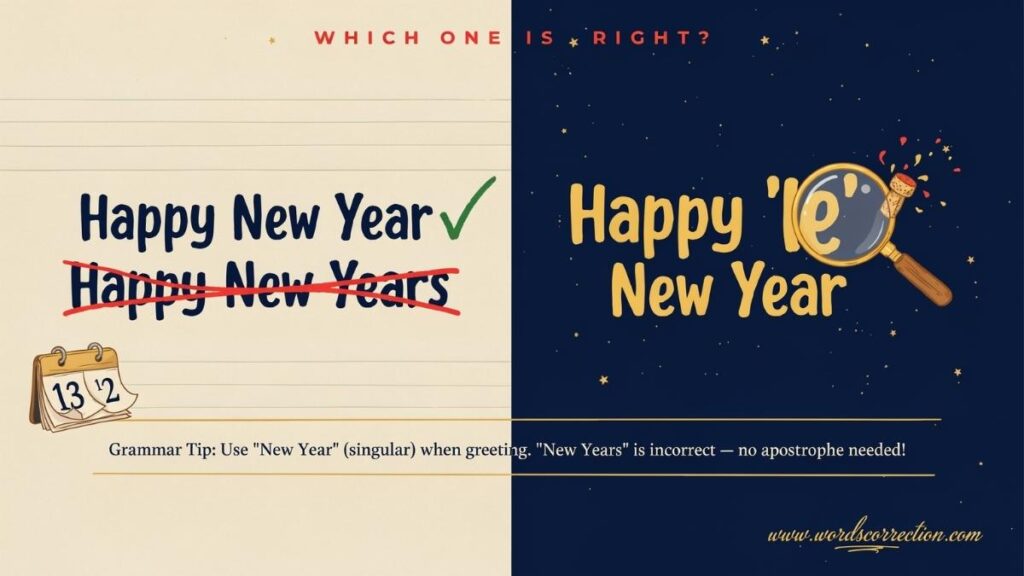
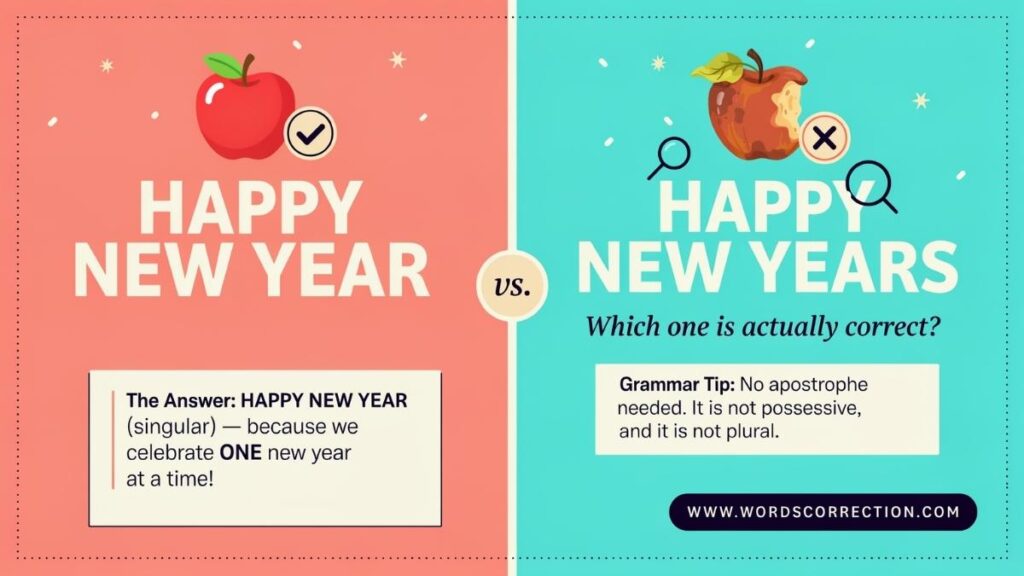
it is the standard and preferred greeting for welcoming the year ahead. Although people sometimes say “Happy New Years” in casual conversation, the version without the final s is the conventional choice in standard written English.
Here’s the simple rule
- Happy New Year! — The standard greeting for friends, family, colleagues, and acquaintances.
- New Year’s Eve — The holiday observed on December 31.
- New Year’s Day — The holiday observed on January 1.
- New years — A plural expression that can refer to multiple years or annual celebrations.
For example, you might write, “Wishing you a wonderful year filled with success.” However, when discussing several celebrations, you could say, “We’ve spent three New Years together.”
The key is understanding what you mean. The standard greeting expresses good wishes for the coming year, while the plural form refers to multiple years or celebrations.
Why Is Happy New Year Correct?
The reason behind the correct New Year greeting comes down to the meaning of the noun year and the way English uses nouns in expressions of goodwill.
When you say “Happy New Year!” you’re wishing someone happiness in the year beginning or the year ahead. You’re not wishing them happiness in several different years at once. The singular noun fits the meaning of the greeting.
The Meaning of New Year
A new year marks the beginning of another calendar year. In the Gregorian calendar, which serves as the civil calendar in the United States and many other countries, January 1 marks the start of the year.
The phrase can refer to the year just beginning, the upcoming year, or the transition into a new calendar period.
Consider these examples
- I hope you have a wonderful new year.
- The new year begins on January 1.
- We’re making plans for the new year.
- Happy New Year!
Each sentence refers to one year in the relevant context. The greeting follows the same basic idea.
Learn the difference between more words people mix up
Chose or Choose What’s the Difference?
Why the Greeting Doesn’t Need an S
English nouns usually take an s or es when they become plural. For example, year becomes years, just as holiday becomes holidays.
However, a plural noun isn’t automatically appropriate just because the New Year celebration includes several events or gatherings. The greeting refers to the year ahead, not to a collection of years.
Compare the following expressions:
| Expression | Meaning | Standard usage |
| Happy New Year! | A wish for happiness in the coming year | Standard greeting |
| Happy New Years! | An informal variant of the greeting | Not the preferred standard form |
| Several new years | Multiple years or annual occasions | Correct when the context supports the plural |
| A happy new year | A description or wish concerning one year | Correct in a sentence |
Think of it this way: if you’re welcoming one new calendar year, the singular form does the job. Adding an s doesn’t make the wish warmer or more complete.
it is Grammatically Correct?
The answer depends on the context.
As a conventional holiday greeting, Happy New Years is nonstandard. In formal writing, business messages, school assignments, and carefully edited content, choose Happy New Year.
However, the words new years aren’t inherently incorrect. English speakers can use the plural when they refer to multiple years or repeated annual celebrations.
For example
- Correct: We’ve celebrated many New Years together.
- Correct: The tradition continued across several new years.
- Preferred greeting: Happy New Year!
The distinction matters because a phrase can be unsuitable as a greeting without being grammatically incorrect in every sentence. Context, meaning, and conventional usage all play a role.
Learn the difference between everyday English mistakes
Leafs or Leaves Which one Is Correct?
New Year vs New Years vs New Year’s What’s the Difference?
The phrases New Year, New Years, and New Year’s look similar, but each serves a different purpose. Understanding these differences will help you avoid common English language mistakes.
| Form | Grammatical role or meaning | Example |
| New Year | Refers to the beginning of a year or the upcoming year | Happy New Year! |
| new year | General reference to a calendar year beginning | I’m excited about the new year. |
| New Year’s | Appears in established holiday names and possessive constructions | New Year’s Eve is tomorrow. |
| New Years | Plural form referring to multiple years or annual celebrations | They celebrated several New Years abroad. |
New Year One Year or the Year Ahead
Use new year when you mean one new calendar year or the period that begins with it.
For example
“The new year gives us an opportunity to review our goals.”
Here, new year refers to the upcoming calendar period. The phrase doesn’t require an apostrophe or a plural ending.
The same words appear in the standard greeting, New Year! In that expression, the greeting offers good wishes for the year ahead.
New Year’s The Possessive Form
The apostrophe in New Year’s is important. It marks a possessive construction in expressions such as New Year’s Eve and New Year’s Day.
The possessive form connects the holiday to the new year. It appears in established names for occasions associated with the calendar transition.
Examples include
- New Year’s Eve
- New Year’s Day
- New Year’s resolutions
- New Year’s party
- New Year’s celebration
In ordinary writing, the apostrophe goes before the s because the expression uses the singular noun year in the possessive form.
New Years The Plural Form
Use new years when you genuinely mean more than one year or annual celebration.
For instance, someone might write, “We have spent the last five New Years with our grandparents.” In this sentence, the plural refers to five separate annual occasions.
The expression can also appear in discussions of traditions, memories, and events that recur every year.
However, don’t confuse a plural noun with a possessive noun. New Years and New Year’s aren’t interchangeable simply because they look alike.
Learn the difference between commonly misused words
Loosing or Losing Which Spelling Is Correct?
New Year’s or New Years When Do You Need an Apostrophe?
One of the most common New Year spelling mistakes involves leaving out the apostrophe in a holiday name. Fortunately, the rule is easy to apply once you recognize the grammatical role of each form.
Why New Year’s Eve Has an Apostrophe
New Year’s Eve is the established name for December 31, the final day of the calendar year. The apostrophe appears in the possessive form New Year’s.
Correct examples
- We’re having dinner on New Year’s Eve.
- The New Year’s Eve party starts at 8 p.m.
- They watched the fireworks on New Year’s Eve.
Incorrect in standard writing
- We’re having dinner on New Years Eve.
- The New Years Eve party starts at 8 p.m.
The missing apostrophe changes the grammatical form and doesn’t follow the conventional spelling of the holiday name.
Learn the difference between commonly confused more words in English
Canceled vs Cancelled Which Spelling Is Correct?
Why New Year’s Day Has an Apostrophe
New Year’s Day is the name for January 1. Like New Year’s Eve, it uses the possessive form.
Examples
- New Year’s Day falls on January 1 in the Gregorian calendar.
- We’re visiting family on New Year’s Day.
- The store will open later on New Year’s Day.
The same rule applies to other established expressions that use New Year’s, such as New Year’s resolution.
Is Happy New Year’s Correct?
As a standalone greeting.The preferred greeting is Happy New Year! without an apostrophe or an s.
However, New Year’s is correct when it belongs to a larger expression or sentence.
Compare these examples
- Correct holiday name: New Year’s Eve
- Correct holiday name: New Year’s Day
- Correct sentence: I hope your New Year’s celebration is wonderful.
The last example uses New Year’s to describe the celebration associated with the holiday. The apostrophe belongs there because the phrase serves a different grammatical purpose.
Learn the difference between basic English word mistakes
Mangoes or Mangos Which Spelling Is Correct?
When Should You Say Happy New Year?
Choosing the right words is only part of the question. People also wonder when they should use a New Year greeting.
The good news is that you don’t need to wait until midnight to wish someone well. People commonly exchange New Year wishes before and after the calendar changes.
Do You Say Happy New Year on December 31?
Yes, you can say it on December 31, especially when you expect to celebrate with someone before midnight or won’t see them again until the next year.
December 31 is New Year’s Eve. People often use this greeting throughout the day as they prepare for parties, family gatherings, and the countdown to midnight.
For example
- “Wishing you a wonderful New Year! Have a great time tonight.”
- “I’m heading out early, so I wanted to send you my best wishes for the coming year.”
- “Warm wishes to you and your family for the year ahead!”
These are all natural ways to express good wishes for the coming year.
Do You Say Happy New Year Before Midnight?
Absolutely. The greeting looks toward the year ahead, so you can use it before the new calendar year officially begins.
At a New Year’s Eve party, someone might say it at 10 p.m. while greeting friends. Another person might wait until midnight to offer the same wish.
Both choices are appropriate. The timing depends on the situation and personal preference.
Can You Say Happy New Year on January 1?
Yes. January 1 is New Year’s Day, making it one of the most common occasions for the greeting.
You might say it when visiting relatives, sending a text, posting on social media, or returning a greeting from a friend.
For example
” New Year! Wishing you a year filled with good health, meaningful experiences, and success.”
The phrase remains the same whether you say it in person or write it in a message.
Learn the difference between often confused words
Each Other or Eachother Which Spelling Is Correct?
When Should You Stop Saying Happy New Year?
There isn’t a universal deadline. People often exchange greetings during the first days of January, and some continue throughout the early weeks of the month.
Your relationship with the recipient and the context matter more than a strict date.
For example, a message sent on January 2 won’t seem unusual. A greeting sent in late January might still be friendly, especially if you haven’t spoken to the recipient since the holiday. You can make it feel more natural by acknowledging the delay.
” I know January is already underway, but I hope it’s off to a wonderful start.”
That wording keeps the greeting warm without pretending the holiday just began.
Happy New Year Capitalization What Is the Correct Form?
Capitalization is another source of confusion. Should you write happy new year, or Happy new year?
The answer depends on where the phrase appears and which style you’re following.
Capitalization in Greetings
When you use the expression as a standalone greeting, capitalizing the main words is the conventional choice.
Examples
- Best wishes for the coming year!
- Wishing you joy and happiness in the year ahead!
Capital letters help present the expression as a greeting. This form works well in cards, messages, social posts, and professional correspondence.
Capitalization in Ordinary Sentences
When you refer to the new year generically in the middle of a sentence, lowercase is often appropriate.
For example
- We’re looking forward to the new year.
- The new year starts next week.
However, writers sometimes capitalize New Year when they treat it as a holiday-related expression or follow a publication’s style. The best approach is to follow the style guide used for your document and remain consistent.
Learn the difference between confusing word pairs
Patient or Patience what’s the Difference?
Capitalization of New Year’s Eve and New Year’s Day
In standard American English, the names of holidays are capitalized.
Correct examples
- New Year’s Eve
- New Year’s Day
- Christmas Day
- Independence Day
Don’t capitalize every occurrence of new year automatically. The capitalization depends on whether you’re writing a holiday name, using the greeting, or referring to the coming calendar year in a general sentence.
How to Write Happy New Year in Different Situations
The correct greeting doesn’t have to sound stiff. You can keep the standard spelling while adjusting the message to suit the person receiving it.
Wishing New Year Messages for Friends
Friends usually appreciate a warm and natural message. Keep it personal rather than filling it with formal language.
Examples
- Wishing you a fantastic New Year filled with good times and exciting adventures.
- Happy New Year! I hope this one brings you everything you’ve been working toward.
If humor fits your relationship, you could write, “Happy New Year! May your coffee stay strong and your resolutions last longer than a week.”
The wording can be playful. The spelling stays the same.
New Year Wishes for Family
Family greetings can express affection, gratitude, and hopes for the year ahead.
Examples
- Happy New Year to my wonderful family. Wishing everyone health, peace, and happiness.
- May the coming year bring our family more time together and many reasons to smile.
- Happy New Year! I’m grateful for all the memories we’ve made and excited for those still to come.
A New Year greeting card is also a good place to mention a shared memory or a hope for the coming year.
Happy New Year Messages for Work
Professional greetings should feel friendly without becoming overly personal. The standard form works well in emails to colleagues, clients, managers, and business partners.
Examples
- Happy New Year! I wish you a successful and rewarding year ahead.
- Wishing you and your team a happy and prosperous New Year.
For a more formal email, you might write
“Best wishes for a happy and successful New Year. Thank you for your continued partnership.”
These messages follow standard New Year spelling and maintain a professional tone.
Learn the difference between tricky grammar more words
In Person vs In-Person When to Use the Hyphen
Happy New Year Greetings for Social Media
Social media posts often use short, upbeat wording. You can make your greeting memorable without changing the standard expression.
Examples
- Happy New Year! New goals, fresh energy, and plenty of reasons to smile.
- Happy New Year! May the next 12 months bring growth, joy, and good memories.
Whether you write a short caption or a longer reflection, the correct New Year greeting remains it
Common New Year Grammar Mistakes to Avoid
Even a short holiday greeting can raise questions about spelling, punctuation, and grammar. The easiest way to avoid mistakes is to understand which form fits your sentence.
Here are the most common errors and how to correct them.
| Common mistake | Correct form | Why it matters |
| Happy New Years! | Happy New Year! | The singular form is the standard greeting. |
| Happy New Year’s! | Happy New Year! | The greeting doesn’t need a possessive apostrophe. |
| New Years Eve | New Year’s Eve | The established holiday name uses an apostrophe. |
| New Years Day | New Year’s Day | The established holiday name uses an apostrophe. |
| I hope you have a Happy new year. | I hope you have a happy new year. | Lowercase is appropriate for a generic reference in this sentence. |
| We celebrated many New Year’s together. | We celebrated many New Years together. | The plural noun doesn’t need a possessive apostrophe. |
Mistake Adding an Apostrophe to the Greeting
Some people write Happy New Year’s! because they’re familiar with expressions such as New Year’s Eve.
However, the greeting doesn’t need the possessive form.
Mistake Assuming New Years Is Always Wrong
The phrase new years can be correct when you mean multiple years or celebrations.
For example, “We’ve welcomed many New Years together” refers to several annual occasions. The plural makes sense because the sentence discusses repeated events.
The mistake occurs when you use that plural form as the conventional greeting.
Mistake Capitalizing Every Word
Capitalization should match the sentence and the style you’re following.
A greeting such as Happy New Year! normally uses capitals. However, a sentence such as “I hope you have a happy new year” can use lowercase because it refers to the coming year rather than treating the entire expression as a standalone greeting.
Learn the difference between commonly mixed-up more words
Color or Colour Which Spelling Is Correct?
Easy Ways to Remember the Correct New Year Spelling
Grammar rules are easier to remember when you connect them to a simple idea. These three memory tricks can help you choose the right form without stopping to think about every punctuation mark.
Remember the One Year Rule
When you’re wishing someone well for the year ahead, use the singular form.
Remember the Apostrophe Rule
When you write the established names of the holidays, include the apostrophe.
- New Year’s Eve
- New Year’s Day
The apostrophe belongs to the possessive form New Year’s. It isn’t part of the standard greeting.
Remember the Multiple-Years Rule
Use new years when you genuinely mean more than one year or annual celebration.
For example
“We’ve celebrated five New Years together.”
The sentence describes five separate occasions. The plural is appropriate because the meaning calls for it.
These rules cover most everyday situations involving the New Year greeting, holiday names, and related expressions.
A Practical Case Study Choosing the Right New Year Greeting
Imagine three people preparing messages for different situations on December 31. Each person wants to send a friendly greeting, but they aren’t sure which form to use.
Situation one A personal text
Maya texts her friend, “Happy New Years! Hope you have an amazing night!”
Her meaning is clear, and her friend will probably understand the message. However, if Maya wants to follow standard written English, she should write:
“Hope you have an amazing night!”
Situation two A professional email
Daniel emails a business client: “Wishing you a Happy New Year’s and a successful year ahead.”
The message combines two different grammatical forms. A clearer version would be:
“Wishing you a happy and successful New Year!”
This version avoids the unnecessary apostrophe and keeps the greeting natural.
Situation three A description of past celebrations
Aisha writes, “Our family has spent the last four New Years celebrating together.”
Here, New Years refers to four separate annual celebrations. The plural form works in this context.
Learn the difference between confusing more English words
Flier or Flyer Which Spelling Is Correct?
What Does This Case Study Show?
The correct choice depends on the intended meaning.
| Situation | Best wording |
| Sending a holiday greeting | Happy New Year! |
| Writing to a client | Wishing you a happy and successful New Year! |
| Describing several annual celebrations | We celebrated several New Years together. |
The lesson is simple: choose the form that matches the meaning of your sentence. A familiar phrase may sound natural in conversation, but standard writing calls for the conventional greeting.
Practice Session Fill in the Blanks
Choose the correct word or phrase to complete each sentence.
1. The correct holiday greeting is “Happy New _____!”
2. We celebrate New Year’s Day on January _____.
3. December 31 is known as New Year’s _____.
4. I wish you a happy and successful _____ ahead.
5. The standard greeting is “Happy New _____,” not “Happy New Years.”
6. The past two _____ brought many changes.
7. This _____ celebration will be special.
8. We stayed up late on New Year’s _____.
9. She sent a warm New Year _____ to her friends.
10. I hope the coming _____ brings you happiness.
11. “Happy New Year!” is a common holiday _____.
12. We made plans for the next two _____.
13. My company sent its clients a New Year _____.
14. January 1 is New Year’s _____.
15. He wished everyone a happy _____.
16. The phrase “Happy New Year” contains _____ words.
17. We celebrated the arrival of the _____ year at midnight.
18. I hope this _____ brings you success.
19. The apostrophe belongs in “New _____ Day.”
20. She wrote “Happy New _____!” on the greeting card.
21. The last few _____ have been full of exciting opportunities.
22. Our team exchanged New Year _____ before the holiday.
23. We watched the countdown on New Year’s _____.
24. I wish you happiness throughout the _____ ahead.
25. Remember to write “Happy New Year” without adding an _____ to “Year.”
Answers
- Year
- 1
- Eve
- year
- Year
- years
- year’s
- Eve
- greeting
- year
- greeting
- years
- message
- Day
- New Year
- three
- new
- year
- Year’s
- Year
- years
- greetings
- Eve
- year
- s
Here’s a trusted source for clear word meanings:
Cambridge Dictionary
FAQs
Which is correct Happy New Year or Happy New Years?
it is the standard greeting. It expresses good wishes for happiness, health, and success in the coming year. Although some people use “Happy New Years” informally, “Happy New Year” is the preferred form in standard English.
Which is correct years or year’s?
Years is the plural form of year, while year’s is the possessive form. For example, “The past three years were busy” uses the plural, while “this year’s celebration” uses the possessive form.
Why do people say Happy New Year?
People say Happy New Year to wish others happiness, good health, peace, and success as a new calendar year begins. It is a traditional greeting shared with family, friends, colleagues, and acquaintances.
Is it New Year or New Year’s Day?
Both expressions are correct, but they have different meanings. New Year refers to the beginning of a new calendar year, while New Year’s Day specifically refers to January 1.
How do you spell Happy New Year correctly?
Write the three words separately, without adding an s to “Year.” When using the phrase as a standalone greeting, capitalize each word.
Should I say Happy New Year or Happy New Years?
You should generally say Happy New Year. This is the standard form in American English and is appropriate for greeting cards, emails, social media posts, and everyday conversations.
What is a better way to say Happy New Year?
You can make your greeting more personal by saying, “Wishing you a wonderful New Year filled with happiness, good health, and success.” This version adds warmth while keeping the message clear and professional.
What is the proper greeting for a Happy New Year?
The standard greeting is “Happy New Year!” You can also say “Wishing you a Happy New Year” or “Best wishes for the year ahead.” Choose the version that best suits your relationship with the recipient.
What can I say instead of New Year?
Depending on the context, you can use phrases such as the year ahead, the coming year, the year to come, or the start of the year. For example, “I hope the year ahead brings you many opportunities” is a natural alternative.
What is the best Happy New Year message?
The best New Year message is sincere, thoughtful, and appropriate for the recipient. For example: “Happy New Year! May the year ahead bring you happiness, good health, and success in everything you do.”
Is Happy New Year grammatically correct?
Yes, it is grammatically correct as a conventional greeting. It expresses a wish for someone to have a great year. The phrase does not require an s at the end of “Year.”
Should New Year be capitalized in a sentence?
Capitalization depends on the context. In the greeting “Happy New Year!” both words are conventionally capitalized. In a general sentence, lowercase may be appropriate, as in “I hope you have a wishing new year.”
Does New Year’s need an apostrophe?
Yes, the standard expressions New Year’s Eve and New Year’s Day include an apostrophe before the s. The apostrophe marks the possessive form used in these holiday names.
Is Happy New Year’s correct?
Happy New Year is the standard greeting. “Happy New Year’s” is less conventional because the greeting does not normally require the possessive form.
What is the difference between New Year and new years?
New Year generally refers to the beginning of a calendar year or its associated celebrations. New years can refer to multiple years or repeated annual occasions, depending on the context. The surrounding sentence determines which form is appropriate.
Is New Year’s Eve written with an apostrophe?
Yes, the correct spelling is New Year’s Eve. It refers to December 31, the final day of the calendar year. Remember to place the apostrophe before the s in “Year’s.”
Is New Year’s Day the same as New Year?
No, the expressions are related but not identical. New Year’s Day specifically means January 1, while New Year can refer more broadly to the beginning of the calendar year or the holiday period.
Can I write Happy New Year in a professional email?
Yes, Happy New Year is appropriate for professional emails. For example, you could write, “Happy New Year! I wish you and your team continued success and new opportunities in the year ahead.”
How do you write Happy New Year on a greeting card?
Write “Happy New Year!” as the main greeting, then add a personal message. For example: “Happy New Year! May the coming year bring you joy, good health, and wonderful opportunities.”
When should you start saying Happy New Year?
You can start saying Happy New Year in the days leading up to January 1, especially when you expect to see someone before the holiday. The greeting is also appropriate on New Year’s Day and during the days that follow.
Is Happy New Year one word or three words?
it consists of three separate words. Write each word with a space between them. Do not combine the phrase into one word or add an unnecessary s to “Year.”
Should Happy New Year have an exclamation point?
An exclamation point is common because it gives the greeting a cheerful tone: “Happy New Year!” A period can also work in a more formal or restrained message. Choose the punctuation that suits your intended tone.
Can I use Happy New Year for business clients?
Yes, Happy New Year is suitable for business clients, colleagues, and professional contacts. A polished example is: “Wishing you a Happy New Year and continued success in the months ahead.”
Why do some people write Happy New Years with an s?
Some people add the s because they associate the phrase with recurring annual celebrations or use it informally in conversation. However, the conventional greeting in standard English is Happy New Year, without the final s.
What is the easiest way to remember the correct New Year greeting?
Remember this simple rule: Use “Happy New Year” as a greeting, and write “New Year’s Eve” or “New Year’s Day” when referring to those specific holidays. Use years when you mean more than one year, and use year’s when the sentence requires the possessive form.
Learn the difference between tricky words and use them correctly
It’s vs Its What’s the Difference?
Conclusion
Choosing between both doesn’t have to be a grammar mystery. The rule is simple use “Happy New Year” as the standard greeting, “New Year’s Eve” for December 31, and “New Year’s Day” for January 1. Use “years” when referring to more than one year and “year’s” when showing possession.
With these simple rules, you can write greeting cards, send messages, and share holiday wishes with confidence. There’s no need to let one little letter spoil the celebration! After all, the New Year should begin with happiness, fresh opportunities, and good grammar, not an unnecessary “s.”

Stella AJS is an experienced blogger and dedicated English language writer at Words Correction. She turns confusing grammar, word meanings, spelling, and usage into clear, practical insights that readers can easily understand and apply. With a passion for precise and engaging writing, Stella helps readers avoid common language mistakes, strengthen their vocabulary, and communicate with greater clarity and confidence.