
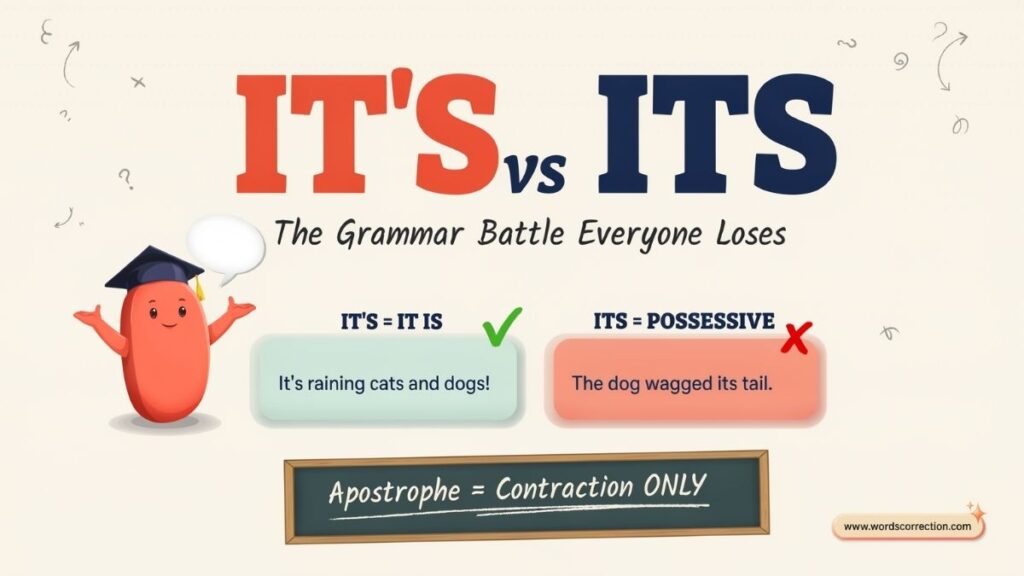
English grammar can be tricky, especially when two words look almost the same. The difference between it’s vs its is a common mistake that can confuse even good writers. One tiny apostrophe can make a big difference! So, how do you know which word to use? Don’t worry. The rule is simple once you understand it. In this article, you’ll learn the meaning of each word, see easy examples, and practice using them correctly. By the end, you’ll know how to avoid common mistakes and write clear correct sentences without letting one little apostrophe cause trouble.
What Is the Difference Between It’s vs Its?
The main difference between it’s vs its is their grammatical function. It’s is a contraction of “it is” or “it has,” while its shows possession, association, or a characteristic of something. Both spellings are correct, but they serve different purposes.
Consider these two sentences
- It’s getting dark outside. (It’s means it is.)
- The cat licked its paw. (Its shows that the paw belongs to the cat.)
Both sentences follow standard English grammar rules. The apostrophe in it’s marks a contraction, while its follows the spelling convention for possessive forms.
It’s vs Its Quick Comparison Table
| Feature | It’s | Its |
| Meaning | It is or it has | Belonging to it |
| Grammatical role | Contraction | Possessive determiner |
| Uses an apostrophe? | Yes | No |
| Example | It’s a sunny day. | The bird spread its wings. |
| Replacement test | Try “it is” or “it has.” | Expresses possession or association |
| Common mistake | Using it to show possession | Adding an apostrophe unnecessarily |
The simplest way to remember the difference between its and it’s is this: if you can replace the word with it is or it has without changing the intended meaning or sentence structure, it’s is likely correct. If you mean that something belongs to or relates to an object, animal, organization, or idea, use its.
What Does It’s Mean?
The word it’s is a contraction. In English grammar, a contraction combines words and uses an apostrophe to mark omitted letters.
In this case, it’s has two possible meanings
- It is
- It has
The surrounding sentence tells you which meaning applies. Although the spelling stays the same, the grammatical function depends on the context.
It’s as a Contraction of It Is
Use it’s when you want to shorten it is. This form commonly appears before adjectives, nouns, and other parts of a sentence.
For example
- It’s cold outside. = It is cold outside.
- It’s a useful book. = It is a useful book.
- It’s almost time to leave. = It is almost time to leave.
- It’s important to check your work. = It is important to check your work.
- It’s not easy to learn a new language. = It is not easy to learn a new language.
In each example, it’s connects the subject it with information about a condition, identity, time, or situation.
You can also use it’s in questions and everyday expressions
- It’s your turn, isn’t it?
- It’s a long way from here.
- It’s hard to believe how quickly time passes.
In formal writing, contractions are grammatically acceptable. However, some academic or professional style guides prefer the expanded form it is. Follow the requirements of your assignment, publication, or workplace.
Learn the difference between similar English words the easy way
Flier or Flyer Which Spelling Is Correct?
It’s as a Contraction of It Has
The second meaning of it’s is it has. This use often appears in the present perfect tense, where has acts as an auxiliary verb.
Consider these examples
- It’s been a busy week. = It has been a busy week.
- It’s already started. = It has already started.
- It’s changed a lot over the years. = It has changed a lot over the years.
- It’s taken longer than expected. = It has taken longer than expected.
- It’s become a popular choice. = It has become a popular choice.
Notice the words that follow it’s. In these sentences, been, started, changed, taken, and become function as past participles in the present perfect construction.
Here’s another useful distinction
- It’s working. = It is working.
- It’s worked well so far. = It has worked well so far.
Both sentences are correct, but they use different verb forms and express slightly different ideas.
Remember that it’s doesn’t always mean it has. The contraction must fit the grammar and meaning of the complete sentence.
What Does Its Mean?
The word its expresses possession, association, or a feature connected to something. It usually appears before a noun and helps identify which thing the noun belongs to or relates to.
For example
- The dog wagged its tail.
- The laptop lost its charge.
- The company changed its policy.
- The garden showed its beauty in spring.
- The book revealed its central idea in the final chapter.
In each sentence, its connects the noun that follows it to something already mentioned or understood.
Learn the difference between more words people mix up
Skillset or Skill Set Which Spelling Is Correct?
Understanding Its as a Possessive Determiner
In modern English grammar, its is commonly called a possessive determiner because it appears before a noun and identifies a relationship between that noun and something else.
For example, in the sentence “The tree lost its leaves,” the word its identifies which leaves the sentence refers to: the leaves of the tree.
Some traditional grammar explanations call its a possessive pronoun. However, many modern grammar references distinguish between possessive determiners, such as my, your, his, her, its, our, and their, and independent possessive pronouns, such as mine, yours, hers, and theirs.
Compare these examples
- The dog ate its food. (Its comes before the noun food.)
- The food is theirs. (Theirs stands independently without a noun after it.)
This distinction helps explain how its works in a sentence. It also prevents confusion when studying possessive pronouns, possessive adjectives, and pronoun usage.
Does Its Always Show Ownership?
Not necessarily. Possession can refer to more than physical ownership.
The word its can describe a feature, part, role, quality, or association:
- The company celebrated its success.
- The city is known for its history.
- The plan has its limitations.
- The website updated its design.
- The story reached its conclusion.
A city doesn’t literally own its history in the same way a person owns a bicycle. In these examples, its expresses a relationship or association.
This broader meaning explains why its works with animals, objects, organizations, places, and abstract ideas. It doesn’t require a physical object that someone can own.
Learn the difference between everyday English mistakes
Wellbeing or Well-Being Which Spelling Is Correct?
It’s vs Its Examples in Sentences
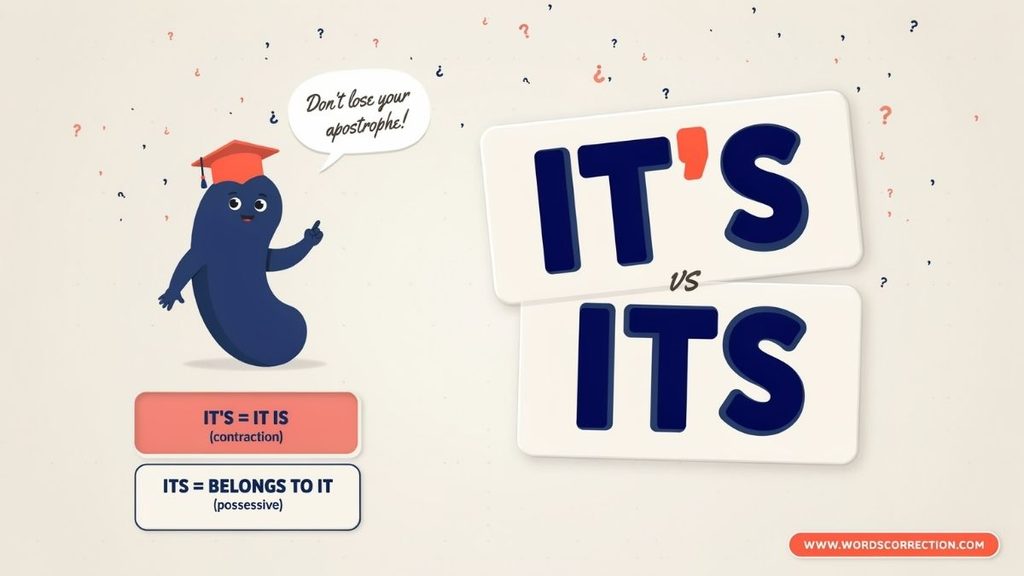
The best way to understand the difference between it’s vs its is to see how each form works in everyday writing. The following examples cover common situations, from talking about animals to describing technology, businesses, and ideas.
Examples of It’s in Sentences
Use it’s when you mean it is or it has.
| Sentence | Meaning of It’s |
| It’s a beautiful morning. | It is |
| It’s too late to call. | It is |
| It’s getting warmer. | It is |
| It’s been a difficult decision. | It has |
| It’s changed since last year. | It has |
| It’s easy to make mistakes. | It is |
| It’s finally finished. | It has |
| It’s not what I expected. | It is |
The spelling stays the same even though the expanded meaning changes. You must read the sentence to identify the correct expansion.
Learn the difference between commonly confused more words in English
Color or Colour Which Spelling Is Correct?
Examples of Its in Sentences
Use its when a noun belongs to or relates to something.
| Sentence | What Its Refers To |
| The cat cleaned its paws. | The cat |
| The tree dropped its leaves. | The tree |
| The phone needs its charger. | The phone |
| The school changed its schedule. | The school |
| The movie earned its reputation. | The movie |
| The website improved its layout. | The website |
| The company announced its plans. | The company |
| The country celebrated its independence. | The country |
In each example, its appears before a noun and connects that noun to the subject or another previously identified thing.
Sentences That Use Both It’s vs Its
Some sentences are especially useful for learning because they contain both forms.
Consider these examples
- It’s easy to see why the plant lost its leaves.
- It’s a good idea to check the car before its next trip.
- It’s clear that the company values its customers.
- It’s been a long time since the building received its last renovation.
- It’s important to understand how a device uses its battery.
In the first sentence, it’s means it is, while its refers to the plant’s leaves. In the fourth, it’s means it has, while its expresses a relationship between the building and its renovation.
These examples show why the distinction matters. One small apostrophe changes the grammatical function of the word, even when both forms appear in the same sentence.
Learn the difference between commonly misused words
Chose or Choose What’s the Difference?
It’s vs Its in Everyday and Formal Writing
Both forms appear in emails, essays, articles, reports, and business communication. The correct choice depends on the sentence, not on whether the writing sounds formal.
For example
- Casual: It’s time to go.
- Formal: It is time to begin the review.
- Business: The company updated its privacy policy.
- Academic: The experiment produced its most significant result in the final stage.
You can use contractions in many professional settings. However, if your style guide discourages contractions, write it is or it has instead of it’s. Never replace its with it is simply to make a sentence sound formal.
How to Remember the Difference Between It’s vs Its
English has many commonly confused words, but this pair becomes much easier once you learn a reliable test. Instead of guessing based on the apostrophe, check what the sentence actually means.
Learn the difference between confusing more English words
In Person vs In-Person When to Use the Hyphen
The It Is or It Has Replacement Test
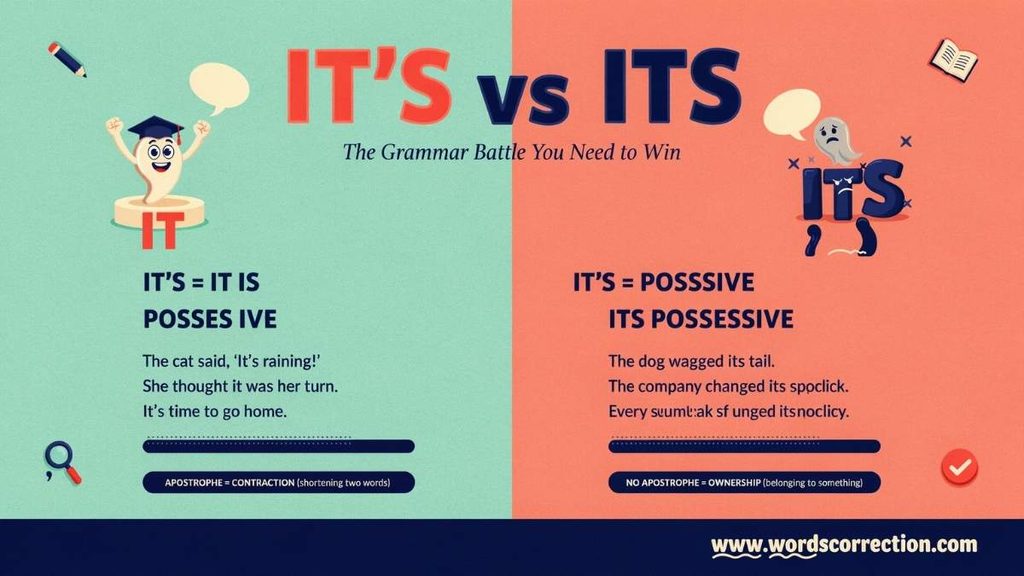
The replacement test is one of the most useful ways to distinguish these spellings.
Follow these steps
- Find the word it’s or vs its in your sentence.
- If you’re unsure, replace it with it is.
- If that doesn’t work, try it has.
- If neither replacement preserves the intended meaning and sentence structure, check whether you need its to express possession or association.
For example
Sentence A It’s raining outside.
Replace it’s with it is: “It is raining outside.” The sentence still makes sense, so it’s is correct.
Sentence B The dog hurt its paw.
Try it is: “The dog hurt it is paw.” That doesn’t work. Try it has: “The dog hurt it has paw.” That doesn’t work either. Since the sentence refers to the dog’s paw, its is correct.
Sentence C It’s been a long day.
Replace it’s with it has: “It has been a long day.” The sentence remains correct, so it’s is the right form.
The test works because contractions expand into complete words, while possessive determiners establish a relationship with the noun that follows.
When the Replacement Test Needs More Care
Don’t apply the test mechanically without considering sentence structure. For example:
“The company says it’s ready to launch.”
Here, it’s means it is. The replacement works: “The company says it is ready to launch.”
Now consider
“The company says its product is ready to launch.”
The word its identifies the product associated with the company. You cannot replace it with it is without changing the sentence structure.
A contraction can also expand to it has when the sentence uses a past participle:
“It’s taken three days to finish.”
This means “It has taken three days to finish.” A useful replacement test must consider both possible expansions, not just it is.
The quick rule If it is or it has fits the sentence, use it’s. If the sentence expresses possession or association, use its.
Learn the difference between basic English word mistakes
Leafs or Leaves Which one Is Correct?
Common Mistakes When Using It’s and Its
Even experienced writers make grammar mistakes when they type quickly or rely on how a sentence sounds. Because it’s and its have the same pronunciation in standard English, hearing the word won’t tell you which spelling to choose.
Mistake Using It’s to Show Possession
Incorrect The dog wagged it’s tail.
Correct The dog wagged its tail.
The sentence describes the dog’s tail, so the possessive form its is necessary. The apostrophe in it’s would incorrectly turn the word into a contraction.
More examples
- Incorrect: The phone lost it’s signal.
- Correct: The phone lost its signal.
- Incorrect: The company changed it’s name.
- Correct: The company changed its name.
Mistake Using Its Instead of It’s
Incorrect: Its going to rain tomorrow.
Correct: It’s going to rain tomorrow.
The intended meaning is it is going to rain tomorrow. Therefore, the contraction needs an apostrophe.
Other examples include:
- Incorrect: Its too early to leave.
- Correct: It’s too early to leave.
- Incorrect: Its a good idea.
- Correct: It’s a good idea.
Mistake Forgetting the Apostrophe in It Has
Incorrect: Its been a long time.
Correct: It’s been a long time.
Here, it’s means it has. The phrase it has been is grammatically correct, so the contraction needs an apostrophe.
This error often appears in quick messages, comments, and informal writing. A brief proofreading check can catch it.
Mistake Writing Its’ With an Apostrophe After the S
Incorrect: The company announced its’ decision.
Correct: The company announced its decision.
Its’ is not the standard possessive form of it. The correct possessive spelling is its, without an apostrophe. The contraction is it’s, with an apostrophe between the t and the s.
English uses apostrophes in several different ways, so avoid assuming that every possessive form needs one.
Mistake Relying on Spell Check Alone
A grammar checker may flag some errors, but both it’s and its are valid English words. A basic spell-checker may accept the wrong choice because it cannot always determine your intended meaning.
For example, “The dog hurt it’s paw” contains correctly spelled individual words but incorrect word usage. The sentence requires its.
During proofreading and editing, read the complete sentence and check what the word means. A grammar checker can support that process, but it shouldn’t replace your judgment.
Learn the difference between often confused words
Loosing or Losing Which Spelling Is Correct?
Why Does Its Not Have an Apostrophe?
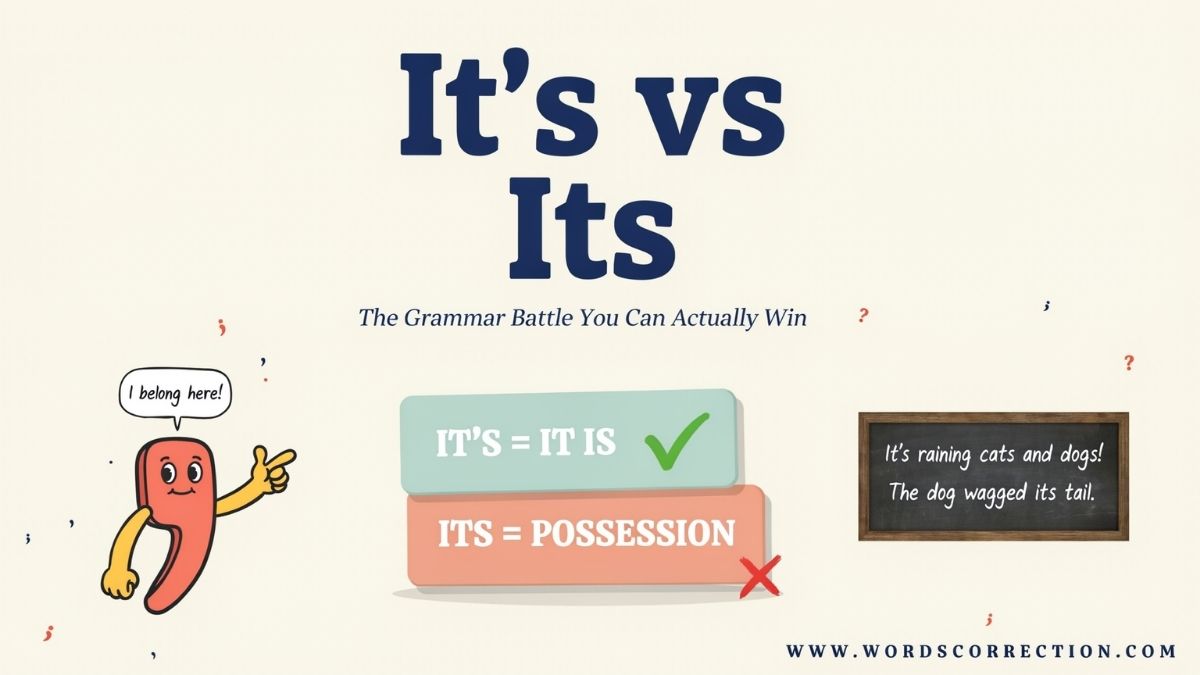
The question of why its doesn’t have an apostrophe makes sense because English often uses apostrophes to show possession. For example, “the girl’s bag” means the bag belongs to the girl. However, English doesn’t use the same spelling pattern for every possessive form.
The key distinction is that possessive forms of pronouns follow their own spelling rules. Words such as his, hers, yours, ours, and theirs don’t use apostrophes to show possession. The word its follows this pattern.
Compare these examples
| Word | Correct Example | Function |
| His | The dog chased his ball. | Possessive |
| Hers | The red bag is hers. | Possessive |
| Yours | Is this book yours? | Possessive |
| Theirs | The final decision was theirs. | Possessive |
| Its | The bird built its nest. | Possessive |
| It’s | It’s a beautiful nest. | Contraction |
The difference between its and it’s reflects two separate grammatical functions. The apostrophe in it’s marks omitted letters in it is or it has. It doesn’t indicate ownership.
Apostrophe Usage Contractions vs Possession
Apostrophe usage becomes easier when you separate contractions from possessive forms.
Apostrophes in contractions replace omitted letters:
- It is becomes it’s.
- It has becomes it’s.
- They are becomes they’re.
- You are becomes you’re.
Possessive forms identify ownership or association:
- The dog’s collar belongs to the dog.
- The dog wagged its tail.
- The students’ books belong to the students.
- The books are theirs.
Notice that dog’s and students’ use apostrophes because they are possessive forms of nouns. However, its and theirs follow the spelling conventions for possessive pronouns and determiners.
This distinction is one of the most useful English punctuation rules to learn because it applies beyond this single pair of words.
Does Its Have a Plural Form?
No. Its doesn’t have a separate plural spelling. The word remains its whether the thing being described has one feature or many.
For example
- The bird spread its wing.
- The bird spread its wings.
- The company changed its policy.
- The company changed its policies.
The number of wings or policies doesn’t change the spelling of its. The possessive determiner connects the noun to the relevant subject or entity.
However, when you refer to multiple owners or entities, you may need a different possessive word.
Learn the difference between confusing word pairs
Mangoes or Mangos Which Spelling Is Correct?
Its vs Their What’s the Difference?
The difference between its and their depends on the subject or entity being discussed.
Use its when referring to one entity described with the pronoun it. Use their when referring to people, animals, organizations, or other entities treated as plural. English also commonly uses singular they when a person’s gender is unknown, irrelevant, or when that person uses they/them pronouns.
Compare
- The company updated its website.
- The companies updated their websites.
- The dog found its toy.
- The dogs found their toys.
- Each applicant submitted their application.
In the final example, their refers to the singular noun applicant. Singular they is widely accepted in modern English.
The important point is that its doesn’t become their simply because the thing being described has several parts. The choice depends on the referent and the sentence’s meaning.
Learn the difference between tricky grammar more words
Each Other or Eachother Which Spelling Is Correct?
It’s vs Its A Complete Comparison Table
This table brings the main rules together for quick reference.
| Feature | It’s | Its | Its’ |
| Standard English form? | Yes | Yes | No |
| Apostrophe | Between t and s | None | Incorrect form |
| Main function | Contraction | Possessive determiner | No standard function |
| Means it is? | Yes | No | No |
| Means it has? | Yes | No | No |
| Shows possession? | No | Yes | No |
| Example | It’s ready. | The device lost its power. | Avoid this spelling. |
The table also clears up a common misunderstanding about possessive forms. Its is the possessive form; it’s is the contraction. The spelling its’ isn’t a standard alternative.
Learn the difference between commonly mixed-up more words
Patient or Patience what’s the Difference?
Case Study How One Apostrophe Changes a Sentence
Imagine a writer preparing a short product review. The draft reads:
“The camera is known for it’s quality, and its easy to use.”
The writer has used both forms incorrectly. The corrected version is:
“The camera is known for its quality, and it’s easy to use.”
Why?
- Its quality: The word its connects the quality to the camera.
- It’s easy: The word it’s means it is.
Now consider a second example:
“The museum changed it’s opening hours because its expanding.”
The correct version is:
“The museum changed its opening hours because it’s expanding.”
The museum’s opening hours are associated with the museum, so the sentence needs its. The second part means it is expanding, so it’s is correct.
These examples illustrate a practical lesson: don’t choose a spelling based on how the word sounds. Identify its grammatical function first.
It’s vs Its Quiz Test Your Grammar
Ready to put the rules into practice? Choose it’s vs its for each blank. Check whether the sentence needs a contraction or a possessive form.
Practice Session Fill in the Blanks
Complete each sentence with it’s vs its.
- The cat cleaned ___ paws.
- ___ getting late for the meeting.
- The company changed ___ name.
- ___ been a wonderful day.
- The dog wagged ___ tail.
- ___ important to follow the rules.
- The bird returned to ___ nest.
- ___ been raining since morning.
- The school updated ___ website.
- The baby dropped ___ toy.
- ___ time to start the lesson.
- The tree lost ___ leaves.
- ___ already finished the work.
- The restaurant changed ___ menu.
- The puppy hurt ___ leg.
- ___ difficult to solve this puzzle.
- The phone lost ___ connection.
- ___ been a busy week.
- The river overflowed ___ banks.
- ___ easy to understand this rule.
- The machine stopped because ___ motor overheated.
- ___ almost time for dinner.
- The bird spread ___ wings.
- ___ been a pleasure working with you.
- The computer needs ___ software updated.
Answer
- Its
- It’s
- Its
- It’s
- Its
- It’s
- Its
- It’s
- Its
- Its
- It’s
- Its.
- It’s
- Its
- Its
- It’s
- Its
- It’s
- Its
- It’s
- Its
- It’s
- Its
- It’s
- Its
Quick Reminder
- It’s means “it is” or “it has.”
- Its shows possession or association.
Helpful tip: If you can replace “it’s” with “it is” or “it has” and the sentence still makes sense, use “it’s.” Otherwise, if you mean possession or association, use “its.”
Here’s a trusted source for clear word meanings:
Cambridge Dictionary
FAQ’s
What is the difference between it’s and its?
“It’s” is a contraction of “it is” or “it has,” while “its” shows possession or association. For example, “It’s a sunny day” means “It is a sunny day,” whereas “The dog wagged its tail” shows that the tail belongs to the dog.
When should you use it’s in a sentence?
Use “it’s” when you mean “it is” or “it has.” For example, “It’s time to leave” means “It is time to leave.”
How do you use its correctly?
Use “its” before a noun to show possession or association. For example, “The company updated its website.” The word “its” connects the website to the company.
Is it’s always short for it is?
No. “It’s” can mean either “it is” or “it has.” For example, “It’s raining” means “It is raining,” while “It’s been a long day” means “It has been a long day.”
Why doesn’t its have an apostrophe?
Although apostrophes often show possession with nouns, possessive determiners such as “its,” “his,” and “their” do not use apostrophes. Therefore, “The cat licked its paws” is correct.
What are five sentences using “its”?
Here are five examples of “its” used correctly:
- The cat licked its paws.
- The school changed its schedule.
- The tree dropped its leaves.
- The phone lost its signal.
- The bird built its nest.
What is a simple sentence using its?
“The dog found its toy.”
In this sentence, “its” shows that the toy belongs to or is associated with the dog.
Can you begin a sentence with its?
Yes. You can begin a sentence with “its” when the context clearly identifies what the word refers to. For example, “Its bright colors attracted everyone’s attention.”
What are 10 examples of its in sentences?
Here are 10 examples
- The baby held its bottle.
- The car needs its tires checked.
- The flower opened its petals.
- The business expanded its services.
- The bird spread its wings.
- The computer restarted its system.
- The river changed its course.
- The restaurant revised its menu.
- The school painted its classrooms.
- The book lost its cover.
Should you use it’s vs its to show possession?
Use “its” to show possession or association. For example, “The company announced its plans.” Using “it’s” would be incorrect because the contraction means “it is” vs “it has.”
What does its mean in English grammar?
“Its” is a possessive determiner that shows a relationship between something and an animal, object, organization, or idea. In the sentence “The country celebrated its independence,” the word connects independence to the country.
What does it’s stand for?
“It’s” stands for “it is” or “it has.” Its meaning depends on the sentence. For example, “It’s important to listen” means “It is important to listen.”
How can you remember when to use its or it’s?
Use the replacement test. Replace “it’s” with “it is” or “it has.” If the sentence still makes sense, “it’s” is correct. If you want to show possession or association, use “its.”
Is its a possessive pronoun?
“Its” is commonly described as a possessive pronoun. More precisely, when it appears before a noun, as in “its tail,” it functions as a possessive determiner. Unlike “mine” or “hers,” it generally does not stand alone in standard English.
Which word is correct in The company changed ___ policy?
The correct word is “its”: “The company changed its policy.” The word “its” shows that the policy belongs to or is associated with the company.
Can it’s mean it has in everyday writing?
Yes. “It’s” can mean “it has” when “has” acts as a helping verb. For example, “It’s been a difficult week” means “It has been a difficult week.”
What is the difference between its and their?
“Its” usually refers to something singular, such as an animal, object, or organization. “Their” generally refers to multiple people or things. It can also refer to one person when their gender is unknown or when they use they/them pronouns. For example, “The dog ate its food” and “The students submitted their work.”
Is The dog wagged it’s tail grammatically correct?
No. The correct sentence is “The dog wagged its tail.” The sentence shows possession, so you should use “its” without an apostrophe.
Can its describe an organization or place?
Yes. Use “its” to refer to an organization, place, or other singular entity. For example, “The museum updated its opening hours.”
What can you use instead of it’s in formal writing?
You can replace “it’s” with “it is” or “it has,” depending on the meaning. For example, “It’s important to check” becomes “It is important to check.” Writing out the full form can suit a formal tone, although “it’s” is also grammatically correct.
Is its own grammatically correct?
Yes. “Its own” emphasizes possession or independence. For example, “The school has its own library.” This phrase indicates that the library belongs to or is provided by the school.
Which form is correct in ___ been raining all morning?
The correct form is “It’s”vs“Its been raining all morning.” In this sentence, “it’s” means “it has,” so you could also write, “It has been raining all morning.”
Can you use its when talking about animals?
Yes. Use “its” when referring to an animal without specifying its sex. For example, “The horse shook its head.” If you refer to a particular animal as “he” or “she,” you may use “his” or “her” instead.
What are the most common mistakes with it’s vs its?
The most common mistake is using “it’s” to show possession. For example, “The phone lost it’s connection” is incorrect. The correct sentence is “The phone lost its connection.” Remember that “it’s” means “it is” or “it has,” while “its” shows possession or association.
Conclusion
Understanding the difference between it’s vs its is easier than it seems. Remember, “it’s” means “it is” or “it has,” while “its” shows possession or a connection to something. A simple replacement test can help you choose the correct form and avoid common grammar mistakes. Although one tiny apostrophe may seem harmless, using it incorrectly can change the meaning of your sentence. With regular practice and careful proofreading, you can use both forms with confidence. Keep these simple rules in mind, and you’ll write clearer, more accurate sentences without letting a little apostrophe cause a big grammar headache.

Stella AJS is an experienced blogger and dedicated English language writer at Words Correction. She turns confusing grammar, word meanings, spelling, and usage into clear, practical insights that readers can easily understand and apply. With a passion for precise and engaging writing, Stella helps readers avoid common language mistakes, strengthen their vocabulary, and communicate with greater clarity and confidence.




