
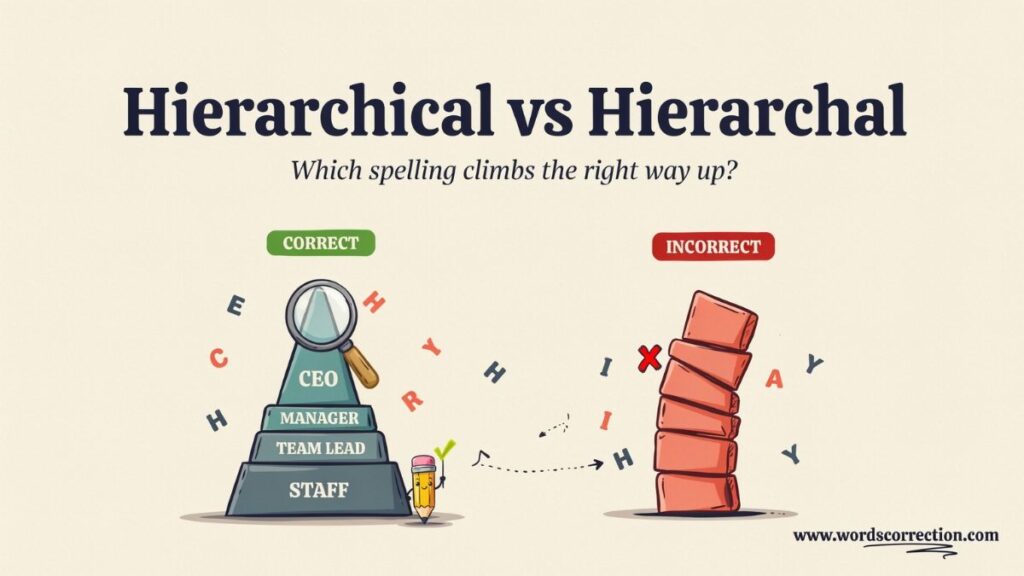
English spelling can be confusing, especially when two words look almost the same. Hierarchical vs hierarchal is a common example. Both words relate to systems with different levels of rank, authority, or importance. But are they equally correct and which one should you use? A small spelling difference can make a big difference in clear writing. In this guide, you’ll learn the meaning of both words, understand how they differ, and see how to use them correctly in sentences. With simple explanations and practical examples, choosing the right word will become much easier.
Hierarchical vs Hierarchal Quick Answer
The main difference between hierarchical vs hierarchal is their spelling preference and frequency of use. Both words can describe something connected with a hierarchy, but hierarchical is considerably more common in modern English.
A hierarchy is a system that arranges people, groups, objects, or ideas into different levels. These levels may represent authority, importance, position, or classification.
For example, a business might have a chief executive officer at the top, department managers in the middle, and employees working under their supervision. This arrangement is known as a hierarchical organizational structure.
The Simple Rule
Remember these three points when choosing between the two spellings
- Hierarchical: The standard and preferred spelling. Use it in academic, professional, and everyday writing.
- Hierarchal: A recognized but considerably less common alternative.
- Recommended choice: Use hierarchical when you want a clear and familiar expression.
For example
- Preferred: The company follows a hierarchical management structure.
- Less common: The company follows a hierarchal management structure.
Both sentences communicate a similar idea. However, the first uses the spelling most readers expect.
Hierarchical vs Hierarchal Examples at a Glance
| Hierarchical | Hierarchal |
|---|---|
| The organization has a hierarchical structure. | The organization has a hierarchal structure. |
| The school follows a hierarchical system. | The school follows a hierarchal system. |
| The website uses hierarchical navigation. | The website uses hierarchal navigation. |
| The company maintains a hierarchical chain of command. | The company maintains a hierarchal chain of command. |
The examples illustrate how both forms can appear in similar contexts. Nevertheless, hierarchical remains the more suitable choice for general writing.
Learn the difference between confusing more English words
Copys or Copies Which Is Correct?
What Does Hierarchical Mean?
The word hierarchical describes something organized into different levels or ranks. These levels may indicate differences in authority, importance, status, responsibility, or classification.
The term commonly appears in discussions about businesses, educational institutions, government departments, computer systems, and social organizations.
Consider a company with several management levels. The CEO oversees the organization, department managers supervise individual departments, and team leaders coordinate employees’ daily responsibilities. Because the company distributes authority across several levels, its management system is hierarchical.
In simple terms, hierarchical meaning in English refers to an arrangement in which people, groups, or elements occupy different positions within an organized system.
Hierarchical Definition and Examples
Hierarchical (adjective): Arranged or organized according to a system of ranks, levels, or degrees of authority, importance, or classification.
The word functions as an adjective. It describes a noun rather than naming the ranking system itself.
Consider these common expressions
| Expression | Meaning |
|---|---|
| Hierarchical organization | An organization divided into different levels of authority |
| Hierarchical system | A system arranged according to an established order |
| Hierarchical classification | A method of grouping items into broader and more specific categories |
| Hierarchical relationship | A relationship involving different positions or levels |
| Hierarchical ranking | An arrangement based on status, importance, or position |
| Hierarchical management | A management system with several levels of authority |
| Hierarchical model | A model that organizes information into levels |
These combinations demonstrate how hierarchical modifies different nouns to explain their organizational arrangement.
Hierarchical Examples in Sentences
Understanding a definition is useful, but seeing the word in context makes its grammatical usage easier to remember.
Here are several examples from different fields
- Business: The company introduced a hierarchical management system to clarify reporting responsibilities.
- Education: The university follows a hierarchical administrative structure.
- Technology: The software organizes files through a hierarchical directory system.
- Science: Researchers use hierarchical classification to organize living organisms.
- Government: The department operates through a hierarchical chain of command.
- Society: Social status can influence an individual’s position within a hierarchical structure.
In each sentence, hierarchical describes an arrangement involving identifiable levels or relationships.
Common Word Combinations With Hierarchical
Some expressions appear frequently in professional, academic, and technical writing. Learning these combinations can help you use the word more naturally.
| Word combination | Meaning |
|---|---|
| Hierarchical structure | An arrangement with multiple levels |
| Hierarchical organization | An organization divided into ranks or levels |
| Hierarchical system | A system based on an established order |
| Hierarchical order | An arrangement according to rank or importance |
| Hierarchical relationship | A relationship involving different levels of authority |
| Hierarchical model | A model organized into levels |
| Hierarchical classification | A method of grouping items into ranked categories |
| Hierarchical management | Management organized through different authority levels |
| Hierarchical leadership | Leadership that follows a defined chain of authority |
These expressions are particularly useful when discussing organizational structures, management systems, technology, and academic classifications.
Learn the difference between commonly mixed-up more words
Prooving vs Proving What’s the Difference?
What Does Hierarchal Mean?
Hierarchal is a recognized English adjective that relates to a hierarchy or a system of ranks and authority. Its general meaning is similar to hierarchical, although it appears much less frequently.
The existence of this spelling can confuse writers who assume that every unfamiliar form must be incorrect. However, English includes several recognized spelling variants, and their popularity isn’t always equal.
If someone asks what hierarchal means, the simplest explanation is that it describes something connected with a hierarchy.
For most modern writing, however, hierarchical remains the more familiar and practical choice.
Hierarchal Definition and Examples
Hierarchal (adjective): Relating to or organized according to a hierarchy.
The word can describe arrangements involving different levels of authority, status, or organization.
Examples include
- The report examined the hierarchal arrangement of authority within the institution.
- The organization maintained a hierarchal system of leadership.
- The researchers studied the hierarchal relationships between different groups.
- The department used a hierarchal structure to distribute responsibilities.
These examples demonstrate the intended meaning. However, most writers would use hierarchical in these situations because readers encounter it more frequently.
Is Hierarchal a Word?
Yes. Hierarchal is a recognized English word, not simply an accidental spelling mistake.
It functions as an adjective and can describe something related to a hierarchy. However, its recognition doesn’t mean that it is equally common or equally suitable for every writing situation.
For example, hierarchal may appear in older publications, specialized texts, or sources that recognize the alternative spelling.
In contrast, hierarchical is widely established in modern English dictionaries, educational resources, and professional communication.
When preparing a school assignment, research paper, business report, or website article, hierarchical is generally the safer option.
Is Hierarchal an Outdated Spelling?
Calling hierarchal completely outdated would be misleading. It remains a recognized English spelling rather than a form that has disappeared from the language.
However, it is considerably less common than hierarchical. Readers may even assume that it is a typing mistake because they are more familiar with the standard form.
This distinction highlights an important principle of English vocabulary: A word can be grammatically recognized without being the preferred choice in everyday communication.
Therefore, use hierarchical unless a particular publication, dictionary, or style guide specifies otherwise.
Learn the difference between tricky grammar more words
A Unique or An Unique Which Is Correct?
Hierarchical vs Hierarchal Key Differences
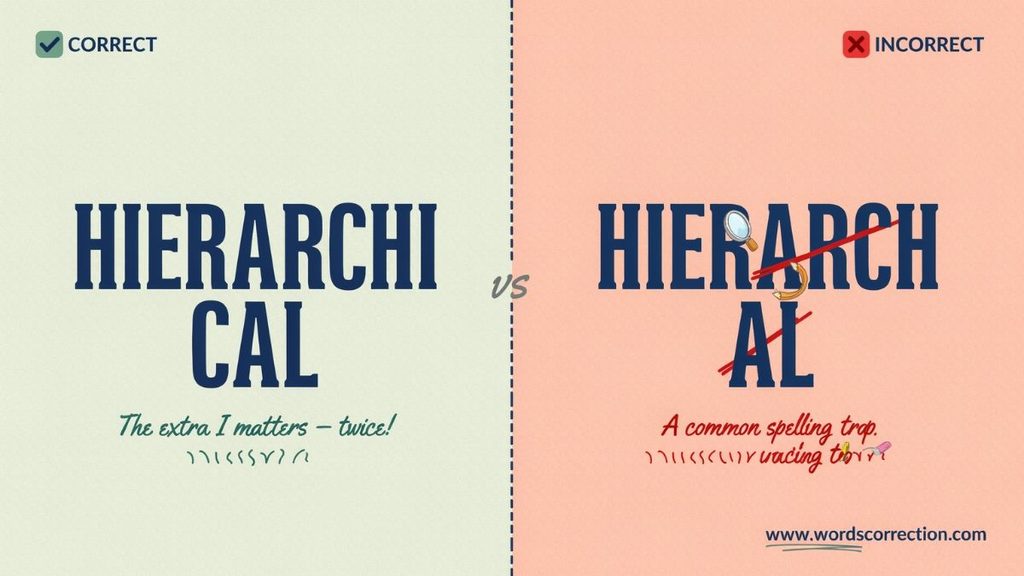
At first glance, the difference between these words appears minor. One ends in -ical, while the other ends in -al. Despite this small spelling change, their frequency and familiarity differ.
The difference between hierarchical vs hierarchal is mainly related to spelling preference and usage rather than a major difference in their general meanings.
Both forms connect to the concept of hierarchy, but hierarchical is the established choice in most modern writing.
Hierarchical vs Hierarchal Comparison Table
| Feature | Hierarchical | Hierarchal |
|---|---|---|
| Part of speech | Adjective | Adjective |
| General meaning | Relating to a hierarchy | Relating to a hierarchy |
| Spelling preference | Standard and preferred | Less common alternative |
| Frequency | Common | Rare |
| Professional writing | Recommended | Less familiar |
| Academic writing | Preferred | Less commonly used |
| American English | Commonly used | Recognized but uncommon |
| British English | Commonly used | Recognized but uncommon |
| Example | Hierarchical structure | Hierarchal structure |
The comparison makes the practical distinction clear: both forms can communicate a similar idea, but they don’t have equal popularity.
Are Hierarchical vs Hierarchal Interchangeable?
In many contexts, yes. Both words can describe an arrangement based on levels of authority, rank, or importance.
Consider these sentences
- The company follows a hierarchical management system.
- The company follows a hierarchal management system.
Both sentences communicate that the company organizes its management through different levels.
However, interchangeable doesn’t necessarily mean equally appropriate. Hierarchical is more familiar to most readers because it appears more frequently in modern English.
For this reason, use hierarchical unless a specific publication or style guide requires another form.
Which Is Correct Hierarchical vs Hierarchal?
If you’re deciding which spelling to use in your writing, hierarchical is the recommended choice.
It is the established adjective used to describe arrangements based on rank, authority, or classification. Although hierarchal is also recognized, its lower frequency makes it less suitable for general professional communication.
Keep these guidelines in mind
- Use hierarchical as your default spelling.
- Recognize hierarchal when you encounter it.
- Don’t automatically classify the less common form as a spelling error.
- Follow your organization’s style guide when it specifies a particular spelling.
Choosing the more familiar form helps maintain consistency and makes your writing easier to understand.
Learn the difference between confusing word pairs
Heros or Heroes which spelling is correct?
Hierarchical vs Hierarchal Origin and Word Formation
The relationship between these words becomes clearer when you examine their history.
Both forms connect to the same word family, which includes hierarchy and hierarch. Their historical development also explains why the term originally had strong associations with religious authority and leadership.
The Origin of Hierarchy
The word hierarchy has roots in Greek and Medieval Latin. It entered English through Old French and Medieval Latin forms.
Its Greek origins connect the term with sacred leadership and the authority of a high priest. Early English usage referred particularly to ranks within religious institutions and the organization of the clergy.
Over time, the meaning expanded beyond religion.
Today, hierarchy describes many different systems that arrange people, groups, or objects into levels.
Examples include
- Church hierarchy: An arrangement of religious leadership through different offices and ranks.
- Corporate hierarchy: A system that establishes management positions and reporting responsibilities.
- Social hierarchy: An arrangement involving differences in social status or influence.
- Political hierarchy: A structure that organizes authority among government officials and institutions.
The word now applies to organizational, social, political, scientific, and technical systems.
How Hierarchical Is Formed
The word hierarchical developed from hierarch combined with the adjective-forming suffix -ical. Its recorded English history dates to the 16th century.
Understanding its related forms makes the word family easier to remember.
| Word | Part of speech | Meaning |
|---|---|---|
| Hierarch | Noun | A person with high-ranking religious authority |
| Hierarchy | Noun | A system of ranks or levels |
| Hierarchical | Adjective | Relating to a hierarchy |
| Hierarchically | Adverb | In a hierarchical manner |
Consider how these words function in sentences
- Hierarchy: The company has a clear hierarchy.
- Hierarchical: The company has a hierarchical structure.
- Hierarchically: The company organizes its departments hierarchically.
The noun names the system, the adjective describes it, and the adverb explains how something is arranged.
How Hierarchal Is Formed
The word hierarchal comes from hierarch combined with the suffix -al. Its recorded use in English dates to the 1640s.
The suffix -al appears in many English adjectives. It generally means relating to or connected with something.
Consider these examples
- Culture becomes cultural.
- Nation becomes national.
- Institution becomes institutional.
- Hierarch becomes hierarchal.
This word formation helps explain why hierarchal is a legitimate English form rather than an arbitrary variation.
Both hierarchical vs hierarchal have historical connections to hierarch, although they use different adjective-forming suffixes.
Learn the difference between often confused words
Thier or Their which is correct?
Hierarchical vs Hierarchal American English vs British English

English spelling differences often create confusion, particularly when writers encounter alternative forms in international dictionaries.
For example, American English generally uses color, while British English uses colour. Similarly, organize and organise reflect different regional spelling preferences.
However, hierarchical vs hierarchal is not an American-versus-British spelling distinction.
Both varieties use hierarchical as the familiar and preferred form.
Usage in American English
American English commonly uses hierarchical in business, education, science, and technology.
Examples include
- The company maintains a hierarchical reporting structure.
- The school uses a hierarchical administrative system.
- The software stores information in a hierarchical database.
- The military follows a hierarchical chain of command.
American speakers also use a pronunciation that places the main stress on the middle portion of the word.
Usage in British English
British English also uses hierarchical in formal and everyday communication.
For example
- The organization follows a hierarchical structure.
- The department introduced a hierarchical management system.
- The university has several hierarchical levels of administration.
The spelling remains the same, although pronunciation can differ between British and American speakers.
Is Hierarchal a British Spelling?
No. Hierarchal isn’t the British equivalent of the American spelling hierarchical.
Both forms can appear in English publications, but neither follows a simple regional spelling rule.
British and American writers generally use hierarchical as the standard form.
Remember: Don’t change the spelling based on whether you’re writing for an American or British audience. Hierarchical is the appropriate choice in both varieties.
Learn the difference between basic English word mistakes
Benefitting or Benefiting Which Spelling Is Correct?
How to Use Hierarchical Correctly in Different Contexts
Understanding a definition is useful, but knowing how to apply a word in different situations makes it easier to use naturally.
A hierarchy doesn’t always involve people or management. It can also describe categories, computer files, scientific classifications, and relationships between different elements.
The following examples demonstrate how hierarchical works across several fields.
Hierarchical Structures in Business
Businesses often use hierarchical structures to organize employees, departments, responsibilities, and decision-making authority.
In a traditional top-down organization, senior leaders make major decisions while managers and team leaders supervise smaller departments or teams.
A simplified corporate hierarchy might look like this:
Chief Executive Officer (CEO)
             |
     Department Managers
             |
        Team Leaders
             |
          Employees
This arrangement shows how a hierarchical management system distributes authority across several levels.
Example: The company introduced a hierarchical organizational structure to establish clear reporting relationships.
Such arrangements can make responsibilities easier to understand. However, they may also slow decision-making when employees need approval from several management levels.
Hierarchical Systems in Technology
Technology provides some of the clearest examples of hierarchical organization.
Computer systems often arrange information through parent-and-child relationships. A higher-level category contains smaller categories, which may contain even more specific items.
Consider a computer’s file system:
Computer
│
├── Documents
│   ├── Reports
│   └── Assignments
│
├── Pictures
│   ├── Family
│   └── Travel
│
└── Videos
    ├── Personal
    └── Educational
The computer organizes files into folders and subfolders. Each folder can contain additional folders or individual files.
This arrangement is called a hierarchical file system because information follows different levels.
Other examples include
- Website navigation menus
- Organizational databases
- Computer network structures
- Data classification systems
- XML document structures
Example: The developer created a hierarchical navigation menu to help visitors find information more easily.
Hierarchical Classification in Education and Science
Education and science also rely on hierarchical classification.
In biology, scientists organize living organisms into taxonomic ranks. These categories move from broader groups to more specific ones.
The traditional classification system includes the following levels
| Classification level | Description |
|---|---|
| Domain | Broadest major classification |
| Kingdom | Major group within a domain |
| Phylum | Group within a kingdom |
| Class | Group within a phylum |
| Order | Group within a class |
| Family | Group within an order |
| Genus | Group within a family |
| Species | Specific organism classification |
For example, the domestic cat belongs to the following classification
- Domain: Eukarya
- Kingdom: Animalia
- Phylum: Chordata
- Class: Mammalia
- Order: Carnivora
- Family: Felidae
- Genus: Felis
- Species: catus
This illustrates hierarchical classification because each level narrows the group into a more specific category.
Example: Scientists use hierarchical classification to organize living organisms according to shared characteristics and evolutionary relationships.
Schools and universities also use hierarchical administrative systems. A university may have a president, deans, department chairs, faculty members, and administrative staff.
Hierarchical Relationships in Society
Social hierarchies describe how people or groups occupy different positions based on status, influence, wealth, authority, or other social factors.
These structures can develop through formal institutions or informal relationships.
Examples include
- Social class systems
- Political leadership
- Religious authority
- Traditional community structures
- Workplace status
- Family leadership arrangements
Religious institutions provide a historical example. A church hierarchy may include senior religious leaders, regional authorities, local clergy, and other members of the institution.
This arrangement reflects differences in ecclesiastical authority and religious leadership.
Example: The historian examined how hierarchical relationships influenced political power in the region.
However, not every social relationship follows a strict hierarchy. Some communities distribute authority more equally or rely on shared decision-making.
Learn the difference between commonly misused words
Freshman or Freshmen what’s the Difference?
Common Mistakes When Using Hierarchical vs Hierarchal
Even experienced writers sometimes confuse words that share similar spellings and meanings. The best solution is to understand each word’s grammatical role and choose the form that fits standard usage.
Here are several mistakes worth avoiding.
Treating Both Spellings as Equally Common
The most common mistake is assuming that hierarchical vs hierarchal appear equally often.
Both forms are recognized, but their usage differs. Hierarchical is the preferred form in most modern writing.
A rare spelling variant may be grammatically acceptable without being the best choice for your audience.
Better approach: Use hierarchical unless your source or style guide specifically requires hierarchal.
Assuming Hierarchal Is the British Version
Some writers assume that every spelling difference reflects American or British English.
That’s not always the case.
Hierarchal isn’t a regional replacement for hierarchical. The standard spelling remains the same in both varieties.
Better approach: Use hierarchical regardless of whether your audience is in the United States or the United Kingdom.
Confusing Hierarchical With Hierarchy
These words belong to the same family, but they have different grammatical functions.
- Hierarchy: A noun that names a ranking system.
- Hierarchical: An adjective that describes something connected with that system.
- Hierarchically: An adverb that explains how something is arranged.
Compare these examples
| Word | Example |
|---|---|
| Hierarchy | The company has a clear hierarchy. |
| Hierarchical | The company has a hierarchical structure. |
| Hierarchically | The departments are hierarchically organized. |
You wouldn’t normally write, “The company has a hierarchical.” The adjective needs a noun to describe.
Incorrect vs Correct Sentence Examples
The following examples highlight common grammatical mistakes and their appropriate alternatives.
| Incorrect or less preferred | Correct or preferred |
|---|---|
| The company has a hierarchy structure. | The company has a hierarchical structure. |
| The organization is hierarchy. | The organization is hierarchical. |
| The school uses an hierarchal system. | The school uses a hierarchical system. |
| The departments are organize hierarchical. | The departments are organized hierarchically. |
| The company follows a hierarchical order. | Correct usage |
| The software uses a hierarchical file system. | Correct usage |
One important distinction: hierarchal isn’t necessarily grammatically incorrect in the third example. The replacement simply uses the more common spelling.
Learn the difference between everyday English mistakes
Requestor or Requester Which Spelling Is Correct?
Hierarchical vs Hierarchal Pronunciation and Spelling
Spelling isn’t the only source of confusion. Pronunciation can also make these words challenging, especially because both contain several syllables and similar sounds.
Although their endings differ, their pronunciation patterns are closely related.
How to Pronounce Hierarchical
The American English pronunciation of hierarchical is:
IPA: /ˌhaɪˈrɑːr.kɪ.kəl/
The British English pronunciation is:
IPA: /ˌhaɪəˈrɑː.kɪ.kəl/
The main stress falls on the middle portion of the word.
To pronounce it more easily:
- Begin with the sound of “high.”
- Move into the stressed middle syllable.
- Finish with the lighter ending sounds.
Practicing the word in a familiar expression, such as hierarchical structure, can make pronunciation easier.
How to Pronounce Hierarchal
The American English pronunciation of hierarchal is:
IPA: /ˌhaɪˈrɑːr.kəl/
The British English pronunciation is:
IPA: /ˌhaɪəˈrɑː.kəl/
The ending differs from hierarchical, so don’t assume that both words have exactly the same pronunciation.
Easy Ways to Remember the Correct Hierarchical Spelling
If you frequently confuse these words, a simple memory technique can help.
Connect hierarchical with hierarchy.
The noun hierarchy and adjective hierarchical belong to the same word family. Remembering this relationship makes the preferred spelling easier to recall.
Try these practical tips
- Remember the expression hierarchical structure.
- Connect hierarchical with hierarchy instead of memorizing it as an isolated word.
- Practice using the complete spelling in sentences.
- Consult a dictionary when you’re unsure about an unfamiliar variant.
A familiar example is often more useful than a complicated spelling rule.
Learn the difference between more words people mix up
Traveler or Traveller Which Spelling Is Correct?
Synonyms and Related Words for Hierarchical
Choosing suitable synonyms can make your writing clearer and prevent unnecessary repetition.
Although hierarchical has several alternatives, each carries a slightly different meaning. The best choice depends on the context and the relationship you’re describing.
Common Hierarchical Synonyms
Here are several useful alternatives:
| Synonym | Meaning | Example |
|---|---|---|
| Ranked | Arranged according to position or status | The employees belong to a ranked system. |
| Ordered | Arranged in a particular sequence | The information follows an ordered structure. |
| Layered | Organized into different levels | The software uses a layered design. |
| Graded | Arranged according to degrees or levels | Students follow a graded system. |
| Stratified | Divided into distinct social or organizational layers | The society has a stratified structure. |
| Tiered | Organized into levels or groups | The company offers a tiered management system. |
| Structured | Arranged according to a defined plan | The department follows a structured process. |
These words aren’t perfect replacements in every sentence.
For example, layered emphasizes separate levels, while ranked emphasizes position or status. Similarly, stratified often describes divisions within societies or groups.
Choose the synonym that communicates your intended meaning most accurately.
Hierarchal Synonym Are the Alternatives Different?
Since hierarchal has essentially the same general meaning as hierarchical, many of their synonyms overlap.
Possible alternatives include
- Hierarchical
- Hierarchic
- Ranked
- Tiered
- Layered
- Stratified
- Ordered
However, hierarchical remains the preferred word when you want to express a clear connection with a hierarchy.
Hierarchical vs Hierarchic
Another spelling worth understanding is hierarchic.
Unlike hierarchal, hierarchic is a recognized adjective meaning related to or arranged according to a hierarchy.
For example
- The organization follows a hierarchic structure.
- The organization follows a hierarchical structure.
Both sentences are understandable and grammatically acceptable.
For general writing, hierarchical remains a familiar and practical choice.
Related Words From the Hierarchy Word Family
Learning related words helps you understand their grammatical functions and expand your English vocabulary.
| Related word | Part of speech | Definition |
|---|---|---|
| Hierarchy | Noun | A system of ranks or levels |
| Hierarch | Noun | A high-ranking religious leader |
| Hierarchical | Adjective | Relating to a hierarchy |
| Hierarchal | Adjective | Relating to a hierarchy |
| Hierarchic | Adjective | Connected with a hierarchy |
| Hierarchically | Adverb | In a hierarchical manner |
| Nonhierarchical | Adjective | Not organized according to a hierarchy |
For example, a company may have a hierarchy, follow a hierarchical structure, and organize its departments hierarchically.
Understanding these related forms helps you choose the correct word according to the sentence.
Learn the difference between tricky English words with easy explanations
Whoa or Woah Which Spelling Is Correct?
Hierarchical vs Hierarchal Practical Case Study
Consider a fictional company called GreenTech Solutions. It employs 120 people across several departments, including marketing, finance, human resources, and technology.
Initially, the company has no clearly defined reporting structure. Employees aren’t sure who approves budgets, supervises projects, or handles major decisions.
To address the problem, management introduces a formal organizational hierarchy.
The new arrangement includes
- The CEO, who oversees the entire company.
- Department managers, who supervise their respective departments.
- Team leaders, who coordinate daily operations.
- Employees, who complete assigned responsibilities.
After implementing the new arrangement, the company documents its reporting relationships.
Which spelling should the company use when describing this system?
The correct and preferred choice is hierarchical.
The company can write
“The new hierarchical management structure clearly defines reporting responsibilities and levels of authority.”
Although hierarchal management structure may communicate a similar meaning, the standard spelling is more familiar to readers.
This example highlights an important point: word choice matters even when two forms share similar definitions. Professional writing should prioritize clarity, consistency, and familiar language.
practice session
Instructions Fill in each blank with the correct word.
- The company has a ______ structure.
- Every business has a ______.
- This is a ______ system.
- The school follows a ______ structure.
- Files are arranged ______.
- The CEO leads the company ______.
- A ______ has different levels.
- The plural of hierarchy is ______.
- Hierarchical is an ______.
- Hierarchal is a less common ______.
- The company has a clear ______.
- The system is highly ______.
- Departments are organized ______.
- The manager explained the ______.
- The organization uses a ______ system.
- A hierarchy is a ______.
- Hierarchically is an ______.
- The company follows a ______ order.
- The school has an administrative ______.
- Hierarchical means arranged in ______.
- Hierarchal is a recognized ______.
- The company changed its ______ structure.
- The system has several ______.
- Hierarchical is the ______ spelling.
- The organization works ______.
Answers
- Hierarchical
- Hierarchy
- Hierarchical
- Hierarchical
- Hierarchically
- Hierarchically
- Hierarchy
- Hierarchies
- Adjective
- Alternative
- Hierarchy
- Hierarchical
- Hierarchically
- Hierarchy
- Hierarchical
- Noun
- Adverb
- Hierarchical
- Hierarchy
- Levels
- Word
- Hierarchical
- Levels
- Preferred
- Hierarchically
Here’s a trusted source for clear word meanings:
Cambridge Dictionary
FAQ’s
Why is hierarchical preferred over hierarchal?
Hierarchical is preferred because it is the standard and widely accepted spelling in modern English. It is commonly used in academic, business, and technical contexts to describe arrangements based on rank, authority, or importance.
Is hierarchal recognized as a legitimate English word?
Yes, hierarchal is a legitimate English word listed in some dictionaries. However, it is rarely used in contemporary writing. Hierarchical is the more familiar and widely preferred form.
Are hierarchical vs hierarchal interchangeable in writing?
Although the two words have similar meanings, hierarchical is the conventional choice in modern English. Hierarchal is an uncommon alternative, so using hierarchical is generally better for clarity and consistency.
Is hierarchal an outdated term?
Hierarchal is considered uncommon rather than completely outdated. It occasionally appears in older texts and specialized contexts, but hierarchical is the established form used in everyday and professional communication.
What does hierarchical describe?
Hierarchical describes something organized into different levels according to rank, authority, status, or importance. It is frequently used when discussing management systems, organizational structures, social groups, and classification methods.
Where does the word hierarchical come from?
Hierarchical originates from the word hierarchy, which has roots in Greek and entered English through French and Latin. Its original associations involved religious authority, but its meaning gradually expanded to include general systems of ranking and organization.
Is hierarchical a noun or an adjective?
Hierarchical is an adjective because it describes the characteristics of a person, system, or organization. For example, in “a hierarchical company,” it explains how the company’s authority and responsibilities are arranged.
How do you form an adjective from hierarchy?
You form the adjective by adding the suffix “-ical” to hierarchy, producing hierarchical. The resulting word describes anything arranged or organized according to different levels of authority, position, or importance.
What is a good example of hierarchical in everyday English?
An example is: “The school follows a hierarchical administrative system.” This means that the school has different levels of responsibility, with senior administrators overseeing teachers and other staff members.
What are some everyday examples of hierarchy?
Examples of hierarchy include company management, school administration, government departments, and family organizational roles. These arrangements demonstrate how people or responsibilities can be organized into different levels.
How does a hierarchical organizational structure work?
A hierarchical organizational structure divides an organization into levels of authority and responsibility. Higher-level employees generally supervise lower-level employees, creating defined reporting relationships and decision-making responsibilities.
Why do businesses use hierarchical management systems?
Businesses use hierarchical management systems to establish clear responsibilities, define reporting relationships, and organize decision-making. This structure helps employees understand their roles and identify the appropriate people to contact for guidance or approval.
What does hierarchical mean in computing?
In computing, hierarchical refers to information or systems arranged in levels, often through parent-and-child relationships. File directories, hierarchical databases, and data classification systems are common examples of this organizational approach.
What word describes something without a hierarchy?
Non-hierarchical is the most direct term for something that does not follow a ranked structure. Depending on the context, flat, decentralized, or egalitarian may also describe systems with fewer levels of authority.
Which words can replace hierarchical in a sentence?
Depending on the context, hierarchical can be replaced with ranked, tiered, layered, structured, graded, or stratified. These alternatives describe different aspects of an arrangement based on levels, classification, or authority.
Do hierarchical and hierarchal have different meanings?
Their meanings overlap considerably when describing something related to a hierarchy. However, hierarchical is the standard adjective for organized levels of authority or importance, while hierarchal is a much less common variant.
Why is hierarchal often confused with hierarchical?
The confusion occurs because both spellings are visually similar and relate to the same root word, hierarchy. Writers may omit the extra syllable when spelling the adjective, even though hierarchical is the conventional form.
Which form is more suitable for academic and professional writing?
Hierarchical is the better choice for academic papers, professional reports, business documents, and formal communication. Its widespread recognition makes it more appropriate for maintaining standard spelling and clear communication.
Does the spelling of hierarchical change in British and American English?
No, hierarchical is spelled the same way in both British and American English. There is no regional spelling difference, so writers can use this form confidently regardless of their intended English variety.
Is hierarchal included in English dictionaries?
Yes, hierarchal appears in certain English dictionaries as a recognized word or variant. Nevertheless, hierarchical is considerably more common and is the preferred spelling for most contemporary writing.
How is hierarchical connected to the word hierarchy?
Hierarchical is the adjective derived from hierarchy. While hierarchy refers to a system of ranked levels, hierarchical describes something that follows or relates to that system.
What is the correct plural spelling of hierarchy?
The correct plural spelling is hierarchies. When converting hierarchy into its plural form, the final “y” changes to “ies.” For example, “The two companies have different organizational hierarchies.”
What is the meaning of a non-hierarchical organization?
A non-hierarchical organization operates without a strict chain of authority or multiple management levels. It generally encourages collaboration, shared responsibilities, and participation in decision-making across different positions.
How is hierarchical different from a hierarchical structure?
Hierarchical is an adjective describing an arrangement based on different levels of rank or importance. A hierarchical structure is the specific system or arrangement that follows this organization, such as a company’s management system.
What is an easy way to remember the spelling of hierarchical?
The easiest way to remember hierarchical is to connect it with its root word, hierarchy. Keeping the original word in mind makes it easier to remember the correct adjective spelling and avoid the less common variant hierarchal.
Learn the difference between confusing more English words step by step
Conclusion
Choosing between hierarchical and hierarchal becomes much easier when you understand their spelling and usage. Although both words relate to systems organized according to different levels of rank, authority, or importance, they aren’t equally common in modern English. Hierarchical is the standard and preferred spelling, while hierarchal remains a recognized but less frequently used alternative.
Whether you’re preparing an academic assignment, writing a business report, or explaining an organizational structure, hierarchical is the most reliable choice. Remember the difference between their related forms: hierarchy is the noun, hierarchical is the adjective, and hierarchically is the adverb.
English spelling can sometimes make simple ideas unnecessarily confusing, but this distinction doesn’t need to become another writing challenge. Choose hierarchical for clear, consistent, and professional communication. After all, good writing is about choosing the right words, not creating a hierarchy of spelling confusion.

Stella AJS is an experienced blogger and dedicated English language writer at Words Correction. She turns confusing grammar, word meanings, spelling, and usage into clear, practical insights that readers can easily understand and apply. With a passion for precise and engaging writing, Stella helps readers avoid common language mistakes, strengthen their vocabulary, and communicate with greater clarity and confidence.




