
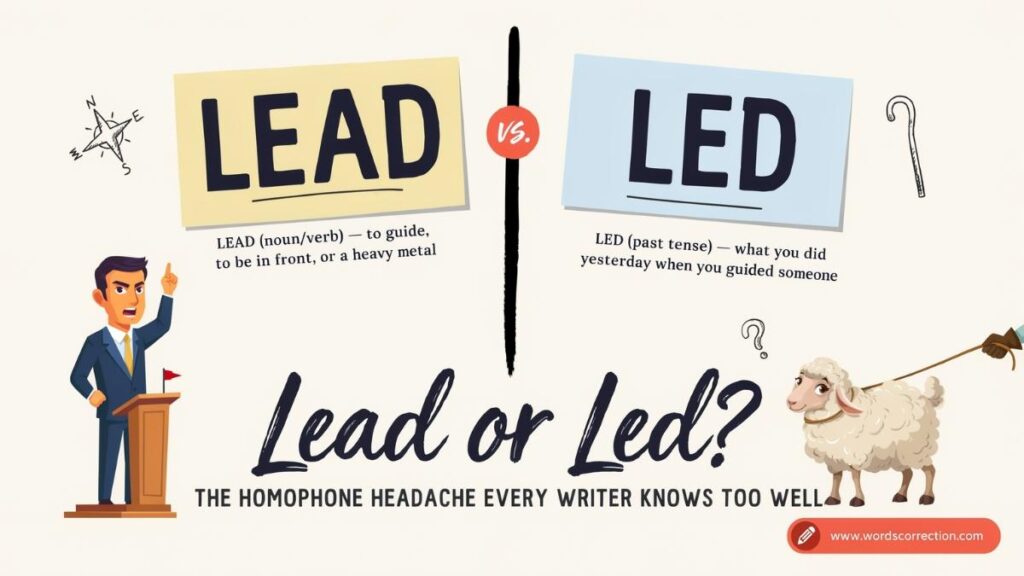
The words lead or led often confuse English writers because they look similar but have different uses. Both are correct, but choosing the wrong one can create a grammar mistake and change the meaning of a sentence. The confusion becomes even greater when pencil lead and LED lights enter the picture. However, learning the difference is easier than it seems. You just need to understand what each word means and where to use it. This guide explains their meanings, grammar rules common mistakes and simple examples to help you choose the right word and improve your writing.
Quick Answer Lead or Led?
The correct word depends on the tense and meaning of your sentence.
- Lead (pronounced LEED): The base form of a verb meaning to guide, direct, manage, or take charge.
- Led (pronounced LED): The simple past tense and past participle of the verb lead.
- Lead (pronounced LED): A noun referring to a heavy chemical element with the symbol Pb.
Here are three examples that show the difference
| Sentence | Correct Word | Explanation |
|---|---|---|
| I lead a marketing team. | Lead | Describes a present responsibility. |
| I led a marketing team last year. | Led | Describes a completed past action. |
| I have led several projects. | Led | Uses the past participle after have. |
The quick rule: Use lead for the base form and present-tense use of the verb. Use led for past actions and perfect-tense constructions.
For example, write, “I lead the team today.” If you’re describing a previous responsibility, write, “I led the team last year.”
Lead vs Led What’s the Difference?
The main difference between lead and led is their grammatical function. Both words belong to the same verb family, but they appear in different situations.
Lead is the base form of the verb, while led is used for completed past actions and as a past participle.
What Does Lead Mean?
Lead is a verb that means to guide, direct, supervise, influence, or take responsibility for someone or something.
When you lead a group, you help its members work toward a shared goal. You may organize tasks, make decisions, provide direction, or take responsibility for the results.
Lead definition: To guide, direct, influence, or take charge of a person, group, activity, or process.
Examples
- Sarah will lead the training session tomorrow.
- Good teachers lead students toward better learning.
- Our manager helps lead the company through difficult situations.
- Strong communication can lead to better teamwork.
- I lead a small team of content writers.
In these examples, lead describes an action, responsibility, or possible result. It can refer to something happening now or an action planned for the future.
For instance, “She will lead the meeting” describes a future responsibility. The word lead remains in its base form because it follows the helping verb will.
What Does Led Mean?
Led is the simple past tense and past participle of lead. Use it when describing an action that happened earlier or when forming a perfect tense.
Led definition: Guided, directed, managed, or took charge of someone or something in the past; also the past participle of lead.
Examples
- Sarah led the training session yesterday.
- Our teacher led the students through the lesson.
- The manager led the company during a difficult period.
- His decision led to a positive result.
- I have led several successful marketing campaigns.
Led also appears in passive sentences
- The meeting was led by Sarah.
- The project has been led by an experienced manager.
In both examples, led comes from the verb lead. However, the sentence structure determines how the action is expressed.
Lead vs Led Comparison Table
This table summarizes the main differences between the two words.
| Feature | Lead | Led |
|---|---|---|
| Part of speech | Verb | Verb |
| Verb form | Base form | Past tense and past participle |
| Pronunciation | LEED | LED |
| Main meaning | Guide or direct | Guided or directed |
| Present-tense use | Yes | No |
| Simple past use | No | Yes |
| Example | I lead the team. | I led the team. |
| Perfect tense | Not used as the participle | I have led the team. |
Both spellings are correct. The tense and structure of your sentence determine which one you should use.
Learn the difference between more words people mix up
Lacs or Lakhs? A Simple Guide to the Correct Spelling
What Is the Past Tense of Lead?
The past tense of lead is led.
This is an important rule to remember when writing about leadership, guidance, or direction. Unlike regular verbs, lead doesn’t form its past tense by simply adding -ed.
For example, regular verbs follow this pattern
- Walk → Walked
- Talk → Talked
- Clean → Cleaned
- Help → Helped
However, lead is an irregular verb. Its spelling changes in the past tense.
The correct form is Lead → Led.
Examples
- Present: The teacher leads the class.
- Past: The teacher led the class.
- Present: He leads the project.
- Past: He led the project.
A common mistake is writing, “She lead the team yesterday.” The meaning is understandable, but the verb form is incorrect.
The correct sentence is, “She led the team yesterday.”
Why Is It Led Instead of Leaded?
Lead is an irregular verb when it means to guide, manage, or direct someone. Its past-tense form is led, not leaded.
English contains many irregular verbs that change their spelling instead of following the usual -ed pattern.
| Base Form | Past Tense | Past Participle |
|---|---|---|
| Lead | Led | Led |
| Feed | Fed | Fed |
| Bleed | Bled | Bled |
| Keep | Kept | Kept |
| Leave | Left | Left |
| Meet | Met | Met |
Therefore, when describing someone who guided a team in the past, use led.
However, leaded is also a valid English word in specific contexts. For example, leaded gasoline contains a lead compound, and leaded glass contains lead. These expressions describe materials containing the metal. They don’t use leaded as the past tense of the verb meaning to guide.
Is Led the Past Tense or Past Participle of Lead?
Led serves two grammatical purposes. It functions as both the simple past tense and the past participle of lead.
Simple past tense: Use led to describe a completed action.
- She led the discussion.
- They led the campaign.
- He led the students to the library.
Past participle: Use led with helping verbs such as have, has, and had.
- She has led the discussion.
- They have led several campaigns.
- He had led the students before the new teacher arrived.
This distinction is important because writers sometimes use lead instead of led after helping verbs.
Incorrect: She has lead the department for five years.
Correct: She has led the department for five years.
Learn the difference between everyday English mistakes
Copys or Copies Which Is Correct?
Lead, Led, Led The Three Forms of the Verb
Understanding the three principal forms of lead makes its correct usage much easier. English grammar commonly identifies these forms as V1, V2, and V3.
The correct pattern is Lead – Led – Led.
| Verb Form | Grammar Term | Correct Word | Example |
|---|---|---|---|
| V1 | Base form | Lead | I lead the group. |
| V2 | Simple past | Led | I led the group. |
| V3 | Past participle | Led | I have led the group. |
Two additional forms are also useful
- Leads: Third-person singular present tense. Example: She leads the department.
- Leading: Present participle and gerund. Example: He is leading the discussion.
Is Lead a Regular or Irregular Verb?
Lead is an irregular verb because its past-tense and past-participle forms don’t follow the standard rule of adding -ed.
Regular verbs generally follow a predictable pattern
- Work → Worked → Worked
- Play → Played → Played
- Watch → Watched → Watched
Irregular verbs follow different patterns
- Lead → Led → Led
- Write → Wrote → Written
- Speak → Spoke → Spoken
- Drive → Drove → Driven
Learning common irregular verbs will help you use the correct forms in academic assignments, professional documents, and everyday conversations.
Present, Past, and Future Tense of Lead
The verb lead appears in different tenses. Its form depends on the time of the action and the grammatical structure of the sentence.
| Tense | Example |
|---|---|
| Simple present | I lead the team. |
| Simple past | I led the team. |
| Simple future | I will lead the team. |
| Present continuous | I am leading the team. |
| Past continuous | I was leading the team. |
| Present perfect | I have led the team. |
| Past perfect | I had led the team. |
| Future perfect | I will have led the team. |
Notice that led appears in perfect tenses because it functions as the past participle.
Learn the difference between commonly misused words
Prooving vs Proving What’s the Difference?
How to Use Lead and Led After Helping Verbs
Helping verbs can make lead and led confusing, especially when a sentence contains more than one verb. Fortunately, a few simple rules make the choice easier.
Lead or Led After Do, Does, and Did?
When do, does, or did acts as a helping verb, use the base form lead.
Even though did indicates past time, the main verb doesn’t change to led.
Examples
- Did she lead the discussion?
- Did he lead the project?
- I didn’t lead the meeting.
- They don’t lead the department.
- Does Sarah lead the marketing team?
Incorrect: Did she led the discussion?
Correct: Did she lead the discussion?
Why? The helping verb did already carries the past-tense meaning. The main verb must remain in its base form.
Lead or Led After Have, Has, and Had?
Use led after have, has, and had when forming perfect tenses.
Examples
- I have led several projects.
- She has led the company for three years.
- They had led the campaign before the new manager arrived.
- We have led many successful training sessions.
Incorrect: He has lead the team.
Correct: He has led the team.
Perfect tenses require the past participle, and the past participle of lead is led.
Lead or Led After Will, Can, Should, and Must?
Modal helping verbs take the base form of the main verb. Therefore, use lead after words such as will, can, should, and must.
Examples
- She will lead the meeting.
- He can lead the team.
- You should lead by example.
- They must lead the discussion.
- We could lead the project together.
Incorrect: She will led the meeting.
Correct: She will lead the meeting.
The same rule applies to other modal verbs, including would, might, and may.
Is It I Lead or I Led?
Both expressions are grammatically correct. The difference depends on when the action happens.
Use I lead when describing a current responsibility, regular activity, or general fact.
Use I led when describing a completed action in the past.
Examples
- I lead a team of five designers. (Present responsibility)
- I led a team of five designers last year. (Past responsibility)
- I lead training sessions every Monday. (Regular activity)
- I led a training session yesterday. (Completed activity)
The time reference usually makes the correct choice clear.
Learn the difference between basic English word mistakes
A Unique or An Unique Which Is Correct?
Lead By or Led By Which One Is Correct?
Both lead by and led by are correct expressions. However, they serve different grammatical purposes.
Lead appears in base-form and present-tense constructions. Led appears in past-tense and past-participial constructions.
When to Use Lead By
Use lead by when the sentence requires the base form or present-tense form of the verb.
Examples
- Good managers lead by example.
- Our teachers lead by encouraging students.
- The company will lead by introducing better practices.
The expression lead by example means demonstrating the behavior you expect from others rather than simply giving instructions.
When to Use Led By
Use led by when describing something managed or directed by someone in a past-tense or past-participial construction.
Examples
- The meeting was led by the department manager.
- The research project was led by experienced scientists.
- The organization has been led by several talented directors.
Led by frequently appears in passive constructions. The person responsible for the activity follows the word by.
Learn the difference between often confused words
Heros or Heroes which spelling is correct?
Common Phrases That Use Lead or Led
Some expressions appear frequently in everyday communication, academic writing, and professional documents. Understanding their correct forms will help you avoid common grammar mistakes.
Led To or Lead To?
Both expressions are correct, but the tense determines which one you need.
Use lead to when discussing a present possibility, general result, or future outcome.
Use led to when describing a result that occurred in the past.
Examples
- Poor communication can lead to misunderstandings.
- Regular exercise can lead to better health.
- The unexpected decision led to serious problems.
- Her research led to an important discovery.
- The new strategy has led to higher sales.
The expression lead to means to cause, produce, or result in something.
For example, “Lack of preparation can lead to failure” describes a possible outcome. In contrast, “Lack of preparation led to failure” describes a result that already happened.
Led Me or Lead Me?
Choose the correct form according to the time of the action.
Examples
- Please lead me to the office.
- His advice led me to change my decision.
- Good teachers lead students toward success.
- Her experience led me to trust her judgment.
The phrase led me describes something that guided, influenced, or caused a person to take a particular action in the past.
Led a Team or Lead a Team?
This distinction is particularly useful in resumes, job applications, interviews, and professional writing.
Examples
- I lead a team of ten employees.
- I led a team of ten employees during my previous job.
- She will lead a new marketing department.
- He has led several successful business projects.
If you’re describing a completed work responsibility on your resume, led is generally the appropriate choice.
For example
“Led a team of eight content writers and improved the company’s publishing workflow.”
If you currently manage the team, you can write:
“Lead a team of eight content writers and manage daily publishing operations.”
Led by Example or Lead by Example?
Both expressions are grammatically correct.
- Lead by example: Use this expression for a present or general action.
- Led by example: Use it when describing past leadership or a past participial construction.
Examples
- Successful managers lead by example.
- Our previous director led by example.
- The department was led by a manager who demonstrated strong leadership.
Led the Way or Lead the Way?
The expression lead the way means to guide others, take the initiative, or make progress toward a goal.
Examples
- She leads the way in educational innovation.
- He led the way during the difficult journey.
- Our company will lead the way in developing new technology.
The time and grammatical structure determine whether you need lead or led.
To Be Led or To Be Lead?
When you mean to be guided or directed, the correct expression is to be led.
Examples
- Every student deserves to be led by a supportive teacher.
- The organization needs to be led by an experienced professional.
- I don’t want to be led by someone who lacks experience.
Why is to be lead incorrect in this context? The passive construction requires the past participle of lead, which is led.
However, to lead is correct in an active infinitive construction.
Example “She wants to lead the team.”
Learn the difference between confusing word pairs
Thier or Their which is correct?
Lead as a Noun Does It Have a Different Meaning?
Lead doesn’t always function as a verb. It can also serve as a noun with several meanings.
One reason people confuse lead and led is that the noun lead, referring to a metal, has a different pronunciation from the verb lead, meaning to guide.
Lead Meaning The Verb and the Metal
As a verb, lead is pronounced LEED and means to guide or direct.
As a noun referring to a metal, lead is pronounced LED.
Lead is a chemical element with the symbol Pb and atomic number 82. It is a dense, soft, malleable metal that can harm human health, particularly when exposure affects the nervous system.
Its chemical symbol, Pb, comes from its Latin name, plumbum.
Examples
- Verb: Good leaders lead their teams with confidence.
- Noun: Lead is a heavy metal found in certain minerals.
The spelling remains the same, but the pronunciation and meaning change.
Is Pencil Lead Actually Made of Lead?
Here’s an interesting fact: ordinary pencil lead doesn’t contain metallic lead.
Despite its familiar name, the material inside a standard pencil is mainly graphite mixed with clay.
Graphite is a form of carbon. It leaves marks on paper because tiny graphite particles transfer from the pencil core onto the writing surface.
The expression pencil lead has remained part of everyday English, even though the material isn’t actually lead metal.
Examples
- My pencil lead broke while I was writing.
- This mechanical pencil uses thin graphite leads.
- She replaced the pencil lead before starting her assignment.
Therefore, pencil lead is the correct spelling. Writing pencil led would be incorrect when referring to the material.
Lead as a Noun in Business and Everyday English
Besides referring to a chemical element, lead has several other meanings.
Common examples include
- Sales lead: A person or business that may become a customer.
- A lead in an investigation: A clue or piece of information that helps investigators.
- The lead role: The main role in a movie, play, or performance.
- An electrical lead: A wire or cable used to make an electrical connection.
- A dog lead: A leash used to guide or control a dog.
For example
“The sales team received 50 new leads this week.”
Here, leads is the plural form of the noun lead. It has nothing to do with the past-tense verb led.
Learn the difference between tricky grammar more words
Benefitting or Benefiting Which Spelling Is Correct?
How Do You Pronounce Lead and Led?

Pronunciation is another reason people confuse these words. Although lead and led look similar, they don’t always sound the same.
The verb lead rhymes with need, while led rhymes with bed. However, the metal noun lead also rhymes with bed.
| Word | Pronunciation | Meaning |
|---|---|---|
| Lead (verb) | LEED | To guide or direct |
| Led (verb) | LED | Past tense of lead |
| Lead (metal) | LED | A chemical element |
Why Do Lead and Led Have Different Pronunciations?
English contains words whose spelling doesn’t fully reveal their pronunciation. Lead is a good example.
The verb lead uses a long vowel sound, while the past-tense form led uses a short vowel sound.
Interestingly, the metal noun lead shares its pronunciation with led, even though the two words have different meanings.
These pronunciation differences can create confusion when reading aloud. The surrounding words usually make the intended meaning clear.
Technically, the verb lead and the past-tense verb led aren’t homophones because they sound different. However, the noun lead, meaning the metal, and the verb led are homophones because they share the same pronunciation.
Learn the difference between commonly mixed-up more words
Freshman or Freshmen what’s the Difference?
Lead vs Led Examples in Sentences
Examples make grammar rules easier to understand. Instead of memorizing definitions alone, look at how these words work in different situations.
Examples of Lead in Sentences
The following sentences demonstrate the correct use of lead
- Good managers lead their employees with confidence.
- I lead a team of digital marketing professionals.
- Our teacher will lead the classroom discussion.
- Strong communication skills lead to better relationships.
- She wants to lead the new business project.
- The captain can lead the team to victory.
- Parents should lead their children by example.
- This decision may lead to positive changes.
- He continues to lead the organization successfully.
- The new strategy could lead to higher profits.
In each example, lead functions as the base or present-tense form of the verb.
Examples of Led in Sentences
These examples show how led describes past actions and works as a past participle.
- She led the meeting yesterday.
- Our teacher led the students through the activity.
- The manager led the company for ten years.
- His decision led to unexpected results.
- Their teamwork led to a successful project.
- I have led several training sessions.
- The campaign was led by experienced professionals.
- Her research has led to new discoveries.
- The team had led the competition before the final match.
- His advice led me toward a better decision.
Lead vs Led in Similar Sentences
Compare these sentence pairs to see how changing the verb affects the tense.
| Lead (Present/Base Form) | Led (Past/Past Participle) |
|---|---|
| I lead the team. | I led the team. |
| She leads the meeting. | She led the meeting. |
| They lead the campaign. | They led the campaign. |
| He will lead the project. | He led the project. |
| Good choices lead to success. | Good choices led to success. |
| I have to lead the group. | I have led the group. |
The sentence structure and time reference determine the correct form.
Learn the difference between confusing more English words
Requestor or Requester Which Spelling Is Correct?
Common Mistakes When Using Lead and Led
Even experienced writers sometimes confuse these words. Most mistakes, however, come from a few recurring grammar problems.
Using Lead Instead of Led for Past Actions
Incorrect: She lead the meeting yesterday.
Correct: She led the meeting yesterday.
The word yesterday indicates a past action, so the sentence requires the past-tense form.
Using Led After Did
Incorrect: Did he led the team?
Correct: Did he lead the team?
The helping verb did already indicates past tense. Therefore, the main verb must remain in its base form.
Writing Leaded Instead of Led
Incorrect: The manager leaded the project last year.
Correct: The manager led the project last year.
Remember that leaded isn’t the standard past tense of lead when the verb means to guide or direct.
Confusing the Verb Lead With the Metal Lead
Incorrect: The pencil is made with led.
Correct: The pencil contains graphite, commonly called pencil lead.
In this example, lead is a noun referring to the material traditionally used in pencils.
Confusing Lead, Leads, Leading, and Led
These four forms belong to the same verb family, but they serve different grammatical purposes.
| Word | Grammatical Use | Example |
|---|---|---|
| Lead | Base form | I lead the team. |
| Leads | Third-person singular present | She leads the team. |
| Leading | Present participle/gerund | He is leading the team. |
| Led | Past tense/past participle | They led the team. |
Understanding these forms will help you write more accurately and avoid unnecessary spelling mistakes.
Learn the difference between tricky words and use them correctly
Traveler or Traveller Which Spelling Is Correct?
How to Remember the Difference Between Lead and Led
If you often forget which word to use, a simple memory technique can help.
The Present and Past Tense Memory Trick
Remember this pattern
Lead → Led → Led
- Lead = Base form or present-tense use.
- Led = Simple past.
- Led = Past participle.
Think about a manager who leads a team today but led a different team last year.
The action is similar, but the time changes. That small difference determines the correct spelling.
The Yesterday Test
When you’re unsure whether to use lead or led, check whether the sentence describes a completed action.
For example
- Yesterday, I led the meeting.
- Last week, she led the students.
- Last year, our manager led the project.
If the sentence describes a completed past action, led is generally the correct choice.
However, don’t rely only on the word yesterday. The same rule applies to other past-time expressions, including last week, last year, and two days ago.
Compare Lead and Led With Other Irregular Verbs
Another useful method is to compare lead with similar irregular verbs.
| Base Form | Past Tense | Past Participle |
|---|---|---|
| Lead | Led | Led |
| Feed | Fed | Fed |
| Bleed | Bled | Bled |
| Meet | Met | Met |
| Keep | Kept | Kept |
| Sleep | Slept | Slept |
Recognizing these patterns can make irregular verbs easier to remember.
Lead or Led Quick Grammar Comparison Chart
Use this chart as a quick reference whenever you’re unsure which form belongs in your sentence.
| Sentence Structure | Correct Form | Example |
|---|---|---|
| Simple present | Lead/Leads | I lead the team. |
| Simple past | Led | I led the team. |
| Present perfect | Led | I have led the team. |
| Past perfect | Led | I had led the team. |
| Future tense | Lead | I will lead the team. |
| After can | Lead | She can lead the group. |
| After did | Lead | Did he lead the team? |
| Present continuous | Leading | He is leading the team. |
| Third-person singular | Leads | She leads the project. |
| Passive voice | Led | The team was led by Sarah. |
| Metal noun | Lead | Lead is a heavy metal. |
| Pencil material | Lead | The pencil lead broke. |
Practice sessions
Instructions: Complete each sentence using the correct word: Lead, Led, Leads, Leading, or LED.
- Our manager will ______ the new marketing project next month.
- Sarah ______ the discussion during yesterday’s meeting.
- Good teachers ______ their students toward success.
- He has ______ several successful business campaigns.
- The company is ______ the industry with its innovative products.
- Did your supervisor ______ the training session last week?
- She is ______ a team of ten employees.
- Their poor communication ______ to several misunderstandings.
- I want to ______ the next team meeting.
- The research project was ______ by an experienced scientist.
- Our coach ______ the team to victory last season.
- Strong leadership can ______ to better results.
- The department has been ______ by a skilled manager for three years.
- Who will ______ the students during the educational trip?
- His decision ______ to unexpected consequences.
- The teacher is ______ the students through a difficult lesson.
- She didn’t ______ the project last year.
- The new director ______ the company with confidence.
- The office recently installed energy-efficient ______ lights.
- The campaign was ______ by a group of experienced professionals.
- I have never ______ such a large team before.
- The captain will ______ the players onto the field.
- Her advice ______ me to make a better decision.
- A good example can ______ others to improve.
- The organization is currently ______ a major development project.
Answers
- Lead
- Led
- Lead
- Led
- Leading
- Lead
- Leading
- Led
- Lead
- Led
- Led
- Lead
- Led
- Lead
- Led
- Leading
- Lead
- Leads
- LED
- Led
- Led
- Lead
- Led
- Lead
- Leading
Here’s a trusted source for clear word meanings:
Cambridge Dictionary
FAQ’s
Should I Use LED or Lead?
Use LED when referring to a light-emitting diode, such as an LED bulb, television, or display. Use lead when referring to the verb meaning to guide someone or the chemical element. The correct choice depends on the context.
Is Lead Correct or LED?
Both are correct, but they have different meanings. Lead is an English word that functions as a verb or noun, while LED stands for light-emitting diode. For example, “She will lead the team” and “The office uses LED lights” are both grammatically correct.
Is It Lead or LED for Pencils?
The correct term is pencil lead. It refers to the graphite core inside a pencil. Despite its name, ordinary pencil lead doesn’t contain metallic lead. It consists mainly of graphite mixed with clay.
What Does Led By Mean?
“Led by” means guided, directed, or managed by a particular person or group. For example, “The research project was led by an experienced scientist” means that the scientist was responsible for directing the project.
Is It Spelled Led or Lead?
Both spellings are correct, but their grammatical uses differ. Lead is the base form of the verb meaning to guide or direct, while led is its past-tense and past-participle form. For example, “I lead the team” describes a present responsibility, while “I led the team” describes a past action.
What Does Lead Mean?
Lead has several meanings depending on how it is used. As a verb, it means to guide, direct, or take responsibility. As a noun, it can refer to a heavy metal, a potential customer, a useful clue, or the main role in a performance.
What Are Two Meanings of Lead?
Two common meanings of lead are:
- Lead as a verb: To guide, direct, or manage someone or something. For example, “She will lead the team.”
- Lead as a noun: A heavy chemical element with the symbol Pb. For example, “Lead can be harmful to human health.”
The verb is pronounced LEED, while the metal is pronounced LED.
What Is a Synonym for Lead?
The most suitable synonym depends on the context. When lead means to guide or direct, common alternatives include guide, direct, manage, supervise, and oversee. For example, “She leads the department” can be rewritten as “She manages the department.”
What Is Lead in Simple Terms?
In simple terms, lead means to guide someone, direct a group, or take responsibility for an activity. It can also refer to a heavy metal used in certain industrial applications.
What Does Lead Mean in Slang?
In informal English, lead can refer to a useful tip, clue, or piece of information. For example, “I got a lead on a new job” means someone provided information about a possible employment opportunity. The intended meaning depends on the context.
What Is Lead With an Example?
As a verb, lead means to guide or direct someone toward a goal. For example, “The teacher will lead the students through the lesson.” As a noun, it can refer to a potential customer, as in “The company received a new sales lead.”
Why Is Lead No Longer Used?
Lead is still widely used, but certain products containing it have been restricted or replaced because exposure can harm human health. For example, lead was phased out of most U.S. automotive gasoline, and the United States banned lead-based residential paint in 1978.
What Does It Mean to Take the Lead?
To take the lead means to assume responsibility, guide others, or become the person directing an activity. It can also mean moving ahead of competitors in a race or competition. For example, “The team took the lead in the final quarter.”
What Does Lead Someone On Mean?
To lead someone on means to create false expectations or give someone misleading hope. The expression often describes situations involving romantic interest or personal relationships. For example, “She didn’t want to lead him on because she wasn’t interested in a relationship.”
What Does Lead Up To Mean?
“Lead up to” describes a series of events or actions that happen before an important event, decision, or outcome. For example, “Several discussions led up to the final decision.” It can also describe preparing someone gradually for an announcement or explanation.
What Does Lead Out Mean?
Lead out means to guide someone away from a place or to begin moving ahead of a group. For example, “The security officer will lead visitors out of the building.” The exact meaning depends on the situation.
What Is the Difference Between Lead and Leadership?
Lead is a verb that describes the action of guiding or directing people. Leadership is a noun that refers to the ability, responsibility, or practice of guiding others. For example, “She leads the team” describes an action, while “She demonstrates strong leadership” describes a quality.
Can Lead Be Used as an Adjective?
Yes. Lead can function as an adjective in expressions such as lead singer, lead role, and lead researcher. In these phrases, it identifies the main person or most important position in a particular activity.
What Is a Lead Character?
A lead character is the main character in a story, movie, television show, or play. This character plays a central role in the storyline and usually appears in many of the most important scenes.
What Does Lead Generation Mean?
Lead generation is the process of attracting and identifying potential customers who may be interested in a business’s products or services. Businesses use strategies such as SEO, social media marketing, email campaigns, and online advertising to generate leads and encourage potential customers to make contact.
What Is a Lead Magnet in Marketing?
A lead magnet is a free resource or offer that a business provides in exchange for a potential customer’s contact information. Common examples include downloadable guides, checklists, templates, e-books, and free training materials. Lead magnets help businesses attract potential customers and build their contact lists.
Is Lead a Positive or Negative Word?
Lead is generally a neutral word. Its meaning depends on the context. Leading a team can describe a positive action, while leading someone into trouble describes a negative outcome. The noun lead, referring to the metal, is associated with health risks when exposure reaches harmful levels.
What Is the Difference Between Lead and Follow?
Lead means to guide, direct, or take responsibility for others. Follow means to accept direction, go after someone, or act according to instructions. For example, a manager may lead a team while employees follow the organization’s plans and procedures.
What Does It Mean to Lead a Double Life?
To lead a double life means maintaining two separate lifestyles, identities, or sets of activities, often without the people involved knowing about each other. For example, someone might maintain a professional public image while secretly living a very different personal life.
What Is the Difference Between Lead and Led in a Resume?
Use lead when describing a current responsibility and led when describing a completed role or achievement. For example, “Lead a team of five employees” describes a current responsibility, while “Led a team of five employees and improved project efficiency” describes a past achievement.
Learn the difference between similar English words the easy way
Whoa or Woah Which Spelling Is Correct?
Conclusion
English grammar can make even simple words confusing, and lead or led is a perfect example. Although these words look similar they serve different purposes in a sentence. Remember, lead is the base form of the verb, while led is its past tense and past participle form. Also, keep in mind that pencil lead and LED lights have completely different meanings. The rule is simple you lead a team today, but you led it yesterday. By understanding these differences and practicing with simple examples, you can avoid common grammar mistakes and make your writing clearer, more accurate and more confident.

Stella AJS is an experienced blogger and dedicated English language writer at Words Correction. She turns confusing grammar, word meanings, spelling, and usage into clear, practical insights that readers can easily understand and apply. With a passion for precise and engaging writing, Stella helps readers avoid common language mistakes, strengthen their vocabulary, and communicate with greater clarity and confidence.




