
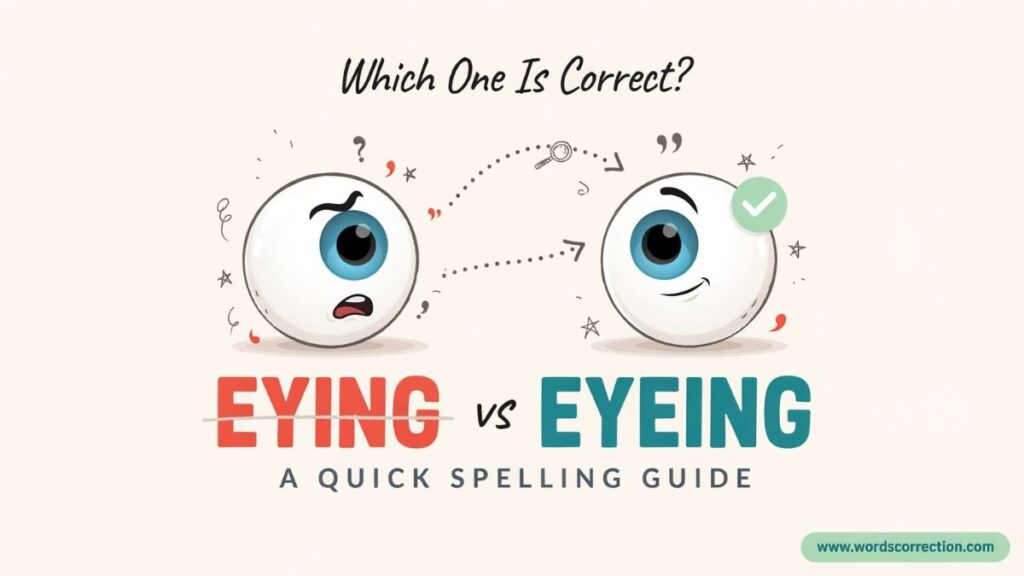
Choosing between eying or eyeing can be confusing, even for experienced writers. The two spellings look slightly different, but both are correct. So, which one should you use? The good news is that you don’t have to worry about making a spelling mistake. Both words have the same meaning and pronunciation, although one is more familiar in everyday writing. Understanding their spelling, meaning, and proper use will help you write more clearly and confidently. In this guide, we’ll explain the difference, explore simple examples, and help you choose the right spelling for your writing.
Quick Answer Eying or Eyeing?
Both eying and eyeing are correct spellings. They are present participle forms of the verb eye, which means to look at something or someone with attention, interest, curiosity, or suspicion.
For example
- She is eyeing the new laptop in the store.
- He was eying the empty seat near the window.
- The manager is eyeing a promotion.
- The cat is eying the bird outside.
Both spellings communicate the same idea. However, eyeing is a familiar choice for general and professional writing, while eying is also a recognized variant.
Eying vs Eyeing Key Differences
| Feature | Eyeing | Eying |
|---|---|---|
| Spelling status | Correct | Correct |
| Meaning | Looking at something with attention or interest | Same meaning |
| Part of speech | Present participle or gerund | Present participle or gerund |
| Pronunciation | Same | Same |
| American English | Accepted | Accepted |
| British English | Accepted | Accepted |
| Professional writing | Suitable | Suitable, depending on style |
| Example | She is eyeing the position. | She is eying the position. |
The main difference is spelling preference, not meaning. You can use either form, but consistency matters. Choose one spelling and use it throughout the same article or document.
What Does Eyeing Mean?
Eyeing means looking at someone or something with particular attention. The look may show interest, curiosity, suspicion, admiration, or desire.
The meaning depends on the situation. Someone might eye a new phone because they want to buy it, or they might eye a stranger because something about that person seems unusual.
For example
- She kept eyeing the chocolate cake.
- The security guard was eyeing the visitors carefully.
- He is eyeing a new position at work.
- The children were eyeing the toys on the shelf.
In each sentence, the person or animal focuses attention on something.
Eyeing Definition
A simple definition of eyeing is
Looking at someone or something carefully, often because of interest, curiosity, suspicion, or desire.
The word can describe several types of attention
- Interest: Looking at something because you want it.
- Curiosity: Watching something to learn more about it.
- Suspicion: Looking at someone because you don’t fully trust them.
- Admiration: Looking at something because you find it attractive.
- Consideration: Showing interest in an opportunity or possibility.
For example, a customer eyeing a new phone may be thinking about buying it. A police officer eyeing a suspicious vehicle may be watching it carefully.
What Does Eying Mean?
Eying has the same meaning as eyeing. It is an accepted spelling variant of the present participle of the verb eye.
For example
- She is eying the last piece of pizza.
- The company is eying a new market.
- He was eying the stranger from across the room.
The meaning does not change when you remove the letter e before adding -ing. Both forms describe looking at something with attention or interest.
Learn the difference between more words people mix up
Copys or Copies Which Is Correct?
Why Are There Two Spellings Eyeing and Eying?
The difference comes from English spelling conventions. When writers add -ing to a verb, the spelling of the original word sometimes changes.
The base verb in this case is eye. It means to look at someone or something.
The two accepted forms are
- Eye + ing = Eyeing
- Eye + ing = Eying
The spelling eyeing retains the final e in the base word before adding the suffix. The alternative spelling eying removes that e.
Both forms have developed into recognized spelling variants. This is why you may find them in dictionaries and other English-language references.
However, spelling conventions don’t always work in exactly the same way for every word. You shouldn’t assume that every verb ending in e can form its -ing version through either pattern.
Compare these examples
| Base verb | Present participle |
|---|---|
| Make | Making |
| Write | Writing |
| Take | Taking |
| Come | Coming |
| See | Seeing |
| Eye | Eyeing or eying |
Most verbs ending in a silent e drop that letter before adding -ing. The word eye has an additional accepted spelling pattern, which explains why both forms appear in English.
Learn the difference between everyday English mistakes
Prooving vs Proving What’s the Difference?
Is Eyeing or Eying More Common?
Both spellings are correct, but eyeing is a familiar and practical choice for many readers. It clearly preserves the connection with the base word eye.
The alternative spelling, eying, is also recognized. Readers can understand it without difficulty, even if they encounter it less often.
For general writing, consider these points
- Use eyeing when you want to retain the familiar spelling of the base word.
- Use eying when it matches the dictionary or editorial style you follow.
- Avoid switching between the two forms in the same document.
- Follow your organization’s preferred spelling when a style guide provides one.
The important point is that neither spelling changes the meaning of the word.
Eyeing in American English
Both eyeing and eying are recognized in American English. The spelling you choose may depend on your dictionary preference, publication, or editorial guidelines.
If you’re writing a blog post, school assignment, business document, or professional email, eyeing is a clear and familiar option.
Examples
- The company is eyeing a major expansion.
- She was eyeing a new car at the dealership.
- Investors are eyeing opportunities in the technology sector.
- The coach is eyeing several talented players.
You can also use eying in these sentences without changing their meanings.
Eyeing in British English
British English also recognizes the spelling eyeing. The alternative eying may appear as a spelling variant, depending on the dictionary or reference source.
Unlike familiar regional differences such as color and colour, the distinction between eyeing and eying is not a simple American-versus-British spelling rule.
Both forms can be understood in English-speaking regions. When writing for a British audience, check the preferred spelling in the dictionary or style guide used by your publication.
Learn the difference between commonly misused words
A Unique or An Unique Which Is Correct?
Is Eyeing Accepted in AP Style?
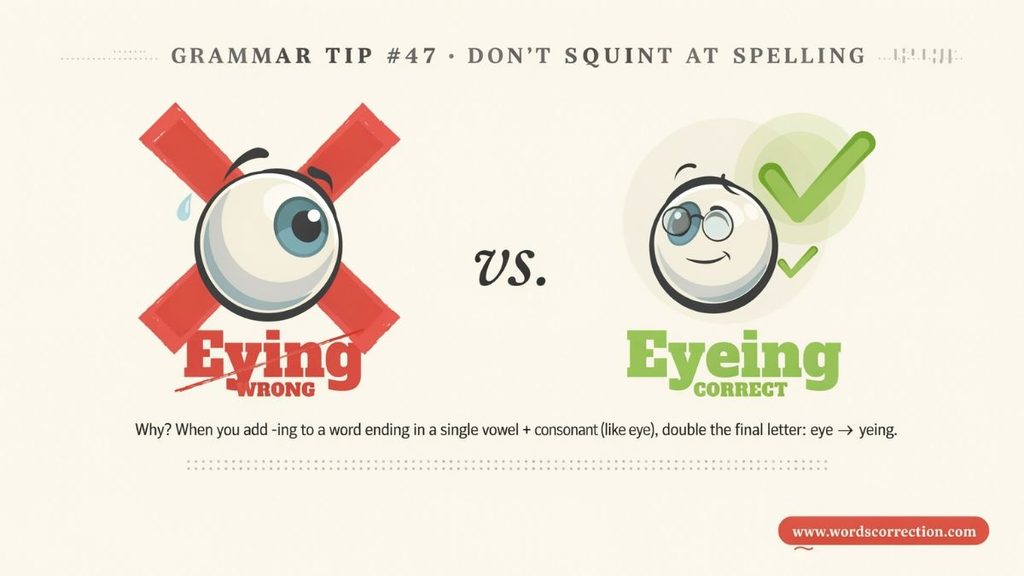
The Associated Press (AP) Stylebook provides editorial guidance for journalists and professional writers. When a style guide doesn’t give a specific instruction for a word, writers generally consult the dictionary recommended by their publication.
If you’re preparing content for an AP-style publication, check its current spelling guidance and the dictionary it follows.
For everyday professional writing, eyeing is a straightforward choice. However, don’t describe eying as automatically incorrect. It is a recognized spelling variant.
The most important rule is to follow one consistent editorial standard throughout your work.
Eyeing as a Verb and Present Participle
The word eye works as a verb when it describes the act of looking at something carefully or with interest.
Its common verb forms include
| Verb form | Example |
|---|---|
| Base form | Eye |
| Third-person singular | Eyes |
| Present participle | Eyeing or eying |
| Past tense | Eyed |
| Past participle | Eyed |
Examples
- I eye the new products whenever I visit the store.
- She eyes the painting carefully.
- They are eyeing the available positions.
- He eyed the package suspiciously.
- The manager has eyed several possible locations.
The present participle appears in continuous verb tenses and can also function as a gerund.
Eyeing in the Present Continuous Tense
Use eyeing with a form of the verb be to describe an action happening now or around the present time.
Examples
- She is eyeing the dress in the window.
- They are eyeing a larger office.
- The dog is eyeing its food.
- I am eyeing a new opportunity.
Eyeing as a Gerund
A gerund is a verb form ending in -ing that functions as a noun.
Examples
- Eyeing the competition can help a business understand its market.
- Careful eyeing of the details revealed a small problem.
- Eyeing new opportunities is part of the company’s growth strategy.
In these examples, the -ing form performs the role of a noun within the sentence.
Learn the difference between basic English word mistakes
Heros or Heroes which spelling is correct?
How to Use Eyeing in a Sentence
The word eyeing works in different situations. You can use it to describe someone looking at an object, watching another person, showing interest in something, or considering an opportunity.
Here are some practical examples.
Eyeing Something With Interest
Use eyeing when someone looks at something because they want it or find it attractive.
- She was eyeing the beautiful handbag in the shop.
- The child kept eyeing the birthday cake.
- He is eyeing the latest smartphone.
- The customer was eyeing the expensive watch.
Eyeing Someone With Suspicion
The word can also describe a doubtful or cautious look.
- The guard was eyeing the visitor suspiciously.
- She kept eyeing the stranger across the street.
- The shopkeeper was eyeing the customer carefully.
Eyeing an Opportunity
In professional and business contexts, eyeing often means considering something as a possible goal.
- The company is eyeing international expansion.
- She is eyeing a senior management position.
- Several investors are eyeing the new project.
- The team is eyeing a place in the final competition.
These examples show that eyeing doesn’t always involve physically looking at an object. It can also express interest in a future opportunity.
Learn the difference between often confused words
Thier or Their which is correct?
Should You Say Eyeing On Something or Eyeing Something?
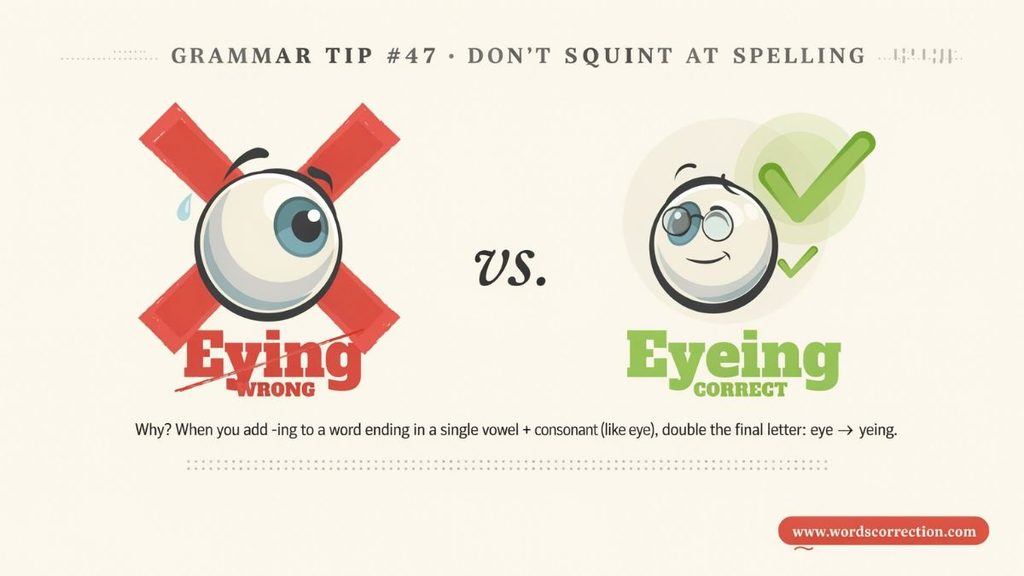
In standard English, eyeing something is generally the correct construction. The verb eye usually takes a direct object, so you don’t need the preposition on.
Correct examples
- She is eyeing the new apartment.
- He is eyeing a promotion.
- The company is eyeing new markets.
- They are eyeing the championship.
Incorrect or unnatural examples
- She is eyeing on the new apartment.
- He is eyeing on a promotion.
- The company is eyeing on new markets.
If you want to use the preposition on, choose a different expression
- She is keeping an eye on the new apartment.
- He is keeping an eye on possible promotions.
- The company is keeping an eye on new markets.
Remember the difference
- Eyeing something: Looking at or showing interest in something.
- Keeping an eye on something: Watching or monitoring something.
Learn the difference between confusing word pairs
Benefitting or Benefiting Which Spelling Is Correct?
Is It Eyeing For or Eyeing Something?
The verb eye normally takes a direct object. Therefore, you generally say eyeing something, not eyeing for something.
Examples
- Correct: She is eyeing a new position.
- Incorrect: She is eyeing for a new position.
- Correct: The company is eyeing an international market.
- Incorrect: The company is eyeing for an international market.
However, other expressions can use for
- She is looking for a new position.
- The company is searching for international opportunities.
- He is hoping for a promotion.
These expressions have different grammatical structures. Choose the verb that best communicates your intended meaning.
Eyeing vs Eyed vs Eyes
These three forms belong to the same verb family, but they serve different grammatical purposes.
| Word | Grammatical form | Meaning |
|---|---|---|
| Eye | Base verb | To look at something |
| Eyes | Third-person singular | Looks at something |
| Eyeing | Present participle or gerund | Looking at something |
| Eyed | Past tense or past participle | Looked at something |
Examples
- I eye the new collection.
- She eyes the expensive shoes.
- He is eyeing the vacant position.
- They eyed the building before entering.
Use the form that matches the tense and structure of your sentence.
Learn the difference between tricky grammar more words
Freshman or Freshmen what’s the Difference?
Synonyms of Eyeing
Depending on the context, several words can replace eyeing. However, not every synonym expresses exactly the same meaning.
For example, watching suggests continued attention, while staring often describes looking at something for a long time. Considering is more suitable when someone is thinking about an opportunity.
| Synonym | Meaning | Example |
|---|---|---|
| Looking at | Directing your eyes toward something | She was looking at the painting. |
| Watching | Observing something over time | He was watching the children. |
| Observing | Paying attention to details | The scientist was observing the experiment. |
| Gazing | Looking steadily, often with admiration | She was gazing at the stars. |
| Staring | Looking for a long time | The child was staring at the toy. |
| Examining | Looking closely to understand something | The mechanic was examining the engine. |
| Inspecting | Checking something carefully | The officer was inspecting the vehicle. |
| Surveying | Looking over an area or situation | The manager was surveying the room. |
| Regarding | Looking at or thinking about something in a particular way | He was regarding the proposal carefully. |
| Scrutinizing | Examining something very closely | The editor was scrutinizing the report. |
| Considering | Thinking about a possible choice | She was considering a new position. |
| Eyeballing | Looking at or estimating something informally | He was eyeballing the distance. |
Choose a synonym based on the meaning you want to express. For example, use scrutinizing when you mean examining something closely, and considering when you mean thinking about a possible decision.
Learn the difference between commonly mixed-up more words
Requestor or Requester Which Spelling Is Correct?
Common Mistakes When Using Eyeing and Eying
Although both spellings are accepted, writers can still make mistakes when using them. Most errors involve spelling consistency, verb forms, and sentence structure.
Treating Eying as an Incorrect Word
Some writers assume that eyeing is the only correct spelling. Others believe eying is always a mistake.
Neither assumption is accurate. Both are recognized forms.
Using Both Spellings in the Same Article
Switching between eyeing and eying can make a document look inconsistent.
For example
- The company is eyeing new markets.
- The investors are eying the same opportunity.
Both sentences are correct, but using one spelling consistently creates a more polished result.
Adding an Unnecessary Preposition
The verb eye usually takes a direct object.
Incorrect: She is eyeing on the new car.
Correct: She is eyeing the new car.
Confusing Eyeing With Keeping an Eye On
These expressions are related, but they don’t always communicate the same idea.
- Eyeing the door: Looking at the door, possibly with interest or intention.
- Keeping an eye on the door: Watching the door to monitor what happens.
Choose the expression that matches your intended meaning.
Using the Wrong Verb Form
Don’t confuse eyeing with eyed or eyes.
Incorrect: She is eyed the new position.
Correct: She is eyeing the new position.
Incorrect: He eyeing the package.
Correct: He is eyeing the package.
The correct form depends on the tense and sentence structure.
Learn the difference between confusing more English words
Traveler or Traveller Which Spelling Is Correct?
When Should You Use Eyeing or Eying?
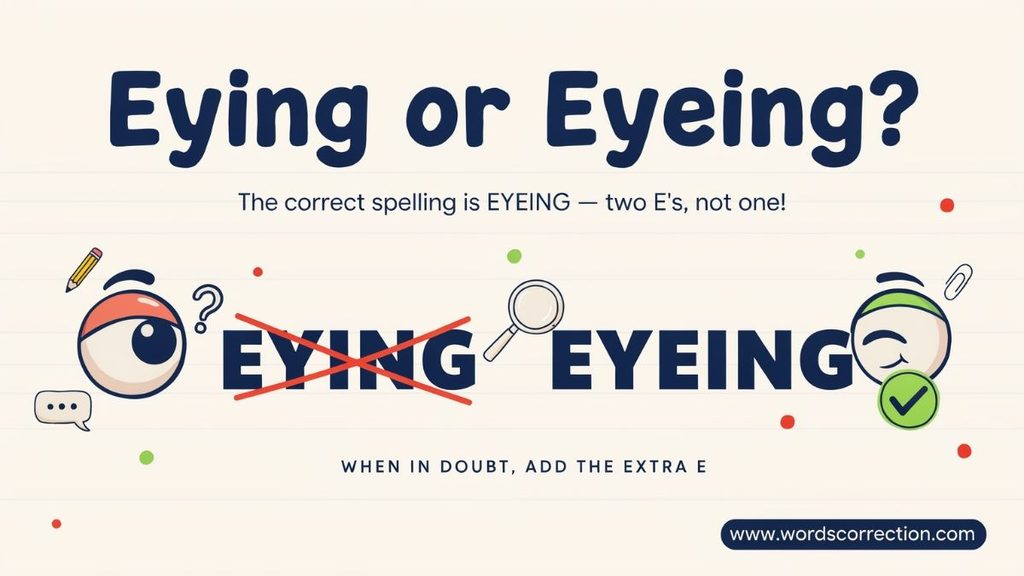
Your choice depends on the writing style you follow. Since both forms are accepted, you don’t need to treat one as a spelling error.
For most general and professional writing, eyeing is a clear and familiar option. It also makes the connection with the base word eye easy to recognize.
Use these guidelines
- Choose eyeing when you want a familiar spelling for a broad audience.
- Use eying when it follows the dictionary or editorial standard you’re using.
- Keep the spelling consistent throughout your article or document.
- Check your publication’s style guide when writing for a specific organization.
- Remember that both forms have the same meaning and pronunciation.
A consistent spelling choice helps readers focus on your message instead of noticing unnecessary changes in word form.
Learn the difference between tricky words and use them correctly
Whoa or Woah Which Spelling Is Correct?
Practice Session Eying or Eyeing
Test your understanding of eying and eyeing with these 25 fill-in-the-blank exercises. Choose the correct word or expression to complete each sentence.
Fill in the Blanks
1. She was ______ the beautiful necklace in the jewelry store.
2. The manager is ______ a new opportunity for business expansion.
3. He kept ______ the stranger suspiciously.
4. The customer was ______ an expensive smartphone.
5. Both ______ and ______ are accepted spellings.
6. The competitor is ______ the company’s latest marketing strategy.
7. She was ______ the delicious chocolate cake on the table.
8. The student kept ______ the clock during the examination.
9. He was ______ a promotion at his workplace.
10. The dog was ______ the food on the kitchen counter.
11. She caught her colleague ______ her new handbag.
12. The investor is ______ a promising business opportunity.
13. He was ______ the unfamiliar object with curiosity.
14. The shopper spent several minutes ______ the designer shoes.
15. The journalist was ______ the politician’s unusual behavior.
16. She gave him a ______ look to express her disapproval.
17. The company is ______ opportunities in international markets.
18. He ______ the expensive watch before entering the store.
19. The children were ______ the colorful decorations.
20. The athlete is ______ a place on the national team.
21. The customer was ______ the available options before making a purchase.
22. She noticed someone ______ her from across the room.
23. The detective was ______ the suspicious activity carefully.
24. He is ______ a new car but has not made a final decision.
25. The writer used ______ consistently throughout the article.
Answers
- Eyeing
- Eyeing
- Eying / Eyeing
- Eyeing
- Eying / Eyeing
- Eyeing
- Eyeing
- Eyeing
- Eyeing
- Eyeing
- Eyeing
- Eyeing
- Eyeing
- Eyeing
- Eyeing
- Side-eyeing
- Eyeing
- Eyed
- Eyeing
- Eyeing
- Eyeing
- Eyeing
- Eyeing
- Eyeing
- Eyeing
Here’s a trusted source for clear word meanings:
Cambridge Dictionary
FAQ’s
What does eying someone mean?
“Eying someone” means looking at a person with noticeable attention, curiosity, admiration, or suspicion. The intended meaning depends on the situation and the observer’s intentions.
What does eyeing mean?
Eyeing means looking at someone or something with interest, attention, or curiosity. It can also describe considering something desirable or evaluating a potential opportunity.
Is it side-eying or side-eyeing?
Side-eyeing is the standard spelling. It refers to looking at someone sideways, usually to express skepticism, suspicion, annoyance, or disapproval.
What does eyeing up mean?
Eyeing up means examining or assessing someone or something carefully. It often suggests evaluating appearance, quality, suitability, or potential value before making a decision.
Is it correct to say eyeing or eying?
Yes, both eyeing and eying are acceptable English spellings. They are present participle forms of the verb eye, share the same pronunciation, and convey the same meaning.
What does eyeing someone up mean?
Eyeing someone up means looking at a person attentively to assess their appearance, characteristics, or suitability. Depending on the context, it may also suggest admiration or romantic interest.
What is another word for eyeing someone?
Suitable synonyms for eyeing someone include observing, watching, examining, scrutinizing, regarding, and sizing up. The most appropriate alternative depends on whether the intended meaning involves curiosity, evaluation, or suspicion.
Is eying a word?
Yes, eying is a recognized English word and an accepted alternative spelling of eyeing. Both forms are derived from the verb eye and describe looking at someone or something attentively.
What does the phrase I’m eyeing mean?
“I’m eyeing” means that someone is looking at something with interest or considering obtaining, selecting, or pursuing it. For example, “I’m eyeing a new laptop” suggests that the speaker is considering buying one.
What is the difference between eyeing and staring?
Eyeing describes looking at someone or something with interest, attention, or a particular intention. Staring involves maintaining a fixed gaze for an extended period. Unlike staring, eyeing does not necessarily involve prolonged looking.
Can eyeing indicate that someone wants something?
Yes, eyeing can indicate interest in or a desire to obtain something. For example, “He is eyeing the latest gaming console” suggests that he is interested in purchasing it.
What does eyeing someone suspiciously mean?
Eyeing someone suspiciously means observing a person with distrust, doubt, or uncertainty. It suggests that the observer questions the person’s intentions, actions, or behavior.
Is eyeing considered a positive or negative word?
Eyeing is generally a neutral expression. Its connotation depends on the context: it can communicate admiration, curiosity, and ambition, or suggest suspicion, criticism, and disapproval.
What does eyeing someone mean in a relationship context?
In a relationship context, eyeing someone means looking at them with noticeable attraction, admiration, or romantic interest. However, the expression alone does not establish whether those feelings are mutual.
What is the past tense of eye?
The simple past tense of eye is eyed, and its past participle is also eyed. For example: “She eyed the unfamiliar painting with curiosity.”
How does eyeing differ from watching?
Eyeing generally involves looking at someone or something with a particular interest, intention, or purpose. Watching refers more broadly to observing an activity, person, or event, often over a period of time.
Can you use eyeing when referring to objects?
Yes, eyeing can refer to objects, possessions, and other things that attract someone’s attention. For example: “She is eyeing a beautiful necklace in the jewelry store.”
What does eyeing the competition mean?
Eyeing the competition means observing competitors to evaluate their strategies, performance, strengths, and weaknesses. This expression is frequently used in business, marketing, and sports discussions.
Is eyeing suitable for formal writing?
Yes, eyeing is appropriate in both formal and informal writing. It appears naturally in professional communication, journalism, descriptive writing, and everyday English when used in the correct context.
What does eyeing an opportunity mean?
Eyeing an opportunity means considering a potential possibility for advancement, growth, or success. For example: “The company is eyeing an opportunity to enter international markets.”
Are eyeing and eyeballing interchangeable?
No, eyeing and eyeballing have related but different meanings. Eyeing refers to looking at something with interest or attention, whereas eyeballing generally means estimating or assessing something visually without precise measurement.
What does eyeing someone across the room mean?
Eyeing someone across the room means looking toward a person from a distance with interest, curiosity, admiration, or suspicion. The surrounding circumstances determine the precise meaning.
What does eyeing something up mean in British English?
In British English, eyeing something up commonly means examining or assessing an object carefully, often because someone is considering purchasing, choosing, or using it.
Is it grammatically correct to say eyeing on something?
No, “eyeing on something” is generally not the standard grammatical construction. The verb eye normally takes a direct object without an additional preposition. For example, write “She is eyeing a new career opportunity” rather than “She is eyeing on a new career opportunity.”
How can you use eyeing and eying correctly in sentences?
Both spellings can be used in identical grammatical constructions because they are accepted forms of the same verb. Consider these examples:
- Eyeing: “The customer is eyeing the expensive watch.”
- Eying: “The customer is eying the expensive watch.”
Both sentences are grammatically correct and express the same idea. Choose one spelling and maintain consistency throughout your writing.
Learn the difference between similar English words the easy way
Conclusion
The difference between eying and eyeing may seem confusing at first, but the rule is simple: both spellings are correct. They have the same meaning, pronunciation, and grammatical use. The only difference is how they’re written. Although eyeing is a familiar choice in everyday and professional writing, eying is also an accepted spelling. The key is to choose one form and use it consistently. So, the next time these two spellings catch your attention, don’t let an extra letter make you doubt your grammar skills. Now you know the difference, and you can use both forms with confidence.

Stella AJS is an experienced blogger and dedicated English language writer at Words Correction. She turns confusing grammar, word meanings, spelling, and usage into clear, practical insights that readers can easily understand and apply. With a passion for precise and engaging writing, Stella helps readers avoid common language mistakes, strengthen their vocabulary, and communicate with greater clarity and confidence.




