
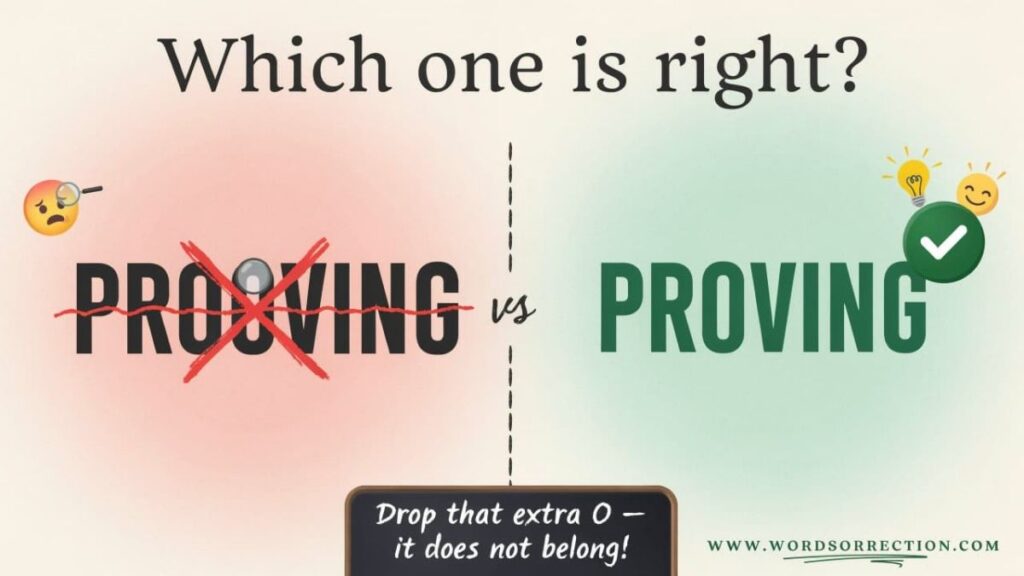
Prooving vs Proving may look similar, but each word has a different meaning and use. Confusing them is a common grammar mistake that can make even a simple sentence unclear. Whether you’re talking about evidence, explaining a fact solving a math problem or baking bread choosing the right word matters. The good news is that learning the difference is easier than you think. In this guide, you’ll discover what each word means, how to use it correctly and how to avoid common mistakes. By the end, you’ll feel more confident using these words and make your writing clearer and more accurate.
Prooving vs Proving Quick Answer
Proving is the correct spelling. Prooving is incorrect and isn’t accepted as a standard English word.
Proving comes from the verb prove, which means to demonstrate that something is true, accurate, or valid through evidence, facts, or logical reasoning.
Consider these examples
- Correct: She is proving her point with reliable evidence.
- Incorrect: She is prooving her point with reliable evidence.
The difference comes from the silent-E spelling rule. When you add -ing to prove, remove the final E and attach the suffix.
Prove + -ing = Proving
You don’t need another O or any additional letter. Simply remove the final E and add -ing.
Prooving vs Proving Comparison Table
A quick comparison makes the difference easier to remember.
| Feature | Proving | Prooving |
|---|---|---|
| Spelling | Correct | Incorrect |
| Standard English usage | Accepted | Not accepted |
| Base word | Prove | Incorrect form of prove |
| Meaning | Demonstrating or establishing something | No standard meaning |
| Part of speech | Present participle and gerund | Incorrect spelling |
| Spelling pattern | Drop final E + -ing | Incorrect letter addition |
| Formal writing | Appropriate | Avoid |
| Example | He is proving his theory. | He is prooving his theory. |
The distinction is straightforward proving has a recognized grammatical function while prooving is simply a spelling mistake.
Whether you’re preparing an academic paper, writing a business report, or sending a quick message, choose proving.
Learn the difference between confusing more English words
Signalling vs Signaling Which Spelling Is Correct?
What Does Proving Mean? Understanding the Proving Definition
The word proving describes the process of demonstrating that something is true, accurate, valid, or effective. It generally involves presenting evidence, examining facts, testing an idea, or using logical reasoning to support a conclusion.
For example, imagine a scientist who believes a particular treatment produces better results than an existing option. The scientist conducts experiments, examines the findings, and compares the outcomes. In this situation, the scientist is proving whether the treatment works as expected.
In simple terms, the proving meaning is the act or process of establishing something through evidence or reasoning.
The word comes from the base verb prove and appears in many areas of everyday life, including education, science, mathematics, law, business, and baking.
Proving as a Verb Form
In English grammar, proving is the present participle of the verb prove. It commonly appears in continuous verb constructions to describe an action that is happening or continuing.
For example
- The scientist is proving the accuracy of her findings.
- His actions are proving that he deserves the promotion.
- The new evidence is proving the witness’s statement correct.
- They are proving their abilities through consistent performance.
In each sentence, proving describes an ongoing process of demonstrating or establishing something.
It frequently appears with helping verbs such as am, is, are, was, and were.
| Sentence | Grammatical construction |
|---|---|
| I am proving my point. | Present continuous |
| She is proving her ability. | Present continuous |
| They are proving their results. | Present continuous |
| He was proving his innocence. | Past continuous |
The word proving retains the same spelling in each construction. The helping verb indicates the tense while proving describes the main action.
Proving as a Gerund
Proving can also function as a noun. In this role, it is called a gerund.
A gerund is a verb form ending in -ing that performs the grammatical function of a noun. Although it comes from a verb, it can act as the subject or object of a sentence.
Consider these examples
- Proving your honesty takes time.
- Proving the theory requires additional research.
- Proving his innocence became his main priority.
- She enjoys proving her arguments with reliable evidence.
In the first sentence, proving your honesty acts as the subject. In the final sentence, proving functions as the object of the verb enjoys.
Compare these two constructions
Present participle: They are proving the results.
Gerund: Proving the results requires patience.
The spelling remains identical. The difference lies in the grammatical role the word performs.
Learn the difference between commonly mixed-up more words
Sent or Send Which one Is Correct?
Different Contexts and Meanings of Proving
Proving appears in several fields. Although its central meaning involves demonstrating or establishing something, its practical use depends on the situation.
Everyday conversations
People use proving when they want to demonstrate that their opinions, statements, or actions are correct.
Example “You’re proving my point by refusing to listen.”
Academic writing
Students and researchers use proving to explain how evidence or logical reasoning supports a conclusion.
Example: “The researchers are proving their hypothesis through controlled experiments.”
Mathematics
In mathematics, proving means using logical steps to establish that a mathematical statement or theorem is true.
Example: “The student is proving that the two triangles are congruent.”
Law
In legal contexts, proving involves presenting relevant evidence to establish a fact or support a legal claim under the applicable standard of proof.
Example “The defense focused on proving that the accused was elsewhere when the incident occurred.”
Business and professional communication
Professionals use proving when demonstrating a product’s value, confirming results, or establishing that a service meets specific requirements.
Example “The company is proving its reliability through consistent customer support.”
Baking
In bread making, proving refers to allowing yeast dough to rest and rise under suitable conditions.
Example “The baker is proving the dough before placing it in the oven.”
This specialized baking meaning is worth remembering because proving and proofing can both describe the process of allowing yeast dough to rise.
Learn the difference between tricky grammar more words
Peak or Peek What’s the Difference?
What Does Prooving Mean? Is Prooving a Word?
If you’ve searched for the prooving meaning, you may have noticed that the spelling doesn’t have a recognized definition in standard English dictionaries.
That’s because prooving is an incorrect spelling of proving. It doesn’t represent a separate verb, noun, or accepted grammatical form.
The mistake usually occurs when writers assume that adding -ing requires another O. However, the base verb is prove, not proove.
Here are some common examples of the mistake and their corrections
| Incorrect spelling | Correct spelling |
|---|---|
| I am prooving my argument. | I am proving my argument. |
| She is prooving her innocence. | She is proving her innocence. |
| They are prooving the results. | They are proving the results. |
| He enjoys prooving people wrong. | He enjoys proving people wrong. |
| The experiment is prooving successful. | The experiment is proving successful. |
Once you understand how the base verb changes before receiving the -ing suffix, this mistake becomes much easier to avoid.
Why Is Prooving Incorrect?
The problem starts with the base word. The correct verb is prove, not proove.
When you add -ing, you remove the final silent E. You don’t replace it with another O.
The correct transformation is
- Prove → Proving
- Move → Moving
- Give → Giving
- Drive → Driving
- Write → Writing
Writing prooving introduces an unnecessary letter and breaks the standard spelling pattern.
Remember that English spelling rules determine how words change when suffixes are added. You can’t simply repeat a vowel because it seems to match the pronunciation.
Learn the difference between confusing word pairs
Mrs or Miss What’s the Difference?
Why Is Proving Correct and Prooving Incorrect? Understanding the Spelling Rule
English spelling can occasionally feel unpredictable. Fortunately, the rule behind proving is easy to understand once you recognize the role of the silent E.
The word follows the silent-E spelling rule, which explains what happens when certain verbs receive a suffix beginning with a vowel.
The Silent-E Spelling Rule
Many English verbs end in a silent E. Although this letter isn’t pronounced separately, it often affects the pronunciation of the preceding vowel.
Consider these examples
- Make
- Take
- Write
- Drive
- Hope
- Prove
When you add a suffix beginning with a vowel, such as -ing, you generally remove the final silent E.
This produces the following forms
| Base verb | Suffix | Correct form |
|---|---|---|
| Prove | -ing | Proving |
| Make | -ing | Making |
| Take | -ing | Taking |
| Write | -ing | Writing |
| Drive | -ing | Driving |
| Hope | -ing | Hoping |
| Move | -ing | Moving |
| Give | -ing | Giving |
The same pattern explains why prove becomes proving.
Why Do We Drop the E Before Adding -ing?
The final E disappears because standard English spelling conventions generally remove a silent E before a vowel-initial suffix.
The process is simple
PROVE
↓
Remove the final silent E.
↓
PROV
↓
Add the suffix -ING.
↓
PROVING
This process is known as dropping the final E before adding a suffix.
However, English has exceptions. For instance, dyeing retains its E to distinguish it from dying. Therefore, the rule applies to many common verbs but not every word.
Why Doesn’t Prove Become Prooving?
This question often causes confusion because writers focus on how a word sounds rather than how its spelling changes.
The word prove already contains the correct vowel combination. When you remove the final E, you attach -ing directly to the remaining letters.
The correct form is
- P + R + O + V + I + N + G
- Proving
The incorrect form is
- P + R + O + O + V + I + N + G
- Prooving
Nothing in the spelling rule requires you to double the O.
Doubling letters follows separate spelling conventions. It doesn’t happen automatically whenever you add a suffix.
Similar Words That Follow the Same Spelling Rule
Comparing proving with familiar verbs makes the pattern easier to remember.
| Base word | Correct -ing form | Incorrect form |
|---|---|---|
| Prove | Proving | Prooving |
| Move | Moving | Moveing |
| Write | Writing | Writeing |
| Drive | Driving | Driveing |
| Give | Giving | Giveing |
| Hope | Hoping | Hopeing |
| Love | Loving | Loveing |
| Take | Taking | Takeing |
Memory tip When a verb ends in a silent E, check whether you need to remove that E before adding -ing. With prove, the correct form is proving.
Learn the difference between often confused words
Todays or Today’s Which Is Correct?
Proving vs Proved vs Proven Understanding the Verb Forms
Understanding the difference between proving, proved, and proven will help you avoid more than one spelling mistake.
All three forms come from the same base verb, prove. However, each serves a different grammatical purpose.
| Verb form | Usage | Example |
|---|---|---|
| Prove | Base form | I can prove my argument. |
| Proves | Third-person singular present | She proves her point. |
| Proving | Present participle or gerund | He is proving his theory. |
| Proved | Simple past and past participle | They proved their case. |
| Proven | Past participle | The method has proven effective. |
Prove The Base Form
Use prove when describing the basic action of demonstrating or establishing something.
Examples
- I can prove that the statement is false.
- You must prove your identity before entering.
- Scientists hope to prove the theory.
- She wants to prove her abilities.
Notice that modal verbs such as can, must, and should take the base form prove rather than proving.
Proving The Present Participle and Gerund
Use proving to describe an ongoing action or when the word performs the function of a noun.
Examples
- He is proving his innocence.
- Proving the claim requires more evidence.
- They are proving the effectiveness of the treatment.
Proved The Past Tense
Use proved when describing an action that happened in the past.
Examples
- The experiment proved successful.
- She proved her point during the discussion.
- The documents proved his ownership of the property.
Proven The Past Participle
Proven is another accepted past participle of prove. It frequently appears with helping verbs such as has, have, and had.
Examples
- The treatment has proven effective.
- She has proven her ability to lead.
- The theory had proven difficult to explain.
Both proved and proven are correct. Their use depends on sentence structure and, in some cases, writing preference.
For example
- The results have proved useful.
- The results have proven useful.
Both sentences are grammatically acceptable.
Learn the difference between basic English word mistakes
Fulfilment or Fulfillment Which Spelling Is Correct?
Prooving vs Proving Examples in Sentences
A spelling rule becomes easier to remember when you see it used in real sentences. The following proving examples demonstrate how the word works in different situations.
Examples Using Proving
Here are 15 examples covering different subjects and grammatical constructions.
Everyday conversations
- You are proving that patience really does make a difference.
- He keeps proving that actions speak louder than words.
- She is proving me wrong with every new example.
Academic writing
- The researcher is proving the hypothesis through controlled experiments.
- The students are proving the mathematical theorem step by step.
- Proving the accuracy of the results requires additional research.
Science and mathematics
- The scientist is proving that the chemical reaction follows a predictable pattern.
- Proving the equation requires a series of logical calculations.
- The new findings are proving the original assumption incorrect.
Professional communication
- The company is proving its commitment to quality through better customer service.
- The employee is proving that he can handle greater responsibility.
- The financial documents are proving useful during the audit.
Legal and personal situations
- The lawyer is proving her client’s innocence through supporting evidence.
- He is proving his ownership of the property with official records.
- Proving that the payment was made requires a valid transaction receipt.
These examples demonstrate that proving works naturally in academic, professional, and everyday communication.
Incorrect Examples Using Prooving
The following sentences contain the common spelling mistake. Each one includes the correct version.
| Incorrect sentence | Correct sentence |
|---|---|
| She is prooving her point. | She is proving her point. |
| He enjoys prooving people wrong. | He enjoys proving people wrong. |
| They are prooving the theory. | They are proving the theory. |
| The results are prooving accurate. | The results are proving accurate. |
| Prooving the claim takes time. | Proving the claim takes time. |
The correction is the same in every example: remove the extra O and use proving.
A Practical Case Study Correcting a Professional Email
Imagine an employee writing an email to explain that a customer’s payment has been completed.
The original sentence reads
“We are prooving that the payment was completed by providing the transaction receipt.”
Although the intended meaning is clear, the spelling mistake makes the message look less professional.
The corrected version reads
“We are proving that the payment was completed by providing the transaction receipt.”
However, a more direct professional version would be:
“The transaction receipt confirms that the payment was completed.”
The revised sentence communicates the same information without unnecessary wording.
This example highlights an important writing principle: accuracy matters, but clarity matters just as much. Choose the most direct expression that communicates your intended message.
Learn the difference between commonly misused words
Amid or Amidst What Is the Difference?
Common Spelling Mistakes to Avoid
The difference between prooving vs proving is straightforward. However, several related errors can cause confusion when you’re writing.
Adding an Extra O
This is the most obvious mistake.
Incorrect: The experiment is prooving the hypothesis.
Correct: The experiment is proving the hypothesis.
The base verb already contains the correct vowel combination. Adding another O creates an incorrect spelling.
Keeping the Silent E
Some writers forget to remove the final E before adding -ing.
Incorrect: She is proveing her argument.
Correct: She is proving her argument.
Remember to remove the silent E before attaching the suffix.
Confusing Proving With Proof
These words have related meanings but different grammatical functions.
- Prove: A verb meaning to demonstrate something.
- Proving: A verb form or gerund describing the process.
- Proof: A noun referring to evidence or confirmation.
For example
- I can prove my point.
- I am proving my point.
- I have proof of my point.
Each sentence uses a different word for a specific grammatical purpose.
Using Prove Instead of Proving
Another common mistake occurs when writers use the base verb where the present participle is required.
Incorrect: She is prove her point.
Correct: She is proving her point.
The helping verb is requires the -ing form in this present continuous construction.
Confusing Proving With Proven
Although both words come from prove, they aren’t interchangeable in every sentence.
Incorrect: The company is proven its reliability.
Correct: The company is proving its reliability.
However
Correct: The company has proven its reliability.
The first construction describes an ongoing action. The second describes an established result.
Learn the difference between everyday English mistakes
Bare or Bear What’s the Difference?
Proving vs Proof vs Prove What’s the Difference?
The words proving, proof, and prove are closely related. They all connect to demonstrating that something is true. However, their grammatical roles differ.
Understanding these distinctions will help you choose the right word in everyday writing.
Prove A Verb
Prove describes the action of demonstrating or establishing something through evidence, facts, or reasoning.
Examples
- I can prove that the information is accurate.
- The lawyer needs to prove her client’s innocence.
- Scientists want to prove their theory.
- Can you prove that you completed the transaction?
Proving A Verb Form or Gerund
Proving describes an ongoing process or functions as a noun.
Examples
- She is proving that the information is correct.
- Proving the statement requires additional evidence.
- They are proving their abilities through practical demonstrations.
Proof A Noun
Proof refers to evidence, information, or a demonstration that supports a claim or establishes something as true.
Examples
- Do you have proof of payment?
- The police collected proof of ownership.
- She provided proof of her identity.
- The student presented a mathematical proof.
Here’s a quick comparison
| Word | Part of speech | Meaning | Example |
|---|---|---|---|
| Prove | Verb | Demonstrate something is true | I can prove it. |
| Proving | Present participle or gerund | The process of demonstrating | He is proving it. |
| Proof | Noun | Evidence or confirmation | Show me the proof. |
What Is the Difference Between Proof and Prove in Mathematics?
Mathematics provides a clear example of the difference between these words.
A mathematical proof is a logical argument that establishes the truth of a mathematical statement using accepted facts, definitions, axioms, and previously established results.
To prove a mathematical statement means to construct that logical argument.
For example
- The student must prove that the equation is correct.
- The teacher checked the mathematical proof.
- Proving the theorem requires several logical steps.
Think of it this way: prove describes the action while proof describes the logical argument that establishes the result.
Proof of Payment or Prove of Payment Which Is Correct?
The correct expression is proof of payment.
People use this phrase when they need evidence that a financial transaction has taken place.
Acceptable examples include
- Please send me proof of payment.
- The bank statement serves as proof of payment.
- You must provide proof of payment before collecting your order.
- The customer submitted a transaction receipt as proof of payment.
The expression prove of payment is incorrect because prove is a verb while the phrase requires the noun proof.
Other common expressions follow the same pattern
- Proof of identity
- Proof of ownership
- Proof of address
- Proof of purchase
- Proof of delivery
- Proof of income
However, you can use prove when describing the action
- You must prove that you made the payment.
- The receipt proves that the transaction was completed.
Quick reminder Use proof when referring to evidence. Use prove when describing the action of demonstrating something.
Learn the difference between more words people mix up
Address vs Adress What’s the Correct Spelling?
Proving Synonyms Other Words for Proving
Repeating the same word throughout an article or conversation can make your writing sound monotonous. Fortunately, English offers several alternatives to proving.
The most suitable synonym depends on the context. Some words emphasize evidence while others focus on confirmation, reasoning, or demonstration.
| Synonym | Meaning | Example |
|---|---|---|
| Demonstrating | Showing how something is true or works | She is demonstrating the effectiveness of the method. |
| Establishing | Making something accepted or certain through evidence | The investigation is establishing the facts. |
| Confirming | Showing that something is correct | The results are confirming the original findings. |
| Verifying | Checking whether something is accurate | The accountant is verifying the transaction. |
| Validating | Showing that something meets accepted standards | Researchers are validating the results. |
| Substantiating | Supporting a claim with evidence | The documents are substantiating his argument. |
| Supporting | Providing reasons or evidence for something | The data is supporting the conclusion. |
| Justifying | Giving valid reasons for an action or belief | She is justifying her decision. |
| Illustrating | Making an idea clear through examples | The experiment is illustrating the principle. |
| Authenticating | Establishing that something is genuine | The system is authenticating the document. |
Which Proving Synonym Should You Use?
Choose your replacement according to the meaning you want to communicate.
- Use demonstrating when showing how something works.
- Use establishing when making a fact or conclusion clear.
- Use confirming when checking an existing belief or statement.
- Use verifying when checking accuracy or authenticity.
- Use validating when testing whether something meets a standard.
- Use substantiating when providing evidence to support a claim.
For example, instead of writing
“The documents are proving his ownership.”
You could write
“The documents are establishing his ownership.”
Both sentences communicate a similar idea, although the second may sound more natural in a formal report.
Remember that synonyms aren’t always interchangeable. A word that works in a scientific report may sound unnatural in casual conversation.
Learn the difference between tricky English words with easy explanations
Advice vs Advise what’s the difference?
Pronunciation of Proving
Spelling and pronunciation don’t always follow the same patterns in English. Fortunately, proving has a fairly straightforward pronunciation.
In standard American English, proving has two syllables and begins with the same sound as prove.
IPA Pronunciation
The International Phonetic Alphabet (IPA) transcription of proving in American English is
proving
Here’s a breakdown of its sounds
- /p/: The initial P sound.
- /r/: The R sound.
- /uː/: The long OO sound, as in food.
- /v/: The voiced V sound.
- /ɪ/: The short I sound, as in sit.
- /ŋ/: The final NG sound, as in sing.
Syllable Breakdown
The word proving contains two syllables
- First syllable: Prove
- Second syllable: Ing
The stress falls on the first syllable.
When speaking, emphasize the opening syllable and pronounce the ending more lightly.
Common Pronunciation Mistakes
Keep these points in mind when pronouncing proving
- Changing the vowel sound: The first syllable has the long OO sound. Avoid replacing it with a short U sound.
- Mispronouncing the ending: The final NG represents one sound rather than a separate N and hard G.
- Adding another syllable: Proving has two syllables, not three.
- Confusing spelling with pronunciation: The incorrect spelling prooving doesn’t represent a different standard pronunciation.
An easy way to remember the sound is to start with the familiar word prove. The first syllable remains the same when you form proving.
Is There Any Difference Between American and British English?
Some English words have different spellings in American and British English. For example, Americans generally write color while British writers use colour.
However, proving has the same spelling in both varieties of English.
| English variety | Correct spelling | Incorrect spelling |
|---|---|---|
| American English | Proving | Prooving |
| British English | Proving | Prooving |
| Australian English | Proving | Prooving |
| Canadian English | Proving | Prooving |
There is no regional spelling variation that makes prooving acceptable.
Whether you’re writing an American business email, a British academic assignment, or an Australian report, the correct form remains proving.
This distinction is worth remembering because some spelling mistakes result from mixing regional conventions. In this case, geography has nothing to do with the difference.
Learn the difference between confusing more English words step by step
Lacs or Lakhs? A Simple Guide to the Correct Spelling
Prooving vs Proving Are They the Same?
The words proving and proofing look similar, but they have different meanings and uses.
Proving comes from the verb prove and generally means demonstrating that something is true, correct, or effective.
Proofing comes from the verb proof and has several meanings depending on the context. It can refer to checking a document for errors, testing something for resistance, or allowing yeast dough to rise.
Consider these examples
| Proving | Proofing |
|---|---|
| She is proving her argument. | She is proofing the document. |
| The scientist is proving the theory. | The baker is proofing the dough. |
| He is proving his innocence. | The editor is proofing the manuscript. |
Proving and Proofing in Baking
This distinction becomes especially interesting in baking.
When a baker allows yeast dough to rise before baking, the process is called proofing or proving.
Both terms are used in baking, although proofing is especially common in American baking terminology.
For example
- The baker is proofing the bread dough.
- The baker is proving the dough before baking.
Both sentences can describe the same process.
However, outside this specialized context, don’t confuse proving with proofing.
For instance
- Correct: She is proving her point.
- Incorrect: She is proofing her point.
The second sentence doesn’t communicate the intended meaning.
Real-Life Examples of Using Proving Correctly
Understanding a spelling rule is useful, but applying it to everyday situations makes the lesson more practical.
Consider three scenarios that show how proving, prove, and proof work in context.
Case Study Proving a Mathematical Statement
A student receives a mathematical problem that requires showing that two expressions are equal.
Instead of guessing the answer, the student applies algebraic rules and follows a series of logical steps to establish the result.
The student is proving the equation.
The written explanation is the mathematical proof.
This example highlights the difference between the verb form and the noun:
- Proving describes the action.
- Proof describes the logical demonstration.
Case Study Proving That a Payment Was Made
Imagine a customer orders a product online and completes the payment through a bank transfer.
The seller requests evidence of the transaction. The customer responds by sending a receipt that displays the payment details.
The following expressions are correct
- “I am proving that I made the payment.”
- “Here is my proof of payment.”
- “The receipt proves that the transaction was completed.”
Each sentence uses a different grammatical form to communicate the same general idea.
Case Study Proving a Scientific Theory
A research team develops a hypothesis and conducts experiments to investigate it.
The researchers collect observations, analyze the results, and compare their findings with the original prediction.
If the evidence supports their conclusion, they can establish that the hypothesis is consistent with the observed results.
In this context, proving describes the process of testing and establishing a scientific claim.
One important distinction deserves attention: scientific research generally provides evidence supporting or challenging hypotheses. A single experiment doesn’t automatically prove a broad scientific theory beyond all possible doubt.
Precise language is essential when discussing research findings.
Practice Session about Prooving vs Proving
Fill in the Blanks
- The scientist is __________ that the new theory is correct.
- Can you __________ that your answer is correct?
- The lawyer presented several __________ to support his argument.
- She needs __________ before she accepts the claim.
- The teacher is __________ the students’ mathematical skills.
- The editor is __________ the article for spelling mistakes.
- The researcher collected evidence for __________ the theory.
- He __________ his point with clear examples.
- The students completed three mathematical __________.
- The baker is __________ the dough before putting it in the oven.
- The company asked for __________ of payment.
- The experiment is __________ that the treatment works.
- Can you __________ your statement with reliable evidence?
- The publisher sent the final __________ to the editor.
- Good research requires __________ before accepting a conclusion.
- She is __________ her skills through regular practice.
- The mathematician explained the __________ step by step.
- The manager wants to __________ that the project was completed.
- The designer checked the printing __________ before approval.
- The evidence __________ that the information is accurate.
- The students are learning how to write mathematical __________.
- Please provide __________ that you completed the transaction.
- The scientist spent months __________ the results.
- The baker allowed the dough to rise during the __________ stage.
- Strong evidence can help __________ whether a claim is true.
Answers
- Proving
- Prove
- Proofs
- Proof
- Testing
- Proofreading
- Proving
- Proves
- Proofs
- Proofing
- Proof
- Proving
- Prove
- Proofs
- Proof
- Improving
- Proof
- Prove
- Proofs
- Proves
- Proofs
- Proof
- Proving
- Proofing
- Prove
Here’s a trusted source for clear word meanings:
Cambridge Dictionary
FAQs
Is it called proofing or proving?
Both words are correct, but they have different meanings. Proving means demonstrating that something is true through evidence or reasoning. Proofing usually refers to checking written material for errors or allowing yeast dough to rise. For example, you prove a mathematical statement but proofread a document.
What does proving mean?
Proving means demonstrating that something is true, correct, or valid through evidence, facts, experiments, or logical reasoning. For example, a scientist may conduct an experiment to prove a theory.
Is it correct to say proofs or proves?
Both words are correct, but they have different grammatical functions. Proofs is the plural form of the noun proof. Proves is the third-person singular form of the verb prove.
Examples
- She proves her point with reliable evidence.
- The report contains several proofs of the theory.
Is proofs a word?
Yes. Proofs is a correctly spelled English word. It is the plural form of proof and refers to multiple pieces of evidence, mathematical arguments, or preliminary versions of printed material that need checking.
What does proofs mean?
Proofs are pieces of evidence or logical arguments that establish whether something is true. The word can also refer to preliminary versions of printed material that people review before publication. Its meaning depends on the context.
How do you do proofs?
The process depends on the type of proof. In mathematics, you begin with known facts or assumptions and use logical steps to reach a conclusion. In everyday situations, you gather reliable evidence, examine the facts, and explain how they support your claim.
What is the plural of proof?
The plural of proof is proofs. You simply add an S to the end of the word. Unlike some nouns ending in F, proof does not change to V in its plural form.
Example: The lawyer presented several proofs during the investigation.
Why are they called proofs?
They are called proofs because they provide evidence or logical reasoning that establishes something as true or correct. In printing, proofs are preliminary versions of a document that allow editors to identify and correct mistakes before final publication.
Why do we use proofs?
We use proofs to support claims, establish facts, solve mathematical problems, and demonstrate that conclusions follow logically from available evidence. Proofs help people distinguish reliable information from unsupported statements.
What are three types of proofs?
Three common types of mathematical proofs are
- Direct proof: Uses known facts and logical steps to establish a conclusion.
- Proof by contradiction: Assumes the opposite of the desired conclusion and demonstrates that this assumption leads to a contradiction.
- Proof by induction: Establishes that a statement is true for an initial case and then demonstrates that it remains true for each subsequent case.
When should you use proof vs prove?
Use proof as a noun when referring to evidence or confirmation. Use prove as a verb when describing the action of demonstrating something as true.
Examples
- Correct: Do you have proof?
- Correct: Can you prove your statement?
Remember that proof names the evidence while prove describes the action of establishing something as true.
Can proof be used as a verb?
In standard modern English, proof is primarily used as a noun. However, it can also function as a verb in specialized contexts, such as making something resistant to water or another substance. For example, waterproofing means treating something to prevent water from passing through it. When you want to demonstrate that a statement is true, use prove.
What is the difference between proof and evidence?
Evidence is information or material that supports a claim. Proof is evidence or reasoning strong enough to establish a conclusion. For example, a fingerprint may serve as evidence in an investigation. Several verified pieces of evidence may help establish proof.
Is proof singular or plural?
Proof is singular, while proofs is plural. Use proof when referring to one piece or body of evidence. Use proofs when referring to multiple proofs.
Examples
- Singular: The researcher found proof.
- Plural: The researchers presented three proofs.
What is the difference between proofs and evidence?
Evidence generally refers to information or material that supports a claim. It is usually an uncountable noun in this context. Proofs is a countable plural noun that refers to separate demonstrations, arguments, or pieces of proof.
For example
- The investigation uncovered important evidence.
- The mathematician presented two proofs.
What does proofs mean in mathematics?
In mathematics, proofs are logical arguments that demonstrate why a mathematical statement or theorem is true. They use definitions, established facts, axioms, and previously proven results to reach a valid conclusion.
What is a proof in simple words?
A proof is something that demonstrates that a statement is true. It can be a document, a piece of evidence, or a logical explanation. For example, a receipt can serve as proof that you paid for something.
What is the difference between proves and proving?
Proves is the present-tense form used with third-person singular subjects such as he, she, and it. Proving is the -ing form of prove. It appears in continuous tenses and can also function as a gerund.
Examples
- She proves her argument with facts.
- She is proving her argument with facts.
How do you use proofs in a sentence?
Use proofs when referring to more than one piece of proof, mathematical demonstration, or preliminary printed copy.
Examples
- The lawyer presented several proofs to support the case.
- The mathematician checked all three proofs.
- The designer reviewed the printing proofs before publication.
Is proofs the same as proofread?
No. Proofs is the plural form of proof. Proofread is a verb that means checking written material for spelling, grammar, punctuation, and other errors.
Examples
- I reviewed the proofs before publication.
- I proofread the article before submitting it.
The first sentence refers to reviewing preliminary copies. The second describes checking a document for mistakes.
What is the difference between proving and proofing in baking?
In baking, proving and proofing can both refer to allowing yeast dough to rest and rise before baking. These terms appear in different English-speaking baking traditions, but they describe essentially the same process in this context.
Can you say I need proof or I need a proof?
Both expressions can be correct depending on the context. I need proof is the natural choice when asking for evidence in everyday English. I need a proof can be appropriate when referring to one specific mathematical argument or a preliminary printed copy.
Examples
- I need proof that the payment was completed.
- The teacher asked each student to write a proof of the theorem.
What Is the Difference Between Proof and Proofing in Printing?
When discussing Prooving vs Proving, it’s also helpful to understand the difference between proof and proofing in printing. A proof is a preliminary version of a document or design that people review before final production. Proofing is the process of checking that version for spelling, layout, color, and formatting errors.
For example, a publishing team may review several proofs before approving a book for printing. Understanding Prooving vs Proving and related terms helps you use the correct words in writing and professional communication.
Is Proofs Used in Everyday English?
Yes. Proofs is commonly used in everyday English when referring to multiple pieces of evidence or preliminary versions of printed documents. Understanding Prooving vs Proving also helps you recognize how related words work in different contexts.
Examples
- The photographer sent us the proofs.
- The company provided proofs of the completed transactions.
- The researcher presented several proofs to support the findings.
Remember, learning Prooving vs Proving makes it easier to understand related words and avoid common spelling and grammar mistakes.
Conclusion
Understanding Prooving vs Proving is easier when you know the simple spelling rule behind the difference. The correct spelling is proving because you must drop the silent E from prove before adding -ing. Although Prooving vs Proving may seem like a small spelling issue, using the correct form makes your writing clearer and more professional.
When learning Prooving vs Proving, remember that prooving is incorrect while proving is the accepted spelling. Knowing the difference between Prooving vs Proving also helps you avoid common spelling and grammar mistakes. Whether you’re writing an essay, presenting evidence, or explaining a mathematical idea, the correct spelling matters.
With regular practice, Prooving vs Proving will become easier to remember. Pay attention to the silent-E rule and use proving whenever you need the -ing form of prove. Once you understand Prooving vs Proving, you’ll feel more confident using the word in everyday writing. Don’t let Prooving vs Proving confuse you again. Remember the correct spelling, apply the rule, and make Prooving vs Proving one less grammar mistake to worry about.

Stella AJS is an experienced blogger and dedicated English language writer at Words Correction. She turns confusing grammar, word meanings, spelling, and usage into clear, practical insights that readers can easily understand and apply. With a passion for precise and engaging writing, Stella helps readers avoid common language mistakes, strengthen their vocabulary, and communicate with greater clarity and confidence.




