
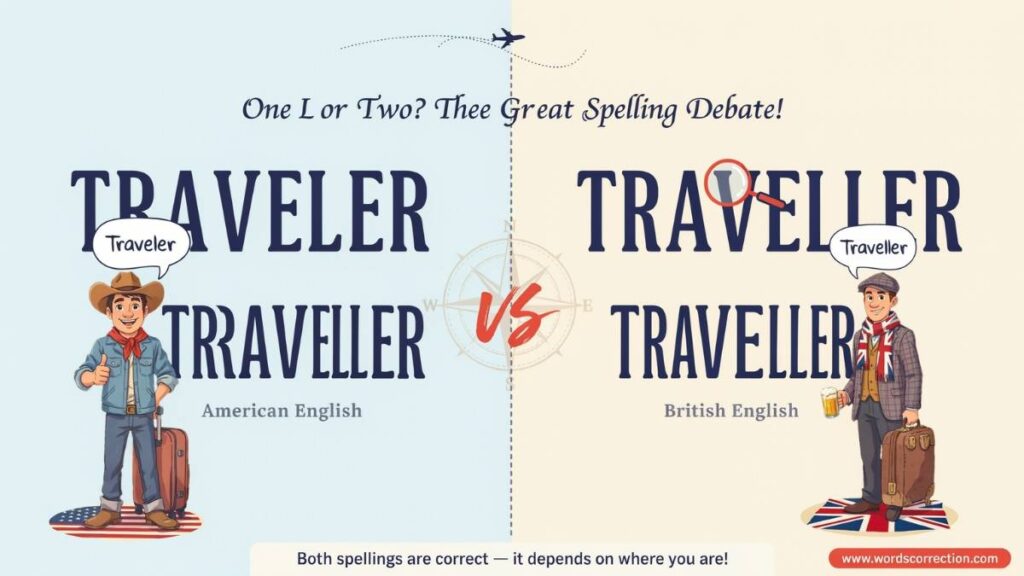
The words traveler and traveller look almost identical, yet one contains an extra letter. This small spelling difference often confuses English learners, writers, and even experienced communicators. The good news is that traveler or traveller isn’t a question of right versus wrong. Both spellings are correct, but their usage depends on the variety of English you follow. In this guide, you’ll discover the difference between American and British English, understand why the extra “l” appears, and learn how to avoid common spelling mistakes. By the end, choosing the correct spelling will be a simple journey.
Traveler or Traveller Quick Answer
Both traveler and traveller are correct. However, their usage depends on the English variety.
- Traveler: The standard spelling in American English.
- Traveller: The standard spelling in British English and commonly used in other varieties that follow British spelling conventions.
The two spellings have the same meaning, pronunciation, and grammatical function. Only the spelling changes.
| Spelling | English variety | Example |
|---|---|---|
| Traveler | American English | The traveler packed her bags. |
| Traveller | British English | The traveller packed her bags. |
Quick rule: Use traveler when writing for an American audience and traveller when following British English conventions.
What Is the Difference Between Traveler and Traveller?
The main difference between traveler and traveller is the number of Ls.
American English uses one L, while British English generally uses two. This difference follows the spelling conventions each variety uses when adding certain endings to words.
For example
- American English: traveling, traveled, traveler
- British English: travelling, travelled, traveller
Both versions communicate the same idea. Neither spelling is grammatically incorrect when used according to its regional convention.
Traveler Meaning
A traveler is a person who moves from one place to another, usually for business, leisure, education, or another purpose.
The word can describe someone taking a short trip, visiting another country, or regularly moving between different locations.
Examples
- The traveler arrived at the airport early.
- Every traveler should check their passport before leaving.
- She is an experienced traveler who enjoys visiting new countries.
- The hotel offers special services for business travelers.
In American English, traveler is the preferred spelling.
Traveller Meaning
A traveller has exactly the same meaning as traveler. It refers to someone who travels from one place to another.
The spelling with two Ls is standard in British English and is also common in other English varieties that follow British spelling conventions.
Examples
- The traveller booked a room near the station.
- Every traveller should carry essential documents.
- The young traveller explored several European cities.
- The railway provides comfortable seats for long-distance travellers.
The meaning does not change when you add another L. The difference is regional spelling preference.
Learn the difference between more words people mix up
Address vs Adress What’s the Correct Spelling?
Why Do Traveler and Traveller Have Different Spellings?
The difference between traveler and traveller comes from the spelling rules followed by American and British English.
One important difference involves the letter L. British English often doubles a final L when adding endings such as -ed, -ing, and -er. American English usually keeps a single L in words such as travel when forming these variations.
This explains why the two varieties use different spellings.
| American English | British English |
|---|---|
| Traveler | Traveller |
| Traveling | Travelling |
| Traveled | Travelled |
| Traveler’s | Traveller’s |
These differences are not limited to the word travel. Other words follow similar patterns.
| American English | British English |
|---|---|
| Canceled | Cancelled |
| Canceling | Cancelling |
| Labeled | Labelled |
| Labeling | Labelling |
| Modeled | Modelled |
| Modeling | Modelling |
There are exceptions and differences between individual words, so it is best to follow a consistent dictionary or style guide when writing professionally.
Learn the difference between everyday English mistakes
Advice vs Advise what’s the difference?
Traveler vs Traveller Which Spelling Does Each Country Use?
English spelling varies across countries. American English generally prefers shorter spellings in several word patterns, while British English often retains the doubled L.
Here is a general guide to the preferred spelling in different English-speaking countries.
| Country | Commonly preferred spelling |
|---|---|
| United States | Traveler |
| United Kingdom | Traveller |
| Canada | Traveller is common |
| Australia | Traveller |
| New Zealand | Traveller |
Canadian English often follows British spelling conventions, including traveller, although individual publishers and organizations may follow their own style guides.
Traveler in American English
In the United States, traveler is the standard spelling.
American English uses one L in related forms such as
- Traveler
- Traveling
- Traveled
- Travelers
Examples
- The traveler visited three states during the summer.
- Traveling by train can be an enjoyable experience.
- The hotel welcomes international travelers.
- She traveled across the country last year.
If your content targets American readers, use the single-L spelling throughout.
Traveller in British English
British English uses traveller with two Ls.
The same spelling convention appears in related forms:
- Traveller
- Travelling
- Travelled
- Travellers
Examples
- The traveller arrived in London yesterday.
- Travelling by train is popular in the United Kingdom.
- The family travelled across Scotland.
- The hotel welcomes international travellers.
When writing for a British audience, the double-L spelling is generally the appropriate choice.
Traveller in Canadian, Australian, and New Zealand English
Canadian, Australian, and New Zealand English generally follow British spelling conventions for this word. Therefore, traveller is commonly preferred.
For example
- The traveller explored the Australian coast.
- Every traveller should carry suitable identification.
- The New Zealand traveller booked a flight to Canada.
However, spelling preferences can vary between organizations. If you are writing for a specific publication, university, or business, check its style guide before choosing a spelling.
Learn the difference between commonly misused words
Lacs or Lakhs? A Simple Guide to the Correct Spelling
How to Remember Traveler or Traveller
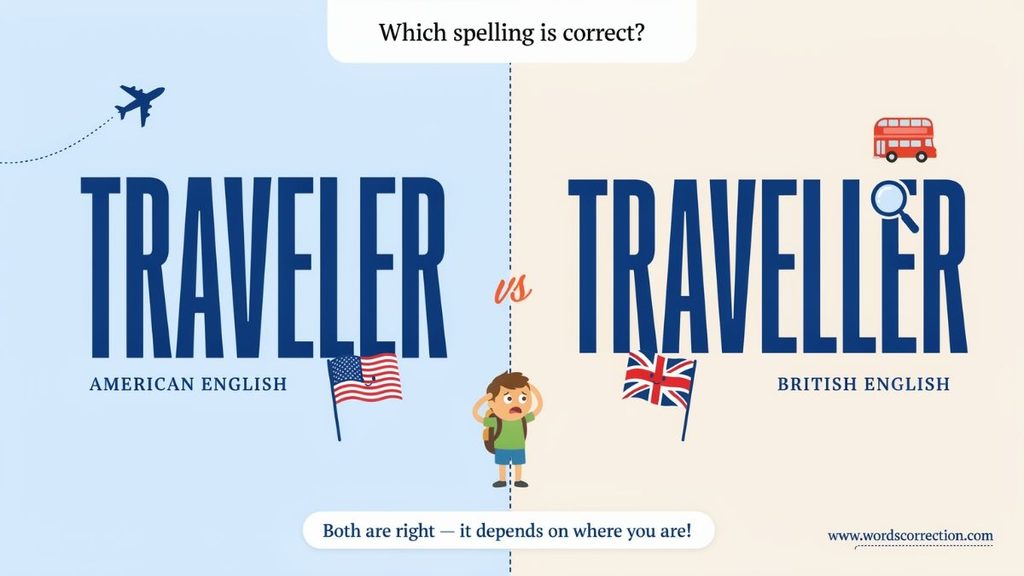
Remembering the difference is easier when you connect the spelling to the English variety.
Use this simple trick
- America = Traveler: One L.
- British English = Traveller: Two Ls.
You can also remember the related words
| American English | British English |
|---|---|
| Travel | Travel |
| Traveler | Traveller |
| Traveling | Travelling |
| Traveled | Travelled |
The base word travel remains the same. The difference appears when you add certain endings.
If you are unsure which version to use, identify your target audience first. That small step can prevent spelling inconsistencies throughout your writing.
Learn the difference between basic English word mistakes
Copys or Copies Which Is Correct?
Traveler and Traveller Example Sentences
Examples make spelling rules easier to understand. The following sentences show how both forms work in everyday writing.
Traveler Examples in American English
- The traveler arrived at the hotel before noon.
- Every traveler should check the weather before starting a journey.
- She is a frequent traveler who visits different countries.
- A smart traveler always keeps important documents safe.
- The business traveler booked a direct flight.
- He became a traveler after completing his university degree.
- Many travelers prefer booking their tickets online.
Traveller Examples in British English
- The traveller arrived at the hotel before noon.
- Every traveller should check the weather before starting a journey.
- She is a frequent traveller who visits different countries.
- A smart traveller always keeps important documents safe.
- The business traveller booked a direct flight.
- He became a traveller after completing his university degree.
- Many travellers prefer booking their tickets online.
Notice that the meaning and sentence structure remain unchanged. Only the spelling differs.
Learn the difference between commonly confused more words in English
Requestor or Requester Which Spelling Is Correct?
Traveler or Traveller What Happens to Other Forms of Travel?
The spelling difference continues when you use travel in other grammatical forms.
If you choose American English, use the single-L forms. If you choose British English, use the double-L forms in the words that follow this convention.
Traveling or Travelling
Both spellings are correct.
- Traveling: American English
- Travelling: British English
Examples:
- I enjoy traveling with my family.
- I enjoy travelling with my family.
The sentences have the same meaning. The spelling simply reflects a regional preference.
Traveled or Travelled
The past-tense form also changes.
- Traveled: American English
- Travelled: British English
Examples
- We traveled to New York last summer.
- We travelled to London last summer.
Both forms describe an action that happened in the past.
Traveler or Traveller
The same spelling pattern applies when referring to a person who travels.
- Traveler: American English
- Traveller: British English
Examples
- The traveler asked for directions.
- The traveller asked for directions.
Travelers or Travellers
The plural form follows the same convention.
- Travelers: American English
- Travellers: British English
Examples
- Many travelers visit the city during the summer.
- Many travellers visit the city during the summer.
Traveler’s or Traveller’s
The possessive form also depends on the spelling convention.
- Traveler’s: American English
- Traveller’s: British English
Examples
- The traveler’s passport was missing.
- The traveller’s passport was missing.
Both sentences show possession. The apostrophe indicates that the passport belongs to the traveler or traveller.
Learn the difference between often confused words
Prooving vs Proving What’s the Difference?
Is Traveler or Traveller a Noun?
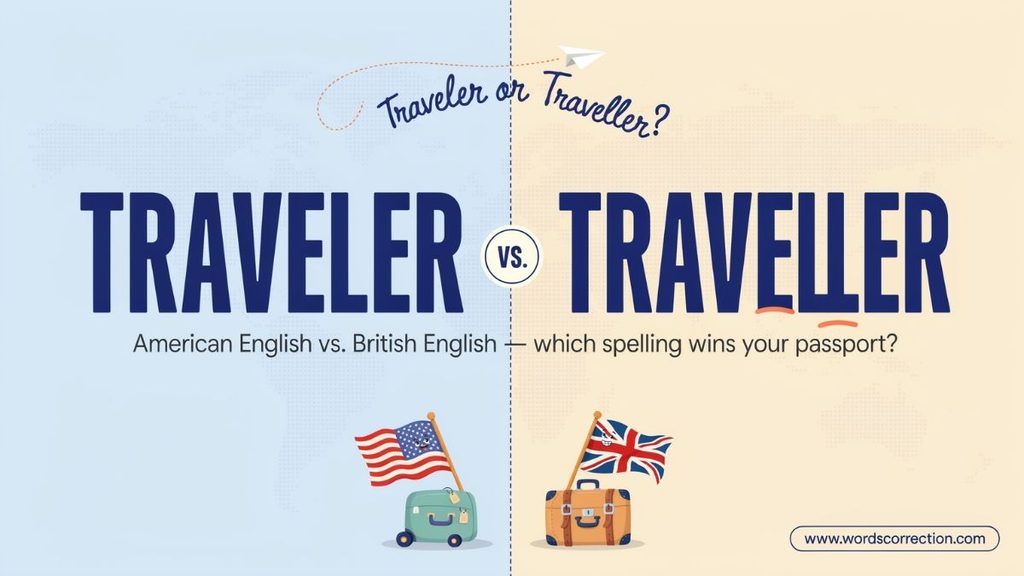
Yes. Both traveler and traveller are nouns.
A noun names a person, place, thing, or idea. In this case, the word identifies a person who travels.
Examples
- The traveler visited several countries.
- A traveller needs a valid passport for international trips.
- The travelers waited at the airport.
- The travellers enjoyed their holiday.
The word can also appear in compound nouns and descriptive phrases.
Examples include
- Business traveler
- Frequent traveler
- International traveller
- Solo traveller
- Budget traveler
The spelling depends on the English variety you are using.
What Is the Difference Between a Traveler and a Tourist?
Although people sometimes use traveler and tourist interchangeably, the words can have slightly different meanings.
A traveler is a broad term for anyone who moves from one place to another. A tourist usually refers to someone visiting a place for pleasure, sightseeing, or recreation.
For example, a person traveling to another city for a business meeting is a traveler, but they may not be considered a tourist.
| Traveler | Tourist |
|---|---|
| A broad term for someone who travels | Usually refers to someone visiting for leisure |
| May travel for work, education, or pleasure | Usually travels for sightseeing or recreation |
| Can describe frequent or occasional travel | Often describes a temporary visit |
| Does not require a leisure purpose | Usually has a leisure-related purpose |
Example
A person flying to another country for a business conference is a traveler. Someone visiting the same country to explore museums and famous landmarks is a tourist.
The distinction depends on context, and the two words can overlap.
Learn the difference between confusing word pairs
A Unique or An Unique Which Is Correct?
Common Mistakes When Using Traveler or Traveller
Even though the spelling difference is simple, writers sometimes make avoidable mistakes.
Here are a few common problems to watch for.
Mixing American and British Spellings
One common mistake is using both spelling styles in the same piece of writing.
For example
- The traveler enjoyed travelling through Europe.
This sentence mixes American traveler with British travelling.
For consistent American English, write
- The traveler enjoyed traveling through Europe.
For consistent British English, write
- The traveller enjoyed travelling through Europe.
Assuming One Spelling Is Incorrect
Some writers believe traveller is a spelling mistake because American English uses traveler. Others assume the opposite.
Neither belief is correct. Both spellings are accepted, but they belong to different regional conventions.
Forgetting the Related Forms
Choosing the correct spelling for traveler is only the first step. You should also use the matching forms of travel.
For example, if you choose American English, write
- Traveler
- Traveling
- Traveled
If you choose British English, write
- Traveller
- Travelling
- Travelled
Ignoring the Target Audience
Your audience should guide your spelling choices.
If you write for an American publication, use American spelling. If your readers are mainly in the United Kingdom, follow British spelling conventions.
For international content, choose a clear style and apply it consistently.
Learn the difference between tricky grammar more words
Heros or Heroes which spelling is correct?
When Should You Use Traveler or Traveller?
The easiest way to choose between these spellings is to consider where your readers live and which English variety your content follows.
Use traveler when
- You are writing for readers in the United States.
- Your publication follows American English.
- Your website uses American spelling conventions.
- Your school or organization requires US English.
Use traveller when
- You are writing for readers in the United Kingdom.
- Your publication follows British English.
- Your content targets readers in Australia or New Zealand.
- Your organization follows British spelling conventions.
For Canadian readers, traveller is common, but check the relevant style guide if consistency is important.
The key is not to switch between the two forms without a reason.
Traveler’s Checks or Traveller’s Cheques Is There a Difference?
This phrase can be confusing because it includes two separate spelling differences.
In American English, the traditional term is traveler’s checks.
In British English, the traditional term is traveller’s cheques.
There are two differences:
- Traveler versus traveller
- Checks versus cheques
The words refer to a traditional form of payment designed for use while traveling. However, travelers today more commonly use bank cards, digital payments, and other modern payment methods.
Examples
- American English: The traveler exchanged his traveler’s checks.
- British English: The traveller exchanged her traveller’s cheques.
This example shows why it is useful to understand regional spelling conventions rather than focusing on one word alone.
Learn the difference between commonly mixed-up more words
Thier or Their which is correct?
What Are Some Synonyms for Traveler or Traveller?
Several words can describe someone who travels. However, each synonym has its own meaning and may not fit every situation.
| Synonym | Meaning |
|---|---|
| Tourist | A person visiting a place, usually for pleasure |
| Explorer | Someone who visits unfamiliar places to discover them |
| Wanderer | A person who moves from place to place without a fixed destination |
| Voyager | Someone who makes a long journey, often by sea or through space |
| Globetrotter | A person who travels frequently to different countries |
| Commuter | Someone who regularly travels between home and work |
| Backpacker | A traveler who often travels independently with a backpack |
| Nomad | Someone who moves from place to place rather than living permanently in one location |
These words are related, but they are not always interchangeable.
For example, a commuter travels regularly between home and work. A tourist usually travels for leisure. A globetrotter often visits many countries.
Choose the word that best describes the person’s journey or travel habits.
Learn the difference between confusing more English words
Benefitting or Benefiting Which Spelling Is Correct?
Practice Session Traveler or Traveller
Fill in the blanks with the correct words. Try answering all 25 questions before checking the answer key.
- American English uses the spelling __________.
- British English commonly uses the spelling __________.
- A person who travels from one place to another is called a __________.
- The American spelling of the word with the -ing ending is __________.
- The British spelling of the word with the -ing ending is __________.
- The American past-tense spelling is __________.
- The British past-tense spelling is __________.
- The plural of traveler in American English is __________.
- The plural of traveller in British English is __________.
- A strong desire to explore the world is called __________.
- A person who frequently travels around the world is called a __________.
- A person who travels alone is known as a __________.
- A person who works remotely while traveling is called a __________.
- A person who regularly travels between home and work is called a __________.
- A person who visits a place mainly for sightseeing is called a __________.
- The fear of traveling is commonly known as __________.
- A person who loves discovering unfamiliar places is called an __________.
- A person who travels for professional purposes is called a business __________.
- The word __________ describes someone who moves from place to place without a fixed destination.
- The word __________ commonly refers to a long journey, especially by sea.
- Traveler and traveller are both __________ spellings.
- The word traveler is a __________ because it names a person.
- Australian English generally follows the __________ spelling of traveller.
- The term __________ describes someone with a strong interest in traveling.
- The most important rule when choosing between traveler and traveller is to maintain spelling __________.
Answers
- Traveler
- Traveller
- Traveler / Traveller
- Traveling
- Travelling
- Traveled
- Travelled
- Travelers
- Travellers
- Wanderlust
- Globetrotter
- Solo traveller / Solo traveler
- Digital nomad
- Commuter
- Tourist
- Hodophobia
- Explorer
- Traveller / Traveler
- Wanderer
- Voyage
- Correct
- Noun
- British
- Travel enthusiast
- Consistency
Here’s a trusted source for clear word meanings:
Cambridge Dictionary
FAQ’s
Who is called a traveller?
A traveller is a person who moves from one place to another for leisure, business, education, adventure, or personal reasons. The term applies to anyone who visits different destinations, whether locally or internationally.
Who is a famous traveller?
Marco Polo is one of the most famous travellers in history. He became widely known for his journeys through Asia during the 13th century and his accounts of the people, cultures, and places he encountered.
Who is the greatest traveller of all time?
There is no universally accepted answer, but Marco Polo, Ibn Battuta, and Zheng He are among history’s most celebrated travellers. Their extensive journeys helped expand geographical knowledge and cultural understanding.
What personality type likes to travel?
People with curious, adventurous, and open-minded personalities often enjoy traveling. However, travel preferences are not limited to one personality type. People with different personalities can find pleasure in exploring new places.
What is the rarest personality type on Earth?
According to the Myers-Briggs Type Indicator (MBTI), INFJ is often identified as one of the rarest personality types. However, its reported prevalence varies across studies and populations.
What type of people travel the most?
Frequent travelers often include business professionals, digital nomads, international students, retirees, and people whose jobs require regular trips. Their travel habits depend on factors such as lifestyle, income, work responsibilities, and personal interests.
What is a beautiful word for travel?
Wanderlust is a popular word that expresses a strong desire to explore the world. Other expressive words associated with travel include voyage, journey, adventure, and odyssey.
Which is the most liked personality type?
No personality type is universally considered the most liked. However, qualities such as kindness, honesty, empathy, confidence, and a positive attitude are widely appreciated in social relationships.
Why do some people love traveling so much?
People often love traveling because it allows them to discover new cultures, meet different people, experience unfamiliar environments, and break away from daily routines. It can also provide excitement, personal growth, and lasting memories.
What is the difference between a traveller and a wanderer?
A traveller generally visits destinations for specific purposes or follows a planned journey. A wanderer tends to move from place to place with fewer fixed plans. Both terms describe people who enjoy exploring different locations.
What do you call someone who travels around the world?
A person who frequently visits different countries and explores various parts of the world is called a globetrotter. The term describes someone with a strong interest in international travel.
What is a person who travels alone called?
A person who travels without companions is called a solo traveller or solo traveler. This term describes someone who independently plans and experiences a journey.
What is a person who travels for adventure called?
A person who travels to experience exciting or challenging activities is known as an adventure traveller. Such travelers often enjoy hiking, mountain climbing, camping, and exploring unfamiliar destinations.
What is the difference between a traveller and a tourist?
A traveller is a broad term for someone who moves between places for different reasons, including work, education, or leisure. A tourist usually visits a destination for sightseeing, recreation, or holidays. The two terms can overlap depending on the purpose of the journey.
What is a person who travels for work called?
A person who regularly travels for professional purposes is called a business traveller or business traveler. This may include consultants, sales representatives, executives, and other professionals who visit different locations for work.
What is a digital nomad?
A digital nomad is someone who works remotely using digital technology while living or traveling in different locations. Digital nomads commonly work in fields such as writing, programming, graphic design, and digital marketing.
What is the fear of traveling called?
The fear of traveling is commonly known as hodophobia. It may involve anxiety about long journeys, transportation, unfamiliar destinations, or leaving familiar surroundings. Its intensity varies from person to person.
What is the desire to travel called?
A strong desire to explore new places and experience different cultures is called wanderlust. The word describes a deep interest in discovering destinations, meeting people, and experiencing the world.
What are the benefits of traveling?
Traveling offers several benefits, including greater cultural awareness, improved communication skills, increased independence, and opportunities for personal growth. It can also help people develop new perspectives and create meaningful memories.
Why is traveling good for personal growth?
Traveling can strengthen confidence, adaptability, and problem-solving skills. Experiencing unfamiliar places and situations encourages people to make independent decisions, adjust to change, and understand different ways of life.
What is the difference between a traveller and an explorer?
A traveller visits different places for various purposes, while an explorer focuses on discovering or studying unfamiliar locations, environments, or cultures. Explorers often seek experiences beyond familiar tourist destinations.
What do you call someone who loves exploring new places?
A person who enjoys discovering unfamiliar destinations may be called an explorer, adventurer, or travel enthusiast. These terms describe people who are curious about new places, cultures, and experiences.
Is traveling a hobby or a lifestyle?
Traveling can be both a hobby and a lifestyle. Some people travel occasionally during holidays, while others make it a regular part of their lives through remote work, long-term journeys, or frequent international trips.
Can traveling change a person’s personality?
Traveling can influence a person’s outlook, confidence, and behavior. Exposure to different cultures and unfamiliar situations may help develop independence, flexibility, patience, and openness to new ideas. However, the effects vary from person to person.
Learn the difference between tricky words and use them correctly
Freshman or Freshmen what’s the Difference?
Conclusion
Choosing between traveler and traveller is easier than it may seem. Both spellings are correct, but the appropriate choice depends on the type of English you use. Traveler is the standard American English spelling, while traveller is commonly used in British English and other varieties that follow British spelling conventions.
The key is to understand your audience and maintain consistency throughout your writing. Avoid mixing American and British spellings in the same article unless a specific context requires it. Once you know this simple rule, you can avoid common spelling mistakes and write with greater confidence. Remember, both spellings are right; using the correct one for your audience makes all the difference.

Stella AJS is an experienced blogger and dedicated English language writer at Words Correction. She turns confusing grammar, word meanings, spelling, and usage into clear, practical insights that readers can easily understand and apply. With a passion for precise and engaging writing, Stella helps readers avoid common language mistakes, strengthen their vocabulary, and communicate with greater clarity and confidence.




