
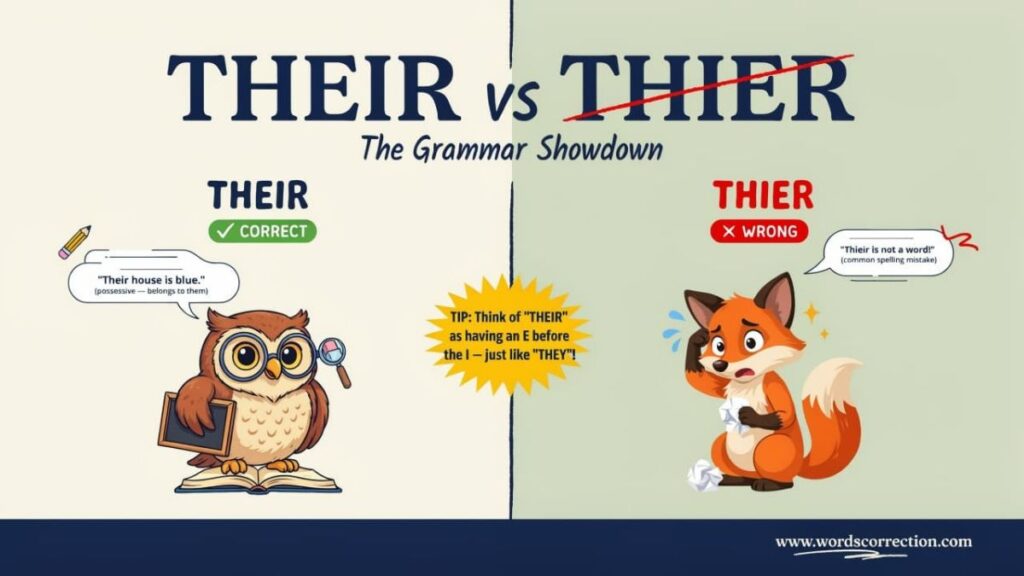
English spelling can be confusing, especially when two words look almost identical. Thier or Their is a common spelling mistake that can easily slip into everyday writing. Although the two forms may look similar, only their is correct in standard English. The confusion often happens because people mix up the order of the letters while typing. In this guide, you’ll learn what their means, why thier is incorrect, and how to use the correct spelling in sentences. You’ll also explore common grammar mistakes and practice choosing the right words with simple examples and exercises.
Quick Answer Is It Thier or Their?
Their is the correct spelling in standard English. Thier is an incorrect spelling and a common typographical error. Use their when you want to show that something belongs to or is associated with someone.
Consider these examples
- Correct: Their house is near the school.
- Incorrect: Thier house is near the school.
The difference comes down to the order of two letters. Their places e before i, while thier reverses them.
| Word | Status | Meaning | Example |
|---|---|---|---|
| Their | Correct | Shows possession or association | Their dog is sleeping. |
| Thier | Incorrect | Common misspelling of their | Thier dog is sleeping. |
If you’re wondering, “Is thier or their correct?” the answer is straightforward: always use their in standard English.
Thier vs Their What’s the Difference?
The difference between thier and their isn’t a difference in meaning. Instead, it is the difference between a correct spelling and an incorrect one.
Their is an established English word with a clear grammatical function. It acts as a possessive determiner and connects an object, person, or idea to its owner or associated group.
Thier, on the other hand, has no accepted meaning in standard modern English. Writers generally produce it by accidentally switching the positions of the letters i and e.
What Does Their Mean?
The word their is a possessive determiner that shows ownership, belonging, or association. It is the possessive form of the personal pronoun they.
In simple terms, their tells you who something belongs to or who something relates to.
For example
- Their children attend the same school.
- The employees finished their work before lunch.
- Their opinions helped shape the final decision.
- The students forgot their books at home.
- Their business has grown significantly over the past year.
In each example, their connects a noun with the people associated with it.
The word doesn’t always indicate legal ownership. It can also describe relationships, responsibilities, ideas, and other connections.
For example, in “Their teacher explained the lesson,” the word identifies the teacher associated with a particular group of students. It doesn’t suggest that the students own their teacher.
Their definition: A possessive determiner used to indicate that something belongs to, relates to, or is associated with people or things referred to as they.
What Does Thier Mean?
The spelling thier has no recognized meaning in standard contemporary English. Most dictionaries and standard grammar references don’t treat it as a separate word.
Instead, writers commonly use it accidentally when they intend to write their.
For example
- Incorrect: The children packed thier bags.
- Correct: The children packed their bags.
- Incorrect: Everyone shared thier ideas.
- Correct: Everyone shared their ideas.
This mistake usually happens because people reverse two neighboring letters. Such errors are called letter transpositions.
A letter transposition occurs when someone places letters in the wrong order while writing or typing a word. The letters themselves may be correct, but their arrangement creates an incorrect spelling.
Therefore, when someone searches for the meaning of thier, they’re usually looking for the meaning of their.
Thier or Their Spelling A Quick Comparison
| Feature | Their | Thier |
|---|---|---|
| Standard English spelling | Yes | No |
| Recognized grammatical function | Possessive determiner | None in standard usage |
| Shows ownership | Yes | No |
| Correct in formal writing | Yes | No |
| Commonly used accidentally | Sometimes | Yes |
The easiest way to understand the thier vs their difference is to remember that only the second spelling follows the accepted English convention.
Learn the difference between more words people mix up
Mrs or Miss What’s the Difference?
What Part of Speech Is Their?
Understanding the grammar behind their makes it easier to use the word correctly. It belongs to the possessive forms of the personal pronoun they.
In traditional grammar, people sometimes call it a possessive adjective. Modern grammatical terminology generally classifies it as a possessive determiner because it appears before a noun and helps identify whose person or thing the noun refers to.
Their as a Possessive Determiner
A possessive determiner comes before a noun to show possession or association.
For example
- Their house has a beautiful garden.
- Their family lives in California.
- Their teacher gave them a difficult assignment.
- Their responsibilities include managing the office.
- Their achievements deserve recognition.
Notice that their appears directly before a noun in each sentence.
It answers questions such as “Whose house?” or “Whose responsibilities?”
For example
Whose books are these?
They’re their books.
Here, their identifies the people associated with the books.
Unlike ordinary adjectives, which describe qualities such as size, color, or appearance, possessive determiners establish a relationship between a noun and its possessor.
Learn the difference between tricky words and use them correctly
A Unique or An Unique Which Is Correct?
Their as a Gender-Neutral Possessive Form
One important feature of modern English is that their can refer to a single person.
Traditionally, English writers sometimes used his when referring to an individual whose gender was unknown. However, singular they and its possessive form their now provide a widely accepted gender-neutral alternative.
Consider these examples
- Someone left their phone on the counter.
- Every student should bring their notebook.
- A customer should keep their receipt.
- If anyone calls, ask for their name.
- Each employee must complete their training.
In these sentences, their refers to one person rather than several people.
It can also refer to an individual who uses they/them pronouns.
For example
“Jordan said their presentation is ready.”
Here, their refers to Jordan, one individual.
Important grammar point: Singular their is grammatically accepted in contemporary standard English. It isn’t automatically incorrect just because the person being discussed is singular.
Their as a Possessive Pronoun: Is That Correct?
People often search for their as a possessive pronoun, but there is a small grammatical distinction worth understanding.
In modern grammar, their is generally classified as a possessive determiner because it normally appears before a noun.
For example
- Their car is outside.
- Their opinions matter.
The standalone possessive pronoun is theirs.
For example
- The car outside is theirs.
- Those opinions are theirs.
Compare the two forms:
| Their | Theirs |
|---|---|
| Their house is large. | The large house is theirs. |
| Their books are missing. | The missing books are theirs. |
| Their decision was final. | The final decision was theirs. |
Remember that their normally introduces a noun, while theirs stands independently.
Learn the difference between everyday English mistakes
Todays or Today’s Which Is Correct?
Their, There, and They’re Understanding the Difference
Although their, there, and they’re sound alike in most English accents, they have different meanings and grammatical functions.
These words are called homophones. Homophones share the same pronunciation but have different spellings and meanings.
Because English pronunciation doesn’t always reveal spelling, writers often confuse these three words. Understanding their individual purposes can prevent many common English spelling mistakes.
Their Shows Possession
Use their when referring to something that belongs to or is associated with people or things.
Examples
- Their house is across the street.
- The children finished their homework.
- Their business opened a new location.
- Everyone should respect their responsibilities.
Memory clue: Their indicates something belonging to them.
There Refers to a Place or Introduces Something
The word there commonly serves two purposes.
First, it can refer to a location or position.
Examples
- The restaurant is over there.
- Put your shoes there.
- We went there last weekend.
Second, there can introduce a statement about the existence or presence of something.
Examples
- There is a book on the table.
- There are several students in the classroom.
- There seems to be a problem with the computer.
Memory clue: There contains the word here. Both words can refer to places.
They’re Means They Are
They’re is a contraction of they are. The apostrophe replaces the missing letter in the contraction.
Examples
- They’re waiting for the bus.
- They’re planning their vacation.
- They’re excited about the new school.
- They’re working on a difficult project.
A useful test is to replace they’re with they are. If the sentence still makes sense, the contraction is probably correct.
For example
“They’re coming to the party.”
“They are coming to the party.”
Both sentences work.
Their vs There vs They’re Comparison Table
| Word | Grammatical Function | Meaning | Example |
|---|---|---|---|
| Their | Possessive determiner | Ownership or association | Their car is new. |
| There | Adverb or introductory expression | Location or existence | The car is over there. |
| They’re | Contraction | They are | They’re buying a car. |
You can even use all three words in one sentence:
They’re putting their bags over there.
- They’re = They are.
- Their = Shows who owns the bags.
- There = Identifies the location.
This simple example demonstrates the difference between their, there, and they’re without making the grammar complicated.
Learn the difference between commonly misused words
Fulfilment or Fulfillment Which Spelling Is Correct?
Why Do People Commonly Misspell Their as Thier?
If their is such a familiar word, why do people continue to write thier?
The answer involves a combination of typing habits, spelling patterns, and the way people process written language.
Here are some common reasons behind this spelling mistake.
Letter reversal: The most direct explanation is that writers accidentally switch the positions of e and i. They know which letters belong in the word but arrange them incorrectly.
Fast typing: When someone types quickly, the fingers may press keys in the wrong order. This happens frequently with familiar words because writers often produce them automatically rather than consciously thinking about every letter.
Spelling uncertainty: English contains several words with the letter combination ie and others with ei. Writers who rely too heavily on general spelling rules may second-guess the correct order.
Visual familiarity: If someone repeatedly sees an incorrect spelling, it may begin to look familiar. Familiarity, however, doesn’t make a spelling correct.
Autocorrect limitations: Some spelling tools detect obvious errors, but not every tool understands context. A grammar checker can help identify misspellings, although you shouldn’t rely on it as a substitute for understanding correct word usage.
A Practical Example of the Mistake
Imagine a student writing an assignment
“All students must submit thier projects before Friday.”
The student understands the sentence perfectly but accidentally reverses two letters.
A spelling checker may underline thier and suggest their as a correction.
The corrected sentence becomes
“All students must submit their projects before Friday.”
The meaning hasn’t changed. Only the spelling has improved.
This is why proofreading matters, even when you understand English grammar and vocabulary well.
Learn the difference between basic English word mistakes
Amid or Amidst What Is the Difference?
Does Their Follow the I Before E Spelling Rule?
You’ve probably heard the familiar spelling rule
“I before E, except after C.”
This rule suggests that i usually comes before e in certain English words, except when the letters follow c.
For example
- Believe
- Field
- Chief
- Receive
- Ceiling
However, English spelling contains plenty of exceptions. The rule doesn’t cover every word, and their is one of the familiar examples that challenges it.
Why Is Their Spelled With EI?
The correct spelling is their, with e before i.
Although the traditional spelling rule may suggest otherwise, the word follows its established historical spelling convention.
English spelling developed through centuries of language contact and change. Its vocabulary includes influences from Old English, Old Norse, French, Latin, and other languages. As a result, spelling patterns aren’t always consistent.
Consider these examples
| Word | Letter Pattern |
|---|---|
| Their | Ei |
| Weird | Ei |
| Neighbor | Ei |
| Receive | Ei |
| Believe | Ie |
| Field | Ie |
| Chief | Ie |
These examples demonstrate why the I before E spelling rule should be treated as a general guideline rather than an absolute rule.
The important lesson: Don’t change the spelling of their just because another English word follows a different letter pattern.
Learn the difference between often confused words
Bare or Bear What’s the Difference?
How to Remember the Correct Spelling of Their
Remembering the correct spelling doesn’t require memorizing complicated grammar rules. A few simple techniques can help you avoid the common typo.
Remember the E Before I
The easiest method is to memorize the letter sequence in their.
Correct: T-H-E-I-R
Incorrect: T-H-I-E-R
Pay attention to the middle letters. The e comes before the i.
Writing the word several times can help reinforce the correct pattern, especially if you frequently make this mistake.
Use the Heir Memory Trick
Here’s a useful spelling trick: associate their with the word heir.
An heir is someone who receives property, money, or another possession from someone else, often through inheritance.
Notice that both words contain the letter sequence eir
- Their
- Heir
This connection can help you remember that their contains ei, not ie.
For example
“Their family business was passed down to the next heir.”
The association between their and heir provides a simple visual reminder.
Connect Their With Ownership
Another helpful technique is to associate their with the phrase “belonging to them.”
For example
- Their books = Books belonging to them.
- Their car = A car belonging to them.
- Their responsibilities = Responsibilities associated with them.
- Their ideas = Ideas belonging to or expressed by them.
Whenever you want to show ownership or association, think of their.
Use a Simple Memory Sentence
Remember this sentence
“Their belongings belong to them.”
The repeated connection between their and belong reinforces the word’s possessive meaning.
If you forget how to spell their, recall the sentence and focus on the correct letter order.
Learn the difference between confusing word pairs
Address vs Adress What’s the Correct Spelling?
Example Sentences Using Their and Thier
Examples make spelling and grammar rules easier to understand. The following sentences show how to use their naturally in everyday conversations, academic writing, and professional communication.
Correct Sentences Using Their
Here are 15 examples demonstrating the correct use of their in different contexts.
| Sentence | What Their Refers To |
|---|---|
| Their house is near the park. | A group’s house |
| The children packed their bags. | The children’s bags |
| Their family visits us every summer. | A family’s visits |
| Students must complete their assignments. | Students’ assignments |
| Their books are on the desk. | A group’s books |
| The employees discussed their responsibilities. | Employees’ responsibilities |
| Their opinions deserve consideration. | A group’s opinions |
| The team celebrated their achievements. | The team’s achievements |
| Their decisions affected the entire company. | The group’s decisions |
| Every student should bring their notebook. | One student at a time |
| Their business has expanded overseas. | A group’s business |
| The neighbors parked their car outside. | The neighbors’ car |
| Everyone should have their own goals. | Each individual |
| Their teacher explained the lesson clearly. | A group’s teacher |
| The children invited their friends to the party. | The children’s friends |
Notice that their appears before a noun in every example. It identifies the person or group associated with that noun.
Incorrect Sentences Using Thier
The following examples show common spelling mistakes and their corrections.
| Incorrect | Correct |
|---|---|
| Thier house is beautiful. | Their house is beautiful. |
| I like thier new car. | I like their new car. |
| Thier children are playing outside. | Their children are playing outside. |
| Everyone should bring thier notebook. | Everyone should bring their notebook. |
| The students forgot thier books. | The students forgot their books. |
| They shared thier opinions. | They shared their opinions. |
| Thier business is growing quickly. | Their business is growing quickly. |
In every case, the correction requires switching the middle letters back to their proper order.
Using Their, There, and They’re in the Same Sentence
A good way to understand commonly confused English words is to see them working together.
Consider these examples
- They’re taking their children over there.
- They’re proud of their achievements because they worked hard to reach their goals.
- Their friends said they’re meeting everyone there.
- They’re bringing their books because there is a test tomorrow.
- Their teacher said they’re going to the library over there.
Each word performs a different grammatical function. Once you understand those functions, choosing the correct spelling becomes much easier.
Learn the difference between tricky grammar more words
Advice vs Advise what’s the difference?
Common Mistakes to Avoid When Using Their
Even experienced English writers sometimes confuse possessive words and contractions. Knowing the most common errors can help you improve your writing.
Writing Thier Instead of Their
This is the main spelling error discussed in this article.
Incorrect: “The children forgot thier lunch.”
Correct: “The children forgot their lunch.”
Always check the position of the middle letters.
Confusing Their With There
Use their to show possession and there to indicate a place or introduce an expression.
Incorrect: “Their is a new restaurant nearby.”
Correct: “There is a new restaurant nearby.”
Another example:
Incorrect: “The students left there books at school.”
Correct: “The students left their books at school.”
Using Their Instead of They’re
Remember that they’re means they are, while their indicates possession.
Incorrect: “Their going to the movies tonight.”
Correct: “They’re going to the movies tonight.”
A quick replacement test can help. If you can replace the word with they are without changing the intended meaning, use they’re.
Confusing Their With Theirs
These words both express possession, but their grammatical positions differ.
Incorrect: “Theirs house is beautiful.”
Correct: “Their house is beautiful.”
However
Correct: “The beautiful house is theirs.”
Use their before a noun and theirs when the possessive form stands independently.
Assuming Their Only Refers to Multiple People
This is another common misunderstanding.
Incorrect assumption: Their can only refer to a group.
Correct understanding: Their can refer to multiple people or a single person in appropriate gender-neutral contexts.
For example:
“Someone forgot their umbrella.”
The sentence refers to one person whose identity hasn’t been specified.
Learn the difference between commonly mixed-up more words
Lacs or Lakhs? A Simple Guide to the Correct Spelling
When Should You Use Their in a Sentence?
The correct use of their depends on the meaning and structure of your sentence. In most situations, you need it when showing ownership or association with a person or group referred to as they.
Here are the main situations in which you should use it.
When discussing something owned by multiple people:
“Their parents bought them a new computer.”
When describing something associated with a group:
“The employees shared their ideas during the meeting.”
When referring to one person whose gender is unknown:
“Someone left their wallet in the waiting room.”
When referring to someone who uses they/them pronouns:
“Alex said their presentation was ready.”
When describing shared responsibilities or relationships:
“The team completed their responsibilities before the deadline.”
In all these situations, their connects a person or group with something associated with them.
Case Study Choosing the Correct Word in Everyday Writing
Consider a short message written by a school administrator:
“Every student must bring thier books tomorrow. Their going to study in the library over their.”
At first glance, the message looks understandable. However, it contains three spelling or word-choice mistakes.
Let’s correct each one
| Original | Correction | Explanation |
|---|---|---|
| Thier books | Their books | The possessive determiner shows which books belong to the students. |
| Their going | They’re going | The sentence means “They are going.” |
| Over their | Over there | The word refers to a location. |
The corrected message reads
“Every student must bring their books tomorrow. They’re going to study in the library over there.”
This example shows why understanding meaning matters just as much as remembering spelling. A grammar checker might identify some errors, but knowing what each word does helps you choose the right one yourself.
Learn the difference between confusing more English words
Copys or Copies Which Is Correct?
Practice Exercise Their or Thier
Fill in the Blanks
- The children left ______ school bags in the classroom.
- ______ going to visit their grandparents this weekend.
- Please put the books over ______ on the shelf.
- Everyone should bring ______ own lunch to the meeting.
- I think ______ going to enjoy the new movie.
- Is this ______ notebook or mine?
- The students completed ______ assignments before the deadline.
- The blue bicycle is ______, not mine.
- ______ house is located near the park.
- The guests said ______ ready for dinner.
- Someone forgot ______ jacket in the office.
- This is not my responsibility; the final decision is ______.
- ______ welcome to join us for lunch.
- The company celebrated ______ tenth anniversary last month.
- The children are playing ______ in the garden.
- She asked whether the team had submitted ______ report.
- That beautiful garden is ______.
- ______ going to need more time to finish the project.
- The teacher reminded the students to bring ______ textbooks.
- I believe this opportunity is ______ to accept or decline.
- The neighbors invited us to see ______ newly renovated kitchen.
- The dog wagged ______ tail when its owner returned.
- The students said ______ excited about the school trip.
- Is that ______ final answer?
- The responsibility for organizing the event is ______.
Answers
- Their
- They’re
- There
- Their
- You’re
- Your
- Their
- Theirs
- Their
- They’re
- Their
- Theirs
- You’re
- Their
- There
- Their
- Yours
- They’re
- Their
- Yours
- Their
- Its
- They’re
- Your
- Theirs
Here’s a trusted source for clear word meanings:
Cambridge Dictionary
FAQ’s
What is correct, their or thier?
Their is the correct spelling in standard English. It indicates ownership or association. Thier is a common spelling mistake and is not accepted in standard English.
Why is their spelled that way?
The spelling their follows an established English spelling convention inherited from older forms of the word. Although the letter combination may seem unusual, the correct order is E-I, not I-E.
How do you use their?
Use their before a noun to show that something belongs to or is associated with one or more people. For example: “The students brought their notebooks to class.”
What does thier mean?
Thier has no recognized meaning in standard English. It is generally a typing error or misspelling of their, the correct word used to express possession or association.
Is thier a word?
No. Thier is not a recognized word in standard English. The correct spelling is their, which indicates that something belongs to or is connected with someone.
What are the three thiers?
The expression usually refers to their, there, and they’re. Although these words sound alike in many English accents, they have different meanings. Their shows possession, there refers to a place or introduces a statement, and they’re is a contraction of they are.
What does the word their mean?
Their means belonging to or associated with one or more people or things. For example, in “They brought their lunch,” the word identifies who the lunch belongs to.
Is it correct to say it is theirs?
Yes. “It is theirs” is grammatically correct. Theirs is a possessive pronoun that indicates ownership without requiring a noun after it. For example: “That blue backpack is theirs.”
Is it correct to say theirs or their’s?
Theirs is correct. The possessive pronoun never takes an apostrophe. For example: “The final decision was theirs.” The spelling their’s is incorrect.
Is their there grammatically correct?
The phrase “their there” can be grammatically correct when each word serves a different purpose in a sentence. For example: “Their house is over there.” The first word indicates ownership, while the second refers to a location.
What does you’re mean?
You’re is a contraction of you are. For example, “You’re welcome” means “You are welcome.” It differs from your, which indicates possession, as in “your book.”
Which is correct your or yours?
Both forms are correct, but they serve different grammatical purposes. Use your before a noun, as in “your phone.” Use yours when the noun is understood or has already been mentioned, as in “The phone is yours.”
Is your beautiful or you’re beautiful correct?
“You’re beautiful” is correct when describing someone as beautiful because it means “You are beautiful.” The phrase “your beautiful” is incomplete in this context because your needs a noun, as in “your beautiful smile.”
Why do people use your guys’s instead of your guys?
Some people use “your guys’s” in informal conversation to express possession, but it is not standard usage. In formal writing, choose the correct possessive form based on the sentence. For example, “Are these your guys’ seats?” uses guys’ as the plural possessive form. You can also say, “Are these seats for your group?”
Is I am yours or I am your correct?
“I am yours” is correct when expressing belonging, commitment, or devotion. Yours can stand alone as a possessive pronoun. By contrast, your must usually come before a noun, as in “I am your friend.”
Can their refer to just one person?
Yes. Their can refer to a single person when that person’s gender is unknown or irrelevant, or when the person uses they/them pronouns. For example: “Someone left their umbrella in the hallway.”
Can you start a sentence with the word their?
Yes. You can begin a sentence with their when it introduces a noun and indicates possession. For example: “Their new apartment is close to the station.”
What is the difference between their own and theirs?
Their own appears before a noun or noun phrase and emphasizes ownership. For example: “They run their own business.” Theirs is a possessive pronoun that stands alone, as in “The business is theirs.”
Should their ever have an apostrophe?
No. Their is already a possessive determiner, so it does not need an apostrophe. The same rule applies to theirs, which is also written without an apostrophe. Therefore, their’s is incorrect.
What is the difference between their and they’re in a sentence?
Their indicates possession, while they’re means “they are.” For example: “Their teacher said they’re ready for the test.” The first word identifies whose teacher it is, while the second describes the students’ readiness.
Can their be used for animals?
Yes. Their can indicate ownership or association when referring to animals. For example: “The dog wagged their tail” may be appropriate when the dog’s sex is unknown or when the writer chooses gender-neutral language.
Is their singular or plural?
Their can be used with both singular and plural meanings. Traditionally, it refers to multiple people. However, singular their is also widely accepted when referring to one person whose gender is unknown or who uses they/them pronouns.
What is the difference between their and there?
Their indicates ownership or association, while there refers to a place or introduces an expression. For example: “Their car is parked over there.” The first word identifies whose car it is; the second indicates its location.
How can you check whether their is the right word?
Replace their with “belonging to them” to check whether the sentence expresses ownership. If the sentence still makes sense, their is likely the correct choice. If you mean “they are,” use they’re instead.
Why is their often confused with there and they’re?
These three words are often confused because they have similar pronunciations in many English accents. However, their meanings and grammatical functions are different. Check whether the sentence expresses ownership, refers to a location, or means “they are” to identify the correct word.
Learn the difference between tricky English words with easy explanations
Prooving vs Proving What’s the Difference?
Conclusion
English spelling can sometimes be confusing, and Thier vs Their is a good example of how switching two letters can lead to a common mistake. The correct spelling is their, while thier is simply a misspelling. Remember that their shows ownership, there refers to a place, and they’re means “they are.” Understanding these differences will help you avoid common spelling and grammar mistakes. With a little practice and attention to detail, you can use these words correctly and improve your writing. After all, a small spelling check can save your sentence from a big grammar mistake.

Stella AJS is an experienced blogger and dedicated English language writer at Words Correction. She turns confusing grammar, word meanings, spelling, and usage into clear, practical insights that readers can easily understand and apply. With a passion for precise and engaging writing, Stella helps readers avoid common language mistakes, strengthen their vocabulary, and communicate with greater clarity and confidence.




