
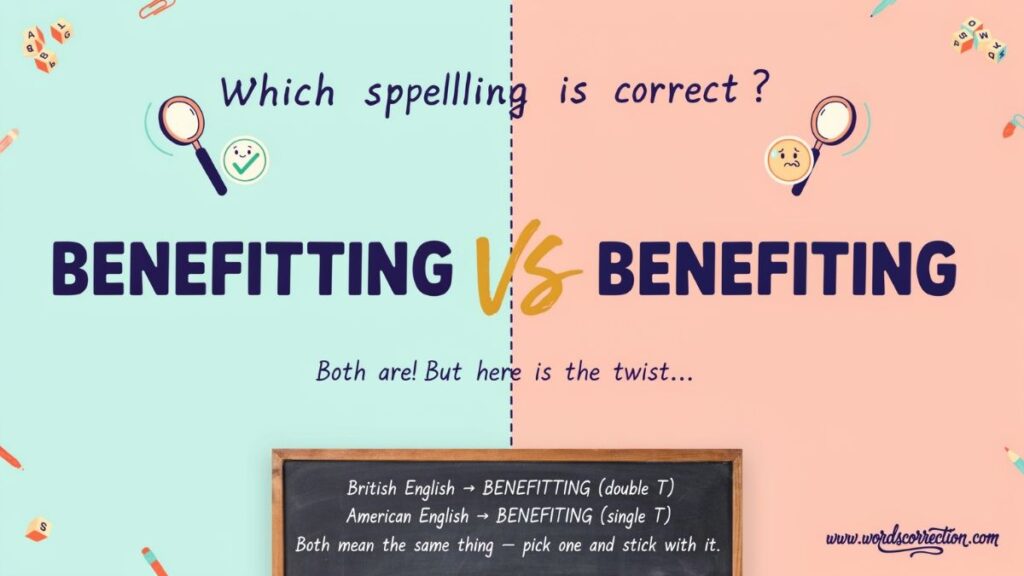
Is it benefiting or benefitting? One extra letter can make a simple spelling question confusing. You may see both spellings and wonder which one is correct. The good news is that both are accepted in English. However, their use depends on regional spelling preferences. In American English, benefiting is the more common spelling, while benefitting is also correct and is used in some British English writing. Knowing the difference can help you avoid spelling mistakes and write more confidently. Let’s look at both forms, understand their meanings, and learn when to use each one.
Quick Answer Benefiting or Benefitting?
Benefiting is the preferred spelling in American English, while benefitting is an accepted alternative, particularly in British English.
Both forms are used to describe receiving an advantage, gaining something positive, or helping someone. However, if you follow American English spelling conventions or want a widely accepted spelling, choose benefiting.
| Spelling | Usage |
|---|---|
| Benefiting | Preferred in American English |
| Benefitting | Accepted alternative, especially in British English |
Examples
- The new training program is benefiting hundreds of students.
- Local businesses are benefitting from increased tourism.
Both sentences are understandable and grammatically correct.
Learn the difference between more words people mix up
Fulfilment or Fulfillment Which Spelling Is Correct?
Benefiting vs Benefitting What Is the Difference?
The main difference between benefiting and benefitting is their spelling. Both words come from the verb benefit and function as its present participle.
The first spelling contains one T, while the second contains two. This difference reflects variations in English spelling conventions rather than a change in meaning.
Benefiting is generally the safer choice for American English writing. Benefitting is also accepted, particularly in British English, although the single-T form is widely used there as well.
| Feature | Benefiting | Benefitting |
|---|---|---|
| Root word | Benefit | Benefit |
| Number of Ts | One | Two |
| Meaning | Receiving an advantage | Receiving an advantage |
| Grammatical form | Present participle | Present participle |
| American English | Preferred | Accepted variant |
| British English | Commonly used | Accepted variant |
Why Do the Spellings Differ?
The difference comes from how English spelling conventions handle words ending in a consonant before adding the suffix -ing.
Some verbs double their final consonant when they take this suffix. Others do not. The spelling of benefit follows a pattern in which the final T generally remains single.
For this reason, benefiting is the standard choice in many dictionaries and style guides.
Learn the difference between everyday English mistakes
Amid or Amidst What Is the Difference?
The Spelling Rule Behind Benefiting and Benefitting
To understand why benefiting is generally preferred, you need to know the consonant-doubling rule.
In English, certain verbs double their final consonant before adding -ing or -ed. This usually happens when a word ends in a single consonant preceded by a single vowel and the final syllable is stressed.
For example
- Run becomes running.
- Sit becomes sitting.
- Admit becomes admitting.
- Begin becomes beginning.
However, the final consonant is not always doubled. The word’s pronunciation and stress pattern help determine the correct spelling.
Why Is the T Not Usually Doubled in Benefiting?
The verb benefit is pronounced BEN-uh-fit. Its primary stress falls on the first syllable, not the final syllable.
Because the final syllable is unstressed, the standard spelling convention does not require doubling the final T before adding -ing.
Therefore
- Benefit + ing = benefiting
- Benefit + ed = benefited
Although benefitting and benefitted are accepted alternative spellings, the single-T forms are widely used and generally preferred in American English.
More Examples of the Consonant-Doubling Rule
| Root Word | Correct Form | Explanation |
|---|---|---|
| Visit | Visiting | Final syllable is unstressed |
| Open | Opening | Final syllable is unstressed |
| Admit | Admitting | Final syllable is stressed |
| Begin | Beginning | Final syllable is stressed |
| Travel | Traveling / Travelling | Spelling varies by region |
| Benefit | Benefiting | Final syllable is unstressed |
Remember that English spelling has exceptions. Learning the stress pattern is useful, but checking a reliable dictionary can help when a word has more than one accepted form.
Learn the difference between commonly misused words
Bare or Bear What’s the Difference?
Benefiting or Benefitting in American and British English
English spelling varies across regions. Words such as color and colour, organize and organise, and traveled and travelled demonstrate these differences.
The same question arises with benefiting and benefitting. Although the double-T form is associated with British English, both spellings appear in British usage.
Benefiting in American English
Benefiting is the standard and preferred spelling in American English.
American dictionaries and common editorial conventions generally use one T in the present participle and past-tense forms.
Examples
- Students are benefiting from the new learning resources.
- The company is benefiting from its recent investment.
- Regular exercise is benefiting her overall well-being.
For American English articles, reports, academic assignments, and professional documents, use benefiting.
Benefitting in British English
Benefitting is an accepted spelling in British English. However, benefiting is also widely used and accepted in the United Kingdom.
British spelling conventions do not require every word to use a doubled consonant. The preferred spelling can vary by dictionary, publisher, and editorial style.
Examples
- The local community is benefitting from the development project.
- Many families are benefiting from improved public services.
- The business is benefitting from a growing customer base.
Both spellings can be found in British writing. Consistency is more important than assuming that one form is exclusively British.
What About Australian and Canadian English?
Australian English often follows British spelling conventions, but it also uses many spellings that overlap with American English.
Canadian English combines features of both traditions. The single-T spelling, benefiting, is commonly recommended in Canadian usage.
| English Variety | Commonly Preferred Spelling |
|---|---|
| American English | Benefiting |
| British English | Benefiting or benefitting |
| Australian English | Benefiting or benefitting |
| Canadian English | Benefiting |
If you’re writing for an international audience, benefiting is a practical choice because it is widely recognized across English-speaking regions.
Learn the difference between basic English word mistakes
Address vs Adress What’s the Correct Spelling?
Benefited or Benefitted Which Spelling Is Correct?
The same spelling question appears when you use the past tense of benefit.
Both benefited and benefitted are accepted spellings. However, benefited is generally preferred in American English and is widely used internationally.
Examples
- The students benefited from additional lessons.
- The company benefited from improved marketing.
- The new policy has benefited local communities.
The double-T form is also accepted
- The students benefitted from additional support.
- The organization benefitted from the partnership.
The meaning does not change. Both forms describe receiving an advantage or gaining something positive.
| Word Form | Single-T Spelling | Double-T Spelling |
|---|---|---|
| Present participle | Benefiting | Benefitting |
| Past tense | Benefited | Benefitted |
For consistent American English writing, use benefiting and benefited.
Learn the difference between often confused words
Advice vs Advise what’s the difference?
Benefiting Meaning and Definition
The word benefiting is the present participle of benefit. It describes receiving an advantage, gaining something useful, or experiencing a positive result.
It can also describe someone or something providing an advantage to another person.
Simple definition: Benefiting means receiving help, gaining an advantage, or experiencing an improvement.
Examples of Benefiting in Different Contexts
Education: Students are benefiting from better learning materials.
Business: Small companies are benefiting from digital marketing.
Health: She is benefiting from a regular exercise routine.
Community: Local residents are benefiting from improved transportation.
Personal development: He is benefiting from professional training.
In each example, benefiting describes a positive result or advantage.
How to Use Benefiting in a Sentence
The word benefiting can appear in different sentence structures. Its exact meaning depends on the context.
Here are some common ways to use it correctly.
Benefiting From Something
Use benefiting from when someone receives an advantage, improvement, or positive result from a particular source.
Examples
- Children are benefiting from the new educational program.
- The company is benefiting from increased online sales.
- Farmers are benefiting from improved irrigation systems.
- She is benefiting from regular professional guidance.
Benefiting Someone
Use benefiting someone when a person, action, or situation provides an advantage to another person.
Examples
- The new policy is benefiting local businesses.
- This decision is benefiting thousands of families.
- The scholarship program is benefiting talented students.
- Improved healthcare services are benefiting the entire community.
Who Is Benefiting?
Use who is benefiting when you want to ask which person or group is receiving an advantage.
Examples
- Who is benefiting from this agreement?
- Which students are benefiting from the program?
- Who is benefiting most from the new policy?
Is Being Benefited Correct?
Yes. The phrase being benefited is grammatically possible, although it can sound less natural than other sentence structures.
Examples
- The community is being benefited by the new development.
- Local families are being benefited by the support program.
In many situations, you can make the sentence clearer by using benefiting from or is benefiting.
For example
- Less natural: The community is being benefited by the program.
- More natural: The community is benefiting from the program.
Learn the difference between confusing word pairs
Lacs or Lakhs? A Simple Guide to the Correct Spelling
Forms of the Verb Benefit
Understanding the different forms of benefit will help you use the word correctly in sentences.
| Verb Form | Word | Example |
|---|---|---|
| Base form | Benefit | Exercise can benefit your health. |
| Third-person singular | Benefits | The program benefits students. |
| Present participle | Benefiting | Students are benefiting from the program. |
| Past tense | Benefited | The company benefited from the investment. |
| Past participle | Benefited | The community has benefited from the project. |
The alternative spellings benefitting and benefitted are also accepted.
Benefit as a Noun
Benefit can also function as a noun. In this form, it refers to an advantage, positive result, or helpful feature.
Examples
- Regular exercise has many health benefits.
- One major benefit of education is better career opportunities.
- The new policy offers financial benefits to employees.
Beneficial and Beneficiary
Two related words are beneficial and beneficiary.
Beneficial is an adjective that describes something helpful or advantageous.
Example: Regular exercise is beneficial for your health.
Beneficiary is a noun that describes someone who receives a benefit or advantage.
Example: She is the main beneficiary of the scholarship program.
These words share the same root but have different grammatical functions.
Learn the difference between tricky grammar more words
Copys or Copies Which Is Correct?
Examples of Benefiting and Benefitting in Sentences
Seeing both spellings in context makes their usage easier to understand.
Examples Using Benefiting
- Students are benefiting from the updated curriculum.
- The company is benefiting from its improved customer service.
- Many families are benefiting from affordable housing.
- Small businesses are benefiting from online advertising.
- Regular reading is benefiting children’s language development.
- The organization is benefiting from stronger partnerships.
- Local farmers are benefiting from modern equipment.
- Employees are benefiting from flexible working hours.
Examples Using Benefitting
- The community is benefitting from better healthcare facilities.
- Local businesses are benefitting from increased tourism.
- Students are benefitting from additional academic support.
- The company is benefitting from its recent expansion.
- Families are benefitting from the new financial assistance program.
Both spellings communicate the same meaning. Choose the form that matches your preferred spelling convention.
Common Mistakes to Avoid
Writers sometimes confuse the spelling of benefit and its related forms. Understanding these common mistakes can help you avoid unnecessary errors.
| Incorrect or Confusing Form | Preferred Form | Explanation |
|---|---|---|
| Benefittting | Benefiting | Three Ts are incorrect. |
| Benefiting from to | Benefiting from | Do not add an unnecessary preposition. |
| Benefiting of | Benefiting from | From is generally the correct preposition for receiving an advantage. |
| He benefiting | He is benefiting | A helping verb is needed in the present continuous tense. |
| She benefit from it | She benefits from it | Use benefits with she, he, or it in the simple present. |
| They is benefiting | They are benefiting | Use are with plural subjects. |
Using the Wrong Verb Form
The verb must agree with its subject and fit the sentence structure.
Incorrect: She benefiting from the course.
Correct: She is benefiting from the course.
Incorrect: The program benefit students.
Correct: The program benefits students.
Incorrect: They was benefiting from the service.
Correct: They were benefiting from the service.
Confusing Benefit With Beneficial
Benefit and beneficial are related, but they cannot always replace each other.
- Benefit is commonly used as a noun or verb.
- Beneficial is an adjective.
Correct: The program provides several benefits.
Correct: The program is beneficial for students.
Incorrect: The program is benefit for students.
Choosing the correct grammatical form makes your writing clearer and more professional.
Learn the difference between commonly mixed-up more words
Prooving vs Proving What’s the Difference?
Synonyms of Benefiting
Synonyms can help you avoid repetition and make your writing more engaging. However, the best replacement depends on the meaning of the sentence.
| Synonym | Meaning | Example |
|---|---|---|
| Gaining | Receiving something useful | Students are gaining valuable knowledge. |
| Profiting | Receiving a financial or personal advantage | The company is profiting from its investment. |
| Improving | Becoming better | Her performance is improving through practice. |
| Advancing | Making progress | The team is advancing through training. |
| Thriving | Growing successfully | Local businesses are thriving. |
| Flourishing | Developing successfully | The community is flourishing. |
| Helping | Providing support | The program is helping families. |
| Assisting | Giving practical support | The organization is assisting local residents. |
| Enriching | Making something more valuable | The course is enriching students’ learning experiences. |
| Rewarding | Providing satisfaction or positive results | The experience is rewarding for everyone involved. |
Choosing the Right Synonym
Not every synonym works in every sentence.
For example, benefiting and profiting can both describe gaining an advantage, but profiting often suggests financial gain.
Similarly, helping emphasizes providing support, while improving focuses on making something better.
Choose a synonym that preserves the original meaning instead of replacing a word simply to avoid repetition.
Learn the difference between confusing more English words
A Unique or An Unique Which Is Correct?
Easy Ways to Remember the Correct Spelling
If you often confuse benefiting and benefitting, a simple memory trick can help.
Remember that benefiting is the preferred American English spelling and uses only one T.
You can also remember the word’s pronunciation:
BEN-uh-fit
The main stress falls on the first syllable. This helps explain why the final T is not doubled in the standard single-T spelling.
Another useful approach is to remember these two common forms together:
- Benefit → Benefiting
- Benefit → Benefited
Using the single-T forms consistently is a reliable choice for American English writing.
Learn the difference between tricky English words with easy explanations
Heros or Heroes which spelling is correct?
Practice Session
Fill in the blanks
- Students are ______ from the new educational program.
- The company ______ from its recent investment last year.
- Regular exercise ______ your physical and mental health.
- The new policy is ______ local families.
- The scholarship has ______ many talented students.
- Both benefiting and ______ are accepted spellings.
- The employees were ______ from the training sessions.
- The community ______ from the development project.
- The organization has been ______ from stronger partnerships.
- The new facilities will ______ the entire community.
- Many small businesses are ______ from digital marketing.
- The training program is ______ for new employees.
- The students have ______ from additional learning resources.
- The new system ______ employees by saving time.
- She is ______ from professional guidance.
- The company has ______ from improved customer service.
- The community is ______ from better healthcare facilities.
- Benefited and ______ are accepted past-tense spellings.
- The new policy will ______ thousands of families.
- Regular reading is ______ children’s language development.
- The program has been ______ to local businesses.
- The students are ______ valuable knowledge through practice.
- Exercise is ______ to overall health.
- The organization ______ local communities through its services.
- The new training course has ______ employees improve their skills.
Answers
- Benefiting
- Benefited
- Benefits
- Benefiting
- Benefited
- Benefitting
- Benefiting
- Benefited
- Benefiting
- Benefit
- Benefiting
- Beneficial
- Benefited
- Benefits
- Benefiting
- Benefited
- Benefiting
- Benefitted
- Benefit
- Benefiting
- Beneficial
- Gaining
- Beneficial
- Benefits
- Helped
Here’s a trusted source for clear word meanings:
Cambridge Dictionary
FAQ’s
Is benefiting or benefitting correct?
Both benefiting and benefitting are accepted spellings. Benefiting is the preferred form in American English, while benefitting is also recognized, particularly in British English.
Is benefited spelled with one T or two?
Both benefited and benefitted are correct. Benefited, with one T, is generally preferred in American English, while benefitted is an accepted alternative.
What does benefiting mean?
Benefiting means receiving an advantage, gaining something useful, or experiencing a positive result. It can also describe providing an advantage to another person or group.
What is the difference between benefited and benefitted?
There is no difference in meaning between benefited and benefitted. Both are past-tense forms of the verb benefit. The difference is purely a matter of spelling preference.
Does benefiting have one T or two Ts?
The preferred American English spelling is benefiting, with one T. Benefitting, with two Ts, is also an accepted spelling variant.
How do you spell benefiting or benefitting?
Both spellings are recognized. Use benefiting for standard American English writing. Benefitting is also accepted, especially in British English.
What is the past tense of benefit?
The past tense of benefit is benefited in standard American English. Benefitted is also an accepted alternative.
Example: The students benefited from the additional lessons.
What is the verb form of benefit?
Benefit is the base form of the verb. Its main forms are benefit, benefits, benefiting, and benefited. The verb describes receiving or providing an advantage.
Is benefiting a noun or a verb?
Benefiting is the present participle of the verb benefit. It can also function as a gerund when it acts as a noun in a sentence.
Example: Benefiting from experience can improve your professional skills.
Why is benefiting spelled with one T?
The verb benefit has its primary stress on the first syllable. The standard spelling rule keeps the final T single when writers add -ing to the word benefit. This gives the preferred spelling benefiting.
Is benefitting considered a misspelling?
No. Benefitting is an accepted spelling variant of benefiting. American English speakers generally prefer benefiting, and people around the world use this spelling widely.
Which spelling should I use in American English?
Use benefiting in American English. It is the standard spelling preferred by American dictionaries and commonly followed in professional, academic, and editorial writing.
Is benefitting accepted in British English?
Yes. Benefitting is an accepted British English spelling. British writers also commonly use benefiting, so they do not need to double the final T.
What is the difference between benefit and benefiting?
Benefit is the base form of the verb and can also function as a noun. Benefiting is its present participle, used to describe an ongoing action or a process of receiving an advantage.
What is the difference between benefiting and beneficial?
Benefiting is a verb form that describes receiving or providing an advantage. Beneficial is an adjective that describes something helpful or advantageous.
Example: Students are benefiting from a beneficial learning program.
Is benefiting from grammatically correct?
Yes. People use the phrase benefiting from when they gain an advantage through a particular source, activity, or situation.
Example: Employees are benefiting from the company’s training program.
Can I use benefitting in formal writing?
Yes. Writers also accept benefitting as an alternative spelling in formal writing. However, if you’re following American English conventions, benefiting is the more appropriate choice.
What is the past participle of benefit?
American English uses benefited as the standard past participle of benefit, but writers also accept benefitted as an alternative spelling.
Example: The organization has benefited from the new partnership.
What are the main forms of the verb benefit?
The main forms are benefit, benefits, benefiting, and benefited. Writers also accept the alternative forms benefitting and benefitted.
What is the pronunciation of benefiting?
People pronounce benefiting as BEN-uh-fit-ing. The primary stress falls on the first syllable, which helps explain why the standard spelling uses one T.
What are some synonyms for benefiting?
Common synonyms include gaining, profiting, improving, advancing, thriving, flourishing, helping, assisting, and enriching. The best choice depends on the context and intended meaning.
Is benefiting used in the present continuous tense?
Yes. Writers can use benefiting in the present continuous tense by adding am, is, or are before it
Example: The company is benefiting from its recent expansion.
What is the difference between benefiting and gaining?
Both words can describe receiving an advantage, but their meanings are not identical. Benefiting emphasizes receiving a positive result or advantage, while gaining can refer to acquiring something more generally, such as knowledge, experience, or money.
Can benefiting describe a person or a business?
Yes. Benefiting can describe individuals, businesses, organizations, communities, or other groups receiving an advantage or positive result.
Examples
- Students are benefiting from better learning resources.
- Small businesses are benefiting from digital marketing.
- Local communities are benefiting from improved healthcare services.
What is the correct spelling for SEO and professional writing: benefiting or benefitting?
Benefiting is the recommended choice for American English SEO content and professional writing. American writers widely recognize this spelling, follow standard American conventions, and use it successfully for international readers.
Learn the difference between confusing more English words step by step
Thier or Their which is correct?
Conclusion
The choice between benefitting or benefiting can seem confusing, but the spelling difference does not change the meaning. Both forms are correct, but American English speakers generally prefer benefiting, which many writers use worldwide.
Remember that the verb benefit has its primary stress on the first syllable. This explains why the standard spelling uses one T when adding -ing. For clear and consistent writing, choose benefiting and benefited unless your preferred dictionary or style guide recommends otherwise.

Stella AJS is an experienced blogger and dedicated English language writer at Words Correction. She turns confusing grammar, word meanings, spelling, and usage into clear, practical insights that readers can easily understand and apply. With a passion for precise and engaging writing, Stella helps readers avoid common language mistakes, strengthen their vocabulary, and communicate with greater clarity and confidence.




