

Is it freshman or freshmen? These two words often confuse students because they look almost identical but have different uses. A small spelling mistake can change the meaning of your sentence. For example, should you say “She is a freshman” or “She is a freshmen”? The correct choice depends on whether you’re talking about one student or a group. Don’t worry, the rule is simple once you understand it. In this guide, you’ll learn the meanings, spelling differences, grammar rules, and correct usage of both words through easy explanations and practical examples.
Freshman or Freshmen The Quick Answer
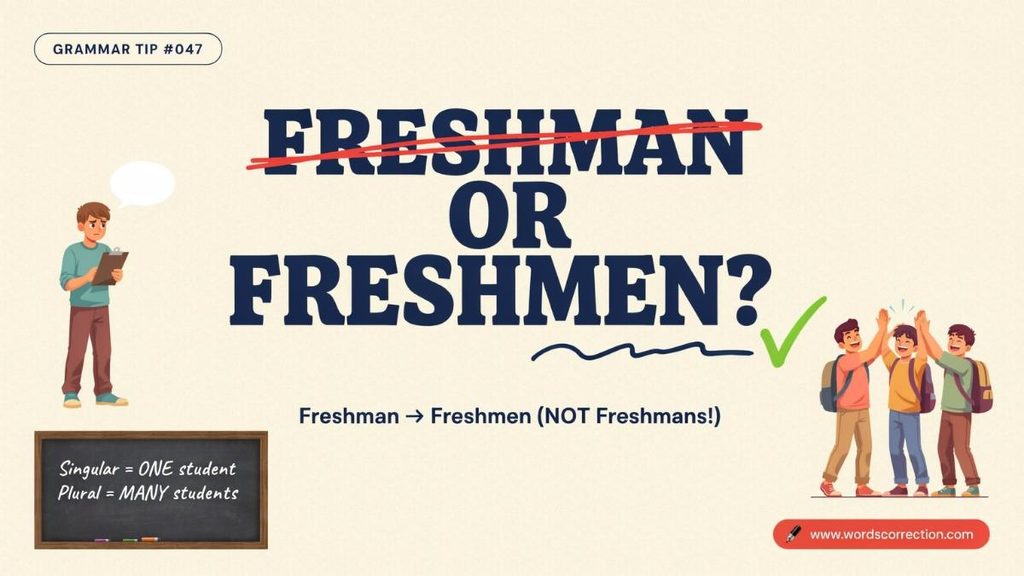
Both freshman and freshmen are correct spellings in standard American English. The right choice depends on how many students you’re describing.
- Freshman: The singular form, used for one student in the first year of high school or college.
- Freshmen: The plural form, used for two or more students in their first year.
Look at these examples
- Sarah is a freshman at the university.
- Sarah and Emily are freshmen at the same university.
- Every freshman must attend the introductory meeting.
- The college welcomed hundreds of freshmen this semester.
The meaning changes with the number of students, but the educational level stays the same.
| Word | Form | Meaning | Example |
|---|---|---|---|
| Freshman | Singular | One first-year student | He is a freshman. |
| Freshmen | Plural | Two or more first-year students | They are freshmen. |
Quick rule: Use freshman for one student and freshmen for more than one.
Freshman vs Freshmen Understanding the Main Difference
The difference between freshman and freshmen is a matter of grammatical number. English uses singular nouns to identify one person or thing and plural nouns to describe more than one.
Freshman is a singular noun. It identifies an individual beginning the first year of a high school or college program. Freshmen is its irregular plural form, which refers to a group of first-year students.
For instance, imagine a university welcoming 300 new students. If you discuss one individual, you would call that person a freshman. If you refer to the entire group, you would use freshmen.
Consider these examples
- One freshman registered for the biology course.
- Five freshmen registered for the biology course.
- The freshman is waiting outside the classroom.
- The freshmen are waiting outside the classroom.
Notice how the verb changes along with the noun. A singular subject takes a singular verb, while a plural subject takes a plural verb.
| Singular Form | Plural Form |
|---|---|
| The freshman is studying. | The freshmen are studying. |
| A freshman has arrived. | Several freshmen have arrived. |
| One freshman was selected. | Three freshmen were selected. |
| This freshman needs help. | These freshmen need help. |
This distinction is especially important in formal writing because incorrect subject-verb agreement can make an otherwise well-written sentence sound awkward.
Learn the difference between confusing more English words
Amid or Amidst What Is the Difference?
What Does Freshman Mean?
The freshman meaning refers to a student who has entered the first year of high school or college. In the American education system, schools and universities commonly use this term to classify students according to their academic progress.
A freshman is usually a newly enrolled student who is beginning a new educational stage. However, the word describes academic standing rather than a particular age.
For example, a student entering ninth grade is generally considered a high school freshman. Similarly, someone starting the first year of an undergraduate degree is commonly called a college freshman.
The term also appears in academic programs, student activities, sports, and campus events.
Freshman Definition and Everyday Examples
The standard freshman definition identifies an individual in the first year of a school or college program.
Here are several examples that show how the word works in different situations
- Education: My younger brother is a freshman at Lincoln High School.
- College: Daniel became a freshman at a state university this fall.
- Sports: The freshman earned a place on the school’s basketball team.
- Academics: Every freshman must complete an introductory writing course.
- Campus activities: A freshman joined the university’s debate society.
In each sentence, freshman refers to one student.
What Is a Freshman Student?
A freshman student is someone completing the first year of high school or college.
This stage often introduces students to new academic expectations, unfamiliar classmates, and different learning environments. College freshmen, for example, may need to manage independent study schedules, attend lectures, select courses, and become familiar with campus resources.
A freshman student might participate in
- Introductory academic courses.
- Student orientation programs.
- Campus clubs and organizations.
- Academic advising sessions.
- Sports and extracurricular activities.
Although freshman student is grammatically correct, the expression can sound repetitive because freshman already identifies a student. In many situations, simply using freshman creates a cleaner sentence.
Learn the difference between commonly mixed-up more words
Bare or Bear What’s the Difference?
What Does Freshmen Mean?
Freshmen is the plural form of freshman. It refers to two or more students who are in the first year of high school or college.
The word doesn’t describe a different educational level. It simply indicates that you’re discussing multiple first-year students instead of one individual.
For example
- The freshmen attended their first college lecture.
- Several freshmen joined the student council.
- The university organized a welcome event for incoming freshmen.
- All freshmen must complete their registration before the deadline.
These sentences discuss groups rather than individual students.
Freshmen Definition With Practical Examples
The freshmen definition applies whenever you’re referring to multiple first-year students.
Consider these situations
FOR high school: The freshmen participated in the school’s annual science competition.
college: The university welcomed 1,200 freshmen during the fall semester.
In sports: The coach selected four freshmen for the basketball team.
Student activities: Several freshmen organized a fundraising event.
The word remains plural in every example because it describes more than one student.
Is Freshmen Students Grammatically Correct?
The expression freshmen students can be grammatically acceptable. However, it often repeats information unnecessarily.
Why? Because freshmen already means first-year students.
Compare the following sentences
- The freshmen attended the welcome ceremony.
- The freshmen students attended the welcome ceremony.
- The first-year students attended the welcome ceremony.
All three communicate a similar message. However, the first and third options sound more concise and natural.
For professional and academic writing, prefer freshmen or first-year students unless the surrounding sentence requires additional clarification.
Learn the difference between tricky grammar more words
Address vs Adress What’s the Correct Spelling?
Freshman Plural What Is the Plural of Freshman?
One reason people confuse these words is that freshman doesn’t form its plural by simply adding an s.
Most English nouns follow a regular pattern
- Student becomes students.
- Teacher becomes teachers.
- Book becomes books.
- Classroom becomes classrooms.
However, English also contains irregular nouns whose spelling changes when they become plural.
For example
- Man becomes men.
- Woman becomes women.
- Child becomes children.
- Foot becomes feet.
- Tooth becomes teeth.
Freshman follows the man-to-men pattern. Therefore, its plural form is freshmen.
Why Is Freshmans Incorrect?
Freshmans isn’t the standard English plural of freshman.
The mistake occurs when writers apply the regular plural rule and add -s to the end of the word. However, freshman belongs to a group of nouns with irregular plural forms.
For example
- Incorrect: The freshmans attended orientation.
- Correct: The freshmen attended orientation.
The same rule applies regardless of how many students you’re describing. Whether a group contains five, fifty, or five hundred students, the correct plural spelling remains freshmen.
Learn the difference between confusing word pairs
Advice vs Advise what’s the difference?
Is Freshman a Noun or an Adjective?
Freshman primarily functions as a noun. It identifies an individual student in the first year of an educational program.
However, English also allows nouns to modify other nouns. This is called an attributive use. In these situations, freshman appears before another noun to describe its purpose or classification.
For example
- She is a freshman.
- She attended freshman orientation.
- His freshman year begins in September.
- The university introduced a new freshman program.
In the first sentence, freshman identifies a person. In the remaining examples, it describes another noun.
Freshman as a Noun
When freshman functions as a noun, it refers directly to one first-year student.
Examples
- A freshman asked the professor for help.
- The freshman completed the assignment.
- Every freshman received an academic handbook.
Because the word identifies one individual, it takes singular verb forms when it serves as the subject.
Freshman as an Attributive Noun
When freshman modifies another noun, it generally remains singular, even if the phrase refers to many students.
Common examples include
- Freshman year
- Freshman class
- Freshman orientation
- Freshman courses
- Freshman seminar
- Freshman program
- Freshman admission
For example, freshman orientation can accommodate hundreds of incoming students. The word freshman still remains singular because it describes the type of orientation rather than counting participants.
This distinction explains why freshman year is correct even when you’re talking about the first academic year of an entire student population.
Learn the difference between often confused words
Lacs or Lakhs? A Simple Guide to the Correct Spelling
Freshman or Freshmen in Common Expressions
Some phrases are particularly confusing because they refer to groups but retain the singular form of freshman. The reason becomes clear when you identify the noun that freshman modifies.
Let’s examine the expressions students and writers encounter most often.
Freshman Year or Freshmen Year?
The correct expression is freshman year.
It describes the first academic year of high school or college. Here, freshman modifies year, so it remains singular.
Examples
- My freshman year was an exciting experience.
- She plans to study biology during her freshman year.
- Freshman year introduces students to a new academic environment.
Even when you’re discussing an entire group of students, the standard expression remains freshman year.
Freshman Class or Freshmen Class?
Freshman class is the standard expression for a group or academic cohort of first-year students.
Examples
- The freshman class organized a welcome event.
- Our university admitted a large freshman class.
- The freshman class elected its student representatives.
The word freshman identifies the academic level of the class. It doesn’t indicate how many students belong to it.
When you refer directly to the students, however, use freshmen.
For example
- The freshmen attended the ceremony.
- Several freshmen joined the student organization.
Freshman Orientation or Freshmen Orientation?
Freshman orientation is the conventional expression for an introductory program designed for incoming first-year students.
Colleges and universities usually organize orientation activities to help students understand their new academic environment.
These programs may cover
- Course registration and academic requirements.
- Campus facilities and student services.
- Academic advising and degree planning.
- Student organizations and extracurricular activities.
- University policies and safety procedures.
- Learning resources and library services.
Examples
- All incoming students must attend freshman orientation.
- The university organizes freshman orientation before the fall semester.
- Freshman orientation helped students understand the registration process.
Although hundreds of freshmen may attend, freshman remains singular because it modifies orientation.
Freshman Team or Freshmen Team?
Freshman team is generally preferred when describing a team made up of first-year students.
Examples
- The freshman team won the basketball tournament.
- Our school introduced a new freshman team.
- The freshman team practiced after school.
When discussing the players themselves, use freshmen.
For example:
- Three freshmen joined the basketball program.
- The coach selected several freshmen for the competition.
Freshman Homecoming or Freshmen Homecoming?
The correct wording depends on what you’re describing.
If you’re referring to a school-wide celebration, homecoming is usually sufficient. If the event specifically targets first-year students, freshman homecoming can describe it.
Examples
- The freshman class participated in homecoming activities.
- Several freshmen attended the homecoming dance.
- The school organized a special freshman homecoming event.
When freshman modifies homecoming, the singular form is the conventional choice.
Freshman 15 or Freshmen 15?
The established expression is Freshman 15.
It refers to the popular belief that college students gain approximately 15 pounds during their first year of college.
However, the number shouldn’t be treated as a guaranteed or universal outcome. Students experience different changes in weight depending on their eating habits, physical activity, sleep, stress, and other lifestyle factors.
Examples
- Some students worry about the freshman 15.
- Healthy eating habits can support students during freshman year.
- Regular physical activity can help maintain overall well-being.
The expression remains singular because freshman identifies the college year being discussed.
Learn the difference between basic English word mistakes
Copys or Copies Which Is Correct?
Is 9th Grade Freshman or Freshmen?

In the United States, ninth grade is commonly known as freshman year of high school.
A student entering ninth grade is called a freshman. When you’re referring to several ninth-grade students, use freshmen.
Examples
- My sister is a freshman in ninth grade.
- The freshmen attended their first high school assembly.
- Our school welcomed 250 freshmen this year.
Most ninth-grade students are approximately 14 or 15 years old when the academic year begins. However, their ages may vary depending on enrollment policies and individual circumstances.
Freshman or Freshmen in High School
American high schools commonly divide students into four traditional academic classifications.
| Grade Level | Classification |
|---|---|
| Ninth Grade | Freshman |
| Tenth Grade | Sophomore |
| Eleventh Grade | Junior |
| Twelfth Grade | Senior |
For example
- My brother is a high school freshman.
- The freshmen are preparing for their first school competition.
- Our freshman class has 300 students.
The singular and plural rules remain the same regardless of the school.
Freshman or Freshmen in College
American colleges and universities also use these terms to identify students in their first academic year.
A college freshman is usually beginning an undergraduate program and adjusting to a new learning environment. This transition may involve attending lectures, selecting courses, meeting academic advisors, and becoming familiar with campus life.
Examples
- My cousin is a freshman at a state university.
- The college welcomed 1,500 freshmen this semester.
- Every freshman must complete the introductory writing course.
Both high school and college follow the same basic grammatical distinction.
However, some universities prefer first-year student in official communications because it’s more inclusive and easily understood by international audiences.
Learn the difference between commonly misused words
Prooving vs Proving What’s the Difference?
Freshman, Sophomore, Junior, and Senior Understanding the Four Academic Levels
The American education system traditionally uses four terms to describe students according to their academic progress.
These classifications help schools and universities identify students at different stages of a four-year program.
| Academic Classification | Year | Meaning |
|---|---|---|
| Freshman | First year | Beginning the program |
| Sophomore | Second year | Completing the second year |
| Junior | Third year | Progressing through the third year |
| Senior | Fourth year | Completing the final year |
These labels appear in high school, college, university sports, academic programs, and student organizations.
What Is a Sophomore?
A sophomore is a student in the second year of high school or college.
For example
- My brother became a sophomore this year.
- The sophomores are preparing for their next semester.
The word comes from Greek elements traditionally associated with wisdom and foolishness.
What Is a Third-Year Student Called?
A third-year student is commonly called a junior in the traditional American system.
For example
- She is a junior at the university.
- The juniors are preparing for their final two years of college.
What Is a Fourth-Year Student Called?
A fourth-year student is generally called a senior.
Examples
- My sister is a senior in high school.
The traditional progression is:
Freshman → Sophomore → Junior → Senior
However, students don’t always follow this exact schedule. Transfer credits, part-time enrollment, course availability, and changes in degree programs can affect academic progress.
Learn the difference between everyday English mistakes
A Unique or An Unique Which Is Correct?
Freshman or First-Year Student Which Term Should You Use?
Freshman and first-year student generally describe the same academic stage. However, they differ in tone and usage.
Freshman is a traditional American term. It’s widely recognized in schools, universities, college sports, and everyday conversations.
First-year student is a more inclusive alternative that works well in formal communication and international academic settings.
Compare these examples
- Traditional: The freshman attended the university orientation.
- Inclusive: The first-year student attended the university orientation.
Both are correct.
When to Use Freshman
Choose freshman when
- Writing about traditional American school classifications.
- Discussing a freshman class or freshman sports team.
- Using established expressions such as freshman year.
- Writing for an audience familiar with American educational terminology.
- Referring to an individual first-year student in everyday conversation.
When to Use First-Year Student
Choose first-year student when
- Preparing formal university announcements.
- Writing institutional documents.
- Addressing students of all genders.
- Communicating with an international audience.
- Following an institution’s preferred writing guidelines.
For example, a university might announce, “All first-year students must attend the introductory seminar.”
This wording is direct, inclusive, and easy to understand.
Learn the difference between more words people mix up
Heros or Heroes which spelling is correct?
Is Freshman Gender-Neutral?

Traditionally, freshman has been used as a general term for first-year students regardless of gender.
Despite containing the word man, it doesn’t necessarily refer to a male student. Women and people of other genders can also be described as freshmen.
Examples
- She is a freshman at the university.
- He is a freshman at the university.
- They are freshmen at the university.
However, some schools and universities now prefer first-year student as an alternative.
Freshman or Freshwoman?
Freshman is the traditional general term. Freshwoman specifically refers to a female first-year student.
However, freshwoman is uncommon in modern academic writing.
Compare these examples
- Traditional: She is a freshman at the college.
- Less common: She is a freshwoman at the college.
- Inclusive: She is a first-year student at the college.
Freshman and first-year student are generally the more natural choices.
Freshman, Freshmen, Freshman’s, and Freshmen’s Understanding Possessive Forms
These four spellings may look similar, but each has a different grammatical purpose.
Freshman identifies one student. Freshmen identifies multiple students. Adding an apostrophe creates a possessive form, showing ownership or association.
| Word | Grammatical Form | Meaning |
|---|---|---|
| Freshman | Singular | One first-year student |
| Freshmen | Plural | Multiple first-year students |
| Freshman’s | Singular possessive | Something belonging to one freshman |
| Freshmen’s | Plural possessive | Something belonging to multiple freshmen |
Freshman’s Singular Possessive
Use freshman’s when something belongs to one first-year student.
Examples
- The freshman’s backpack is on the desk.
- I borrowed the freshman’s textbook.
- The freshman’s academic advisor scheduled a meeting.
The apostrophe appears before the s because the owner is singular.
Freshmen’s Plural Possessive
Use freshmen’s when something belongs to several first-year students.
Examples
- The freshmen’s dormitory is near the library.
- The freshmen’s projects were displayed in the hallway.
- The freshmen’s orientation program begins Monday.
The apostrophe appears after the s because freshmen is already plural.
Freshman or Freshman’s Which One Is Correct?
Both forms are correct, but they communicate different meanings.
- The freshman is studying in the library.
- The freshman’s book is on the table.
The first sentence identifies a student. The second identifies a book belonging to that student.
Always consider whether your sentence needs to identify a person or show possession.
Learn the difference between tricky words and use them correctly
Thier or Their which is correct?
Common Freshman and Freshmen Grammar Mistakes
Even experienced writers sometimes mix up these forms. Most mistakes happen when someone forgets the irregular plural or uses the singular form with a plural verb.
The following examples show common errors and their corrections.
| Incorrect | Correct | Reason |
|---|---|---|
| She is a freshmen. | She is a freshman. | One student requires the singular form. |
| The freshman are waiting. | The freshmen are waiting. | Multiple students require the plural form. |
| Five freshmans joined. | Five freshmen joined. | Freshmen is the correct plural. |
| My freshmen year was great. | My freshman year was great. | Freshman modifies year. |
| The freshmen class arrived. | The freshman class arrived. | Freshman class is the standard expression. |
| A freshmen attended. | A freshman attended. | A requires a singular noun. |
| The freshmen is ready. | The freshmen are ready. | A plural subject takes a plural verb. |
Why Do People Confuse These Words?
Several factors contribute to this common grammar problem.
- Similar spelling: The words differ by only one letter.
- Irregular pluralization: Writers may expect the plural to end in -s.
- Compound expressions: Phrases such as freshman year create confusion about when to use the singular form.
- Subject-verb agreement: Some writers forget to change the verb when the subject becomes plural.
- Everyday communication: People may understand the intended meaning even when the spelling is incorrect.
The simplest solution is to identify the number of students before choosing the noun.
Is Freshman Capitalized?
No. Freshman and freshmen generally remain lowercase in standard English because they describe academic classifications rather than proper nouns.
Examples
- My brother is a freshman at college.
- The freshmen attended the welcome event.
- She enjoyed her freshman year.
However, capitalize the word when it begins a sentence or forms part of an official title or name.
Examples
- Freshmen must complete registration before classes begin.
- Freshman Orientation Week starts in August.
The same capitalization rule generally applies to sophomore, junior, and senior.
How to Remember the Difference Between Freshman and Freshmen
A simple spelling comparison can help you remember the correct form.
Think about the relationship between man and men
- One man.
- Two men.
- One freshman.
- Two freshmen.
Both words follow the same irregular plural pattern.
You can also use the verb in your sentence as a helpful clue.
Singular examples
- A freshman is studying.
- The freshman has arrived.
- One freshman was selected.
Plural examples
- The freshmen are studying.
- The freshmen have arrived.
- Several freshmen were selected.
This trick can help you recognize errors before submitting an assignment or publishing an article.
Practice session about Freshman or Freshmen
Test your understanding of the difference between freshman and freshmen with these 25 practice questions. Choose the correct word for each sentence.
1. My younger brother is a __________ at his new high school.
2. The college welcomed hundreds of __________ during orientation week.
3. She enjoyed her __________ year at university.
4. All __________ must attend the introductory meeting.
5. He joined the basketball team as a __________.
6. The school organized a special event for incoming __________.
7. My __________ experience helped me become more independent.
8. Several __________ participated in the science competition.
9. The university offers academic support programs for every __________.
10. These __________ are preparing for their first semester exams.
11. Sarah is a high school __________ this year.
12. The college invited all incoming __________ to campus.
13. Our school arranged a welcome party for the new __________.
14. He made several friends during his __________ year.
15. The __________ attended a workshop about study skills.
16. Every __________ should become familiar with the school’s academic policies.
17. The university introduced new activities for its __________.
18. My cousin and her friends are college __________.
19. The teacher gave each __________ a copy of the course outline.
20. Hundreds of __________ registered for the orientation program.
21. She received an award during her __________ year.
22. The school cafeteria prepared a special meal for the __________.
23. A __________ should understand the importance of time management.
24. The college arranged a campus tour for its new __________.
25. My sister is excited about starting her __________ year in college.
Answers
- Freshman
- Freshmen
- Freshman
- Freshmen
- Freshman
- Freshmen
- Freshman
- Freshmen
- Freshman
- Freshmen
- Freshman
- Freshmen
- Freshmen
- Freshman
- Freshmen
- Freshman
- Freshmen
- Freshmen
- Freshman
- Freshmen
- Freshman
- Freshmen
- Freshman
- Freshmen
- Freshman
Here’s a trusted source for clear word meanings:
Cambridge Dictionary
FAQ’s
Grammar and Correct Usage
Should I use freshman or freshmen for 9th grade?
Use freshman for one ninth-grade student and freshmen for multiple ninth-grade students. For example, “My brother is a freshman” and “The freshmen are preparing for their final exams.”
Is it freshman girls or freshmen girls?
Use freshman girls when referring to multiple girls in their first year of high school or college. In this phrase, freshman functions as a modifier and does not change to its plural form.
Why are 9th graders called freshmen?
In the United States, ninth graders are called freshmen because they are entering their first year of high school. The term traditionally identifies students at the beginning of a new academic stage. It is also used for first-year college students.
Is it my freshman year or my freshmen year?
“My freshman year” is correct because freshman describes the academic year rather than the number of students. For example, “I joined the school basketball team during my freshman year.”
How do I know when to use freshman or freshmen?
Use freshman when referring to one first-year student and freshmen when referring to more than one. For example, “A freshman attended the meeting” and “Several freshmen attended the meeting.” The number of students determines which form is appropriate.
GPA and Academic Performance
What is a good GPA for a freshman?
A GPA of 3.0 or higher is generally considered good for a freshman. However, expectations vary depending on the school, grading system, and academic goals.
Is a 3.4 GPA good for a high school freshman?
Yes. A 3.4 GPA is a solid academic result for a high school freshman. It shows good progress and provides an opportunity to improve throughout the school year.
What is the average GPA for a college freshman?
The average GPA varies by college, major, and grading system. Many colleges consider a GPA between 3.0 and 3.5 a good academic result, although there is no universal freshman GPA average.
Can a freshman improve their GPA during the school year?
Yes. Freshmen can improve their GPA by studying regularly, completing assignments on time, preparing for exams, and asking teachers for help when needed. Consistent effort can lead to better academic results.
Does freshman year GPA matter for college admissions?
Yes. High school freshman grades can contribute to a student’s cumulative GPA and academic record. Colleges may consider these grades when reviewing an application, although admission requirements and evaluation methods vary.
Can one bad grade affect a freshman’s GPA?
Yes. One low grade can reduce a freshman’s overall GPA, especially when the student has completed only a few courses. However, strong grades in future classes can help improve the cumulative GPA.
How can freshmen get a 4.0 GPA?
Freshmen can work toward a 4.0 GPA by attending classes regularly, completing assignments, preparing for exams, managing their time, and maintaining consistent study habits. A 4.0 GPA usually requires earning A grades in all GPA-counted courses, depending on the school’s grading system.
Freshman Year and Student Life
Is a freshman the same as a first-year student?
Yes. Both terms describe someone in the first year of an academic program. However, first-year student is a gender-neutral alternative that many colleges and universities prefer in official communication.
Can you call a college student a freshman?
Yes. In the United States, a student in their first year of an undergraduate college program is commonly called a freshman. The term appears in academic announcements, orientation programs, campus events, and everyday conversations.
Can you be a freshman twice?
Yes. A student may receive freshman classification more than once when beginning a new academic program or transferring to another institution. This depends on how the new school evaluates previously completed credits and determines academic standing.
How many credits do you need to become a sophomore?
Many colleges require approximately 24 to 30 completed credit hours for sophomore standing. However, the exact requirement varies by institution. Students should review their college’s academic policies to confirm the number of credits needed.
What comes after freshman year?
Sophomore year follows freshman year. In the traditional four-year US education system, the academic sequence is freshman, sophomore, junior, and senior. These terms represent the first, second, third, and fourth years of study.
Are ninth-grade students considered high school freshmen?
Yes. In the United States, ninth-grade students are generally considered high school freshmen because ninth grade is typically the first year of high school. This classification may differ in education systems that use different grade structures.
What is the purpose of freshman orientation?
Freshman orientation helps new students become familiar with their school or college. It usually introduces academic expectations, campus facilities, student services, registration procedures, school policies, and extracurricular activities. The program helps students prepare for their first academic year.
What is the difference between a freshman and a sophomore?
A freshman is in the first year of high school or college, while a sophomore is in the second year. These terms describe academic standing and help distinguish students at different stages of their education.
Do all colleges use the word freshman?
No. Although freshman remains widely recognized in the United States, some colleges use first-year student in official documents and communications. This alternative provides gender-neutral language while keeping the meaning clear.
What does freshman standing mean in college?
Freshman standing refers to a student’s academic classification as a first-year college student. Colleges may determine this status through completed credit hours, transfer credits, or other academic requirements. The specific classification rules vary by institution.
Is freshman year the hardest year of college?
Freshman year can be challenging because students adjust to college-level coursework, independent study, new responsibilities, and a different social environment. However, the difficulty depends on the student’s major, preparation, learning habits, and individual circumstances.
Can a transfer student have freshman standing?
Yes. A transfer student may receive freshman standing if the new college accepts only a limited number of their previously earned credits. The institution reviews the student’s academic history before assigning a classification.
What is the plural form of freshman class?
The plural form is freshman classes when referring to multiple classes for first-year students. You can also say classes of freshmen when referring specifically to groups of students. For example, “The college offers several freshman classes each semester.”
Learn the difference between commonly confused more words in English
Benefitting or Benefiting Which Spelling Is Correct?
Conclusion
Understanding the difference between freshman and freshmen is easier than it may seem. The rule is simple: use freshman for one first year student and freshmen for two or more students. Remember, one student is a freshman, while a group is called freshmen. Also, use phrases such as “my freshman year” and “the new freshmen” correctly to avoid common grammar mistakes. Although these words look similar, knowing when to use each one can make your writing clearer and more accurate. Keep practicing, follow the simple rule, and you’ll never have to second guess freshman or freshmen again.

Stella AJS is an experienced blogger and dedicated English language writer at Words Correction. She turns confusing grammar, word meanings, spelling, and usage into clear, practical insights that readers can easily understand and apply. With a passion for precise and engaging writing, Stella helps readers avoid common language mistakes, strengthen their vocabulary, and communicate with greater clarity and confidence.




