
A Unique or An Unique. This common grammar question can confuse even confident English writers. Since the word begins with the vowel letter U “an” may look correct at first glance. However, English grammar follows sounds rather than letters when choosing between “a” and “an.” That small detail makes all the difference! Using the wrong article is a common mistake, but the rule is easier than it seems. In this guide, you’ll learn which article is correct, understand the grammar rule, explore common mistakes, and practice with simple examples to improve your writing with confidence.
Quick Answer A Unique or An Unique?
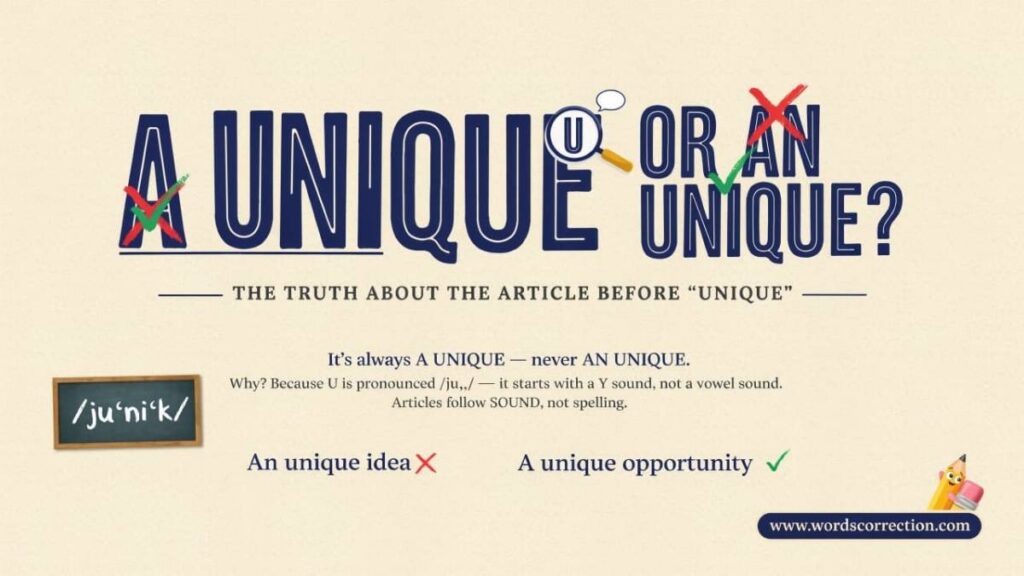
“A unique” is the correct expression in standard English. Use “a” before this word because it begins with a consonant sound rather than a vowel sound.
Although the word starts with the vowel letter U, its initial sound is /j/, the same consonant sound heard at the beginning of “you.” This sound is commonly called the Y sound.
Consider these examples
- Correct: She has a distinctive perspective on the subject.
- Incorrect: She has an distinctive perspective on the subject.
- Correct: We had an unforgettable experience during our vacation.
- Incorrect: We had a unforgettable experience during our vacation.
The same article rule applies to expressions such as “a university,” “a useful opportunity,” and “a unicorn.”
| Expression | Correct or Incorrect? | Reason |
|---|---|---|
| A unique idea | Correct | Begins with a consonant sound |
| An unique idea | Incorrect | Uses the wrong article |
| A unique experience | Correct | Begins with the Y sound |
| An unusual experience | Correct | Begins with a vowel sound |
| A university | Correct | Begins with the Y sound |
| An umbrella | Correct | Begins with a vowel sound |
The key is to remember that the first sound of a word determines whether you use a or an, not its first written letter.
Why Is A Unique Correct?
The answer depends on pronunciation. English has two indefinite articles, a and an. Both introduce singular countable nouns, but they appear in different sound environments.
Use a before words that begin with consonant sounds. Use an before words that begin with vowel sounds.
The word unique starts with /j/, a consonant sound. Therefore, it takes a rather than an.
For example
- An effective solution can make a difficult problem easier to solve.
- The artist created an impressive painting for the exhibition.
- Our teacher introduced an interesting method of learning grammar.
- Every culture has a rich history and its own traditions.
Each sentence uses the correct article based on the initial sound of the following word.
The Role of Vowel and Consonant Sounds in the A vs An Grammar Ruleule
One reason this expression causes confusion is that English spelling doesn’t always reflect pronunciation.
The letters A, E, I, O, and U are generally classified as vowels. However, words beginning with these letters don’t always start with vowel sounds.
Consider these examples
- Unique begins with a consonant sound.
- University begins with a consonant sound.
- Useful begins with a consonant sound.
- Umbrella begins with a vowel sound.
- Unusual begins with a vowel sound.
This explains why two words beginning with the same letter can require different articles.
In unique, the letter U represents the /juː/ sound. The first part, /j/, is a consonant sound, followed by the vowel sound /uː/.
Because the initial sound is a consonant, the correct expression is a unique.
What Does A Unique Mean?
The phrase a unique refers to one person, thing, experience, or idea that stands out because of its distinctive qualities.
The adjective unique describes something that is unlike anything else or has special characteristics that distinguish it from others.
For example
- A unique person: Someone with distinctive qualities or characteristics.
- A unique idea: An original idea or one that stands out from others.
- A unique experience: An experience that differs noticeably from ordinary experiences.
- A unique opportunity: A special opportunity with distinctive advantages.
The article a introduces a singular, indefinite noun, while it describes that noun.
For example, in the sentence “She discovered a unique opportunity,” a introduces one opportunity, and unique explains why it stands out.
Learn the difference between more words people mix up
Peak or Peek What’s the Difference?
How Is Unique Pronounced?
Understanding the pronunciation of unique makes the article rule easier to remember.
In standard American English, unique is commonly pronounced /juːˈniːk/. It has two syllables, with the primary stress on the second syllable.
The opening sound /j/ is the same consonant sound heard at the beginning of yes and you.
Think about how you pronounce you. Your tongue moves into position for the Y sound before producing the vowel. Unique begins with that same consonant sound.
Here’s a simple pronunciation breakdown
| Pronunciation Feature | Explanation |
|---|---|
| IPA | /juːˈniːk/ |
| Number of syllables | Two |
| Initial sound | /j/ |
| Main stress | Second syllable |
| First sound category | Consonant |
| Correct article | A |
The initial consonant sound explains why a unique is correct.
Compare these words:
| Word | Initial Sound | Correct Phrase |
|---|---|---|
| Unique | /j/ | A unique design |
| University | /j/ | A university |
| Useful | /j/ | A useful tool |
| Unusual | /ʌ/ | An unusual event |
| Umbrella | /ʌ/ | An umbrella |
| Uncle | /ʌ/ | An uncle |
Although these words all begin with U, their initial sounds determine which article they need.
Learn the difference between everyday English mistakes
Mrs or Miss What’s the Difference?
Understanding the Difference Between A and An
Before exploring more examples of a unique and an unique, it’s helpful to understand how indefinite articles work.
In English grammar, a and an are indefinite articles. They introduce a singular countable noun when the speaker or writer isn’t referring to a specific person or thing.
For example
- I bought a book.
- She adopted a dog.
- He ate an apple.
- We visited an interesting museum.
Both articles serve the same grammatical purpose. The difference lies in the sound that follows them.
When to Use “A” Before a Consonant Sound
Use a before a word that begins with a consonant sound. This rule applies even when the word starts with a vowel letter.
For example
- A university student
- A useful suggestion
- A European country
- A uniform design
- A unicorn story
- A user account
- A one-time offer
Why do we say a one-time offer? Because one begins with the /w/ consonant sound rather than a vowel sound.
The same principle explains why a unique idea is correct. Unique begins with /j/, so it takes a.
When to Use “An” Before a Vowel Sound
Use an before words that begin with vowel sounds. This rule also applies when a word starts with a consonant letter that isn’t pronounced.
For example
- An apple
- An orange
- An umbrella
- An unusual situation
- An honest person
- An hour
- An uncle
- An interesting story
Consider the phrase an honest person. The letter H appears at the beginning of honest, but it isn’t pronounced. The word begins with a vowel sound, so an is correct.
Similarly, hour begins with a vowel sound because its H is silent.
A vs An Quick Comparison
The following table summarizes the A vs. An grammar rule with examples you can use in everyday English.
| Use A | Use An |
|---|---|
| A unique idea | An unusual idea |
| A university | An umbrella |
| A useful book | An interesting book |
| A European city | An Egyptian city |
| A user account | An uncle |
| A uniform | An hour |
| A one-time event | An honest answer |
Remember that the article depends on pronunciation, not spelling. Once you understand this principle, choosing between a and an becomes much easier.
Learn the difference between commonly misused words
Todays or Today’s Which Is Correct?
A vs An Why Do These Words Require Different Articles?
Here’s an interesting comparison: “university” and “umbrella” both begin with U, yet they require different articles.
Why? The answer lies in their initial sounds.
University begins with /j/, the consonant sound heard at the beginning of “you.” Therefore, we say “a university.”
Umbrella begins with /ʌ/, a vowel sound. Therefore, we say “an umbrella.”
Consider these examples
- She enrolled in a university near her home.
- She carried an umbrella during the rain.
- He bought a useful tool for his workshop.
- She received an unexpected gift on her birthday.
- They visited a European country last summer.
- He waited for an important announcement.
Both expressions are grammatically correct, but they communicate slightly different meanings.
Unique emphasizes distinctive or exceptional qualities. Unusual describes something that differs from what people commonly expect.
For example, a unique painting might have an original design or distinctive artistic qualities. An unusual painting might feature unexpected colors or an uncommon subject.
The article changes because of pronunciation, not because of the adjective’s meaning.
Learn the difference between basic English word mistakes
Fulfilment or Fulfillment Which Spelling Is Correct?
Common Mistakes With A Unique and An Unique
Even people who understand the basic A vs. An grammar rule sometimes make mistakes. These errors often occur when spelling influences article selection.
Here are some common mistakes and ways to avoid them.
Using An Because Unique Starts With U
This is one of the most common errors.
Writers see the letter U and assume that an must come before it. However, English articles depend on pronunciation rather than the first letter.
For example
- Incorrect: He suggested an unique solution.
- Correct: He suggested a unique solution.
The initial /j/ sound makes unique a consonant-sound word. Therefore, a is the correct choice.
Confusing Vowel Letters With Vowel Sounds
A vowel letter doesn’t always produce a vowel sound at the beginning of a word.
Consider these examples
| Word | First Letter | First Sound | Correct Article |
|---|---|---|---|
| Unique | U | Consonant | A |
| University | U | Consonant | A |
| Umbrella | U | Vowel | An |
| Unusual | U | Vowel | An |
| European | E | Consonant | A |
| Honest | H | Vowel | An |
This comparison shows why spelling alone isn’t a reliable guide.
Assuming Every Word Beginning With U Needs A
The opposite mistake can also happen.
Some writers learn that a unique is correct and then assume every word beginning with U takes a. That’s not true.
For example
- A unique experience
- A useful application
- An umbrella
- An unusual event
- An uncle
The correct article depends on the word’s opening sound, not its first letter.
Ignoring Pronunciation in Spoken English
Article mistakes can also become noticeable during conversation.
If you regularly say an unique opportunity, you may have developed the habit of choosing articles by looking at spelling rather than listening to pronunciation.
A simple way to correct this habit is to say the entire phrase aloud before using it.
Compare a unique opportunity with an unusual opportunity. Once you hear the different opening sounds, the correct article becomes easier to recognize.
Learn the difference between often confused words
Amid or Amidst What Is the Difference?
Examples of A Unique in Different Sentences
Learning a grammar rule is useful, but seeing it in context helps you understand how to apply it.
The following examples demonstrate the correct use of a unique in everyday conversations, academic writing, and professional communication.
Everyday English Examples
Here are some natural sentences using different descriptive words:
They found a practical solution to an everyday problem.Each sentence uses a because unique begins with a consonant sound.
Everyone has a distinct personality that makes them different from others.
My grandmother has a special way of telling stories.
We discovered a charming little café during our vacation.
She gave me a thoughtful gift for my birthday.
Every child has an individual way of learning.
He created a beautiful design for his bedroom.
This restaurant offers an exceptional dining experience.
Academic and Professional Writing Examples
The same article rule applies to formal writing. Whether you’re preparing an essay, research paper, report, or presentation, choose the correct article based on the initial sound of the following word.
Examples include
- The researcher developed an effective approach to studying language.
- This study provides an insightful perspective on environmental issues.
- The university introduced an advanced academic program.
- Her research offers a valuable contribution to the field.
- The professor presented an interesting interpretation of the historical evidence.
- The project uses an efficient method to collect information.
The article doesn’t change according to the formality of the sentence.
Business and Technology Examples
Business communication follows the same grammar rule.
Consider these examples
- Our company offers an exceptional service to its customers.
- The startup introduced an innovative business model.
- The developers created a valuable feature for the application.
- This platform provides an effective way to manage projects.
- The organization developed a creative marketing strategy.
- Our team identified a promising opportunity in the market.
Whether you’re writing a business proposal, website description, product review, or marketing campaign, choosing the right article helps make your writing clear and professional.marketing email, a unique remains the correct expression.
both Example Comparing Common Phrases
The following table covers several phrases people commonly search for when trying to understand this grammar rule.
| Common Search Phrase | Correct Expression |
|---|---|
| A unique experience or an unique experience | A unique experience |
| A unique person or an unique person | A unique person |
| A unique opportunity or an unique opportunity | A unique opportunity |
| A unique idea or an unique idea | A unique idea |
| A unique word or an unique word | A unique word |
| A unique design or an unique design | A unique design |
| A unique approach or an unique approach | A unique approach |
For all these expressions, the correct article is a. The adjective unique begins with the same consonant sound regardless of the noun that follows it.
Learn the difference between confusing word pairs
Bare or Bear What’s the Difference?
Is An Ever Correct Before This Word?
In standard modern English, “an” is not the correct article before this adjective. The correct expression is “a” because the word begins with a consonant sound.
You may occasionally encounter this incorrect form in older texts or nonstandard writing. It can also appear when writers choose articles according to spelling rather than pronunciation.
However, seeing an expression in writing doesn’t automatically make it grammatically correct.
For contemporary American and British English, use these forms:
A European perspectiveThis distinction is especially important for English learners and anyone preparing formal written content.
A university opportunity
A useful experience
Can You Say “An Unique” in English?
People may understand what you mean if you say an unique. However, being understood and following standard grammar are two different things.
If you want your writing and speech to follow conventional English usage, choose it.
The same principle applies to other words that begin with the /j/ sound, including university, useful, and user.
Learn the difference between tricky grammar more words
Address vs Adress What’s the Correct Spelling?
Does the Rule Change in American and British English?
English has several regional varieties, but the basic rule for choosing between a and an remains the same in standard American and British English.
Both varieties use a unique, not an unique.
For example
| American English | British English |
|---|---|
| A unique experience | A unique experience |
| A unique opportunity | A unique opportunity |
| A university student | A university student |
| A useful idea | A useful idea |
| An unusual situation | An unusual situation |
Pronunciation can vary slightly among speakers and regional accents. However, the initial consonant sound in the standard pronunciation of unique explains why it takes a.
You don’t need to memorize separate American and British grammar rules for this expression.
When checking a word in a dictionary, pay attention to its pronunciation as well as its spelling and definition. Phonetic transcription can help you understand why a particular article is appropriate.
Learn the difference between commonly mixed-up more words
Advice vs Advise what’s the difference?
Related Examples A or An Before Other Words Beginning With U
Unique isn’t the only word that causes confusion. Many English words begin with U but require different articles.
Understanding these comparisons will help you avoid similar mistakes.
| Incorrect Expression | Correct Expression | Reason |
|---|---|---|
| An university | A university | Begins with /j/ |
| An useful tool | A useful tool | Begins with /j/ |
| An uniform | A uniform | Begins with /j/ |
| An unicorn | A unicorn | Begins with /j/ |
| An user | A user | Begins with /j/ |
| An European country | A European country | Begins with /j/ |
| A unusual event | An unusual event | Begins with a vowel sound |
| A umbrella | An umbrella | Begins with a vowel sound |
| A uncle | An uncle | Begins with a vowel sound |
| A honest person | An honest person | H is silent |
| A hour | An hour | H is silent |
These examples demonstrate that the first written letter doesn’t determine article usage.
Some words can have different initial sounds depending on accent or pronunciation. In those cases, article selection should match the pronunciation being used. The examples above reflect their usual standard pronunciations.
Easy Ways to Remember A Unique or An Unique
You don’t need to memorize hundreds of grammar examples to use the correct article. A few simple techniques can help you choose between a and an naturally.
Remember the You Sound
The word unique begins with the same consonant sound as you.
Try saying these words aloud
- You
- University
- Useful
- User
Notice how each word begins with the Y sound.
Since this is a consonant sound, use a before these words.
Say the Complete Phrase Out Loud
Sometimes the easiest way to recognize a grammar mistake is to hear it.
Compare these expressions
- A unique opportunity
- An unique opportunity
- An unusual opportunity
The first and third expressions follow standard English grammar.
Saying the phrases aloud can help you recognize the natural connection between the article and the following word.
Focus on Sound, Not Spelling
This is the most important technique.
Whenever you’re unsure whether to use a or an, ignore the first written letter for a moment. Instead, listen to the first sound.
Use this simple rule
- Consonant sound = A
- Vowel sound = An
For example
- A unique idea
- An unusual idea
- A university
- An umbrella
- A European country
- An honest person
Once you understand this sound-based rule, choosing the correct article becomes much easier.
Learn the difference between confusing more English words
Lacs or Lakhs? A Simple Guide to the Correct Spelling
Case Study Why Spelling Alone Can Lead to the Wrong Article
Consider a student preparing an English assignment about unusual inventions.
While writing the introduction, the student types
“An unique invention changed the way people communicate.”
The sentence might look reasonable at first because unique begins with U. However, the student has chosen the article according to spelling rather than pronunciation.
After reviewing the sentence, the student changes it to:
“A unique invention changed the way people communicate.”
Now the sentence follows standard English grammar.
Next, the student encounters another sentence:
“___ unusual invention attracted worldwide attention.”
This time, the correct answer is an because unusual begins with a vowel sound.
What does this example teach?
The same starting letter can require different articles. You don’t need to memorize whether every word beginning with U takes a or an. Instead, understanding the initial sound gives you a reliable way to choose the correct article.
This approach works in essays, emails, presentations, conversations, and almost every other form of English communication.
Learn the difference between tricky words and use them correctly
Copys or Copies Which Is Correct?
Practice session
Fill in the Blanks
- She had _____ unique opportunity to study abroad.
- We stayed at _____ hotel near the airport.
- He received _____ MBA from a well-known university.
- My brother studies at _____ university in London.
- The doctor recommended _____ MRI for further examination.
- She bought _____ umbrella because it was raining.
- It was _____ unusual experience for everyone.
- He made _____ honest mistake during the presentation.
- They developed _____ innovative solution to the problem.
- She is _____ European researcher.
- We waited for _____ hour before the meeting began.
- He shared _____ useful suggestion with the team.
- The company introduced _____ unique product.
- She adopted _____ adorable puppy from the shelter.
- He works for _____ international organization.
- We need _____ uniform for the school event.
- She gave me _____ interesting book to read.
- They discovered _____ unusual pattern in the research.
- He made _____ one-time offer to the customer.
- She wants to become _____ engineer.
- We visited _____ historic building during our trip.
- He purchased _____ expensive watch for his father.
- The teacher explained _____ useful grammar rule.
- She received _____ invitation to the annual conference.
- They presented _____ unique idea at the business meeting.
Answers
- A
- A
- An
- A
- An
- An
- An
- An
- An
- A
- An
- A
- A
- An
- An
- A
- An
- An
- A
- An
- A
- An
- A
- An
- A
Here’s a trusted source for clear word meanings:
Cambridge Dictionary
fAQ’s
Why Do You Use A Instead of An?
The correct article is “a” because the following word begins with the consonant sound /j/, similar to the Y sound in “you.” English uses “a” before consonant sounds and “an” before vowel sounds. Therefore, choosing “a” is grammatically correct.
Do I Say A MRI or An MRI?
The correct expression is an MRI because the letter M is pronounced “em,” which begins with a vowel sound. For example, “The doctor recommended an MRI to examine the injury.”
Should I Use A or An Before the Letter A?
Use an before the letter A when referring to the letter itself because its spoken name begins with a vowel sound. For example, “She received an A on her English exam.”
When Should I Use A vs An?
Use a before words that begin with consonant sounds and an before words that begin with vowel sounds. For example, write a book, a university, an apple, and an hour. The first sound, rather than the first letter, determines which article to use.
Do I Say A Hotel or An Hotel?
In standard modern American and British English, a hotel is the correct and widely accepted expression. The H in hotel is pronounced, so the word begins with a consonant sound. For example, “We booked a hotel near the airport.”
Do We Say An House or A House?
The correct expression is a house because the H is pronounced at the beginning of the word. Since house starts with a consonant sound, it takes a rather than an. For example, “They bought a house in the countryside.”
What Do British People Call a Hotel?
British people generally use the word hotel, just as Americans do. However, other accommodation terms include guesthouse, inn, bed and breakfast, and hostel. These terms describe different types of places to stay rather than alternative names for every hotel.
Is the H Silent in A Hotel?
No. In standard modern English, the H in hotel is pronounced. The word begins with an audible /h/ sound, which is why a hotel is correct. This differs from words such as hour, where the H is silent and an hour is correct.
How Do Catholics Pronounce the Letter H?
Catholics don’t have a distinct pronunciation of the letter H. Pronunciation depends on a person’s language, accent, and regional background rather than religious affiliation. In English, the letter H is generally pronounced “aitch.”
Why Do Some British People Pronounce H Differently?
Pronunciation varies across British regional accents and social backgrounds. Some speakers pronounce H clearly, while others drop it in certain words or informal speech. This feature is known as H-dropping and occurs in several English dialects.
How Do British People Pronounce “Hotel”?
Most British English speakers pronounce hotel with a clearly audible H at the beginning. The word has two syllables, with the primary stress generally falling on the second syllable. Regional accents may affect the exact vowel sounds, but the H is normally pronounced.
Is It A Historic Event or An Historic Event?
A historic event is the standard and widely preferred expression in contemporary American English. It is also common in modern British English. Although an historic event appears in some traditional and regional usage, the H is generally pronounced, making a the usual choice.
Is It A Hour or An Hour?
The correct expression is an hour because the H is silent. The word begins with the vowel sound /aʊ/, so it takes an. For example, “The meeting lasted an hour.”
Is It A Honest Person or An Honest Person?
The correct expression is an honest person because the H in honest is silent. The word begins with a vowel sound, so it requires an. For example, “She is an honest person who always tells the truth.”
Do You Say A University or An University?
The correct expression is a university. Although university begins with the vowel letter U, its pronunciation starts with the consonant /j/ sound. For example, “My sister attends a university in London.”
Is It A European or An European?
Use a European because European begins with the consonant /j/ sound. Although the word starts with E, its pronunciation begins with the same sound heard at the beginning of you. For example, “He visited a European country last summer.”
Should I Write A MBA or An MBA?
The correct expression is an MBA because the letter M is pronounced “em,” which begins with a vowel sound. For example, “She plans to complete an MBA after graduation.”
18. Is It A FBI Agent or An FBI Agent?
The correct expression is an FBI agent. The letter F is pronounced “ef,” which begins with a vowel sound. For example, “An FBI agent arrived to investigate the case.”
Do You Use A or An Before Numbers?
The correct article depends on how the number is pronounced. For example, use a one-time offer because one begins with the consonant /w/ sound. However, use an eight-year-old child because eight begins with a vowel sound.
Is It A URL or An URL?
The correct article depends on how you pronounce URL. If you say “you-are-ell,” use a URL because the pronunciation begins with the consonant /j/ sound. The same principle applies when you pronounce the letters individually.
Why Do Some People Say An Hotel?
Some speakers use an hotel because of historical pronunciation patterns or regional speech habits. In older forms of English, the H in certain borrowed words was sometimes silent. However, modern standard English generally pronounces the H in hotel, making a hotel the preferred expression.
Is the Letter H Always Pronounced in English?
No. The letter H is pronounced in many English words, including house, hotel, happy, and history. However, it is silent in words such as hour, honest, honor, and heir. The pronunciation determines whether you use a or an.
Why Is the Letter H Sometimes Silent in English Words?
The silent H in some English words reflects their historical origins and changes in pronunciation over time. English has borrowed vocabulary from several languages, and pronunciation has developed differently across words. This explains why the H is pronounced in hotel but silent in hour.
Is An Used Before Every Word That Begins With a Vowel Letter?
No. An is used before vowel sounds, not automatically before vowel letters. For example, use a unique, a university, and a European country because these words begin with consonant sounds. In contrast, use an umbrella and an unusual situation because they begin with vowel sounds.
Can the Choice Between A and An Change the Meaning of a Sentence?
The choice between a and an generally doesn’t change the basic meaning of a sentence. Instead, it determines grammatical correctness and helps sentences sound natural. For example, a unique idea and an unusual idea use different articles because their adjectives begin with different sounds, not because the articles change their meanings.
Learn the difference between similar English words the easy way
Prooving vs Proving What’s the Difference?
Conclusion
Choosing between “a” and “an” may seem like a minor grammar detail, but using the correct article makes your writing clearer and more accurate. Although the word begins with the vowel letter U, its first sound is /y/, which is a consonant sound. This is why “a unique” is correct, while “an unique” is incorrect in standard English.
The key to remembering this rule is to focus on pronunciation rather than spelling. Use “a” before consonant sounds and “an” before vowel sounds. This simple rule also helps you choose the correct articles with words such as “university,” “useful,” and “unicorn.”
Whenever you describe a special idea, opportunity, or experience, remember this simple rule. With regular practice, choosing the right article will become easier and more natural. After all, good grammar isn’t about memorizing complicated rules it’s about understanding how words sound and using them correctly.

Stella AJS is an experienced blogger and dedicated English language writer at Words Correction. She turns confusing grammar, word meanings, spelling, and usage into clear, practical insights that readers can easily understand and apply. With a passion for precise and engaging writing, Stella helps readers avoid common language mistakes, strengthen their vocabulary, and communicate with greater clarity and confidence.




