

English spelling can sometimes turn a simple word into an unexpected grammar puzzle. Persuing or pursuing is a common example. You may understand the meaning perfectly, yet one misplaced letter can make the spelling incorrect. The correct form is pursuing, while persuing is a common misspelling. But why is this mistake so easy to make? The answer becomes clearer when you look at how the verb pursue changes into pursuing when -ing is added. In this guide, you’ll discover the correct spelling, meaning, pronunciation, grammar, and everyday uses of pursuing. By the end, this confusing spelling mistake will be much easier to recognize and avoid. When comparing persuing or pursuing, remember that pursuing is the correct spelling, while persuing is a common spelling mistake.
Persuing or Pursuing Quick Answer
The correct spelling of pursuing is:
P-U-R-S-U-I-N-G
The incorrect form is:
P-E-R-S-U-I-N-G
| Word | Correct? | Meaning |
| Pursuing | Yes | Following, seeking, continuing, or working toward something |
| Persuing | No | Common misspelling of pursuing |
| Pursing | Yes, but different | Drawing together, especially the lips, or relating to a purse |
Therefore, if you’re asking, “Is it pursuing or persuing?”, use pursuing.
Meaning of “Pursuing”
Pursuing means actively following, seeking, continuing, or trying to achieve something.
For example:
- She is pursuing a degree in psychology.
- He is pursuing a career in engineering.
- They are pursuing their goals with determination.
- The police were pursuing the suspect.
- The company is pursuing an opportunity in a new market.
The word can describe both physical action and abstract effort. You can pursue a person, a career, a goal, an opportunity, a question, a plan, or an idea.
Why “Persuing” Is Wrong
Persuing is not a separate English word with a different meaning. It is a common misspelling of pursuing.
The easiest way to avoid this mistake is to remember the base verb:
pursue → pursuing
Once you remember pursue, the correct spelling becomes much easier to recognize.
What Is the Pursuing Meaning?
The pursuing meaning changes slightly depending on context, but the central idea remains the same: actively going after something or continuing toward something.
Pursuing as Following or Chasing
In its more literal sense, pursuing means following or chasing someone or something because you want to catch it.
For example:
The police were pursuing the vehicle.
Here, pursuing means chasing or following.
Another example:
The dog ran through the yard, pursuing the squirrel.
In this sentence, the action is physical and direct.
Learn the difference between more words people mix up
Many or Meny What’s the Right English Word?
Pursuing as Trying to Achieve Something
The word also has a figurative meaning. You can pursue something without physically moving toward it.
For example:
She is pursuing her dream of becoming a doctor.
Nobody is being chased. Instead, she is working toward a personal ambition.
This meaning appears frequently in education, careers, business, research, and personal development.
Pursuing as Continuing Something
You can also pursue a plan, activity, investigation, or course of action.
For example:
The researchers are pursuing several possible explanations.
Here, pursuing means continuing to investigate or work on something.
This broader meaning explains why the word appears so often in academic and professional writing.
Pursuing Definition What Does the Word Mean?
A useful pursuing definition is:
Pursuing means actively following, seeking, continuing, or trying to achieve someone or something.
The exact meaning depends on what follows the word.
| Expression | Meaning |
| Pursuing someone | Following or trying to catch someone |
| Pursuing a career | Working toward a particular career |
| Pursuing a degree | Working toward an academic qualification |
| Pursuing a goal | Working to achieve an objective |
| Pursuing an opportunity | Trying to obtain or develop an opportunity |
| Pursuing a question | Continuing to investigate an issue |
| Pursuing a plan | Continuing with or working toward a plan |
This flexibility makes pursuing useful in both everyday conversation and formal writing.
Pursue Meaning and the Definition of Pursue
To understand pursuing, start with pursue.
The pursue meaning includes following or chasing someone or something. It can also mean trying to achieve something or continuing with a particular activity or course of action.
The definition of pursue can therefore be summarized as:
To pursue something is to follow it, seek it, or work toward it with continued effort.
Consider these examples:
- I want to pursue a career in journalism.
- She plans to pursue higher education.
- The team will pursue every possible solution.
- The officer began to pursue the suspect.
Notice the difference between the base form and the -ing form:
I plan to pursue a degree.
I am pursuing a degree.
Both are correct. The grammatical structure determines which form belongs in the sentence.
Learn the difference between everyday English mistakes
Finalise or Finalize Meaning, Difference and Usage
Verb Forms of Pursue
The word pursue has several important forms that appear throughout English writing.
| Verb form | Example |
| Pursue | I want to pursue my goal. |
| Pursues | She pursues her interests seriously. |
| Pursued | He pursued a career in law. |
| Pursuing | They are pursuing new opportunities. |
| Pursuit | Her pursuit of knowledge never stopped. |
Pursues Meaning
Pursues is the third-person singular present form of pursue.
For example:
She pursues her goals with patience.
The subject she requires the form pursues.
Pursued Meaning
Pursued is the past tense and past participle of pursue.
For example:
He pursued a career in medicine.
It can also appear in passive constructions:
The suspect was pursued by police.
Pursuing as a Present Participle
Pursuing is the present participle of pursue. It commonly appears with forms of be to create continuous verb phrases.
For example:
She is pursuing a degree.
They were pursuing the same objective.
The -ing form can also function as a gerund:
Pursuing a difficult goal requires patience.
In that sentence, pursuing functions as a noun because it names an activity.
Learn the difference between commonly misused words
Classes or Class’s Meaning, Difference and Usage
Why Is “Pursuing” Spelled With “Pursu”?
This is where the pursuing spelling becomes easier to understand.
The base word is:
P-U-R-S-U-E
When you add -ing, the final e is removed:
pursue + ing → pursuing
The transformation looks like this:
P U R S U E
↓
Remove the final e
↓
P U R S U
↓
Add I N G
↓
P U R S U I N G
That is why pursuing begins with pursu-, not persu-.
What Happens When -ing Is Added?
English spelling includes several patterns for adding -ing to verbs. One common pattern involves dropping a final silent e before adding -ing.
For example:
- make → making
- write → writing
- pursue → pursuing
However, English spelling contains many patterns and exceptions. For that reason, it is useful to learn pursue and pursuing as related forms rather than trying to reconstruct the spelling from pronunciation alone.
Persuing vs Pursuing What’s the Difference?
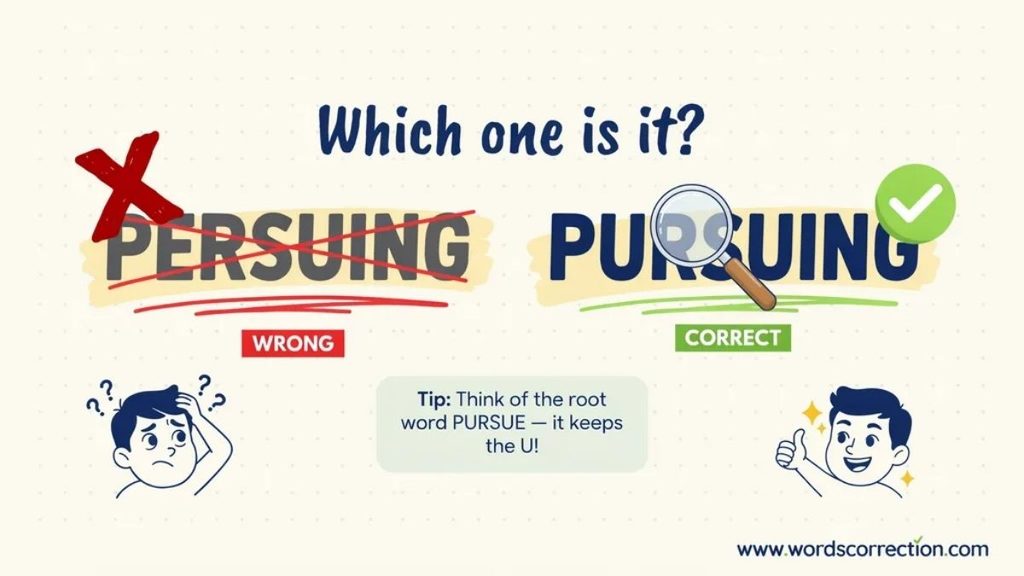
The difference between persuing and pursuing is straightforward:
Pursuing is correct. Persuing is incorrect.
There is no difference in meaning because persuing is not the standard spelling of the intended word.
| Feature | Persuing | Pursuing |
| Standard English spelling | No | Yes |
| Correct spelling | No | Yes |
| Base verb | — | Pursue |
| Meaning | — | Following, seeking, or working toward something |
| Appropriate in formal writing | No | Yes |
| Appropriate in academic writing | No | Yes |
| Used in American English | No | Yes |
| Used in British English | No | Yes |
If you see persuing in an essay, résumé, email, or article, the intended word is almost certainly pursuing.
Is “Persuing” a Word?
If you’re asking, “Is persuing a correct word?”, the answer is no in standard English.
It is generally a spelling error created by replacing the u in pursuing with an e.
This distinction matters because English contains many words that look similar but have different meanings. In this particular case, however, persuing does not provide a second legitimate spelling choice.
The correct word is pursuing.
Pursuing vs Pursing Two Words You Shouldn’t Mix Up
Here’s another spelling trap: pursing is a real English word.
That makes it different from persuing.
What Does “Pursing” Mean?
Pursing is the present participle of purse.
One common use describes tightening or drawing together the lips:
She was pursing her lips while thinking.
The word can also relate to a purse depending on the context.
By contrast:
She was pursuing a degree.
Here, pursuing means working toward an academic qualification.
Pursuing vs Pursing Examples
Compare these sentences:
He is pursuing a career in medicine.
She was pursing her lips.
One letter changes the word and completely changes the meaning.
That’s why careful spelling matters. English can be surprisingly sensitive to small differences.
Learn the difference between basic English word mistakes
Uncapable or Incapable Which Spelling Is Correct?
How to Use Pursuing in a Sentence
Learning how to use pursuing becomes easier when you recognize the patterns that commonly follow it.
Pursuing a Degree Meaning
Pursuing a degree means working toward earning an academic qualification.
For example:
Maria is pursuing a degree in computer science.
The phrase describes the overall process of working toward the qualification. It doesn’t mean that Maria must be studying at that exact moment.
Pursuing Higher Education
Pursuing higher education means continuing education after secondary school, usually through college, university, graduate study, or another advanced educational program.
For example:
After finishing high school, Daniel began pursuing higher education.
Pursuing a Career Meaning
The phrase pursuing a career means actively working toward a particular professional path.
For example:
She is pursuing a career in environmental science.
This can include education, training, work experience, networking, and other steps related to a professional ambition.
Pursuing Goals Meaning
Pursuing goals means actively working to achieve specific objectives.
For example:
Successful athletes spend years pursuing their goals.
The phrase emphasizes continued effort rather than simply having an ambition.
Pursuing an Opportunity
Pursuing an opportunity means actively trying to obtain, develop, or take advantage of an opportunity.
For example:
The company is pursuing an opportunity to expand into a new market.
Learn the difference between often confused words
Analyses or Analysis Meaning, Difference and Usage
I Am Pursuing Meaning
The phrase “I am pursuing” means “I am actively working toward, seeking, following, or trying to achieve something.”
Its exact meaning depends on what comes after it.
| Sentence | Meaning |
| I am pursuing a degree. | I am working toward a degree. |
| I am pursuing a career in finance. | I am working toward a career in finance. |
| I am pursuing my goals. | I am working to achieve my goals. |
| I am pursuing this opportunity. | I am actively trying to obtain or develop this opportunity. |
| I am pursuing the matter. | I am continuing to investigate or deal with the matter. |
The phrase often communicates ongoing effort, which is an important part of its meaning.
Pursuing Someone Meaning
The phrase “pursuing someone” can have different meanings depending on the context.
In a literal situation, it means following or chasing someone:
The police were pursuing someone who had fled the scene.
In a relationship context, pursuing someone can mean making an active effort to develop a romantic relationship or gain that person’s interest.
For example:
He had been pursuing her for several months.
However, pursuing someone doesn’t automatically have a romantic meaning. A police officer, journalist, athlete, investigator, or other person can pursue someone for an entirely different reason.
Pursuing Examples in Everyday English
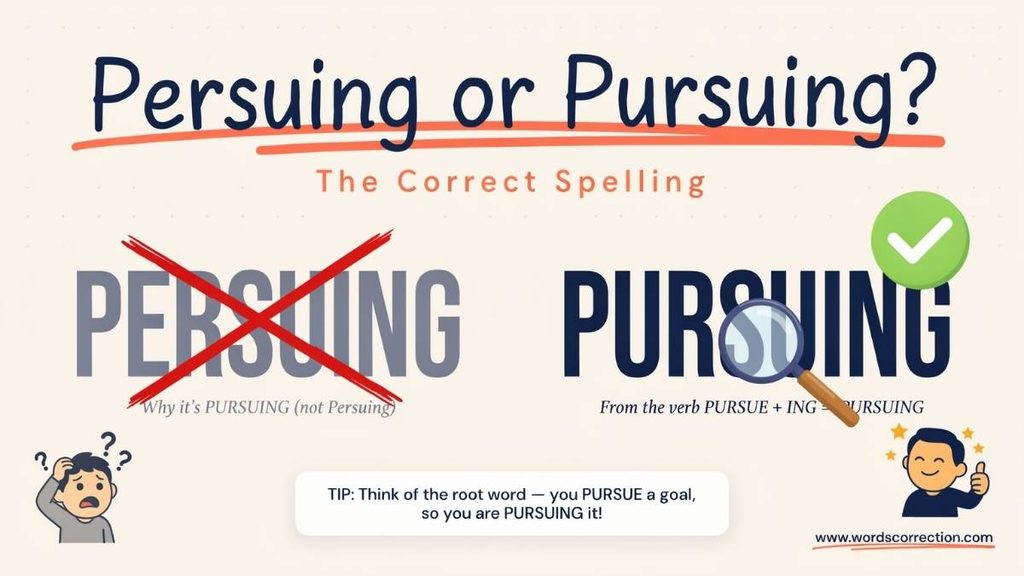
Here are practical pursuing examples across different contexts.
Education
- She is pursuing a master’s degree.
- He plans to pursue higher education.
- They are pursuing academic studies in biology.
Career
- She is pursuing a career in medicine.
- He left his previous position to pursue a new career.
- The graduate is pursuing professional development.
Goals
- They are pursuing an ambitious goal.
- She is pursuing her dream of becoming an author.
- He continues pursuing success despite several setbacks.
Business
- The company is pursuing new opportunities.
- The team is pursuing a long-term growth strategy.
- Management decided to pursue a different approach.
Research
- Scientists are pursuing several possible explanations.
- The researchers are pursuing a new line of inquiry.
Investigation
- The police are pursuing several leads.
- Investigators are pursuing the matter further.
Literal Following
- The officers were pursuing the suspect.
- The dog was pursuing the rabbit across the field.
These examples show why pursuing cannot be reduced to a single synonym. Its meaning changes naturally according to the context.
Learn the difference between confusing word pairs
Devide or Divide Difference, Meaning and Usage
Pursuing in English Grammar
From a grammar perspective, pursuing is an -ing form of the verb pursue. It can function as a present participle or gerund.
Present Participle
It can form continuous verb phrases:
She is pursuing a career in law.
They were pursuing the same objective.
Gerund
It can function as a noun:
Pursuing your goals takes patience.
Here, pursuing names an activity.
Adjective-Like Use
Present participles can sometimes modify nouns:
The pursuing officers approached the vehicle.
This construction is less common in everyday writing, but it illustrates the flexibility of -ing forms.
Learn the difference between tricky grammar more words
Businesses or Business’s Meaning, Grammar and Correct Usage
Pursue vs Pursuing
The difference between pursue and pursuing is mainly grammatical. Both forms relate to the same basic idea, but they perform different jobs in sentences.
| Form | Typical use | Example |
| Pursue | Base verb | I want to pursue a career in science. |
| Pursues | Third-person singular present | She pursues her goals. |
| Pursued | Past tense/past participle | He pursued the opportunity. |
| Pursuing | Present participle/gerund | They are pursuing the opportunity. |
Compare these two sentences:
I want to pursue a degree.
I am pursuing a degree.
The first sentence uses the base verb after want to. The second uses the present participle after am.
Pursuing Pronunciation
The pursuing pronunciation can vary slightly between American and British English.
In American English, the word is commonly pronounced with a sound represented approximately by /pɚˈsuːɪŋ/. British pronunciation can differ, particularly in the vowel sound associated with the first syllable.
The spelling can be difficult because English pronunciation doesn’t always reveal every letter clearly.
That’s why spelling a word entirely from its sound can lead to mistakes.
A more reliable strategy is to connect the word to its base form:
pursue → pursuing
Once that relationship becomes familiar, the spelling is much easier to remember.
The Origin and History of Pursuing
The history of pursuing reaches back centuries.
The verb pursue entered English through Anglo-French and Old French forms related to the Latin verb prosequi, which carried meanings connected with following, accompanying, or pursuing.
The historical connection with the idea of following helps explain the word’s modern meanings.
Over time, pursue developed beyond physical chasing. It came to describe following a course of action, seeking an objective, investigating something, and working toward an achievement.
That development is reflected in modern expressions such as:
- pursuing a career
- pursuing an education
- pursuing a goal
- pursuing an opportunity
- pursuing a solution
- pursuing an ambition
- pursuing success
The related noun pursuit follows the same word family and can refer to the act of pursuing or an activity someone spends time doing.
Learn the difference between commonly mixed-up more words
Alternately or Alternatively Meaning, Usage and Examples
British English vs American English Is the Spelling Different?

Fortunately, pursuing isn’t one of those English words that changes spelling between British and American English.
The standard spelling is pursuing in both varieties.
There can be differences in pronunciation, vocabulary, and other spelling patterns between British and American English. However, persuing isn’t an accepted alternative in either variety.
Is “Persuing” Correct in British English?
No.
British English does not make persuing a correct alternative spelling.
American English doesn’t use it as an accepted spelling either.
Whether you’re writing:
- a college essay,
- a résumé,
- a business email,
- a research paper,
- a website,
- or a social media post,
the correct spelling
Learn the difference between similar English words the easy way
Emigrate or Immigrate Difference, Meaning and Usage
Common Mistakes With Pursuing
Writing “Persuing” Instead of “Pursuing”
This is the most common spelling mistake.
Incorrect: She is persuing a degree.
Correct: She is pursuing a degree.
Confusing Pursuing With Pursing
This mistake can be particularly confusing because pursing is a legitimate word.
Incorrect for the intended meaning: He is pursing a career in medicine.
Correct: He is pursuing a career in medicine.
Confusing Pursuing With Pursue
These forms aren’t interchangeable in every grammatical position.
Correct: I want to pursue a degree.
Correct: I am pursuing a degree.
Incorrect: I want to pursuing a degree.
The phrase want to requires the base verb pursue.
Spelling the Word From Pronunciation
English pronunciation can be an unreliable guide to spelling.
The spoken form doesn’t always make every letter obvious. As a result, writers may substitute e for u and produce persuing.
Remembering related forms such as pursue, pursued, pursues, pursuing, and pursuit provides a stronger spelling guide.
Forgetting the “U”
A quick visual reminder is:
PURSUING
The beginning is PURS-, not PERS-.
Learn the difference between confusing more English words
Tie or Tye Meaning, Difference and Usage
Pursuing Synonym What Is Another Word for Pursuing?
The best pursuing synonym depends on the context.
Synonyms for Following or Chasing
- following
- chasing
- tracking
- trailing
- going after
- running after
Synonyms for Working Toward a Goal
- seeking
- striving for
- working toward
- aiming for
- trying to achieve
- going after
for Continuing an Activity
- continuing
- carrying on
- undertaking
- following through with
However, synonyms aren’t always interchangeable.
For example:
She is pursuing a degree.
This sounds natural and professional.
She is chasing a degree.
The second sentence is understandable, but it has a more informal and figurative tone.
Choosing a synonym requires attention to both meaning and context.
Persue or Pursue Another Common Spelling Confusion
Another common spelling question is persue or pursue.
The correct spelling is:
pursue
Not:
persue
This mistake resembles persuing vs pursuing because both incorrectly replace the u with e.
The complete word family makes the spelling easier to remember:
- pursue
- pursues
- pursued
- pursuing
- pursuit
- pursuer
Once purs- becomes familiar, several related spelling questions become much easier.
How to Remember the Correct Spelling of Pursuing
If spelling isn’t your favorite memory exercise, use a simple strategy.
Start With the Base Word
Remember:
PURSUE
Then transform it:
PURSUE → PURSUING
The final e disappears before -ing is added.
Remember “PURS,” Not “PERS”
The first four letters provide a useful visual anchor:
P-U-R-S
Then add:
U-I-N-G
Together:
P-U-R-S-U-I-N-G
Connect It to “Pursuit”
The related noun pursuit also begins with purs-.
Think of the word family:
pursue → pursuing → pursuit
That connection can serve as a useful spelling reminder.
Learn the difference between tricky English words with easy explanations
Mater or Matter Difference in Meaning and Usage
Quick Case Study Choosing the Correct Form

Imagine a student writing this sentence:
“I am persuing a master’s degree in business.”
The intended meaning is clear, but the spelling is incorrect.
Break the sentence down:
- Base verb: pursue
- Present participle: pursuing
- Context: working toward an academic qualification
The corrected sentence is:
“I am pursuing a master’s degree in business.”
Now compare another sentence:
“I want to pursue a master’s degree in business.”
This sentence is also correct, but the grammatical structure has changed.
The difference isn’t simply spelling. The sentence structure determines whether you need pursue or pursuing.
A Simple Rule for Persuing or Pursuing
When you mean following, seeking, or working toward something, use:
PURSUING
Never:
PERSUING
When you need the base verb after to, use:
PURSUE
For example:
- I want to pursue a degree.
- I am pursuing a degree.
- She pursues her goals.
- He pursued a new career.
- Their pursuit of knowledge continues.
This small word family eliminates most of the confusion.
Practice Session
Fill in the Blanks
- She is ________ a degree in computer science at a prestigious university.
- The correct spelling of the word is ________, not “persuing.”
- He hopes to ________ his dream of becoming a successful doctor.
- They are ________ new opportunities to expand their business.
- The police ________ the suspect after the incident.
- Maria is ________ a career in medicine.
- Everyone should ________ their goals with dedication and determination.
- Throughout his career, he has ________ excellence in every project.
- She ________ her passion for music with enthusiasm.
- I am ________ a master’s degree in English literature.
- Many students are ________ higher education abroad.
- “________” is a common spelling mistake in English.
- He decided to ________ a new career path after graduation.
- The company is ________ several promising business opportunities.
- She ________ her ambitions despite facing numerous challenges.
- Are you ________ a professional qualification this year?
- The athlete continued ________ his dream of winning a championship.
- He ________ his objectives with patience and determination.
- They have been ________ this opportunity for several months.
- You should ________ your interests and work toward developing your skills.
- The journalist ________ the story to uncover the truth.
- My brother is ________ a degree in business administration.
- She hopes to ________ a successful career in journalism.
- The correct present participle of “pursue” is ________.
- To avoid a spelling error, write “________” instead of “persuing.”
Answers
- pursuing
- pursuing
- pursue
- pursuing
- pursued
- pursuing
- pursue
- pursued
- pursues
- pursuing
- pursuing
- persuing
- pursue
- pursuing
- pursues
- pursuing
- pursuing
- pursues
- pursuing
- pursue
- pursued
- pursuing
- pursue
- pursuing
- pursuing
Here’s a trusted source for clear more words Comparison:
Grammar Update
Frequently Asked Questions
Is it persuing or pursuing?
The correct spelling is pursuing. “Persuing” is a common spelling error. For example, “She is pursuing a degree in business administration.”
What does pursuing mean?
Pursuing means following, seeking, or making a sustained effort to achieve something. It can refer to academic goals, career ambitions, personal objectives, or romantic relationships.
What is the meaning of pursue?
“Pursue” is a verb that means to follow, seek, or strive to achieve something. For example, “He plans to pursue a career in engineering.”
Why is persuing incorrect?
“Persuing” is incorrect because the verb is spelled “pursue,” not “persue.” When adding -ing, the final silent e is dropped, producing the correct spelling “pursuing.”
How do you spell pursuing correctly?
The correct spelling is p-u-r-s-u-i-n-g. To remember it, start with “pursue,” remove the final e, and add -ing.
What is the difference between pursue and pursuing?
“Pursue” is the base form of the verb, while “pursuing” is its present participle and gerund form. For example, “I want to pursue a degree” expresses an intention, while “I am pursuing a degree” describes an ongoing activity.
What is the definition of pursuing?
Pursuing refers to the act of following, seeking, or working toward something. It can describe physically following someone or making a continued effort to achieve an academic, personal, or professional goal.
What is the past tense of pursue?
The past tense of “pursue” is pursued. For example, “She pursued her dream of becoming a lawyer.”
What is the noun form of pursue?
The noun form of “pursue” is pursuit. It refers to the act of seeking or striving to achieve something. For example, “The pursuit of knowledge requires dedication.”
What is another word for pursuing?
Depending on the context, synonyms for “pursuing” include seeking, following, chasing, striving for, and working toward. For example, “pursuing a goal” can also be expressed as “working toward a goal.”
How do you use pursuing in a sentence?
Use “pursuing” to describe an ongoing action or an activity functioning as a noun. For example, “She is pursuing a career in medicine.” Another example is “Pursuing your goals requires patience and dedication.”
Is pursuing a verb or a noun?
“Pursuing” can function as part of a verb phrase or as a gerund, depending on the sentence. In “He is pursuing a degree,” it forms part of the verb phrase. In “Pursuing knowledge is valuable,” it functions as a gerund.
What does “I am pursuing” mean?
“I am pursuing” means that someone is currently working toward, seeking, or trying to achieve something. For example, “I am pursuing a master’s degree” means that the person is working toward earning that qualification.
What does pursuing a degree mean?
Pursuing a degree means studying toward an academic qualification at a college, university, or another recognized educational institution. For example, “She is pursuing a degree in psychology” means she is working toward completing that qualification.
What does pursuing a career mean?
Pursuing a career means taking steps to enter, develop, or advance in a particular profession. This may involve obtaining relevant qualifications, gaining practical experience, and applying for professional opportunities.
What does pursuing someone mean in a relationship?
In a romantic context, pursuing someone means expressing interest and making a sincere effort to develop a relationship. This may involve initiating conversations, arranging dates, and communicating feelings while respecting the other person’s boundaries and wishes.
What is the difference between pursued and pursuing?
“Pursued” is the past tense and past participle of “pursue,” whereas “pursuing” describes an ongoing action or functions as a gerund. For example, “He pursued his goal last year” and “He is pursuing his goal now.”
What is the third-person singular form of pursue?
The third-person singular form is pursues. It is used with singular subjects such as “he,” “she,” or “it.” For example, “She pursues her ambitions with determination.”
How do you pronounce pursuing?
“Pursuing” is commonly pronounced per-SOO-ing, with the primary stress on the second syllable. Although pronunciation may vary slightly across accents, the spelling remains the same.
What does pursuing your dreams mean?
Pursuing your dreams means taking deliberate steps toward achieving your ambitions or fulfilling your personal aspirations. This often involves setting clear goals, developing relevant skills, and remaining committed despite challenges.
Can pursuing be used at the beginning of a sentence?
Yes. “Pursuing” can begin a sentence when it functions as a gerund. For example, “Pursuing a healthy lifestyle requires consistent effort.”
What preposition is used with pursuing?
The preposition depends on the sentence and its intended meaning. Common expressions such as “pursuing a degree,” “pursuing a career,” and “pursuing an opportunity” do not require a preposition immediately after “pursuing.” For example, “She is pursuing a career in education.”
Is pursuing formal or informal?
“Pursuing” is appropriate in both formal and informal contexts. It is commonly used in academic writing, professional communication, everyday conversation, and discussions about personal ambitions.
What are common mistakes when using pursuing?
Common mistakes include spelling the word as “persuing,” confusing “pursuing” with “pursued,” and using the wrong verb form. Remember the distinctions: “pursuing a degree,” “pursued a goal,” and “pursues her ambitions.”
How can I remember the correct spelling of pursuing?
Remember the base word “pursue,” spelled P-U-R-S-U-E. To form “pursuing,” remove the final silent e and add -ing. Practicing the word in sentences can help reinforce the correct spelling and prevent future mistakes.
Conclusion
The confusion between persuing or pursuing is easy to understand, but the correct spelling is simple: pursuing. The spelling persuing is a common mistake and should be avoided in formal and professional writing. The key is to remember how the verb pursue changes when -ing is added. The final e is dropped, producing pursuing, not “persuing.”
Whether you’re pursuing a degree, pursuing a career, pursuing a goal, or pursuing an opportunity, the spelling remains the same. Once you remember the pattern pursue → pursuing, there’s little reason to let this spelling trap cause trouble again. English may have plenty of confusing rules, but this one is refreshingly straightforward.

Stella AJS is an experienced blogger and dedicated English language writer at Words Correction. She turns confusing grammar, word meanings, spelling, and usage into clear, practical insights that readers can easily understand and apply. With a passion for precise and engaging writing, Stella helps readers avoid common language mistakes, strengthen their vocabulary, and communicate with greater clarity and confidence.




