

A single missing letter can turn a perfectly clear sentence into a spelling mystery. That’s exactly what happens with access or acess. Although these two spellings look nearly identical, only access is the correct standard English spelling. The confusion often comes from accidentally dropping one of the two Cs or Ss, especially when typing quickly. Whether you’re writing about internet access, website access, or access to important information, spelling the word correctly matters. In this guide, we’ll clear up the confusion, explain what access means, show how to use it correctly, and share practical examples to help you remember the spelling without giving your keyboard another chance to cause trouble.
Access or Acess Quick Answer
Access is the correct spelling
Acess is not the standard English spelling of this word. If you mean the ability, permission, or opportunity to enter, reach, use, or obtain something, write access.
Quick Comparison
| Word | Correct? | Meaning |
| Access | Yes | The ability, right, opportunity, or means to enter, reach, use, or obtain something |
| Acess | No | Incorrect spelling of access |
| Assess | Yes | To evaluate or judge something |
| Excess | Yes | More than what is needed, allowed, or usual |
For example:
- Correct: I have access to the company database.
- Incorrect: I have acess to the company database.
- Assess: We need to assess the situation.
- Excess: The report contains an excess of unnecessary detail.
So, if you’re asking, “Is it access or acess?” the correct choice is access.
Access or Acess Meaning
The access or acess meaning question is primarily a spelling question because only access is the standard English word in this pair.
Access Meaning in English
The meaning of access in English depends on how the word functions in a sentence. Generally, it refers to the ability or opportunity to enter, reach, use, or obtain something.
For example:
- You may have access to a building.
- You may have access to information.
- You may access a website.
- You may access files and documents.
- A user may receive access permission to an account.
- A restricted area may deny access to unauthorized people.
The word can describe physical entry, digital availability, information retrieval, or permission.
Access Definition
A simple access definition is:
Access means the ability, right, opportunity, or means to enter, reach, use, or obtain something.
The exact meaning depends on the context.
Consider these two sentences:
The employee has access to the office.
Here, access means permission or ability to enter.
The employee can access the database.
Here, access means to retrieve or use information stored in the database.
The underlying idea is similar: getting to something you want or need.
Is Acess a Word?
No, “acess” is not the standard spelling of the English word meaning entry, availability, or the ability to use something.
If you see “acess” in an email, essay, website, or document, it is generally a spelling error for access.
This makes the answer to “Is acess a word?” straightforward:
Acess is an incorrect spelling in standard English. Access is the correct form.
Why Is “Acess” Incorrect?
The correct word contains two consecutive Cs and two consecutive Ss:
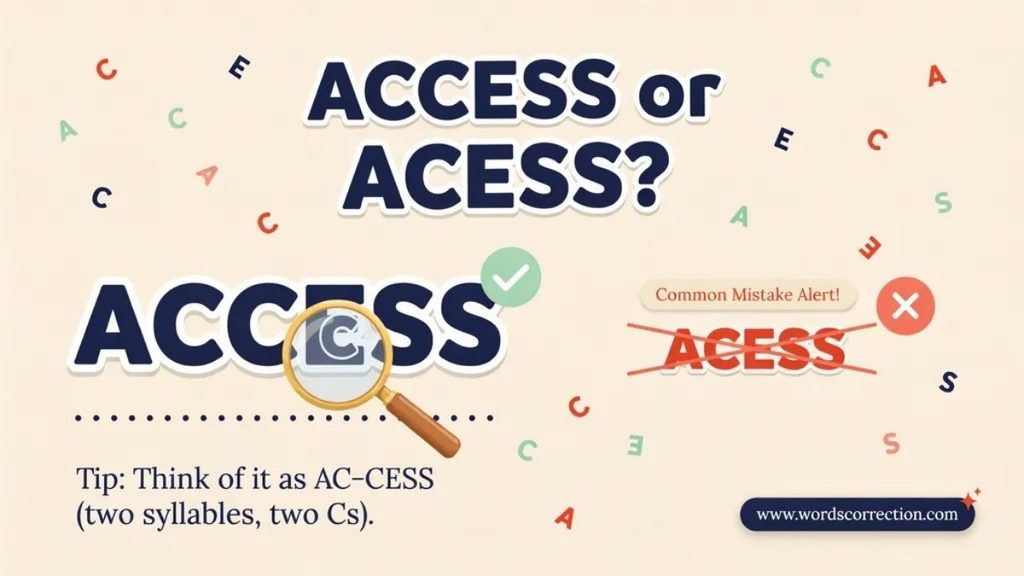
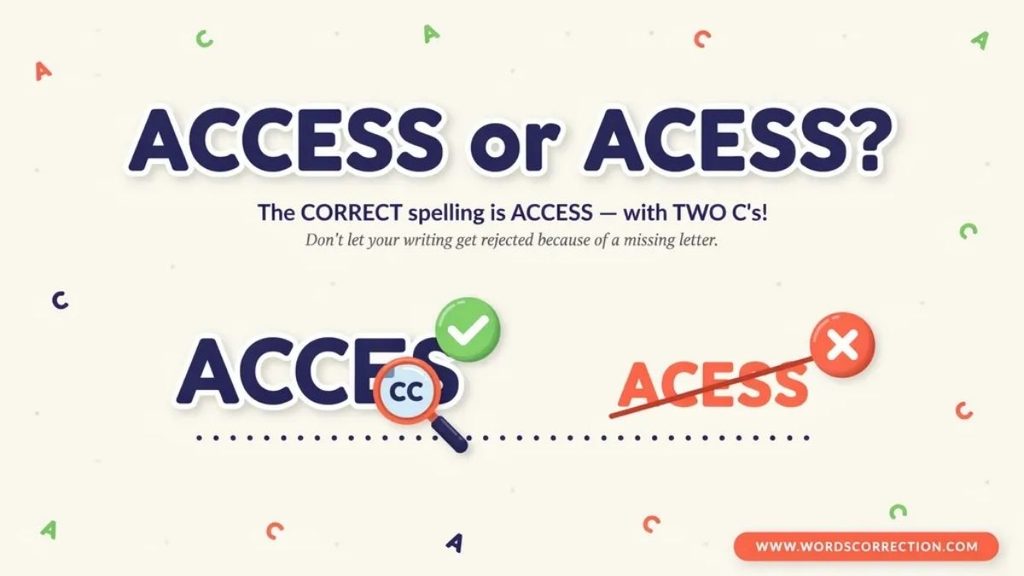
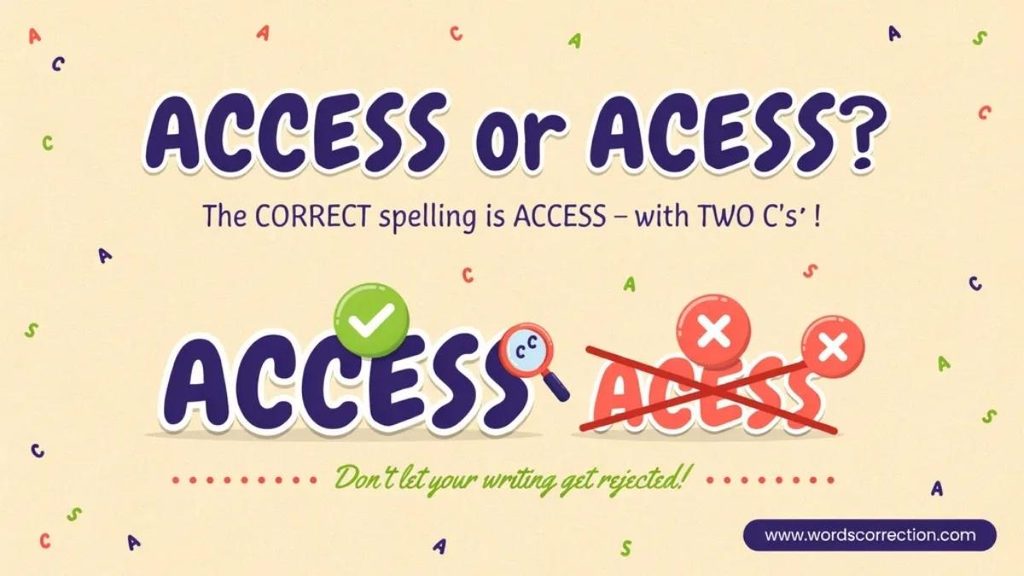
A C C E S S
The incorrect form drops one C:
A C E S S
That small difference turns a correctly spelled word into a spelling error.
Learn the difference between more words people mix up
Finalise or Finalize Meaning, Difference and Usage
How to Spell Access Correctly
If you’re trying to remember how to spell access, focus on the two doubled letters.
The Correct Pattern
A + CC + E + SS
That gives you:
ACCESS
A useful visual reminder is:
ACCESS = double C + double S
Don’t rely entirely on pronunciation. The sound of access doesn’t make every letter obvious, especially when the word is spoken quickly.
Instead, remember its written pattern.
A Simple Spelling Check
Before you type the word, check three things:
- Does it have CC?
- Does it have SS?
- Does it contain an E between them?
If the answer is yes, you have:
A-C-C-E-S-S
Access Spelling Mistake
A common access spelling mistake looks like this:
Incorrect: acess
Correct: access
Another common error is:
Incorrect: acces
Correct: access
The final S matters just as much as the second C.
Learn the difference between everyday English mistakes
Classes or Class’s Meaning, Difference and Usage
What Does Access Mean in English?
The definition of access in English covers several closely related ideas.
At its core, access describes the ability to get to something.
That something might be a physical place:
Visitors have access to the museum through the main entrance.
It might be information:
Students have access to information online.
It might be a computer system:
Only authorized employees have access to the system.
Or it might be an opportunity:
The program gives families access to public services.
The word therefore appears across everyday conversation, business, education, technology, law, government, and many other areas.
Access as a Noun
One of the most common uses is access as a noun.
As a noun, access refers to the ability, permission, opportunity, or means to enter, reach, use, or obtain something.
Examples of Access as a Noun
- I have access to the library.
- Employees need access to the building.
- She doesn’t have access to the account.
- The website provides access to research papers.
- Students need reliable internet access.
- The administrator controls user access.
Notice the common structure:
access to + noun
For example:
We need access to the files.
Here, access is a noun, while “the files” identifies what someone can reach or use.
Common Noun Expressions With Access
You’ll often see access in phrases such as:
- have access to
- gain access to
- get access to
- provide access to
- deny access to
- restrict access to
- request access to
- allow access to
- limit access to
For example:
Employees have access to the internal portal.
The manager denied access to the confidential records.
You must request access to the document.
These patterns are particularly common in professional and technical writing.
Access as a Verb
Access is also a verb.
As a verb, access means to reach, enter, retrieve, or use something.
For example:
You can access the website from your phone.
She accessed the file yesterday.
Employees can access the system remotely.
The technician accessed the database to retrieve the records.
In these examples, access acts directly on an object.
How to Use Access as a Verb
The usual structure is:
Subject + access + object
For example:
I accessed the document.
Not:
I accessed to the document.
The second sentence is incorrect because access is functioning as a verb in this construction.
Compare these examples:
| Noun | Verb |
| I have access to the file. | I can access the file. |
| She has access to the database. | She can access the database. |
| We need access to the system. | We need to access the system. |
| They were given access to the website. | They were allowed to access the website. |
This is one of the most useful access grammar rules to remember.
Learn the difference between commonly misused words
Uncapable or Incapable Which Spelling Is Correct?
Access to Something vs Access Something
A common grammar question is whether you should say access to something or simply access something.
Both can be correct, but they use access differently.
Use “Access To” With the Noun Form
I have access to the files.
She was given access to the building.
Students need access to educational resources.
Here, access is a noun.
Use “Access” Directly With the Object as a Verb
I can access the files.
She can access the building.
Students can access educational resources online.
Here, access is a verb.
A simple way to remember the difference is:
Have access to something.
That distinction helps prevent one of the most common grammatical mistakes involving this word.
Access or Acess in a Sentence
Seeing the word in context makes the spelling easier to remember.
Here are several access or acess in a sentence examples using the correct form.
Access as a Noun
- Employees have access to the company library.
- The password gives you access to your account.
- The building provides easy access for visitors.
- Students need access to reliable internet.
- Only authorized users have access to these records.
Access as a Verb
- You can access the website from any device.
- Please access the document before the meeting.
- The technician accessed the computer system remotely.
- Users can access their files through the application.
- She accessed the database to retrieve the information.
Incorrect Examples
Incorrect: Please acess the document.
Correct: Please access the document.
Incorrect: Students need acess to the library.
Correct: Students need access to the library.
Incorrect: I don’t have acess to the account.
Correct: I don’t have access to the account.
Learn the difference between basic English word mistakes
Analyses or Analysis Meaning, Difference and Usage
in Everyday English Examples
The word access appears frequently because modern life revolves around permissions, information, systems, and resources.
Internet Access
Reliable internet access is essential for many online services.
Website Access
You need a password to access the website.
Database Access
Only trained employees can access the database.
Access to Information
Students should have access to information from trustworthy sources.
Access to Public Services
The new program aims to improve access to public services.
Access to Personal Information
Users should control who has access to personal information.
Restricted Access
This area has restricted access.
Public Access
The trail is open for public access during daylight hours.
Access Rights
The administrator changed the employee’s access rights.
These examples show why access appears so often in professional, academic, legal, and technical contexts.
Learn the difference between often confused words
Devide or Divide Difference, Meaning and Usage
Common Mistakes When Spelling Access
The spelling isn’t complicated once you know the pattern. Still, several mistakes appear frequently.
Missing One C
Incorrect: acess
Correct: access
This is one of the most obvious spelling errors involving the word.
Missing One S
Incorrect: acces
Correct: access
The word needs two S’s at the end.
Mixing the Letters
Common incorrect forms include:
- acces
- acess
- aces
The correct spelling is:
- access
When in doubt, look for the CC + SS pattern.
Learn the difference between commonly confused more words in English
Persuing or Pursuing Meaning, Difference and Correct Spelling
Confusing Access With Assess
The difference between access and assess is important because the two words look and sound somewhat similar.
Access means to enter, reach, use, or obtain something.
You can access the database.
Assess means to evaluate, judge, or estimate something.
We need to assess the situation.
A simple distinction is:
Access = get to it.
Assess = evaluate it.
That contrast can help prevent a common vocabulary mistake.
Confusing Access With Excess
The difference between access and excess becomes clear once you focus on meaning.
Access relates to reaching or using something.
Employees have access to the files.
Excess means an amount greater than what is needed, allowed, or usual.
The project suffered from an excess of unnecessary paperwork.
They may look similar at first glance, but they have completely different meanings.
Learn the difference between confusing word pairs
Businesses or Business’s Meaning, Grammar and Correct Usage
Access vs Acess Spelling Comparison
The access vs acess question has only one correct spelling in standard English.
| Feature | Access | Acess |
| Standard English spelling | Yes | No |
| Meaning | Ability, permission, opportunity, entry, or retrieval | No standard meaning in this context |
| Noun | Yes | No |
| Verb | Yes | No |
| US English | Used | Not standard |
| British English | Used | Not standard |
| Correct letter pattern | CC + SS | Missing a C |
| Example | Access the file. | Acess the file. |
There is no British-versus-American spelling difference here. Both varieties use access.
Access Word Origin and History
The spelling becomes easier to understand when you look at the word’s history.
Access ultimately traces back to the Latin word accessus, which is related to the idea of approaching or coming near. The word entered English through French before developing into the modern English form.
That history connects naturally with the word’s modern meaning. If you can access something, you can essentially get near it, reach it, enter it, or use it.
Over time, the meaning expanded beyond physical entry.
Today, access can refer to:
- entering a building
- reaching a location
- using a service
- obtaining information
- retrieving digital data
- opening an account
- connecting to a system
- receiving permission
- using educational or public resources
The modern word is therefore much broader than simply “entrance.”
Access Pronunciation
Access pronunciation can contribute to spelling confusion because spoken English doesn’t always make the doubled letters obvious.
In standard US English, access has two syllables, with the stress on the first syllable.
The important point for spelling is that pronunciation alone won’t reliably tell you that the written word contains two C’s and two S’s.
That’s why visual memory can help:
ACCESS = CC + SS
English contains many words whose spelling isn’t immediately obvious from pronunciation. Access is a good example of why hearing a word and spelling a word are related skills rather than identical ones.
Learn the difference between tricky grammar more words
Alternately or Alternatively Meaning, Usage and Examples
Synonyms and Alternative Words
If you’re looking for an access or acess synonym, remember that the appropriate alternative depends on the context.
Access Synonyms as a Noun
Possible access synonyms include:
- entry
- admission
- availability
- approach
- entrance
- opportunity
- permission
These words aren’t perfect substitutes in every sentence.
For example:
Visitors have access to the building.
Depending on the context, you might use entry instead:
Visitors have entry to the building.
However, the meaning and naturalness can change depending on the sentence.
Similarly:
Students have access to online resources.
The word availability communicates part of the idea, but it doesn’t always replace access naturally.
Access Synonyms as a Verb
Depending on the context, alternatives can include:
- enter
- reach
- retrieve
- obtain
- open
- use
- connect to
For example:
I accessed the document.
Depending on what actually happened, you might say:
I opened the document.
Or:
I retrieved the document.
The best alternative depends on whether the action involved opening, finding, obtaining, or using something.
Learn the difference between commonly mixed-up more words
Tie or Tye Meaning, Difference and Usage
Access and Accessibility What’s the Difference?

The words access and accessibility are closely related, but they aren’t interchangeable.
Access usually refers to the ability, right, opportunity, or means to reach or use something.
Students have access to the online library.
Accessibility refers more broadly to how easily something can be accessed or used, especially by people with different needs or abilities.
The website’s accessibility needs improvement.
The related adjective is accessible:
The building is accessible to wheelchair users.
The opposite is inaccessible:
The remote location is difficult to reach and largely inaccessible.
This distinction is especially important when discussing digital accessibility, public spaces, transportation, education, and technology.
Learn the difference between tricky English words with easy explanations
Emigrate or Immigrate Difference, Meaning and Usage
How to Use Access Correctly in Professional Writing
Professional writing uses access frequently, particularly in technology, business, education, healthcare, and administration.
The safest approach is to decide whether you’re using access as a noun or access as a verb.
Noun
Employees have access to confidential documents.
Verb
Employees can access confidential documents.
Both sentences are correct. The grammatical structure changes, but the basic idea remains similar.
Professional Examples
- Please request access to the shared folder.
- Only managers have access to financial records.
- Users can access the platform with their existing credentials.
- The administrator will provide access to authorized employees.
- The system automatically denies access to unauthorized users.
- Employees should not share their access credentials.
These examples also demonstrate terms such as authorization, permission, user access, system access, access control, and access privileges.
Learn the difference between confusing more English words
Mater or Matter Difference in Meaning and Usage
A Short Case Study Access in Technology
Imagine a company that stores employee records in a secure database.
An employee may need access to the database to perform their job.
The IT administrator might then:
- Verify the employee’s identity.
- Grant appropriate access rights.
- Provide permission to use specific files.
- Restrict sensitive records.
- Remove access when the employee no longer needs it.
Notice how naturally the word works in this context:
The employee has access to the database.
But:
The employee can access the database.
The first sentence uses access as a noun. The second uses access as a verb.
This small grammatical distinction appears constantly in real-world technology writing.
A Short Case Study Access in Education
Consider a student who needs online research materials.
The student may have:
Access to educational resources.
The school might:
Provide access to academic databases.
The student can then:
Access the databases from home.
These examples demonstrate three common patterns:
- have access to
- provide access to
- access something
Understanding these patterns makes the word much easier to use naturally.
Practice Session Fill in the Blanks
Complete the following 25 sentences by filling in each blank with the correct word: access, acess, assess, or excess, or the appropriate form of access where required.
- Students need ______ to the online learning platform.
- The correct spelling of the word is ______, not “acess.”
- The manager will ______ the team’s performance.
- Employees can ______ their work accounts remotely.
- The website denied me ______ to my account.
- We should ______ the situation before making a decision.
- You need permission to gain ______ to the restricted area.
- The company provides internet ______ to all employees.
- The teacher asked us to ______ the quality of the research.
- You can ______ the document by entering your password.
- The correct phrase is “have ______ to,” not “have an access to.”
- The new road provides ______ to the village.
- The system administrator granted me ______ to the database.
- The company wants to reduce ______ spending.
- Please ______ the risks before starting the project.
- I cannot ______ my email because I forgot my password.
- The word “acess” is an incorrect ______ of “access.”
- Visitors must request ______ before entering the building.
- The doctor will ______ the patient’s condition.
- Students have ______ to a wide range of educational resources.
- The website displayed an “access ______” message.
- The librarian helped us ______ the digital archive.
- The team needs to ______ the project’s progress.
- You must be authorized to ______ confidential files.
- Remember that “access” contains two Cs and two ______.
Answer Session
- Access
- Access
- Assess
- Access
- Access
- Assess
- Access
- Access
- Assess
- Access
- Access
- Access
- Access
- Excess
- Assess
- Access
- Spelling
- Access
- Assess
- Access
- Denied
- Access
- Assess
- Access
- Ss
Here’s a trusted source for clear more words Comparison:
Grammar Update
Frequently Asked Questions Access or Acess
What is the correct spelling access or acess?
Access is the correct spelling in standard English. Acess is a misspelling. Remember that access contains two Cs and two Ss.
What does the word access mean?
Access refers to the ability, right, or permission to enter a place, use a service, or obtain information. For example, “Students have access to the online library.”
What does acess mean?
Acess is an incorrect spelling of access in standard English. If you are referring to the ability or permission to use something, the correct spelling is access.
What does “to access” mean?
To access means to enter, reach, open, or retrieve something, such as a website, document, or computer system. For example, “You can access your account using your password.”
What is the difference between access and assess?
Access means to enter, use, or obtain something, whereas assess means to evaluate or examine something. For example, “I accessed the report” means I opened it, while “I assessed the report” means I evaluated its content.
How do you spell “assess a situation”?
The correct phrase is “assess a situation.” The verb assess means to examine or evaluate circumstances to understand them before making a decision.
Example: “The manager needs to assess the situation before taking action.”
What is the difference between access and excess?
Access refers to the ability or permission to enter, use, or obtain something. Excess refers to an amount that exceeds what is necessary, acceptable, or desirable.
Examples:
- “Employees have access to the office.”
- “Excess spending can create financial difficulties.”
What does “access it” mean?
“Access it” means to open, reach, use, or retrieve something that has already been mentioned. The phrase commonly refers to a file, website, account, document, or online resource.
Example: “The report is available online, so you can access it anytime.”
What does “I have access” mean?
“I have access” means that you have the ability, permission, or opportunity to enter, use, or obtain something. The exact meaning depends on the context.
Example: “I have access to the company database.”
What is the plural of access?
Access is generally an uncountable noun when referring to the ability or permission to use something, so it does not normally have a plural form in this context. However, the plural accesses may be used in specialized contexts to refer to multiple entry points or instances of access.
Should you say “have access” or “have an access”?
“Have access” is the standard expression when referring to permission or the ability to use something. The phrase “have an access” is generally incorrect in this context because access is used as an uncountable noun.
Correct: “I have access to the website.”
Incorrect: “I have an access to the website.”
Which is correct: “access to something” or “access something”?
Both expressions are correct, depending on whether access is used as a noun or a verb. As a noun, access is generally followed by the preposition to. As a verb, access takes a direct object without to.
- Noun: “She has access to the records.”
- Verb: “She can access the records.”
How do you use access in a sentence?
Access can function as both a noun and a verb.
- Noun: “Employees need access to the office.”
- Verb: “Employees can access the system remotely.”
As a noun, access refers to the ability or permission to use something. As a verb, it describes the action of reaching, opening, or using something.
What are some examples of access?
Here are three examples demonstrating how to use access correctly:
- “Visitors need access to the main building.”
- “I cannot access my email account.”
- “The new road provides access to the village.”
These examples illustrate access as permission, the ability to retrieve information, and a means of reaching a location.
What is another word for access?
Depending on the context, synonyms for access include entry, admission, admittance, permission, and availability. In technical contexts, authorization may also be appropriate when referring to permission to use a system or resource.
What is another word for having access?
Alternatives to having access include having permission, being authorized, being able to use something, and having the right to enter.
Example: “I am authorized to use the system” can replace “I have access to the system” when permission is the intended meaning.
What is another way to say “get access”?
You can use phrases such as gain access, obtain access, secure entry, receive permission, or gain authorization. The most appropriate expression depends on the situation.
Example: “You must obtain permission before entering the restricted area.”
What is another way to say “to provide access”?
Suitable alternatives include grant access, allow entry, enable access, provide entry, and give permission.
Example: “The administrator granted access to the new employees.”
What does it mean to have access to something?
Having access to something means having the ability, right, or permission to enter, use, view, or obtain it.
For example, having access to an online course means being able to open and use its educational materials.
What is another way to say “to have access to”?
Depending on the context, you can use expressions such as be able to use, be permitted to enter, be authorized to view, or have the opportunity to obtain.
Example: “Students can use the digital library” is a straightforward alternative to “Students have access to the digital library.”
What is another word for access in professional writing?
In professional writing, suitable alternatives include authorization, permission, availability, entry, and use. Choose a synonym that accurately conveys your intended meaning.
Example: “Please grant me permission to view the document” may be more precise than “Please give me access.”
What are the synonyms of assess?
Common synonyms for assess include evaluate, appraise, examine, estimate, judge, analyze, and review. These words describe examining something to determine its value, quality, condition, or significance.
Example: “The team will evaluate the project’s progress.”
What does it mean when a website says “access denied”?
“Access denied” means that a user is not permitted to enter a website, open a file, or use a particular resource. This message may appear because of insufficient permissions, incorrect login credentials, or security restrictions.
Is access spelled correctly?
Yes, access is the correct spelling in standard English. It contains two Cs and two Ss. Acess is a spelling error and should be corrected in academic, professional, and everyday writing.
How can you remember the spelling of access?
A simple way to remember the spelling is to focus on the two Cs and two Ss in access. Check that both pairs are present whenever you write the word.
Memory tip: Access has double Cs and double Ss. Remember both pairs, and you will have access to the correct spelling every time!
Conclusion
The access or acess confusion is easy to resolve once you remember the correct spelling: access, with two Cs and two Ss. The spelling acess is simply a common mistake caused by leaving out one of those letters.
Whether you’re writing about internet access, website access, access to information, or access to a service, the spelling remains the same. A useful memory trick is ACCESS = double C + double S. It’s simple, but it can save you from an unnecessary spelling error.
So, the next time you’re tempted to type “acess,” pause for a second and check those letters. After all, even a tiny spelling mistake shouldn’t block your access to clear, professional writing.

Stella AJS is an experienced blogger and dedicated English language writer at Words Correction. She turns confusing grammar, word meanings, spelling, and usage into clear, practical insights that readers can easily understand and apply. With a passion for precise and engaging writing, Stella helps readers avoid common language mistakes, strengthen their vocabulary, and communicate with greater clarity and confidence.




