
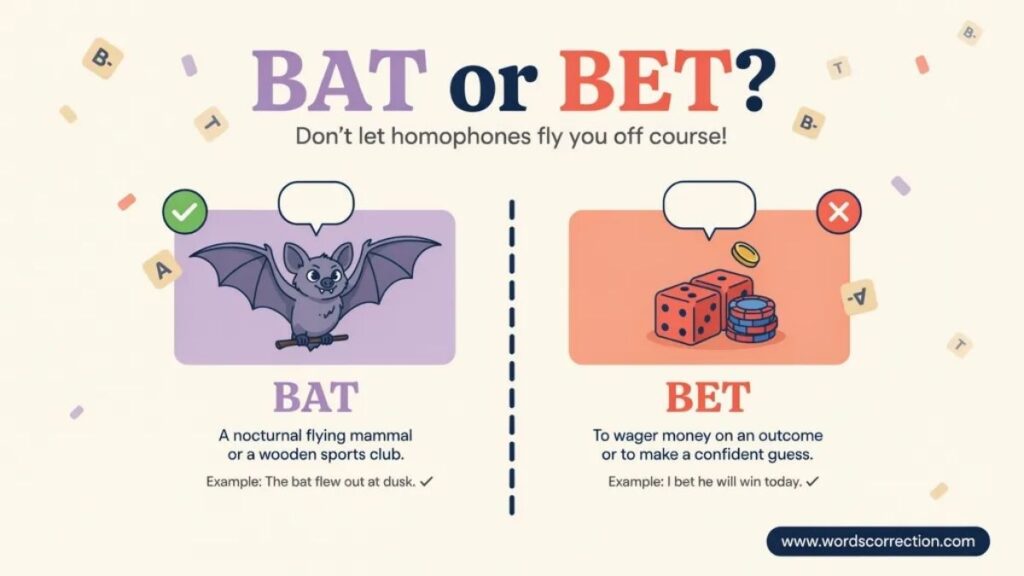
Bat or bet it’s amazing how one small vowel can create such a big English-language headache. These two words look nearly identical, yet they have completely different meanings, uses, and pronunciations. A bat can be a flying mammal or a piece of sports equipment, while a bet refers to a wager, prediction, or confident guess. The main source of confusion is their vowel sounds: bat uses the short A sound /æ/, while bet uses the short E sound /ɛ/. Once you understand this simple difference, you’ll find it much easier to recognize, pronounce, and use these commonly confused words correctly in everyday English.
Bat or Bet Quick Answer
The simplest way to remember the difference between bat and bet is this:
- Bat usually means a piece of equipment used to hit a ball or a flying mammal.
- Bet usually means a wager, prediction, or risk involving an uncertain outcome.
- Bat contains the /æ/ vowel sound.
- Bet contains the /ɛ/ vowel sound.
Compare these sentences:
She picked up the bat before stepping onto the field.
I wouldn’t bet on that outcome.
Changing just one vowel changes both the spelling and the meaning.
Quick Comparison
| Word | Main Meaning | Vowel Sound | Example |
| Bat | Sports equipment or flying mammal | /æ/ | He swung the bat. |
| Bet | Wager, prediction, or informal expression | /ɛ/ | I wouldn’t bet on that. |
Therefore, there isn’t one universally correct choice between bat or bet. Both are standard English words. The correct choice depends on the meaning you want to express.
Bat Meaning What Does “Bat” Mean in English?
The bat meaning depends on context because English uses bat for several different ideas.
Most commonly, bat functions as a noun.
Bat as Sports Equipment
A bat is a piece of equipment used to hit a ball in sports such as baseball and cricket.
For example:
- The baseball player lifted his bat.
- She bought a new cricket bat.
- The batter swung the bat and missed.
- He carried his bat onto the field.
The design of a bat varies depending on the sport. A baseball bat, for example, has a different shape and construction from a cricket bat.
Bat as a Flying Mammal
A bat can also refer to a flying mammal.
Bats belong to the order Chiroptera. They are the only mammals capable of sustained natural flight, and many species are nocturnal, meaning they are most active at night.
For example:
- A bat flew across the garden at dusk.
- Bats often become active after sunset.
- The cave provides shelter for a colony of bats.
This meaning has nothing to do with sports equipment. The surrounding context tells you which meaning the speaker intends.
Bat as a Verb
Bat can also function as a verb.
In sports, it can describe hitting a ball with a bat:
She bats for the home team.
The verb can also describe hitting or moving something with a quick motion.
For example:
- The cat batted at the toy.
- He batted the ball away.
- She batted her eyelashes.
That last example shows why context matters. The word bat doesn’t always belong on a baseball field.
Learn the difference between confusing more English words
Classes or Class’s Meaning, Difference and Usage
Bet Meaning What Does “Bet” Mean in English?
The bet meaning centers on uncertainty, risk, and prediction.
As a noun, a bet is an agreement in which someone risks money or another stake based on what will happen.
For example:
He placed a bet on the horse.
As a verb, bet means to risk something based on the expected result of an uncertain event.
For example:
I wouldn’t bet on that happening.
The word commonly appears in expressions such as:
- place a bet
- make a bet
- bet on a game
- bet against someone
- bet that something will happen
- win a bet
- lose a bet
Bet Doesn’t Always Mean Gambling
Here’s an important point: bet doesn’t always involve formal gambling.
People often use the word when making an informal prediction.
For example:
I bet Sarah is already home.
The speaker isn’t necessarily risking money. Instead, the sentence expresses a confident guess.
Similarly:
I bet you’ve heard that story before.
Here, I bet means something like “I’m fairly sure.”
Bat vs Bet The Difference in Meaning
The difference between bat and bet becomes much easier to understand when their main meanings are compared directly.
| Meaning | Bat | Bet |
| Sports equipment | ✓ | — |
| Flying mammal | ✓ | — |
| Hit with a bat | ✓ | — |
| Wager | — | ✓ |
| Prediction | — | ✓ |
| Risk money on an outcome | — | ✓ |
| Informal “certainly” | — | ✓ |
A useful memory rule is:
Bat is associated with hitting. Bet is associated with risk or prediction.
That rule won’t explain every idiomatic use, but it works well for everyday English.
Bat or Bet Pronunciation What’s the Difference?
For many learners, the most difficult part of bat or bet pronunciation isn’t the consonants. Both words begin with /b/ and end with /t/.
The key difference is the vowel.
- bat → /bæt/
- bet → /bɛt/
The middle sounds are different:
- bat → /æ/
- bet → /ɛ/
This makes bat and bet a classic minimal pair. The words differ by only one sound, yet that single sound changes their meaning.
Bat and Bet Pronunciation Difference
Compare:
bat → /bæt/
bet → /bɛt/
The consonants stay the same. Only the vowel changes.
That’s precisely why these words are useful for English pronunciation practice.
Learn the difference between commonly mixed-up more words
Uncapable or Incapable Which Spelling Is Correct?
Vowel Sounds Short A vs Short E
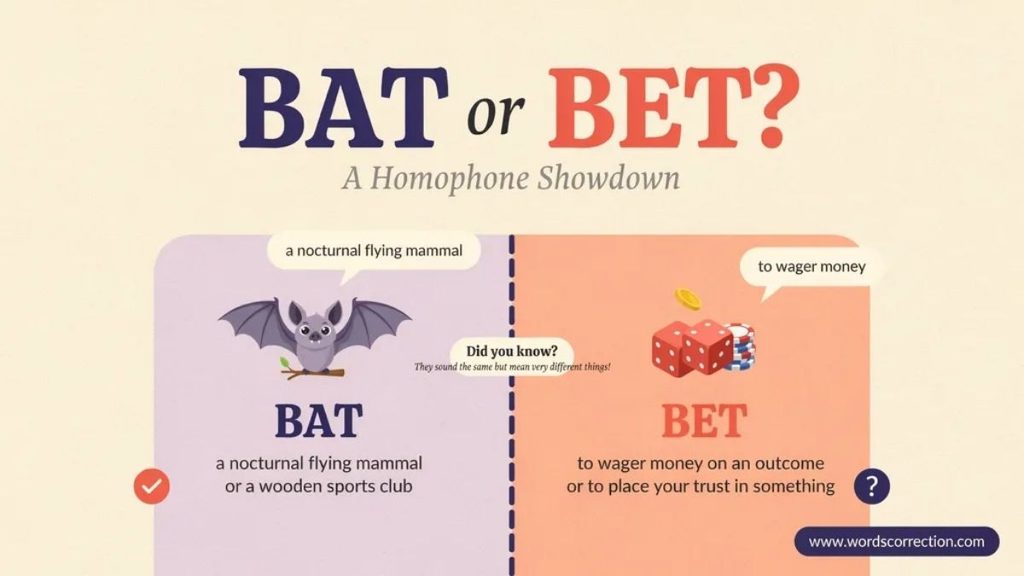
The bat vs bet vowel sounds represent two important short vowel sounds in English.
The /æ/ Sound in Bat
The /æ/ vowel appears in bat.
You’ll also hear it in words such as:
- cat
- hat
- map
- man
- bad
- black
- apple
The jaw generally opens more for this sound.
The /ɛ/ Sound in Bet
The /ɛ/ vowel appears in bet.
You can hear the same sound in:
- get
- bed
- red
- pen
- ten
- men
- head
The jaw generally stays somewhat less open than it does for /æ/.
Simple Comparison
| Sound | Word | Similar Examples |
| /æ/ | bat | cat, hat, map, bad |
| /ɛ/ | bet | get, bed, red, pen |
Understanding the short A vs short E sound can improve both pronunciation and listening skills.
Learn the difference between tricky grammar more words
Analyses or Analysis Meaning, Difference and Usage
How to Pronounce Bat and Bet
If you’re wondering how to pronounce bat and bet, focus on the vowel rather than changing the entire word.
Bat Pronunciation in English
The bat pronunciation in English uses the /æ/ vowel.
Begin with the /b/ sound. Open your jaw relatively wide for the vowel, then finish with /t/.
The mouth generally opens more than it does when producing the vowel in bet.
Bet Pronunciation in English
The bet pronunciation in English uses the /ɛ/ vowel.
The jaw remains somewhat less open, and the tongue sits slightly higher than it does for /æ/.
Don’t exaggerate these movements permanently. They’re simply useful tools for training your mouth to recognize and produce the contrast.
Mouth Position for Vowel Sounds
Your mouth position can help you hear and produce the difference.
For /æ/:
- The jaw drops more.
- The mouth opens wider.
- The tongue sits relatively low and toward the front.
For /ɛ/:
- The jaw stays less open.
- The vowel feels slightly closer.
- The tongue sits somewhat higher.
With practice, these movements become more natural.
Learn the difference between confusing word pairs
Devide or Divide Difference, Meaning and Usage
Bat and Bet Minimal Pairs for English Pronunciation Practice
Minimal pairs are particularly useful because they isolate a single sound difference.
Try these pairs:
- bat — bet
- bad — bed
- bag — beg
- ban — Ben
- band — bend
- pan — pen
- mat — met
- sat — set
- had — head
The pattern becomes easier to recognize with repetition. In each pair, changing the vowel can create a completely different word.
A Simple Practice Routine
Read each pair in three stages:
- Slowly — make the vowel contrast clear.
- Naturally — use normal conversational speed.
- In sentences — place each word in context.
For example:
The bat is on the table.
I made a bet with my brother.
Then try:
The bat hit the ball.
I wouldn’t bet on that.
This type of practice combines pronunciation, listening, spelling, and meaning.
Bat and Bet in American English
In American English, bat and bet remain clearly distinct words.
The standard pronunciations are:
- bat → /bæt/
- bet → /bɛt/
Individual speakers may produce slightly different vowel qualities because of regional accents. However, the contrast remains meaningful.
Bat and Bet in American English Examples
- The batter grabbed his bat.
- I wouldn’t bet against them.
- A bat flew out of the cave.
- I made a bet with my friend.
For learners, listening to these words in complete sentences can be more helpful than memorizing phonetic symbols alone.
Bat and Bet in British English
The spelling remains the same in British English:
- bat
- bet
The vowel distinction also remains important, although individual British accents can produce these sounds somewhat differently.
How Do You Pronounce Bet in British English?
In standard British pronunciation, bet uses the /ɛ/ vowel.
Regional accents can affect the precise sound, but bet remains distinct from bat.
How Do You Pronounce Bet in American English?
In standard American English, bet also uses the /ɛ/ vowel.
So the important point is simple:
British and American English don’t use different spellings for bat and bet.
Accent differences may affect pronunciation, but they don’t change the basic written distinction.
Learn the difference between often confused words
Businesses or Business’s Meaning, Grammar and Correct Usage
Bat or Bet Slang What Does “Bet” Mean in Slang?
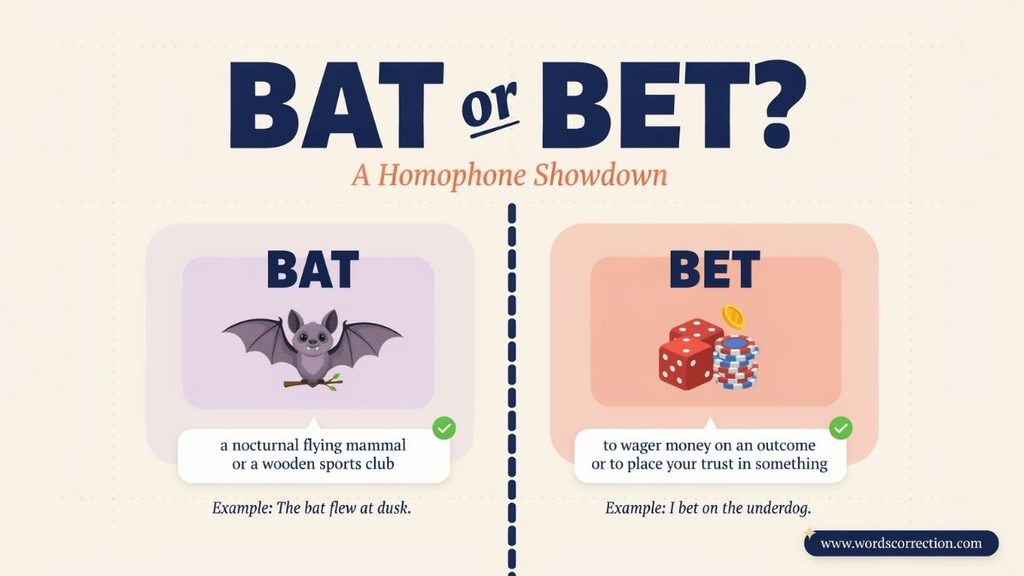
The phrase bat or bet slang can cause confusion because bet has several informal uses in modern conversation.
One of the most recognizable is:
You bet.
In informal American English, “You bet” can mean:
- certainly
- definitely
- absolutely
- of course
- sure
For example:
“Can you help me tomorrow?”
“You bet.”
Here, bet doesn’t mean the speaker is gambling. Instead, it expresses agreement or confidence.
“I Bet” as an Informal Expression
I bet can also introduce a confident assumption.
bet you’re tired after that trip.
The speaker is expressing a strong belief that the listener is tired.
Again, no money needs to change hands.
Is “Bet” Always Slang?
No.
Bet is a standard English noun and verb. Its ordinary meanings relate to wagering, risk, and prediction.
Expressions such as “You bet” and some conversational uses of “bet” are informal.
Context determines the intended meaning.
Learn the difference between basic English word mistakes
Alternately or Alternatively Meaning, Usage and Examples
Bat or Bet Which Is Correct?
The question “bat or bet which is correct?” can be misleading because both words are correct.
The correct choice depends on your intended meaning.
Use bat when you mean:
- sports equipment
- a flying mammal
- hitting something with a bat
- certain actions involving quick striking or movement
Use bet when you mean:
- a wager
- a prediction
- risking something on an outcome
- an informal expression such as “You bet”
Compare These Sentences
Correct:
He bought a new bat for baseball.
Correct:
He placed a bet on the game.
But these sentences don’t work if the intended meanings are sports equipment and wagering:
He bought a new bet for baseball.
He placed a bat on the game.
The spelling isn’t a matter of personal preference. The meaning determines the word.
Learn the difference between commonly misused words
Tie or Tye Meaning, Difference and Usage
Bat and Bet Examples in Everyday English
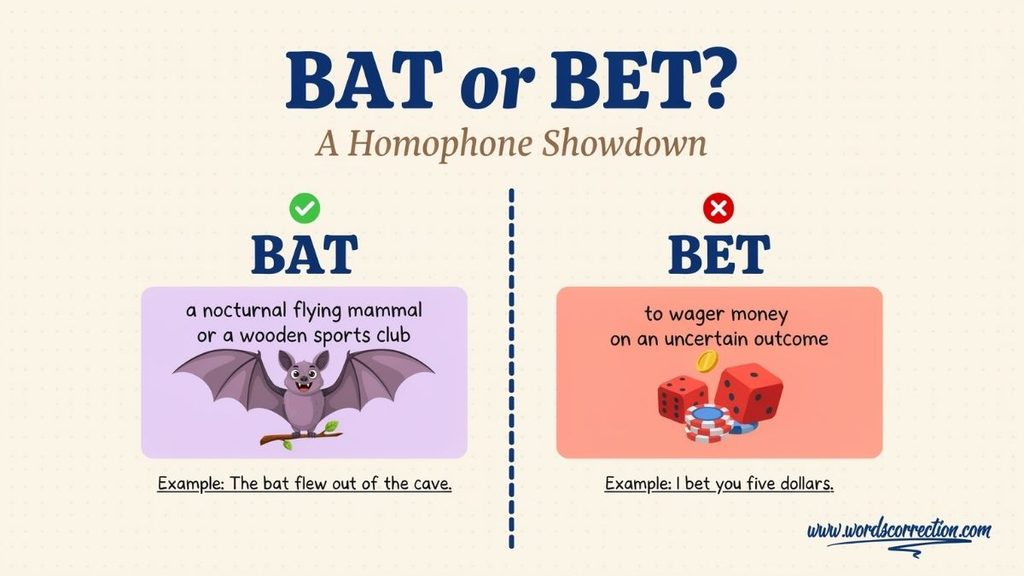
Seeing bat and bet examples in context makes the difference easier to remember.
Examples With Bat
- The player swung the bat too early.
- She left her cricket bat at home.
- A bat flew over the roof.
- The little boy carried a plastic bat.
- The cat batted at the string.
- He batted the ball toward the fence.
Examples With Bet
- I made a bet with my brother.
- She placed a bet on the race.
- I wouldn’t bet on that happening.
- He bet on the final score.
- I bet they’re already there.
- You bet I can help.
Bat vs Bet in Context A Mini Case Study
Consider this short conversation:
Alex: “Did you bring the bat?”
Sam: “Yes. It’s in the car.”
Here, bat clearly refers to sports equipment.
Now change the conversation:
Alex: “Do you think they’ll win?”
Sam: “I’d bet on it.”
Here, bet expresses confidence in a predicted outcome.
What Changed?
The vowel changed because the meaning changed.
This is an important lesson when learning commonly confused English words: don’t rely on spelling alone. Pay attention to context, grammar, pronunciation, and meaning.
Words That Rhyme With Bat and Bet
Rhyming can make the vowel distinction easier to remember.
Words That Rhyme With Bat
Bat rhymes with:
- cat
- hat
- mat
- pat
- rat
- sat
- flat
- chat
So:
Bat rhymes with cat.
Both words contain the /æ/ vowel.
Words That Rhyme With Bet
Bet rhymes with:
- get
- let
- met
- net
- pet
- set
- wet
- yet
So:
Bet rhymes with get.
Both words contain the /ɛ/ vowel.
This simple technique can make English pronunciation for beginners much easier.
Learn the difference between everyday English mistakes
Mater or Matter Difference in Meaning and Usage
How to Distinguish Bat and Bet When Listening
Spelling helps when you’re reading. Listening requires a slightly different approach.
If you’re wondering how can I hear the difference between bat and bet, focus on three things: the vowel, mouth position, and context.
Listen for the Vowel
The /æ/ sound in bat generally has a wider, more open quality.
The /ɛ/ sound in bet generally has a slightly closer quality.
Connect Each Word to a Familiar Rhyme
Use these mental anchors:
- bat → cat
- bet → get
If a word sounds closer to cat, you’re likely hearing the /æ/ sound.
If it sounds closer to get, you’re likely hearing /ɛ/.
Use Context
Suppose someone says something that sounds like bat or bet.
Ask:
Does the sentence involve sports, hitting, or an animal?
If so, bat may be the intended word.
Does it involve risk, gambling, prediction, or agreement?
If so, bet is more likely.
Context won’t replace pronunciation practice, but it can help you confirm what you hear.
Learn the difference between more words people mix up
Emigrate or Immigrate Difference, Meaning and Usage
Common Pronunciation Mistakes With Bat and Bet
English learners often struggle with short vowel sounds because their first language may not distinguish the same sounds in the same way.
Mistake 1 Making Both Vowels Sound the Same
A learner may pronounce bat and bet almost identically.
When that happens, listeners may have to depend on context to determine which word was intended.
Mistake 2 Replacing /æ/ With /ɛ/
Changing one vowel can turn one word into another:
- bat → bet
- bad → bed
- pan → pen
The consonants remain the same. The vowel carries the contrast.
Mistake 3 Stretching the Vowel Too Much
Both sounds are short vowels. Avoid turning them into unnecessarily long sounds.
Natural timing matters as much as vowel quality.
Mistake 4 Focusing Only on Spelling
Knowing that bat contains a and bet contains e helps with writing. It doesn’t automatically teach your mouth to produce the sounds correctly.
Effective pronunciation practice combines:
spelling + listening + mouth position + repetition + context
Learn the difference between tricky more English words
Access or Acess Which Spelling Is Correct?
How to Improve Your English Vowel Pronunciation
If the difference between /æ/ and /ɛ/ still feels difficult, use a structured practice routine.
Practice Minimal Pairs
Start with:
- bat / bet
- bad / bed
- bag / beg
- pan / pen
- man / men
- sat / set
- mat / met
Record Yourself
Say:
bat, bet, bat, bet
Then listen to the recording.
Ask yourself:
- Can you hear two distinct vowels?
- Does bat sound closer to cat?
- Does bet sound closer to get?
- Does your mouth open more for /æ/?
Practice in Complete Sentences
Isolated words are useful, but sentences create more realistic speaking practice.
Try:
The bat is black.
I made a bet yesterday.
Then gradually increase your speaking speed.
Focus on Clarity Rather Than Accent
The goal isn’t to copy every feature of an American or British accent.
Instead, aim for a clear vowel distinction that listeners can understand easily.
Good pronunciation isn’t about sounding like someone else. It’s about making your meaning clear.
Learn the difference between similar English words the easy way
Persuing or Pursuing Meaning, Difference and Correct Spelling
both Full Comparison Table

| Feature | Bat | Bet |
| Word type | Noun and verb | Noun and verb |
| Main noun meaning | Sports equipment or flying mammal | Wager or prediction |
| Main verb meaning | Hit or strike with/like a bat; other related uses | Risk something on an uncertain outcome |
| Common sports connection | Baseball, cricket | Sports betting |
| Animal connection | Flying mammal | None |
| Gambling connection | None in the ordinary sense | Strong |
| Main vowel | /æ/ | /ɛ/ |
| Vowel category | Short A | Short E |
| Common rhyme | Cat | Get |
| Common expression | Baseball bat | You bet |
| Example | He swung the bat. | I wouldn’t bet on it. |
Bat or Bet A Simple Way to Remember the Difference
When you’re unsure which word to use, connect each word with one strong idea.
BAT = BALL
Think:
Bat → ball → hit
A baseball bat or cricket bat makes this connection easy to remember.
BET = RISK
Think:
Bet → risk → prediction
If you’re risking money or confidently predicting an outcome, bet is probably the word you need.
For Pronunciation
Use two familiar rhymes:
Bat → cat
Bet → get
This gives you a quick reference for the two short vowel sounds.
Practice Session
Fill in the Blanks
- The baseball player swung his ______ and hit the ball over the fence.
- I ______ you will enjoy watching this movie.
- A ______ is a nocturnal mammal that can fly.
- She took a small ______ of chocolate cake after dinner.
- “Are we meeting at 5 p.m.?” “______!”
- The young player learned how to hold a cricket ______ correctly.
- I accidentally ______ my tongue while eating dinner.
- He placed a ______ on his favorite football team.
- The ______ flew out of the cave shortly after sunset.
- “Can you help me with my homework?” “You ______!”
- I ______ she will arrive before the meeting begins.
- The batter picked up his ______ before stepping onto the field.
- “Let’s go shopping this weekend.” “______!”
- She took a ______ of the apple before putting it down.
- My brother bought a new cricket ______ yesterday.
- I ______ you cannot solve this puzzle in one minute.
- In informal conversations, “______” can express agreement or confirmation.
- The tiny ______ flew silently through the night sky.
- He took a small ______ of the sandwich before putting it back on his plate.
- “I’ll send you the notes tonight.” “______!”
- The player practiced swinging the ______ in the backyard.
- I ______ our team will win the match.
- The word “______” rhymes with “cat.”
- She accidentally ______ her lip while eating.
- In casual conversation, “______” can mean “okay” or “agreed.”
Answers
- Bat
- Bet
- Bat
- Bit
- Bet
- Bat
- Bit
- Bet
- Bat
- Bet
- Bet
- Bat
- Bet
- Bit
- Bat
- Bet
- Bet
- Bat
- Bit
- Bet
- Bat
- Bet
- Bat
- Bit
- Bet
Here’s a trusted source for clear more words Comparison:
Grammar Update
Frequently Asked Questions About Bat or Bet
What does bet mean in slang?
In slang, “bet” is an informal expression meaning “okay,” “sure,” or “agreed.” It is commonly used to confirm plans, accept a challenge, or express confidence. For example, if someone says, “Meet me at 6 p.m.,” replying “Bet!” means “Sure, I’ll be there.”
What does bat mean in slang?
The word “bat” does not have one universally recognized slang meaning. Its interpretation depends on the context. It may refer to sports equipment or appear in expressions such as “go to bat for someone,” which means to support or defend another person.
Is it bit or bet?
Both “bit” and “bet” are correct English words, but they have different meanings. “Bit” is the past tense of “bite” and can also refer to a small amount of something. “Bet” refers to a wager or an informal expression of agreement. For example, “I bit into an apple” and “I bet you are right.”
Is it bat or ba’t?
“Bat” is the standard English spelling. “Ba’t” is not a standard English spelling of the word. Use “bat” when referring to a flying mammal, a piece of sports equipment, or the action of blinking, as in “bat your eyelashes.”
Why does Gen Z say bet?
Gen Z frequently uses “bet” as a casual way to express agreement, confidence, or acceptance. The expression is common in text messages, social media, and everyday conversations because it communicates a quick, positive response. For example, “Want to study together?” “Bet!” means “Sure, let’s do it.”
What is a slang synonym for bet?
Common slang alternatives to “bet” include “for sure,” “say less,” “I’m down,” “got you,” and “facts.” The appropriate expression depends on the context. For example, “I’m down” indicates willingness to participate, while “got you” communicates understanding or confirmation.
Does bat have two meanings?
Yes. “Bat” has several meanings in English. As a noun, it can refer to a flying mammal or a piece of equipment used to hit a ball in sports such as baseball and cricket. As a verb, it can mean to strike a ball or blink, as in “She batted her eyelashes.”
What does bat mean?
“Bat” is an English word with several meanings. It commonly refers to a nocturnal flying mammal or a piece of sports equipment used to strike a ball. As a verb, it can describe hitting a ball with a bat or blinking. The intended meaning depends on the context in which the word appears.
Is bat short for bakit?
In some Filipino online conversations, “bat” is an informal abbreviation of “bakit,” which means “why” in Filipino. However, this abbreviation is separate from the standard English word “bat,” which refers to a flying mammal, sports equipment, or an action such as blinking.
Is bet still cool to say?
“Bet” remains a recognizable expression of agreement in informal conversations and digital communication. However, whether it sounds natural or fashionable depends on the speaker, audience, and social context. In professional or formal communication, expressions such as “certainly,” “agreed,” or “that sounds good” are generally more appropriate.
What is another word for bet?
The synonyms for “bet” depend on its intended meaning. As a noun, “bet” can mean “wager,” “gamble,” or “stake.” As a verb, it can mean “wager” or “risk.” When used as slang to express agreement, alternatives include “sure,” “absolutely,” “okay,” and “definitely.”
What does bet mean on Urban Dictionary?
On Urban Dictionary, user-submitted definitions commonly describe “bet” as an informal expression meaning “okay,” “deal,” “sure,” or “challenge accepted.” The precise interpretation can vary depending on the entry and the context in which the expression is used.
What is slang for bet?
In informal English, “bet” is slang for expressing agreement, confirming an arrangement, or accepting a challenge. Similar expressions include “for sure,” “say less,” “I’m in,” and “deal.” For example, “Let’s meet after work.” “Bet!” indicates agreement with the plan.
What can you say instead of bet?
You can replace “bet” with expressions such as “sure,” “sounds good,” “absolutely,” “deal,” “definitely,” or “I’m in.” The best choice depends on the situation. For example, instead of replying “Bet” to “Let’s study together,” you could say, “Sounds good!”
What does bet mean in Gen Z slang?
In Gen Z slang, “bet” generally means “okay,” “agreed,” or “you can count on it.” It may also indicate that someone accepts a challenge or is confident about a situation. For example, “I’ll send you the notes tonight.” “Bet!” means “Okay, I’ll count on that.”
What does bet mean in text lingo?
In text messages, “bet” is a casual expression used to communicate agreement, confirmation, or acceptance. It often replaces longer responses such as “Okay, that works for me.” For example, if someone texts, “I’ll call you after class,” replying “Bet” indicates that you understand and agree.
What does yes, bet mean?
“Yes, bet” is an informal expression that combines affirmation with agreement. Depending on the conversation, it may mean “Yes, definitely” or “Yes, that sounds good.” However, the expression is less standardized than simply saying “yes,” “sure,” or “bet.”
What does bet really mean?
The word “bet” has different meanings depending on how it is used. Traditionally, it refers to risking money or something valuable on the outcome of an uncertain event. In modern informal English, it can also mean “okay,” “agreed,” or “I’m confident that this will happen.”
What did bet originally stand for?
“Bet” is a complete English word, not an acronym, so it does not stand for a phrase made up of separate words. Its traditional meaning relates to wagering on an uncertain outcome. In contemporary informal speech, it is also used to express agreement, confirmation, or confidence.
What does you bet mean?
“You bet” is an informal expression that means “certainly,” “of course,” or “absolutely.” It is commonly used to respond positively to a request or express strong agreement. For example, if someone asks, “Can you help me with this task?” replying “You bet!” means “Of course!”
What does I bet mean in a chat?
In a chat, “I bet” can express confidence, make a prediction, or indicate that something seems likely. For example, “I bet you were tired after that long trip” means the speaker believes the other person was probably tired. Depending on the context, the phrase can also refer to making a wager.
How should you reply when someone says bet?
Your response depends on the context. If “bet” confirms a plan, you could reply, “See you then!” If it expresses acceptance of a challenge, you might say, “Let’s do it!” In some conversations, “bet” already completes the exchange, so no additional response is necessary.
What is an example of a bet?
A bet is an agreement in which someone risks money or something else on the outcome of an uncertain event. For example, two friends might agree that whoever correctly predicts the winner of a football match will receive $5 from the other person. This is an example of a wager.
How do you use bet correctly?
The word “bet” can function as a noun, a verb, or an informal expression of agreement.
- As a noun: “He placed a bet on the football match.”
- As a verb: “I bet it will rain tomorrow.”
- As slang: “Are we meeting at noon?” “Bet!”
Use the slang meaning primarily in casual conversations, text messages, and social media. In formal writing, choose a more precise expression when appropriate.
What is the difference between bat and bet?
“Bat” and “bet” are different English words with distinct meanings and vowel sounds. “Bat” contains the short A sound /æ/, as in “cat,” while “bet” contains the short E sound /ɛ/, as in “get.” A bat can refer to a flying mammal or sports equipment, whereas a bet can refer to a wager or an informal expression of agreement.
Final Takeaway Bat vs Bet
The bat or bet confusion may involve only one vowel, but that tiny difference can completely change the meaning of a sentence. A bat can refer to a flying mammal, a piece of sports equipment, or the action of hitting something. A bet, however, refers to a wager, prediction, or confident assumption. The pronunciation differs as well: bat contains the short A sound /æ/, while bet contains the short E sound /ɛ/.
A simple memory trick can keep these words from causing trouble: bat goes with ball, while bet goes with risk. Pay attention to the vowel sound, consider the context, and practice the minimal pair bat/bet aloud. Once you master that small distinction, these commonly confused words become much easier to pronounce, understand, and use correctly. No more letting one little vowel swing your sentence in the wrong direction!

Stella AJS is an experienced blogger and dedicated English language writer at Words Correction. She turns confusing grammar, word meanings, spelling, and usage into clear, practical insights that readers can easily understand and apply. With a passion for precise and engaging writing, Stella helps readers avoid common language mistakes, strengthen their vocabulary, and communicate with greater clarity and confidence.




