
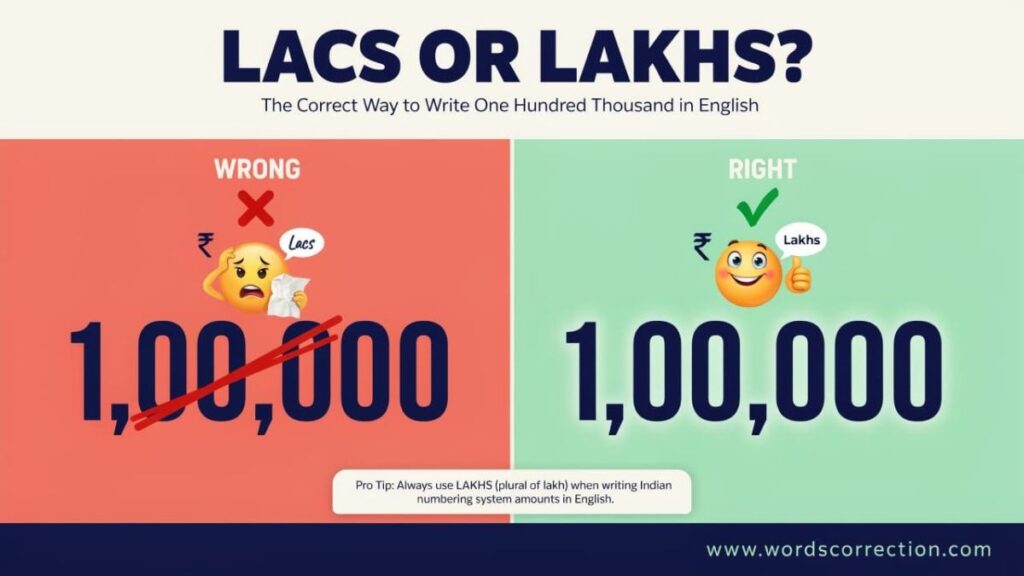
The difference between lacs or lakhs can be confusing. Both spellings are used, but which one should you choose? This small spelling difference can cause mistakes when writing salaries filling out cheques or preparing financial reports. Don’t worry. You don’t need to be a grammar expert to get it right. With a few simple rules, you can easily understand the difference and choose the correct spelling. In this guide you’ll learn five easy rules to use lacs or lakhs correctly. You’ll also discover their meanings, common uses and how to avoid spelling mistakes in everyday and formal writing.
Lacs or Lakhs Quick Answer
The short answer is that both lac and lakh can refer to 100,000, but lakh and lakhs are the preferred forms for most modern writing about numbers in South Asian English.
Here’s a quick guide:
| Word or phrase | Meaning | Example |
|---|---|---|
| Lakh | 100,000 | One lakh rupees |
| Lakhs | Multiple units of 100,000 | Five lakhs in savings |
| Lac | An alternative spelling for 100,000 | One lac rupees |
| Lacs | An alternative plural spelling | Several lacs of rupees |
For everyday writing, financial discussions, and professional communication, choose lakh and lakhs unless a specific style guide or document requires another form.
For example
- Preferred: The car costs 15 lakh rupees.
- Also common: The car costs 15 lakhs.
- Alternative spelling: The car costs 15 lacs.
The important point is that these forms refer to the same numerical unit. The spelling choice doesn’t change the amount.
What Do Lakh, Lakhs, Lac, and Lacs Mean?
To understand the difference between Lacs or Lakhs, start with the meaning of each word. Once you understand the number and how the word behaves in a sentence, the spelling becomes much easier to manage.
What Does Lakh Mean in English?
The meaning of lakh in English is one hundred thousand, written as 100,000 in the international numbering format or 1,00,000 in the Indian numbering system.
The word is widely used in India and other South Asian countries, including Pakistan, when people discuss money, property, salaries, populations, and large quantities.
Consider these examples
- One lakh rupees equals ₹100,000.
- Two lakhs equal ₹200,000.
- Five lakhs equal ₹500,000.
- Ten lakhs equal ₹1,000,000, or one million.
The word lakh makes large numbers easier to discuss in regions where the South Asian numbering system is common.
For example, someone might say, “The apartment costs 80 lakh rupees.” A reader familiar with the Indian number system will understand that the price is ₹80,00,000.
In everyday usage, the word can describe more than money. You might hear someone say that a video received lakhs of views or that a city has lakhs of residents.
Remember One lakh always represents 100,000, regardless of the currency or subject being discussed.
What Does Lac Mean?
The word lac has two relevant meanings in English.
First, it can serve as an alternative spelling of lakh when referring to 100,000. You may encounter this form in older publications, regional writing, and financial documents.
Second, lac refers to a natural resinous substance produced by certain scale insects. This material has traditionally been used to make shellac, varnishes, and other products.
Context tells you which meaning applies.
For example
- “The company earned one lac rupees.” Here, lac means 100,000.
- “The craftsman used lac to coat the decorative object.” Here, lac refers to the resin.
Because lac has this separate meaning, lakh is often the clearer choice when writing about numbers.
What Is the Difference Between Lacs or Lakhs?
The main difference is spelling rather than numerical value.
Lakh is the preferred singular form for the number unit, while lakhs is its common plural form. Lac and lacs are recognized alternative forms in the numerical sense.
Compare these examples
- One lakh rupees
- Two lakhs of rupees
- One lac rupee
- Two lacs of rupees
The first two use the preferred spelling. The last two use the alternative spelling.
However, natural sentence construction matters, too. In South Asian English, both “The project costs five lakh rupees” and “The project costs five lakhs” are common. The first uses lakh after a specific number as a unit of measurement. The second treats lakhs as a plural noun.
For polished writing, choose a construction that sounds natural and use it consistently throughout the document.
Learn the difference between confusing more English words
Monkeys or Monkies Which Spelling Is Correct?
Lacs vs Lakhs Comparison Table
When you’re deciding between lac or lakh, a comparison table can help you remember the preferred spelling and understand how each form works.
| Feature | Lakh / Lakhs | Lac / Lacs |
|---|---|---|
| Numerical meaning | 100,000 per unit | 100,000 per unit |
| Preferred modern usage | Lakh and lakhs | Recognized alternatives |
| Singular example | One lakh | One lac |
| Plural example | Five lakhs | Five lacs |
| Common context | Salaries, prices, savings, population | Older or alternative usage |
| Other meaning | Primarily a number term | Also a natural resin |
| Best choice for consistent modern writing | Recommended | Use when required by a specific source or style |
The practical lesson is simple: you don’t need to treat every occurrence of lac as a spelling error. Instead, consider the audience, the intended meaning, and the style of the document.
Learn the difference between commonly mixed-up more words
Signalling vs Signaling Which Spelling Is Correct?
5 Simple Rules to Never Confuse Lacs or Lakhs
Knowing the definitions is useful, but applying them correctly is even better. These five rules cover the situations in which spelling mistakes most often occur.
Rule 1 Use Lakh as Your Default Spelling
If you’re unsure whether to write Lacs or Lakhs, choose lakh for the singular and lakhs for the plural in modern South Asian English.
This choice works well in articles, reports, business emails, educational content, and everyday writing. It also makes your writing easier to understand for readers who expect the more familiar spelling.
For example
- The company invested 25 lakh rupees in new equipment.
- She saved five lakhs over several years.
- The property is worth 1.2 crore rupees.
- The campaign reached lakhs of people online.
Notice that the spelling doesn’t change the amount. The purpose of choosing one form is to maintain a clear and consistent style.
A useful editing tip: If you’re reviewing a document that contains both lacs or lakhs, decide which form suits your audience and standardize the wording. Don’t automatically change a quotation or an official document’s original wording.
Rule 2 Learn What One Lakh Looks Like in Numbers
Many spelling mistakes begin with confusion about the number itself. Once you know the numerical value, you can check your writing more confidently.
One lakh equals 100,000 and contains five zeros.
In the Indian numbering system, you write it as 1,00,000. In the international numbering system, you write it as 100,000. Both represent the same amount.
| Amount | Indian numbering format | International format |
|---|---|---|
| One lakh | 1,00,000 | 100,000 |
| Two lakhs | 2,00,000 | 200,000 |
| Five lakhs | 5,00,000 | 500,000 |
| Ten lakhs | 10,00,000 | 1,000,000 |
| Twenty-five lakhs | 25,00,000 | 2,500,000 |
The Indian place value system groups digits differently from the international system. After the first three digits from the right, it groups digits in pairs. That explains why 100,000 becomes 1,00,000.
Try this simple check whenever you write an amount: count the zeros, then compare the number with the words. If you write “five lakh” but enter 50,000 instead of 500,000, the spelling isn’t the problem. The numerical amount is.
Rule 3 Use the Correct Singular or Plural Form
The plural of lakh is usually lakhs, just as the plural of book is books. However, South Asian English often uses lakh after a specific number when the word functions as a unit of measurement.
Both of these sentences are common
- The project cost five lakh rupees.
- The project cost five lakhs.
The first treats lakh like a unit following a number. The second uses lakhs as a plural noun without repeating the currency unit.
This distinction also appears in other expressions
- One lakh rupees
- Two lakh rupees
- Two lakhs
- Five lakh people
- Lakhs of people
In international English, a reader might find “five lakhs of people” less familiar than “500,000 people.” That doesn’t make the regional expression meaningless. It simply means that audience and context influence the best wording.
Learn the difference between confusing more English words step by step
Advice vs Advise what’s the difference?
Is It Two Lakh or Two Lakhs?

Both constructions occur in South Asian English, but they work differently.
- Two lakh rupees is common when lakh directly follows the number and acts as a unit.
- Two lakhs is common when the plural noun stands on its own.
- Two lakhs of rupees is also used regionally, although “two lakh rupees” is usually more concise.
For formal writing, choose a construction that fits the sentence and use it consistently.
Rule 4 Write Financial Amounts Clearly on Cheques and Documents
A small spelling mistake can cause confusion in a financial document. A mismatch between the amount in words and the amount in figures can create an even bigger problem.
When writing a cheque, make sure the numerical amount matches the amount written in words. Follow the instructions printed on the cheque or provided by your bank.
For example, if the intended amount is ₹2,00,000, you could write the amount in words as:
Rupees Two Lakh Only
Some banks or regional writing conventions may prefer slightly different wording. The important point is that the amount must be unambiguous and must match the figures.
Here is a simple reference table
| Amount in figures | Amount in words |
|---|---|
| ₹1,00,000 | One lakh rupees only |
| ₹2,00,000 | Two lakh rupees only |
| ₹5,00,000 | Five lakh rupees only |
| ₹10,00,000 | Ten lakh rupees only |
| ₹25,00,000 | Twenty-five lakh rupees only |
These are examples of amount wording, not a guarantee that every bank requires precisely the same phrasing.
Learn the difference between tricky grammar more words
Sent or Send Which one Is Correct?
Lac or Lakh on a Cheque Which Should You Use?
If you’re wondering whether to write lac or lakh on a cheque, lakh is the clearer default when writing the amount in words. However, follow your bank’s requirements and the conventions applicable to your account.
Don’t assume that the Reserve Bank of India (RBI) has issued a universal rule requiring the word lakh rather than lac. General spelling preferences and official cheque requirements are different matters.
For Indian cheques, banking standards address the format and placement of important fields, including the amount in words and figures. They should not be confused with a general dictionary ruling about spelling.
In Pakistan, banks also advise customers to write the amount in words and figures clearly and legibly. For any cheque, follow these precautions:
- Write the amount in words clearly and legibly.
- Make sure the words match the numerical amount.
- Avoid leaving gaps that someone could use to alter the wording.
- Follow the bank’s instructions about the currency and amount fields.
- Correct mistakes by following your bank’s procedure rather than assuming an alteration will be accepted.
Rule 5 Match Your Spelling to Your Audience
English varies across regions. Words that are familiar in one country may be less familiar in another.
The word lakh is widely used in Indian English and other forms of South Asian English. It is also recorded in major English dictionaries, including dictionaries that cover British and American English. That makes it an English word with a strong regional association rather than a spelling mistake.
When writing for a South Asian audience, a sentence such as “The house costs 90 lakh rupees” will usually be clear.
For an international audience, consider writing
“The house costs 9,000,000 rupees (nine million rupees).”
You don’t have to avoid lakh in international writing. You simply need to decide whether the term helps your readers understand the amount.
Use these guidelines
- For South Asian readers: Use lakh, lakhs, and crore where appropriate.
- For international readers: Consider including the equivalent number or explaining the term at first mention.
- For academic writing: Follow the publication’s style guide.
- For financial documents: Follow the relevant bank or institution’s instructions.
- For existing quotations: Preserve the original spelling unless you have permission to edit it.
Consistency is the key. A document that switches between lacs, lakhs, and hundred thousand without a clear reason can confuse readers, even when every expression refers to the correct number.
Learn the difference between confusing word pairs
Peak or Peek What’s the Difference?
Lakh to Million and Crore Understand the Numbers
Understanding lakh and crore helps you avoid numerical errors and makes large amounts easier to compare.
A lakh represents 100,000. A crore represents 10,000,000, which is ten million or 100 lakhs.
Here is how the units compare
| South Asian number name | Indian format | International format |
|---|---|---|
| One lakh | 1,00,000 | 100,000 |
| Ten lakhs | 10,00,000 | 1,000,000 |
| One crore | 1,00,00,000 | 10,000,000 |
| Ten crore | 10,00,00,000 | 100,000,000 |
These relationships are numerical facts, not currency conversions. Ten lakh Pakistani rupees and ten lakh Indian rupees represent the same number of currency units, but they do not necessarily have the same value when exchanged into another currency.
Lakh vs Hundred Thousand
The difference between lakh and hundred thousand is mainly terminology.
- One lakh = one hundred thousand.
- Two lakhs = two hundred thousand.
- Five lakhs = five hundred thousand.
- Ten lakhs = one million.
If you’re writing for readers who regularly use the Indian numbering system, lakh may be the most natural term. If your readers primarily use the international numbering system, hundred thousand may be more familiar.
For example, a financial report might say “Revenue reached 25 lakh rupees.” An international report might instead use “Revenue reached 2.5 million rupees.” Both statements describe the same numerical amount if the currency and scale remain unchanged.
How Many Zeros Are in One Lakh?
One lakh has five zeros.
- 1 lakh = 100,000
- 2 lakhs = 200,000
- 5 lakhs = 500,000
- 10 lakhs = 1,000,000
A handy way to remember this is to start with 100,000 and multiply it by the relevant number of units. Two lakhs are twice 100,000, while five lakhs are five times 100,000.
This is particularly useful when converting salaries, savings, property prices, or business figures from words into numbers.
Learn the difference between often confused words
Mrs or Miss What’s the Difference?
Lacs or Lakhs Examples in Real Sentences

Examples make spelling rules easier to remember because they show how the words work in everyday situations. The following sentences cover money, business, population, education, and general writing.
Examples Using Lakh and Lakhs
Here are natural examples of the preferred spellings
- Salary: She earns 18 lakh rupees per year.
- Savings: He has saved five lakhs for a down payment.
- Property: The apartment costs 85 lakh rupees.
- Education: The university received a grant of 12 lakh rupees.
- Business: The startup raised 40 lakh rupees in its first funding round.
- Population: Lakhs of people attended the public event.
- Social media: The video received two lakh views within a week.
- Charity: The organization collected three lakh rupees for flood relief.
Each example uses the number term in a meaningful context. In formal writing, you can also use figures when the exact amount matters, such as “The organization raised ₹3,00,000.”
Examples Using Lac and Lacs
Although lakh and lakhs are the preferred default forms, you may encounter lac and lacs in older records, regional publications, or documents that follow a particular house style.
Examples include
- The historical record lists a donation of one lac rupees.
- The old report refers to several lacs in outstanding payments.
- The agreement records a sum of five lac rupees.
- The archived article describes a property worth 20 lacs.
These examples illustrate the alternative spellings. They aren’t a recommendation to switch between variants in the same article.
If you’re editing an older document, consider its original purpose and audience before changing the wording. If you’re writing a new article, choose one spelling convention and follow it throughout.
How to Write One Lakh Rupees in Words and Figures
Writers often need to convert a number into words for an invoice, receipt, cheque, contract, or other financial document.
Use this table as a reference
| Numerical amount | Amount in words |
|---|---|
| ₹1,00,000 | One lakh rupees |
| ₹2,00,000 | Two lakh rupees |
| ₹5,00,000 | Five lakh rupees |
| ₹10,00,000 | Ten lakh rupees |
| ₹50,00,000 | Fifty lakh rupees |
| ₹1,00,00,000 | One crore rupees |
For a cheque, you may add “only” after the amount in words when the applicable bank format calls for it. For example, ₹1,00,000 may be written as “One Lakh Rupees Only.”
The amount in words must match the amount in figures. If the two differ, don’t assume that the bank will automatically know which amount you intended.
Learn the difference between basic English word mistakes
Todays or Today’s Which Is Correct?
Common Mistakes When Writing Lacs or Lakhs
Even experienced writers can make mistakes when they move between regional English conventions and international number formats. These are the errors worth watching for.
Treating Lacs as Always Wrong
One common misconception is that lacs is never correct.
That claim goes too far. Dictionaries recognize lac as an alternative spelling of lakh and list lacs among its plural forms. The more useful distinction is between an accepted variant and the preferred form for your audience.
For most modern South Asian writing, use lakh and lakhs by default. However, don’t label every alternative spelling as an error without considering context.
Confusing Lakhs With Millions
A lakh and a million are different numerical units.
- One lakh = 100,000.
- Ten lakhs = 1,000,000.
- One million = ten lakhs.
- One crore = ten million.
Suppose a report states that a company earned 20 lakh rupees. That means ₹2,000,000, not ₹20,000,000. The latter equals two crore rupees.
A misplaced zero can change a financial figure dramatically. Always check the number before publishing it.
Using the Wrong Comma Placement
Indian and international number formats group digits differently.
| Number name | Indian format | International format |
|---|---|---|
| One thousand | 1,000 | 1,000 |
| Ten thousand | 10,000 | 10,000 |
| One lakh | 1,00,000 | 100,000 |
| Ten lakhs | 10,00,000 | 1,000,000 |
| One crore | 1,00,00,000 | 10,000,000 |
The two formats don’t change the value. They change how you group digits for readability.
When preparing a report for an international audience, consider using the format your readers expect or showing both formats at the first mention.
Mixing Singular and Plural Forms
Writers sometimes use lakh and lakhs without considering the sentence structure.
Compare
- One lakh rupees
- Five lakh rupees
- Five lakhs
- Lakhs of rupees
These expressions are all found in South Asian English. The most natural choice depends on whether the word functions as a unit following a number or as a plural noun.
For consistent formal writing, select a construction that suits your style and apply it throughout.
Assuming Every Bank Requires the Same Spelling
A bank may specify how customers should write an amount, but that doesn’t automatically establish a universal spelling rule for every English-language document.
Don’t confuse an institution’s instructions with a general rule of grammar. Check the relevant bank guidance when writing a cheque, and consult the applicable style guide when preparing a report or article.
Learn the difference between commonly misused words
Fulfilment or Fulfillment Which Spelling Is Correct?
Is Lakh an English Word? British, American, and Indian Usage
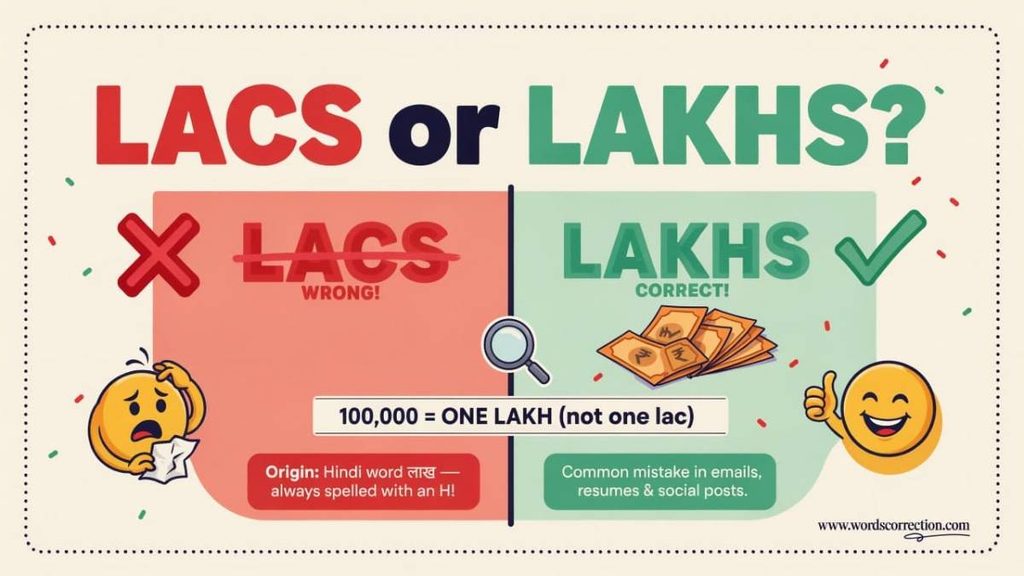
Yes. Lakh is an established English word, although its use is strongly associated with South Asia.
The word appears in major English dictionaries. Its use is particularly common in Indian English and other South Asian English varieties.
Lakh Spelling in Indian English
In Indian English, lakh is a familiar term for 100,000. People use it when discussing salaries, real estate, business revenue, school fees, budgets, and population figures.
The word works naturally alongside crore, which represents 10 million.
For example
“The company invested ₹25 lakh in new equipment.”
Readers familiar with Indian numbering conventions can understand this sentence without needing the international equivalent.
Lakh Spelling in British English
British English recognizes the word lakh, particularly in contexts involving South Asia, its currencies, and its numbering conventions.
However, hundred thousand may be more familiar in writing for a general British audience. The right choice depends on the subject and the intended readers rather than a rule that prohibits lakh.
Is Lakh Used in American English?
Yes. American English dictionaries recognize lakh, too. However, the term is less common in everyday US writing than one hundred thousand.
For example, a US audience might understand “The business earned $100,000” more readily than a sentence using one lakh dollars.
When writing for international readers, consider explaining the term on first use:
“One lakh, or 100,000, people registered for the service.”
After that explanation, you can use lakh if it suits the rest of the article.
Learn the difference between everyday English mistakes
Amid or Amidst What Is the Difference?
Where Did the Word Lakh Come From?
The word lakh entered English through Hindi and ultimately comes from Sanskrit. Its history reflects the influence of South Asian languages on English vocabulary.
Like many words borrowed into English, lakh became established through regular use in a particular cultural and numerical context.
The word is closely connected to the South Asian numbering system, which uses lakh for 100,000 and crore for 10 million.
This history also explains why the word may feel unfamiliar to readers who mainly use the international system. English includes many regional number terms, and their familiarity varies across countries.
The useful takeaway is straightforward: lakh is a legitimate English word with a specific numerical meaning. You don’t need to replace it simply because it isn’t equally common in every English-speaking country.
Learn the difference between more words people mix up
Bare or Bear What’s the Difference?
practice session about Lacs or Lakhs
Fill in the blanks Lacs or Lakhs
Here’s the practice session with “Write your answer here” removed from beneath every blank.
- One ______ is equal to 100,000.
- The correct spelling commonly used in South Asian English is ______.
- The word “lakh” is used in the South Asian ______ system.
- One lakh contains ______ zeros.
- Ten lakh equals ______ million.
- One crore is equal to ______ lakh.
- The plural of “lakh” is often written as ______ in South Asian English.
- The word “lac” is an accepted spelling variant of ______.
- In formal financial writing, clarity and ______ are essential.
- One lakh rupees can be written as Rs. ______ in figures.
- The number 1,00,000 is read as one ______.
- The number 5,00,000 is equal to five ______.
- The number 10,00,000 is equal to ten ______.
- The South Asian numbering system uses lakh and ______.
- One hundred thousand is another way to express one ______.
- In a financial document, write the amount in figures and ______ when required.
- The spelling “lakhs” is widely used in Indian and Pakistani ______.
- The word “lakh” refers to a specific ______.
- The number 2,00,000 is equal to two ______.
- One million is equal to ______ lakh.
- When writing for an international audience, explain unfamiliar number ______ if needed.
- The word “crore” represents ten ______.
- Consistent spelling makes financial documents easier to ______.
- “Lacs” is a variant spelling of ______.
- To avoid confusion, use one spelling ______ throughout your document.
Answers
- lakh
- lakh
- numbering
- five
- one
- one hundred
- lakhs
- lakh
- accuracy
- 100,000
- lakh
- lakh
- lakh
- crore
- lakh
- words
- English
- number
- lakh
- ten
- terms
- lakh
- understand
- lakh
- consistently
Here’s a trusted source for clear word meanings:
Cambridge Dictionary
FAQ’s
General Usage and Grammar
Is lakh accepted in formal English writing?
Yes. “Lakh” is accepted in formal English, particularly in South Asian countries such as India, Pakistan, and Bangladesh. It commonly appears in financial reports, business documents, news articles, and official publications.
Should I write one lakh or a lakh?
Both expressions are correct. “One lakh” emphasizes the exact amount, while “a lakh” is a natural alternative in everyday conversation and writing.
Is lakh a countable noun?
Yes. “Lakh” is a countable noun used to express a quantity of 100,000. For example, you can write “one lakh,” “two lakh,” or “several lakhs,” depending on the sentence and the style you follow.
Should I use lakh or one hundred thousand in an international report?
“One hundred thousand” or “100,000” is generally clearer for an international audience unfamiliar with the South Asian numbering system. You can also write “one lakh (100,000)” when introducing the term.
Is lakh included in English dictionaries?
Yes. Major English dictionaries recognize “lakh” as a word meaning 100,000. It is particularly common in South Asian English and in international writing about the region.
Spelling and Sentence Structure
Is lakh an English word or a borrowed word?
“Lakh” is an established English word borrowed from South Asian languages. It has become part of modern English vocabulary, especially in discussions of money, population, business, and statistics.
Can I use lakh without a number before it?
Yes. You can use “lakh” without a specific number when the context makes the quantity clear. For example, “The project will cost several lakh rupees” is used in some regional varieties of English. “Several lakhs of rupees” is another common construction.
Is lakh rupees grammatically correct?
Yes. “Lakh rupees” is grammatically correct in common South Asian English usage. For example, “The property costs five lakh rupees” is a natural construction in this regional style.
Should I write five lakh rupees or five lakhs rupees?
“Five lakh rupees” is the standard construction in much of South Asian English when a number directly precedes “lakh.” The phrase “five lakhs of rupees” is also used in some contexts. For clear, consistent writing, follow the conventions of your intended audience.
Can I use lakh at the beginning of a sentence?
Yes. For example, “One lakh people attended the event” is grammatically correct. Starting a sentence with a number expressed in words can also make formal writing easier to read.
Numbers and Conversions
How many thousands make one lakh?
One lakh equals 100,000, or 100 thousand. It is written as 100,000 in the international numbering system and 1,00,000 in the Indian numbering system.
What is half a lakh in numbers?
Half a lakh is 50,000. This amount can be written as 50,000 in both the international and Indian numbering systems because the comma placement is identical.
What is a quarter of a lakh?
A quarter of a lakh is 25,000. This is calculated by dividing 100,000 by four.
How do you write 1.5 lakh in figures?
Write 1.5 lakh as 150,000 in the international numbering system or 1,50,000 in the Indian numbering system. In words, the amount is “one lakh fifty thousand.”
How many lakhs are there in one crore?
One crore equals 100 lakhs. In figures, one crore is written as 10,000,000 internationally and 1,00,00,000 in the Indian numbering system.
Business, Money, and Everyday English
How should I write a lakh amount in a business proposal?
Write the amount clearly and use one numbering style consistently throughout the proposal. For example, you could write “The estimated budget is INR 5 lakh (INR 500,000).” Including the equivalent international figure helps readers understand the amount without needing to know the South Asian numbering system.
Should I spell out lakh amounts in contracts?
Follow the contract’s drafting requirements and any applicable legal rules. If you spell out an amount, make sure the words match the numerical figure exactly. Including the currency name or code can also help prevent misunderstandings.
Is lakh appropriate for academic writing?
Yes. “Lakh” is appropriate in academic writing when it suits the subject and intended audience. For international readers, define the term at first use or provide the equivalent figure, such as “one lakh (100,000).”
How can I avoid confusion between lakhs and millions?
Remember that one lakh equals 100,000, while one million equals 1,000,000. Therefore, ten lakhs equal one million. Checking the number of zeros and writing the numerical equivalent can help prevent costly mistakes.
Which spelling should a company use lac or lakh?
A company should follow its preferred style guide and use the same spelling across its website, reports, invoices, and marketing materials. “Lakh” is widely used in modern South Asian English, while “lac” is also an accepted variant.
Meaning, Origin, and Regional Differences
Does lac have a meaning other than a number?
Yes. “Lac” can refer to a natural resinous substance produced by certain insects. This substance has traditionally been used to make shellac, varnishes, and other products. The intended meaning depends on the context.
Is lakh commonly used outside South Asia?
Yes. “Lakh” appears in international reporting about South Asian populations, finances, property, and business. However, readers unfamiliar with the term may find “100,000” or “one hundred thousand” easier to understand.
Why does the Indian numbering system use different comma placement?
The Indian numbering system groups digits differently from the international system. It places the first comma three digits from the right and subsequent commas after every two digits. For example, 1,000,000 in the international system is written as 10,00,000 in the Indian system.
Is lakh used in British English?
Yes. “Lakh” is recognized in British English, particularly in writing about South Asia. However, “one hundred thousand” may be clearer when addressing readers who are unfamiliar with the term.
What is the easiest way to remember the correct spelling of lakh?
Use “lakh” as your default spelling when writing for a South Asian audience. Remember that one lakh equals 100,000, and use “lac” when it matches your organization’s style guide or the convention of your intended audience. Consistency is the key to clear, professional writing.
Learn the difference between tricky English words with easy explanations
Address vs Adress What’s the Correct Spelling?
Conclusion
Choosing between lacs or lakhs doesn’t have to be confusing! Although both spellings are used, lakh and lakhs are more common in South Asian English. Knowing the difference can help you avoid mistakes when writing salaries, filling out cheques, or preparing financial reports.
Remember, a small spelling mistake can cause unnecessary confusion, especially when money is involved. Understanding lacs or lakhs makes it easier to write clearly and professionally. Follow the five simple rules in this guide, keep your spelling consistent, and double-check important documents before sharing them. With a little practice, you’ll know how to use lacs or lakhs correctly and confidently. Say goodbye to spelling confusion and let your numbers do the talking.

Stella AJS is an experienced blogger and dedicated English language writer at Words Correction. She turns confusing grammar, word meanings, spelling, and usage into clear, practical insights that readers can easily understand and apply. With a passion for precise and engaging writing, Stella helps readers avoid common language mistakes, strengthen their vocabulary, and communicate with greater clarity and confidence.




