
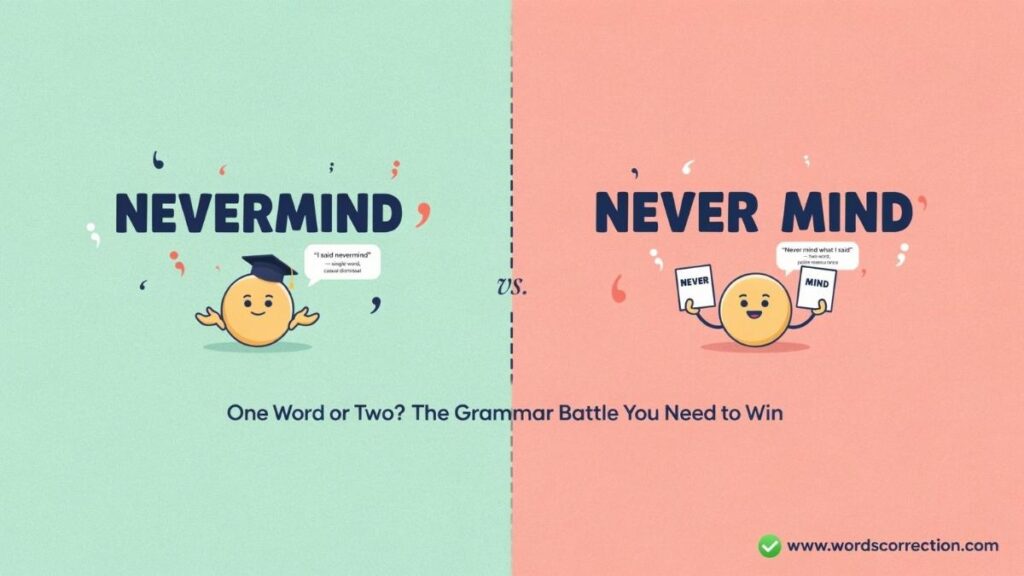
The difference between “nevermind” or “never Mind” can confuse even confident writers. Both look almost the same, so choosing the correct spelling can feel tricky. However, the rule is simple once you understand it. Using the wrong form may lead to grammar mistakes in emails, school assignments, or everyday messages. The good news is that learning the difference takes only a few minutes. In this guide, you’ll learn which spelling is correct, understand common mistakes, and practice using the phrase in everyday conversations and professional writing. By the end, you’ll know how to use “never mind” with confidence.
Quick Answer Nevermind or Never Mind?
Use “never mind” as two words for the standard English expression. The one-word form is appropriate in certain noun uses and proper names, depending on the context.
Consider these examples
- Correct: Never mind what I said earlier.
- Correct: Never mind the dishes; we can wash them tomorrow.
- Correct: Never mind, I found my keys.
- Proper name: Nevermind is the title of Nirvana’s 1991 album.
The last example uses Nevermind as a proper title. It doesn’t change the standard spelling of the everyday expression.
| Question | Answer |
|---|---|
| Is it nevermind or never mind? | Usually never mind |
| Should never mind be one word or two? | Two words for the common expression |
| Is nevermind ever correct? | Yes, in certain noun uses and proper names |
| Is never mind correct in American English? | Yes |
| Is never mind correct in British English? | Yes |
| What’s the safest choice in formal writing? | Never mind for the ordinary expression |
If you’re unsure how to spell never mind in an email, essay, text message, or article, the two-word form is the most reliable choice.
Learn the difference between confusing more English words
Each Other or Eachother Which Spelling Is Correct?
What Does “Never Mind” Mean?
The meaning of never mind depends on the situation, but the expression generally tells someone to disregard something, stop worrying about it, or treat it as unimportant.
In everyday conversation, people use it to withdraw a request, correct themselves, dismiss a concern, or move on from a subject. The words remain the same, but the speaker’s intention can change.
For example, imagine asking a coworker to print a document. A moment later, you discover that you’ve already printed it. You might say, “Never mind, I found the copy.” You’re telling your coworker that the request is no longer necessary.
Here are the three most common meanings.
Never Mind Meaning “Forget It”
The first meaning is to tell someone to disregard something previously said, asked, or suggested.
Examples
- “Never mind what I said earlier.”
- “I was going to ask you a question, but never mind.”
- “Never mind that message. I sent it to the wrong person.”
In each example, the speaker withdraws or dismisses something. The expression doesn’t necessarily mean the original subject was unimportant. It simply means the speaker no longer wants the other person to focus on it.
Never Mind Meaning “Don’t Worry About It”
The phrase can also reassure someone that a problem isn’t serious or that they don’t need to feel concerned.
Consider this conversation
Alex: “I’m sorry I spilled some water on the table.”
Jordan: “Never mind. I’ll wipe it up.”
Here, Jordan uses the expression to dismiss a minor problem and reassure Alex. Depending on the tone, it can communicate patience, kindness, or mild impatience.
Other examples include
- “Never mind the delay. We still have plenty of time.”
- “Never mind the cost; I’ll take care of it.”
- “Never mind the mistake. Everyone makes them.”
This meaning overlaps with “don’t worry about it,” but the two expressions aren’t identical in every situation. Never mind can also mean that a subject no longer deserves attention, while don’t worry about it focuses more directly on someone’s concern.
Never Mind as a Way to Withdraw a Request
People frequently use the expression when they change their minds during a conversation.
For example
“Could you send me the report? Actually, never mind. I just found it.”
The speaker no longer needs the report, so the original request becomes unnecessary.
This usage appears frequently in online communication, text messaging, and everyday conversation. It’s short, natural, and easy to understand.
However, tone matters. Saying “Never mind” abruptly can sound dismissive or irritated, especially when the other person doesn’t know why you’ve changed your mind.
Learn the difference between commonly mixed-up more words
Patient or Patience what’s the Difference?
What Does “Nevermind” Mean as One Word?
The meaning of nevermind is less straightforward because the one-word form has a narrower role than the familiar two-word expression.
Some dictionaries recognize nevermind as a noun referring to something that doesn’t deserve attention or consideration. This usage is uncommon in modern everyday English, and many writers will find a clearer alternative, such as “a minor issue,” “an unimportant matter,” or “something insignificant.”
The word also appears in proper names and titles. Nirvana’s Nevermind, for example, is the title of the band’s famous 1991 album.
These uses explain why nevermind isn’t simply an invented spelling. However, seeing it in a title or dictionary doesn’t mean you should use it whenever you want to say “forget it.”
Nevermind as a Noun
A noun names a person, place, thing, idea, or concept. When nevermind appears as a noun, it refers to something considered unimportant or unworthy of attention.
This is a relatively rare construction. It can sound unnatural if you force it into an ordinary sentence.
For instance, instead of writing
- “That problem is a nevermind.”
A more natural choice would be
- “That problem isn’t important.”
- “It’s a minor issue.”
- “That’s nothing to worry about.”
These alternatives communicate the intended meaning more clearly.
The practical rule: Don’t use nevermind as a noun simply because you’re unsure about the spelling of the expression. Choose a noun that fits the sentence naturally, or use never mind if you mean “forget it.”
Is “Nevermind” Grammatically Correct?
It can be, depending on the context. Some dictionaries record the closed form as a noun, while the standard expression is conventionally written as two words.
Grammar and spelling work together, but they’re not the same thing. A word can have a legitimate dictionary entry without being the correct choice for every sentence.
When in doubt, consult a reputable dictionary. Pay attention to the part of speech, definition, and example sentences rather than relying on spelling alone.
Learn the difference between tricky grammar more words
In Person vs In-Person When to Use the Hyphen
Nevermind or Never Mind What’s the Difference?
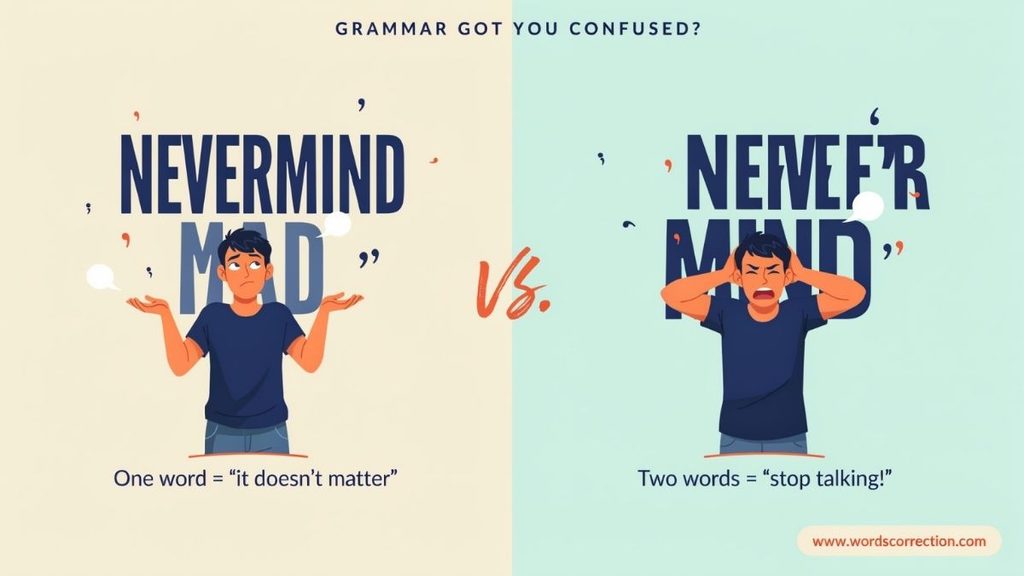
The main difference between nevermind or never mind lies in their conventional usage and grammatical roles.
The two-word form functions as an established expression in English. The one-word form has a narrower noun use and appears in proper names. In ordinary conversation, writers sometimes intend the standard expression even when they type it as one word.
| Feature | Never mind | Nevermind |
|---|---|---|
| Spelling | Two words | One word |
| Main role | Established expression | Less common noun; also used in titles |
| Common meaning | Forget it, disregard that, or don’t worry | Something unimportant or not worth attention |
| Everyday frequency | Very common | Much less common as a noun |
| Formal writing | Standard choice for the expression | Use only when the context supports it |
| Example | “Never mind the earlier email.” | Nevermind is Nirvana’s album title. |
Why Is “Never Mind” Written as Two Words?
The expression combines never, an adverb associated with negation or time, and mind, a verb meaning to pay attention to, concern oneself with, or take something into consideration.
In the phrase never mind, the words work together to tell someone not to concern themselves with something or to disregard it. English contains many expressions that retain separate words even when speakers treat them as a single unit of meaning.
Over time, some word combinations become closed compounds, meaning they appear as one word. However, this process doesn’t happen uniformly across the language. Familiarity, pronunciation, and frequent use don’t automatically determine standard spelling.
That’s why never mind remains the conventional form of the expression.
Is “Nevermind” One Word or Two?
The answer depends on what you’re trying to write.
- If you mean “forget it,” write never mind.
- If you’re referring to a recognized noun use of nevermind, consult the dictionary and style guide relevant to your context.
- If you’re writing the title of Nirvana’s album, preserve its official spelling: Nevermind.
The important point is to choose the form based on its meaning, not merely on how it sounds.
Learn the difference between confusing word pairs
Color or Colour Which Spelling Is Correct?
When Should You Use “Never Mind” or “Nevermind”?
For most writers, the decision is simple: use never mind for the ordinary expression in professional writing, academic work, and everyday communication.
The one-word form should be reserved for contexts in which it functions as a noun or forms part of a proper name.
Never Mind in Formal Writing
In formal writing, grammatical accuracy and clarity matter more than saving a space.
Use never mind when you want to withdraw a request or tell someone to disregard something. For example:
- “Never mind the previous attachment; please review the revised document.”
- “Never mind the formatting issue. The final version is ready.”
- “Please disregard my earlier request.”
The last example is especially useful in formal correspondence because it communicates the instruction directly and avoids the potentially abrupt tone of never mind.
In academic papers, business reports, and other formal documents, choose language that suits the purpose. Although never mind is grammatically acceptable, a more precise alternative may be better when the expression sounds too conversational.
Never Mind in Informal Writing
Informal writing gives the expression plenty of room to work naturally.
You’ll often see it in text messages, group chats, emails between friends, and online discussions. People use it to correct themselves, cancel a request, or signal that they want to move on.
Example conversation
Sam: “Can you pick up some bread?”
Taylor: “Sure. Anything else?”
Sam: “Never mind, I just remembered we already have some.”
The phrase sounds natural because it reflects ordinary speech. There’s no need to replace it with a more complicated expression.
Never Mind in American English and British English
Writers sometimes wonder whether American and British English follow different spelling rules for this expression.
For the standard expression, both American and British English use never mind. There is no general US-versus-UK spelling distinction that makes nevermind the preferred form in one country.
Regional differences may affect pronunciation, tone, and preferred alternatives. However, the standard two-word spelling remains the safe choice in both varieties.
| Context | Recommended form | Example |
|---|---|---|
| American English | Never mind | “Never mind; I found it.” |
| British English | Never mind | “Never mind; I’ve found it.” |
| Formal US writing | Never mind | “Please disregard my previous request.” |
| Formal UK writing | Never mind | “Please disregard my earlier request.” |
Notice that the examples vary slightly in wording, but the spelling rule stays the same.
Learn the difference between often confused words
Flier or Flyer Which Spelling Is Correct?
Nevermind or Never Mind Examples in Everyday English
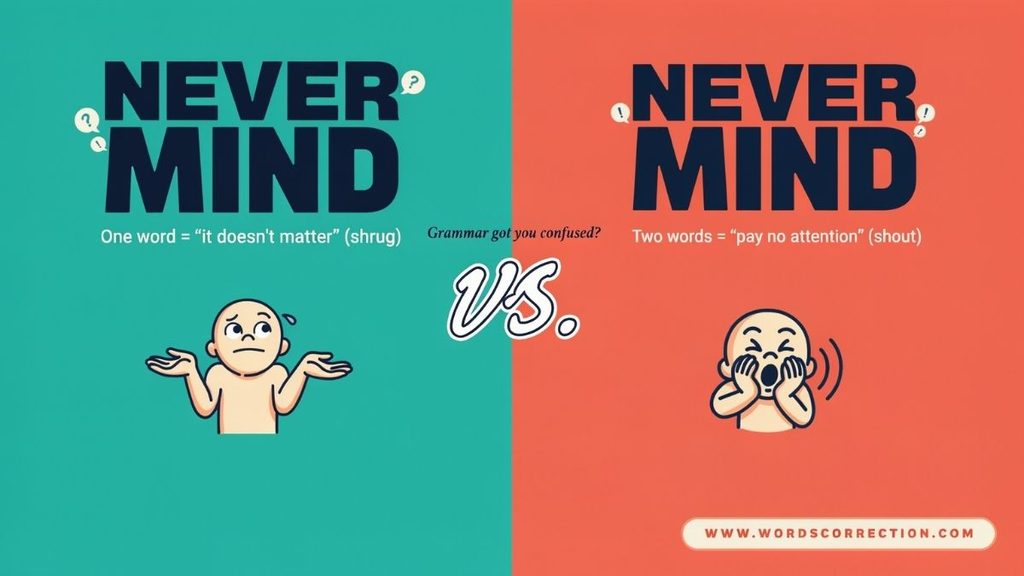
Examples make spelling rules easier to remember because they show how a phrase works in real sentences.
The following examples cover common situations in which writers use never mind.
Examples Meaning “Forget It”
- “Never mind what I said yesterday.”
- “I was going to explain, but never mind.”
- “Never mind the first draft; use the updated version.”
- “You don’t need to call her anymore. Never mind.”
- “Never mind my earlier question. I figured it out.”
In each sentence, the speaker asks someone to disregard a previous statement, request, or subject.
Examples Meaning “Don’t Worry About It”
- “Never mind the mess. We’ll clean it up later.”
- “Never mind the small delay; we can still make it.”
- “Never mind the cost. I’ve already budgeted for it.”
- “Never mind your mistake. We can correct it.”
- “Never mind what other people think. Focus on your goals.”
These examples show how context affects the phrase’s meaning. In some cases, it reassures someone. In others, it shifts attention away from a distraction.
Examples in Questions and Conversations
- “Did you want to ask me something? Never mind if it’s personal.”
- “Should I bring another chair? Never mind, there are plenty here.”
- “Can you check the schedule? Actually, never mind. I have it open.”
- “Never mind that for now. Let’s finish the first task.”
The expression works at the beginning, middle, or end of a sentence, depending on the intended meaning and sentence structure.
Examples of “Nevermind” as a Noun
Because the noun use is uncommon, it deserves careful treatment.
Rather than forcing nevermind into sentences where it sounds unnatural, remember its dictionary-recognized noun use and distinguish it from the much more familiar expression. In most everyday situations, you can express the same idea more naturally with phrases such as:
- “It’s not important.”
- “That’s a minor issue.”
- “It’s nothing worth worrying about.”
These aren’t examples of the noun nevermind. They’re practical alternatives that help you communicate clearly without using an unfamiliar construction.
Learn the difference between basic English word mistakes
It’s vs Its What’s the Difference?
Common “Never Mind” Spelling and Grammar Mistakes
Even fluent English speakers sometimes mix up the two forms. The confusion usually comes from treating never mind as one fixed idea rather than considering how it functions in a sentence.
Here are the mistakes worth avoiding.
Writing “Nevermind” When You Mean “Forget It”
This is the most common mistake.
- Nonstandard for the usual expression: “Nevermind, I’ll do it myself.”
- Standard: “Never mind, I’ll do it myself.”
The one-word spelling may appear in casual messages, but the two-word form is the standard choice for the expression.
Assuming Every Two-Word Phrase Becomes One Word
English contains open compounds, closed compounds, and hyphenated compounds. These categories describe how writers conventionally spell word combinations.
For example, ice cream is generally written as two words, while notebook is one word. You can’t determine the correct spelling of a phrase simply by combining its words.
The same principle applies to never mind. Its established spelling takes precedence over the temptation to close the gap.
Learn the difference between confusing more English words step by step
Whose or Who’s What’s the Difference?
Confusing “Never Mind” With “Don’t Mind”
These expressions look similar, but they don’t mean the same thing.
Compare:
- “Never mind the noise.” This means to disregard the noise or not let it concern you.
- “I don’t mind the noise.” This means the noise doesn’t bother me.
The first expression directs attention away from something. The second describes someone’s attitude or lack of objection.
Using “Never Mind” Without Considering Tone
Spelling isn’t the only thing that affects communication. Tone can change how a reader interprets the phrase.
“Never mind” can sound reassuring, neutral, disappointed, or irritated. In a professional email, the phrase might seem abrupt if the recipient doesn’t understand why you’re withdrawing a request.
For a warmer tone, try
- “No worries. I’ve taken care of it.”
- “Please disregard my earlier message.”
- “Thanks, but I no longer need help with this.”
The best choice depends on your relationship with the reader and the situation.
Learn the difference between commonly misused words
Canceled vs Cancelled Which Spelling Is Correct?
Is “Never Mind” Hyphenated or Capitalized?
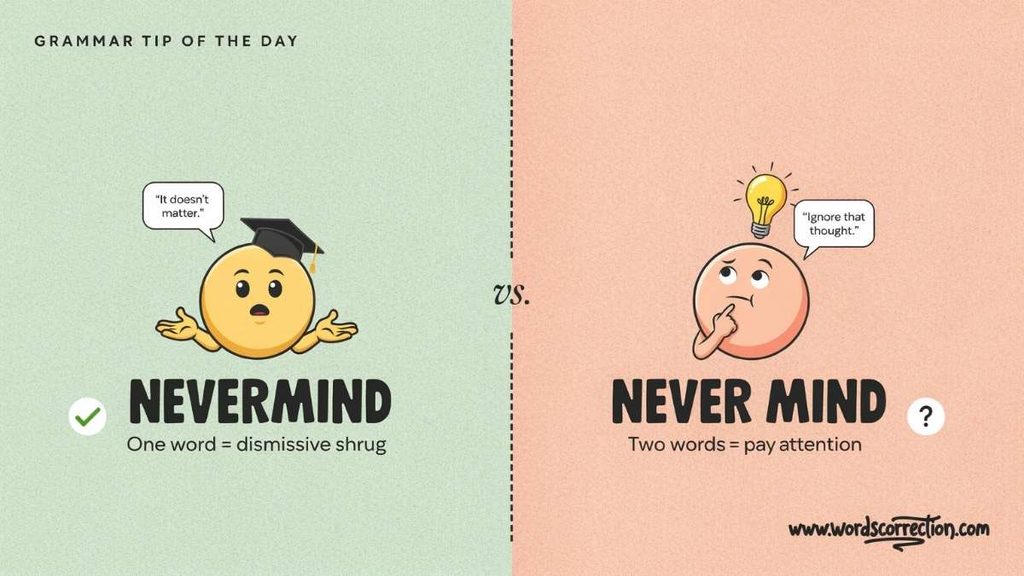
The standard expression is written as two words without a hyphen.
Use these forms
- Correct: never mind
- Correct at the beginning of a sentence: Never mind
- Nonstandard for the usual expression: never-mind
- Nonstandard for the usual expression: nevermind
Capitalization follows ordinary sentence rules. Start the expression with a capital letter when it begins a sentence, and use lowercase when it appears in the middle unless another rule requires capitalization.
Titles follow the publication’s capitalization style. For example, a heading might use “Nevermind or Never Mind: Which Spelling Is Correct?” under title case conventions.
One exception is a proper name. In Nevermind, Nirvana’s album title, the spelling and capitalization are part of the official name and should remain unchanged.
Learn the difference between everyday English mistakes
Happy New Year or Happy New Years Which Is Correct?
What Are Some Synonyms for “Never Mind”?
Choosing a synonym for never mind requires understanding what you want to communicate. No single alternative works in every context.
Some expressions tell someone to ignore something. Others reassure the listener or indicate that a subject no longer matters.
| Alternative | Meaning or purpose | Example |
|---|---|---|
| Forget it | Withdraw a request or dismiss a subject | “Forget it; I found the answer.” |
| Don’t worry about it | Reassure someone | “Don’t worry about it. These things happen.” |
| It doesn’t matter | Say something isn’t important | “It doesn’t matter which route we take.” |
| Disregard it | Tell someone to ignore something | “Please disregard the previous attachment.” |
| Ignore it | Direct someone not to pay attention | “Ignore the earlier notification.” |
| Let it go | Encourage someone to stop dwelling on an issue | “It’s over now. Let it go.” |
| Leave it | Ask someone to stop interfering or discussing something | “Leave it for tomorrow.” |
| No need to worry | Offer reassurance | “There’s no need to worry about the delay.” |
| Never mind that | Redirect attention from a particular subject | “Never mind that for now; let’s review the plan.” |
| Pay no attention | Tell someone not to focus on something | “Pay no attention to the rumor.” |
“Never Mind” vs “Forget It”
These expressions overlap, especially when someone withdraws a request.
For example
- “Never mind. I found my phone.”
- “Forget it. I found my phone.”
Both sentences communicate that the speaker no longer needs help. However, forget it can sound more forceful or dismissive, depending on the situation.
“Never Mind” vs “Don’t Worry”
The difference is subtle but useful.
“Never mind the expense” directs attention away from the expense. “Don’t worry about the expense” directly reassures someone who may be concerned about the cost.
When choosing between them, think about the listener’s likely concern. If you’re trying to comfort someone, don’t worry about it may communicate your intention more clearly.
What About “Let Alone” and “Much Less”?
Although let alone and much less sometimes appear in discussions of related expressions, they aren’t direct synonyms for never mind.
They usually introduce a stronger or less likely comparison.
For example
- “She barely has time to cook, let alone prepare a three-course meal.”
- “He couldn’t afford the bus fare, much less a plane ticket.”
These phrases serve a different grammatical purpose. Don’t substitute them for never mind unless the sentence calls for that comparative meaning.
Learn the difference between more words people mix up
Grey or Gray Which Spelling Is Correct?
Is “Never Mind” Slang?
Never mind is an established English expression, not merely slang. People use it in casual conversations, but it also appears in ordinary written English.
Its informality comes from the situation and tone rather than the spelling itself.
For example, “Never mind, I figured it out” sounds natural in a text message. In a formal business letter, however, “Please disregard my previous request” may be more suitable.
Online communication has also encouraged shorter forms, including NVM, which stands for never mind.
You might see it in messages such as
- “NVM, I found it.”
- “NVM, figured it out.”
- “Can you send the link? NVM, got it.”
NVM is an informal abbreviation rather than a replacement for standard spelling in formal writing. In professional documents, use the full expression unless you’re discussing the abbreviation itself.
Practice Session Never Mind vs Nevermind
Instructions: Fill in each blank with the correct word or phrase.
- I found it. ________.
- Please ________ my last email.
- ________ the noise.
- ________, I found my keys.
- “________, thank you.”
- The correct spelling is ________.
- “________” can reassure someone.
- Please ________ that request.
- ________, I finished the task.
- “Please disregard” sounds more ________.
- “Never mind” can mean ________ it.
- ________ the cost for now.
- Let me know if you need ________.
- Write “never mind” or “________”?
- ________, I found my way.
- “You’re ________” is a polite reply.
- “Never mind” may sound rude in an ________ tone.
- ________ what I said earlier.
- “Never mind” contains ________ words.
- Please ________ my previous request.
- ________, everything is fine.
- I’m glad you ________ it out.
- “Never mind that” means ________ that detail.
- ________, I found the file.
- The standard spelling is ________.
Answers
- Never mind
- Disregard
- Never mind
- Never mind
- Never mind
- Never mind
- No worries
- Disregard
- Never mind
- Professional
- Forget
- Never mind
- Anything else
- Nevermind
- Never mind
- Welcome
- Impatient
- Never mind
- Two
- Disregard
- Never mind
- Figured
- Ignore
- Never mind
- Never mind
Here’s a trusted source for clear word meanings:
Cambridge Dictionary
FAQs
What is the difference between never mind and nevermind?
“Never mind” is the standard spelling of the expression used to tell someone to disregard something or stop worrying. “Nevermind” appears in limited contexts, including some dictionary entries and proper names. For everyday writing, “never mind” is the preferred choice.
Is never mind one word or two?
“Never mind” is two words when used as a common expression in standard English. For example, “Never mind, I found the answer.” Although “nevermind” appears in some contexts, the two-word spelling is the safest option for general and professional writing.
How do you use never mind in a sentence?
Use “never mind” when you want someone to disregard a question, comment, or concern. For example, “Never mind the delay; we still have time to finish.” You can also say, “Never mind, I figured it out,” when you no longer need assistance.
When should you say never mind?
Say “never mind” when you want to withdraw a question, reassure someone, or indicate that something no longer requires attention. For example, “Never mind, I found the document.” In formal or sensitive conversations, consider a more specific phrase to avoid sounding dismissive.
Is nevermind grammatically correct?
“Nevermind” occurs in English, but it is not the standard spelling for the common expression. In most sentences, use “never mind” as two words. This form is widely accepted in everyday communication, academic writing, and professional correspondence.
How can you say never mind politely?
You can replace “never mind” with “No worries,” “It’s all right,” or “Please don’t worry about it.” If you are withdrawing a request, say, “Please disregard my earlier message.” These alternatives communicate your intention more clearly and can sound more considerate.
What are some alternatives to never mind?
Useful alternatives include “forget it,” “no worries,” “it’s okay,” “please disregard that,” and “I figured it out.” Choose the phrase that matches your meaning. For example, use “no worries” to reassure someone and “please disregard that” in a professional message.
Can you say never mind after someone thanks you?
You can, but “never mind” is not usually the most natural response to “thank you.” It may sound dismissive or suggest that the other person did not need to express gratitude. “You’re welcome,” “No problem,” or “Happy to help” are more appropriate responses.
Why do people use the phrase “never mind”?
People use “never mind” to withdraw a question, dismiss a concern, or explain that they no longer need help. For example, someone might say, “Never mind, I found the information I needed.” The phrase is convenient, but its tone can affect how others interpret it.
How should you respond when someone says never mind?
Respond according to the context. If the person has solved a problem, you might say, “Okay, glad you figured it out.” If they seem upset, ask, “Are you sure? I’m happy to help.” In a professional setting, “No problem. Let me know if you need anything else” keeps the conversation courteous.
Is never mind formal or informal?
“Never mind” works in both formal and informal situations, but its suitability depends on the context. It sounds natural in everyday conversation and casual messages. In professional writing, phrases such as “Please disregard my previous message” may communicate the same idea more precisely.
Should you write nevermind or never mind in an email?
Use “never mind” for the common expression in an email. If you need to withdraw a request professionally, consider writing, “Please disregard my previous email” or “I no longer need assistance with this matter.” These alternatives are clear and courteous.
Does never mind mean forget it?
Yes, “never mind” can mean “forget it,” particularly when you want someone to disregard a question or comment. However, “never mind” can also reassure someone that a problem is not important. The intended meaning depends on the surrounding words and the speaker’s tone.
Is never mind rude?
“Never mind” is not inherently rude, but it can sound dismissive when spoken sharply or used to end a conversation abruptly. A softer expression, such as “It’s okay, I worked it out,” can communicate the same message without making the other person feel brushed off.
What does never mind mean in texting?
In text messages, “never mind” usually means that the sender has changed their mind, no longer needs help, or wants the recipient to ignore an earlier message. Because text lacks vocal tone, adding context can prevent misunderstandings. For example, “Never mind, I found it. Thanks anyway!” sounds more reassuring.
Is never mind the same as no worries?
Not exactly. “Never mind” often tells someone to disregard something, while “no worries” usually reassures them that a problem or mistake is acceptable. For example, “Never mind the first draft” means to ignore it, whereas “No worries about the delay” reassures someone.
Can never mind be used to apologize?
“Never mind” is not a direct apology, although people sometimes use it to move past a minor misunderstanding. If you need to apologize, say “I’m sorry for the confusion” or “Please excuse my earlier message.” These expressions acknowledge the situation more clearly.
What punctuation should you use with never mind?
Punctuation depends on how the phrase functions in the sentence. Use a comma when it introduces a follow-up thought, as in “Never mind, I found the answer.” A period works when it stands alone: “Never mind.” You can also use it within a sentence, as in “Never mind the cost for now.”
Can never mind start a sentence?
Yes, “never mind” can begin a sentence. For example, “Never mind the weather; we can hold the event indoors.” It can also introduce a correction or change of direction, as in “Never mind, I have another idea.” The appropriate punctuation depends on the sentence structure.
Is never mind hyphenated?
No. The standard expression is written as two separate words without a hyphen: “never mind.” Avoid forms such as “never-mind” in ordinary writing. When you mean “forget it” or “don’t worry about it,” the two-word spelling is the conventional choice.
What does never mind that mean?
“Never mind that” means to disregard a particular detail, concern, or statement. For example, “Never mind that the first plan failed; we can try another approach.” Depending on the tone, the phrase can redirect attention or suggest that the detail is less important than something else.
What does never mind mean in British and American English?
The expression “never mind” is commonly used in both British and American English. Its meaning remains broadly similar: disregard something, stop worrying, or move on from a matter. The standard two-word spelling is appropriate in both varieties for everyday use.
Is never mind appropriate for academic writing?
“Never mind” is grammatically acceptable, but it may sound conversational in formal academic writing. Depending on the sentence, alternatives such as “disregard,” “set aside,” or “exclude” may be more precise. Choose wording that fits the purpose and tone of your work.
What does never mind mean when someone is upset?
When someone says “never mind” while upset, they may be withdrawing a request, expressing frustration, or deciding not to discuss an issue. The phrase alone does not reveal exactly how they feel. A calm response, such as “I’m here if you want to talk,” gives them space without dismissing their concern.
What is the easiest way to remember the correct spelling of never mind?
Remember that the common expression uses two words: “never mind.” If you mean “forget it,” “don’t worry about it,” or “pay no attention,” write it this way. When in doubt, choose “never mind” for everyday, academic, and professional writing.
What is the abbreviation for never mind?
NVM is a common abbreviation for never mind, especially in texting, online chats, and informal messages. In formal writing, use the full expression unless the context specifically calls for the abbreviation.
Learn the difference between tricky English words with easy explanations
To That Effect or To That Affect Which Is Correct?
Conclusion
Understanding the difference between “never mind” and “nevermind” is easier than it seems. The key rule is simple: use “never mind” as two words when you mean “forget it” or “don’t worry about it.” Although “nevermind” appears in certain contexts, the two-word form is the preferred choice for everyday and professional writing.
To avoid common spelling mistakes, remember this rule and practice using the phrase in different sentences. A small correction can make your writing clearer and more polished. With a little practice, you’ll know which form to use without second-guessing yourself. After all, good grammar helps you communicate clearly, and that’s one thing you should never mind getting right.

Stella AJS is an experienced blogger and dedicated English language writer at Words Correction. She turns confusing grammar, word meanings, spelling, and usage into clear, practical insights that readers can easily understand and apply. With a passion for precise and engaging writing, Stella helps readers avoid common language mistakes, strengthen their vocabulary, and communicate with greater clarity and confidence.




