
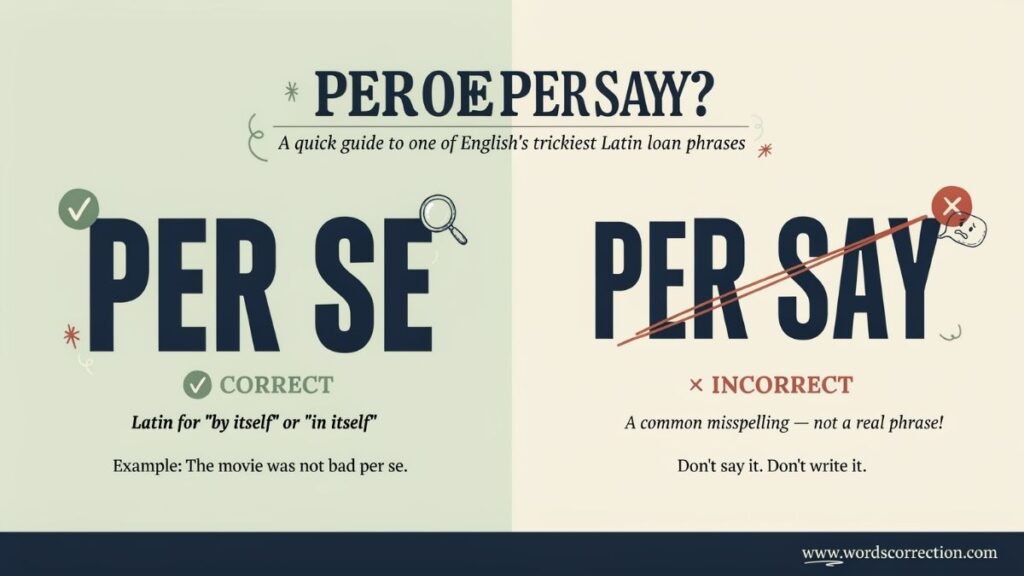
The confusion between per se or per say is common because both phrases sound alike, but only one is correct. The correct spelling is “per se,” a Latin expression meaning “in itself” or “by itself.” In contrast, “per say” is a common spelling mistake that can appear in emails, essays, and professional writing. Although the difference may seem small, using the correct expression helps keep your writing clear and accurate. The good news is that learning the difference is simple. This guide explains the correct spelling, meaning, usage, and common mistakes with clear definitions and easy examples.
Quick Answer Is It Per Se or Per Say?
it is the correct spelling when you mean “in itself,” “by itself,” or “considered on its own.” Per say is a common misspelling of this Latin expression.
Here’s the difference at a glance
| Expression | Correct? | Meaning or Use |
|---|---|---|
| Per se | Yes | In itself; considered on its own |
| Per say | No, not for this meaning | Common misspelling of per se |
| Perse | No, not as the standard phrase | Incorrectly combines the two words |
| As per | Yes, in a different construction | According to; in accordance with |
| As per say | No, when intended to mean per se | Confuses two different expressions |
Quick rule: When you want to say “in itself,” write per se as two separate words.
For example
- Correct: “The plan isn’t expensive per se, but the additional fees make it costly.”
- Incorrect: “The plan isn’t expensive per say, but the additional fees make it costly.”
The distinction may seem small, but using the correct spelling makes your writing clearer and more professional.
Learn the difference between tricky words and use them correctly
Cannot or Can Not which one is Correct Spelling?
What Does Per Se Mean?
The meaning is “in itself,” “by itself,” or “considered independently.” The expression helps you discuss something on its own merits rather than judging it solely by its circumstances, consequences, or associations.
In plain English, it often means that something isn’t necessarily good, bad, useful, harmful, or important simply because of what it is. The surrounding circumstances may change how you evaluate it.
Consider this example
“Money isn’t the problem per se; the problem is how it’s managed.”
Here, the writer isn’t criticizing money itself. The concern lies in how someone handles it.
Now consider another example
“The restaurant isn’t expensive per se, but the small portions make it feel overpriced.”
The restaurant’s prices might be reasonable on their own. However, the portion sizes influence the customer’s overall judgment.
In both sentences, it separates an individual characteristic from the broader situation.
What Is the Per Se Definition in Simple English?
A practical definition is
Per se: An expression meaning “in itself” or “considered on its own,” without taking other factors into account.
The phrase serves several related purposes
- To distinguish something from its consequences: “Technology isn’t harmful per se; its effects depend on how people use it.”
- To describe an inherent quality: “The design isn’t unattractive per se, although it doesn’t suit the room.”
- To separate a general idea from a particular situation: “Competition isn’t bad per se, but unfair competition creates problems.”
The precise interpretation depends on the context. In many sentences, you can replace with “in itself” without changing the main point.
However, the expression doesn’t always fit wherever you might use “essentially,” “fundamentally,” or “as such.” These phrases overlap in meaning but serve different purposes.
Learn the difference between more words people mix up
In Person vs In-Person When to Use the Hyphen
Per Se or Per Say Meaning Why Is Per Se Correct?
The difference between per se and per say comes down to the phrase’s origin and established spelling in English.
it is a Latin expression that English has adopted in its original form. The word say is an English verb, but it doesn’t belong in this expression. Although the two forms sound alike, pronunciation doesn’t determine the correct spelling of every phrase.
What Is the Origin of Per Se?
The phrase per se comes from Latin. Its two elements are commonly understood as follows:
- Per: A preposition that can mean “through,” “by,” or “by means of,” depending on context.
- Se: A reflexive pronoun meaning “itself” or “himself or herself,” depending on grammatical context.
Together, it conveys the idea of something being considered in itself or on its own.
The phrase has a long history in Latin and has become an established expression in English. Writers use it when they want to isolate one thing from other influences or distinguish an inherent quality from a broader judgment.
For example
“The rule isn’t unfair it, but the way it’s enforced creates difficulties.”
The sentence distinguishes the rule itself from the effects of its enforcement.
One important detail: the modern English meaning isn’t always a word-for-word translation of the original Latin elements. In contemporary English, the expression functions as a set phrase with a familiar meaning: “in itself” or “considered on its own.”
Why Do People Spell Per Se as Per Say?
The confusion arises mainly from pronunciation. In American English, per se is commonly pronounced approximately “pur SAY.” Because the final sound resembles the English word say, writers sometimes substitute the more familiar spelling.
This is an example of a phonetic spelling error. Someone writes an expression according to how it sounds rather than how it’s conventionally spelled.
Similar mistakes occur with other commonly confused words and expressions. People may recognize a phrase when they hear it but struggle to reproduce its spelling in an email, essay, or social media post.
Three factors contribute to this mistake:
- Pronunciation: The final sound of per se resembles the English word say.
- Familiarity: Many people encounter the expression in speech before seeing it in print.
- Word association: The familiar word say seems more intuitive than the Latin word se.
The solution is straightforward learn the expression as a complete phrase rather than trying to spell it from sound alone.
Learn the difference between everyday English mistakes
Color or Colour Which Spelling Is Correct?
How Do You Pronounce Per Se?
The standard American English pronunciation of per se is approximately “pur SAY.” The second word receives the main stress.
The pronunciation explains why per say looks plausible to someone who has only heard the expression. However, the sound doesn’t change its spelling.
Here’s a simple guide
| Feature | Explanation |
|---|---|
| Written form | Per se |
| Approximate pronunciation | Pur SAY |
| Main stress | Second word |
| Language of origin | Latin |
| Common spelling error | Per say |
When speaking, you don’t need to emphasize the phrase dramatically. It usually fits smoothly into the sentence.
For example
“I’m not opposed to the idea per se, but I have concerns about the timing.”
The expression should sound like a natural part of the sentence rather than a separate, heavily stressed phrase.
Remember: Pronunciation and spelling serve different purposes. The fact that se sounds like say doesn’t make the latter the correct written form.
Learn the difference between commonly misused words
Flier or Flyer Which Spelling Is Correct?
How to Use Per Se in a Sentence
The easiest way to understand per se usage is to examine how the phrase works in context. Writers often use it to qualify a statement, narrow a judgment, or distinguish something’s inherent qualities from the circumstances surrounding it.
In grammatical terms, per se functions as an adverbial expression. It modifies the meaning of a statement by indicating that the writer is considering something in itself or on its own.
You can place it in different parts of a sentence, although it often appears after the noun, adjective, or idea being qualified.
Per Se in a Sentence Everyday Examples
Consider these examples from everyday life.
Example 1: Food
“I’m not against fast food per se, but I don’t want to eat it every day.”
The speaker isn’t rejecting fast food entirely. The concern is how frequently they eat it.
Example 2: Exercise
“Running isn’t difficult per se, but finding time to exercise consistently can be.”
The sentence distinguishes running itself from the practical challenge of maintaining a routine.
Example 3: Shopping
“The jacket isn’t expensive per se, but I can’t justify buying another one.”
The price might be reasonable. The speaker simply doesn’t have a strong enough reason to make the purchase.
Example 4: Social media
“Social media isn’t harmful per se; its effects depend on how people use it.”
The sentence avoids treating social media as inherently harmful in every situation.
Example 5: Education
“Memorization isn’t bad per se, but students also need to understand the material.”
The writer acknowledges that memorization can be useful while explaining why it isn’t sufficient on its own.
These examples share a common structure: the first part qualifies a judgment, while the second part explains the circumstances that influence it.
Learn the difference between similar English words the easy way
Nevermind or Never Mind Which Spelling Is Correct?
Per Se Usage Examples in Professional Communication
The expression also works well in professional settings when you need to make a careful distinction.
Business: “The proposal isn’t impractical per se, but it requires more funding than we currently have.”
The proposal itself may be workable, although the budget creates an obstacle.
Workplace: “Remote work isn’t a problem per se; unclear expectations are.”
The sentence identifies the actual concern instead of automatically blaming remote work.
Customer service: “The delay wasn’t unreasonable per se, but the lack of communication frustrated customers.”
The writer distinguishes the length of the delay from the poor communication surrounding it.
Project management: “The deadline isn’t unrealistic per se, provided the team receives the necessary resources.”
The deadline could be achievable under the right conditions.
In professional communication, it can make a statement more precise. It allows you to acknowledge a distinction without making an overly broad claim.
Still, consider your audience. In a casual email, “in itself” may sound more natural. A formal report or analytical discussion, it may fit comfortably.
in Academic and Formal Writing
Academic writing often requires careful distinctions between a concept, its characteristics, and its effects. The expression can help writers make those distinctions.
For example
- “The intervention is not ineffective per se, although its results vary across groups.”
- “The policy does not create inequality per se; its implementation may produce unequal outcomes.”
- “A larger sample size does not guarantee greater accuracy per se.”
These sentences show how the expression can narrow a claim.
However, it doesn’t replace evidence or reasoning. A sentence can sound sophisticated while remaining vague or unsupported. Use the phrase only when it clarifies the relationship between an idea and its context.
For academic work, follow the relevant style guide and choose simpler wording when it communicates the same point more clearly.
Learn the difference between basic English word mistakes
It’s vs Its What’s the Difference?
Per Se vs Itself What’s the Difference?
The expressions per se and itself overlap in meaning, but they don’t always work in the same way.
Itself is a pronoun. It can refer to a thing, action, or idea. it is an adverbial expression that indicates how you should consider something: on its own or in itself.
Compare these sentences
| Sentence | Meaning |
|---|---|
| “The machine repaired itself.” | The machine performed the repair without outside help. |
| “The machine isn’t dangerous per se.” | The machine isn’t inherently dangerous when considered on its own. |
| “The problem itself is easy to solve.” | The problem, rather than another part of the situation, is easy to solve. |
| “The problem isn’t difficult per se, but it takes time.” | The problem isn’t inherently difficult, although another factor makes it challenging. |
The difference becomes clearer when you consider the expression “in and of itself.” This longer phrase often emphasizes that something has a particular quality independently of outside circumstances.
For example
“A high salary isn’t a guarantee of happiness in and of itself.”
Here, the expression stresses that a high salary alone doesn’t guarantee happiness.
You could also write
“A high salary doesn’t guarantee happiness per se.”
Both sentences communicate a similar idea, although their emphasis and rhythm differ slightly.
Is Per Se the Same as By Itself?
Not always.
By itself can mean that something exists or acts alone, without assistance. it usually means that something should be considered on its own merits or inherent qualities.
Compare
- “The child completed the assignment by herself.” This means she completed it without help.
- “The assignment isn’t difficult per se.” This means the assignment isn’t inherently difficult.
Replacing per se with “by itself” in the second sentence might change the intended meaning. The best substitute depends on what the writer wants to communicate.
Learn the difference between often confused words
Canceled vs Cancelled Which Spelling Is Correct?
it’s Synonyms What Can You Say Instead?
If you’re looking for synonyms, several expressions may work. However, no single alternative fits every sentence.
The right choice depends on whether you’re discussing an inherent quality, something considered independently, or a basic characteristic.
| Synonym or Alternative | Meaning | Example |
|---|---|---|
| In itself | Considered independently | “The idea isn’t unreasonable in itself.” |
| By itself | Alone or without assistance | “The feature isn’t useful by itself.” |
| In and of itself | Emphasizes an independent quality | “The award isn’t a measure of success in and of itself.” |
| On its own | Considered separately | “The evidence isn’t conclusive on its own.” |
| Intrinsically | By the inherent nature of something | “The activity isn’t intrinsically harmful.” |
| Inherently | As a natural or essential quality | “The process isn’t inherently complicated.” |
| Fundamentally | At the basic level | “The two proposals are fundamentally different.” |
| Essentially | In its basic nature or main meaning | “The two methods are essentially similar.” |
| In essence | In the most important sense | “In essence, the policy aims to reduce waste.” |
| As such | In the stated role or capacity, depending on context | “The document is a draft and should be treated as such.” |
How to Choose the Right Synonym
Consider what you want the sentence to emphasize.
“in itself” when you want to stay close to the usual meaning of per se.
- Original: “The change isn’t harmful it.”
- Alternative: “The change isn’t harmful in itself.”
“inherently” when you want to emphasize a natural or essential characteristic.
- Original: “The technology isn’t dangerous per se.”
- Alternative: “The technology isn’t inherently dangerous.”
Use “on its own” when you’re emphasizing whether something is sufficient without additional factors.
- Original: “The evidence doesn’t prove the claim per se.”
- Alternative: “The evidence doesn’t prove the claim on its own.”
Be careful with “essentially” and “fundamentally.” These words often describe a basic nature or central difference rather than the act of considering something independently.
For example, “The two plans are essentially identical” means they’re very similar in their main features. It doesn’t mean exactly the same thing.
The practical rule is simple: choose a synonym that preserves the sentence’s intended meaning rather than replacing per se automatically.
Learn the difference between confusing word pairs
Happy New Year or Happy New Years Which Is Correct?
Common Per Se Grammar Mistakes to Avoid
The main spelling error is writing per say. However, a few related mistakes can also affect clarity.
Writing Per Say Instead of Per Se
This is the most common mistake associated with the expression.
Incorrect: “The policy isn’t unfair per say.”
Correct: “The policy isn’t unfair per se.”
The error occurs because the writer follows the pronunciation instead of the established spelling.
When proofreading, pay special attention to expressions you’ve learned primarily through conversation. Familiar sounds don’t always reveal the correct written form.
Writing Perse as One Word
The standard expression contains two separate words
Incorrect: “The proposal isn’t unreasonable perse.”
Correct: “The proposal isn’t unreasonable per se.”
Combining the words removes the conventional spelling of the Latin expression. In standard English writing, keep the space.
Confusing Per Se With As Per
Although these expressions share the word per, they have different meanings.
it means “in itself” or “considered on its own.”
As per generally means “according to” or “in accordance with.”
Consider these examples
- “The contract isn’t complicated per se.” The writer is discussing the contract’s inherent complexity.
- “As per the contract, payment must be made within 30 days.” The writer is referring to a requirement in the contract.
The phrase as per say is incorrect when someone intends to use per se. However, don’t confuse that error with the valid expression as per, which can stand on its own with an appropriate object.
When a Simpler Phrase Would Be Clearer
Another common issue involves style rather than spelling.
Consider
“The instructions aren’t difficult per se.”
This sentence is grammatically sound. However, depending on the audience, the following version may sound more natural:
“The instructions aren’t difficult in themselves.”
Both communicate a similar idea.
In informal conversation, simple expressions often feel more direct. In academic writing, it can be useful when it makes a distinction more precise.
The goal isn’t to avoid the phrase. It’s to use it when it adds clarity rather than merely making a sentence sound formal.
Learn the difference between tricky grammar more words
Grey or Gray Which Spelling Is Correct?
Should Per Se Be Italicized or Capitalized?
Because it originated in Latin, writers sometimes wonder whether they should italicize it or capitalize either word. The answer depends on where the phrase appears and which style guide you’re following.
Should Per Se Be Italicized?
In ordinary modern English writing, you generally don’t need to italicize it. The phrase has become established in English, and many publications treat familiar Latin expressions as part of standard English vocabulary.
For example, this sentence is appropriate in ordinary prose
“The proposal isn’t unreasonable per se, but it needs further review.”
You may encounter publications that italicize Latin expressions or follow specific academic conventions. If you’re writing a research paper, legal document, or journal article, check the applicable style guide.
The important distinction is between a familiar expression used naturally in English and a Latin phrase that a writer introduces or discusses as a foreign-language expression.
Should Per Se Be Capitalized?
Normally, write per se in lowercase within a sentence.
- Correct at the beginning of a sentence: “ the proposal presents no major difficulty.”
- Correct in a title when the chosen capitalization style calls for it: “Per Se or Per Say: Which Spelling Is Correct?”
Although the expression comes from Latin, its origin doesn’t require capitalization in ordinary English sentences.
Learn the difference between commonly mixed-up more words
To That Effect or To That Affect Which Is Correct?
How to Remember the Correct Spelling of Per Se or Per Say
If you frequently confuse the two forms, a simple memory trick can help.
Remember that per se is the complete Latin expression. Don’t replace the final word with the familiar English verb say just because the two sound alike.
Here are three practical ways to remember the correct spelling:
- Learn the meaning with the spelling: Associate per se directly with “in itself.”
- Remember the two-word form: The standard expression contains per and se, separated by a space..
You can also remember this distinction
- Per se: A phrase meaning “in itself.”
- Per say: A common misspelling when someone intends per se.
For example, if you want to write “The book isn’t difficult per se,” ask yourself whether you mean that the book is inherently difficult. If that’s your intended meaning, per se is the correct choice.
practice Session
Fill in the Blanks
Choose the correct word to complete each sentence.
- The food isn’t bad ______.
- Is it per ______ or per se?
- The job isn’t difficult ______.
- Money isn’t everything ______.
- The idea isn’t wrong ______.
- The movie isn’t boring ______.
- The rule isn’t unfair ______.
- Is the correct spelling per say or per ______?
- The problem isn’t serious ______.
- The book isn’t expensive ______.
- The plan isn’t bad ______.
- The work isn’t easy ______.
- The decision isn’t wrong ______.
- The place isn’t noisy ______.
- The test isn’t difficult ______.
- The product isn’t useful ______.
- The change isn’t harmful ______.
- The question isn’t simple ______.
- The service isn’t poor ______.
- The answer isn’t incorrect ______.
- The game isn’t boring ______.
- The idea isn’t unusual ______.
- The task isn’t impossible ______.
- The situation isn’t dangerous ______.
- The result isn’t surprising ______.
Answers
- per se
- say
- per se
- per se
- per se
- per se
- per se
- se
- per se
- per se
- per se
- per se
- per se
- per se
- per se
- per se
- per se
- per se
- per se
- per se
- per se
- per se
- per se
- per se
- per se
Here’s a trusted source for clear word meanings:
Cambridge Dictionary
FAQ’s
Why do people spell per se incorrectly?
People often misspell “per se” as “per say” because the phrase sounds like the familiar English word “say.” Since the expression comes from Latin, its spelling may be less intuitive to people who have not encountered it in writing.
How do you use per se correctly?
Use “per se” to describe something in its own right, independently of other factors. For example, “The proposal isn’t unreasonable per se, but it needs more supporting evidence.”
What did per se mean originally?
“Per se” comes from Latin and means “by itself” or “in itself.” English adopted the expression with essentially the same meaning, and it is now used to describe a quality or characteristic considered independently.
Why do we use per se in English?
Writers use “per se” to make distinctions more precise. It helps clarify whether a quality belongs to something inherently or depends on the surrounding circumstances.
Is it per say or per se?
The correct spelling is “per se.” “Per say” is a common misspelling caused by the phrase’s pronunciation. In standard English, the two words should be written as “per se.”
What does per se mean in simple terms?
“Per se” means “in itself” or “by itself.” It describes something based on its own characteristics rather than outside circumstances. For example, “A high price doesn’t make a product better per se.”
Can you give an example sentence using per se?
Certainly. “The assignment wasn’t difficult per se, but it required considerable time and attention.” Here, “per se” indicates that the assignment was not inherently difficult, even though it demanded effort.
What is another word for per se?
Common alternatives include “in itself,” “by itself,” “on its own,” “intrinsically,” and “essentially.” The best substitute depends on the sentence. For example, “The idea isn’t bad per se” can be rewritten as “The idea isn’t bad in itself.”
How is per se pronounced?
“Per se” is commonly pronounced as two syllables, with the emphasis on the second syllable. Its pronunciation explains why people sometimes write “per say,” but the correct spelling remains “per se.”
Is per se considered formal English?
Yes. “Per se” is accepted in formal and informal English, although it appears frequently in academic writing, professional discussions, legal contexts, and analytical arguments. Use it when it improves precision rather than simply making a sentence sound more formal.
Should per se be italicized in a sentence?
No. In modern English writing, “per se” generally does not need italics because it is an established expression. Follow a publication’s style guide if it specifies a different convention.
Is per se one word or two words?
“Per se” is written as two separate words. Both words are necessary to form the expression, and combining them into “perse” is incorrect when you intend to use the Latin phrase.
Can per se appear at the beginning of a sentence?
Yes, although this construction is less common. For example, “Per se, the rule is not unreasonable; its application creates the difficulty.” In most cases, placing the phrase later in the sentence sounds more natural.
What is the difference between per se and by itself?
Both expressions can refer to something considered independently, but their usage differs slightly. “By itself” often emphasizes physical or practical independence, while “per se” typically emphasizes an inherent quality or characteristic.
Can per se be used in academic writing?
Yes. “Per se” can clarify distinctions in research papers, essays, and analytical reports. For example, “The study does not establish that screen time per se causes poor academic performance.” Use the phrase only when its meaning fits the argument.
Is per se appropriate in professional emails?
Yes. You can use “per se” in workplace emails when discussing policies, performance, proposals, or business decisions. However, “in itself” or “by itself” may sound clearer when communicating with readers who are unfamiliar with the expression.
Does per se always mean not necessarily?
No. “Per se” does not directly mean “not necessarily.” It means “in itself” or “by itself.” In negative statements, it can suggest that something is not inherently a particular way, which explains why the meanings sometimes seem similar.
What is the difference between per se and essentially?
“Per se” focuses on something considered in isolation or according to its inherent qualities. “Essentially” usually introduces the fundamental nature or main point of something. Although they can overlap, they are not interchangeable in every sentence.
Can per se be used in legal writing?
Yes. Legal professionals use “per se” to describe rules, conditions, or actions that have a particular status in themselves, without requiring the same level of contextual analysis. Its precise meaning depends on the legal doctrine and jurisdiction involved.
Is per se the same as intrinsically?
Not exactly. Both expressions can describe an inherent quality, but “intrinsically” more directly means belonging to the essential nature of something. “Per se” can also emphasize that a statement applies to something considered independently of other factors.
How can you remember the correct spelling of per se?
Remember that “per se” is a Latin expression, not a combination of ordinary English words. Associate it with the meaning “in itself,” and avoid replacing “se” with “say” simply because the phrase sounds similar when spoken.
Can per se be used in everyday conversation?
Yes. People use “per se” in everyday conversations to express nuanced opinions or clarify what they mean. For example, “I don’t dislike the restaurant per se; I just think the prices are too high.” In casual settings, simpler alternatives may sound more natural.
What punctuation should you use with per se?
“Per se” does not require special punctuation. Use commas only when the sentence’s structure calls for them. For example, “The plan, per se, is reasonable” uses commas to set off the phrase, while “The plan is reasonable per se” does not need them.
Is per se interchangeable with in and of itself?
Often, but not always. Both expressions emphasize something considered independently. “In and of itself” can provide stronger emphasis, while “per se” is more concise. Choose the version that sounds clearest in the surrounding sentence.
What is the easiest way to check whether per se is correct?
Check whether you mean “in itself” or “by itself.” If that meaning fits your sentence, “per se” is likely appropriate. Always use the spelling “per se,” never “per say,” when referring to this established expression.
Learn the difference between confusing more English words
Whose or Who’s What’s the Difference?
Conclusion
Understanding the difference between per se and per say is simple once you know the correct spelling. Per se is the correct expression and means “in itself” or “by itself,” while “per say” is a common spelling mistake. Although both sound similar, using the right form helps keep your writing clear, accurate, and professional. Remember, the next time you use this phrase in an email, essay, or conversation, choose per se. With a little practice, you can avoid this common grammar mistake and use the expression confidently whenever it fits your sentence.

Stella AJS is an experienced blogger and dedicated English language writer at Words Correction. She turns confusing grammar, word meanings, spelling, and usage into clear, practical insights that readers can easily understand and apply. With a passion for precise and engaging writing, Stella helps readers avoid common language mistakes, strengthen their vocabulary, and communicate with greater clarity and confidence.




