
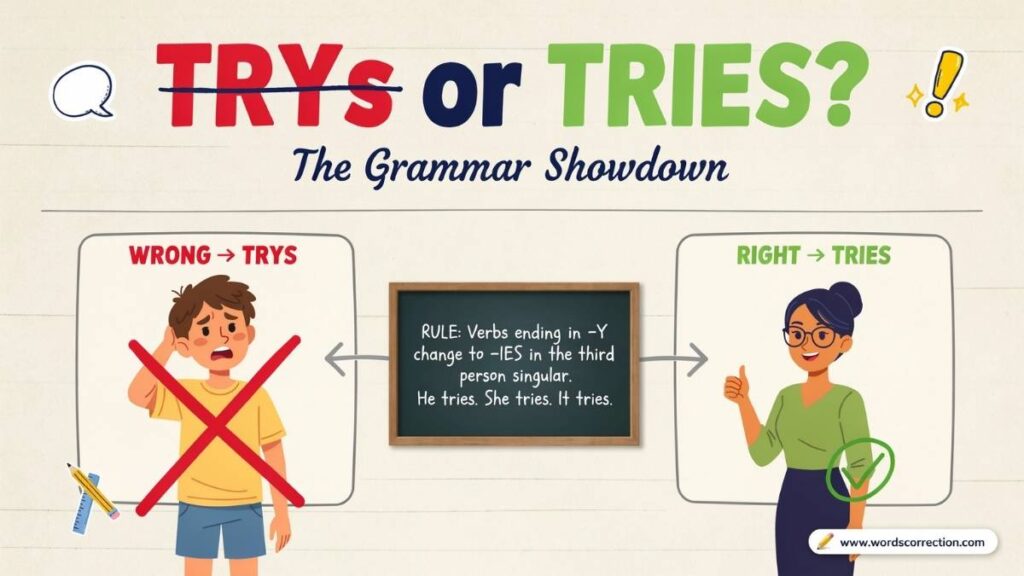
English spelling can turn even familiar words into confusing grammar puzzles. The difference between “trys” or “tries” is a common example. Adding an s might seem logical, but English follows specific spelling rules that can catch writers off guard. Although this mistake may seem minor, using the correct form makes your writing clearer and more professional. Fortunately, understanding the difference is straightforward once you learn the rule. In this guide, you’ll discover the correct spelling, understand the grammar behind it, explore practical examples, and learn how to avoid common mistakes with confidence.
Trys or Tries The Quick Answer
Tries is the correct spelling. Use it when forming the third person singular present tense form of the verb try or the plural form of the noun try.
The spelling trys is generally incorrect when you mean either of these standard English forms.
| Word or phrase | Correct? | Explanation |
|---|---|---|
| She tries her best. | Yes | Tries is the present-tense verb form used with she. |
| He tries again. | Yes | Tries agrees with the singular subject he. |
| He made three tries. | Yes | Tries is the plural noun referring to attempts. |
| She trys her best. | No | The standard spelling changes y to i and adds -es. |
| They try their best. | Yes | Use the base form try with they. |
| He tried yesterday. | Yes | Tried is the simple past-tense form. |
The rule to remember: When a verb ends in a consonant followed by y, change y to i and add -es to form the third-person singular present tense.
For example
- Try becomes tries.
- Cry becomes cries.
- Study becomes studies.
- Carry becomes carries.
Therefore, if you’re asking, “Is it tries or trys?” choose tries in standard English.
Learn the difference between confusing more English words
Color or Colour Which Spelling Is Correct?
Why Is Tries the Correct Spelling?
English spelling follows patterns that help distinguish grammatical forms. The word tries follows one of the most common spelling rules for verbs ending in y.
The base verb is try. When you use it with a third-person singular subject in the simple present tense, you change the ending from y to i and add -es.
Consider these examples
- I try to finish my work on time.
- You try to understand the instructions.
- She tries to finish her work on time.
- The student tries to understand the lesson.
Notice how the verb changes in the third sentence. Because she is a third-person singular subject, the verb takes the form tries.
The same pattern applies to singular nouns used as subjects
- The teacher tries to explain the concept.
- My brother tries a different approach.
- The company tries to improve customer service.
In each sentence, tries follows the subject-verb agreement rule.
The Spelling Rule Behind Tries
The consonant-plus-y spelling rule applies when a word ends in a consonant immediately before the final y. When you add -es to form the third-person singular present tense, you change y to i.
Here are some common examples
| Base verb | Third-person singular | Example |
|---|---|---|
| Try | Tries | She tries again. |
| Cry | Cries | The baby cries at night. |
| Study | Studies | He studies every evening. |
| Carry | Carries | She carries a notebook. |
| Worry | Worries | He worries about the exam. |
| Reply | Replies | The manager replies promptly. |
This rule explains why trys is not the standard spelling. Simply adding s without changing y doesn’t produce the correct form.
However, English has another pattern worth understanding. When a verb ends in a vowel followed by y, you usually keep the y and add -s.
For example
- Play becomes plays.
- Enjoy becomes enjoys.
- Stay becomes stays.
- Buy becomes buys.
The difference lies in the letter immediately before the final y. In try, the letter r is a consonant. In play, the letter a is a vowel.
Learn the difference between commonly mixed-up more words
Flier or Flyer Which Spelling Is Correct?
What Does Tries Mean?
The meaning of tries depends on how you use it in a sentence. It can function as a verb or as a plural noun.
Understanding this distinction helps you choose the right word form and avoid mistakes in everyday writing.
Tries as a Verb
As a verb, tries is the third-person singular present-tense form of try. It describes an action involving effort, an attempt, an experiment, or a test.
Depending on the context, it can mean
- Makes an effort: She tries to learn something new every day.
- Attempts an action: He tries to open the locked door.
- Tests something: The chef tries the sauce before serving it.
- Seeks to achieve a goal: The team tries to win every match.
- Experiments with an option: She tries a different method to solve the problem.
The verb doesn’t guarantee success. Someone who tries to solve a problem may succeed or fail. The word describes the attempt, not necessarily the outcome.
For example, consider this sentence
“Daniel tries to repair his bicycle.”
Daniel makes an effort to fix the bicycle, but the sentence doesn’t tell you whether he succeeds. To describe a completed attempt in the past, you could write, “Daniel tried to repair his bicycle.”
This distinction matters because tries and tried communicate different time frames.
Tries as a Plural Noun
The word tries can also function as the plural of the noun try. In this context, it refers to more than one attempt.
Consider these examples
- She made three tries before solving the puzzle.
- His first two tries failed, but the third succeeded.
- After several tries, the child learned to ride a bicycle.
- The athlete needed five tries to complete the difficult exercise.
In each example, tries represents separate attempts rather than an action performed by a subject.
The singular noun is try, while the plural noun is tries.
| Singular noun | Plural noun | Example |
|---|---|---|
| One try | Two tries | I gave it one try before asking for help. |
| A try | Several tries | It took several tries to get the answer right. |
| Another try | Three tries | She needed three tries to solve the puzzle. |
Therefore, if you’re wondering about the plural of try, the correct answer is tries.
Learn the difference between more words people mix up
Cannot or Can Not which one is Correct Spelling?
What Does Trys Mean?
When people search for trys meaning, they’re usually trying to understand whether the spelling has a valid definition.
In ordinary English grammar, trys is not the standard spelling of the verb form tries or the plural noun tries. If someone writes “He trys to help,” they generally mean “He tries to help.”
The word might appear in a username, a brand name, a fictional name, or another specialized context. Proper names can use unconventional spellings. That doesn’t make trys an accepted substitute for tries in standard prose.
For school assignments, professional documents, articles, emails, and everyday writing, use tries when that is the intended word.
Learn the difference between tricky grammar more words
It’s vs Its What’s the Difference?
Trys vs Tries How to Use Each Word Correctly
The comparison between trys and tries is straightforward once you identify the grammatical form you’re trying to express.
Tries is the standard spelling for both the third-person singular present-tense verb and the plural noun. Trys is generally a misspelling in these contexts.
Look at the following examples to see how the correct form works in different situations.
Examples of Tries in a Sentence
Here are examples of the verb tries across everyday contexts.
School and learning
- The student tries to understand the difficult equation.
- Maria tries to complete her homework before dinner.
- He tries a new study method before the final exam.
Work and business
- The manager tries to resolve customer complaints quickly.
- The company tries to reduce unnecessary expenses.
- She tries to meet every deadline without sacrificing quality.
Sports and physical activities
- The player tries to score during the final minutes.
- He tries a more effective training routine.
- The runner tries to improve her personal record.
Daily life
- My brother tries to cook a new recipe every weekend.
- She tries to call her parents regularly.
- The child tries to tie his shoes without assistance.
Each sentence uses tries with a third-person singular subject, such as the student, Maria, the manager, or the child.
Examples of the Noun “Tries”
The noun form appears when a sentence counts attempts or describes how many efforts someone makes.
- It took three tries to unlock the door.
- His first two tries didn’t produce the desired result.
- After several tries, she finally learned the dance routine.
- The machine started working after two tries.
- I gave the difficult question a few tries before checking the answer.
These examples demonstrate why the plural form matters. Writing “three trys” would be incorrect in standard English. The correct phrase is three tries.
Learn the difference between tricky English words with easy explanations
Nevermind or Never Mind Which Spelling Is Correct?
Incorrect Trys in a Sentence Corrections
The easiest way to recognize a spelling mistake is to compare the incorrect sentence with its corrected version.
| Incorrect sentence | Correct sentence | Reason |
|---|---|---|
| He trys to help everyone. | He tries to help everyone. | Change y to i and add -es. |
| She trys a new recipe. | She tries a new recipe. | The verb follows the consonant-plus-y rule. |
| The student trys to answer. | The student tries to answer. | A singular subject takes tries. |
| He made three trys. | He made three tries. | The plural noun is tries. |
| My sister trys again. | My sister tries again. | The third-person singular form is tries. |
When proofreading, look for trys in sentences about attempts or efforts. Unless the word belongs to a proper name or a specific specialized usage, replace it with the appropriate standard form.
Learn the difference between confusing word pairs
Canceled vs Cancelled Which Spelling Is Correct?
Trys or Tries in American and British English
Some English words have different spellings in American and British English. For instance, American English commonly uses color, while British English generally uses colour. Similarly, organize is standard in American English, whereas organise is common in British English, although both -ize and -ise forms occur in British usage.
The spelling of tries doesn’t follow that kind of regional variation.
Both American and British English use tries as the standard spelling. The consonant-plus-y rule applies in both varieties.
| Context | American English | British English |
|---|---|---|
| Third-person singular verb | She tries. | She tries. |
| Plural noun | Three tries | Three tries |
| Simple past tense | She tried. | She tried. |
| Present participle | She is trying. | She is trying. |
The same forms are standard in other major varieties of English, including Australian and Canadian English.
You don’t need to choose between trys and tries based on your location. Choose tries whenever the sentence requires that grammatical form.
A Separate Meaning in Rugby
The word try also has a specific meaning in rugby. A try is a scoring play in which a player grounds the ball in the opposing team’s in-goal area according to the rules of the game.
Its plural is tries, not trys.
For example
“The team scored three tries in the second half.”
Here, tries refers to three scoring plays rather than three general attempts. The spelling remains the same because the noun follows the standard plural spelling rule.
This example shows that the correct form applies across different contexts, even when the word has a specialized meaning.
Learn the difference between often confused words
Happy New Year or Happy New Years Which Is Correct?
Try, Tries, Tried, or Trying Which Form Should You Use?
The words try, tries, tried, and trying all come from the same base verb, but they serve different grammatical purposes.
Choosing the right form depends on the subject, tense, and structure of the sentence.
Try The Base Verb
Use try with I, you, we, and they in the simple present tense. You also use it after modal verbs such as can, should, will, and must, and in the infinitive form to try.
Examples
- I try to exercise every morning.
- They try to solve the problem together.
- You should try a different approach.
- She wants to try the new restaurant.
Notice that the verb remains try after should and in the phrase wants to. The subject doesn’t change the spelling in these constructions.
Tries The Third-Person Singular Present
Use tries with he, she, it, or a singular noun in the simple present tense.
Examples
- He tries to stay organized.
- She tries to arrive early.
- The dog tries to catch the ball.
- The business tries to meet customer expectations.
The third-person singular of try requires the spelling change from y to i followed by -es.
Tried The Simple Past and Past Participle
Use tried when describing an attempt in the past.
Examples
- She tried to fix the computer yesterday.
- He tried several solutions before finding the answer.
- They have tried this approach before.
In the last example, tried acts as the past participle after have. The same form appears with has and had.
Trying The Present Participle and Gerund
Use trying in continuous verb forms and when the verb functions as a gerund.
Examples
- She is trying to learn Spanish.
- They were trying to finish the project.
- Trying something new can help you develop useful skills.
Unlike tries, the form trying keeps the original y and adds -ing.
Learn the difference between confusing more English words step by step
Per Se or Per Say Which Spelling Is Correct?
Comparison Table Verb Forms of Try
| Form | Grammatical use | Example |
|---|---|---|
| Try | Base verb | I try to stay calm. |
| Tries | Third-person singular present | He tries to stay calm. |
| Tried | Simple past | He tried yesterday. |
| Tried | Past participle | He has tried before. |
| Trying | Present participle | He is trying now. |
| Trying | Gerund | Trying takes patience. |
A useful way to check your sentence is to identify the time of the action and the subject. If the subject is he, she, or it and the sentence uses the simple present, tries is usually the correct form.
Learn the difference between basic English word mistakes
Grey or Gray Which Spelling Is Correct?
Common Mistakes When Spelling and Using Tries
Even when you know the spelling rule, several common grammar mistakes can lead to incorrect sentences. Understanding these errors makes it easier to write accurately.
Writing “Trys” Instead of “Tries”
This is the central spelling error. Writers often add -s directly to try because they apply the same pattern used by words such as work to works.
However, try ends in a consonant followed by y. The correct third-person singular form is tries.
Incorrect: He trys to finish the assignment.
Correct: He tries to finish the assignment.
The same rule applies to the plural noun:
Incorrect: She made two trys.
Correct: She made two tries.
Using Tries With Every Subject
The spelling tries isn’t correct with every subject in the simple present tense.
For example:
- I try to improve.
- You try to improve.
- We try to improve.
- They try to improve.
- He tries to improve.
- She tries to improve.
The difference comes from subject-verb agreement. In the simple present, third-person singular subjects generally require an -s or -es ending, with spelling changes when necessary.
Therefore, writing “They tries to improve” is incorrect. The correct sentence is “They try to improve.”
Confusing Tries With Tried
The words tries and tried describe attempts, but they don’t serve the same tense function.
- Present: She tries to solve the puzzle.
- Past: She tried to solve the puzzle yesterday.
- Present perfect: She has tried to solve the puzzle before.
Use tries for a present-tense action involving a third-person singular subject. Use tried for the simple past or as the past participle.
Confusing Tries With Trying
The word trying appears in continuous tenses and as a gerund. It doesn’t replace tries in every sentence.
Compare
- They tries to help every day.
- He is trying to help right now.
The first sentence describes a present-tense action or habit. The second emphasizes an action in progress.
Both are correct, but the context determines which form you need.
Adding “-S” Without Changing Y
Another mistake occurs when writers forget that English uses different spelling patterns for words ending in y.
Compare these forms:
| Base verb | Correct form | Rule |
|---|---|---|
| Try | Tries | Consonant + y: change y to i and add -es. |
| Study | Studies | Consonant + y: change y to i and add -es. |
| Play | Plays | Vowel + y: keep y and add -s. |
| Enjoy | Enjoys | Vowel + y: keep y and add -s. |
Remembering the letter before the final y will help you apply the correct rule.
Learn the difference between commonly misused words
To That Effect or To That Affect Which Is Correct?
A Simple Trick to Remember the Spelling of Tries
You don’t need to memorize a long list of spelling rules to remember tries. Instead, focus on the ending of the base verb.
If a verb ends in a consonant + y, change the y to i and add -es when forming the third-person singular present tense.
For example
- Try becomes tries.
- Cry becomes cries.
- Study becomes studies.
- Carry becomes carries.
If the verb ends in a vowel + y, keep the y and add -s
- Play becomes plays.
- Stay becomes stays.
- Enjoy becomes enjoys.
A second trick is to say the sentence aloud and check the subject.
“He tries” is grammatically correct because tries agrees with he. “They try” uses the base form because they is not a third-person singular subject.
When the word acts as a noun, remember that the same spelling change produces the plural: one try, two tries.
Practice Exercise
Fill in the blanks
Complete each sentence with the correct form of try, tries, or tried. Write your answers in the blanks. The answer key is provided separately in Session 2.
- She _____ to learn something new every day.
- I _____ to call you yesterday.
- They _____ their best to finish the project.
- He _____ to arrive at work on time every morning.
- We _____ several times before we succeeded.
- The student _____ to answer every question correctly.
- I always _____ to eat healthy food.
- She _____ a new recipe last weekend.
- The players _____ hard during every practice session.
- My brother _____ to improve his English pronunciation.
- The team _____ several times before scoring.
- Every morning, the dog _____ to catch the ball.
- You should _____ to understand the instructions first.
- She has _____ to contact the manager several times.
- The children _____ to solve the puzzle together.
- They _____ to fix the computer, but it still did not work.
- My teacher _____ to explain difficult topics clearly.
- We will _____ again tomorrow.
- The athlete _____ to break the record last year.
- Each player _____ to follow the coach’s instructions.
- I have _____ this method before.
- The company _____ to provide better customer service.
- Please _____ to keep your answers short and clear.
- They _____ to win the match, but the other team played better.
- The rugby team _____ to score another try in the final minutes.
Answers
- tries
- tried
- try
- tries
- tried
- tries
- try
- tried
- try
- tries
- tried
- tries
- try
- tried
- try
- tried
- tries
- try
- tried
- tries
- tried
- tries
- try
- tried
- tries
Here’s a trusted source for clear word meanings:
Cambridge Dictionary
FAQ’s
What is the plural of try?
The plural of try is tries. When a noun ends in a consonant followed by y, change the y to i and add es. For example, “The team made several tries to improve its performance.”
Is it trys or tries in rugby?
Tries is the correct spelling in rugby. A try is a scoring play in which a player grounds the ball in the opponent’s in-goal area. For example, “The team scored three tries during the match.”
What does tries mean?
“Tries” has two primary meanings. As a verb, it describes an attempt to do something, as in “She tries to solve the problem.” As a plural noun, it refers to multiple attempts, as in “He made several tries before succeeding.” In rugby, a try is a scoring play.
How do you pronounce tries?
The word “tries” is pronounced with one syllable and a final /z/ sound. It rhymes with “flies” and “cries.” Its pronunciation remains the same whether it functions as a verb or a noun.
Which is correct tries or tried?
Both tries and tried are correct, but they express different tenses. Use tries for the present tense with a singular subject, such as “She tries to improve every day.” Use tried for the past tense, as in “She tried yesterday.”
What are five example sentences using tries?
Here are five examples of “tries” used correctly:
- She tries to complete her homework before dinner.
- He tries a different approach to solve the problem.
- The athlete tries to improve his performance.
- My sister tries to learn a new skill every month.
- The rugby team scores several tries each season.
What is another word for try?
Common synonyms for “try” include attempt, effort, endeavor, test, and experiment. The best alternative depends on the context. For example, “I will try to solve the problem” can become “I will attempt to solve the problem.”
Why is tries spelled with ies instead of ys?
“Tries” follows the English spelling rule for words ending in a consonant followed by y. Change the y to i and add es to form the plural noun or third-person singular verb. Therefore, try becomes tries, not trys.
Is trys ever a correct spelling?
In standard English, “trys” is generally incorrect when you mean the plural of try or the verb form used with he, she, or it. The correct spelling is tries. However, “Trys” may appear as a name, username, or brand-specific term.
When should I use tries in a sentence?
Use “tries” when describing an action performed by a singular third-person subject in the present tense. For example, “they tries to arrive early every morning.” You can also use tries as the plural of the noun try, as in “She made three tries.”
What is the difference between try, tries, and tried?
Try is the base form, tries is the present-tense form used with singular third-person subjects and the plural noun, and tried is the past-tense and past-participle form. For example: “I try,” “She tries,” and “They tried.”
What is the past tense of try?
The past tense of try is tried. To form it, replace the final y with i and add ed. For example, “I try to exercise every day” becomes “I tried to exercise yesterday.”
Is tries singular or plural?
“Tries” can be either a singular verb form or a plural noun. In “She tries again,” it is a verb agreeing with a singular subject. In “He made two tries,” it is a plural noun referring to two attempts.
How do you make a sentence with tries?
To use “tries” as a verb, place it after a singular third-person subject and describe the action. For example, “The student tries to answer every question.” As a noun, use it to describe multiple attempts: “Her first two tries were unsuccessful.”
What is the plural form of the noun try?
The plural form of the noun try is tries. This follows the spelling rule for nouns ending in a consonant and y. For example, “His first three tries failed, but his fourth attempt succeeded.”
What does tries mean in rugby?
In rugby, tries refers to multiple scoring plays. A team earns a try by grounding the ball in the opponent’s in-goal area according to the rules of the game. For example, “The visiting team scored four tries in the second half.”
Is tries used in American and British English?
Yes. “Tries” is the standard spelling in both American and British English. The spelling rule does not change between these varieties of English. In both, try becomes tries when used as a plural noun or a third-person singular present-tense verb.
What Is the Present Tense of Try?
In the simple present tense, use “tries” with he, she, or it, and “try” with I, you, we, or they. For example, “She tries to help her classmates,” while “They try to finish their work on time.” This spelling follows the consonant-plus-y rule: change the y to i and add -es for the third-person singular form.
What are common mistakes when using tries?
A common mistake is writing trys instead of tries. Another is using tries when the sentence requires the past tense tried. For example, “She tries yesterday” is incorrect; “She tried yesterday” is correct.
How do you use tries in the third-person singular?
Use “tries” when the subject is he, she, or it, or a singular noun, and the sentence describes a present-tense action. For example, “The manager tries to support the team.” The ending changes because English verbs usually take -s or -es with third-person singular subjects.
What is the difference between tries and attempts?
“Tries” and “attempts” can have similar meanings, but their usage depends on the sentence. As a verb, “She tries to fix the computer” can be rewritten as “She attempts to fix the computer.” As a noun, both words can refer to efforts made to achieve a goal.
Can tries be used as a noun?
Yes. “Tries” is the plural form of the noun try and refers to attempts to do something. For example, “After several tries, he finally opened the locked door.” In this sentence, tries describes repeated efforts rather than an action performed by the subject.
How do you spell try in the third-person present tense?
Spell it tries when the subject is he, she, or it. For example, “She tries to read for thirty minutes every night.” Because try ends in a consonant followed by y, change the y to i and add es.
What are some alternatives to try in formal writing?
In formal writing, suitable alternatives include attempt, undertake, endeavor, and seek to. Choose a word that preserves the intended meaning. For example, “The researchers tried to identify the cause” can become “The researchers attempted to identify the cause.”
How can I remember whether to write trys or tries?
Remember this simple rule: when a word ends in a consonant followed by y, change the y to i and add es for the relevant plural noun or third-person singular verb form. Therefore, write tries, not trys. The same pattern appears in words such as fly → flies and cry → cries.
Learn the difference between everyday English mistakes
Whose or Who’s What’s the Difference?
Conclusion
English spelling can be confusing, and the difference between “tries” and “trys” is a good example. Although adding an s might seem logical, this word follows a specific spelling rule. When a word ends in a consonant followed by y, change the y to i and add -es. That’s why try becomes tries, cry becomes cries, and study becomes studies.
The correct form also depends on the subject and tense. We write “She tries” but “They try.” For past actions, we use tried, while trying describes an ongoing action. When referring to multiple attempts, the correct phrase is “three tries,” not “three trys.”
The good news is that you don’t need to memorize every example. Once you understand the rule, you can apply it to many other words and avoid similar mistakes. So, the next time you’re unsure whether to write “tries” or “trys,” check the spelling pattern and choose the correct form with confidence.
After all, learning grammar takes practice, and mistakes are part of the process. You might not get every word right on the first attempt, but with each new lesson, your writing improves. And when it comes to this particular spelling challenge, remember one simple rule: she tries, they try, and everyone can try again.

Stella AJS is an experienced blogger and dedicated English language writer at Words Correction. She turns confusing grammar, word meanings, spelling, and usage into clear, practical insights that readers can easily understand and apply. With a passion for precise and engaging writing, Stella helps readers avoid common language mistakes, strengthen their vocabulary, and communicate with greater clarity and confidence.




