
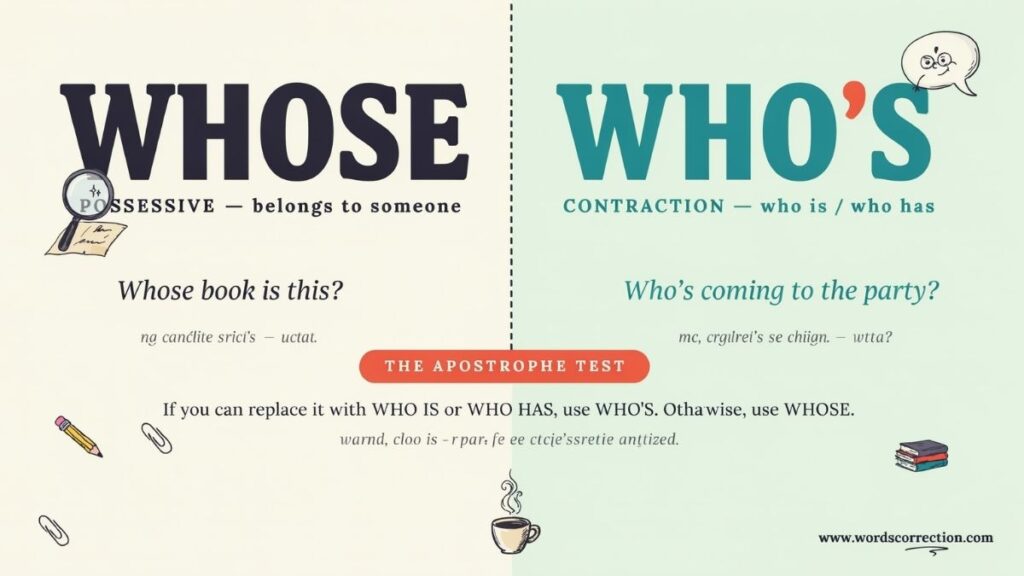
The words “whose” and “who’s” sound the same, but they have different meanings. Using the wrong one can turn a simple sentence into a confusing grammar mistake. For example, “Who’s birthday is it?” may look correct, but the proper phrase is “Whose birthday is it?” The good news is that learning the difference is easier than it seems. In this guide to whose vs who’s, you’ll learn how to use each word correctly, avoid common mistakes, and understand the rules with simple examples. You’ll also get 25 fill-in-the-blank exercises to test your knowledge and build confidence.
Whose vs Who’s The Main Difference
The main difference between whose and this is possession versus contraction. Whose identifies the person or thing associated with something, while it combines who with either is or has.
| Word | Meaning | Grammatical function | Example |
|---|---|---|---|
| Whose | Belonging to which person or thing | Possessive form of who | Whose keys are these? |
| Who’s | Who is | Contraction | Who’s waiting outside? |
| Who’s | Who has | Contraction | Who’s finished the assignment? |
Notice that whose doesn’t contain an apostrophe, even though it expresses possession.however, includes an apostrophe because it combines two words.
This distinction reflects an important English grammar rule: apostrophes in contractions indicate omitted letters, but possessive words don’t always require apostrophes.
For example, it’s means it is or it has, while its indicates possession. Similarly, whose expresses possession or association, whereas it represents who is or who has.
Understanding this difference makes it easier to recognize the correct spelling and avoid confusing these commonly misused words.
The Quick Rule for Whose or Who’s
If you’re unsure which word to use, follow these two rules:
- Use whose when asking about ownership, belonging, or association.
- Use this when you can replace it with who is or who has without changing the intended meaning.
Consider these examples
- Whose notebook is on my desk? The question asks who owns the notebook.
- It already submitted the form? The sentence means who has already submitted the form.
The substitution test is one of the easiest ways to check your writing. Replace who’s with who is or who has. If the expanded sentence makes sense, the contraction is correct.
However, context still matters. “Who’s responsible?” is correct because it means “Who is responsible?” By contrast, “Whose responsibility is it?” asks which person has that responsibility.
Learn the difference between confusing more English words
Loosing or Losing Which Spelling Is Correct?
What Does Whose Mean?
Whose is the possessive form of who. It identifies the person, animal, organization, or thing that owns something or has a particular relationship with it.
The word commonly appears in questions and relative clauses. Its exact function depends on the sentence, but it generally expresses ownership, belonging, or association.
Consider these examples
- Whose shoes are by the door?
- Do you know whose phone is ringing?
- The author whose book won the award thanked her readers.
- The company whose products we use recently changed its packaging.
In each example, whose connects something to the person or entity associated with it.
Using Whose to Ask About Ownership
One of the most common uses of whose is to ask who owns something. These questions appear in everyday conversations, classrooms, workplaces, and professional correspondence.
Examples include
- Whose wallet did you find?
- Whose car is blocking the driveway?
- Whose turn is it to cook dinner?
- Do you know whose glasses these are?
- Whose signature appears at the bottom of the document?
In these sentences, whose identifies the person connected to an object, responsibility, or record.
Ownership doesn’t always refer to legal ownership. The word can also describe temporary possession or an expected relationship. For instance, “Whose seat is this?” may ask who is supposed to sit in a particular place rather than who legally owns the chair.
A useful rule: If you’re asking which person is associated with something, whose is often the correct choice.
Using Whose in Questions and Statements
Whose can appear at the beginning of a question, but it can also appear within a statement or an indirect question.
Examples include
- Whose appointment is scheduled for noon?
- I wonder whose appointment is scheduled for noon.
- Can you tell me whose coat is hanging in the hallway?
- Nobody knows whose car was damaged.
The first sentence asks a direct question. The remaining examples use whose within a larger sentence.
This distinction matters because punctuation doesn’t determine whether you should use whose or who’s. The word’s grammatical role does.
For example, both “Whose bag is this?” and “I know whose bag this is” are correct, even though only the first sentence ends with a question mark.
Using Whose as a Relative Pronoun
Whose also functions as a relative pronoun. In this role, it connects a person or thing to additional information about something associated with them.
Consider this sentence
“The student whose essay impressed the teacher received an award.”
Here, whose connects the student with the essay. It introduces a relative clause that identifies the student more precisely.
Additional examples include
- The woman whose dog won the competition lives next door.
- I spoke with a manager whose team exceeded its sales target.
- We visited a museum whose collection includes ancient artifacts.
- She bought a laptop whose battery lasts all day.
Although many people associate whose exclusively with people, standard English also allows it to refer to animals, objects, and organizations.
For example, “The building whose roof collapsed is being repaired” is grammatically acceptable.
Writers sometimes use the phrase of which for things in formal writing, but whose often produces a more natural and concise sentence.
Learn the difference between commonly mixed-up more words
Each Other or Eachother Which Spelling Is Correct?
What Does Who’s Mean?
it is a contraction of who is or who has. A contraction combines two words and uses an apostrophe to indicate omitted letters.
Unlike whose, it doesn’t express possession. Instead, it helps form questions, statements, and relative clauses involving a person’s identity, condition, action, or experience.
Examples include
- Who’s calling my phone?
- I know someone who’s studying engineering.
When Who’s Means Who Is
In many sentences, it stands for who is. The contraction often appears before an adjective, a noun phrase, or a verb ending in -ing.
Examples include:
| Contraction | Full form | Example |
|---|---|---|
| Who’s | Who is | Who’s at the door? |
| Who’s | Who is | Who’s responsible for the report? |
| Who’s | Who is | Who’s coming to dinner? |
| Who’s | Who is | Do you know who’s available tomorrow? |
In the sentence “Who’s coming to the party?” the contraction expands to “Who is coming to the party?”
That expansion clarifies the meaning. The question asks which person or people will attend the event, not who owns the party.
When Who’s Means Who Has
it can also stand for who has when has functions as an auxiliary verb to form a perfect tense.
Examples include
- Who’s been working on this project?
- Do you know who’s submitted the application?
These sentences mean
- Who has finished the report?
- Who has seen my glasses?
- Who has been working on this project?
- Do you know who has submitted the application?
In these examples, has helps form a verb phrase that describes a completed action or an experience continuing over time.
However, it doesn’t replace every use of who has.
Consider these two sentences
- Who has a spare pen?
- Who’s borrowed my pen?
The first sentence uses has to express possession. It wouldn’t be standard to contract this sentence to “Who’s a spare pen?” because that wording doesn’t preserve the intended grammatical structure.
The second sentence uses has as an auxiliary verb. Therefore, who’s correctly means who has.
This distinction is particularly useful when checking contractions in English.
Learn the difference between tricky grammar more words
Patient or Patience what’s the Difference?
Whose or Who’s Eoxamples in Everyday Sentences
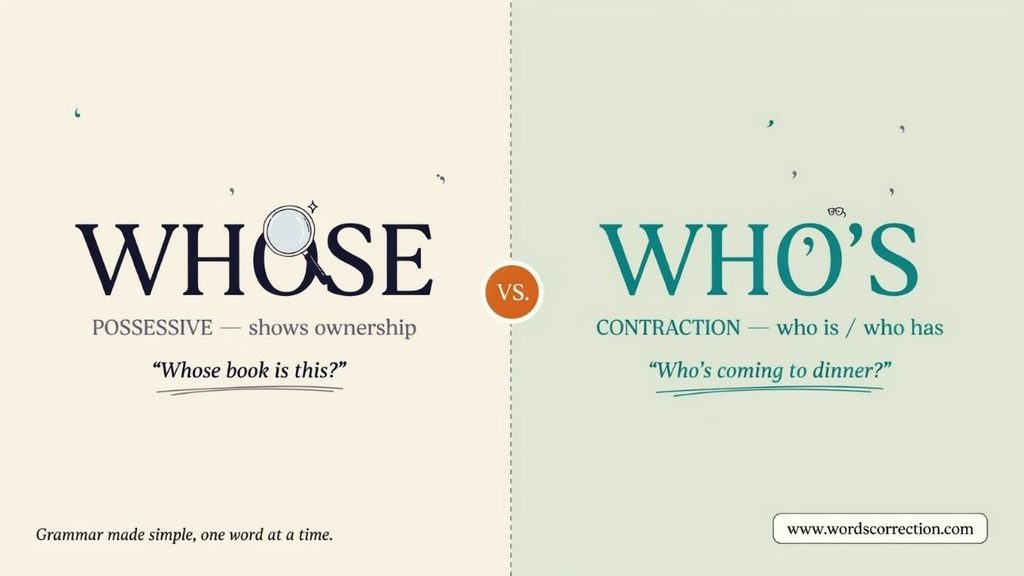
Definitions explain the rule, but paired examples show how the words work in real situations. Comparing sentences also makes it easier to recognize how a small spelling difference can affect meaning.
Questions About Belongings
- Whose phone is ringing? This asks who owns or is associated with the phone.
- Who’s calling? This asks who is making the call.
- Whose jacket did you borrow? This asks who the jacket belongs to.
- Whose dog is barking? This asks who owns or cares for the dog.
- Who’s walking the dog? This asks who is performing the action.
These examples illustrate the central distinction. Whose identifies a relationship, while it introduces a statement about a person.
Questions About Responsibility and Decisions
The same distinction applies to less tangible things, such as decisions, ideas, and responsibilities.
- Whose idea was this? This asks who came up with the idea.
- Who’s suggesting this idea? This asks who is making the suggestion.
- Whose responsibility is it? This asks who has the responsibility.
- Whose decision changed the schedule? This asks who made the decision.
Whose doesn’t always refer to something someone can physically hold. It can also express authorship, accountability, or association.
Whose and Who’s in Longer Sentences
Longer sentences can make the distinction less obvious, especially when the words appear within clauses rather than at the beginning.
Consider these examples
- I met the author whose book you recommended.
- The employee whose report went missing contacted the manager.
- Can you tell me who’s responsible for approving these expenses?
- She found a wallet but couldn’t determine whose it was.
In the first, third, and fifth examples, whose expresses possession or association. In the remaining examples, it means who is.
When you encounter a difficult sentence, identify what the word connects or replaces. This approach is more reliable than judging the word by its appearance alone.
Learn the difference between confusing word pairs
In Person vs In-Person When to Use the Hyphen
Common Mistakes With Whose and Who’s
Because whose and who’s sound alike, even experienced writers sometimes confuse them. The most reliable way to avoid these common grammar mistakes is to examine the sentence’s intended meaning.
Whose Birthday or Who’s Birthday?
When asking who has a birthday on a particular day, write whose birthday.
Incorrect: Who’s birthday is today?
Correct: Whose birthday is today?
The question asks which person’s birthday it is. It doesn’t mean “Who is birthday is today?” or “Who has birthday is today?”
However, it is correct in a different sentence
“it celebrating a birthday today?”
Here, it means who is. The sentence asks which person is celebrating.
Whose Fault or Who’s Fault?
The correct expression is whose fault because it asks who is responsible for a mistake or problem.
Incorrect: it fault was it?
Correct: Whose fault was it?
Now compare that with
“Who’s at fault?”
This sentence is correct because it means who is. Both expressions address responsibility, but their grammatical structures differ.
Other correct examples include
- Whose fault is it that the meeting started late?
- Nobody knows whose fault the error was.
The correct choice depends on how the sentence is constructed.
Learn the difference between confusing more English words step by step
To That Effect or To That Affect Which Is Correct?
Whose Name or Who’s Name?
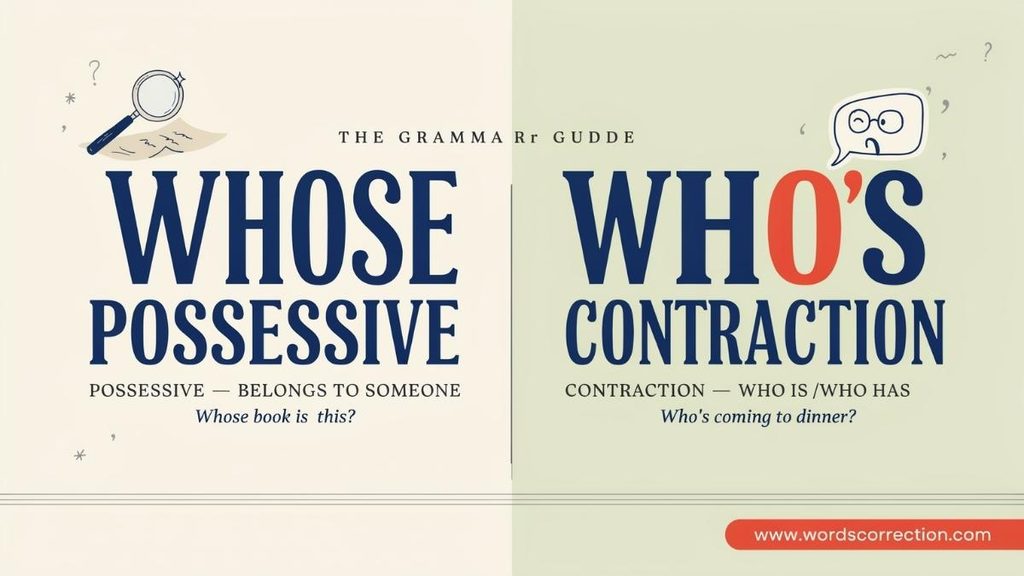
When asking about the person associated with a name on a form, list, document, or certificate, use whose name.
Incorrect: Who’s name is on the application?
Correct: Whose name is on the application?
Whose expresses the relationship between the name and the person it identifies.
By contrast, “named in the application?” means “Who is named in the application?” That sentence is also correct, but it asks a different question.
Additional examples include
- Whose name appears on the lease?
- Do you know whose name is missing from the list?
- Who’s listed as the emergency contact?
As Someone Whose or As Someone Who’s?
Both expressions are correct, but they serve different purposes.
Whose connects a person to something associated with them:
“She is someone whose advice I trust.”
The sentence means that the speaker trusts the advice given by that person.
it introduces a description or action:
“She is someone who’s always willing to help.”
Here, it means who is. The sentence describes the person’s behavior.
Compare these additional examples
- He’s a writer whose work attracts international readers.
- He’s a writer who’s gaining popularity.
- She’s a teacher whose students enjoy her classes.
The easiest way to distinguish these forms is to expand who’s. If who is or who has fits the sentence, the contraction is correct.
Learn the difference between often confused words
Color or Colour Which Spelling Is Correct?
Common Expressions That Use Whose or Who’s
Certain everyday phrases frequently cause confusion because they sound almost identical when spoken. Understanding their grammatical structure makes the correct spelling easier to recognize.
Guess Whose or Guess Who’s
Both expressions are correct, depending on what follows.
- Guess whose picture I found. This asks whose picture it is or who is associated with it.
- Guess who’s coming to dinner. This means guess who is coming to dinner.
- Guess whose birthday we’re celebrating. This asks which person’s birthday it is.
The expression guess whose often introduces a noun or a clause involving possession. Guess it introduces a statement in which it means who is or, in some contexts, who has.
Learn the difference between tricky English words with easy explanations
Grey or Gray Which Spelling Is Correct?
Whose Turn or Who’s Next
Both expressions appear frequently in everyday conversations and instructions.
Examples include
- Whose turn is it to pay?
- Whose turn is it to choose a movie?
In the first two examples, whose asks which person is associated with a turn. In the remaining examples, who’s means who is.
Whose Idea or Who’s Going
Compare these sentences
- Whose idea was it to change the meeting time?
- Who’s going to explain the new schedule?
- Whose suggestion did the committee accept?
The distinction remains the same even when the sentences contain additional details. Whose expresses association, while it represents a contraction.
Learn the difference between basic English word mistakes
Flier or Flyer Which Spelling Is Correct?
Whose vs Who’s vs Whom What’s the Difference?
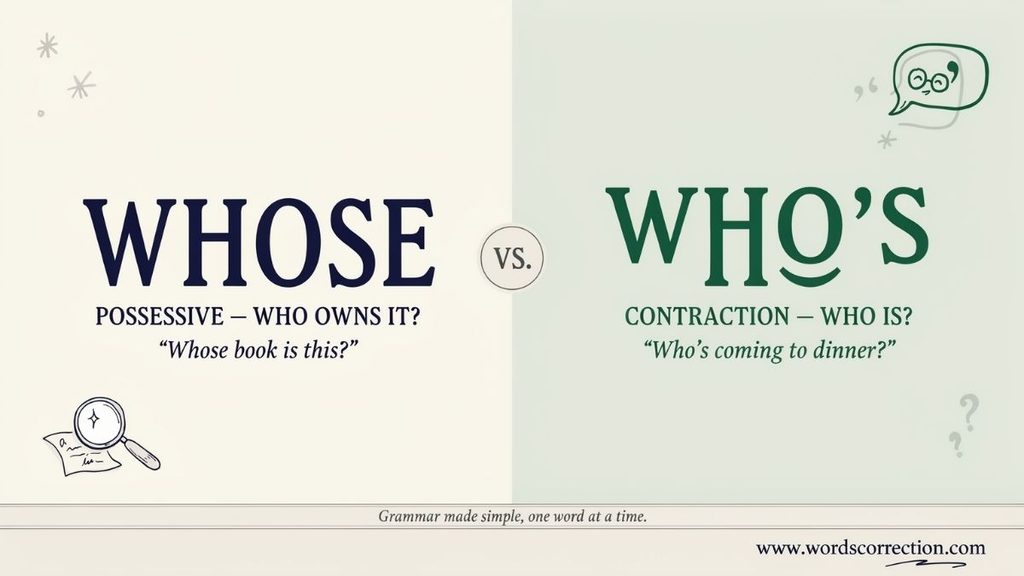
Although these three words look similar, they have different grammatical roles.
- Who commonly functions as the subject of a sentence or clause.
- Whose expresses possession or association.
- Whom traditionally functions as the object of a verb or preposition.
Consider the following examples
| Word | Example | Function |
|---|---|---|
| Who | Who called you? | Subject performing the action |
| Whose | Whose phone is this? | Asks about ownership |
| Whom | Whom did you invite? | Object of the verb invite |
In everyday American English, people often use who instead of whom in informal questions, such as “Who did you invite?” However, whose isn’t interchangeable with either word simply because the spellings resemble one another.
For example, “Whose did you invite?” doesn’t normally convey the intended meaning of “Whom did you invite?” The first suggests possession or an omitted noun in an appropriate context, while the second asks which person someone invited.
Learn the difference between commonly misused words
It’s vs Its What’s the Difference?
How to Remember the Difference Between Whose and Who’s
The simplest memory trick is to connect each word with its grammatical purpose.
Whose means belonging or association.
it means who is or who has
Whenever you’re uncertain, expand the contraction. This technique is quick, practical, and easy to apply when proofreading.
For example
- Whose coat is this? asks who the coat belongs to, so whose is correct.
- Whose assignment is missing? asks which person’s assignment is missing, so whose is correct.
You can also remember the apostrophe’s purpose. The apostrophe replaces omitted letters from who is or who has. In whose, no letters have been omitted, so no apostrophe is needed.
Don’t rely on the idea that an apostrophe always indicates possession. English uses apostrophes in contractions and possessive nouns, but possessive pronouns and related forms don’t all follow the same spelling pattern.
For instance, the student’s book uses an apostrophe to mark possession, but its cover doesn’t. Similarly, whose book is correct even though it refers to ownership.
Learn the difference between everyday English mistakes
Canceled vs Cancelled Which Spelling Is Correct?
Practice Session Choose the Correct Word
Instructions: Fill in each blank with correct answer. Read the complete sentence carefully and consider whether it refers to possession or means “who is” or “who has.”
- ______ birthday are we celebrating today?
- Do you know ______ waiting outside the classroom?
- ______ bag did you leave on the bus?
- She is the student ______ project won first prize.
- ______ coming to dinner with us tonight?
- Can you tell me ______ phone is ringing?
- ______ responsible for organizing the event?
- I met a writer ______ latest book became a bestseller.
- ______ turn is it to wash the dishes?
- Do you know ______ already finished the assignment?
- ______ shoes are these near the door?
- ______ going to explain the rules to the new students?
- The woman ______ car broke down called for help.
- ______ been using my computer without permission?
- ______ idea was it to organize the surprise party?
- I wonder ______ jacket was left in the conference room.
- ______ your favorite singer?
- The company ______ products we use has opened a new office.
- ______ going to take responsibility for the mistake?
- ______ dog keeps barking in the backyard?
- Do you know ______ already submitted the application?
- ______ wedding are you planning to attend this summer?
- The teacher asked ______ completed the homework.
- ______ been invited to speak at the conference?
- Can you guess ______ painting won the competition?
Answers
- Whose
- Who’s
- Whose
- Whose
- Who’s
- Whose
- Who’s
- Whose
- Whose
- Who’s
- Whose
- Who’s
- Whose
- Who’s
- Whose
- Whose
- Who’s
- Whose
- Who’s
- Whose
- Who’s
- Whose
- Who’s
- Who’s
- Whose
Here’s a trusted source for clear word meanings:
Cambridge Dictionary
FAQ’s
What Is the Difference Between Whose and Who’s?
Whose is a possessive word used to ask who owns something or to describe a relationship. it is a contraction of “who is” or “who has.”
Examples:
- Whose jacket is this?
- Who’s coming to the meeting?
Is It Whose or Who’s Birthday?
Whose birthday is correct when asking whose birthday is being celebrated. “Whose” indicates possession or association.
Example: Whose birthday is it today?
Is It Whose Dad or Who’s Dad?
Use whose dad when asking which person someone’s father is.
Example: Whose dad is picking you up?
However, “Who’s your dad?”
Is It Whose or Who’s Wedding?
Use whose wedding to ask which person is getting married.
Example: Whose wedding are you attending this summer?
Use “who’s” when it means “who is,” as in “Who’s getting married?”
Is It Whose or Who’s Funeral?
Whose funeral is correct when asking which person’s funeral it is.
Example: Whose funeral are we attending?
“Who’s funeral” is incorrect because the sentence requires a possessive word.
Is It Whose Fault or Who’s Fault?
Use whose fault when asking who is responsible for a mistake or problem.
Example: Whose fault was the accident?
Should I Write Who’s to Blame or Whose to Blame?
Who’s to blame is correct because it means “who is to blame.”
Example: Who’s to blame for the delay?
Use “whose” when asking about possession or association, not when identifying responsibility with this expression.
Is It Whose Wife or Who’s Wife?
Use whose wife when asking which person someone is married to.
Example: Whose wife is speaking at the event?
“Who’s his wife?” is also correct because it means “Who is his wife?”
When Should I Use Whose in a Sentence?
Use whose to ask who owns something or to describe someone or something connected to a particular person.
Examples:
- Whose phone is ringing?
- She is the author whose book won an award.
- We met a student whose project impressed the judges.
Can Who’s Be Used Instead of Whose?
No. Who’s cannot replace whose when expressing possession. it means “who is” or “who has,” while “whose” asks who something belongs to or identifies an association.
Correct: Whose keys are these?
Incorrect: Who’s keys are these?
How Can I Remember the Difference Between Whose and Who’s?
Replace who’s with “who is” or “who has.” If the sentence still makes sense, “who’s” is correct. If you are asking who owns something, use “whose.”
Examples:
- Who’s at the door? (“Who is at the door?”)
- Whose shoes are these? (Who owns the shoes?)
Can a Sentence Use Both Whose and Who’s?
Yes. Both words can appear in the same sentence when each serves a different purpose.
Example: Who’s the student whose painting won the competition?
Here, “who’s” means “who is,” while “whose” identifies the student associated with the painting.
Is Whose Is Whose Grammatically Correct?
Yes. “Whose is whose?” is a grammatically acceptable question when asking which items belong to which people.
Example: These bags look alike. Whose is whose?
The phrase is especially useful when several people have similar belongings.
Is It Whose Drink Is Whose or Who’s Drink Is Who’s?
“Whose drink is whose?” is correct when asking which drink belongs to each person.
Example: There are four glasses on the table. Whose drink is whose?
“Who’s drink is who’s?” is incorrect because the sentence asks about ownership.
Is It Who’s Right and Who’s Wrong or Whose Right and Whose Wrong?
“Who’s right and who’s wrong” is correct when asking who is correct and who is mistaken.
Example: The two witnesses disagree about what happened. Who’s right and who’s wrong?
In this expression, “who’s” means “who is.”
What Is the Difference Between Whose and Whom?
Whose expresses possession or association, while whom is traditionally the object form of “who.”
Examples
- Whose coat is hanging by the door?
- Whom did you invite to dinner?
Use “whose” to ask about ownership and “whom” when referring to someone receiving an action in formal English.
Why Is Whom Less Common in Everyday English?
“Whom” is less common because many English speakers use “who” in everyday conversation, even when traditional grammar calls for “whom.”
For example, “Who did you call?” is widely used instead of the more formal “Whom did you call?” Whom remains useful in formal writing and after prepositions, as in “To whom should I address the letter?”
Is Who Do You Love or Whom Do You Love Correct?
Both forms are used. “Whom do you love?” follows traditional formal grammar because “whom” is the object of the verb “love.” “Who do you love?” is more common in everyday English.
Choose the formal version for contexts that require traditional grammar, or use “who” for a more conversational tone.
Is I Who Am or I Who Is Correct?
“I who am” is correct in traditional grammar because the verb agrees with “I.”
Example: I, who am responsible for the project, will explain the results.
This construction sounds formal, so a simpler sentence, such as “I am responsible for the project,” is often more natural.
Can Whose Refer to Things as Well as People?
Yes. Whose can refer to people, animals, and sometimes things, particularly when describing a relationship or association.
Examples
- We adopted a dog whose ears flop forward.
- They visited a house whose roof needed repairs.
- She works for a company whose products are sold worldwide.
Using “whose” for things is widely accepted in modern English.
What Is the Difference Between Whose and Who Has?
Whose asks about ownership or association, while who has is a two-word phrase that may ask who possesses something or who has completed an action.
Examples
- Whose notebook is this?
- Who has my notebook?
- Who’s finished the assignment?
In the last example, “who’s” means “who has.”
Is Whose Name or Who’s Name Correct?
“Whose name” is correct when asking which person a name belongs to or refers to.
Example: Whose name is written on the envelope?
“Who’s name” is incorrect because the sentence requires the possessive word “whose.”
Is It Whose Turn or Who’s Turn?
Use whose turn when asking which person should act next.
Example: Whose turn is it to choose the game?
“Who’s turn” is incorrect because “who’s” is a contraction, not a possessive word.
Can Whose Be Used in Formal and Informal Writing?
Yes. Whose is correct in both formal and informal English. It can introduce direct questions, indirect questions, and relative clauses.
Examples:
- Informal: Whose snacks are these?
- Formal: The committee interviewed a candidate whose experience matched the role.
- Indirect question: I wonder whose umbrella this is.
What Is the Easiest Way to Check Whether Whose or Who’s Is Correct?
The easiest method is to check the meaning of the sentence. If you can replace “who’s” with “who is” or “who has,” use “who’s.” If the sentence asks about ownership or association, use “whose.”
Examples
- Whose car is parked here? (Who owns the car?)
Learn the difference between more words people mix up
Happy New Year or Happy New Years Which Is Correct?
Conclusion
Understanding the difference between “whose” and “who’s” is easier than it seems. Remember, “whose” shows possession, while “who’s” means “who is” or “who has.” Using the wrong word can confuse your readers, but learning this simple rule will make your writing clearer and more accurate. No grammar detective needed.
To build your confidence, review the examples and complete the 25 fill in the blank exercises. Check your answers to identify mistakes and strengthen your understanding. With regular practice, you’ll know when to use “whose” or “who’s” and avoid this common grammar mix up in your everyday writing.

Stella AJS is an experienced blogger and dedicated English language writer at Words Correction. She turns confusing grammar, word meanings, spelling, and usage into clear, practical insights that readers can easily understand and apply. With a passion for precise and engaging writing, Stella helps readers avoid common language mistakes, strengthen their vocabulary, and communicate with greater clarity and confidence.




