
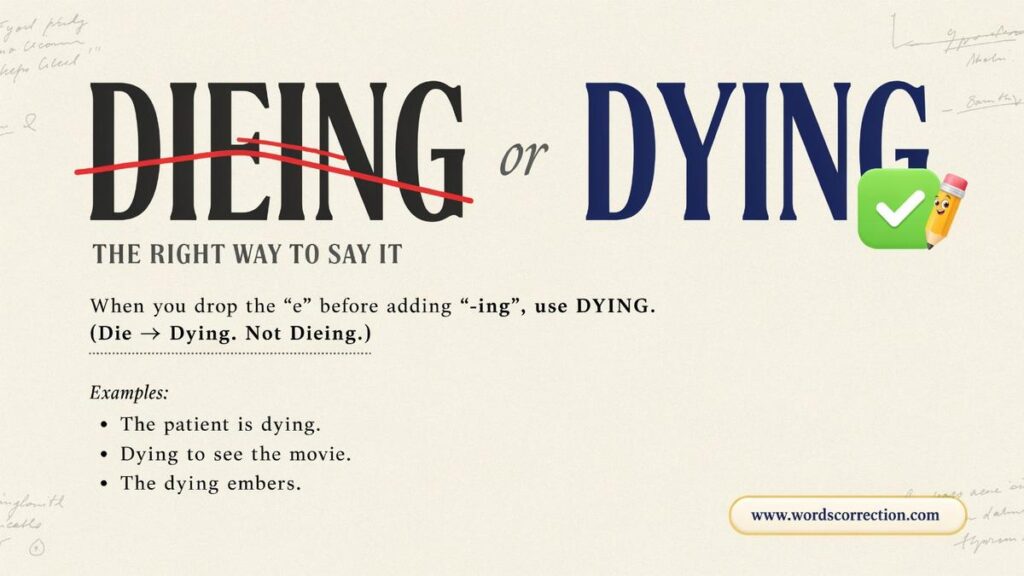
English spelling can be confusing, especially when words look almost identical but have different meanings. Dieing or dying is a common example that often leaves writers unsure which spelling to use. While dying refers to the process of death or something coming to an end, dyeing means adding color to hair, fabric, or clothing. And what about dieing? Is it ever correct? Don’t worry. This guide explains the meanings, differences, and spelling rules with simple examples. By the end, you’ll know which word to use and how to avoid these common spelling mistakes.
Dieing or Dying Which Spelling Is Correct?
Dying is the correct spelling when you mean approaching death or coming to the end of life. It is the present participle of the verb die.
Dieing is generally considered a misspelling when used with this meaning. Although you may occasionally encounter it in older or specialized material, it isn’t the standard spelling in modern English.
Dyeing is another correct word, but it has an entirely different meaning. It describes the process of adding color to materials such as fabric, clothing, or hair.
Here’s a quick comparison
| Word | Correct Usage | Meaning | Example |
|---|---|---|---|
| Dying | Correct | Approaching death or gradually disappearing | The patient is dying. |
| Dieing | Generally incorrect | Nonstandard spelling of dying | She is dieing. |
| Dyeing | Correct | Adding color to something | She is dyeing her hair. |
The easiest way to remember the difference is to connect dying with death and dyeing with color.
What Does Dying Mean?
Dying is the present participle and gerund form of the verb die. It describes the process of approaching death, losing life, or coming to an end.
The word can also describe something gradually disappearing, weakening, or losing its importance. For example, a dying tradition is one that fewer people continue to practice.
Dying appears in several grammatical structures, including continuous tenses and phrases that describe ongoing actions.
Definition of Dying
According to its standard English usage, dying means
- Approaching the end of life.
- Experiencing the process of death.
- Gradually disappearing or becoming extinct.
- Losing strength, energy, or influence.
- Coming to an end.
Examples of Dying in Sentences
- The doctors did everything they could to help the dying patient.
- The old man was dying peacefully at home.
- Several endangered species are slowly dying out.
- The flowers are dying because they haven’t received enough water.
- The village is struggling to preserve its dying traditions.
- She was dying to know what happened at the meeting.
- The fire was dying down as the night grew colder.
Notice that dying doesn’t always describe a person approaching death. Depending on the context, it can refer to plants, animals, traditions, businesses, fires, and even emotions.
Is Dying a Verb, Noun, or Adjective?
Dying primarily functions as the present participle of the verb die, but it can also work as a noun or adjective.
As a verb
- The injured bird is dying.
- The patient was dying when the ambulance arrived.
An adjective
- The family gathered around the dying man.
- They worked to protect the dying language.
As a noun
- The dying of the old tree saddened the children.
- The story describes the final moments before his dying.
Its grammatical role depends on how you use it in a sentence.
Learn the difference between confusing more English words
Hierarchical vs Hierarchal Which Word Should You Use?
What Does Dieing Mean?
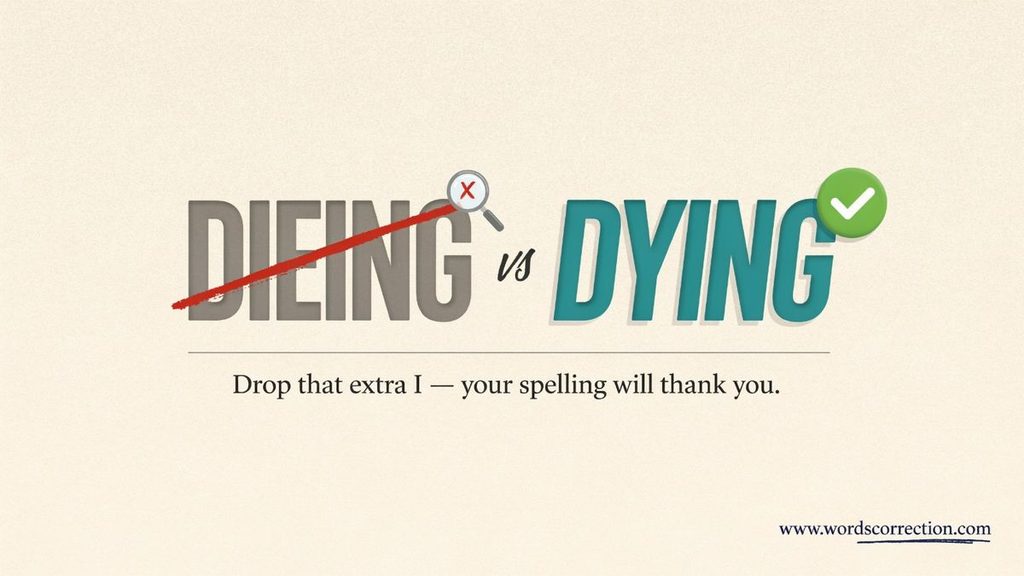
Dieing is generally an incorrect spelling of dying when you want to describe the process of death.
The confusion comes from the spelling of the original verb, die. Many English verbs ending in -ie change that ending to -y before adding -ing. Therefore, die becomes dying, not dieing.
For example
- Die → Dying
- Lie → Lying
- Tie → Tying
- Vie → Vying
Writing dieing instead of dying ignores this spelling pattern.
Is Dieing Ever a Word?
You may occasionally find dieing in older texts, historical references, or specialized technical contexts. However, it isn’t the accepted spelling for the ordinary meaning of approaching death.
In technical language, a die can refer to a tool used for cutting, shaping, or stamping materials. Related terms include die-making and die-cutting. These specialized terms follow their own word-building patterns and shouldn’t be confused with the verb die, meaning to stop living.
For everyday writing, remember this simple rule
Use dying when you mean death. Don’t use dieing as an alternative spelling.
Why Do People Write Dieing?
Several reasons explain why people make this mistake.
The original word ends in -ie. Many writers assume they can simply add -ing to the end of die. However, English spelling rules require a change.
The spelling looks logical. Words such as seeing and being retain their final letters when they take -ing. This may lead writers to believe dieing follows the same pattern.
Autocorrect doesn’t catch every mistake. Depending on the software and context, a nonstandard spelling may not always receive a clear correction.
The best solution is to remember the spelling pattern rather than rely entirely on spell-checking tools.
Learn the difference between commonly mixed-up more words
Eying or Eyeing Which Spelling Is Correct?
What Does Dyeing Mean?
Dyeing is a correct English word that means adding or changing color. It is the present participle and gerund form of the verb dye.
People commonly use dyeing when discussing clothing, fabrics, hair, leather, and other materials that can absorb color.
For example, when someone changes their hair from brown to blonde, they are dyeing their hair. Similarly, when a clothing manufacturer adds color to white fabric, the process is called dyeing.
Definition of Dyeing
Dyeing means
- Adding color to fabric or clothing.
- Changing the color of hair.
- Applying dye to materials.
- Coloring an object through a chemical or natural process.
Examples of Dyeing in Sentences
- She is dyeing her hair red for the summer.
- The company specializes in dyeing cotton fabrics.
- My grandmother enjoys dyeing wool with natural colors.
- They are dyeing the white curtains blue.
- The workers finished dyeing the fabric yesterday.
- Hair dyeing has become a popular beauty treatment.
- The artist is dyeing the cloth before making the final design.
Dyeing as a Verb and Noun
Like dying, dyeing can perform different grammatical roles.
As a verb
- She is dyeing her hair.
- They are dyeing the fabric for the new collection.
As a noun
- Dyeing requires the correct temperature and materials.
- Natural dyeing has a long history in textile production.
The context makes its meaning clear. If the sentence involves adding color, dyeing is usually the word you need.
Learn the difference between tricky grammar more words
Passtime or Pastime Which Spelling Is Correct?
Dying vs Dyeing What’s the Difference?
The difference between dying and dyeing is more than one extra letter. These words come from different verbs and describe completely different actions.
Dying comes from the verb die and refers to death, decline, or gradual disappearance.
Dyeing comes from the verb dye and refers to adding color to an object or material.
Compare these examples
| Dying | Dyeing |
|---|---|
| The plant is dying. | She is dyeing the fabric. |
| The patient is dying. | He is dyeing his hair. |
| The fire is dying down. | They are dyeing the curtains. |
| The old tradition is dying out. | The workers are dyeing cotton. |
| The flowers are dying without water. | My sister is dyeing her dress. |
How to Remember the Difference
Use these simple memory tricks
- Dying = Die: Think about death or something coming to an end.
- Dyeing = Dye: Think about color, hair, fabric, or clothing.
You can also remember that dye contains the word eye. Imagine looking at a colorful object with your eyes. This small association can help you remember the spelling.
Learn the difference between confusing word pairs
Ingage vs Engage Which Word Is Correct?
Why Does Die Change to Dying?
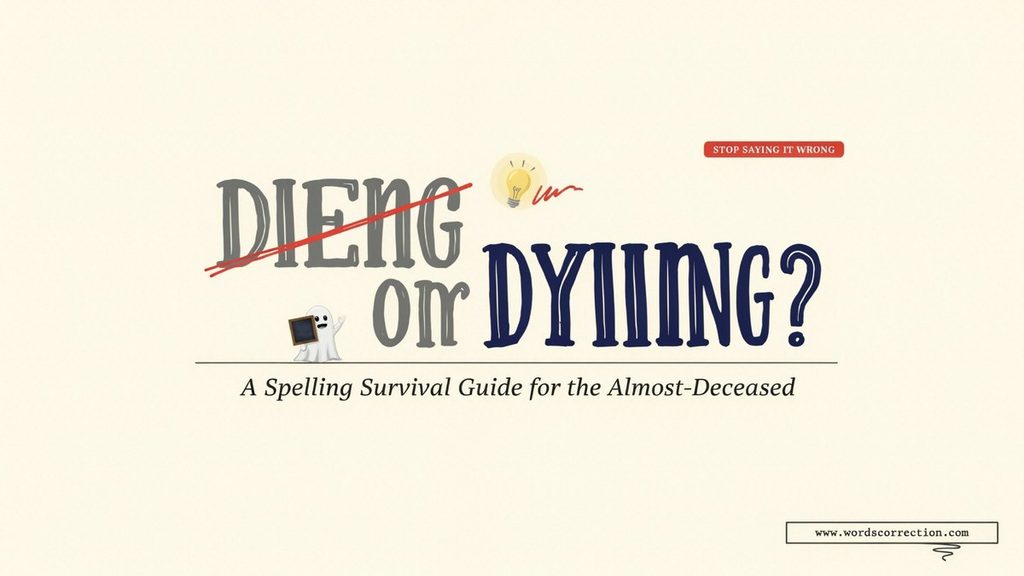
One of the most useful ways to avoid the dieing or dying mistake is to understand the spelling rule behind the word.
When a verb ends in -ie, you usually change the -ie to -y before adding -ing.
This rule keeps the spelling natural and prevents awkward combinations of letters.
The IE to Y Spelling Rule
The pattern works like this
Verb ending in -ie + -ing = Replace -ie with -y and add -ing.
Here are some common examples
| Base Verb | Correct -ing Form | Incorrect Form |
|---|---|---|
| Die | Dying | Dieing |
| Lie | Lying | Lieing |
| Tie | Tying | Tieing |
| Vie | Vying | Vieing |
This pattern appears in everyday English, so learning it can help you spell several words correctly.
More Examples of the Rule
Die → Dying
- The plant is dying.
- The animal was dying from an illness.
Lie → Lying
- He is lying on the sofa.
- The documents are lying on the table.
Tie → Tying
- She is tying her shoes.
- The worker is tying the packages together.
Vie → Vying
- Several teams are vying for the championship.
- The candidates are vying for the same position.
Remember that this is a spelling pattern for verbs ending in -ie. Not every English verb follows the same rule, so it’s important to learn common forms individually.
Learn the difference between often confused words
Implicit vs Complicit what’s the Differences?
Dying vs Dyeing Are They Pronounced the Same?
Yes. Dying and dyeing are pronounced the same way in standard English.
Both words have the pronunciation /ˈdaɪ.ɪŋ/.
They are examples of homophones: words that sound alike but have different spellings and meanings.
Although the pronunciation is identical, the context tells you which word a speaker means.
For example
- The flowers are dying.
- She is dyeing the flowers for a craft project.
When you hear these sentences, the surrounding words make the intended meaning clear.
The same principle applies to other homophones in English, such as
- Their and there
- Two and too
- See and sea
- Right and write
- Flour and flower
Understanding context is an important part of choosing the correct spelling.
Learn the difference between basic English word mistakes
Xenodochial vs Xenodochium Which Word Should You Use?
Is Dying the Same in American and British English?
Yes. Dying is the standard spelling in both American and British English.
Unlike some words that have different spellings across English varieties, dying doesn’t change between the United States and the United Kingdom.
The same applies to dyeing. Both American and British writers use this spelling when describing the process of adding color.
| Meaning | American English | British English |
|---|---|---|
| Approaching death | Dying | Dying |
| Adding color | Dyeing | Dyeing |
| Incorrect death-related spelling | Dieing | Dieing |
You don’t need to worry about regional spelling differences when choosing between these words. Use dying for the process of death and dyeing for adding color.
Common Mistakes With Dieing and Dying
Even experienced writers sometimes confuse words with similar spellings. The best way to avoid these errors is to understand the meaning and grammatical role of each word.
Here are some common mistakes and their corrections.
Using Dieing Instead of Dying
Incorrect: The old dog is dieing.
Correct: The old dog is dying.
Explanation: Dying is the correct present participle of die. Dieing isn’t the standard spelling for this meaning.
Confusing Dying With Dyeing
Incorrect: She is dying her hair blonde.
Correct: She is dyeing her hair blonde.
Explanation: The sentence describes changing hair color, so dyeing is the correct word.
Writing Dyeing When You Mean Death
Incorrect: The patient is dyeing.
Correct: The patient is dying.
Explanation: The sentence refers to someone approaching death, not changing color.
Confusing Died With Dying
These words come from the same verb, but they serve different grammatical purposes.
- Died is the simple past tense.
- Dying is the present participle.
Examples
- My grandfather died last year.
- The patient is dying.
- Several trees died during the drought.
- The flowers are dying because of the heat.
Use died for a completed past action and dying for an ongoing process.
Confusing Death, Dead, and Dying
These three words are related, but they aren’t interchangeable.
| Word | Part of Speech | Meaning | Example |
|---|---|---|---|
| Die | Verb | To stop living | All living things eventually die. |
| Died | Verb | Past form of die | The bird died yesterday. |
| Dying | Verb form or adjective | Approaching death | The animal is dying. |
| Dead | Adjective | No longer alive | The tree is dead. |
| Death | Noun | The end of life | The family mourned his death. |
Knowing these differences will make your writing more accurate and natural.
Learn the difference between commonly misused words
Stigmatism vs Astigmatism Which Term Is Correct?
15 Example Sentences Using Dying and Dyeing
Examples make spelling rules easier to understand because they show how words work in real situations.
1 Examples With Dying
- The doctors tried every possible treatment to save the dying patient.
- Several rare animals are dying because of habitat loss.
- The flowers are dying because nobody has watered them.
- The small business is slowly dying due to financial problems.
- The old custom is dying out among younger generations.
- The fire was dying down when we arrived.
- I am dying to know what happened at the party.
2 Examples With Dyeing
- She is dyeing her hair a lighter shade.
- The workers are dyeing the fabric in large containers.
- My mother enjoys dyeing clothes with natural colors.
- The company uses modern methods for dyeing cotton.
- He spent the afternoon dyeing his old jacket.
- They are dyeing the curtains to match the furniture.
- The textile factory specializes in dyeing different materials.
These examples show why context matters. Dying describes death or decline, while dyeing describes the process of adding color.
Learn the difference between everyday English mistakes
Realize vs Realise What Is the Difference?
Common Expressions That Use Dying
The word dying appears in many familiar English expressions. Some have literal meanings, while others are figurative.
Understanding these expressions will help you recognize dying in different contexts.
Dying to Know
This expression means that you are extremely curious about something.
Example: I’m dying to know how the surprise party went.
Dying of Laughter
This phrase describes laughing very hard. It doesn’t usually refer to actual death.
Example: We were dying of laughter after hearing his joke.
Dying Wish
A dying wish is something a person wants or requests near the end of life.
Example: Her dying wish was to see her family together.
Dying Breed
A dying breed refers to a group, tradition, or type of person that is becoming rare.
Example: People who still write handwritten letters are becoming a dying breed.
Dying Out
Dying out means gradually disappearing or becoming extinct.
Example: Many traditional languages are dying out.
Dying Down
Dying down means becoming weaker, quieter, or less intense.
Example: The storm finally started dying down.
Dying Breath
A person’s dying breath refers to their final moments or last breath.
Example: He remembered his family until his dying breath.
Dying Embers
Dying embers are the remaining pieces of a fire that are gradually losing heat and brightness.
Example: We watched the dying embers of the campfire before going to bed.
These expressions show that dying can describe more than the literal process of death. English speakers also use it to express curiosity, humor, decline, and fading intensity.
Learn the difference between more words people mix up
Coaches or Coach’s Which Spelling Is Correct?
A Simple Trick to Remember Dieing or Dying
If you frequently confuse dieing and dying, use this quick memory trick:
Dying has no extra e because die changes to dy before adding -ing.
For dyeing, keep the e because it comes from the verb dye.
Think about the meanings
- Dying: Someone or something is approaching death or fading away.
- Dyeing: Someone is adding color to an object.
- Dieing: Avoid this spelling for the ordinary meaning of death.
You can test yourself by asking one simple question: Does the sentence describe death or color?
If it describes death, use dying. If it describes adding color, use dyeing.
Learn the difference between tricky English words with easy explanations
Grimey or Grimy Which Spelling Is Correct?
Practice Session Dieing or Dying
Instructions: Choose the correct word to complete each sentence.
1. The flowers are slowly __________ because they haven’t received enough water.
2. She is __________ her hair a beautiful shade of brown.
3. The correct spelling of the present participle of die is __________.
4. The old tree started __________ after several weeks without rain.
5. My sister is __________ her white dress blue.
6. The endangered species is slowly __________ out.
7. Everyone was __________ laughing at the comedian’s jokes.
8. The noise from the crowd is gradually __________ down.
9. He is __________ to know the final results.
10. The correct past tense of die is __________.
11. The artist is __________ the fabric using natural colors.
12. The battery in my phone is __________ and needs charging.
13. The traditional art form is __________ out in many communities.
14. She is __________ to visit her favorite country.
15. The correct spelling is __________, not dieing.
16. The children were __________ laughing during the comedy show.
17. My mother is __________ the curtains to match the room.
18. The old custom is slowly __________ away.
19. The plant is __________ because it hasn’t received enough sunlight.
20. The workers are __________ the cotton fabric in different colors.
21. The excitement surrounding the event is __________ down.
22. He was __________ to hear the unexpected news.
23. The correct word for changing the color of clothes is __________.
24. The sentence “She is dieing” contains a __________ spelling mistake.
25. The flowers were __________ yesterday because of the extreme heat.
Answers
- Dying
- Dyeing
- Dying
- Dying
- Dyeing
- Dying
- Dying
- Dying
- Dying
- Died
- Dyeing
- Dying
- Dying
- Dying
- Dying
- Dying
- Dyeing
- Dying
- Dying
- Dyeing
- Dying
- Dying
- Dyeing
- Spelling
- Dying
Here’s a trusted source for clear word meanings:
Cambridge Dictionary
FAQ’s
Is it dying or dyeing when referring to coloring your hair?
Dyeing is the correct spelling when referring to changing your hair color. It comes from the verb dye, which means to apply color to something. Dying refers to the process of losing life. For example, “She is dyeing her hair brown.”
What does dieing mean in English?
Dieing is generally considered a misspelling of dying in standard English. The correct word dying refers to the process of losing life, gradually disappearing, or expressing an intense desire for something.
Why is dying spelled with a y instead of ie?
The spelling follows a standard English rule for verbs ending in -ie. When adding -ing, the final ie changes to y. Therefore, die becomes dying, not dieing.
Is dieing ever considered a correct English word?
In standard English, dieing is incorrect when referring to the process of losing life. Although it may occasionally appear in specialized technical contexts, dying is the accepted spelling in everyday writing.
What is the difference between dying, dyeing, and dieing?
These three spellings have different meanings and uses. Dying refers to losing life or gradually disappearing. Dyeing means coloring hair, fabric, or another material. Dieing is generally an incorrect spelling of dying.
Is dying a verb, an adjective, or both?
Dying is primarily the present participle of the verb die. However, it can also function as an adjective when describing something that is approaching its end or gradually disappearing, as in “a dying industry.”
What is the present participle of the verb die?
The present participle of die is dying. To form it, replace the final ie with y and add -ing. For example, “The flowers are dying because they haven’t received enough water.”
What is the past tense of die?
The past tense of die is died. It describes an action that happened in the past. For example, “The old tree died during the winter.”
How does the meaning of died differ from dying?
Died describes a completed action in the past, whereas dying describes an ongoing process or condition. For example, “The plant died yesterday” indicates a completed event, while “The plant is dying” describes a continuing process.
Is the spelling of dying different in American and British English?
No. Both American and British English use dying as the standard spelling. Unlike some words that have regional spelling variations, dying remains consistent in both varieties of English.
How can you use dying correctly in a sentence?
You can use dying to describe the process of losing life, something gradually disappearing, or an intense desire. For example, “The leaves are dying,” “The tradition is dying,” and “I’m dying to know the results.”
What does the expression dying laughing mean?
Dying laughing is an informal expression used to describe laughing extremely hard. It emphasizes how funny something is rather than referring to actual death. For example, “Everyone was dying laughing at his joke.”
Should you write dying out or dieing out?
Dying out is the correct expression. It describes something gradually disappearing, declining, or becoming less common. For example, “Several traditional languages are dying out.”
What does dying down mean in everyday English?
Dying down means gradually becoming weaker, quieter, or less intense. It commonly describes noise, excitement, arguments, or strong emotions. For example, “The excitement surrounding the event is dying down.”
What does the phrase dying to know mean?
Dying to know is an informal expression that means being extremely curious or eager to discover something. It doesn’t refer to actual death. For example, “I’m dying to know who won the competition.”
Can the word dying describe things other than living organisms?
Yes. Dying can describe nonliving concepts and situations in figurative language. It may refer to declining industries, disappearing traditions, fading trends, or weakening institutions. For example, “The popularity of that fashion trend is dying.”
Why do people frequently misspell dying as dieing?
People often misspell dying as dieing because they assume that adding -ing requires keeping the original spelling of the verb. However, English spelling rules require changing the final ie to y before adding -ing.
What other English verbs follow the same spelling rule as dying?
Several English verbs ending in -ie follow the same spelling pattern when taking the -ing suffix. Common examples include
- Die → Dying
- Lie → Lying
- Tie → Tying
- Untie → Untying
These examples demonstrate how the final ie changes to y before adding -ing.
Is the word dyeing related to dying?
No. Dyeing and dying come from different verbs and have different meanings. Dyeing comes from dye, which means to color a material, while dying comes from die, which means to lose life or gradually disappear.
Is it correct to write dyeing clothes or dying clothes?
Dyeing clothes is correct when describing the process of changing the color of clothing with fabric dye. The word dyeing specifically refers to applying color to materials such as cotton, wool, and other fabrics.
Can the word dying describe a battery that is losing power?
Yes. Dying can be used informally to describe a battery that is running out of charge or gradually losing its ability to provide power. For example, “My phone battery is dying, so I need to charge it.”
What does dying mean when used figuratively?
Figuratively, dying describes something that is gradually disappearing, weakening, or losing its importance. It can refer to traditions, customs, businesses, interests, or cultural practices. For example, “The art of traditional storytelling is dying.”
What is the difference between dying and dead?
Dying describes the process of losing life or approaching the end of life, while dead describes the state of no longer being alive. For example, “The plant is dying” describes an ongoing process, whereas “The plant is dead” describes its final condition.
What is an easy way to remember the correct spelling of dying?
An easy way to remember dying is to learn the spelling rule for verbs ending in -ie. Replace the final ie with y before adding -ing. For example, die becomes dying, lie becomes lying, and tie becomes tying.
Which sentence is grammatically correct He is dieing or He is dying?
“He is dying” is grammatically correct because dying is the standard present participle of the verb die. The spelling dieing is incorrect in this context. Always use dying when referring to the process of losing life.
Learn the difference between confusing more English words step by step
Visualization or Visualisation Which Spelling Is Correct?
Conclusion
Choosing between dieing or dying becomes simple once you understand the difference. Dying is the correct spelling when referring to the process of death or something gradually coming to an end. Dyeing means adding color to hair, fabric, or clothing, while dieing is generally considered incorrect in standard English when used to describe death. The key is to remember that dying comes from the verb die, whereas dyeing comes from dye. By understanding their meanings and the spelling rule, you can avoid this common mistake and use each word with confidence. After all, clear writing starts with choosing the right words.

Stella AJS is an experienced blogger and dedicated English language writer at Words Correction. She turns confusing grammar, word meanings, spelling, and usage into clear, practical insights that readers can easily understand and apply. With a passion for precise and engaging writing, Stella helps readers avoid common language mistakes, strengthen their vocabulary, and communicate with greater clarity and confidence.




