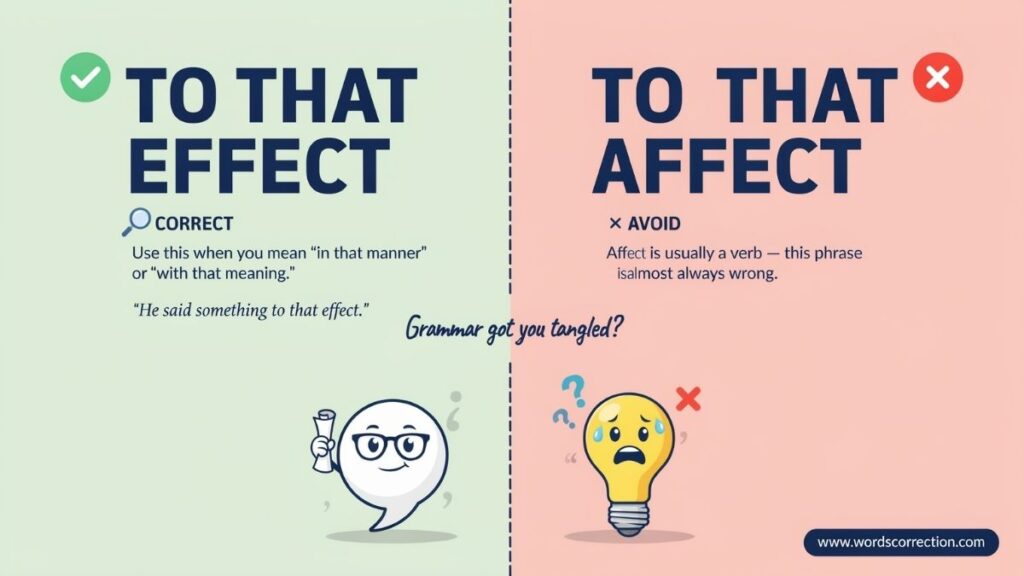
Choosing between “to that effect” and “to that affect” can be confusing because both words sound the same. This common grammar mistake can happen to students, professionals, and even experienced writers. Although the words look and sound similar, they have different meanings and uses. The good news is that learning the difference is easier than you might think. In this guide, you’ll discover which phrase is correct, understand how to use affect and effect in sentences, and learn simple tips to remember the difference. You’ll also get 25 fill in the blank exercises to practice your skills and build confidence.
Quick Answer To That Effect or To That Affect?
“To that effect” is the correct expression. The phrase refers to the general meaning or message of something that someone said or wrote. “To that affect” is incorrect in this context because affect does not serve the same grammatical purpose as effect.
Here is a quick comparison:
| Expression | Correct? | Explanation |
|---|---|---|
| To that effect | Yes | Refers to the meaning or general message of a statement. |
| To that affect | No | Uses the wrong word for this expression. |
| Something to that effect | Yes | Refers to a statement with approximately the same meaning. |
| Words to that effect | Yes | Refers to the general wording or meaning of a statement. |
| To this effect | Yes | Introduces a similar idea or message. |
| To the effect of | Yes | Introduces the content or meaning of a statement, or indicates an approximate amount in other contexts. |
The easiest way to remember the correct expression is to connect effect with a result, outcome, or intended meaning. Since “to that effect” refers to the meaning of a statement, effect is the appropriate choice.
Learn the difference between similar English words the easy way
Grey or Gray Which Spelling Is Correct?
What Does “To That Effect” Mean?
The phrase “to that effect” means that something was expressed, communicated, or understood in a particular way. It is commonly used when someone wants to summarize what another person said without repeating the exact words.
Rather than quoting a statement word for word, you can use this phrase to convey its general meaning.
For example:
“Daniel mentioned that he might leave the company soon, or something to that effect.”
This sentence tells the reader that Daniel communicated an idea about possibly leaving the company. However, the speaker is not claiming to remember or reproduce his exact words.
The phrase is especially useful when the precise wording is unimportant, uncertain, or too lengthy to repeat.
How the Phrase Works in a Sentence
“To that effect” usually refers to a statement or idea mentioned earlier in the sentence or surrounding discussion.
Consider this example:
“The manager explained that the deadline would not change and made a statement to that effect.”
Here, the phrase refers to the manager’s message about the deadline. It does not introduce an entirely new idea. Instead, it connects the wording or content of a statement to the meaning already established.
The expression can also appear in reported speech:
“Several employees said they had received instructions to that effect.”
In this example, the employees received instructions conveying a particular message. The sentence does not specify the exact wording of those instructions.
What Does “Something to That Effect” Mean?
“Something to that effect” means something similar in meaning to what has already been described. People often use it when they remember the general idea of a statement but cannot recall the exact words.
For example
“My neighbor said the repairs would take a few days, or something to that effect.”
The speaker remembers the general message but may not remember whether the neighbor said “a few days,” “several days,” or another similar expression.
This phrase is common in everyday conversation because it allows people to summarize information naturally without pretending to remember every detail.
What Does “Words to That Effect” Mean?
“Words to that effect” refers to the general meaning of something someone said or wrote. It often appears in storytelling, reporting, business communication, and formal writing.
For example
“The director told the team that the project needed immediate attention, or words to that effect.”
The sentence communicates the director’s message without presenting an exact quotation.
Although “something to that effect” and “words to that effect” are similar, they have slightly different emphases. “Something to that effect” often refers to a general statement or idea, while “words to that effect” places more emphasis on the wording of a statement.
Both expressions are correct and useful.
Learn the difference between more words people mix up
Loosing or Losing Which Spelling Is Correct?
Why Is “To That Effect” Correct?
The reason “to that effect” is correct comes down to the grammatical roles of the words affect and effect.
Although they sound alike, they generally function differently in a sentence. Effect is most commonly a noun, while affect is most commonly a verb.
The phrase “to that effect” requires a noun because the word effect refers to the meaning, result, or substance of a statement.
Effect as a Noun
The word effect usually means a result, consequence, outcome, or influence produced by something.
For example
- The new policy had a positive effect on employee morale.
- The medication may cause a temporary effect.
- The announcement had an immediate effect on the market.
- She made a statement to that effect.
In the final example, effect refers to the general meaning or substance of the statement. That is why it fits the expression.
A helpful way to remember this distinction is to think of effect as the result or meaning that comes from an action, event, or statement.
Affect as a Verb
The word affect is generally used as a verb meaning to influence, change, or have an impact on something.
For example
- The weather can affect your travel plans.
- Lack of sleep may affect your concentration.
- The decision could affect the entire department.
- Rising prices affect household budgets.
In each example, affect describes an action or influence. It tells the reader what is being influenced or changed.
Because “to that affect” does not express the intended meaning, it is incorrect when referring to the general meaning of a statement.
Are There Exceptions?
Yes. Although effect is usually a noun and affect is usually a verb, both words have less common uses.
Effect can function as a verb meaning to bring about or accomplish something.
For example
“The new director hopes to effect meaningful change.”
Here, effect means to bring about change. It is not being used as a noun.
Affect can also function as a noun in psychology, where it refers to an observable emotional expression or response.
For example
“The clinician noted that the patient displayed a restricted affect.”
This specialized use is different from the everyday verb affect.
These exceptions are worth knowing, but they do not change the correct form of the expression. In standard usage, the phrase remains “to that effect.”
Learn the difference between everyday English mistakes
Mangoes or Mangos Which Spelling Is Correct?
Affect vs Effect What Is the Difference?
Understanding the difference between affect and effect makes it easier to avoid common grammar mistakes.
| Word | Most common grammatical role | Meaning | Example |
|---|---|---|---|
| Affect | Verb | To influence or change something | The delay may affect our plans. |
| Effect | Noun | A result, outcome, or consequence | The delay had an unexpected effect. |
| Effect | Verb, less common | To bring about or accomplish something | The organization hopes to effect reform. |
| Affect | Noun, specialized | An observable emotional expression or response | The report described a flat affect. |
For most everyday writing, the simplest rule is to remember that affect is usually an action, while effect is usually a result.
For example:
“The changes will affect the schedule.”
In this sentence, affect is a verb because the changes will influence the schedule.
“The changes will have an effect on the schedule.”
In this sentence, effect is a noun because it refers to the result of the changes.
Both sentences communicate a similar idea, but they use different grammatical structures.
A Simple Memory Trick
One popular way to remember the difference is the word RAVEN:
- R: Remember
- A: Affect
- V: Verb
- E: Effect
- N: Noun
The mnemonic reminds you that affect is usually a verb and effect is usually a noun.
For example, if you are writing about how a decision influences a person, affect is likely the correct choice. If you are describing the result of that decision, effect is probably the right word.
However, remember that RAVEN is a general guideline, not an absolute rule. The less common uses of both words still exist.
When deciding whether to write “to that effect or affect,” focus on the meaning of the complete expression. Since the phrase refers to the content or meaning of a statement, effect is correct.
Learn the difference between commonly misused words
Each Other or Eachother Which Spelling Is Correct?
How to Use “To That Effect” in Everyday Writing
The expression works in a variety of situations, from casual conversations to formal documents. The key is to use it when you want to communicate the general meaning of a statement without reproducing the exact wording.
In Everyday Conversation
People often use “to that effect” when recalling conversations or summarizing what someone said.
Examples
- My friend said she might move to another city, or something to that effect.
- He mentioned that the restaurant was closing early, or words to that effect.
- Sarah told me she would arrive after lunch, or something to that effect.
- They said the event might be postponed, or something to that effect.
These examples sound natural because the speaker is communicating an approximate recollection rather than offering a precise quotation.
The phrase is especially useful when you remember the main point but not the exact wording.
In Professional Writing
In workplace communication, “to that effect” can help summarize instructions, decisions, announcements, and discussions.
Examples
- The department issued a notice to that effect.
- The supervisor sent an email to that effect.
- Management confirmed that the existing deadline would remain unchanged and issued instructions to that effect.
- The company released a statement to that effect following the meeting.
These sentences are appropriate when the surrounding context already explains the message being referenced.
For example, if a paragraph describes a company’s decision to extend a deadline, saying that management issued a notice to that effect can prevent unnecessary repetition.
However, clarity should always come first. If the reader cannot determine what the phrase refers to, restate the message more directly.
Learn the difference between tricky words and use them correctly
Happy New Year or Happy New Years Which Is Correct?
In Academic and Formal Writing
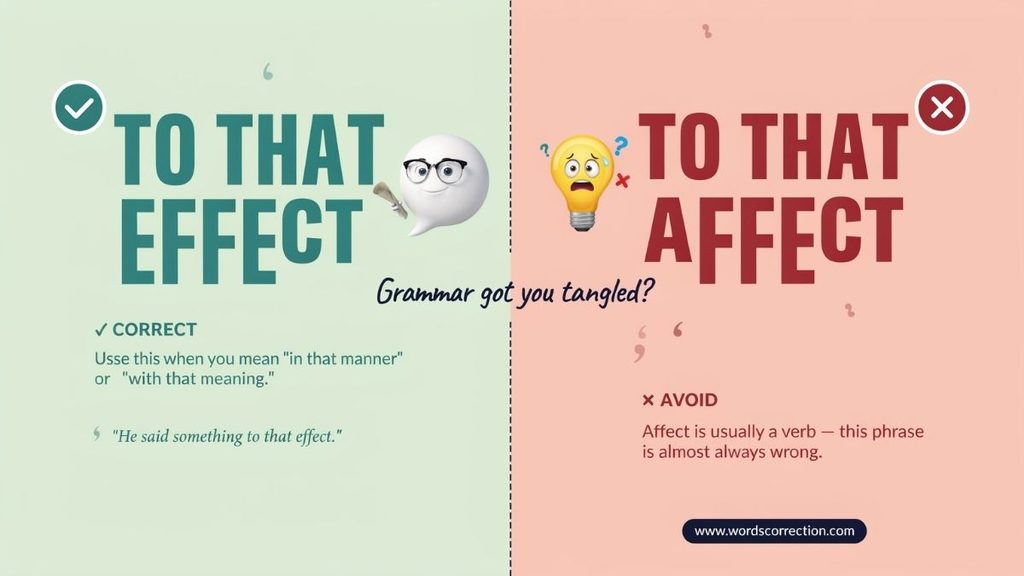
The phrase can also appear in academic papers, reports, and formal discussions. It is useful when summarizing an argument or referring to a claim without repeating its exact wording.
Examples
- The author makes a claim to that effect in the final section.
- The report includes a recommendation to that effect.
- Several findings support the conclusion that the intervention improved performance, with the evidence pointing to that effect.
- The committee adopted a resolution to that effect.
Use the expression carefully when precision matters. In research papers, legal documents, and technical reports, a direct quotation or a specific paraphrase may be more appropriate if the exact wording affects the interpretation.
For instance, if you are analyzing an author’s particular choice of words, you should quote or describe those words accurately rather than relying on a general phrase.
When Reporting What Someone Said
“To that effect” is particularly helpful when reporting speech indirectly.
Suppose a colleague says, “I cannot finish the assignment by Friday because I need more information.”
You might summarize the conversation as follows:
“My colleague said that the assignment could not be completed by Friday, or something to that effect.”
The sentence communicates the main idea without presenting the original statement as an exact quotation.
This distinction matters because quotation marks generally indicate that the words inside them reproduce what someone actually said or wrote. If you are uncertain about the precise wording, an expression such as “something to that effect” can make that uncertainty clear.
Learn the difference between basic English word mistakes
Patient or Patience what’s the Difference?
“To This Effect” vs “To That Effect”
Both “to this effect” and “to that effect” are correct expressions. The difference is usually a matter of context and how the writer refers to an idea.
“To this effect” often introduces or emphasizes a statement, instruction, or message that is being presented in the current context.
For example
“The notice stated to this effect: all applications must be submitted by Monday.”
A clearer and more natural alternative in many situations would be:
“The notice stated that all applications must be submitted by Monday.”
“To that effect” more commonly refers to an idea or statement that has already been mentioned or can be understood from the surrounding context.
For example
“The company decided to extend the deadline and sent an email to that effect.”
The email communicated the decision described earlier in the sentence.
In everyday writing, the two phrases can sometimes overlap. The most important consideration is whether the reference is clear. If either expression makes the sentence unnecessarily complicated, a direct statement may be better.
Learn the difference between often confused words
In Person vs In-Person When to Use the Hyphen
“To the Effect Of” vs “To That Effect”
Although the phrases look similar, “to the effect of” and “to that effect” are not always interchangeable.
“To the effect of” commonly introduces the general content or meaning of a statement. It may also describe an approximate amount in certain contexts.
Examples
- The witness gave a statement to the effect that the vehicle had stopped at the intersection.
- The letter contained a warning to the effect that late payments could result in additional charges.
- The company announced a reduction in expenses to the effect of several thousand dollars.
In the first two examples, the phrase introduces the substance of a statement or warning. In the third, it indicates the approximate amount of a financial change.
By contrast, “to that effect” generally refers back to a message or idea already established.
For example
“The letter warned that late payments could result in additional charges. The company had previously sent a notice to that effect.”
The first sentence explains the warning. The second refers back to it.
Choosing the right phrase depends on the sentence structure and the relationship between the expression and the information around it.
Learn the difference between confusing word pairs
Color or Colour Which Spelling Is Correct?
Common Mistakes to Avoid
Even experienced writers sometimes confuse affect and effect. These mistakes are easy to correct once you understand how the words function.
1. Writing “To That Affect”
Incorrect: “The manager sent a message to that affect.”
Correct: “The manager sent a message to that effect.”
The correct word is effect because the sentence refers to the meaning or content of the message.
2. Assuming Affect and Effect Are Interchangeable
Incorrect: “The new rules had a positive affect on productivity.”
Correct: “The new rules had a positive effect on productivity.”
In this sentence, effect is a noun referring to the result of the new rules.
However, affect is correct when used as a verb:
“The new rules may affect productivity.”
The grammatical structure determines which word you need.
Learn the difference between confusing more English words
Canceled vs Cancelled Which Spelling Is Correct?
3. Using the Phrase Without a Clear Reference
Unclear: “She made a statement to that effect.”
This sentence is grammatically correct, but the reader may not know which statement or idea the phrase refers to if no relevant information appears nearby.
Clearer: “She explained that the meeting would be postponed and made a statement to that effect.”
The second version provides context and makes the reference easier to understand.
4. Using the Expression Too Frequently
Although “to that effect” is useful, repeating it throughout a paragraph can make your writing sound repetitive.
Instead, consider alternatives such as:
- Along those lines
- In similar terms
- With a similar meaning
- To that end, when referring to a purpose or goal
- In other words
- Essentially
- Something similar
These alternatives are not exact substitutes in every situation. Choose one that preserves the intended meaning.
5. Treating an Approximate Statement as an Exact Quote
If you cannot remember someone’s exact words, avoid placing an invented or uncertain statement inside quotation marks.
Instead of writing:
“She said, ‘I will probably leave next month.’”
You could write:
“She indicated that she might leave the following month, or something to that effect.”
The second version makes it clear that you are summarizing the general message rather than claiming to reproduce the exact words.
Learn the difference between tricky grammar more words
Flier or Flyer Which Spelling Is Correct?
Examples of “To That Effect” in Sentences
The following examples demonstrate how the expression works in different situations.
| Context | Example sentence |
|---|---|
| Everyday conversation | He said he would call me later, or something to that effect. |
| Workplace communication | The manager issued a reminder to that effect. |
| Academic writing | The author makes an argument to that effect in the conclusion. |
| Business reporting | The company released a statement to that effect after the announcement. |
| Recalling instructions | We were told to arrive early, or words to that effect. |
| Formal correspondence | The letter included a warning to that effect. |
| Reporting a decision | The committee agreed to postpone the vote and circulated a notice to that effect. |
| Describing a conversation | She mentioned that the project needed additional funding, or something to that effect. |
| Summarizing a policy | The handbook contains a provision to that effect. |
| Reporting a recommendation | The consultant offered advice to that effect during the meeting. |
Notice that the expression usually works best when the relevant statement or idea is already clear.
For example, “The committee agreed to postpone the vote and circulated a notice to that effect” is easy to understand because the sentence identifies the decision before referring to the notice.
Practice Session
Fill in the Blanks
Instructions: Fill in each blank with the correct word: affect or effect.
- The weather may ______ our travel plans.
- The new rules had a positive ______ on students.
- Lack of sleep can ______ your health.
- The medicine began to take ______.
- The new law will go into ______ next month.
- The noise had a negative ______ on my concentration.
- Stress can ______ your mood.
- The teacher explained the ______ of pollution.
- The new policy may ______ many workers.
- The storm had a serious ______ on the village.
- The company hopes to ______ positive change.
- Does this decision ______ your future?
- The medicine caused a few side ______.
- The announcement had an immediate ______ on the public.
- Poor nutrition can ______ your energy levels.
- The new rules have not taken ______ yet.
- Her words had a powerful ______ on me.
- The cold weather may ______ crop growth.
- The manager sent a message to that ______.
- The accident will ______ traffic in the city.
- The government wants to ______ major improvements.
- The movie had a lasting ______ on the audience.
- Loud music can ______ your sleep.
- She said she would arrive late, or something to that ______.
- The changes may ______ the entire team.
Answers
- affect
- effect
- affect
- effect
- effect
- effect
- affect
- effect
- affect
- effect
- effect
- affect
- effects
- effect
- affect
- effect
- effect
- affect
- effect
- affect
- effect
- effect
- affect
- effect
- affect
Here’s a trusted source for clear word meanings:
Cambridge Dictionary
FAQ’s
Is it to that effect or to that affect?
“To that effect” is correct. The phrase refers to the general meaning or message of something someone said or wrote. “To that affect” is incorrect in this context because affect does not fit the expression.
What does to that effect mean?
“To that effect” means conveying a particular idea or message without necessarily repeating the exact words. For example, “She said the meeting might be postponed, or something to that effect” means she communicated a similar idea.
Is it has that effect or has that affect?
“Has that effect” is correct when referring to a result or consequence. For example, “The change has that effect on employee productivity.” Use affect as a verb when describing influence, as in “The change affects employee productivity.”
Which is correct to effect or to affect something?
Both expressions are correct, but they have different meanings. To affect something means to influence or change it. To effect something means to bring it about or accomplish it. For example, “The weather may affect our plans” and “The organization hopes to effect meaningful change.”
Does this effect or affect me?
Use affect when asking whether something influences you: “Does this affect me?” Use effect as a noun when asking about a result: “What effect does this have on me?” The correct word depends on the sentence structure.
How can I remember the difference between affect and effect?
A simple memory trick is Affect = Action and Effect = End result. Affect is usually a verb that describes influence, while effect is usually a noun that describes a result. This rule works in most everyday situations, although both words have less common uses.
Does a law go into effect or affect?
A law goes into effect when it officially becomes active or enforceable. For example, “The new law will go into effect on January 1.” Effect is a noun in this expression.
Is it go into effect or go into affect?
The correct phrase is “go into effect.” It describes when a law, regulation, policy, or agreement becomes active. For example, “The revised policy will go into effect next month.” “Go into affect” is incorrect.
Does medicine take effect or affect?
The correct expression is “take effect.” It refers to when a medication begins producing its effects. For example, “The medication may take some time to take effect.” The time varies depending on the medicine and the individual.
How long does it take for medicine to take effect?
The time depends on the medication, its formulation, the dose, and individual factors. Some medicines begin working within minutes, while others take hours or longer. Always follow the medication instructions or ask a healthcare professional if you are unsure.
Is it has not taken effect or has not taken affect?
“Has not taken effect” is correct. It means something has not yet become active or started producing a result. For example, “The new policy has not taken effect yet.”
How do I use affect and effect in a sentence?
Use affect as a verb to describe influence and effect as a noun to describe a result. For example, “Lack of sleep can affect concentration” uses affect as a verb, while “Lack of sleep can have an effect on concentration” uses effect as a noun.
What is the difference between affect and effect in simple terms?
Affect usually means to influence or change something, while effect usually means a result or consequence. For example, “The rain affected the game” describes an influence, whereas “The rain had an effect on the game” describes the result.
Can effect be used as a verb?
Yes. Effect can be a verb meaning to bring about or accomplish something. For example, “The new director hopes to effect positive change.” This use is more formal than the common noun form of effect.
Can affect be used as a noun?
Yes. In psychology and related fields, affect is a noun referring to a person’s observable emotional expression or response. For example, “The clinician noted a restricted affect.” This specialized meaning differs from the more common verb affect.
Is for all intents and purposes related to to that effect?
No. These expressions have different meanings. “To that effect” refers to the general meaning of a statement, while “for all intents and purposes” means effectively or in practical terms. For example, “The project is complete for all intents and purposes” describes its practical status.
What does something to that effect mean in conversation?
“Something to that effect” means something similar to what has been described or remembered. People use it when they recall the general meaning of a statement but may not remember the exact words. For example, “He said he would arrive later, or something to that effect.”
What does words to that effect mean?
“Words to that effect” refers to the general wording or meaning of something someone said or wrote. It allows a speaker to summarize a message without claiming to reproduce an exact quotation. For example, “The supervisor said the deadline would not change, or words to that effect.”
Is to this effect correct English?
Yes. “To this effect” is a correct expression used to refer to or introduce a particular message or idea. For example, “The notice stated that all applications were due Monday.” In many contexts, a direct statement is clearer than using the phrase.
What is the difference between to this effect and to that effect?
Both expressions are correct, and their meanings can overlap. “To this effect” often introduces or emphasizes a message in the current context, while “to that effect” commonly refers to an idea already mentioned. Choose the expression that makes the reference clearest.
What does to the effect of mean?
“To the effect of” can introduce the general content or meaning of a statement. For example, “The letter included a warning to the effect that late payments could incur a fee.” In other contexts, the phrase can indicate an approximate amount, such as “expenses to the effect of $500.”
Can I use to that effect in formal writing?
Yes. “To that effect” is appropriate in professional emails, reports, academic writing, and formal correspondence when the intended message is clear. However, if exact wording or precise meaning matters, a direct statement or a specific paraphrase may be more effective.
What are some alternatives to “to that effect”?
Depending on the context, alternatives include “along those lines,” “with a similar meaning,” “in other words,” and “something similar.” These expressions are not interchangeable in every situation, so choose one that preserves the intended meaning.
Is to that affect ever grammatically correct?
“To that affect” is not the standard expression when referring to the meaning of a statement. Although affect has specialized uses as a noun and can be a verb, those uses do not make “to that affect” a correct substitute for “to that effect.”
How can I tell whether effect or affect is correct in a sentence?
First, determine the word’s role. If you need a verb meaning to influence or change something, use affect. If you need a noun meaning a result or consequence, use effect. Then check the context, since effect can also mean to bring something about and affect has a specialized noun form in psychology.
Learn the difference between commonly mixed-up more words
It’s vs Its What’s the Difference?
Conclusion
Understanding the difference between “to that effect” and “to that affect” is easier than it seems. The correct expression is “to that effect” when referring to the meaning or message of something someone said or wrote. Remember, affect usually means to influence something, while effect generally refers to a result or outcome.
Although these words sound alike, using the wrong one can weaken your writing and confuse your readers. The good news is that a few simple rules and regular practice can help you avoid this common grammar mistake. Complete the practice exercises to test your knowledge, strengthen your grammar skills, and use affect and effect correctly and confidently.

Stella AJS is an experienced blogger and dedicated English language writer at Words Correction. She turns confusing grammar, word meanings, spelling, and usage into clear, practical insights that readers can easily understand and apply. With a passion for precise and engaging writing, Stella helps readers avoid common language mistakes, strengthen their vocabulary, and communicate with greater clarity and confidence.