
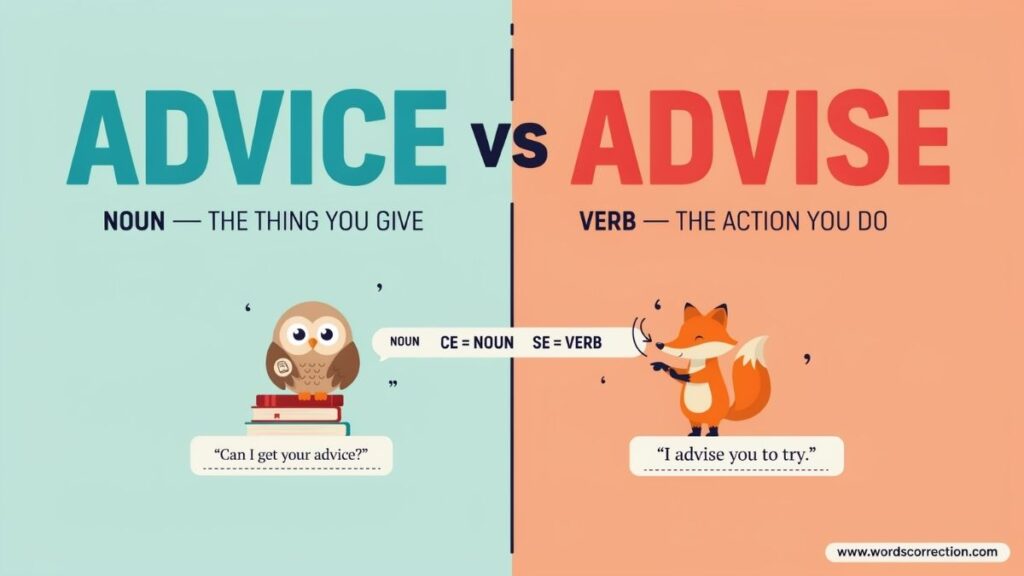
Advice vs advise is a common grammar mistake that can confuse even good writers. These two words look almost the same but they have different meanings and uses. Mixing them up in emails, schoolwork or everyday conversations can lead to awkward sentences. The good news is that learning the difference is easier than you might think. You don’t need to memorize difficult grammar rules or spend hours practicing. With a simple trick and a few clear examples, you can understand when to use each word. Explore the difference between advice and advise so you can write with confidence and avoid common mistakes.
Advice vs Advise Quick Answer
The difference between advice and advise comes down to their parts of speech. Advice is a noun that means guidance or a recommendation. Advise is a verb that means to recommend or offer guidance.
| Feature | Advice | Advise |
|---|---|---|
| Part of speech | Noun | Verb |
| Meaning | Guidance or a recommendation | To recommend or guide |
| Final sound | Unvoiced /s/ sound | Voiced /z/ sound |
| Example | I need your advice. | Please advise me. |
| Common usage | Give someone advice | Advise someone to do something |
Consider these examples
- Advice: My teacher gave me useful advice before the exam.
- Advise: My teacher advised me to review my notes.
In the first sentence, advice refers to the guidance the teacher provided. In the second, advised describes the teacher’s action.
Both words are correct English. The key is choosing the one that fits the sentence.
The Simple Trick to Remember Advice vs Advise
English spelling can be confusing, especially when two words differ by only one letter. Fortunately, you don’t need to memorize complicated grammar rules to distinguish advice from advise.
Use two simple methods: the noun-versus-verb test and the S-versus-Z pronunciation trick.
The Noun vs Verb Test
Ask yourself one question: Am I talking about guidance, or am I describing the act of giving guidance?
- If you’re referring to the guidance itself, use advice.
- If you’re describing the act of recommending or guiding, use advise.
For example
- I asked my manager for career advice.
- My manager advised me to improve my communication skills.
The first sentence names something you requested. The second describes what your manager did.
Here’s another example
- My doctor gave me some advice.
- My doctor advised me to get more rest.
Once you identify the grammatical function, choosing the correct word becomes much easier.
The S vs Z Pronunciation Trick
The final sound offers another useful clue.
- Advice ends with an /s/ sound, as in ice.
- Advise ends with a /z/ sound, as in wise.
Although the spelling difference appears in the letters c and s, the pronunciation difference lies in the final consonant sounds.
Think of it this way advice ends with an unvoiced sound, while advise ends with a voiced sound.
This trick can help you remember the difference in both pronunciation and spelling. However, the noun-versus-verb test is more reliable when editing a sentence because it focuses on meaning and grammar rather than sound alone.
A Quick Memory Shortcut
Remember this simple rule
You give advice. You advise someone.
It can also remember the distinction through these examples
- I appreciate your advice.
- I advise you to consider your options.
If you remember this basic difference, you’ll avoid most common mistakes involving these words.
Learn the difference between more words people mix up
Gopher or Gofer Which Spelling Is Correct?
Advice vs Advise Meaning and Definitions
Although advice and advise share the idea of guidance, they perform different grammatical functions. Understanding their definitions makes it easier to use them correctly in different situations.
What Does Advice Mean?
Advice means guidance, an opinion, or a recommendation about what someone should do. People give advice to help others make decisions, solve problems, or choose an appropriate course of action.
Advice can come from a friend, teacher, doctor, lawyer, manager, or anyone with relevant knowledge or experience.
For example
- My friend gave me useful advice about managing my time.
- She asked her professor for advice before choosing a major.
- The lawyer offered advice about reviewing the contract.
- His parents gave him practical advice about saving money.
- I followed my supervisor’s advice and revised the report.
In each example, advice refers to the guidance itself rather than the action of providing it.
Advice is a noun, specifically an uncountable noun in standard English. This grammatical detail matters because it affects how you use the word in a sentence.
You can say
- I need some advice.
- She gave me valuable advice.
- He offered a piece of advice.
- We received two pieces of advice from the consultant.
However, you generally shouldn’t write an advice or advices when referring to individual recommendations in standard everyday English.
Instead, use a piece of advice for one recommendation and pieces of advice for multiple recommendations.
What Does Advise Mean?
Advise means to recommend something, provide guidance, or tell someone what you think they should do.
Unlike advice, advise is a verb. It describes an action, so its form can change to reflect tense and grammatical structure.
For example
- I advise you to prepare before the interview.
- The teacher advises students to read carefully.
- My manager advised me to submit the report early.
- The consultant is advising the company on its next steps.
- The lawyer advised that the client seek independent counsel.
Each sentence describes someone giving guidance or making a recommendation.
The verb advise also appears in several common sentence patterns.
| Sentence pattern | Example |
|---|---|
| Advise someone to do something | I advise you to check the figures. |
| Advise against something | She advised against buying the car. |
| Advise someone on something | He advised us on the project. |
| Advise that something be done | The committee advised that further research be conducted. |
These patterns are especially useful in professional writing because they help you make recommendations clearly and directly.
Advice vs Advise What’s the Difference?
The difference between advice and advise becomes clearer when you compare them in related sentences.
Consider this example
The financial adviser gave me sound advice and advised me to review my budget.
This sentence uses both words correctly.
- Advice is the noun that identifies the guidance.
- Advised is the past-tense verb that describes the recommendation.
The same distinction applies in other contexts.
| Context | Advice (noun) | Advise (verb) |
|---|---|---|
| Education | The teacher’s advice was helpful. | The teacher advised me to practice. |
| Career | I need career advice. | My mentor advised me to update my résumé. |
| Health | The doctor gave me advice. | The doctor advised me to rest. |
| Business | We requested professional advice. | The consultant advised us to revise the plan. |
| Everyday life | Her advice saved me time. | She advised me to leave early. |
The central rule stays the same regardless of the situation. Advice names the guidance, while advise describes the act of giving it.
Learn the difference between everyday English mistakes
Monkeys or Monkies Which Spelling Is Correct?
Advice vs Advise in a Sentence Everyday Examples
A definition might make sense until you need to use the word yourself. Comparing advice and advise in complete sentences is one of the best ways to understand the difference.
Pay attention to each word’s role rather than relying on spelling alone.
Examples of Advice in Sentences
Use advice when referring to guidance, a recommendation, or an opinion about what someone should do.
- I need your advice before accepting the job offer.
- Her advice helped me prepare for the presentation.
- My parents always give me practical advice.
- He ignored his doctor’s advice and continued working late.
- Thank you for your advice and encouragement.
- The company sought legal advice before signing the agreement.
- She offered me a useful piece of advice about time management.
- Good financial advice can help people make informed decisions.
- His career advice gave me a clearer idea of my goals.
- I would appreciate your advice on this matter.
In every example, advice names the guidance being requested, received, offered, or discussed.
Examples of Advise in Sentences
Use advise when describing the act of giving guidance or recommending a particular action.
- I advise you to read the instructions carefully.
- The teacher advises students to review their notes.
- My supervisor advised me to improve the report.
- The consultant is advising the business on its expansion plans.
- I would advise against making a decision in a hurry.
- The lawyer advised the client to review the agreement.
- Could you advise me on the next steps?
- The company advises customers to keep their receipts.
- She advised us that the meeting had been postponed.
- The trainer advised beginners to start with manageable goals.
The verb can appear in different tenses. Advise, advises, advised, and advising all belong to the same verb family.
Advice vs Advise Examples in Similar Sentences
The easiest way to understand the difference is to compare sentences that express nearly the same idea.
| Advice | Advise |
|---|---|
| I need your advice. | Could you advise me? |
| She gave me advice about my career. | She advised me on my career. |
| His advice was helpful. | He advised me to follow a different approach. |
| We requested legal advice. | We asked the lawyer to advise us. |
| Thank you for your advice. | Thank you for advising me. |
Notice that you can often rewrite a sentence using the other word. However, you’ll need to change the sentence structure to keep the grammar correct.
For example
- Noun: The manager gave us advice.
- Verb: The manager advised us.
Both sentences are correct, but the words serve different grammatical functions.
Learn the difference between basic English word mistakes
Signalling vs Signaling Which Spelling Is Correct?
Please Advise or Advice Which Is Correct?
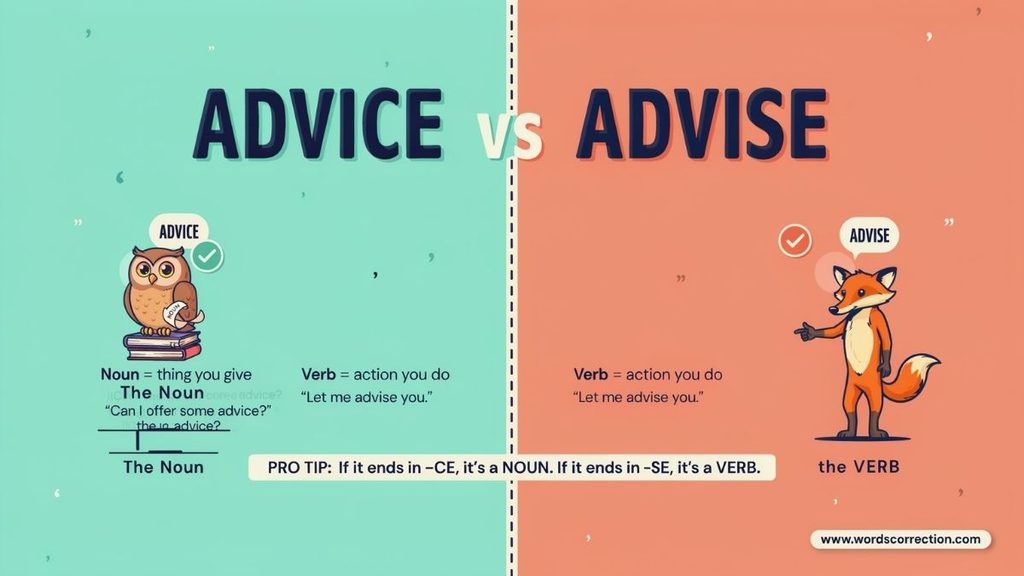
One of the most common sources of confusion in workplace communication is the difference between please advise and please advice. The correct expression is please advise.
The word please introduces a request for an action, and advise is the verb that describes that action.
Consider these examples
- Correct: Please advise me on how to proceed.
- Incorrect: Please advice me on how to proceed.
- Correct: Please advise us if the schedule changes.
- Incorrect: Please advice us if the schedule changes.
The distinction matters in emails, business letters, customer support messages, and professional conversations.
What Does Please Advise Mean?
The phrase please advise means you’re asking someone to provide guidance, a recommendation, or information about what to do next.
For example
The deadline has changed. Please advise us on how to adjust the schedule.
Here, the sender requests guidance about the next steps.
Although the phrase is grammatically correct, it can sound vague if you don’t explain what kind of response you need. In many professional situations, a more specific request sounds clearer and friendlier.
Instead of writing
Please advise.
You could write
Could you please advise me on which form I should submit?
Or
Please let me know whether Friday’s deadline still applies.
Both alternatives make the request more precise.
Writing tip: Use please advise when you genuinely need guidance. If you’re simply requesting information, consider asking a direct question instead.
I Need Your Advice vs Advise What’s Correct?
The correct expression is I need your advice.
The verb need takes a noun phrase in this sentence. The possessive word your also appears before the noun, making advice the appropriate choice.
Compare the following examples
- Correct: I need your advice about my career.
- Incorrect: I need your advise about my career.
- Correct: I would appreciate your advice on this issue.
- Incorrect: I would appreciate your advise on this issue.
Here are a few more expressions to remember
- Ask for advice.
- Give someone advice.
- Offer advice.
- Seek professional advice.
- Follow someone’s advice.
- Thank someone for their advice.
- Receive a piece of advice.
Each expression uses advice because it refers to the guidance itself.
When you want to describe the act of giving guidance, switch to the verb:
- Could you advise me about my career?
- Would you advise me to accept the offer?
- She advised me to speak with my supervisor.
A simple question can help you decide: Does the sentence need a thing or an action? If it needs the guidance itself, use advice. If it needs the act of recommending, use advise.
Learn the difference between often confused words
Sent or Send Which one Is Correct?
Doctor’s Advice or Advise Understanding the Correct Usage
Medical situations provide another useful way to learn the difference. The correct expression is doctor’s advice when you’re referring to the guidance a doctor gives.
For example
- I followed my doctor’s advice.
- She asked for medical advice about her symptoms.
- The doctor gave him a piece of advice about getting enough rest.
Use advise when the doctor performs the action of recommending something:
- The doctor advised him to get more rest.
- The doctor advises patients to follow their prescribed treatment plans.
- The doctor advised her to discuss the side effects with her healthcare professional.
The same rule applies to legal advice, career advice, financial advice, and professional advice.
| Correct noun usage | Correct verb usage |
|---|---|
| The lawyer gave me legal advice. | The lawyer advised me to review the contract. |
| I requested career advice. | My mentor advised me to explore other roles. |
| She received financial advice. | The consultant advised her to compare the available options. |
| We sought professional advice. | The expert advised us to review the proposal. |
The topic doesn’t determine which word you need. The grammatical role determines the correct choice.
Learn the difference between confusing word pairs
Peak or Peek What’s the Difference?
Advice vs Advise Grammar Rules You Should Know
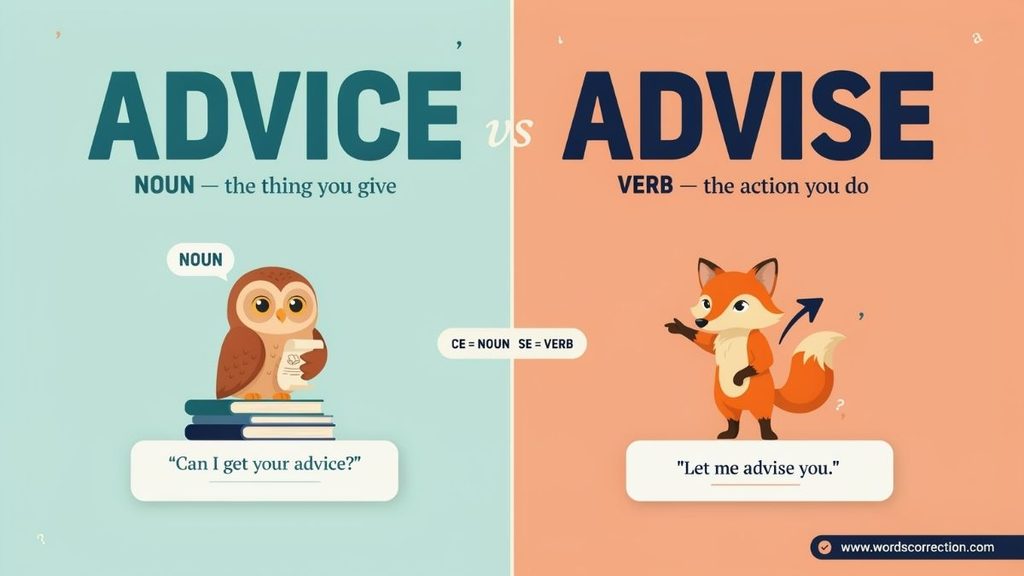
Once you understand the basic difference, a few additional grammar rules will help you use both words confidently.
Advice Is an Uncountable Noun
In standard English, advice is generally an uncountable noun. That means you don’t normally put a or an directly before it, and you don’t add s to make it plural.
These forms are correct
- I need some advice.
- She gave me helpful advice.
- He offered a piece of advice.
- We received three pieces of advice.
- They asked for professional advice.
These forms are generally incorrect when you mean individual recommendations
- I need an advice.
- She gave me several advices.
- He offered two advice.
The solution is simple. Use a piece of advice for one recommendation and pieces of advice when referring to multiple recommendations.
For example
Incorrect: My teacher gave me two useful advices.
Correct: My teacher gave me two useful pieces of advice.
This rule is particularly helpful for English learners because many countable nouns form their plurals by adding s. Advice doesn’t follow that pattern.
Advise Is a Verb That Changes Form
Unlike the noun advice, the verb advise changes according to tense and sentence structure.
| Verb form | Grammatical use | Example |
|---|---|---|
| Advise | Base form | I advise you to prepare early. |
| Advises | Present tense with he, she, or it | She advises new employees. |
| Advised | Past tense or past participle | He advised me yesterday. |
| Advising | Present participle or gerund | They are advising the team. |
Let’s look at each form more closely.
Advise: Use the base form after subjects such as I, you, we, and they in the simple present, or after modal verbs such as should and could.
- I advise you to check the details.
- You should advise the manager immediately.
- They could advise us on the procedure.
Advises: Use this form with a third-person singular subject in the simple present.
- She advises students about course selection.
- The company advises customers to read the instructions.
Advised: Use this form for the past tense and in perfect constructions.
- My supervisor advised me to revise the document.
- The consultant has advised us on the proposal.
Advising: Use this form in continuous verb constructions or when the verb functions as a gerund.
- She is advising the committee.
- Advising new employees takes patience.
Remember that advised and advice aren’t interchangeable. One is a verb form, while the other is a noun.
Learn the difference between commonly confused more words in English
Address vs Adress What’s the Correct Spelling?
What Is the Difference Between Advice, Advise, and Adviser?
These three words are related, but each has a different meaning.
- Advice: The guidance or recommendation.
- Advise: The act of giving guidance or making a recommendation.
- Adviser: A person who provides guidance.
For example
The career adviser gave me advice and advised me to update my résumé.
The sentence uses all three concepts naturally. The adviser is the person, advice is the guidance, and advised describes the action.
You may also encounter advisor, a common alternative spelling of the word for a person who advises, especially in professional titles and institutional names. Both adviser and advisor are accepted in American English.
Learn the difference between tricky grammar more words
Mrs or Miss What’s the Difference?
Advice vs Advise Pronunciation How to Hear the Difference
The pronunciation difference between advice and advise is small but useful. Both words have two syllables and share the same initial vowel sound. The main difference lies in the final consonant.
| Word | IPA pronunciation | Final sound |
|---|---|---|
| Advice | /ədˈvaɪs/ | /s/, as in ice |
| Advise | /ədˈvaɪz/ | /z/, as in wise |
The stress falls on the second syllable in both words.
To practice the difference, say these pairs aloud
- Advice — ice
- Advise — wise
- Advice — price
- Advise — rise
In American English, advice ends with an unvoiced /s/ sound. To make this sound, push air through your mouth without vibrating your vocal cords. For advise, use a voiced /z/ sound, which involves vocal cord vibration.
You can check the difference by placing your fingers lightly against your throat while saying the final sound. You should feel more vibration when pronouncing advise.
Is the Pronunciation Different in American and British English?
The essential distinction remains the same in both American and British English:
- Advice ends in /s/.
- Advise ends in /z/.
Accent can affect how people pronounce vowels and unstressed syllables, but it doesn’t remove this important consonant distinction.
Pronunciation is a helpful memory aid, but spelling and grammar still matter. Even if you pronounce both words correctly, you need to choose the right one for your sentence.
Learn the difference between commonly mixed-up more words
Todays or Today’s Which Is Correct?
Advice vs Advise Common Mistakes and How to Fix Them
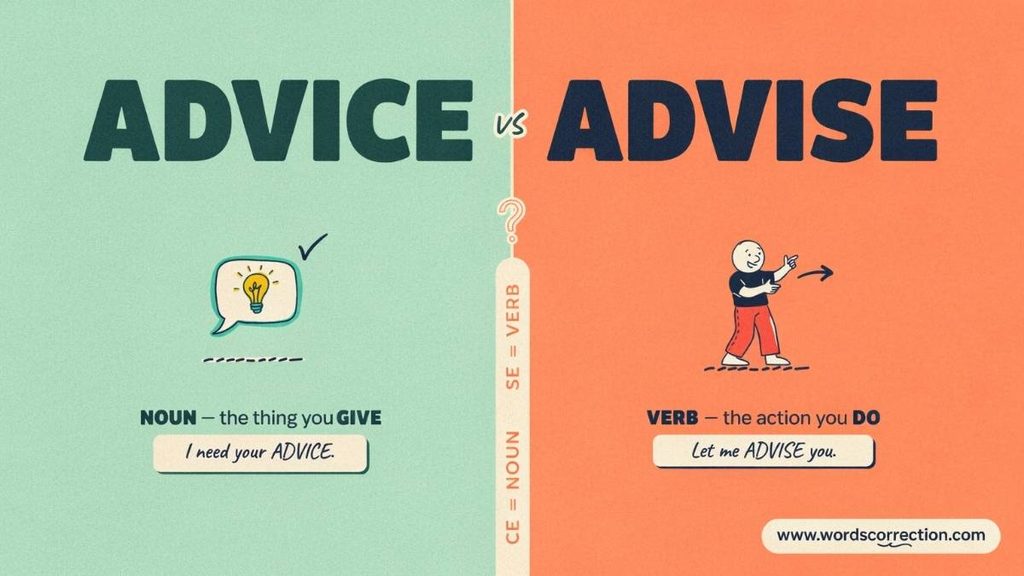
These words belong to a larger group of commonly confused English words. Their similar spelling makes them easy to mix up, especially when you’re writing quickly.
Here are the mistakes to watch for.
| Common mistake | Correct version | Explanation |
|---|---|---|
| I need your advise. | I need your advice. | The sentence requires a noun. |
| Please advice me. | Please advise me. | The sentence requires a verb. |
| She gave me an advice. | She gave me a piece of advice. | Advice is uncountable. |
| He gave me three advices. | He gave me three pieces of advice. | Use pieces of advice for separate recommendations. |
| My manager advice me yesterday. | My manager advised me yesterday. | The past tense is advised. |
| She advice students every day. | She advises students every day. | Use advises with a third-person singular subject. |
| Thank you for your advise. | Thank you for your advice. | Your is followed by a noun here. |
| I would advice you to wait. | I would advise you to wait. | The modal would takes the base verb. |
Mistake: Confusing Advice With Advised
The difference between advice and advised is especially important because the words don’t have the same grammatical function.
Compare
- Advice: Her advice helped me solve the problem.
- Advised: She advised me to speak with the manager.
In the first sentence, advice is a noun. In the second, advised is the past-tense verb.
A useful editing trick is to identify the action in the sentence. If someone recommended something in the past, advised may be the correct choice. If you’re referring to the recommendation itself, use advice.
Mistake Assuming Advices Is the Plural Form
Many English nouns form plurals by adding s, but advice generally doesn’t work that way.
In standard American English, write:
- Some advice
- A piece of advice
- Several pieces of advice
Don’t automatically turn advice into advices when referring to multiple recommendations.
Mistake Using Advice and Advise Interchangeably in Emails
Workplace messages are a common source of confusion. A writer may type please advice because the phrase sounds natural while speaking.
However, the correct expression is please advise. Similarly, I would appreciate your advice requires the noun.
Before sending a professional email, check whether the sentence asks someone to perform an action or refers to guidance itself. This quick review can catch many grammar mistakes.
Learn the difference between confusing more English words
Fulfilment or Fulfillment Which Spelling Is Correct?
Advice vs Advise in Professional and Everyday Writing
Understanding the grammar is only part of the job. You also need to choose the right word in context.
Advice vs Advise in Workplace Emails
Professional communication often involves requesting guidance, making recommendations, or asking colleagues to clarify a decision.
Here are three examples.
Requesting guidance
I would appreciate your advice on the proposed schedule.
The writer requests guidance, so advice is correct.
Asking someone to recommend a course of action
Could you advise me on the best way to handle this request?
The writer asks the other person to perform an action, so advise is correct.
Giving a recommendation
The project manager advised the team to complete the review before Friday.
The verb advised describes the recommendation the manager made.
Advice vs Advise in Academic Writing
Students may use both words when discussing feedback, learning strategies, or recommendations from teachers.
For example:
- My professor gave me valuable advice about my research.
- My professor advised me to narrow the research question.
- I followed my teacher’s advice when revising the essay.
- The instructor advises students to check their citations.
These examples also show how changing the grammatical form can help you avoid repetition in a paragraph.
Advice vs Advise in Everyday Conversations
The same rule applies when talking with friends and family.
- My sister gave me advice about buying a laptop.
- My sister advised me to compare prices first.
- Thanks for your advice.
- I would advise you to leave early to avoid traffic.
You don’t need formal language to use the words correctly. The distinction works in casual conversation just as it does in professional writing.
Advice vs Advise Practical Case Studies
Understanding the rule becomes easier when you see how it works in realistic situations.
Case Study A Workplace Email
Imagine that Maya is writing an email to her supervisor. She wants guidance about an upcoming presentation and drafts the following message:
Hi Alex,
I need your advise about the presentation. Please advice me on how to organize the slides. I would appreciate any suggestions you have.
The message is understandable, but it contains two grammar mistakes.
Here’s the corrected version:
Hi Alex,
I need your advice about the presentation. Please advise me on how to organize the slides. I would appreciate any suggestions you have.
Why is the revised version correct?
- Your advice: Maya refers to the guidance she needs, so she uses the noun.
- Please advise me: Maya asks her supervisor to take an action, so she uses the verb.
- Suggestions: This noun refers to possible ideas Alex might offer.
The example illustrates a useful principle: good grammar doesn’t require complicated rules. Often, you only need to recognize the role a word plays in the sentence.
Case Study A Career Decision
Suppose Jordan is considering a new job. A friend offers guidance about salary negotiations.
Jordan might say
My friend gave me helpful advice and advised me to negotiate the salary before accepting the offer.
Both words fit naturally because the sentence refers to the guidance and the act of providing it.
This is also a useful pattern to remember when writing longer sentences. You can use advice to introduce the recommendation and advised to explain what the person suggested.
These are illustrative scenarios rather than documented real-world events. Their purpose is to demonstrate how the grammar works in situations readers commonly encounter.
Learn the difference between tricky English words with easy explanations
Amid or Amidst What Is the Difference?
How to Use Advice and Advise Correctly A Quick Checklist
Before you submit an assignment, publish an article, or send an email, run through these questions.
- Am I referring to guidance itself? Use advice.
- Am I describing someone recommending an action? Use advise or the appropriate verb form.
- Does the sentence contain my, your, or their before the word? If the sentence refers to guidance, advice is usually the right choice.
- Does the sentence begin with a request such as “Please ___ me”? Use advise.
- Am I counting individual recommendations? Write a piece of advice or pieces of advice.
- Am I describing a recommendation made in the past? Consider advised.
- Am I writing in the present tense about what someone regularly does? Use advise with I, you, we, or they, and advises with he, she, or it.
The checklist is especially useful when editing quickly. Instead of second-guessing the spelling, identify the grammatical function first.
Practice Session Advice vs Advise
1. My teacher gave me useful ______ about improving my writing.
2. I would ______ you to read the instructions carefully.
3. Can you give me some ______ about choosing a career?
4. The doctor will ______ him to get more rest.
5. Thank you for your helpful ______.
6. I strongly ______ you to check your work before submitting it.
7. She asked her manager for ______ about handling the situation.
8. Please ______ me on how to prepare for the interview.
9. My parents always give me good ______.
10. I would like to ______ you to save some money every month.
11. His lawyer will ______ him about his legal options.
12. Could you give me a piece of ______?
13. The teacher tried to ______ the students on their future careers.
14. I need your ______ before making this important decision.
15. Experts ______ people to exercise regularly.
16. She ignored my ______ and made the same mistake again.
17. I would ______ you to arrive at least fifteen minutes early.
18. He asked his colleague to ______ him on the new project.
19. Her grandmother gave her valuable ______ about life.
20. The company hired a consultant to ______ its management team.
21. I appreciate your ______ and support.
22. Please ______ us of any changes to your schedule.
23. My friend gave me excellent ______ on how to improve my résumé.
24. I would never ______ someone to make a decision without thinking carefully.
25. Before you make your final choice, ask someone you trust for ______.
Answers
- Advice
- Advise
- Advice
- Advise
- Advice
- Advise
- Advice
- Advise
- Advice
- Advise
- Advise
- Advice
- Advise
- Advice
- Advise
- Advice
- Advise
- Advise
- Advice
- Advise
- Advice
- Advise
- Advice
- Advise
- Advice
Here’s a trusted source for clear word meanings:
Cambridge Dictionary
FAQ’s
When should I use advice and advise?
Use advice when referring to guidance or a recommendation. Use advise when describing the act of giving guidance. For example, “I need your advice” is correct because advice is a noun, while “I advise you to wait” uses advise as a verb.
Should I say Can you please advise me or Can you please advice me?
“Can you please advise me?” is correct. The sentence asks someone to provide guidance, so it requires the verb advise rather than the noun advice.
Is it correct to say Can I give you some advice?
Yes. “Can I give you some advice?” is grammatically correct because advice is the noun that refers to the guidance being offered. The phrase “give you some advise” is incorrect.
How do you use advise in a sentence?
Use advise when recommending an action or providing guidance. For example, “I advise you to review the contract before signing it.” You can also write, “The consultant advised us on the project.”
Is Please advise grammatically correct?
Yes. “Please advise” is grammatically correct and commonly used in professional communication when requesting guidance or a recommendation. For greater clarity, specify what you need help with, such as “Please advise me on the next steps.”
Should I write I need advice or I need advise?
“I need advice” is correct because the sentence requires a noun. Advice refers to the guidance you need, whereas advise is a verb that describes the act of giving guidance.
Is it I advice you or I advise you?
“I advise you” is correct. Advise is the verb that means to recommend or guide someone. Advice is a noun and cannot replace the verb in this sentence.
Is I need some advice grammatically correct?
Yes. “I need some advice” is grammatically correct because advice is an uncountable noun. You can also say “I need a piece of advice” when referring to one specific recommendation.
Should I say I need your advice or I kindly need your advice?
“I need your advice” is correct and natural. In professional communication, “I would appreciate your advice” or “I would be grateful for your guidance” often sounds more polished and courteous.
What is a more polite alternative to Please advise?
You can write “Could you please let me know what you recommend?” or “I would appreciate your guidance on this matter.” These alternatives sound courteous and make your request more specific.
Is I need an advice correct English?
No. In standard English, advice is an uncountable noun and does not normally take the article an. Write “I need some advice” or “I need a piece of advice” instead.
Is Please advise appropriate for professional emails?
Yes. “Please advise” is acceptable in professional emails when requesting direction, clarification, or a recommendation. However, a specific question often sounds more helpful. For example, “Could you advise me on how to proceed with the application?”
What is the easiest way to remember the difference between advice and advise?
Remember this simple rule: You give advice, but you advise someone. Advice names the guidance, while advise describes the action of providing it.
What is the plural form of advice?
Advice generally has no plural form in standard English. When referring to multiple recommendations, use “pieces of advice.” For example, “She gave me three pieces of advice” is correct.
What is the past tense of advise?
The past tense of advise is advised. For example, “My manager advised me to revise the report.” The noun advice does not change to show tense.
What is the difference between advice, advise, and advisory?
Advice is a noun meaning guidance or a recommendation. Advise is a verb meaning to provide guidance. Advisory can function as an adjective, as in “an advisory committee,” or as a noun referring to an official notice or recommendation.
Why are advice and advise pronounced differently?
Advice ends with an unvoiced /s/ sound, while advise ends with a voiced /z/ sound. This distinction helps you recognize the words when speaking. However, their grammatical roles are the most reliable way to choose the correct word in writing.
Can advice and advise appear in the same sentence?
Yes. You can use both words in one sentence when referring to guidance and the act of providing it. For example, “My teacher gave me useful advice and advised me to practice every day.”
Is Thank you for your advice correct?
Yes. “Thank you for your advice” is grammatically correct because advice is a noun referring to the guidance someone provided. The expression “Thank you for your advise” is incorrect.
Should I use advice on or advice about?
Both expressions are correct. Use “advice on” when referring to a particular subject or issue, such as “advice on grammar.” Use “advice about” when discussing a topic or situation, such as “advice about choosing a career.”
Is advise me on grammatically correct?
Yes. “Advise me on” is a correct expression used when asking someone for guidance about a subject, decision, or situation. For example, “Could you advise me on the best approach to this project?”
What is the difference between a piece of advice and some advice?
Both expressions are correct. “A piece of advice” refers to one recommendation, while “some advice” refers to an unspecified amount of guidance. For example, “She gave me a piece of advice” and “She gave me some advice” are both grammatically correct.
Is I was advised correct English?
Yes. “I was advised” is grammatically correct. It uses the passive voice to indicate that someone gave you guidance without identifying that person. For example, “I was advised to submit the application early.”
What is the difference between advice and suggestion?
Advice generally provides guidance about what someone should do, while a suggestion presents an idea or possible course of action. For example, “My mentor gave me career advice” refers to guidance, while “My colleague suggested a different meeting time” presents an alternative idea.
How can I tell whether to use advice vs advise in my writing?
Identify the grammatical role the word needs to play. If you need a noun referring to guidance, use advice. If you need a verb describing the act of recommending or guiding, use advise or its appropriate form, such as advises, advised, or advising. For example, “I need your advice” and “Please advise me” are both correct.
Learn the difference between confusing more English words step by step
Bare or Bear What’s the Difference?
Final Thoughts
Confusing advice and advise can make even a simple sentence feel like a grammar puzzle. The good news is that you now know the trick to telling them apart. Advice is a noun that means a suggestion or recommendation, while advise is a verb that means to give guidance. Remember this simple difference, practice with a few examples, and you’ll be less likely to mix them up. After all, English has enough confusing rules without letting two nearly identical words cause trouble! Keep practicing, use each word with confidence, and let your grammar mistakes become lessons rather than habits.

Stella AJS is an experienced blogger and dedicated English language writer at Words Correction. She turns confusing grammar, word meanings, spelling, and usage into clear, practical insights that readers can easily understand and apply. With a passion for precise and engaging writing, Stella helps readers avoid common language mistakes, strengthen their vocabulary, and communicate with greater clarity and confidence.




