
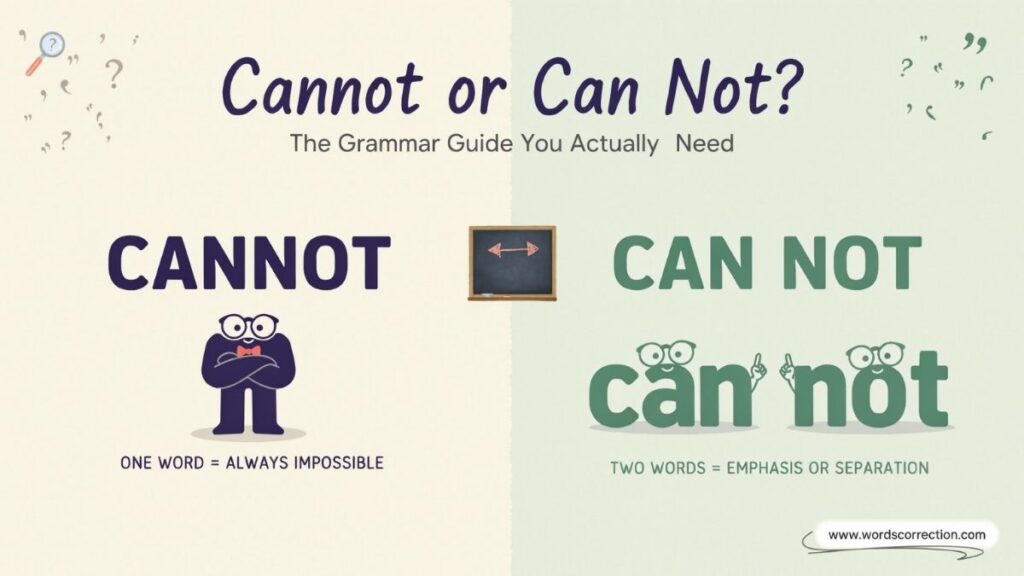
Choosing between cannot or can not can be confusing because both forms look almost identical. However, each has a specific use in English grammar. The good news is that the difference is easy to understand. In this guide, you’ll learn when to use cannot and can not, explore simple examples, and understand the rules behind each form. You’ll also discover common mistakes to avoid and practical tips to improve your writing. By the end, you’ll know which form to use in different situations and feel more confident using both correctly.
Cannot or Can Not Which Spelling Is Correct?
Cannot is the correct default spelling when you want to negate the modal verb can. In standard English, writers generally combine can and not into one word to express inability, impossibility, or prohibition.
Consider these examples
- I cannot open the file.
- She cannot attend the interview.
- You cannot enter the building without permission.
- This explanation cannot be correct.
- We cannot finish the assignment without the missing information.
In each sentence, cannot expresses a negative meaning. It tells the reader that an action is not possible, permitted, or achievable under the circumstances.
However, can not is not automatically incorrect. The two-word spelling is appropriate in particular grammatical constructions, including sentences that use not only … but also.
For example
The training program can not only improve communication but also strengthen teamwork.
Here, not only introduces the first of two related benefits, while but also introduces the second. The word not does not simply negate can. Instead, it forms part of a construction that emphasizes an additional point.
The key rule is straightforward
- Use cannot for ordinary negative statements.
- Use can not when the sentence’s grammatical structure or intended emphasis supports two separate words.
- Use can’t when you want the contraction of cannot, particularly in conversational writing.
If you are unsure which form to choose, cannot is usually the safest option.
Learn the difference between more words people mix up
Each Other or Eachother Which Spelling Is Correct?
What Does Cannot Mean?
The definition of cannot is simple: cannot is the negative form of the modal verb can, expressing inability, impossibility, or lack of permission.
The modal verb can helps express ability, possibility, and permission. Adding not makes the meaning negative.
For example
- I can swim. The speaker has the ability to swim.
- I cannot swim. The speaker lacks that ability.
- You can leave. The speaker indicates that leaving is permitted or possible.
- You cannot leave. Leaving is not permitted or possible in the situation.
The meaning depends on the surrounding sentence. Cannot does not always indicate physical inability. It can also express a logical conclusion, a restriction, or a lack of opportunity.
Cannot as a Negative Modal Verb
In English grammar, can is a modal auxiliary verb. Modal verbs work with other verbs to express ideas such as ability, permission, possibility, and obligation.
The negative form cannot follows the same basic sentence structure as can.
Structure
Subject + cannot + base form of the verb
Examples
- She cannot drive.
- They cannot agree.
- He cannot remember the password.
- We cannot proceed without approval.
Notice that the verb after cannot stays in its base form. You write cannot go, not cannot goes or cannot to go.
This rule matters because writers sometimes add an unnecessary to after a modal verb. Standard English uses can go, cannot go, can understand, and cannot understand.
The Three Main Meanings of Cannot
Cannot commonly expresses three related ideas.
Inability
Use cannot when someone lacks the ability, resources, or opportunity to do something.
Examples:
- I cannot lift this box by myself.
- She cannot attend the conference because she has another commitment.
- We cannot access the account without the correct password.
Impossibility
Use cannot when a situation seems logically or practically impossible.
Examples:
- That cannot be the correct answer.
- The package cannot have arrived yet because it was shipped this morning.
- This device cannot operate without electricity.
In the second example, cannot have arrived expresses a conclusion about a past event. The structure combines cannot with have and a past participle.
Learn the difference between everyday English mistakes
Patient or Patience what’s the Difference?
Prohibition or lack of permission
Use cannot when a rule or authority prohibits an action.
Examples
- Visitors cannot enter this area.
- Employees cannot share confidential information with unauthorized people.
- You cannot park in front of the emergency exit.
These meanings can overlap. Context tells the reader whether the sentence describes inability, impossibility, or a restriction.
Cannot vs Can Not What’s the Difference?
The main difference between cannot and can not lies in how the words function in a sentence. Although both spellings exist, standard English generally uses cannot for ordinary negation and reserves can not for specific grammatical contexts.
The distinction becomes clearer when you compare their sentence structures.
| Feature | Cannot | Can Not |
|---|---|---|
| Spelling | One word | Two words |
| Typical use | Ordinary negative statements | Specific constructions and contexts |
| Meaning | Inability, impossibility, or prohibition | Depends on the grammatical structure |
| Example | I cannot stay late. | We can not only save time but also reduce costs. |
| Best default choice | Yes | Only when the context supports it |
Why Is Cannot Written as One Word?
English spelling conventions often combine words that function together as a single grammatical unit. Cannot is the established one word spelling of the negative form of can.
Rather than treating can and not as separate words in an ordinary negative statement, standard written English uses the closed form cannot.
For example
- Preferred: I cannot find my keys.
- Standard negative form: She cannot come today.
- Preferred: They cannot afford the expense.
Writing can not in these sentences is not the usual spelling choice. Although readers will generally understand the intended meaning, the separated form may look inconsistent in polished professional or academic writing.
The important point is that the distinction is not simply a matter of formality. It depends primarily on grammar and meaning.
When to Use Cannot
Use cannot when you want to negate the ability, possibility, or permission expressed by can.
Examples include
- I cannot answer that question.
- You cannot change the results after submission.
- The company cannot accept applications after the deadline.
- We cannot assume that every customer has the same needs.
In each case, cannot acts as the negative modal form. You do not need to separate the words to create emphasis or change the sentence’s meaning.
When to Use Can Not
Use can not when the sentence’s construction supports the separation of can and not. One of the clearest examples is the not only … but also construction.
Consider this sentence
The updated software can not only process data faster but also identify errors more accurately.
The phrase not only introduces the first item in a pair. The words but also introduce the second. Because not belongs to this larger construction, the sentence naturally uses can not only rather than cannot only.
The same structure works in many contexts
- This course can not only teach grammar but also improve writing skills.
- The new policy can not only lower costs but also reduce waste.
- Regular proofreading can not only catch spelling errors but also improve clarity.
A second possible use involves deliberate contrast or emphasis. For example, a writer might separate can and not to highlight the negative element in a carefully constructed sentence. Such uses are less common and can sound awkward without a clear grammatical reason.
For most ordinary negative statements, however, use cannot.
Learn the difference between commonly misused words
In Person vs In-Person When to Use the Hyphen
Cannot or Can Not in Formal and Academic Writing
Formal writing requires consistent spelling, clear sentence structure, and precise word choice. The distinction between cannot and can not matters because readers expect standard English usage in academic essays, reports, applications, and professional documents.
Cannot in Formal Writing
Cannot is fully acceptable in formal writing. In fact, it is generally the preferred spelling for ordinary negative statements.
Examples
- The available evidence cannot establish a direct causal relationship.
- Researchers cannot draw a reliable conclusion from a single observation.
- The proposed method cannot account for every variable.
- The organization cannot approve the request without additional documentation.
These sentences sound professional because they communicate their meaning directly. There is no need to replace cannot with a more complicated expression simply to make the writing seem formal.
Can Not in Formal Writing
The two-word form also appears in formal and academic writing when the grammar calls for it.
For example
This approach can not only improve measurement accuracy but also reduce the risk of human error.
Here, can not only is grammatically appropriate because it introduces a paired construction.
However, consider a different sentence:
The researcher can not confirm the findings.
If the intended meaning is simply that the researcher is unable to confirm the findings, the researcher cannot confirm the findings is the more conventional choice.
When editing academic work, do not separate can and not merely because the sentence feels formal. Check the grammatical structure first.
Should You Use Cannot or Can’t in Formal Writing?
Both cannot and can’t are standard English forms, but they suit different tones.
| Situation | Recommended form | Example |
|---|---|---|
| Academic essay | Cannot | The results cannot support that conclusion. |
| Business report | Cannot | We cannot approve the request yet. |
| Formal letter | Cannot | Unfortunately, we cannot offer a refund. |
| Friendly email | Can’t or cannot | I can’t attend tomorrow. |
| Casual conversation | Can’t | I can’t believe it! |
In academic writing, cannot is usually the safer choice. Contractions are not inherently incorrect, but some instructors, publishers, or organizations prefer that writers avoid them in formal work.
Follow the style guide or assignment instructions when they specify a preference.
Learn the difference between basic English word mistakes
Color or Colour Which Spelling Is Correct?
Cannot in American English and British English
Does British English use cannot or can not? What about American English?
The answer is the same for both: cannot is the standard one-word spelling in American and British English.
The ordinary negative form does not change between these varieties of English.
American English examples
- I cannot find the receipt.
- Students cannot use their phones during the examination.
- The company cannot guarantee delivery by Friday.
British English examples
- I cannot find the receipt.
- Visitors cannot enter the premises without authorization.
- We cannot guarantee that the service will be available.
The spelling remains cannot. Differences between American and British English may affect other words, punctuation conventions, or preferred expressions, but they do not make can not the required default in either variety.
If you are writing for an American audience, use cannot for ordinary negation. If you are writing for a British audience, the same rule applies.
Learn the difference between often confused words
Flier or Flyer Which Spelling Is Correct?
Cannot, Can’t, Cant, and Can Not Understanding the Differences
Several similar-looking forms can confuse readers and language learners. Although they share letters, they do not all serve the same grammatical purpose.
Cannot vs Can’t
Can’t is the contraction of cannot. Both forms express negation, but they differ in style.
Examples
- I cannot attend the meeting.
- I can’t attend the meeting.
Both sentences mean that the speaker cannot attend. The first uses the full form, while the second uses the contraction.
Contractions combine words and replace omitted letters with an apostrophe. In can’t, the apostrophe marks the omitted letters in the contracted form.
Use cannot when you want a neutral, professional, or more formal tone. Use can’t when a conversational tone feels natural and suits your audience.
Neither form is universally better. The context determines the most appropriate choice.
Cannot vs Cant
The word cant, without an apostrophe, has its own meanings. It can refer to insincere or conventional language, specialized jargon, or a slant or tilt in certain technical contexts.
For example
- The speech was full of political cant.
- The carpenter adjusted the cant of the board.
These meanings have nothing to do with the ordinary negative form of can.
Compare the forms:
- Cannot: I cannot attend the event.
- Can’t: I can’t attend the event.
- Cant: The speaker relied on empty cant.
If you mean that someone is unable to do something, use cannot or can’t. Do not omit the apostrophe from can’t and write cant.
Cannot vs Can’t Not
The phrase can’t not differs from both cannot and can not.
In can’t not, the contraction already contains a negative, and the second not adds another layer of negation. In everyday English, the expression often means that someone feels unable to avoid an action.
For example
I can’t not tell her the truth.
This means the speaker feels compelled to tell the truth. Remaining silent may feel impossible or unacceptable.
Compare that with
I cannot tell her the truth.
This usually means the speaker is unable to tell her the truth, whether because of circumstances, restrictions, or personal limitations.
The two sentences can communicate very different intentions.
Another example
- I can’t not respond. I feel that I must respond.
- I cannot respond. I am unable or not permitted to respond.
Double negatives can be confusing, so use can’t not only when the intended meaning is clear. In formal writing, a more direct alternative may work better, such as I feel compelled to respond.
Learn the difference between confusing word pairs
It’s vs Its What’s the Difference?
Cannot vs Will Not vs Could Not
Choosing the right negative verb form helps you communicate whether someone lacks the ability to act, refuses to act, or could not act in the past.
Although cannot, will not, and could not may look similar, they express different meanings.
| Expression | Main meaning | Example |
|---|---|---|
| Cannot | Present inability, impossibility, or prohibition | I cannot attend the meeting today. |
| Will not | Refusal, unwillingness, or a future negative outcome | I will not accept those terms. |
| Could not | Past inability or a negative possibility in certain contexts | I could not attend yesterday. |
Cannot Inability or Prohibition
Use cannot when an action is not possible or permitted.
- I cannot drive because I do not have a license.
- You cannot enter the laboratory without protective equipment.
The first example describes a limitation. The second communicates a restriction.
Will Not Refusal or Future Outcome
Use will not when someone refuses to do something or when a negative future outcome is expected.
- She will not change her decision.
- The package will not arrive before Monday.
In the first sentence, will not expresses refusal. In the second, it describes an expected future event.
Could Not Past Inability
Use could not to describe an inability in the past.
- I could not open the door yesterday.
- They could not attend the meeting because their flight was delayed.
The distinction matters because replacing one expression with another can change the intended meaning. Someone who cannot attend may be unavailable, while someone who will not attend may be refusing to go.
Learn the difference between tricky grammar more words
Canceled vs Cancelled Which Spelling Is Correct?
Cannot or Can Not Example Sentences
Examples make the grammar easier to understand because they show how each form works in context. The following sentences cover ordinary negative statements, formal writing, and constructions that require two words.
Cannot Sentence Examples
Use cannot when the sentence expresses ordinary negation.
| Example sentence | Meaning |
|---|---|
| I cannot find my phone. | The speaker is unable to locate the phone. |
| She cannot attend the meeting. | She is unable to attend. |
| We cannot ignore the warning. | Ignoring the warning is not possible or advisable. |
| You cannot enter without a ticket. | Entry is not permitted without a ticket. |
| This answer cannot be correct. | The speaker considers the answer impossible or highly unlikely. |
| He cannot remember where he parked. | He is unable to recall the location. |
| The team cannot finish without more time. | The team lacks the time needed to finish. |
| The company cannot guarantee immediate delivery. | The company cannot promise that delivery will happen immediately. |
Notice how the meaning changes with context. In one sentence, cannot expresses a physical limitation. In another, it communicates a rule or a logical conclusion.
Learn the difference between similar English words the easy way
Whose or Who’s What’s the Difference?
Can Not Sentence Examples
The following examples demonstrate legitimate two-word constructions.
| Example sentence | Why can not works |
|---|---|
| This method can not only save money but also reduce waste. | Not only … but also connects two benefits. |
| The new policy can not only improve safety but also increase efficiency. | The sentence pairs two results. |
| This exercise can not only strengthen your vocabulary but also improve your grammar. | The construction emphasizes two related benefits. |
These examples follow a recognizable pattern:
Subject + can + not only + first benefit + but also + second benefit
The pattern allows the writer to emphasize that something produces more than one result.
Compare
- The method cannot reduce costs.
- The method can not only reduce costs but also improve quality.
The first sentence denies that the method can reduce costs. The second says that it can reduce costs and improve quality.
The placement of not changes its grammatical role and therefore changes the meaning.
Can Not in a Sentence A Note About Emphasis
Some writers separate can and not to create a contrast or emphasize a negative element. However, the distinction can be subtle, and the construction may sound unnatural if the context does not support it.
For instance
You can not accept the offer if the conditions are unreasonable.
Depending on the intended structure, this sentence may be read as a separated can and not, but it can also confuse readers. If the meaning is simply that accepting the offer is not required, a clearer version would be:
You do not have to accept the offer if the conditions are unreasonable.
If the intended meaning is that acceptance is impossible or prohibited, write:
You cannot accept the offer if the conditions are unreasonable.
Practical lesson: Do not force can not into a sentence just to create emphasis. If a clearer construction communicates your meaning, use it.
Learn the difference between commonly mixed-up more words
Happy New Year or Happy New Years Which Is Correct?
Common Mistakes When Using Cannot or Can Not
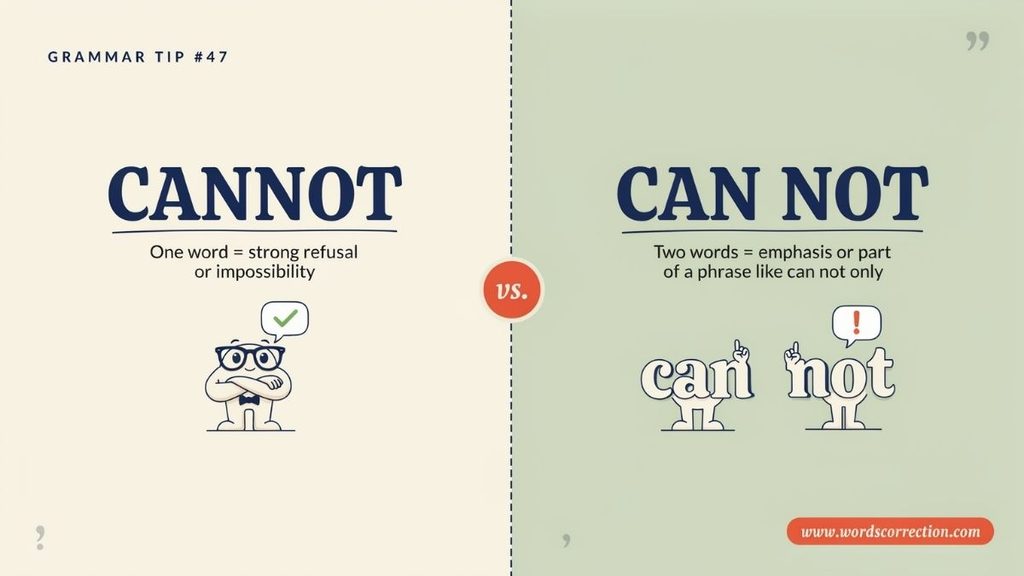
Even experienced writers can mix up these forms when they focus on spelling instead of sentence structure. Fortunately, a few simple checks can prevent most errors.
Mistake Writing Can Not for Ordinary Negation
Less conventional for ordinary negation:
I can not attend the appointment.
Preferred standard spelling:
I cannot attend the appointment.
When you simply mean that you are unable to attend, cannot is the conventional choice.
Mistake Writing Cant Without an Apostrophe
Incorrect:
I cant come to work today.
Correct:
I can’t come to work today.
You can also write I cannot come to work today. The apostrophe matters when you use the contraction can’t.
Mistake Assuming Can Not Is Always Wrong
Incorrect rule:
Can not is never grammatically correct.
Better rule: Cannot is the standard negative form, but can not can be correct in specific grammatical constructions.
For example:
The program can not only identify errors but also suggest corrections.
Here, separating the words supports the not only … but also structure.
Mistake Confusing Cannot With Can’t Not
These expressions do not mean the same thing.
- I cannot leave. I am unable or not permitted to leave.
- I can’t not leave. I feel that I must leave or cannot reasonably avoid leaving.
If the double negative makes your sentence difficult to understand, rephrase it. Clear writing is more important than clever wording that leaves readers guessing.
Mistake Adding To After Cannot
Incorrect:
She cannot to attend the meeting.
Correct:
She cannot attend the meeting.
Modal verbs such as can, could, will, and should take the base form of the following verb without to.
This is one of the most useful grammar rules to remember when learning how to use cannot.
Learn the difference between confusing more English words
Grey or Gray Which Spelling Is Correct?
A Simple Trick to Remember Cannot vs Can Not
If you need a quick memory trick, start with the ordinary negative meaning.
When can expresses ability or permission and you want to make it negative, write cannot as one word.
Then check whether the sentence contains a construction that requires not to function separately.
Try this three-step test:
- Ask whether you simply mean that something is not possible or permitted.
- If yes, use cannot.
- If the sentence contains a structure such as not only … but also, check whether can not is the correct form.
For example:
- I cannot solve this problem. This is ordinary negation.
- The technique can not only solve the problem but also prevent it from happening again. This is a paired construction.
This simple test works for most everyday writing and helps you avoid unnecessary spelling mistakes.
Practice Sessions
Fill in the Blanks
Complete each sentence with cannot or can not.
- I ______ come to the party because I have to study.
- Sara ______ find her phone anywhere.
- You ______ enter the room without permission.
- Ahmed can ______ only speak English but also understand it well.
- We ______ go outside because it is raining heavily.
- My little brother ______ tie his shoes by himself.
- I ______ attend the meeting because I am feeling sick.
- She can ______ only cook delicious meals but also bake cakes.
- You ______ use your phone during the exam.
- They ______ finish the project without more time.
- I ______ believe that we won the match!
- He ______ come to work today because he has a fever.
- Students ______ submit their homework after the deadline.
- She can ______ only sing beautifully but also play the guitar.
- We ______ find a taxi because the roads are busy.
- You ______ borrow my laptop without asking me first.
- My friend ______ join us for dinner tonight.
- He can ______ only teach mathematics but also explain science clearly.
- I ______ open this jar because the lid is too tight.
- They ______ enter the building after it closes.
Answers
- cannot
- cannot
- cannot
- not
- cannot
- cannot
- cannot
- not
- cannot
- cannot
- cannot
- cannot
- cannot
- not
- cannot
- cannot
- cannot
- not
- cannot
- cannot
Quick tip: Use cannot in ordinary negative sentences. In the pattern can not only … but also …, the missing word is not.
Here’s a trusted source for clear word meanings:
Cambridge Dictionary
FAQ’s about Cannot or Can Not
Which is correct cannot or can not?
“Cannot” is the standard spelling for the negative form of “can.” “Can not” is also correct in specific constructions, particularly when “not” belongs to a separate phrase, such as “You can not only save time but also reduce costs.”
Is cannot one word or two?
“Cannot” is written as one word in standard negative statements. For example, “I cannot attend the meeting” is the conventional form.
What does cannot mean?
“Cannot” expresses inability, impossibility, or lack of permission. For example, “I cannot lift this box” describes an inability, while “Visitors cannot enter this area” expresses a restriction.
Is can’t grammatically correct?
Yes. “Can’t” is the contraction of “cannot” and is grammatically correct in everyday speech, informal writing, and many professional contexts. The full form may be more suitable when a formal tone is required.
What is the difference between cannot and can’t?
Both forms express the same basic negative meaning. “Cannot” is the full form, while “can’t” is its contraction. The choice usually depends on tone, formality, and the writing context.
When should you use cannot in a sentence?
Use “cannot” when expressing an inability, a restriction, or something that is impossible. For example, “The system cannot process the request without valid information.”
When is can not correct in English?
“Can not” is appropriate when “not” forms part of a separate construction or receives separate emphasis. A common example is “He can not only explain the problem but also suggest a solution.”
Why is cannot usually preferred over can not?
“Cannot” is the conventional spelling of the negative modal verb in ordinary sentences. Using it avoids unnecessary separation and follows standard written English usage.
Can cannot begin a sentence?
Yes. “Cannot” can begin a sentence when the subject appears before it in an appropriate construction, although this is less common. For example, “Cannot the issue be resolved another way?” is a formal question. In everyday English, “Can’t the issue be resolved another way?” sounds more natural.
What is the difference between cannot and could not?
“Cannot” generally refers to present inability, impossibility, or lack of permission. “Could not” often refers to past inability or a situation that is not possible under particular conditions. For example, “I cannot open the file” describes a current problem, while “I could not open it yesterday” refers to the past.
Is cannot appropriate for academic writing?
Yes. “Cannot” is suitable for academic papers, research reports, essays, and formal analyses. It provides a clear, direct alternative to the contraction “can’t.”
What is a formal alternative to can’t?
Common alternatives include “cannot,” “am unable to,” and “am not in a position to.” The best choice depends on the intended meaning. For example, “I am unable to attend the conference” is appropriate in a formal email.
What is a polite way to say I cannot?
You can say, “Unfortunately, I won’t be able to attend,” or “I’m afraid I’m unable to help with that request.” These expressions communicate a limitation politely without sounding unnecessarily abrupt.
Can cannot express prohibition?
Yes. “Cannot” can indicate that an action is not permitted. For example, “Employees cannot share confidential information with unauthorized individuals” expresses a rule rather than a physical inability.
How do you use cannot with infinitive verbs?
Place “cannot” before the base form of a verb, usually with “to” when the verb requires an infinitive construction. For example, “I cannot afford to buy a new car.” In this sentence, “cannot” is followed by “afford,” and “afford” is followed by “to buy.”
Is cannot be grammatically correct?
Yes. “Cannot be” is correct when expressing impossibility, a restriction, or a negative conclusion. For example, “This answer cannot be correct” indicates that the answer is considered impossible or inconsistent with the evidence.
What is the difference between cannot and will not?
“Cannot” generally expresses inability, impossibility, or lack of permission. “Will not” usually expresses refusal, unwillingness, or a future negative action. For example, “I cannot attend because I’m ill” describes an inability, while “I will not attend because I disagree” expresses a decision.
Can cannot be used in negative questions?
Yes. “Cannot” can appear in negative questions to express surprise, make a suggestion, or ask whether something is possible. For example, “Cannot we find a better solution?” is grammatically correct, although “Can’t we find a better solution?” is more common in conversation.
Is cannot the same as can never?
No. “Cannot” expresses inability, impossibility, or lack of permission, while “can never” emphasizes that something is never possible or never happens. For example, “I cannot access the account” describes a limitation, whereas “I can never remember that password” emphasizes repeated difficulty.
Should you write cannot or can not in business emails?
Use “cannot” for standard negative statements in business emails. For example, “We cannot approve the request without the required documents.” Use “can not” only when the sentence structure calls for the separate words.
What is the difference between cannot and may not?
“Cannot” can express inability or prohibition, while “may not” often expresses a lack of permission or uncertainty about a future event. For example, “You cannot enter this room” states a restriction, while “You may not need additional documents” suggests that additional documents might not be necessary.
Is cannot used in both American and British English?
Yes. “Cannot” is standard in both American and British English. The spelling and basic grammatical usage are the same in both varieties.
What common mistakes should you avoid when using cannot?
The most common mistake is writing “can not” in an ordinary negative statement when “cannot” is the standard choice. Writers should also avoid using “cannot” when they mean “will not,” since inability and refusal express different meanings.
How do you use cannot in a negative sentence?
“Cannot” already makes the sentence negative, so you generally do not need another negative word to express the same idea. For example, write “I cannot find my keys,” rather than “I cannot not find my keys,” unless the double negative is intentional and has a specific meaning.
How can you remember when to use cannot?
Remember this simple rule: use “cannot” for ordinary negative statements and reserve “can not” for constructions in which “not” has a separate grammatical role. When in doubt, “cannot” is the safest standard choice.
Learn the difference between tricky words and use them correctly
To That Effect or To That Affect Which Is Correct?
Conclusion
Choosing between cannot or can not is easier when you understand the basic grammar rules. In most negative sentences, cannot is the correct choice. However, can not is used in specific constructions, such as “can not only … but also.” Paying attention to the sentence structure will help you avoid common mistakes and write more clearly.
Remember, a small space can make a difference, but there’s no need to overthink every sentence. Practice these rules, use the correct form in context, and you’ll soon feel more confident using both forms in your writing.

Stella AJS is an experienced blogger and dedicated English language writer at Words Correction. She turns confusing grammar, word meanings, spelling, and usage into clear, practical insights that readers can easily understand and apply. With a passion for precise and engaging writing, Stella helps readers avoid common language mistakes, strengthen their vocabulary, and communicate with greater clarity and confidence.




