
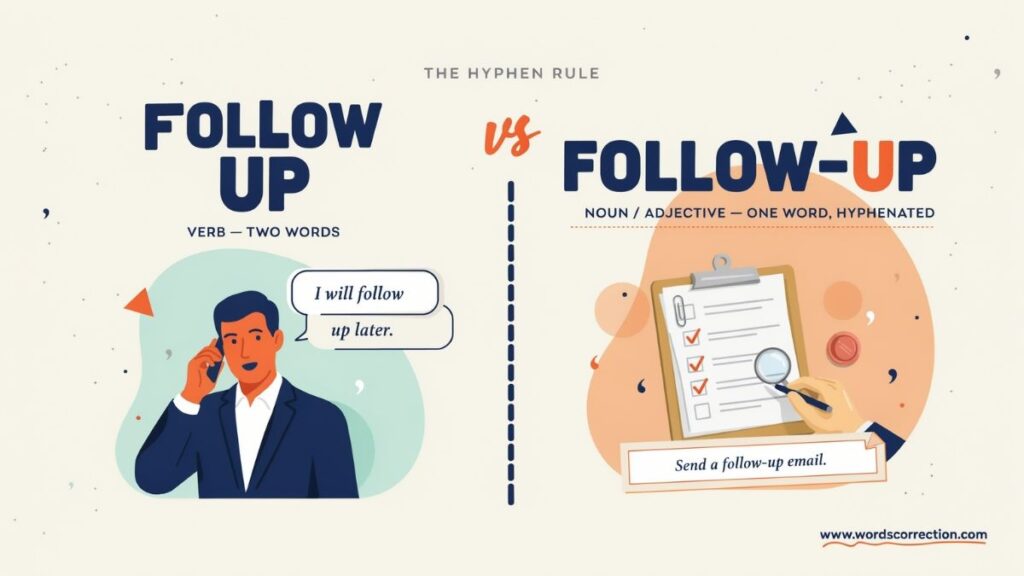
English grammar can be surprisingly confusing, especially when similar looking expressions follow different spelling rules. Follow up vs follow-up is a common example that often leaves writers wondering whether to use two separate words, add a hyphen or combine them into one. Although the difference may seem minor, choosing the wrong form can affect the clarity and professionalism of your writing. Fortunately, the rule is simple once you understand how each expression functions in a sentence. Let’s explore their meanings grammatical differences practical examples and common mistakes to help you use both forms accurately and confidently.
Quick Answer Follow Up vs Follow-Up?
Both follow up vs follow-up are correct. However, the right spelling depends on the expression’s role in a sentence.
- Follow up: Use two separate words when describing an action. It means contacting someone again, checking progress, or taking additional steps.
- Follow-up: Use a hyphen when the expression functions as a noun or adjective. It refers to a subsequent action, communication, meeting, or event.
- Followup: Avoid this one-word spelling in standard edited American English. The accepted forms are follow up vs follow-up.
Examples
- Verb: I will follow up with the customer tomorrow.
- Noun: We scheduled a follow-up for Friday.
- Adjective: She sent a follow-up email after the interview.
The simplest way to remember the difference is to identify the grammatical function before choosing the spelling.
The Quick Rule Follow Up vs Follow-Up in One Line
Use follow up as a verb and follow-up as a noun or adjective.
Here’s a quick comparison
| Form | Grammatical role | Example |
|---|---|---|
| Follow up | Verb phrase | Please follow up tomorrow. |
| Follow-up | Noun | We need a follow-up. |
| Follow-up | Adjective | I received a follow-up message. |
| Follow-ups | Plural noun | The team completed three follow-ups. |
If the expression describes an action, keep the words separate. If it names or describes something, use the hyphen.
What Does Follow Up Mean?
The expression follow up means taking further action after an earlier event, conversation, or activity. It often involves checking information, requesting an update, continuing a discussion, or making sure someone completes a task.
For example, imagine submitting a job application but receiving no response. A week later, you contact the employer to ask about your application. That action is called following up.
The same expression appears in many other situations. A doctor may contact a patient after treatment to check their recovery. A business may contact a client after a meeting to discuss outstanding matters. A teacher may follow up with a student about an unfinished assignment.
Common situations include
- Workplace communication: Contacting a colleague about an unfinished task.
- Business: Checking whether a customer received an order.
- Education: Asking a student about an assignment or application.
- Healthcare: Monitoring a patient’s progress after treatment.
- Job applications: Contacting a recruiter after an interview.
- Customer service: Checking whether a complaint has been resolved.
Although the circumstances vary, the central meaning stays the same: taking another step to continue, review, or complete something that started earlier.
What Is the Follow-Up Meaning?
The expression follow-up has a related meaning but serves a different grammatical purpose.
As a noun, it refers to an additional action, communication, or event connected to something that happened earlier.
Examples
- The manager requested a follow-up after the presentation.
- The doctor scheduled a follow-up appointment.
- Our team sent a follow-up after the customer complaint.
As an adjective, follow-up describes another noun and indicates that something comes after or relates to an earlier event.
Examples
- Follow-up email
- Follow-up meeting
- Follow-up discussion
- Follow-up report
- Follow-up appointment
The distinction is straightforward: follow up describes an action, while follow-up identifies or describes something connected to that action.
Learn the difference between tricky words and use them correctly
Hierarchical vs Hierarchal Which Word Should You Use?
Follow Up vs Follow-Up Understanding the Grammar Difference
The most reliable way to understand follow up vs follow-up is to examine how each form functions in a sentence.
Follow Up as a Verb
Follow up is a phrasal verb. It describes an action that continues an earlier activity, checks information, or seeks an additional response.
A phrasal verb combines a main verb with another word to create a particular meaning. In this expression, follow and up work together to describe further action.
The verb phrase always appears as two separate words, regardless of its tense.
Follow up examples
- I will follow up with the hiring manager next week.
- Please follow up on the payment request.
- The teacher needs to follow up with the parents.
- We should follow up after the meeting.
- She followed up with the client yesterday.
- The company plans to follow up on every complaint.
The spelling stays the same even when the verb changes form.
| Verb form | Example |
|---|---|
| Follow up | I follow up with customers. |
| Follows up | She follows up with customers. |
| Followed up | He followed up yesterday. |
| Following up | They are following up now. |
Remember: Never add a hyphen when using follow up as a verb. The expression remains open in standard American English.
Follow-Up as a Noun
Follow-up functions as a noun when it identifies an additional action, communication, or event that comes after an earlier one.
It can refer to a phone call, appointment, conversation, meeting, investigation, or another step.
Examples
- The doctor recommended a follow-up.
- We arranged a follow-up with the customer.
- The manager requested two follow-ups before approving the project.
- Her follow-up to the interview went well.
- The journalist published a follow-up to the original report.
One useful way to recognize the noun form is to look for an article or another determiner before it.
For example
- A follow-up is necessary.
- The follow-up was successful.
- We need another follow-up.
In these sentences, follow-up names something rather than describing an action.
Follow-Up as an Adjective
Follow-up also functions as an adjective when it describes a noun. It explains that something comes after an earlier event or relates to a previous activity.
In this role, the hyphen connects the words into a compound modifier.
Common examples include
| Expression | Meaning |
|---|---|
| Follow-up email | An email sent after earlier communication |
| Follow-up meeting | A meeting held after an earlier discussion |
| Follow-up appointment | A later appointment to review progress |
| Follow-up question | An additional question about an earlier topic |
| Follow-up report | A report containing further findings |
| Follow-up message | A message sent to continue communication |
| Follow-up procedure | A subsequent procedure connected to an earlier one |
Example sentences
- I received a follow-up email from the recruiter.
- The company arranged a follow-up meeting with its clients.
- The doctor recommended a follow-up appointment.
- She asked several follow-up questions during the interview.
- The research team published a follow-up report.
In every example, follow-up describes the noun that comes after it.
Learn the difference between similar English words the easy way
Eying or Eyeing Which Spelling Is Correct?
Followup or Follow-Up Is One Word Correct?
Is followup one word or two? This question often causes confusion because the expression appears in three different written forms.
However, standard edited American English generally uses two forms:
- Follow up: Two separate words when used as a verb.
- Follow-up: A hyphenated compound when used as a noun or adjective.
The closed spelling followup is generally considered nonstandard.
Consider these examples
| Incorrect or nonstandard | Correct |
|---|---|
| I will followup tomorrow. | I will follow up tomorrow. |
| Send a followup email. | Send a follow-up email. |
| We need a followup meeting. | We need a follow-up meeting. |
| The manager requested a followup. | The manager requested a follow-up. |
When choosing between followup or follow-up, focus on the grammatical function rather than the sound of the expression.
This distinction matters in professional emails, academic writing, business correspondence, and other situations where standard spelling conventions help maintain clarity.
How to Use Follow Up vs Follow-Up in Different Situations
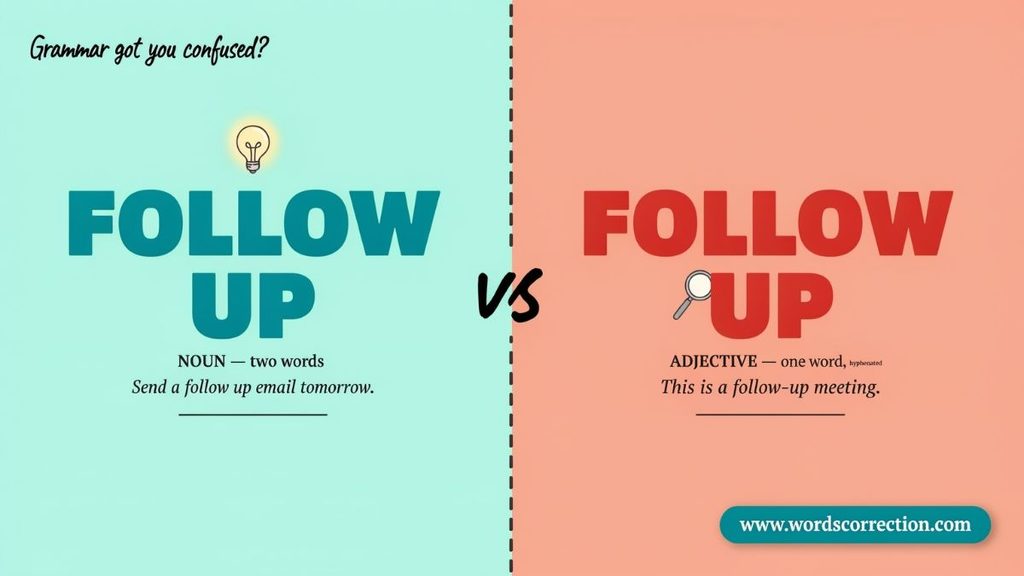
Knowing the basic grammar rule is important. However, applying it correctly in everyday writing makes the difference.
Both forms appear frequently in professional communication, customer service, healthcare, education, and business settings.
Follow Up vs Follow-Up in Emails
Professional correspondence frequently uses both forms.
The verb phrase describes the action of contacting someone again. The hyphenated form identifies the email or message itself.
Correct examples
- I will follow up on your application tomorrow.
- Please follow up with the supplier about the delivery.
- Thank you for your follow-up email.
- I received a follow-up message from the hiring manager.
- We sent a follow-up after the initial discussion.
How to Write a Follow-Up Email
A professional follow-up email should be brief, polite, and purposeful. It should remind the recipient of your earlier conversation and explain why you’re contacting them again.
A well-structured message generally includes
- Subject line: Follow-Up Regarding Your Application
- Opening: Briefly mention your previous conversation or request.
- Purpose: Explain why you’re getting in touch.
- Next step: Ask for an update or provide additional information.
- Closing: Thank the recipient for their time.
Example follow-up email
Hello Sarah,
I hope you’re doing well. I’m following up on my application for the marketing assistant position. I wanted to ask whether there have been any updates regarding the hiring process.
Thank you for your time. I look forward to hearing from you.
Best regards,
Alex
Notice how both forms appear naturally. Following up describes the action, while follow-up appears in the subject line as a compound modifier.
Follow-Up Meeting or Follow Up Meeting?
The correct expression is follow-up meeting.
A follow-up meeting takes place after an earlier discussion. Its purpose is usually to review progress, address outstanding questions, or agree on the next steps.
Examples
- We scheduled a follow-up meeting for Monday.
- The team will follow up after the presentation.
- I requested a follow-up meeting with the department manager.
- Please follow up with everyone who attended the meeting.
Compare the grammatical structures
- Follow-up meeting: An adjective describing a noun.
- Follow up after the meeting: A verb phrase describing an action.
Follow-Up Questions or Follow Up Questions?
When describing additional questions related to an earlier discussion, use follow-up questions.
Examples
- The interviewer asked several follow-up questions.
- I have a follow-up question about your proposal.
- The teacher encouraged students to ask follow-up questions.
However, when describing the action of asking additional questions later, use the verb phrase
- I will follow up with a few questions.
- She followed up with another question.
The context determines which spelling you need.
Follow Up in Customer Service and Sales
Businesses often follow up with customers to maintain communication, address concerns, and improve service.
For example, after a customer purchases a product, a sales representative might contact them to confirm delivery or ask whether they need assistance.
The representative follows up with the customer. The message they send is a follow-up message.
Other examples include
- Our sales representative will follow up with you tomorrow.
- The company sent a follow-up email after the purchase.
- Customer service followed up on the unresolved complaint.
- The manager requested a follow-up report.
Follow-Up in Healthcare and Education
Healthcare professionals use follow-up communication to monitor patients after treatment, surgery, or medical examinations.
Examples
- The patient needs a follow-up appointment next month.
- The doctor will follow up after reviewing the test results.
- The nurse scheduled a follow-up call.
Education also uses the expression regularly
- The teacher will follow up with students about their assignments.
- The school arranged a follow-up meeting with the parents.
- The instructor sent a follow-up message about the examination.
These examples show why the distinction matters across different professional settings.
Learn the difference between commonly confused more words in English
Passtime or Pastime Which Spelling Is Correct?
Follow-Ups What Is the Correct Plural Form?
The plural form of follow-up is follow-ups.
When follow-up functions as a countable noun, add -s to the end of the compound word. Keep the hyphen in place.
Examples
- The manager scheduled three follow-ups.
- We completed two follow-ups with the customer.
- All follow-ups should happen before Friday.
- The doctor recommended regular follow-ups.
However, don’t confuse the plural noun with the verb form.
- Correct: The team completed several follow-ups.
- Correct: The team follows up with several customers.
- Incorrect: The team follow-ups with several customers.
The difference comes down to grammar. Follow-ups is a plural noun, while follows up is the correct third-person singular verb phrase.
Followed Up or Followed-Up Which Is Correct?
Use followed up without a hyphen when describing an action that happened in the past.
Examples
- I followed up with the client yesterday.
- The manager followed up on the complaint.
- She followed up after the interview.
- They followed up with the supplier about the order.
The same spelling applies to other verb constructions
- We had followed up before the deadline.
- The sales representative has followed up with the customer.
Although hyphenated participial modifiers sometimes appear in English, constructions such as followed-up request often sound awkward. A clearer sentence usually works better.
- Awkward: The followed-up request was resolved.
- Better: The request we followed up on was resolved.
The general rule remains simple: Use followed up as a verb, without a hyphen.
Learn the difference between confusing more English words step by step
Ingage vs Engage Which Word Is Correct?
Following Up or Following-Up Which Spelling Is Correct?
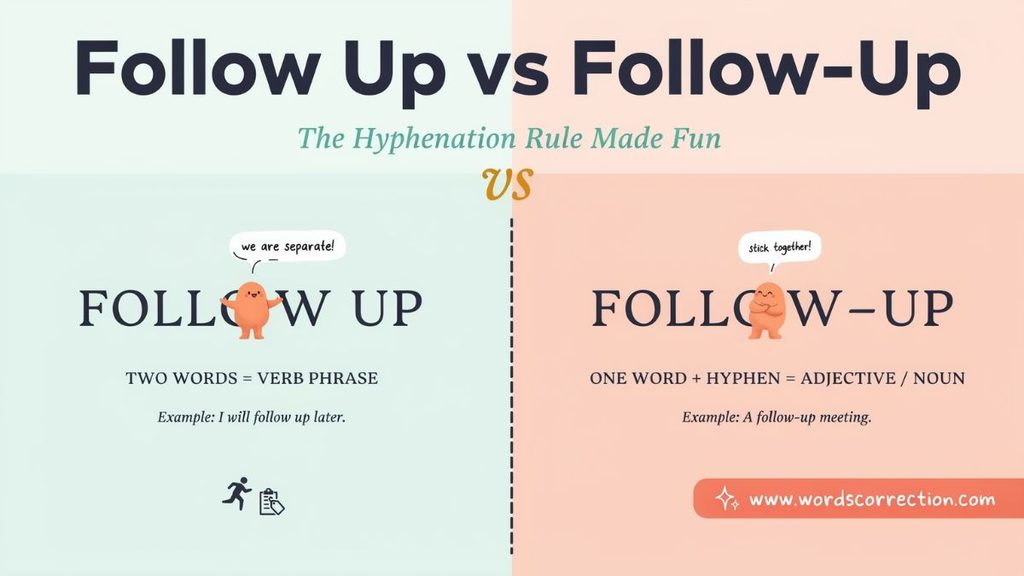
Use following up when describing an ongoing action or using the expression as a gerund.
Examples
- I am following up on your application.
- She is following up with the customer.
- Following up after interviews shows professional courtesy.
- The team is following up on outstanding payments.
The hyphenated form remains appropriate when follow-up functions as a noun or adjective.
Compare these sentences
- Following up: The manager is following up with the client.
- Follow-up: The manager scheduled a follow-up meeting.
The first describes an action. The second identifies a type of meeting.
Learn the difference between commonly confused more words in English
Visualization or Visualisation Which Spelling Is Correct?
Follow Up On or Follow Up With What’s the Difference?
The prepositions on and with often appear after the verb phrase. However, they introduce different information.
When to Use Follow Up On
Use follow up on when identifying the subject, issue, request, or matter that needs further attention.
Examples
- I will follow up on your application.
- She followed up on the complaint.
- We need to follow up on the payment.
- The manager followed up on the employee’s progress.
Here, on introduces the matter receiving attention.
When to Use Follow Up With
Use follow up with when identifying the person or group you plan to contact.
Examples
- I will follow up with the customer.
- She followed up with her teacher.
- The company followed up with its suppliers.
- Please follow up with the hiring manager.
Here, with introduces the person or organization involved in the additional communication.
Can You Use Follow Up On and Follow Up With Together?
Yes. Both prepositions can appear in the same sentence when they provide different information.
For example
“I will follow up with the manager on your application.”
In this sentence
- With the manager identifies the person being contacted.
- On your application identifies the subject being discussed.
This structure is common in professional communication because it clearly identifies both the person and the matter involved.
Learn the difference between tricky English words with easy explanations
Implicit vs Complicit what’s the Differences?
Follow-Up vs Follow-On What’s the Difference?
Although follow-up and follow-on look similar, they don’t have exactly the same meaning.
Follow-up refers to an additional action, communication, or event connected to something that happened earlier.
Examples
- The company arranged a follow-up meeting.
- The doctor recommended a follow-up appointment.
Follow-on generally describes something that follows from an earlier event, action, or development.
Examples
- The initial project received follow-on funding.
- The company announced a follow-on investment.
The difference becomes clearer in business writing. A follow-up meeting reviews progress after an earlier meeting, while a follow-on project may develop from the original project.
These expressions are related, but they’re not interchangeable.
Follow-Up vs Follow-Through Understanding the Difference
Another commonly confused pair is follow-up and follow-through.
Both expressions relate to taking action, but they describe different ideas.
- Follow-up: An additional action after something has already happened.
- Follow-through: Completing a commitment, plan, or intended action.
Consider these examples
- The recruiter sent a follow-up email after the interview.
- The employee demonstrated excellent follow-through by completing the project on time.
A person can follow up without completing the original task. Similarly, someone can demonstrate follow-through by carrying out a promise without sending another message.
In short, follow-up means taking an additional step, while follow-through means seeing something through to completion.
Follow Up Vs Follow-Up Comparison Table
Use this table as a quick reference whenever you need to check the correct spelling.
| Expression | Part of speech | Correct usage | Example |
|---|---|---|---|
| Follow up | Verb phrase | Taking further action | I will follow up tomorrow. |
| Follow-up | Noun | An additional action | We scheduled a follow-up. |
| Follow-up | Adjective | Describing something later | Send a follow-up email. |
| Follow-ups | Plural noun | Multiple additional actions | We completed three follow-ups. |
| Followed up | Past-tense verb | An action completed earlier | She followed up yesterday. |
| Following up | Gerund/participle | An ongoing or general action | He is following up now. |
| Followup | Nonstandard spelling | Avoid in standard edited American English | Use follow-up instead. |
Learn the difference between confusing more English words
Xenodochial vs Xenodochium Which Word Should You Use?
Common Grammar Mistakes When Using Follow Up vs Follow-Up
Even experienced writers sometimes confuse these forms. Most mistakes happen because they focus on the expression itself rather than its grammatical role.
Here are some errors worth avoiding.
1 Mistake: Adding a hyphen to the verb
- Incorrect: I will follow-up with the client.
- Correct: I will follow up with the client.
2 Mistake: Writing the noun as one word
- Incorrect: We scheduled a followup.
- Correct: We scheduled a follow-up.
3 Mistake: Leaving out the hyphen in a compound adjective
- Incorrect: She sent a follow up email.
- Correct: She sent a follow-up email.
4 Mistake: Confusing the plural noun with the verb
- Incorrect: The manager follow-ups with customers.
- Correct: The manager follows up with customers.
5 Mistake: Choosing the wrong preposition
- Less suitable: I will follow up with your application.
- Better: I will follow up on your application.
Use with when identifying the person you’re contacting and on when identifying the matter receiving attention.
6 Mistake: Confusing follow-up with follow-through
- Incorrect: The employee showed excellent follow-up by completing every task.
- Better: The employee showed excellent follow-through by completing every task.
The second sentence expresses the intended meaning more accurately.
Learn the difference between commonly mixed-up more words
Stigmatism vs Astigmatism Which Term Is Correct?
A Practical Case Study Follow Up vs Follow-Up in Workplace Communication
Consider a small company that provides digital marketing services.
After meeting a potential client, the sales manager needs to share additional information, answer questions, and check whether the client wants to move forward.
Here’s how both forms work in the same situation
| Situation | Correct expression | Reason |
|---|---|---|
| Contacting the client again | Follow up | Verb phrase |
| Sending another email | Follow-up email | Compound adjective |
| Scheduling another discussion | Follow-up meeting | Compound adjective |
| Naming the additional discussion | Follow-up | Noun |
| Contacting the client yesterday | Followed up | Past-tense verb |
| Contacting the client now | Following up | Present participle |
For example
“The sales manager will follow up with the client tomorrow. She has already prepared a follow-up email and requested a follow-up meeting for next week.”
This example shows how both forms can appear naturally in the same paragraph.
The key is to choose the spelling according to its grammatical role rather than the situation itself.
Learn the difference between tricky grammar more words
Realize vs Realise What Is the Difference?
How to Remember When to Use Follow Up vs Follow-Up
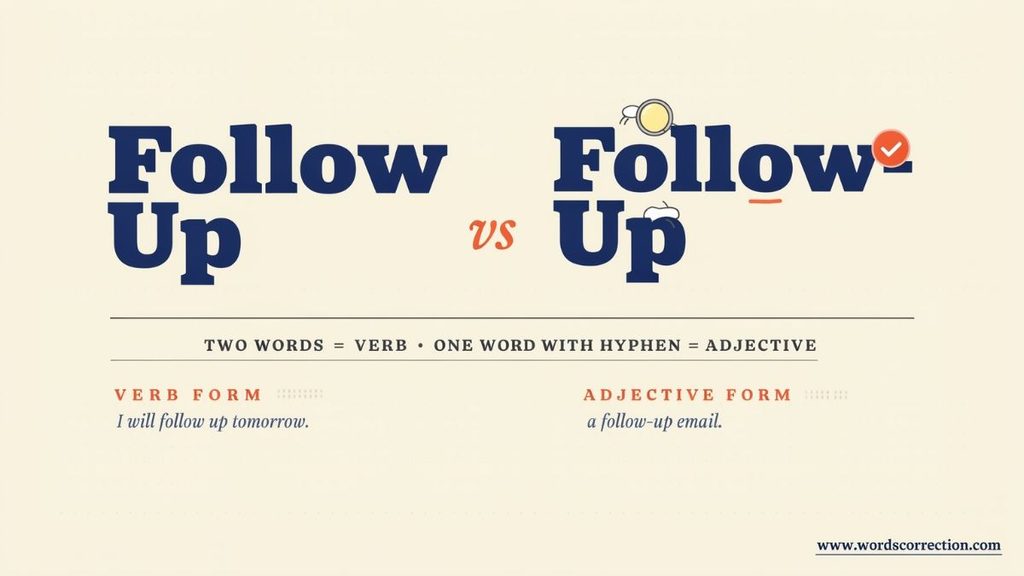
You don’t need to memorize a long list of English grammar rules to get this right. A few simple tests can help you choose the correct spelling.
Use the Action Test
Ask yourself: Am I describing someone taking further action?
If the answer is yes, write follow up.
Examples
- I need to follow up.
- She will follow up tomorrow.
- We followed up with the customer.
Use the Naming Test
Ask yourself: Am I naming an additional action, event, or communication?
If the answer is yes, write follow-up.
Examples
- I sent a follow-up.
- We scheduled a follow-up appointment.
- The manager requested a follow-up report.
Use the Describing Test
Ask yourself: Is the expression describing another noun?
If the answer is yes, use the hyphenated form.
Examples
- Follow-up question
- Follow-up meeting
- Follow-up message
Easy memory trick
- Action = Two words.
- Thing or description = Hyphen.
This simple rule works in emails, reports, conversations, and most other forms of writing.
Learn the difference between confusing word pairs
Coaches or Coach’s Which Spelling Is Correct?
Practice Session
Test your understanding of follow up, follow-up, followed up, following up, and follow-ups. Complete each sentence with the correct form.
- I will ______ with the customer tomorrow.
- The manager scheduled a ______ meeting for Monday.
- She sent a ______ email after the interview.
- We need to ______ on the payment request.
- The doctor recommended a ______ appointment.
- He ______ with the supplier yesterday.
- I am ______ with the hiring manager about my application.
- The company completed three ______ last week.
- Please ______ with the client before the deadline.
- The teacher requested a ______ discussion with the parents.
- She wants to ______ on her previous request.
- The recruiter sent a ______ message to the applicant.
- They are ______ with customers about their orders.
- The manager has already ______ with the sales team.
- We arranged another ______ to review the project.
- You should ______ with the department about the schedule.
- The patient needs a ______ examination next month.
- I will ______ with you after reviewing the documents.
- The team completed several customer ______ this week.
- He is ______ on the latest project updates.
- The company plans to send a ______ report next week.
- She ______ with the client to confirm the meeting.
- We need to ______ with the supplier about the delivery.
- The doctor scheduled two ______ appointments for the patient.
- Thank you for your email. I will ______ on your request shortly.
Answers
- Follow up
- Follow-up
- Follow-up
- Follow up
- Follow-up
- Followed up
- Following up
- Follow-ups
- Follow up
- Follow-up
- Follow up
- Follow-up
- Following up
- Followed up
- Follow-up
- Follow up
- Follow-up
- Follow up
- Follow-ups
- Following up
- Follow-up
- Followed up
- Follow up
- Follow-up
- Follow up
Here’s a trusted source for clear word meanings:
Cambridge Dictionary
FAQ’s
What is the correct way to write follow-up?
The correct form depends on its grammatical function. Use follow up as a verb and follow-up as a noun or adjective. For example, “I will follow up tomorrow” and “I sent a follow-up message.”
Does follow-up email have a hyphen?
Yes. Follow-up email is the correct spelling because follow-up functions as a compound adjective describing the noun email. The hyphen connects the two words.
Is follow up a hyphenated word?
No. When used as a verb, follow up is written as two separate words without a hyphen. Use follow-up when the expression functions as a noun or adjective.
How do you use follow up in a sentence?
Use follow up to describe an action that continues an earlier conversation, checks progress, or requests additional information. For example: “I will follow up with the manager about my application.”
What is a professional alternative to follow-up?
Depending on the context, you can use alternatives such as check-in, progress review, additional communication, further discussion, or status update. Choose the expression that best communicates your intended meaning.
What are five examples of sentences using follow up?
Here are five examples showing how to use the verb phrase correctly
- I will follow up with the customer tomorrow.
- She needs to follow up on her application.
- The manager followed up after the meeting.
- We should follow up with the supplier this week.
- He is following up on the payment request.
What are 10 simple sentences using follow-up?
These examples demonstrate both the verb and hyphenated forms
- I will follow up tomorrow.
- She sent a follow-up email.
- We need a follow-up.
- He followed up yesterday.
- They scheduled a follow-up meeting.
- Please follow up soon.
- The follow-up was helpful.
- I am following up now.
- She requested a follow-up call.
- We completed two follow-ups.
How can you identify the correct form of follow up in a sentence?
Identify the expression’s grammatical role. If it describes an action, write follow up. If it names an additional action or describes another noun, write follow-up. For example, “Please follow up” and “Send a follow-up email” are both correct.
What is the best way to start a sentence with follow up?
Start with Follow up when giving an instruction or recommendation. For example: “Follow up with the client before the end of the day.” This structure is direct and appropriate for professional instructions.
What are effective opening lines for a follow-up email?
A professional follow-up email should begin with a polite and relevant statement. Consider these examples:
- I’m following up on our previous conversation.
- I wanted to check whether there have been any updates.
- I’m writing regarding my earlier request.
- I hope you’re doing well. I’m following up on…
- I’m reaching out to check the status of…
What is a simple sentence using follow up?
A simple sentence using follow up is: “I will follow up tomorrow.” It contains one independent clause and communicates a complete thought.
How do you write an effective opening sentence for a follow-up message?
Begin by briefly referring to your previous conversation or explaining the purpose of your message. For example: “I’m following up on the proposal we discussed last Monday.” This opening provides context and helps the recipient understand your reason for writing.
Should you write follow-up or follow up after the word to?
Use follow up after to when forming an infinitive verb phrase. For example: “I need to follow up with the supplier.” The verb phrase doesn’t require a hyphen.
Is it correct to write I will follow-up?
No. The standard form is “I will follow up.” In this sentence, follow up functions as a verb phrase, so the two words should remain separate.
Can follow-up appear at the beginning of a sentence?
Yes. Follow-up can begin a sentence when it functions as a noun or part of a compound adjective. For example: “The follow-up revealed several important details.”
Is the spelling of follow up the same in British and American English?
Yes. Both British and American English generally use follow up as a verb and follow-up as a noun or adjective. The basic spelling distinction remains the same.
How should you use follow-up in a business report?
Use follow-up as a noun or adjective when referring to additional actions, reviews, or activities. For example: “The report recommends a follow-up review to evaluate the project’s progress.”
What is the difference between a follow-up and a reminder?
A follow-up is an additional action or communication that continues an earlier activity. A reminder prompts someone to remember a task, appointment, or responsibility. A follow-up may include a reminder, but the two terms have different meanings.
Can you use follow-up in an email subject line?
Yes. Follow-up is appropriate in professional email subject lines when referring to an earlier conversation, request, or activity. Examples include “Follow-Up on Your Application” and “Project Meeting Follow-Up.”
Is follow-up one word, two words, or hyphenated?
The two standard forms are follow up vs follow-up. Use follow up as a verb and follow-up as a noun or adjective. The one-word spelling followup is generally nonstandard in edited American English.
How can you make a follow-up sentence sound more professional?
Use polite language, refer briefly to the previous conversation, and state your purpose clearly. For example, instead of writing “I’m asking again about this,” write “I’m following up to see whether there are any updates regarding my request.”
Can you use follow up without an object?
Yes. You can use follow up without directly mentioning an object when the context makes the subject clear. For example: “I haven’t received a response yet, so I’ll follow up tomorrow.”
What punctuation should you use with follow-up?
Punctuation depends on the sentence structure. Use a period for a statement, a question mark for a direct question, and a comma when the sentence requires one. Keep the hyphen in follow-up when it functions as a noun or adjective.
How can you avoid repeating follow up in professional emails?
Use suitable alternatives such as check in, request an update, contact again, revisit the discussion, or check on progress. Choose an alternative that preserves the intended meaning and keeps your message natural.
When is the appropriate time to send a follow-up message?
Send a follow-up message when you need to continue a discussion, request an update, clarify information, or check progress. Allow the recipient a reasonable amount of time to respond before sending another message. The appropriate interval depends on the urgency and nature of the communication.as a noun or adjective. The grammatical role determines the spelling.
Learn the difference between often confused words
Grimey or Grimy Which Spelling Is Correct?
Conclusion
Understanding follow up vs follow-up is easier than it may initially seem. The key is to recognize the grammatical role each form plays in a sentence. Use follow up as a verb when describing an action, such as contacting someone again or checking progress. Use follow-up as a noun or adjective when referring to an additional action, email, meeting, or discussion. Avoid the one-word spelling follow up in standard edited American English. By applying this simple distinction, you can avoid common spelling mistakes and communicate more clearly and professionally. Remember, even a small hyphen can make a significant difference in grammar. Master this rule, and you’ll never have to follow up on your spelling again.

Stella AJS is an experienced blogger and dedicated English language writer at Words Correction. She turns confusing grammar, word meanings, spelling, and usage into clear, practical insights that readers can easily understand and apply. With a passion for precise and engaging writing, Stella helps readers avoid common language mistakes, strengthen their vocabulary, and communicate with greater clarity and confidence.




