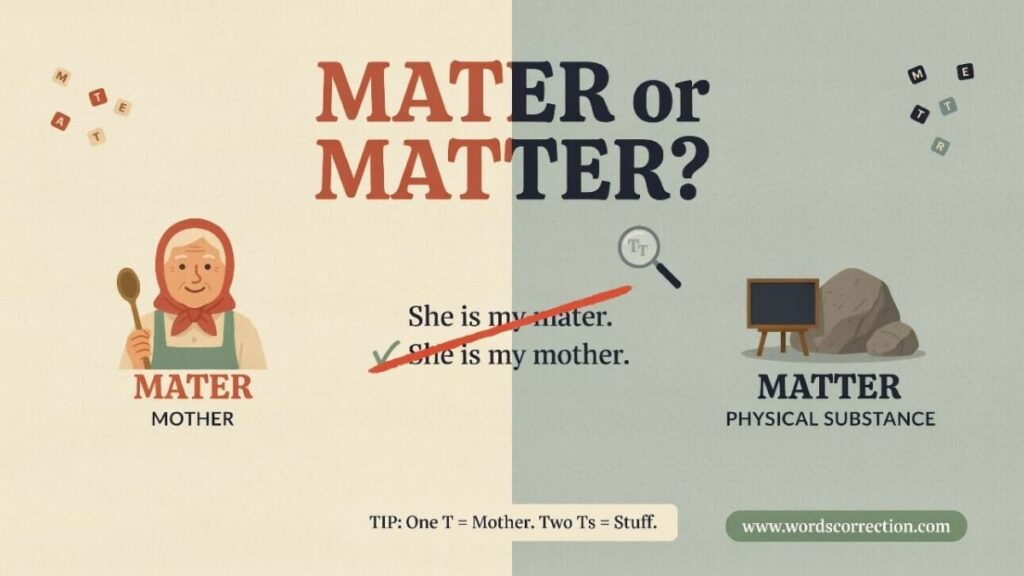
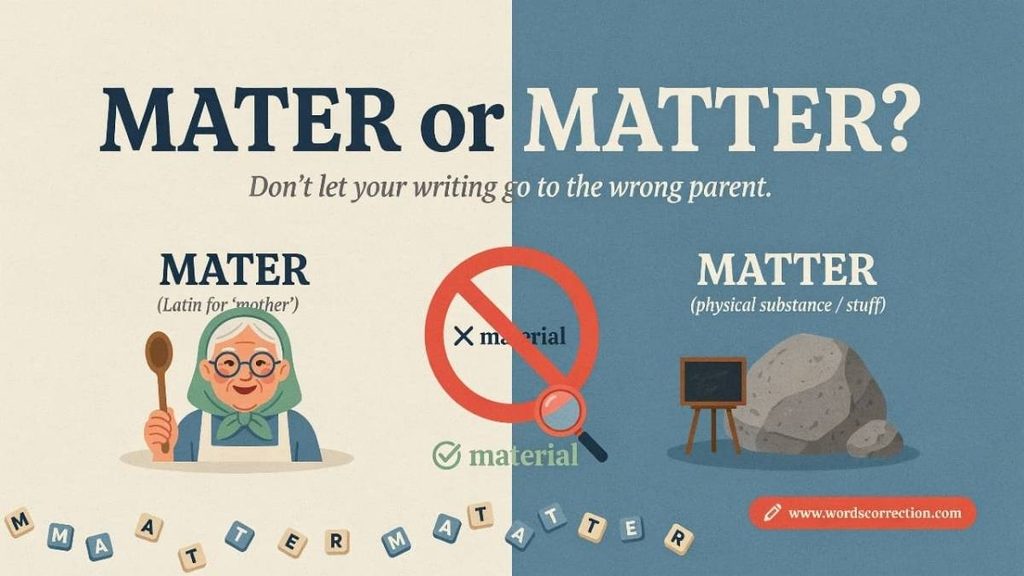
The difference between mater or matter may look like a tiny spelling issue, but that extra t can completely change the meaning. Matter is a common English word used for physical substance, an issue, or something that carries importance. on the other hand, has a very different origin and meaning. It comes from Latin and means “mother,” appearing in familiar expressions and anatomical terms such as alma and dura mater. One missing letter can turn a scientific concept into a reference to motherhood, which is quite a grammatical plot twist. Let’s explore the meanings, origins, usage, and common mistakes that separate for both.
Mater or Matter Quick Answer
The simplest answer to mater or matter is this:
| Word | Main meaning | Common usage |
| matter | Substance, issue, subject, concern, or importance | Everyday English, science, academic and formal writing |
| mater | Mother, especially in Latin-derived expressions | Alma mater, dura mater, and other specialized contexts |
Matter is the correct English word in sentences such as:
- “This matter needs immediate attention.”
- “Water is a form of matter.”
- “Your opinion matters.”
- “It doesn’t matter anymore.”
- “What is the matter?”
it is correct in expressions such as:
- “She returned to her alma mater.”
- “The dura mater surrounds the brain and spinal cord.”
- “The pia mater is one of the meningeal layers.”
Therefore, both isn’t really a choice between two spellings of the same word. They’re different words with different histories and uses.
Mater or Matter Meaning
Understanding the both meaning starts with separating their definitions rather than focusing only on spelling.
Matter has several common meanings in English. It can describe physical substance, an issue under discussion, or something that has importance. it has a much narrower meaning and usually appears in Latin-derived expressions.
That difference explains why matter vs mater can be confusing for writers and learners. The words look related, but their modern English uses are quite different.
Learn the difference between more words people mix up
Directer or Director Correct Spelling and Usage
Matter Meaning and Definition
What Is Matter?
The word matter has several meanings.
In ordinary English, a matter can be an issue, subject, concern, affair, situation, or problem.
For example:
- “We need to discuss this matter.”
- “The payment is a private matter.”
- “That is a serious matter.”
- “The committee considered the matter carefully.”
In these sentences, matter doesn’t mean physical . It means something being considered, discussed, or dealt with.
The word also has a scientific meaning. In introductory chemistry, matter is anything that occupies space and has mass. OpenStax uses this standard definition and explains that matter includes solids, liquids, and gases.
So, the matter definition depends heavily on context.
as a Noun
Matter as a noun has several important meanings.
Matter means physical substance
In science, matter refers to physical substance with mass and volume.
Examples include:
- water
- oxygen
- iron
- wood
- soil
- carbon dioxide
- your phone
- the air around you
The scientific concept goes much deeper than simply saying that something is “stuff.” Matter can be classified according to its composition and physical state. Chemists study elements, compounds, mixtures, atoms, molecules, and the properties of these substances.
Matter means an issue or concern
In general English, matter can refer to something that needs attention or discussion.
“The contract is a legal matter.”
Here, matter means an issue or subject.
Matter means a subject or topic
You can also use matter when referring to something under discussion.
“The speaker avoided discussing the matter during the interview.”
Matter means importance or significance
Consider this sentence:
“Your support matters.”
Here, matter doesn’t mean substance. It means to be important or significant.
That meaning leads naturally to the verb form of the word.
Matter as a Verb
Matter as a verb means to be important, significant, relevant, or consequential.
Examples include:
- “Your opinion matters.”
- “Small details matter.”
- “It doesn’t matter anymore.”
- “What matters is that everyone understands.”
- “The final result mattered to the entire team.”
The verb appeared in English with the sense “to be of importance or consequence” in the late 16th century.
This gives you a useful shortcut:
If you could replace the word with “be important,” you’re probably using matter as a verb.
For example:
“Your decision matters.”
means:
“Your decision is important.”
Learn the difference between everyday English mistakes
Attendance or Attendence Correct Spelling and Usage
What Does Matter Mean in English?
The matter English meaning changes according to context.
It can mean:
- physical substance — “Matter has mass.”
- issue — “We need to resolve this matter.”
- subject — “The matter was discussed yesterday.”
- affair or situation — “It’s a complicated matter.”
- importance — “It doesn’t matter.”
- to be important — “Your choices matter.”
This flexibility explains why matter appears so often in English vocabulary. A single word developed several connected meanings over centuries.
Common Expressions With Matter
Some of the most familiar English expressions contain matter.
What is the matter?
This usually asks what is wrong or what problem someone is experiencing.
You look worried. What is the matter?
Historically, this expression developed from matter meaning a circumstance, condition, or issue affecting someone.
It doesn’t matter
This means something is not important or doesn’t make a meaningful difference.
“You can choose either seat. It doesn’t matter.”
“It matters”
This means something is important or significant.
“Every vote matters.”
“No matter”
This expression can mean regardless of a condition or circumstance.
“No matter what happens, keep the receipt.”
As a matter of fact
This phrase introduces information presented as factual or corrects an assumption.
“As a matter of fact, the meeting starts at nine.”
A matter of time
This expression means something will happen eventually.
“With enough practice, improvement is only a matter of time.”
For that matter
This phrase means “as far as that particular thing is concerned.”
“I don’t like the first option. For that matter, I don’t like the second one either.”
These expressions demonstrate how deeply matter is woven into everyday English. Historical records trace several of these uses back hundreds of years.
Learn the difference between commonly misused words
Many or Meny What’s the Right English Word?
Mater Meaning and Definition
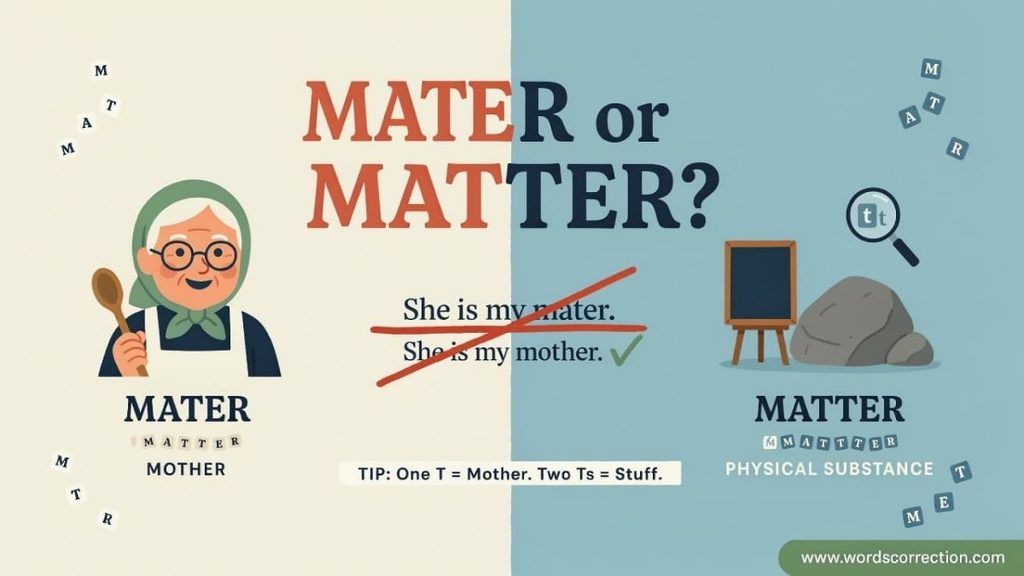
What Is this?
If you’re asking what is this the short answer is it is a Latin-derived word meaning “mother.”
The Latin noun māter means “mother.” It belongs to a much older Indo-European family of words connected with the concept of mother. English mother ultimately comes from the same broader ancestral root.
However, English doesn’t normally use mater as the everyday word for a mother.
You wouldn’t ordinarily say:
“My mater made dinner.”
Modern English uses mother, not mater, in ordinary conversation.
Instead, it survives in particular learned, formal, institutional, and anatomical expressions.
Mater Definition
A practical definition is:
A Latin-derived word meaning “mother,” chiefly encountered in established English expressions and technical terms.
So, if someone asks what does mater mean, the answer depends slightly on the context. At its root, it means mother. In a phrase such as alma mater, however, it contributes to the phrase’s specialized meaning.
What Does Mater Mean in English?
The English meaning is essentially “mother,” but its modern use is limited.
You may encounter it in:
- academic language
- university references
- Latin expressions
- anatomy
- historical writing
- proper names or institutional expressions
This is why in English can seem unusual. It isn’t a common everyday synonym for mother.
Alma Mater Meaning
The expression alma is probably the most familiar place where English speakers encounter.
An alma mater refers to a school, college, or university that a person attended or graduated from.
The expression comes from Latin. Alma means nourishing or fostering, while means mother. The phrase therefore carries the idea of a nourishing mother or mother-like institution.
In modern English, however, you don’t need to translate the phrase word for word every time. its functions as an established expression for an educational institution associated with someone.
Mater in Anatomy
One of the most important specialized uses of mater appears in anatomy.
The membranes surrounding the brain and spinal cord are called the meninges. The three layers are:
- dura mater
- arachnoid mater
- pia mater
Here, it comes from Latin and retains its connection with “mother.”
The word mater is therefore correct in these anatomical terms.
Writing dura matter would be a spelling error because matter has a completely different meaning.
Dura Mater
it is the tough outer meningeal layer surrounding the brain and spinal cord.
The name comes from Latin and reflects the historical anatomical terminology used to describe the membrane.
Arachnoid Mater
This is the middle meningeal layer.
Its name relates to its spider-web-like appearance.
Pia Mater
This is the delicate inner meningeal layer that closely follows the surface of the brain and spinal cord.
These terms provide a perfect example of why context matters. In anatomy, mater is not a typo for matter. It is part of established terminology.
Learn the difference between basic English word mistakes
Finalise or Finalize Meaning, Difference and Usage
Mater or Matter in Science
The phrase mater or matter in science can be confusing because science uses matter, not mater, for physical substance.
What Is Matter in Science?
The standard scientific definition describes matter as anything that has mass and occupies space. OpenStax explains that solids and liquids clearly occupy space, while gases also qualify because they have mass and occupy volume.
That means:
- a rock is matter
- water is matter
- oxygen is matter
- a metal spoon is matter
- carbon dioxide is matter
Light, by contrast, isn’t classified as matter simply because it carries energy. Introductory chemistry distinguishes matter from forms of energy such as light.
Matter in Chemistry
Matter in chemistry concerns substances, their composition, their properties, and the ways they change.
Chemistry studies matter at several levels:
- Macroscopic level — what can be observed and measured.
- Microscopic level — atoms, molecules, and particles.
- Symbolic level — chemical formulas, equations, symbols, and calculations.
Chemists classify matter into categories such as elements, compounds, homogeneous mixtures, and heterogeneous mixtures.
States of Matter
The familiar states of matter include:
| State | Shape | Volume | Particle behavior |
| Solid | Definite | Definite | Particles stay relatively fixed and vibrate |
| Liquid | Indefinite | Definite | Particles move past one another |
| Gas | Indefinite | Indefinite | Particles are much farther apart |
| Plasma | Indefinite | Indefinite | Charged particles form an ionized state |
Solids, liquids, and gases are the three common states encountered in ordinary conditions. Plasma is also recognized as a major state of matter in introductory science.
Learn the difference between often confused words
Classes or Class’s Meaning, Difference and Usage
Matter Takes Up Space
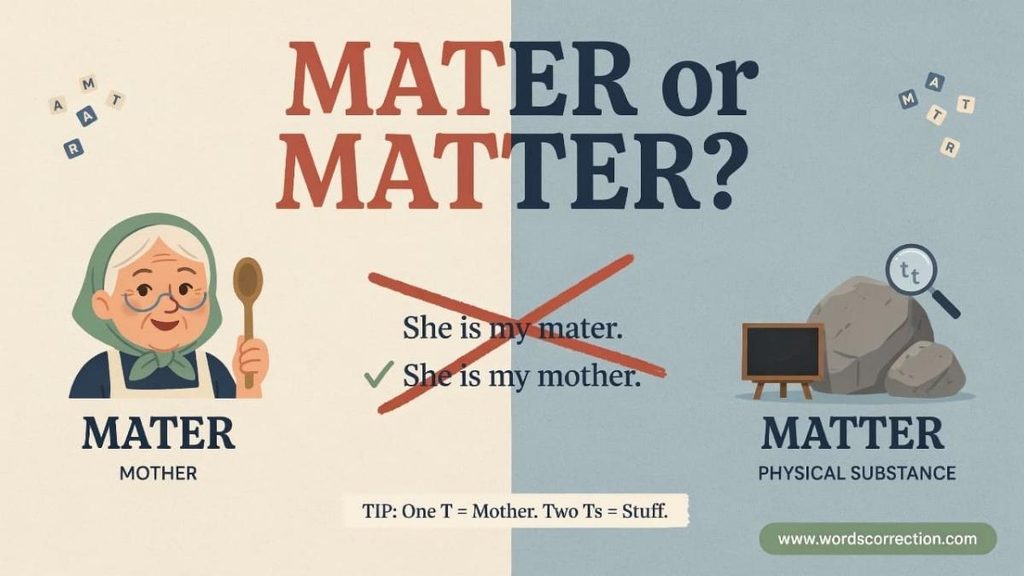
One of the easiest ways to understand matter is through mass and volume.
Mass measures the amount of matter in an object. Volume measures the amount of space it occupies.
For example, a glass of water has both mass and volume. The water remains matter even though it takes the shape of the glass.
A gas provides an even better example. Air isn’t visible, but it still has mass and occupies space. That’s why filling a balloon increases its volume.
Properties of Matter
Scientists examine both physical and chemical properties of matter.
Physical properties include:
- density
- color
- hardness
- melting point
- boiling point
- electrical conductivity
Chemical properties describe how a substance behaves during chemical changes.
So when you see matter definition in science, matter definition in chemistry, or matter definition in physics, the context remains scientific. The spelling is always matter, not mater.
The Origin of both
Both the difference becomes even clearer when you examine their histories.
Origin of Matter
The English word matter dates to around the beginning of the 13th century. It came through Anglo-French and Old French forms from Latin materia, meaning material or substance, including the material from which something is made.
Interestingly, Latin materia is historically connected with it, meaning “mother,” through the idea of origin or source. The Latin philosophical use of materia was also influenced by the Greek philosophical concept of material or substance.
Over time, English expanded matter beyond physical substance.
It came to mean:
- the substance from which something is made
- the content of a written work
- a subject or topic
- an affair or issue
- a question under discussion
- something of importance
Those meanings explain why modern English uses matter in such different contexts.
Origin of Mater
Latin meaning is much more direct.
Latin māter means mother. It is related to an ancient Indo-European root associated with “mother,” which also produced related forms across several languages.
English inherited through learned Latin-based vocabulary rather than replacing the everyday word mother.
That distinction is important.
it is a Latin word used in English contexts. It isn’t simply the older English spelling of “matter.”
Learn the difference between confusing word pairs
Uncapable or Incapable Which Spelling Is Correct?
Mater vs Matter Key Difference in Meaning
The difference between both can be summarized in four questions: What does the word mean? Where does it come from? How is it used? How common is it?
| Feature | Matter | Mater |
| Core meaning | Substance, issue, subject, importance | Mother |
| Origin | Latin materia through French and English | Latin māter |
| Part of speech | Noun and verb | Mainly noun in English uses |
| Everyday use | Very common | Uncommon |
| Scientific use | Very common | Mainly specialized anatomy |
| Academic use | Common | Common in alma mater |
| Example | “This matter is important.” | “She returned to her alma mater.” |
This makes mater vs matter meaning much easier to remember.
Matter has a broad modern English life.
it has a narrow, specialized one.
Mater or Matter in English Which Word Belongs?
The phrase both in English usually comes down to context.
Use matter when you’re discussing:
- an issue
- a subject
- a concern
- a situation
- physical substance
- importance
- significance
- something that is relevant
- something that affects an outcome
Use it when you’re dealing with:
- alma mater
- dura mater
- pia mater
- arachnoid mater
- a Latin-derived reference to a mother
The key isn’t simply remembering that one word has an extra t. The stronger strategy is to remember the meaning.
When to Use Matter
Knowing when to use matter becomes simple once you recognize its major functions.
Use Matter for an Issue
“The manager investigated the matter.”
Use Matter for a Subject
“Education was the main matter discussed.”
Use Matter for Physical Substance
“Scientists study the properties of matter.”
Use Matter for Importance
“Your decision matters.”
Use Matter in Common Expressions
“It doesn’t matter.”
“No matter what happens, stay calm.”
“It’s only a matter of time.”
When to Use
Knowing when to use mater is mostly about recognizing established expressions.
Use in Alma Mater
“He donated books to his alma mater.”
Use in Anatomy
“The dura mater forms the tough outer meningeal layer.”
Don’t Use Mater as an Everyday Synonym for Mother
Although it means mother in Latin, modern English normally uses mother.
So this would sound unnatural in ordinary English:
“My mater lives nearby.”
Use:
“My mother lives nearby.”
The specialized Latin-derived word has its place. It just isn’t the everyday choice.
Learn the difference between tricky grammar more words
Analyses or Analysis Meaning, Difference and Usage
Mater or Matter Spelling Common Mistakes
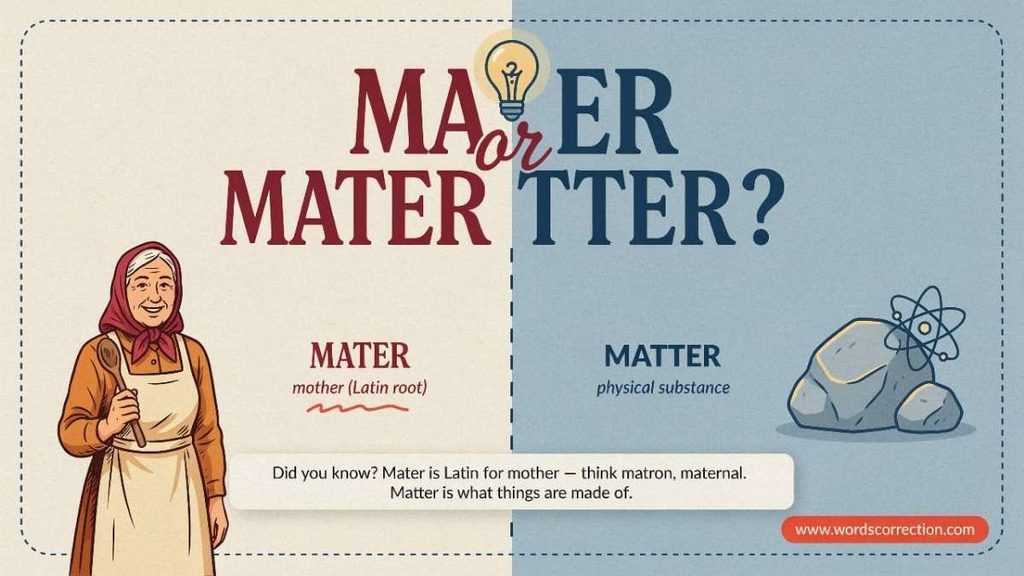
The mater or matter spelling problem usually appears when someone knows the pronunciation or recognizes the general shape of the word but doesn’t remember which spelling belongs to the sentence.
Mistake “It doesn’t mater.”
Correct:
“It doesn’t matter.”
The sentence means that something isn’t important.
Mistake “Alma matter”
Correct:
“Alma mater.”
The expression refers to a person’s former school, college, or university.
Mistake “Dura matter”
Correct:
“Dura mater.”
This is an anatomical term.
Mistake Assuming Mater Is a Shorter Matter
It isn’t.
Mater and matter have distinct meanings and etymological histories.
Learn the difference between commonly mixed-up more words
Devide or Divide Difference, Meaning and Usage
Mater or Matter Example Sentences
A good example should show meaning through context rather than simply repeat the definition.
Matter Sentence Examples
- “The court must consider the matter carefully.”
- “Water is a common form of matter.”
- “Your health and safety matter.”
- “This is a private matter.”
- “The researchers examined the properties of matter.”
- “It doesn’t matter which route we take.”
- “The committee discussed the matter for two hours.”
- “What matters most is accuracy.”
Sentence Examples
- “The professor returned to her alma mater.”
- “The medical student studied the structure of the dura mater.”
- “The pia mater is the innermost meningeal layer.”
- “The surgeon examined the dura mater during the procedure.”
- “The university is his alma mater.”
Notice the pattern. Matter fits naturally into ordinary sentences. the tends to appear inside established expressions.
A Practical Case Study Three Sentences, One Letter, Three Outcomes
Consider these three examples:
Case One Everyday English
“This matter needs to be resolved.”
Here, matter means an issue or concern.
Case Two Science
“Water is matter.”
Here, matter refers to physical substance.
Case Three Education
“She returned to her alma mater.”
Here, it means mother as part of a Latin-derived expression referring to an educational institution.
The spelling changes by only one letter, but the meaning changes completely.
That’s the heart of the matter vs mater distinction.
Learn the difference between confusing more English words
Businesses or Business’s Meaning, Grammar and Correct Usage
Is Mater a Word?
Yes. it is a word? Absolutely.
However, “being a word” doesn’t mean it can replace another word whenever the spellings look similar.
it is an established Latin-derived word in English. It appears in expressions including alma mater and anatomical terminology involving the meninges.
So:
- Is mater correct? Yes, in the right context.
- Is mater a synonym for matter? No.
- Can mater replace matter? No.
- Is mater a misspelling of matter? Not inherently.
Context determines correctness.
Is Matter a Word?
Yes. Is matter a word? It is one of the most useful and flexible words in English.
Matter functions as both a noun and a verb.
As a noun:
“We need to discuss this matter.”
As a verb:
“Your choices matter.”
It also serves as a core scientific term for physical substance.
That makes matter a much more common word than mater in general English.
Learn the difference between tricky English words with easy explanations
Alternately or Alternatively Meaning, Usage and Examples
Is Mater a Misspelling of Matter?
The answer is sometimes, but not always.
If someone writes:
“It doesn’t mater.”
then mater is a spelling mistake because the sentence needs the verb matter.
But if someone writes:
“She visited her alma mater.”
the is correct.
This is a useful lesson about English vocabulary: a word can be correctly spelled and still be the wrong word for the sentence.
Correct Spelling both?
If the question is “Is mater or matter the correct spelling?”, neither spelling is universally “more correct.”
Both are legitimate words.
The real question is:
Which word matches the intended meaning?
Use matter for:
- physical substance
- an issue
- a subject
- a concern
- importance
- significance
- the verb “to be important”
Use mater for:
- mother in Latin-derived contexts
- alma mater
- dura mater
- pia mater
- arachnoid mater
That is the most reliable way to solve the spelling problem.
Learn the difference between commonly confused more words in English
Tie or Tye Meaning, Difference and Usage
British English vs American English Mater or Matter
There isn’t a British-versus-American spelling difference that turns matter into mater.
Both American English and British English use:
- matter
- mater
according to their established meanings.
So you shouldn’t assume that mater is a British spelling of matter or that matter is an American spelling of mater. They are different words.
This is an important distinction because many English spelling questions involve genuine regional differences, such as color/colour or center/centre. Mater and matter aren’t that kind of pair.
both Comparison Table
| Question | Matter | Mater |
| Is it an English word? | Yes | Yes |
| Is it commonly used? | Yes | No, not in ordinary conversation |
| Can it be a noun? | Yes | Yes, in established uses |
| Can it be a verb? | Yes | No in ordinary modern English |
| Does it mean physical substance? | Yes | No |
| Can it mean an issue or concern? | Yes | No |
| Can it mean “be important”? | Yes | No |
| Does it mean mother? | No | Yes, in Latin-derived usage |
| Appears in alma mater? | No | Yes |
| Appears in dura mater? | No | Yes |
| Used in science for physical substance? | Yes | No |
How to Spell Matter Correctly
If you’re asking how to spell matter, remember the double t:
M-A-T-T-E-R
The extra t is essential when you mean:
- issue
- concern
- substance
- importance
- significance
- “be important”
Examples:
- “It doesn’t matter.”
- “This matter requires attention.”
- “Matter has mass.”
Writing mater in these sentences changes the word.
How to Spell Correctly
If you’re asking how to spell, use:
M-A-T-E-R
You will most often see it in established expressions.
Examples:
- alma mater
- dura mater
- pia mater
- arachnoid mater
The missing second t isn’t an error in these expressions. It’s part of the correct spelling.
Why Do People Confuse for these spelling?
The spelling confusion is easy to understand.
Both words begin with mate- and differ by only one letter. In fast typing, proofreading, or unfamiliar academic contexts, that small difference can disappear.
There is also an interesting historical connection. English matter comes from Latin materia, while it comes directly from Latin māter. Etymologically, materia itself has been connected with mater in the sense of origin or source.
That historical relationship doesn’t make the modern words interchangeable.
Think of it like two branches growing from an old linguistic tree. They may share deep roots, but they developed into different words.
A Simple Memory Trick for Mater or Matter
Here’s an easy way to remember the difference.
Think “Two Ts = Typical English Matter”
If you’re talking about an issue, substance, or importance, use:
matter
The double t can remind you that this is the common everyday word.
Think “Mater = Mother”
The Latin it means mother.
So when you see:
alma mater
think:
mother institution
When you see:
dura mater
think:
Latin-derived anatomical term
This memory trick won’t explain every historical detail, but it works well when you’re writing quickly.
A Quick Decision Test
When you’re unsure, ask three questions.
Question 1 Am I talking about an issue or concern?
Use matter.
“The matter needs attention.”
Question 2 Am I talking about physical substance?
Use matter.
“Matter has mass and occupies space.”
Question 3 Am I using a Latin-derived expression such as alma or dura mater?
Use it.
That’s usually enough to solve the mater or matter which is correct question in seconds.
Practice Session
Fill in each blank with the correct word
- It doesn’t ________ which option you choose.
- The scientist studied the properties of ________.
- The university is her ________.
- This is a serious ________ that requires immediate attention.
- In Latin, the word ________ means “mother.”
- Your opinion really ________ to me.
- Solid, liquid, and gas are common states of ________.
- He decided to discuss the ________ with his manager.
- The phrase “alma ________” refers to an educational institution a person attended.
- Does it ________ if I arrive a few minutes late?
- Chemistry is the study of substances and changes in ________.
- The issue is an important ________ for the entire community.
- Her ________ was a respected university where she studied for four years.
- Nothing else will ________ once the decision has been made.
- In scientific terms, ________ has mass and occupies space.
- The Latin word ________ is associated with the meaning “mother.”
- We need to settle this ________ before the meeting ends.
- His alma ________ celebrated its 100th anniversary.
- It doesn’t ________ how expensive the item is if it does not work properly.
- The researchers examined how temperature affects ________.
- Is this a ________ of personal preference or a practical concern?
- The expression “alma ________” has Latin origins.
- The teacher explained that everything around us is made of ________.
- The school remains an important part of her life because it is her alma ________.
- Whether you agree or disagree does not ________ to the final decision.
Answers
- matter
- matter
- mater
- matter
- mater
- matters
- matter
- matter
- mater
- matter
- matter
- matter
- mater
- matter
- matter
- mater
- matter
- mater
- matter
- matter
- matter
- mater
- matter
- mater
- matter
Here’s a trusted source for clear more words Comparison:
Grammar Update
FAQ’s
What is the meaning of mater?
it is a Latin word meaning “mother.” In modern English, it is primarily used in Latin-derived expressions, particularly which refers to a school, college, or university that someone attended.
Is it mater or matter?
Matter is the correct word for most everyday English uses. It can refer to a physical substance, an issue or subject, or something that is important.it is a separate Latin-derived word meaning “mother.”
What does matter mean?
Matter has several meanings in English. As a noun, it can refer to a physical substance or an issue, subject, or concern. As a verb, matter means to be important or significant.
What does does it matter mean?
The expression “Does it matter?” means “Is it important?” or “Does it make a difference?” For example: “Does it matter which option we choose?”
How do you use matter in a sentence?
Matter can function as both a noun and a verb. For example, as a noun: “This is a serious matter.” As a verb: “Your opinion matters to me.”
What is another word for matter?
The appropriate synonym depends on the context. Common alternatives include substance, material, issue, subject, concern, affair, importance, and significance.
What is another word for mater?
When it is used to mean “mother,” possible alternatives include mother, mom, mum, parent, and female parent. However, it is generally restricted to formal or Latin-derived usage rather than everyday English.
What does mater mean in Latin?
In Latin, it means “mother.” The word appears in several English terms and expressions derived from Latin, including alma mater.
What is alma mater?
it is a Latin expression traditionally translated as “nourishing mother.” In modern English, it commonly refers to the educational institution that a person attended, particularly a college or university.
it is a Scrabble word?
Whether it is accepted in Scrabble depends on the official word list being used. Different Scrabble editions and regional dictionaries may have different accepted-word lists, so players should consult the applicable official dictionary.
What words contain mater?
Words containing or deriving from the same Latin root include maternal, maternity, matriarch, and matriculate. However, their historical word origins are not identical in every case.
What words have the root mater?
The Latin root , meaning “mother,” is associated with words such as maternal, maternity, matriarch, and matricide. These words developed through Latin and related linguistic forms connected with motherhood or the maternal line.
What is the root word of matter?
The English word matter ultimately comes through Old French from the Latin materia, meaning “material” or “substance.” Although materia is historically connected to an older root associated with “mother,” modern matter and mater have distinct meanings.
Is mater a synonym for matter?
No. Mater and matter are not synonyms. it refers to “mother” in Latin-derived usage, while matter can refer to a physical substance, an issue, or importance.
What is the difference between mater and matter?
The two words differ in both meaning and usage. Matter is a common English word referring to substance, an issue, or importance.it is a Latin-derived term meaning “mother,” most commonly encountered in expressions such as alma mater.
Is matter a noun or a verb?
Matter can be used as both a noun and a verb. As a noun, it can mean a substance, issue, or concern: “We need to discuss this matter.” As a verb, it means to be important: “Your decision matters.”
What are the different meanings of matter?
Matter can refer to a physical substance, an issue or subject, or importance. As a verb, it means to be important or significant.
What does it doesn’t matter mean?
“It doesn’t matter” means that something is not important or does not affect the outcome. For example: “It doesn’t matter which color you choose.”
What is the scientific meaning of matter?
In science, matter is generally defined as anything that has mass and occupies space. Common examples include solids, liquids, gases, and plasma.
What is matter in chemistry?
In chemistry, matter refers to physical substance composed of particles such as atoms and molecules. Chemistry examines the composition, structure, properties, and transformations of matter.
What are the common states of matter?
The commonly recognized states of matter are solid, liquid, gas, and plasma. They differ in characteristics such as particle arrangement, movement, and energy.
Can mater be used instead of matter?
No. Mater should not be used as a substitute for matter in standard English. For example, “It doesn’t matter” is correct, whereas “It doesn’t mater” is incorrect.
Is mater an English word?
Mater is found in English dictionaries, but it is not normally used as an everyday alternative to mother. It is chiefly encountered in formal, historical, or Latin-derived contexts, particularly in the expression alma mater.
What is the plural of mater?
The plural form depends on how mater is being used. When referring to the English noun, maters can be formed according to standard English pluralization, although the word is uncommon in everyday usage. The Latin plural is a separate grammatical matter.
What is the easiest way to remember mater and matter?
A useful way to remember the distinction is that matter has two t’s and is the standard English word used for a substance, issue, or importance. Mater has one t and is associated with the Latin word for “mother,” particularly in alma mater.
Conclusion
The mater or matter confusion may seem like a minor spelling mistake, but that extra t can completely change the meaning. Matter is the everyday English word used for physical substance, an issue, a situation, or something considered important. meanwhile, comes from Latin and means “mother.” It mainly appears in expressions such as alma mater and anatomical terms such as dura mater and pia mater.
When choosing between mater or matter, always consider the context before blaming the keyboard. That single extra t can prevent a surprisingly confusing sentence. In short, matter belongs in everyday English, while it has a more specialized role. Remembering that small difference can help you avoid a common spelling mistake and choose the correct word with confidence.

Stella AJS is an experienced blogger and dedicated English language writer at Words Correction. She turns confusing grammar, word meanings, spelling, and usage into clear, practical insights that readers can easily understand and apply. With a passion for precise and engaging writing, Stella helps readers avoid common language mistakes, strengthen their vocabulary, and communicate with greater clarity and confidence.