
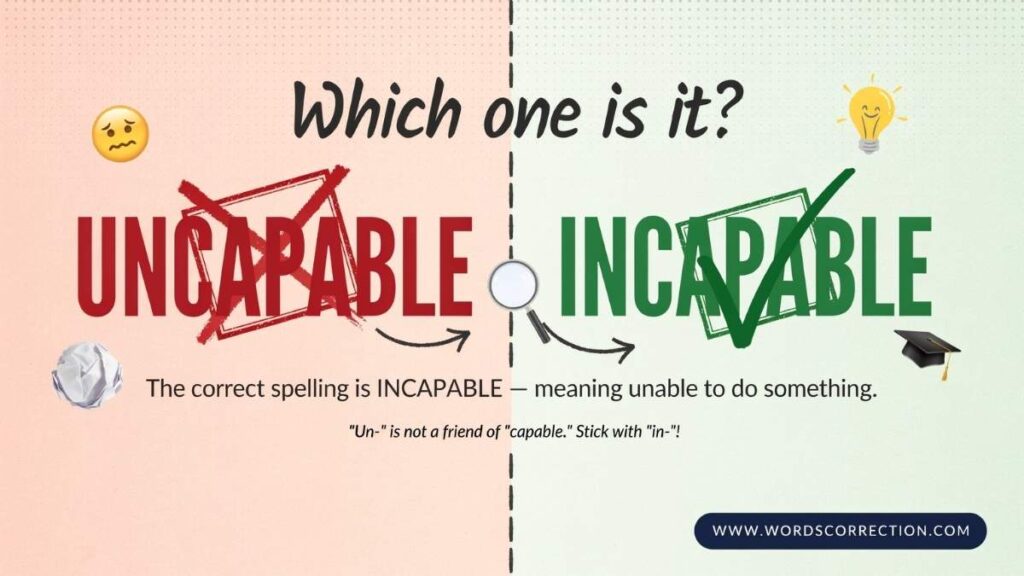
The confusion between uncapable or incapable can make even confident writers pause. After all, English turns “able” into “unable,” so why shouldn’t “capable” become “uncapable”? English, as usual, has its own rules. Although uncapable appears in historical usage, incapable is the standard form in modern English. Choosing the wrong form can make an otherwise polished sentence sound awkward or incorrect. In this guide, you’ll learn the difference between uncapable and incapable, explore their meanings and usage, and review clear examples. By the end, you’ll know which spelling to use and why incapable is the preferred choice in contemporary English.
Uncapable or Incapable Quick Answer
The standard modern spelling is incapable.
Incapable is an adjective meaning unable to do something or lacking the ability, skill, power, or capacity to do something.
For example:
- She is incapable of making that decision alone.
- The machine is incapable of operating without electricity.
- He was incapable of understanding the instructions.
Uncapable is a historical or uncommon form that has been used to mean the same thing as incapable. Although dictionaries may list it, it is not the usual choice in contemporary standard English.
| Word | Status | Meaning | Recommended? |
| Incapable | Standard modern English | Unable or lacking ability | Yes |
| Uncapable | Historical/uncommon | Unable or lacking ability | Generally no |
So, if you are wondering, “Which is correct, uncapable or incapable?”, choose incapable in modern writing.
Is Uncapable a Word?
Yes, uncapable is a word that has been recorded in English dictionaries and historical texts.
However, being listed in a dictionary does not automatically mean that a word is common or preferred in modern English. Some words survive mainly in historical texts, regional usage, or uncommon contexts.
Uncapable developed from the prefix un- combined with capable. It has been used to mean “incapable” or “not capable.”
Today, however, incapable is far more established as the standard form.
For example, instead of writing:
He is uncapable of completing the task.
Use:
He is incapable of completing the task.
The second sentence sounds natural and follows standard contemporary usage.
What Does Incapable Mean?
The incapable meaning is straightforward: not able to do something or lacking the ability or capacity to do it.
The word incapable describes a person, object, system, or situation that lacks the necessary ability, power, skill, or capacity.
For example:
- She is incapable of driving because she has never learned how.
- The old computer is incapable of running the new software.
- He felt incapable of solving the problem.
- The damaged equipment was incapable of performing properly.
The exact meaning depends on context. Incapable can describe a lack of physical ability, mental ability, skill, competence, capacity, or control.
Learn the difference between more words people mix up
Personalise or Personalize Difference,Meaning and Usage
Incapable Definition
As an adjective, incapable generally means:
- Not able to do something
- Lacking the ability to perform an action
- Lacking the necessary capacity or skill
- Unable to control or manage something in certain contexts
The word often appears with of:
incapable of + noun
or
incapable of + verb-ing
Examples:
- incapable of action
- incapable of change
- incapable of understanding
- incapable of working
- incapable of making a decision
How to Use Incapable Correctly
The most common grammatical structure is:
incapable of + noun
or
incapable of + gerund
For example:
- The team was incapable of finding a solution.
- The device is incapable of handling heavy workloads.
- She was incapable of controlling her emotions.
- The organization was incapable of responding quickly.
Avoid replacing of with to after incapable.
Incorrect:
He is incapable to complete the assignment.
Correct:
He is incapable of completing the assignment.
The structure unable to is different:
He is unable to complete the assignment.
Both sentences can communicate a similar idea, but the grammar differs.
Learn the difference between everyday English mistakes
Unvoluntary or Involuntary Which One Is Correct?
Incapable in a Sentence
Understanding a word becomes easier when you see it in context. Here are several examples of incapable in a sentence.
Everyday Examples
- I was incapable of answering the question.
- The child was incapable of reaching the shelf.
- She felt incapable of making such a difficult choice.
- The broken phone was incapable of connecting to the network.
Workplace Examples
- The outdated system is incapable of processing large files.
- The employee was incapable of completing the task without assistance.
- The department was incapable of meeting the deadline because of the technical problems.
- The company needs a system capable of handling increased demand.
Academic Examples
- The experiment was incapable of producing reliable results under those conditions.
- The student initially felt incapable of understanding the complex topic.
- The research method was incapable of addressing the central question.
Formal Examples
- The organization was deemed incapable of fulfilling its contractual obligations.
- The system was incapable of providing adequate protection.
- The individual was considered incapable of managing the responsibilities independently.
These examples show how naturally incapable fits into both everyday and formal writing.
Learn the difference between commonly misused words
Incurable or Uncurable? Meaning, Difference and Usage
What Does Uncapable Mean?
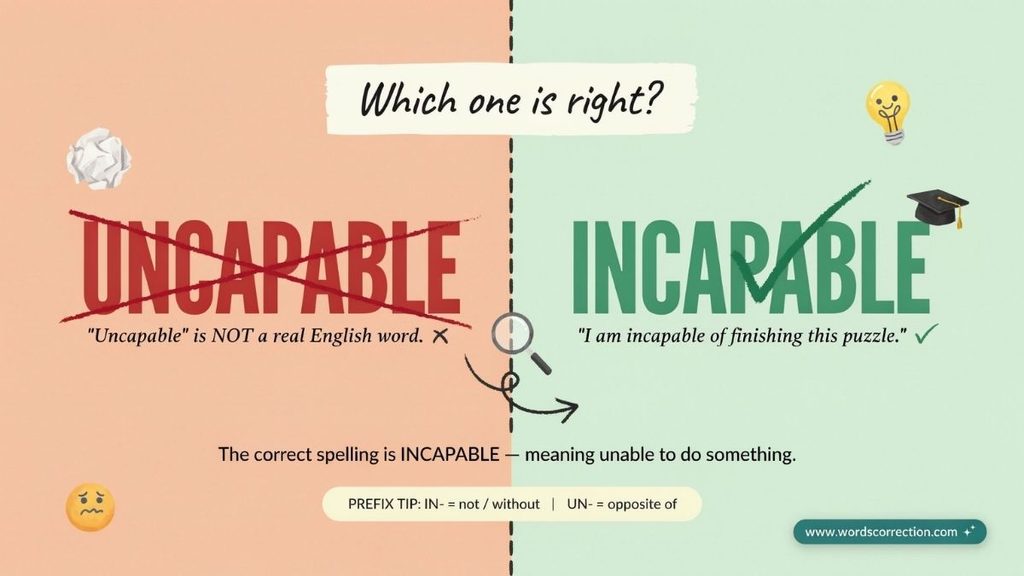
The uncapable meaning is essentially the same as incapable: not capable or unable to do something.
However, the important distinction is usage.
Although uncapable has historical dictionary support, modern writers generally prefer incapable.
For example, you may encounter:
The man was uncapable of defending himself.
But contemporary standard English would normally use:
The man was incapable of defending himself.
Therefore, knowing the meaning of uncapable is useful when reading older or unusual texts, but it does not make the word the preferred choice for modern writing.
Uncapable in a Sentence
Because uncapable is uncommon in contemporary English, examples are most useful for understanding its historical or nonstandard use.
Examples include:
- The machine was described as uncapable of performing the task.
- He was considered uncapable of managing the situation.
- The device appeared uncapable of functioning properly.
In modern standard English, replace uncapable with incapable:
- The machine was incapable of performing the task.
- He was considered incapable of managing the situation.
- The device appeared incapable of functioning properly.
This distinction matters especially in professional, academic, and formal writing.
Learn the difference between confusing more English words step by step
Classes or Class’s Meaning, Difference and Usage
Uncapable vs Incapable What Is the Difference?
The main difference between uncapable and incapable is not their basic meaning. Both have been used to express a lack of ability.
The difference lies mainly in modern usage, frequency, and standardness.
Incapable
Incapable is the normal modern form.
It is appropriate for:
- Professional writing
- Academic writing
- Business communication
- Formal documents
- News writing
- Everyday conversation
- Technical writing
Uncapable
Uncapable is an uncommon form with historical usage.
You may encounter it in:
- Older literature
- Historical texts
- Older dictionaries
- Unusual or nonstandard writing
For contemporary standard English, incapable is the safer and more natural choice.
Learn the difference between basic English word mistakes
Vain or Vein Key Difference, Meaning, Grammar and Usage
Why Do People Write Uncapable Instead of Incapable?
The confusion usually comes from the way English forms negative words.
English commonly uses prefixes such as un-, in-, im-, il-, and ir- to create negative meanings.
For example:
- able → unable
- possible → impossible
- legal → illegal
- regular → irregular
- capable → incapable
Because unable is common, it may seem logical to form uncapable by adding un- to capable.
English, however, does not always follow a predictable pattern.
You cannot simply choose a negative prefix based on what sounds logical. Established usage determines which form becomes standard.
That is why:
able → unable
but:
capable → incapable
The spelling may seem inconsistent, but English contains many such patterns.
The Origin of Incapable
The word incapable has roots in Latin and French.
It developed from forms related to the Latin word capere, meaning “to take” or “to hold.” The prefix in- gives the word a negative sense.
Over time, incapable became established in English with the meaning of being unable or lacking the necessary ability or capacity.
The word has been part of English vocabulary for centuries and remains common in contemporary usage.
The Origin of Uncapable
Uncapable also has a long history in English.
It developed through the combination of un- and capable. Historical sources show that writers used the word to mean “not capable” or “incapable.”
However, historical existence does not guarantee modern popularity.
English vocabulary changes over time. Some words become standard, while others become uncommon or disappear from everyday use.
That appears to be the situation with uncapable. Although it has historical and dictionary evidence, incapable has become the established modern form.
Learn the difference between often confused words
Congrats or Congratulations Which One Is Correct?
Incapable vs Unable
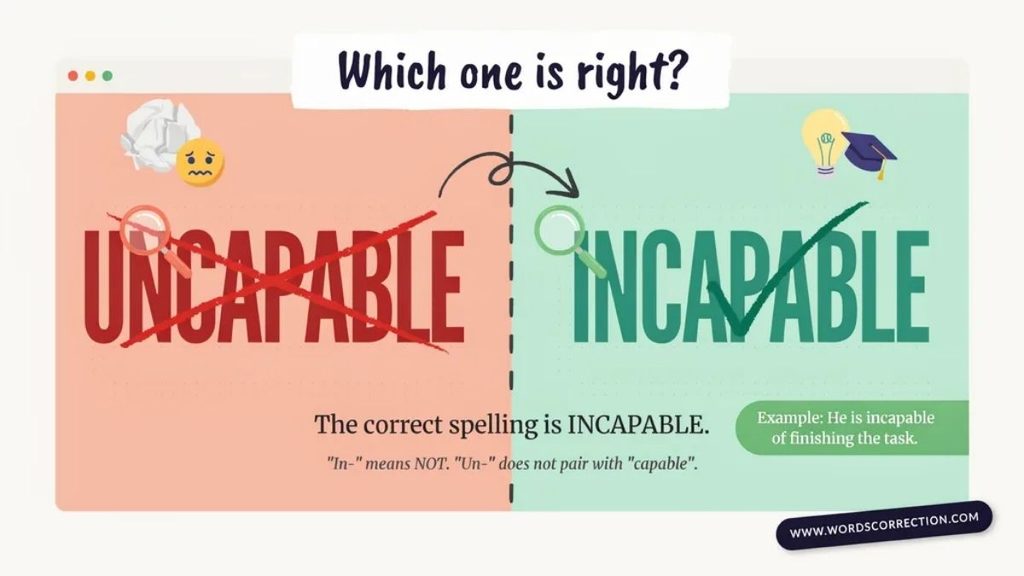
both Incapable and unable are closely related, but they aren’t always interchangeable.
Incapable
Incapable often emphasizes a lack of ability, capacity, skill, or suitability.
Example:
The small computer is incapable of running the software.
The sentence suggests that the computer lacks the necessary capacity.
Unable
Unable often describes a specific situation in which someone or something cannot perform an action.
Example:
I was unable to attend the meeting.
This usually describes a particular circumstance rather than a permanent lack of ability.
Compare:
She is incapable of swimming.
This suggests that she lacks the ability to swim.
She was unable to swim because of her injury.
This suggests that she normally may be able to swim, but a particular situation prevented her from doing so.
The distinction isn’t absolute, but it can help you choose the more precise word.
Learn the difference between confusing word pairs
Synched or Synced Correct Spelling, Meaning and Usage
Common Mistakes With Incapable and Uncapable
Using Uncapable Because It Sounds Logical
One of the most common mistakes is assuming that capable should become uncapable because able becomes unable.
English doesn’t always form negative words that way.
Use:
capable → incapable
rather than:
capable → uncapable
Confusing Incapable With Unable
These words often overlap, but they can carry slightly different meanings.
Use unable when you want to describe a specific inability.
Use incapable when you want to emphasize a lack of ability, capacity, or competence.
Using the Wrong Preposition
A frequent grammatical mistake is writing:
incapable to do something
The standard construction is:
incapable of doing something
For example:
Incorrect:
She is incapable to complete the work.
Correct:
She is incapable of completing the work.
Assuming Spellcheck Determines Correctness
Spellcheck tools can help identify spelling errors, but they don’t always determine whether a word is the best choice for modern standard English.
A word may appear in a dictionary while still being uncommon, historical, regional, or context-specific.
That is why uncapable can cause confusion. Its existence doesn’t make it the preferred form in contemporary formal writing.
Treating Both Forms as Equally Common
Uncapable and incapable should not be treated as equally common modern alternatives.
For contemporary standard English, incapable is the established choice.
Learn the difference between tricky grammar more words
Directer or Director Correct Spelling and Usage
British English vs American English

There is no major British-versus-American spelling difference between incapable and uncapable.
Both varieties use incapable as the normal modern form.
You may encounter uncapable in historical or unusual texts from different English-speaking regions, but it isn’t a standard American-versus-British spelling distinction.
For example:
- American English: incapable
- British English: incapable
So if you are writing for an American, British, Canadian, Australian, or international audience, incapable is generally the appropriate choice.
Incapable Synonyms
Depending on context, several words can replace incapable.
Common synonyms include:
- Unable
- Powerless
- Helpless
- Inept
- Incompetent
- Unfit
- Ineffective
- Inadequate
- Unskilled
- Lacking ability
However, these words are not always exact substitutes.
For example, unable focuses on inability, while incompetent often suggests a lack of skill or competence.
Similarly, powerless may emphasize a lack of control rather than a lack of ability.
Choose the synonym that best matches your intended meaning.
Incapable Antonyms
The most common antonyms of incapable include:
- Capable
- Able
- Competent
- Skilled
- Effective
- Qualified
- Proficient
- Powerful
The simplest opposite is capable.
For example:
She is incapable of completing the task.
Opposite:
She is capable of completing the task.
This makes capable and incapable a useful word pair to remember.
Learn the difference between commonly mixed-up more words
Attendance or Attendence Correct Spelling and Usage
How to Remember the Correct Spelling
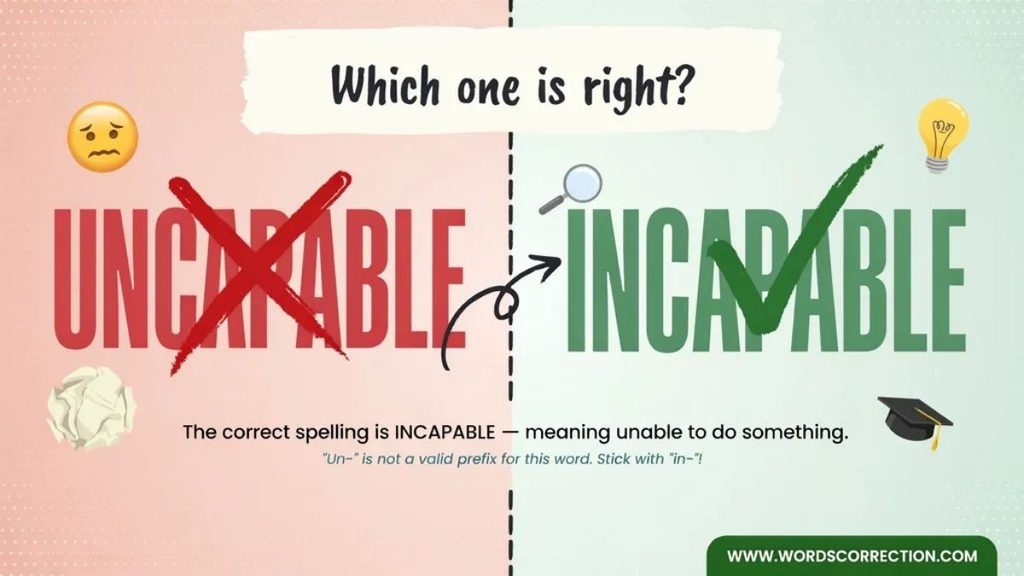
A simple memory trick can help:
Able → Unable
Capable → Incapable
Think of these as two separate word pairs rather than trying to create every negative word with un-.
Another useful reminder is:
If the positive form is capable, the standard negative form is incapable.
Once you remember this pattern, the spelling becomes much easier.
Which Is Correct Incapable or Uncapable?
If you’re writing in modern standard English, choose incapable.
The word is widely accepted and works naturally in formal and informal contexts.
For example:
He is incapable of solving the problem.
This is standard and natural.
Although uncapable has historical usage and can be found in dictionaries, it is uncommon in contemporary English.
Therefore, if you are preparing an essay, email, report, article, academic paper, or professional document, incapable is the appropriate choice.
Should I Use Incapable or Uncapable?
Use incapable in almost all modern writing.
Choose incapable when you mean:
- Not able to do something
- Lacking ability
- Lacking capacity
- Lacking skill
- Unable to perform an action
- Not capable of achieving something
For example:
The device is incapable of processing the file.
Avoid using uncapable simply because it appears logical or because you have seen it somewhere.
If you are discussing historical language or quoting an older source, however, uncapable may appear in the original wording.
Learn the difference between confusing more English words
Many or Meny What’s the Right English Word?
Incapable in Different Types of Writing
Professional Writing
In business communication, clarity matters. Use incapable rather than the uncommon uncapable.
The current system is incapable of handling the increased workload.
Academic Writing
Academic writing generally favors established standard vocabulary.
The method was incapable of producing consistent results.
Technical Writing
Technical documents often describe the limits of machines, systems, and software.
The device is incapable of supporting the required operating system.
Social Media
Informal writing allows more flexibility, but incapable still remains the natural choice.
My old laptop is incapable of running this game.
Formal Writing
Legal, administrative, and official writing should favor clear, established language.
The system was incapable of meeting the required standards.
Learn the difference between tricky English words with easy explanations
Finalise or Finalize Meaning, Difference and Usage
Uncapable or Incapable Comparison Table
| Feature | Incapable | Uncapable |
| Word type | Adjective | Adjective |
| Basic meaning | Not able or lacking ability | Not capable |
| Modern usage | Common | Uncommon |
| Standard English | Yes | Generally not preferred |
| Historical usage | Yes | Yes |
| Formal writing | Recommended | Avoid unless context requires it |
| Common construction | Incapable of | Historically uncapable of |
| Opposite | Capable | Capable |
| Related word | Unable | Unable |
Practice Session
Fill in the Blanks
Complete each sentence with the most appropriate word or phrase.
- The correct standard spelling is __________.
- “Incapable” means lacking the __________ or capacity to do something.
- The word “uncapable” is considered rare, archaic, or __________ in modern English.
- She is __________ of completing the task without assistance.
- The machine is __________ of operating without electricity.
- The most direct opposite of “incapable” is __________.
- A person who lacks the necessary ability or skill may be described as __________.
- The standard expression is “incapable __________,” not “incapable to.”
- He was __________ of solving the problem on his own.
- “Unable” can be used as a __________ of “incapable” in some contexts.
- The noun form of “incapable” is __________.
- The adjective “incapable” describes someone or something that lacks the __________ to perform an action.
- The adverb form of “incapable” is __________.
- The sentence “She is incapable of making the decision” uses the correct __________.
- In modern English, “incapable” is preferred over __________.
- A suitable antonym of “incapable” is __________.
- The old computer is __________ of running the latest software.
- “Incapable of” is followed by a noun or an __________ form.
- The manager was considered __________ of handling the complicated situation.
- “Competent” and “capable” can both serve as __________ of “incapable” in appropriate contexts.
- The employee was __________ of completing the assignment independently.
- “Incapable” is an __________ used to describe a lack of ability or capacity.
- The word “uncapable” may appear in __________ English but is uncommon today.
- Instead of saying “He is incapable to understand,” write “He is __________ of understanding.”
- When writing in modern standard English, use __________ rather than “uncapable.”
Answer Key
- incapable
- ability
- nonstandard
- incapable
- incapable
- capable
- incapable
- of
- incapable
- synonym
- incapability
- ability
- incapably
- construction
- uncapable
- capable
- incapable
- -ing
- incapable
- antonyms
- incapable
- adjective
- historical
- incapable
- incapable
Here’s a trusted source for clear more words Comparison:
Grammar Update
Frequently Asked Questions
What does “incapable” mean?
“Incapable” means unable to do something or lacking the ability, skill, power, or capacity to perform a particular task. For example, “She is incapable of making the decision on her own.”
What does “uncapable” mean?
“Uncapable” has been used historically with a meaning similar to “incapable.” However, it is rare and generally considered archaic or nonstandard in modern English. “Incapable” is the preferred term in contemporary writing.
Which is correct: “incapable” or “uncapable”?
“Incapable” is the correct and standard word in modern English. Although “uncapable” has appeared in historical usage, it is uncommon today and is generally best avoided in formal writing.
Is “uncapable” a word?
“Uncapable” has existed in historical English, but it is rarely used in contemporary English. For modern standard English, “incapable” is the appropriate choice.
What is another word for “incapable”?
Depending on the context, synonyms for “incapable” include “unable,” “powerless,” “inept,” “incompetent,” “ineffective,” “unqualified,” and “helpless.” The most suitable synonym depends on the specific meaning intended.
What is the opposite of “incapable”?
The most direct opposite of “incapable” is “capable.” Other suitable antonyms include “able,” “competent,” “skilled,” “qualified,” and “proficient,” depending on the context.
What is another word for an “incapable person”?
An incapable person may be described as “incompetent,” “inept,” “unskilled,” “unqualified,” or “ineffective,” depending on the situation. Because some of these terms can sound critical, the choice should match the intended meaning and context.
What is a formal synonym for “incompetent”?
Formal alternatives to “incompetent” include “inept,” “unqualified,” “ineffective,” and “incapable.” These words are related but can have slightly different meanings, so the most accurate choice depends on the context.
Is “incapable” an adjective?
Yes. “Incapable” is an adjective that describes someone or something that lacks the ability, capacity, or power to perform a particular action.
How do you use “incapable” in a sentence?
“Incapable” is commonly followed by “of” and a noun or an -ing form. For example, “The machine is incapable of operating without electricity.”
What is the difference between “incapable” and “unable”?
“Incapable” and “unable” can both indicate a lack of ability. However, “incapable” often emphasizes a lack of capacity or ability, while “unable” commonly describes a situation in which someone or something cannot perform an action.
Can “incapable” describe a person?
Yes. “Incapable” can describe a person who lacks the ability or capacity to perform a particular task. For example, “He is incapable of completing the task without assistance.”
Can “incapable” describe a thing?
Yes. “Incapable” can describe an object, machine, system, or organization that lacks the ability to perform a particular function. For example, “The outdated computer is incapable of running the software.”
What are common synonyms for “incapable”?
Common synonyms include “unable,” “powerless,” “inept,” “incompetent,” “ineffective,” “unqualified,” and “helpless.” The appropriate synonym depends on the context.
What are common antonyms for “incapable”?
Common antonyms include “capable,” “able,” “competent,” “skilled,” “qualified,” and “proficient.” Each word may be appropriate in a different context.
Is “incapable of” grammatically correct?
Yes. “Incapable of” is a standard and grammatically correct construction. For example, “They are incapable of completing the project without additional resources.”
Should you say “incapable of” or “incapable to”?
The standard construction is “incapable of,” not “incapable to.” For example, write “She is incapable of understanding the instructions,” rather than “She is incapable to understand the instructions.”
What is the noun form of “incapable”?
The noun form is “incapability,” which refers to a lack of ability, capacity, or power to perform something.
What is the adverb form of “incapable”?
The adverb form is “incapably.” It describes an action performed without sufficient ability or competence, although the word is less common in everyday English.
What is the opposite of an incapable person?
Depending on the context, an incapable person may be described in contrast as a “capable,” “competent,” “skilled,” “qualified,” or “proficient” person.
Is “incapable” stronger than “unable”?
Not necessarily. Both words can describe a lack of ability, but “incapable” can emphasize a limitation in ability or capacity, whereas “unable” may simply indicate that something cannot be done under particular circumstances.
What is the best alternative to “uncapable”?
“Incapable” is the best standard alternative to “uncapable” in modern English. It is the established form used in contemporary formal and informal writing.
What is the correct spelling: “incapable” or “uncapable”?
The standard spelling is “incapable.” It is the widely accepted form in modern English and should be used in professional, academic, and general writing.
Conclusion
The confusion between uncapable or incapable is understandable. English often follows patterns that seem logical, but then surprises us with an exception. Since “able” becomes “unable,” it’s natural to assume that “capable” should become “uncapable.” However, incapable is the standard form in modern English.
Although uncapable has appeared in historical usage, it is uncommon in contemporary writing. For emails, essays, academic work, professional documents, and everyday communication, incapable is the clearer and more widely accepted choice.
Remember the simple pattern: capable → incapable and able → unable. With that distinction in mind, you can avoid this common spelling confusion and keep your writing accurate, polished, and professional.

Stella AJS is an experienced blogger and dedicated English language writer at Words Correction. She turns confusing grammar, word meanings, spelling, and usage into clear, practical insights that readers can easily understand and apply. With a passion for precise and engaging writing, Stella helps readers avoid common language mistakes, strengthen their vocabulary, and communicate with greater clarity and confidence.




