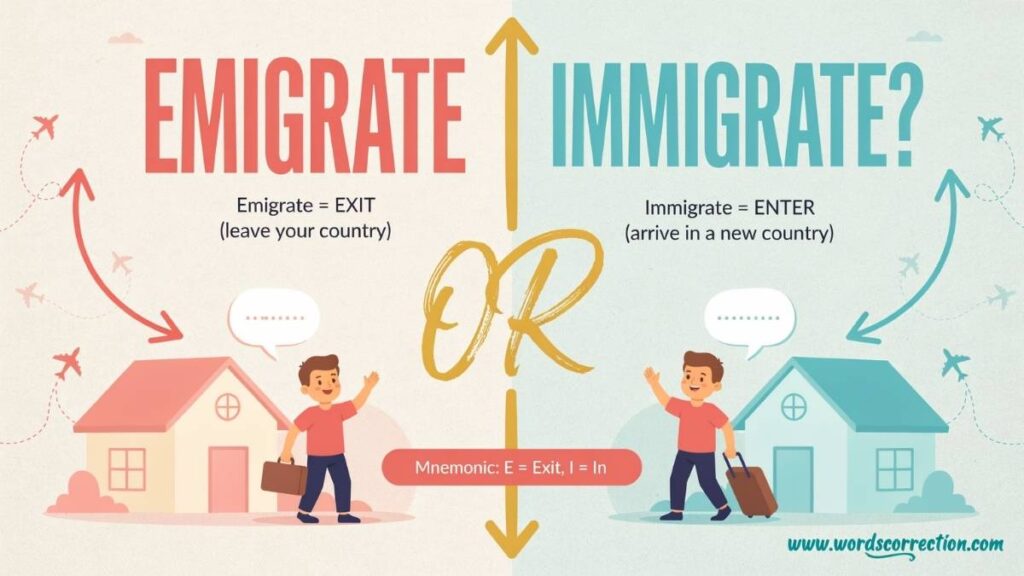
Moving to another country may sound straightforward, but English can make the journey surprisingly confusing. The terms emigrate or immigrate describe the same international move from different perspectives, which is where many grammar mistakes begin. If someone leaves Canada to settle in Australia, should you say they emigrated or immigrated? The answer depends on the direction you’re describing. Emigrate focuses on leaving your home country, while immigrate focuses on entering and settling in a new country. Once you understand this simple distinction, these easily confused words become much easier to use. No passport is required for this grammar lesson—just a clear sense of direction.
Emigrate or Immigrate Quick Answer
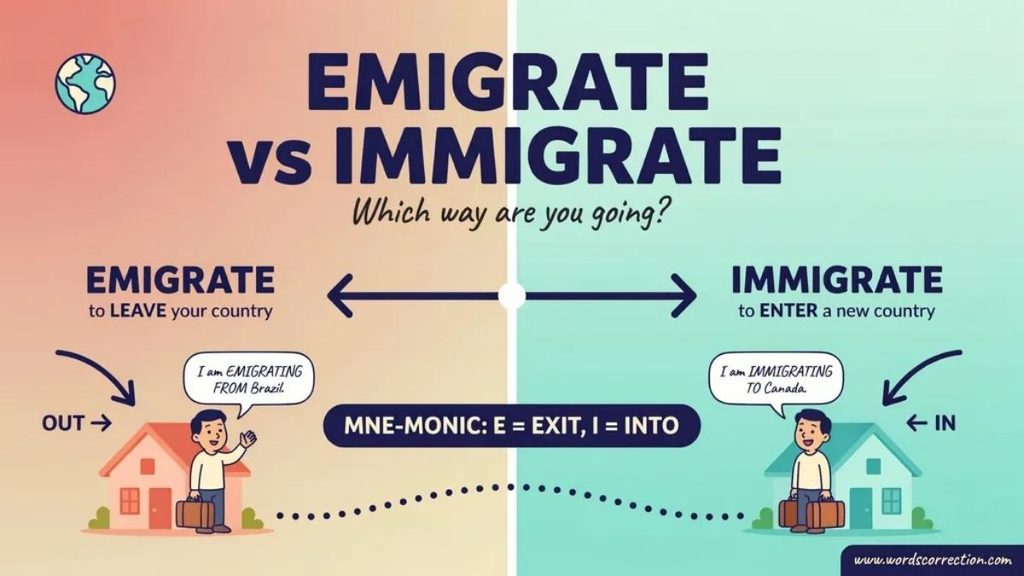
The simplest distinction is this:
- Emigrate means to leave your country or place of origin to live somewhere else.
- Immigrate means to move into another country to live there.
- Migrate means to move from one place to another and has a broader meaning.
Consider this example:
Sara emigrated from Pakistan and immigrated to the United Kingdom.
Both verbs are correct because they describe the same international move from different perspectives.
Emigrate focuses on the country being left. Immigrate focuses on the destination country.
A useful memory trick is:
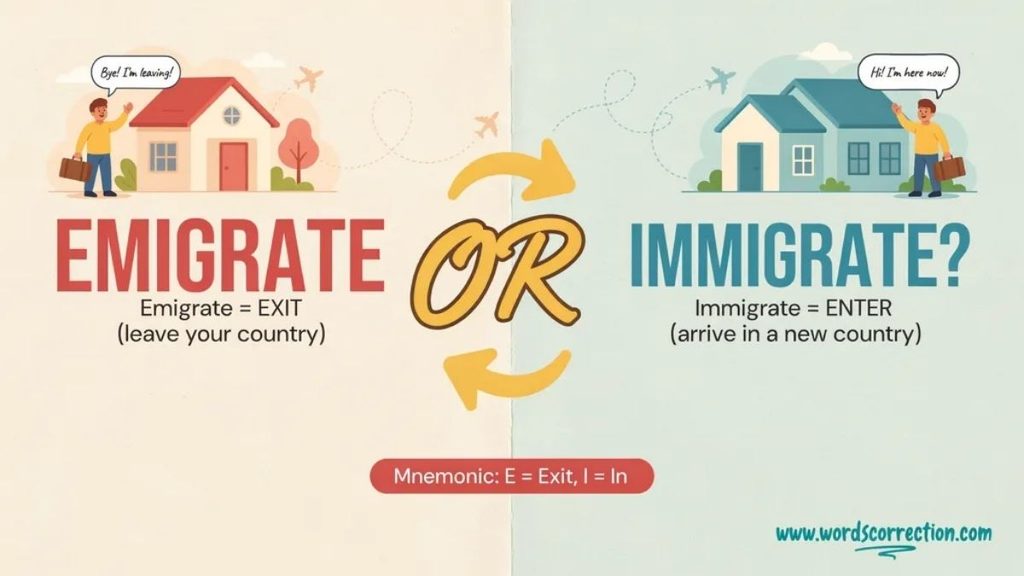
E = Exit → Emigrate
I = In → Immigrate
This isn’t a complete grammar rule for every possible sentence, but it provides a simple and effective way to remember the basic difference.
Emigrate vs Immigrate vs Migrate at a Glance
| Word | Main meaning | Main focus | Example |
| Emigrate | Leave a country to live elsewhere | Country left | She emigrated from Poland. |
| Immigrate | Move into another country to live | Destination country | She immigrated to Canada. |
| Migrate | Move from one place to another | Movement itself | The family migrated to another region. |
If you’re asking, “Is it emigrate or immigrate when leaving a country?” the usual answer is emigrate.
If you’re asking, “Is it immigrate or emigrate when moving to a new country?” immigrate generally fits when the sentence emphasizes entering and settling in the destination.
What Does Emigrate Mean?
Emigrate Meaning
The emigrate meaning centers on leaving a country or place of origin to establish a life somewhere else.
The word emphasizes departure. Someone who emigrates leaves their home country, native country, or country of residence for another place.
For example:
Maria emigrated from Italy and settled in Australia.
The sentence focuses on Italy as the country Maria left.
Definition of Emigrate
The definition of emigrate is essentially to leave one’s country or region to live permanently or for an extended period somewhere else.
The word commonly appears in discussions about:
- International relocation
- Permanent residence
- Population movement
- Historical migration
- Families moving abroad
- People leaving their native country
- Cross-border settlement
It generally describes a substantial move rather than a short vacation or ordinary trip.
Someone who spends two weeks in France hasn’t necessarily emigrated there. Emigration involves leaving one place to establish residence elsewhere.
Learn the difference between confusing more English words
Directer or Director Correct Spelling and Usage
What Does Emigrate Mean in Simple English?
To emigrate means to leave your country to live somewhere else.
For example:
- He emigrated from Germany.
- Her grandparents emigrated from Ireland.
- Thousands of people emigrated from the region during the economic crisis.
- They decided to emigrate to another country.
Notice an important point: although from commonly appears with emigrate, to can also appear.
The core meaning comes from the movement away from the original country, not from one mandatory preposition.
Emigrate in a Sentence
Here are several natural examples:
My grandfather emigrated from Poland in the 1960s.
They emigrated from the United States and settled in Spain.
Her family plans to emigrate after retirement.
Many people emigrated from the country during the conflict.
Each sentence presents emigration as movement away from a place of origin.
Learn the difference between commonly mixed-up more words
Attendance or Attendence Correct Spelling and Usage
What Does Immigrate Mean?
Immigrate Meaning
The immigrate meaning focuses on moving into another country to live there.
In other words, immigration describes movement from the perspective of the destination.
For example:
Daniel immigrated to Canada in 2018.
The sentence emphasizes Canada as the country Daniel entered and chose as his new place of residence.
Definition of Immigrate
The definition of immigrate is to move to another country or place to live there.
The word commonly appears when discussing:
- Immigration and settlement
- Permanent residence
- Citizenship
- Residency
- Immigration status
- Immigration laws
- International relocation
- A destination country’s population
For example:
Her parents immigrated to the United States before she was born.
The destination matters because immigrate frames the move from the receiving country’s perspective.
What Does Immigrate Mean?
In simple terms, to immigrate means to move into another country to live there.
For example:
- They immigrated to Canada.
- She immigrated to Australia.
- His parents immigrated to the United States.
- Thousands of people immigrated to the country over several decades.
Immigrate in a Sentence
My uncle immigrated to the United Kingdom in 2005.
Her family immigrated to Canada after several years of planning.
They immigrated to Australia and eventually became citizens.
His parents immigrated from another country before settling permanently in the United States.
That last example highlights an important point: immigrate can appear with from when the sentence supplies an origin. The verb still describes immigration into the destination.
Learn the difference between tricky grammar more words
Many or Meny What’s the Right English Word?
Emigrate and Immigrate Difference The Direction Matters
The biggest emigrate and immigrate difference isn’t the journey itself. It’s the point of view.
Imagine a person named Ahmed moving from Pakistan to the United Kingdom.
From Pakistan’s perspective:
Ahmed emigrated from Pakistan.
From the United Kingdom’s perspective:
Ahmed immigrated to the United Kingdom.
From a broader perspective:
Ahmed migrated from Pakistan to the United Kingdom.
Nothing contradictory happened. Ahmed made one move.
The vocabulary changes because the sentence changes its focus.
Country of Origin vs Destination Country
This distinction becomes easier when you separate two concepts:
- Country of origin or home country: where the person leaves
- Destination country or host country: where the person moves
The pattern looks like this:
COUNTRY OF ORIGIN DESTINATION COUNTRY
Pakistan ───────────────────────► United Kingdom
EMIGRATE FROM
IMMIGRATE TO
The two verbs aren’t competing descriptions. They describe the same international movement from opposite ends.
Learn the difference between confusing word pairs
Finalise or Finalize Meaning, Difference and Usage
Emigrate vs Immigrate vs Migrate
The emigrate vs. immigrate vs. migrate distinction becomes much clearer once migrate enters the picture.
What Does Migrate Mean?
The migrate meaning is broader than either emigrate or immigrate.
To migrate means to move from one place to another. The movement can involve people, animals, populations, or groups.
Migration doesn’t necessarily involve international borders.
For example:
The family migrated to another city.
That’s migration, but it isn’t necessarily immigration or emigration.
Likewise:
Birds migrate south in winter.
No immigration process exists here. The birds aren’t establishing legal residency. They’re simply moving from one region to another.
Emigrate vs Migrate
Emigrate is more specific.
It focuses on leaving a country or established home to live elsewhere.
Migrate simply describes movement.
Compare:
Thousands of workers migrated to the city.
Thousands of families emigrated from the country.
The first sentence doesn’t necessarily involve international movement. The second specifically frames people as leaving their country.
Immigrate vs Migrate
Immigrate is also more specific than migrate.
The family migrated to another region.
This tells us about movement.
The family immigrated to Canada.
This tells us that the family moved into Canada to establish residence.
Therefore, immigration is a type of migration, but not every migration is immigration.
Learn the difference between often confused words
Classes or Class’s Meaning, Difference and Usage
One Move, Three Verbs
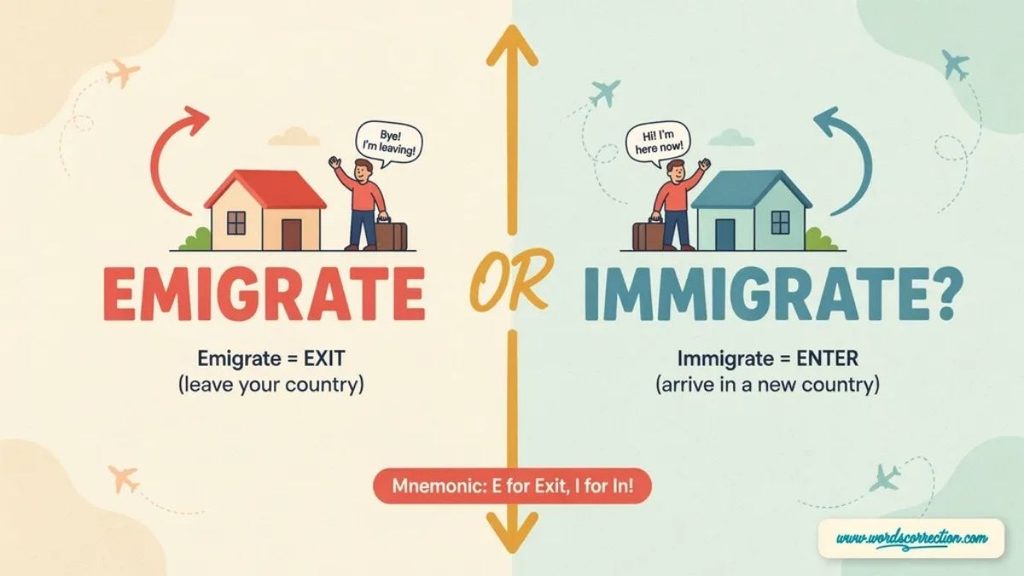
Consider a simple case study.
Imagine that Elena leaves Poland and settles permanently in Canada.
You could describe the same event three ways:
| Perspective | Sentence | What it emphasizes |
| Departure | Elena emigrated from Poland. | Leaving Poland |
| Destination | Elena immigrated to Canada. | Entering Canada to live |
| General movement | Elena migrated from Poland to Canada. | The movement itself |
This example shows why dictionary definitions alone don’t always settle the confusion. Context determines which aspect of the movement matters.
Learn the difference between basic English word mistakes
Uncapable or Incapable Which Spelling Is Correct?
The Origin of Emigrate and Immigrate
The connection between these words isn’t accidental.
Both ultimately come from the Latin root migrare, meaning “to move.”
Their prefixes help explain the directional difference.
Where Does Emigrate Come From?
Emigrate comes from the Latin emigrare.
The prefix is associated with the idea of moving out or away.
That provides a useful conceptual connection:
E → Exit → Emigrate
English has used emigrate for centuries to describe people leaving one place to settle elsewhere.
Where Does Immigrate Come From?
Immigrate comes from the Latin immigrare, associated with moving into a place.
That creates the matching memory aid:
I → In → Immigrate
The two words therefore share a historical foundation while pointing in different directions.
The Shared Root Migrate
The word migrate comes from the same broad Latin family.
That’s why all three words look alike:
- Emigrate → move out
- Immigrate → move in
- Migrate → move
Etymology doesn’t replace modern definitions, but it provides a useful memory aid.
Learn the difference between commonly misused words
Analyses or Analysis Meaning, Difference and Usage
Emigrate vs Immigrate Pronunciation
Pronunciation can create another layer of confusion because the words differ by only their opening sounds.
Emigrate Pronunciation
In American English, emigrate is commonly pronounced /ˈem.ə.ɡreɪt/.
The primary stress falls on the first syllable.
Immigrate Pronunciation
In American English, immigrate is commonly pronounced /ˈɪm.ə.ɡreɪt/.
Again, the first syllable receives the main stress.
The key difference is the opening vowel sound.
- Emigrate begins with an /e/ sound.
- Immigrate begins with an /ɪ/ sound.
Emigrate vs Immigrate Pronunciation Why It Matters
Because the spelling is similar, careful pronunciation can help listeners distinguish the words.
However, pronunciation alone doesn’t explain their meanings. Context still matters.
When people speak quickly, the surrounding sentence usually makes the intended meaning clear.
British English vs American English
If you’re wondering whether emigrate and immigrate have different British and American spellings, the answer is straightforward:
The standard spellings are the same.
American English:
- Emigrate
- Immigrate
British English:
- Emigrate
- Immigrate
The main variation worth noting involves pronunciation rather than spelling.
Therefore, if you’re writing for an American audience, you don’t need to change either word into a different spelling. The distinction remains one of meaning, perspective, and direction.
Learn the difference between everyday English mistakes
Devide or Divide Difference, Meaning and Usage
Common Mistakes With Emigrate and Immigrate
The most common errors happen when writers remember that both words involve moving countries but forget which side of the journey each word emphasizes.
Mistake Treating Them as Interchangeable
Consider:
She immigrated from France to Canada.
This sentence can be grammatically acceptable because immigrate can occur with from when the origin is identified. However, if the intended focus is leaving France, emigrated from France is usually clearer.
A more precise version is:
She emigrated from France and immigrated to Canada.
That sentence makes both directions explicit.
Mistake Thinking Emigrate Can Only Take From
A common shortcut says:
Emigrate from. Immigrate to.
It’s useful as a memory aid, but it isn’t a complete grammar rule.
English also allows constructions such as:
They emigrated to Australia.
The important question is what the verb means, not whether one preposition appears every time.
Mistake Assuming Immigrate Can Never Appear With From
That’s also too rigid.
A sentence can say:
He immigrated from India to Canada.
Here, from India identifies the source while to Canada identifies the destination. The verb still describes immigration into Canada.
For straightforward writing, however, emigrate from and immigrate to make the directional distinction especially clear.
Mistake Using Migrate as an Exact Substitute
Migrate is broader.
Birds migrate every year.
The family immigrated to Canada.
Replacing immigrated with migrated removes the specific immigration meaning.
Mistake Confusing the Verbs With the Nouns
The word families look like this:
| Verb | Noun | Person |
| Emigrate | Emigration | Emigrant |
| Immigrate | Immigration | Immigrant |
| Migrate | Migration | Migrant |
Once you understand the pattern, these forms become much easier to use.
Learn the difference between more words people mix up
Businesses or Business’s Meaning, Grammar and Correct Usage
When to Use Emigrate or Immigrate
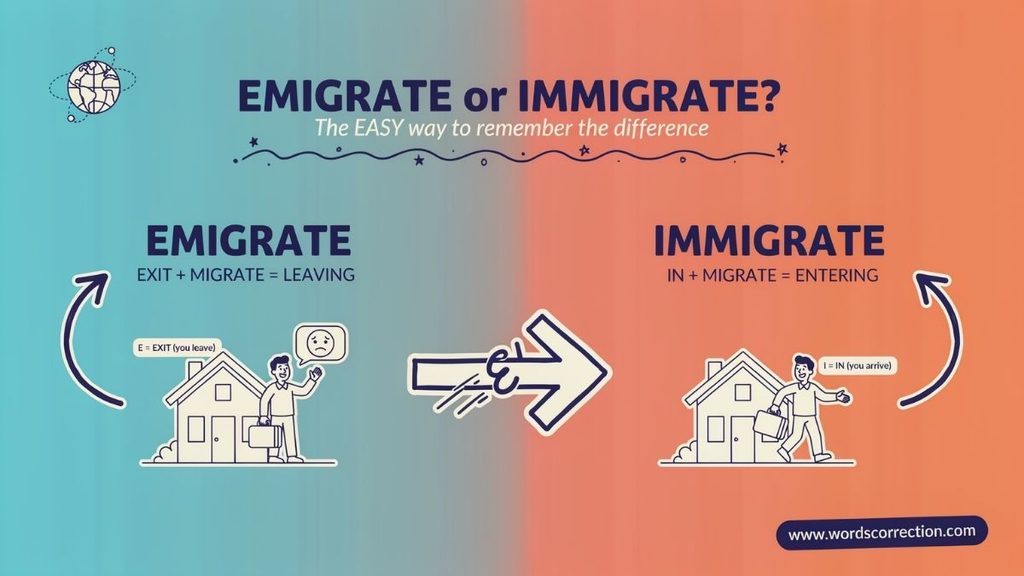
The best way to choose between the words is to ask one simple question:
What part of the journey does the sentence emphasize?
Use Emigrate When the Focus Is Leaving
Use emigrate when you want to focus on the country or place someone leaves.
She emigrated from India.
His grandparents emigrated from Poland.
Thousands of families emigrated from the region.
The key idea is departure.
Use Immigrate When the Focus Is Entering and Settling
Use immigrate when you want to focus on the destination.
She immigrated to Canada.
His family immigrated to the United States.
They immigrated to Australia and established permanent residence.
The key idea is entering a new country for residence.
Use Migrate When the Focus Is General Movement
Use migrate when you don’t need to emphasize immigration or emigration.
Many people migrate to cities for employment.
Some communities migrate between regions seasonally.
Birds migrate south during winter.
The word covers a much wider range of movement.
Emigrate From the United States Correct Usage
“Emigrate from the United States” is a natural construction when someone leaves the United States to live elsewhere.
For example:
She emigrated from the United States to Germany.
The phrase identifies the United States as the country of departure.
You could reverse the perspective:
She immigrated to Germany from the United States.
Or describe the journey more generally:
She migrated from the United States to Germany.
All three sentences describe the same basic movement. The wording changes the perspective.
Likewise, if someone moves into the United States:
They immigrated to the United States.
From their previous country’s perspective:
They emigrated from Poland.
This is why “emigrate from the United States” and “immigrate to the United States” aren’t competing phrases. They describe different directions.
Learn the difference between tricky English words with easy explanations
Alternately or Alternatively Meaning, Usage and Examples
Emigrate vs Immigrate Examples
Seeing the words side by side is often more useful than memorizing definitions.
| Emigrate Example | Immigrate Example |
| She emigrated from Mexico. | She immigrated to Canada. |
| He emigrated from Germany. | He immigrated to Australia. |
| They emigrated from Poland. | They immigrated to the United States. |
| Her family emigrated from Ireland. | Her family immigrated to New Zealand. |
| Thousands emigrated from the country. | Thousands immigrated to the region. |
Emigrate Example Sentence
My grandparents emigrated from Poland after World War II.
The focus is on the country they left.
Immigrate Example Sentence
My grandparents immigrated to Canada after World War II.
The focus is on the country where they settled.
Migrate in a Sentence
The family migrated from a rural area to a major city.
This sentence describes movement without necessarily using immigration terminology.
Emigration vs Immigration
The noun forms follow the same directional distinction as the verbs.
Meaning of Emigration
Emigration means the act or process of leaving one’s country to live elsewhere.
Emigration from the country increased.
The emphasis lies on people leaving their country of origin.
Meaning of Immigration
Immigration means the process of moving into another country to live there.
Immigration to the country increased.
The focus lies on people entering and settling in the destination country.
Emigration vs Immigration Table
| Term | Perspective | Example |
| Emigration | Leaving | Emigration from the country increased. |
| Immigration | Entering | Immigration to the country increased. |
| Migration | Movement generally | Migration between regions continued. |
A single international movement can therefore involve both emigration and immigration.
Emigrant vs Immigrant
An emigrant is someone viewed in relation to the country they leave.
An immigrant is someone viewed in relation to the country they enter and settle in.
Consider Daniel, who leaves Poland and settles in Canada.
From Poland’s perspective:
Daniel is an emigrant.
From Canada’s perspective:
Daniel is an immigrant.
Daniel hasn’t become two different people. The labels reflect two different perspectives.
Immigrant vs Migrant
An immigrant is a type of migrant, but the terms aren’t always interchangeable.
Migrant is broader.
It can refer to people who move:
- Within a country
- Between countries
- Temporarily
- Seasonally
- Permanently
- For work
- For family reasons
- For safety or other circumstances
Immigrant generally carries the more specific idea of moving into another country to establish residence.
Therefore:
Every immigrant is a migrant in the broad sense, but not every migrant is an immigrant.
Immigration vs Migration
The immigration vs. migration distinction is another common source of confusion.
Migration describes movement from one place to another.
Immigration describes movement into a country for residence.
For example:
Workers migrated from rural communities to cities.
This doesn’t necessarily involve crossing an international border.
By contrast:
Workers immigrated to Canada.
Now the sentence specifically describes movement into another country.
Does Migrate Always Mean Moving to Another Country?
No.
A person can migrate within the same country.
For example:
The family migrated from a small town to a major city.
No international border appears in the sentence.
Animals also migrate:
Monarch butterflies migrate thousands of miles during seasonal movement.
That’s clearly migration without immigration.
Immigration and Emigration Examples in Real Contexts
Family Relocation
Imagine a family moves from India to the United Kingdom for permanent residence.
From India’s perspective:
The family emigrated from India.
From Britain’s perspective:
The family immigrated to the United Kingdom.
From a general perspective:
The family migrated from India to the United Kingdom.
Historical Settlement
Suppose a group leaves Ireland and settles in another country.
A historian focusing on the departure might discuss Irish emigration.
A historian examining the receiving country’s population might discuss Irish immigration.
The historical event hasn’t changed. The analytical perspective has.
International Relocation for Work
Consider an engineer who leaves Germany for a permanent job in Australia.
engineer emigrated from Germany.
The engineer immigrated to Australia.
The engineer migrated from Germany to Australia.
Each sentence works because each verb highlights a different aspect of the relocation.
Emigration Process and Immigration Process
The terms can also appear in discussions about practical relocation.
The emigration process may involve preparing to leave a home country, changing residency arrangements, moving possessions, and establishing life elsewhere.
The immigration process can involve procedures established by the destination country, such as:
- Visa applications
- Residency requirements
- Documentation
- Border procedures
- Immigration status
- Permanent residence
- Citizenship pathways
However, these legal processes vary considerably by country. The linguistic distinction between emigrate and immigrate doesn’t tell you what a particular country’s immigration laws require.
That’s an important difference between language terminology and legal terminology.
Reasons for Immigration and Emigration
People may describe the same move differently depending on the circumstances.
Common reasons for emigration can include:
- Employment opportunities
- Education
- Family reunification
- Economic conditions
- Political circumstances
- Safety
- Retirement
- Long-term lifestyle changes
From the destination country’s perspective, the same movement becomes immigration.
For example:
A worker emigrated from Pakistan for a permanent position abroad.
From the receiving country’s perspective:
The worker immigrated to the United Kingdom for employment.
The reason for the move doesn’t determine which verb you use. The perspective does.
Can Someone Emigrate and Immigrate at the Same Time?
Yes, in the sense that one international move can involve both processes.
Suppose someone moves permanently from France to Canada.
That person can:
- Emigrate from France
- Immigrate to Canada
- Migrate from France to Canada
The actions describe the same cross-border movement from different viewpoints.
However, emigrate and immigrate aren’t interchangeable within the same sentence if you want to preserve that directional distinction.
Which Preposition Is Used With Emigrate?
The most familiar construction is:
emigrate from + place
Examples:
- emigrate from Poland
- emigrate from the United States
- emigrate from Ireland
You can also encounter:
emigrate to + destination
For example:
They emigrated to Australia.
So the useful rule isn’t “emigrate always takes from.”
Instead:
Emigrate focuses on leaving.
The preposition depends on which part of the movement the sentence identifies.
Which Preposition Is Used With Immigrate?
The most familiar construction is:
immigrate to + destination
Examples:
- immigrate to Canada
- immigrate to the United States
- immigrate to Australia
You may also see:
immigrate from + origin + to + destination
For example:
They immigrated from India to Canada.
Again, the core meaning remains movement into a new country for residence.
Emigrate and Immigrate Verb Forms
Knowing the different grammatical forms helps when writing more complex sentences.
Emigrate
- Base form: emigrate
- Third-person singular: emigrates
- Past tense: emigrated
- Present participle: emigrating
- Noun: emigration
- Person: emigrant
Example:
They emigrated last year.
Immigrate
- Base form: immigrate
- Third-person singular: immigrates
- Past tense: immigrated
- Present participle: immigrating
- Noun: immigration
- Person: immigrant
Example:
They immigrated to Canada in 2019.
These forms belong to the same word family but perform different grammatical roles.
Emigrate or Immigrate A Simple Memory Trick
When the words start blurring together, return to the prefixes.
E = Exit
Emigrate → think exit.
Emigrate from a country.
I = In
Immigrate → think in.
Immigrate to a country.
M = Move
Migrate → think move.
Migrate from one place to another.
A quick visual makes the distinction easier:
MOVE
|
+——–+——–+
| |
EMIGRATE IMMIGRATE
| |
OUT IN
| |
LEAVE ENTER
It’s a memory device rather than a complete grammar rule. Still, it provides a quick way to separate the words when you’re writing.
Learn the difference between commonly confused more words in English
Tie or Tye Meaning, Difference and Usage
Emigrate vs Immigrate Comparison Table
| Feature | Emigrate | Immigrate | Migrate |
| Basic meaning | Leave a country to live elsewhere | Move into another country to live | Move from one place to another |
| Main focus | Departure | Destination | Movement |
| Typical perspective | Country left | Country entered | General movement |
| Common construction | Emigrate from a country | Immigrate to a country | Migrate from/to a place |
| Related noun | Emigration | Immigration | Migration |
| Person | Emigrant | Immigrant | Migrant |
| Can involve international movement? | Yes | Yes | Yes |
| Must involve international movement? | Typically | Yes in its standard immigration sense | No |
| Example | She emigrated from Poland. | She immigrated to Canada. | She migrated to another region. |
Emigrate or Immigrate Usage What Actually Matters?
Search engines may show that people frequently search for “emigrate or immigrate,” but search popularity doesn’t determine correct English usage.
For language questions, dictionary definitions and established usage provide more useful evidence.
The distinction between these words isn’t a recent internet rule. It has a long history in English and reflects two different perspectives on international movement.
Search trends can reveal what people find confusing. They don’t determine which word belongs in a sentence.
That’s an important distinction when evaluating online language advice.
Why Are Emigrate and Immigrate Often Confused?
The confusion makes perfect sense.
Both words:
- Describe international movement.
- Refer to people changing countries.
- Share the root migrate.
- Look almost identical.
- Sound similar.
- Often appear in the same discussions about relocation and population movement.
The biggest difference is perspective.
Imagine watching a traveler walk through a doorway.
Someone standing behind the traveler might say:
He left.
Someone standing inside the room might say:
He came in.
The traveler made one movement. The observers describe it differently because they stand on opposite sides of the doorway.
That’s essentially what happens with emigrate and immigrate.
Practice sessions
Fill in the Blanks
- She decided to ________ from France.
- They plan to ________ to Canada.
- Birds ________ south in winter.
- He ________ from Pakistan last year.
- She ________ to Australia in 2024.
- Many families ________ for better opportunities.
- We ________ from our home country.
- They ________ to the United States.
- Some animals ________ long distances.
- He wants to ________ from his native country.
- She hopes to ________ to Germany.
- They ________ from Italy in 2019.
- The family ________ to Canada.
- Birds ________ to warmer regions.
- Many people ________ because of work.
- He ________ from England.
- She ________ to New Zealand.
- People ________ from one country to another.
- They ________ from Poland in 2020.
- He ________ to the United States.
- Some animals ________ seasonally.
- She decided to ________ from her home country.
- They hope to ________ to France.
- He ________ from Brazil and ________ to Portugal.
- You emigrate ________ a country and immigrate ________ another country.
Answers
- emigrate
- immigrate
- migrate
- emigrated
- immigrated
- migrate
- emigrate
- immigrate
- migrate
- emigrate
- immigrate
- emigrated
- immigrated
- migrate
- migrate
- emigrated
- immigrated
- migrate
- emigrated
- immigrated
- migrate
- emigrate
- immigrate
- emigrated; immigrated
- from; to
Here’s a trusted source for clear more words Comparison:
Grammar Update
Frequently Asked Questions
Do you immigrate or emigrate to America?
You immigrate to America when you move there from another country to live. You emigrate from your home country when you leave it to settle elsewhere. The correct term depends on whether you are describing your arrival in a new country or your departure from your home country.
What is the difference between migration and immigration?
Migration refers to the movement of people from one place to another, either within a country or across international borders. Immigration specifically refers to entering another country to establish residence. Therefore, immigration is one form of migration.
What is the difference between an immigrant and an emigrant?
An immigrant is someone who moves into another country to live, while an emigrant is someone who leaves their home country to settle elsewhere. For example, a person moving from Pakistan to Canada is an emigrant from Pakistan and an immigrant to Canada.
Do humans migrate or emigrate?
Humans can migrate, emigrate, or immigrate, depending on the circumstances. Migration is the general term for moving from one place to another. Emigration describes leaving a country to live elsewhere, while immigration describes entering another country to establish residence.
Should I use emigrate or immigrate?
Use emigrate when describing someone leaving a country and immigrate when describing someone entering another country to live. For example, “She emigrated from India” emphasizes her departure, while “She immigrated to Australia” emphasizes her arrival.
What does it mean to emigrate from the United States?
To emigrate from the United States means to leave the country to establish residence elsewhere. For example, an American who moves to Spain to live there has emigrated from the United States.
What does it mean to immigrate to another country?
To immigrate means to enter another country with the intention of living there. For example, someone who moves from the United States to Canada to establish residence has immigrated to Canada.
Can someone emigrate and immigrate at the same time?
Yes. Both terms can describe the same international move from different perspectives. A person moving from Mexico to the United States emigrates from Mexico and immigrates to the United States.
What is the difference between emigration and immigration?
Emigration refers to leaving a country to live elsewhere, whereas immigration refers to entering another country to establish residence. These terms describe opposite sides of the same international move.
What is the difference between an immigrant and a migrant?
An immigrant is someone who moves into another country to live, while a migrant is a broader term for someone who moves from one place to another. Migrants may move within their own country or across international borders.
What is the difference between an emigrant and a migrant?
An emigrant is someone who leaves their country to live elsewhere. A migrant is a more general term for someone who moves from one place to another, either within a country or internationally. Therefore, an emigrant is a type of migrant.
What is the past tense of emigrate?
The past tense of emigrate is emigrated. For example: “My grandparents emigrated from Italy several decades ago.”
What is the past tense of immigrate?
The past tense of immigrate is immigrated. For example: “Her family immigrated to Canada in 2015.”
What is the noun form of emigrate?
The noun form of emigrate is emigration. It refers to the act or process of leaving one’s country to live in another. For example: “Emigration increased as more families moved abroad.”
What is the noun form of immigrate?
The noun form of immigrate is immigration. It refers to the act or process of entering another country to live. For example: “Immigration has contributed to the country’s cultural diversity.”
Which preposition is used with emigrate?
The verb emigrate is commonly used with the preposition “from” when identifying the country someone leaves. For example: “They emigrated from Ireland.” The preposition highlights the place of departure.
Which preposition is used with immigrate?
The verb immigrate is commonly used with the preposition “to” when identifying the country someone enters to live. For example: “They immigrated to New Zealand.” The preposition highlights the destination.
Is migration always international?
No. Migration can occur within a country or across international borders. Moving from one city to another within the same country is called internal migration, while moving from one country to another is called international migration.
What is the difference between immigration and relocation?
Immigration specifically refers to entering another country to live, whereas relocation means moving to a different place, either within the same country or abroad. For example, moving from Chicago to New York is relocation, not immigration.
What is the difference between immigration and resettlement?
Immigration refers to entering another country to live, while resettlement means establishing a home in a different place. Resettlement can occur within a country or internationally and is often used when discussing refugees or displaced people.
Can you use emigrate and immigrate in the same sentence?
Yes. Both words can be used in the same sentence to describe an international move from two perspectives. For example: “Daniel emigrated from Brazil and immigrated to Portugal to pursue a new career.”
What is an example of emigration?
An example of emigration is a family leaving the Philippines to establish a home in Australia. From the Philippines’ perspective, the family’s departure is considered emigration.
What is an example of immigration?
An example of immigration is a family arriving in Australia from the Philippines to establish a new home. From Australia’s perspective, the family’s arrival is considered immigration.
How can I remember the difference between emigrate and immigrate?
Use these simple memory aids to distinguish the terms:
- Emigrate = Exit: leaving a country to live elsewhere.
- Immigrate = In: entering another country to establish residence.
- Migrate = Move: the general act of moving from one place to another.
These associations can help you select the correct word in writing and conversation.
Is it correct to say “emigrate to America”?
Although the phrase can be understood, immigrate to America is the more appropriate expression when describing someone entering the United States to live. Use emigrate from America when describing someone leaving the United States to settle in another country.
Conclusion
The difference between emigrate or immigrate becomes much easier to understand when you focus on direction. Emigrate means leaving your home country to live elsewhere, while immigrate means entering another country with the intention of settling there. In other words, you emigrate from a country and immigrate to another.
The word migrate is broader. It describes moving from one place to another and doesn’t always involve crossing an international border. The same person can therefore emigrate from one country and immigrate to another. Once you remember who is leaving and who is arriving, these commonly confused words become far less intimidating. English may love its little traps, but this one is easy to escape.

Stella AJS is an experienced blogger and dedicated English language writer at Words Correction. She turns confusing grammar, word meanings, spelling, and usage into clear, practical insights that readers can easily understand and apply. With a passion for precise and engaging writing, Stella helps readers avoid common language mistakes, strengthen their vocabulary, and communicate with greater clarity and confidence.