
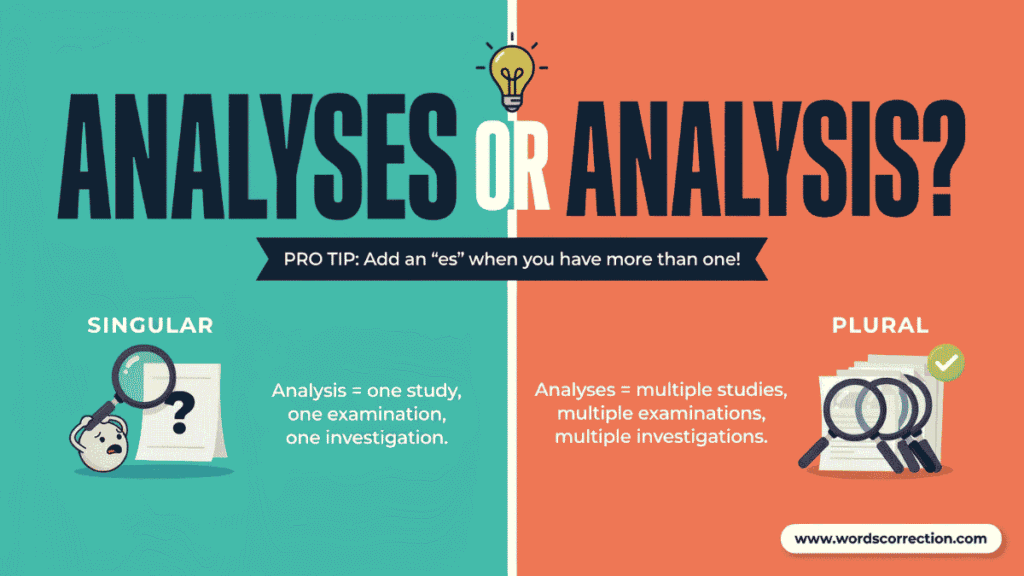
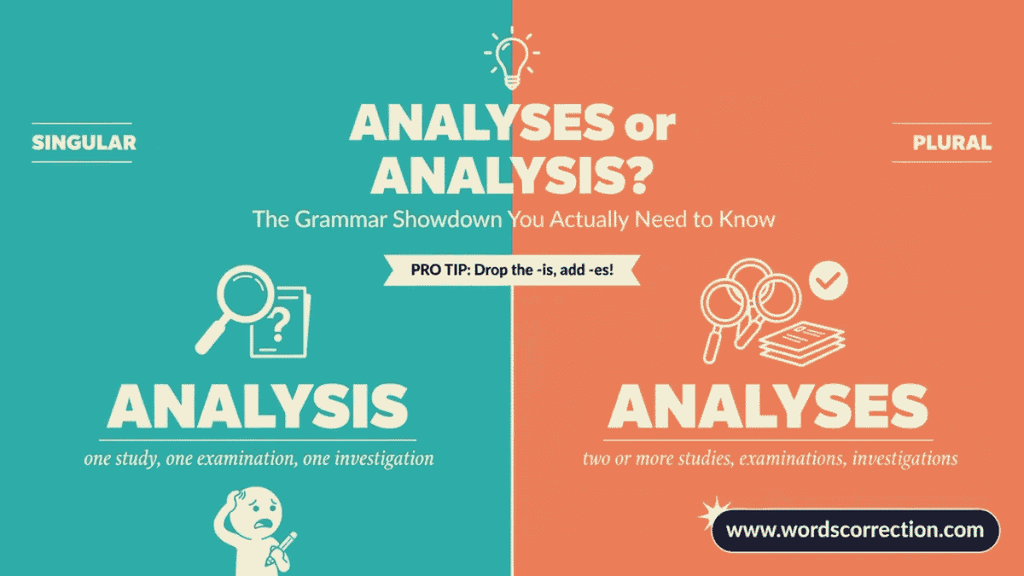
Choosing between analyses or analysis can turn a simple sentence into a surprisingly tricky grammar puzzle. The two words look nearly identical, but they don’t serve the same grammatical purpose. Use the wrong form, and even a carefully written sentence can lose its polish. Fortunately, the rule is much easier than the spelling makes it seem. Analysis refers to one detailed examination, while analyses refers to two or more. Once this singular-and-plural distinction becomes clear, the confusion quickly fades. This guide breaks down their meanings, spelling, pronunciation, grammar rules, and common usage mistakes with clear examples, helping you choose the correct form confidently.
Analyses or Analysis Quick Answer
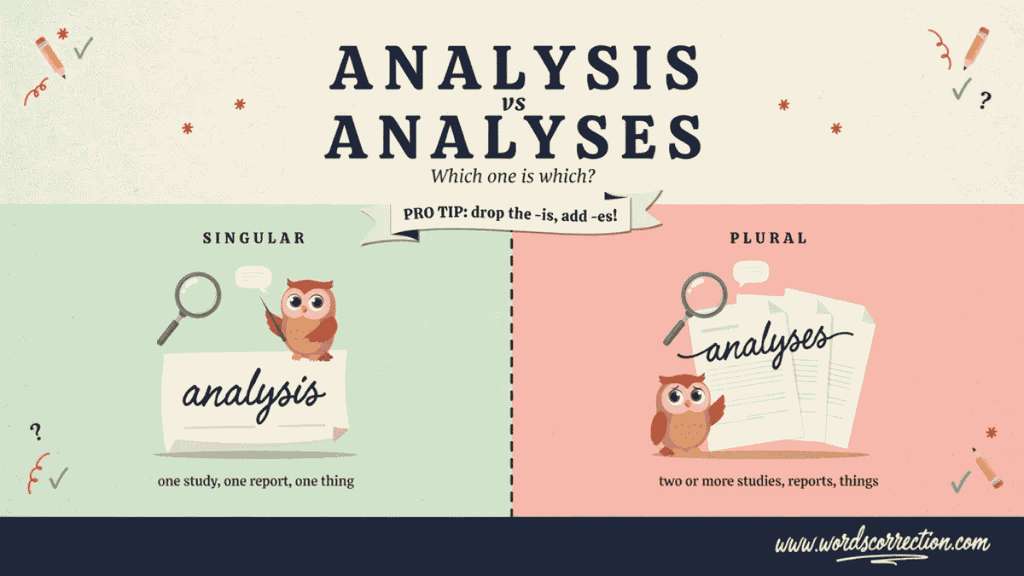
The difference between analysis and analyses comes down to grammatical number.
| Word | Number | Meaning | Example |
| analysis | Singular | One detailed examination or interpretation | The analysis reveals a significant trend. |
| analyses | Plural | Two or more detailed examinations or interpretations | The analyses reveal several significant trends. |
In other words:
- One analysis
- Two analyses
- Several analyses
- Multiple analyses
- Different analyses
The form “analysises” is not the standard plural.
Analyses or Analysis Examples
Consider these examples:
- The researcher completed an analysis of the survey results.
- The report contains three analyses of the survey results.
- Her analysis of the market was detailed.
- Their analyses of the market produced different conclusions.
- The company conducted a financial analysis before investing.
- The company conducted several financial analyses before making a decision.
The surrounding words often provide a useful clue. Words such as an, one, this, and a generally point toward the singular form. Words such as several, two, many, multiple, and different indicate a plural form.
Learn the difference between confusing more English words
Unvoluntary or Involuntary Which One Is Correct?
The Simple Rule for Analysis vs Analyses
The easiest way to remember the analysis plural is:
One = analysis
More than one = analyses
That rule answers most questions about when to use analysis and when to use analyses.
Analysis vs Analyses What Is the Difference?
The difference between analysis and analyses is grammatical rather than a difference in their basic meaning.
Both words refer to examination, interpretation, or study. The difference is the number of examinations being discussed.
Analysis is a singular noun.
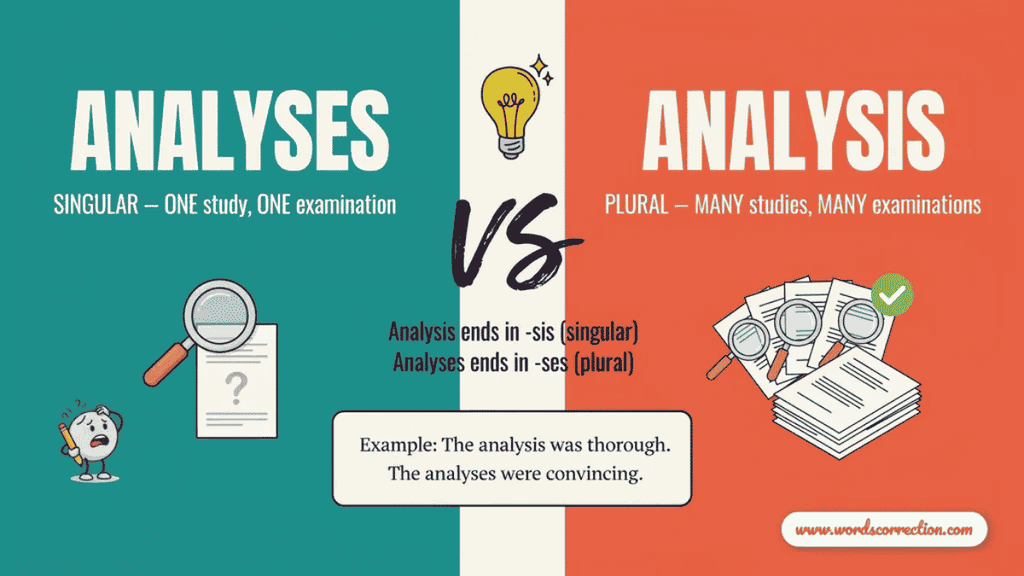
The analysis of the data was thorough.
This sentence describes one examination of the data.
Analyses is a plural noun.
The analyses of the data were thorough.
This sentence describes multiple examinations.
The same distinction appears in verb agreement:
- The analysis shows a pattern.
- The analyses show several patterns.
The noun determines the grammatical number, which then affects other parts of the sentence.
One Analysis or Multiple Analyses
Imagine a researcher examining customer satisfaction.
If the researcher performs one statistical examination, you might write:
The analysis identified a decline in customer satisfaction.
If the researcher performs three separate statistical examinations, you might write:
The analyses identified different factors affecting customer satisfaction.
The subject has not necessarily changed. The number of analytical examinations has.
Analysis Meaning What Does Analysis Mean?
The analysis meaning centers on careful examination.
Analysis refers to the process of examining something in detail, often by separating it into parts, identifying relationships, interpreting evidence, or determining how different elements work together.
In simple terms, analysis means looking closely at something to understand it better.
For example:
scientist performed an analysis of the water sample.
The scientist did more than simply observe the sample. it examined its characteristics and interpreted the resulting information.
Analysis can involve:
- Examination
- Investigation
- Interpretation
- Evaluation
- Assessment
- Comparison
- Data interpretation
- Identification of patterns
- Evaluation of evidence
The precise meaning depends on the context.
Analysis Definition
A practical analysis definition is:
Analysis is a detailed examination of something to understand its parts, relationships, characteristics, meaning, or significance.
The word can describe both the process of examining something and the result of that examination.
For example:
The analyst’s analysis revealed an unexpected pattern.
Here, analysis refers to the examination that produced the finding.
Learn the difference between commonly mixed-up more words
Incurable or Uncurable? Meaning, Difference and Usage
What Does Analysis Mean in Everyday Language?
When someone says they are going to analyze something, they usually mean they intend to examine it carefully rather than simply observe it.
For example:
- A teacher analyzes a student’s essay.
- A scientist analyzes experimental results.
- A financial expert analyzes company performance.
- A journalist analyzes a report.
- A researcher analyzes survey responses.
- A business analyzes customer behavior.
The common thread is careful examination followed by interpretation.
Analysis Meaning in Research
Research relies heavily on analysis because collecting information alone is not enough. Researchers must examine that information and determine what it means.
In research writing, analysis can involve numerical data, written responses, interviews, observations, experimental results, or other forms of evidence.
For example:
The study included an analysis of responses from 500 participants.
Here, analysis refers to one analytical process involving the collected responses.
Research commonly uses different forms of analysis, including:
- Statistical analysis
- Qualitative analysis
- Quantitative analysis
- Content analysis
- Thematic analysis
- Regression analysis
- Comparative analysis
However, mentioning several analytical techniques does not automatically mean you must use analyses.
For instance:
The study used statistical analysis to evaluate the results.
That sentence is grammatically correct even if the analysis involved many calculations.
The key question is whether you are referring to one analytical process or multiple distinct analyses
Learn the difference between tricky grammar more words
Vain or Vein Key Difference, Meaning, Grammar and Usage
Analysis Meaning in Business
Businesses use analysis to understand markets, customers, finances, risks, and performance.
Common business expressions include:
- Market analysis
- Financial analysis
- Competitor analysis
- Sales analysis
- Customer analysis
- Risk analysis
- Cost analysis
- Performance analysis
For example:
The company completed a market analysis before launching the product.
That sentence refers to one market analysis.
If the company examined several markets independently, you could write:
The company completed separate market analyses for the United States, Canada, and Mexico.
The plural makes sense because the company performed distinct examinations.
Learn the difference between confusing word pairs
Congrats or Congratulations Which One Is Correct?
Analysis Synonyms
The best synonym depends on what kind of analysis you are describing.
| Synonym | Common context |
| Examination | Looking at something carefully |
| Investigation | Seeking facts or explanations |
| Evaluation | Judging quality, value, or effectiveness |
| Assessment | Measuring or determining a condition |
| Interpretation | Explaining meaning |
| Study | Examining a subject systematically |
| Review | Examining existing information or material |
These words overlap with analysis, but they are not always interchangeable.
For example, a financial analysis may involve an evaluation, but evaluation does not always capture the full analytical process involved.
Analyses Meaning What Does Analyses Mean?
The analyses meaning is simply the plural meaning of analysis.
Analyses refers to two or more separate examinations, interpretations, or analytical studies.
For example:
The researchers conducted three analyses of the experimental data.
This means the researchers conducted three distinct analytical examinations.
Analyses Definition
The analyses definition can be stated simply:
Analyses is the plural form of analysis and refers to two or more detailed examinations, interpretations, or studies.
This answers the common questions “What is analyses?” and “What does analyses mean?”
When you see analyses in a sentence, look for evidence that the writer is discussing more than one analytical examination.
Learn the difference between often confused words
Synched or Synced Correct Spelling, Meaning and Usage
Analyses Meaning in Research
Research frequently uses analyses when researchers conduct multiple distinct procedures.
For example:
The researchers conducted separate analyses for younger and older participants.
The researchers did not perform one single analysis. They performed separate analyses for different groups.
Another example:
The researchers compared the results from two independent analyses.
Again, the plural is appropriate because there were two analytical procedures.
Analyses Examples in Academic Writing
Here are several natural examples:
- The analyses produced consistent findings.
- The researchers conducted multiple analyses of the survey data.
- Different analyses produced slightly different results.
- The paper reports two statistical analyses.
- The researchers performed separate analyses for each group.
These examples demonstrate how analyses functions in formal and academic writing.
Why Is the Plural of Analysis Analyses?
If you are wondering why the plural of analysis is analyses, the answer lies partly in the word’s history.
Analysis ultimately comes from the Greek word analysis, which is associated with breaking something apart or loosening it. English adopted the term and retained its historical plural pattern.
As a result:
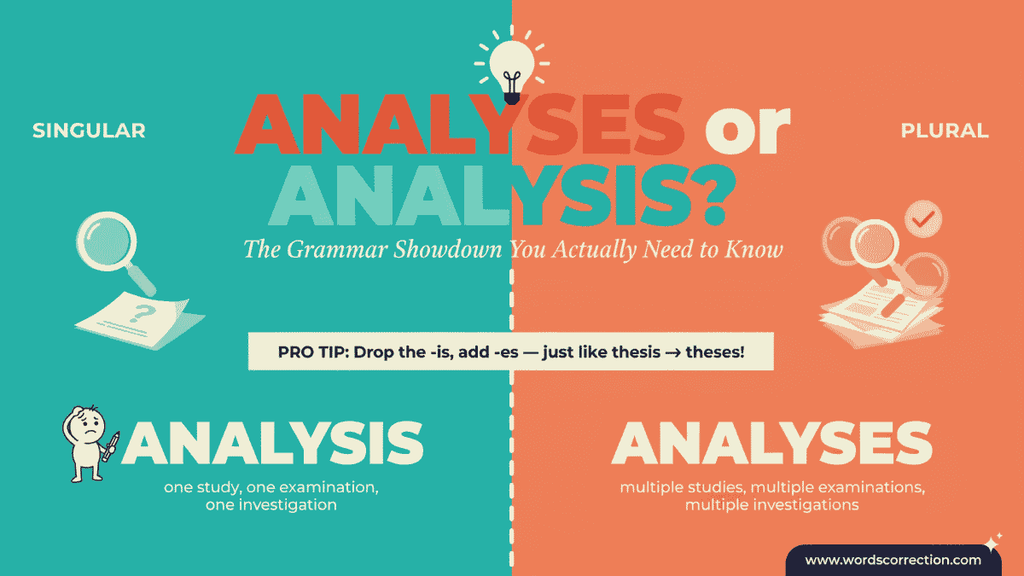
analysis → analyses
This is not the same pattern as ordinary English nouns such as:
book → books
or:
report → reports
Instead, analysis belongs to a group of Greek-derived nouns whose plural forms developed from their historical endings.
Similar patterns appear in words such as:
- crisis → crises
- thesis → theses
- hypothesis → hypotheses
- diagnosis → diagnoses
These words can look unusual to English learners because their plural forms involve more than simply adding s.
How Do You Pluralize Analysis?
The standard pluralization is:
analysis → analyses
Not:
analysises
and not:
analysis
when you clearly mean multiple examinations.
So, if you are asking what is the plural form of analysis, the answer is analyses.
If you are asking what is the plural word for analysis, the answer is also analyses.
Learn the difference between basic English word mistakes
Directer or Director Correct Spelling and Usage
both in Pronunciation
Spelling is not the only difference. Analysis pronunciation and analyses pronunciation also differ.
In American English, analysis has four syllables, while analyses has three.
The singular ends with a sound similar to “sis.” The plural ends with a sound similar to “seez.”
The pronunciation difference matters because someone might recognize the spelling but still misunderstand the spoken word.
The key is to pay attention to the ending. The singular and plural forms do not sound exactly alike.
Analysis Grammar Singular or Plural?
One of the most common questions is “Is analysis singular or plural?”
The answer is straightforward:
Analysis is singular
That means you can use singular determiners and singular verbs with it.
Examples:
- An analysis was completed.
- The analysis shows a clear trend.
- This analysis provides useful evidence.
- One analysis identified the problem.
So, is analysis singular or plural? It is singular when used as the noun.
Is Analyses Plural?
Yes.
Analyses is plural when used as the noun.
Examples:
- The analyses were completed.
- The analyses show different patterns.
- These analyses provide useful evidence.
- Several analyses identified the same issue.
This explains the basic analyses grammar and analysis grammar rules.
Learn the difference between commonly misused words
Attendance or Attendence Correct Spelling and Usage
Analysis Singular or Plural A Quick Grammar Test
When you are unsure about analysis singular or plural, replace the word mentally with study.
If you would say:
One study
then use:
One analysis
If you would say:
Several studies
then use:
Several analyses
For example:
The study was detailed.
becomes:
The analysis was detailed.
And:
The studies were detailed.
becomes:
The analyses were detailed.
This substitution trick works well because it makes the grammatical number obvious.
Data Analysis or Data Analyses?
one of the most useful distinctions to understand because both expressions can be correct.
Data Analysis
Use data analysis when referring to the general process, a particular analytical activity, or one analysis.
Examples:
Data analysis is an important part of the research process.
The researcher completed a data analysis of the survey responses.
The first sentence describes the broader process.
Data Analyses
Use data analyses when referring to multiple distinct analyses.
For example:
The researchers conducted separate data analyses for each age group.
Here, multiple analytical procedures took place.
Learn the difference between everyday English mistakes
Many or Meny What’s the Right English Word?
Data Analysis vs Data Analyses
| Expression | Typical meaning |
| Data analysis | The general process or one analytical examination |
| Data analyses | Multiple distinct analytical examinations |
The fact that data can refer to many individual observations does not automatically require analyses.
The grammatical number of analysis depends on how many distinct analytical examinations you mean.
Multiple Analysis or Multiple Analyses?
The standard expression is:
Multiple analyses
For example:
The researchers performed multiple analyses.
Why? Because multiple means more than one, so it requires a plural noun.
Similarly, these expressions are standard:
- Multiple analyses
- Several analyses
- Two analyses
- Three analyses
- Different analyses
By contrast:
Multiple analysis
is generally incorrect when analysis functions as a countable noun referring to separate examinations.
One Analysis or One Analyses?
The correct expression is:
One analysis
Not:
One analyses
The word one clearly indicates a singular noun.
Two Analysis or Two Analyses?
The correct expression is:
Two analyses
Not:
Two analysis
The number two requires the plural noun.
Learn the difference between more words people mix up
Finalise or Finalize Meaning, Difference and Usage
Different Analyses or Different Analysis?
Usually:
Different analyses
is correct when you mean several separate examinations.
For example:
The researchers used different analyses to examine the data.
However, different analysis can appear when analysis has a singular construction:
A different analysis may produce another interpretation.
The article a signals the singular form.
Analysis or Analyses in Research and Academic Writing
Academic writing requires careful grammatical number because a small change can alter what a sentence communicates.
Consider:
The researchers performed an analysis of the results.
This indicates one analysis.
Now compare:
The researchers performed three analyses of the results.
This indicates three distinct analytical procedures.
Analysis or Analyses in Academic Writing
The distinction becomes especially important when a paper compares different methods.
For example:
The study used a statistical analysis to determine whether the variables were related.
One analytical procedure is being described.
But:
The study used separate statistical analyses for the three participant groups.
The plural tells the reader that the researchers performed separate procedures.
Statistical Analysis or Statistical Analyses?
Both are correct.
Use statistical analysis for one analysis or for the broader practice:
Statistical analysis revealed a significant relationship between the variables.
Use statistical analyses when referring to multiple statistical procedures:
The researchers conducted statistical analyses using three different models.
The same principle applies to qualitative analysis, quantitative analysis, and other specialized forms.
Learn the difference between tricky English words with easy explanations
Classes or Class’s Meaning, Difference and Usage
both in Professional Writing
These words appear across many forms of professional communication.
In Emails
I’ve attached the analysis of last month’s sales.
One analysis is attached.
If multiple documents or examinations are included:
I’ve attached the analyses of last month’s sales by region.
In News Writing
A journalist might write:
The expert’s analysis explains the economic changes.
If several experts provide separate examinations:
Several analysts offered different analyses of the economic changes.
In Formal Reports
The report includes an analysis of operating costs.
But:
The report includes separate analyses of operating costs, revenue, and customer demand.
In Academic Writing
The analysis supports the study’s conclusion.
Or:
The analyses support the study’s broader conclusions.
The surrounding context determines whether the singular or plural noun fits.
Learn the difference between confusing more English words step by step
Uncapable or Incapable Which Spelling Is Correct?
Common Mistakes With Analysis and Analyses
The unusual plural creates several predictable mistakes.
Mistake 1: Using Analyses for One Examination
Incorrect:
The analyses was completed yesterday.
Correct:
The analysis was completed yesterday.
The singular verb was provides another clue that the writer means one analysis.
Mistake 2: Using Analysis for Several Examinations
Incorrect:
The researchers conducted three analysis.
Correct:
The researchers conducted three analyses.
The number three requires a plural noun.
Mistake 3: Writing Analysises
A common spelling mistake is adding es to analysis as though it were an ordinary English noun.
Incorrect:
analysises
Correct:
analyses
Remember:
analysis → analyses
This is one of the most important analysis spelling rules to remember.
Mistake 4: Confusing Analysis With a Verb
Analysis is a noun.
The corresponding US English verb is analyze.
| Word | Part of speech | Example |
| analyze | Verb | Researchers analyze the data. |
| analyzed | Verb | Researchers analyzed the data. |
| analyzing | Verb | Researchers are analyzing the data. |
| analysis | Noun | The analysis was detailed. |
| analyses | Plural noun | The analyses were detailed. |
| analytical | Adjective | The report used an analytical approach. |
| analyst | Noun | The analyst reviewed the findings. |
This distinction becomes particularly useful when editing academic or professional writing.
Analysis vs Analyses in Everyday and Professional Sentences
Seeing the words in context is often more useful than memorizing a grammar rule.
Analysis in a Sentence
The analysis of the survey results revealed a strong preference for online learning.
This describes one analytical examination.
Another example:
Her analysis of the novel focused on its central themes.
Again, one detailed examination is involved.
Analyses in a Sentence
The analyses of the survey results revealed different patterns.
Here, several analyses produced several sets of findings.
Another example:
The researchers compared two analyses before reaching their conclusion.
The number is explicit.
Analysis or Analyses in a Sentence
| Singular | Plural |
| The analysis was completed. | The analyses were completed. |
| The analysis shows a trend. | The analyses show several trends. |
| This analysis supports the conclusion. | These analyses support the conclusion. |
| One analysis was sufficient. | Several analyses were necessary. |
These examples also demonstrate an important part of analysis grammar rules: the verb should agree with the noun.
Case Study Choosing Analysis or Analyses in a Research Report
Consider a fictional research project examining employee satisfaction.
The researchers collect responses from 1,000 employees. They then perform one overall statistical examination.
The report could say:
The analysis of employee satisfaction identified three major concerns.
Although the researchers examined 1,000 responses and produced many statistics, they are describing one analytical procedure.
Now suppose the researchers separately examine:
- Employee satisfaction by age
- Employee satisfaction by department
- Employee satisfaction by length of employment
The report could say:
The researchers conducted three analyses of employee satisfaction.
The important point is that the number of data points does not determine whether you use analysis or analyses.
The number of distinct analytical examinations does.
That distinction prevents a common grammar mistake in research writing.
Analysis vs Analyses Comparison Table
| Feature | Analysis | Analyses |
| Grammatical number | Singular | Plural |
| Part of speech | Noun | Noun |
| Meaning | One detailed examination | Two or more detailed examinations |
| Singular article | an analysis | — |
| Number words | one analysis | two analyses |
| Common modifiers | this, one, each | these, several, many, multiple |
| Verb agreement | analysis is/shows | analyses are/show |
| Example | The analysis was useful. | The analyses were useful. |
| Common research phrase | data analysis | data analyses |
| Correct spelling | analysis | analyses |
The essential rule is simple: analysis is singular, while analyses is plural.
How to Remember Analysis vs Analyses
A simple memory pattern can save you from repeatedly checking the spelling.
Think of It This Way
One → analysis
Two or more → analyses
Then remember the spelling change:
-is → -es
So:
analysis → analyses
You can also memorize one sentence:
One analysis, several analyses.
This short phrase reinforces both the grammatical number and the spelling.
Practice Session Analysis or Analyses
Complete each sentence with the correct word analysis or analyses.
- The researcher conducted an ________ of the survey results.
- The report contains several detailed ________ of the market.
- We need to complete an ________ before making a final decision.
- The scientists performed multiple ________ of the experimental data.
- Her ________ of the problem was detailed and accurate.
- The study includes three separate ________ of the collected information.
- The manager requested an ________ of the company’s financial performance.
- The researchers compared their different ________ of the results.
- The professor asked students to write an ________ of the article.
- Several ________ were conducted to identify the main trends.
- The report provides a detailed ________ of the findings.
- The team completed two independent ________ of the data.
- An ________ of the evidence revealed several important patterns.
- The researchers presented their ________ at the scientific conference.
- The financial ________ revealed a significant change in revenue.
- The study required several statistical ________ before the researchers could reach a conclusion.
- The journalist provided an in-depth ________ of the issue.
- The researchers conducted separate ________ for each group in the study.
- The final report includes an ________ of the research findings.
- The team reviewed all the ________ before preparing the final report.
- We need an expert ________ of the technical problem.
- The researchers used different methods to perform their ________.
- The detailed ________ helped the company understand the results.
- The paper presents several ________ of the experimental findings.
- Before writing the conclusion, the researcher completed an ________ of the available evidence.
Answer Section
- analysis
- analyses
- analysis
- analyses
- analysis
- analyses
- analysis
- analyses
- analysis
- analyses
- analysis
- analyses
- analysis
- analyses
- analysis
- analyses
- analysis
- analyses
- analysis
- analyses
- analysis
- analyses
- analysis
- analyses
- analysis
Here’s a trusted source for clear more words Comparison:
Grammar Update
Frequently Asked Questions About Analysis and Analyses
What is the difference between analysis and analyses?
Analysis is the singular form and refers to one detailed examination, evaluation, or interpretation. Analyses is the plural form and refers to two or more examinations or evaluations.
Example:
- The report contains an analysis of the market.
- The researchers conducted several analyses of the data.
What does “analyses” mean?
Analyses is the plural form of analysis. It refers to two or more detailed examinations, evaluations, or interpretations of a subject, problem, or set of information.
Example: The study includes several analyses of the research findings.
Is “analyses” a correct word?
Yes, analyses is a correct English word. It is the standard plural form of analysis.
Example: The researchers presented their analyses at the conference.
What is the correct plural of analysis?
The correct plural form of analysis is analyses.
- Singular: analysis
- Plural: analyses
Example: The report contains one analysis, while the research paper includes several analyses.
How do you pronounce “analyses”?
Analyses is pronounced approximately uh-NAL-uh-seez. The final sound is similar to the word “sees.”
Is it correct to say “an analysis” or “a analysis”?
The correct expression is “an analysis.” The word analysis begins with a vowel sound, so it takes the indefinite article an.
Correct: The team prepared an analysis of the results.
Incorrect: The team prepared a analysis of the results.
How do you say more than one analysis?
The correct plural form is analyses. Use analyses when referring to two or more separate examinations or evaluations.
Example: The researchers completed three analyses of the collected data.
What is a simple word for analysis?
Depending on the context, simpler alternatives for analysis include examination, review, study, assessment, and evaluation.
Example: The report provides an analysis of the results.
A simpler version could be: The report provides a review of the results.
What is another word for “analyses”?
Depending on the context, alternatives to analyses include examinations, evaluations, assessments, reviews, studies, and interpretations.
What does “analysis” mean in simple words?
In simple terms, analysis means carefully examining something to understand it, identify important details, or reach a conclusion.
Example: The scientist performed an analysis of the test results.
What does “analyze” mean in simple words?
Analyze means to examine something carefully by studying its parts, details, or information in order to understand it better or reach a conclusion.
Example: The researchers analyzed the survey results.
What is another word for “analyze”?
Depending on the context, synonyms for analyze include examine, evaluate, assess, study, inspect, review, and interpret.
What is a more formal word for “analyze”?
More formal alternatives to analyze include evaluate, examine, assess, investigate, interpret, and scrutinize. The appropriate choice depends on the context and intended meaning.
What is an example sentence using the word “analysis”?
Here is a clear example:
“The researcher completed an analysis of the survey results.”
In this sentence, analysis refers to one detailed examination of the survey results.
What is an example of “analyses” in a sentence?
Here is an example:
“The researchers conducted several analyses to identify patterns in the data.”
In this sentence, analyses refers to multiple examinations of the data.
Which is correct “analysis” or “analyses”?
Both analysis and analyses are correct, but they have different grammatical functions. Analysis is singular, while analyses is plural.
Examples:
- The study includes one analysis.
- The study includes several analyses.
Is there a plural form of “analysis”?
Yes. The plural form of analysis is analyses.
Example: The researchers compared several analyses of the findings.
What is the difference between “analysis” and “analyses” in research?
In research, analysis generally refers to one examination or analytical process, whereas analyses refers to multiple examinations or analytical processes.
Example:
- The analysis of the survey data revealed an important trend.
- The researchers conducted separate analyses of the survey and interview data.
What is the difference between “analysis” and “analyses” in data analysis?
Data analysis can refer to the process of examining data or to a particular examination of data. Data analyses is used when referring to multiple separate examinations or analytical procedures.
Example: The researchers performed statistical analyses on data from several groups.
Where did the word “analysis” come from?
The word analysis comes from the Greek word analysis, which originally referred to breaking something apart or loosening it. The word eventually developed its modern meaning of examining something by separating it into parts.
What is the noun form of “analyze”?
The noun form associated with analyze is analysis. Its plural form is analyses.
Examples:
- Verb: Researchers analyze the data.
- Singular noun: Researchers conduct an analysis of the data.
- Plural noun: Researchers conduct several analyses of the data.
What is the difference between “analyze” and “analysis”?
Analyze is a verb that means to examine something carefully. Analysis is a noun that refers to the examination or evaluation itself.
Example: Scientists analyze the results and publish their analysis.
What is the difference between “analyse” and “analysis”?
Analyse is the British English spelling of the verb meaning “to examine carefully.” Analysis is the corresponding noun and is spelled the same in both British and American English.
Examples:
- British English: Researchers analyse the data.
- Noun: Researchers conduct an analysis of the data.
What is another way to say “doing an analysis”?
Depending on the context, you can use phrases such as conducting an analysis, performing an analysis, examining the data, evaluating the results, or analyzing the information.
Example: The research team is conducting an analysis of the survey results.
What is the correct way to use “analysis” and “analyses”?
Use analysis when referring to one examination or evaluation and analyses when referring to more than one.
Examples:
- The report contains an analysis of the problem.
- The report contains several analyses of the problem.
Quick Reference
| Word | Number | Meaning |
| Analysis | Singular | One detailed examination or evaluation |
| Analyses | Plural | Two or more detailed examinations or evaluations |
| Analyze | Verb | To examine something carefully |
| Analyse | Verb | British English spelling of “analyze” |
Conclusion
The confusion between analysis and analyses may seem like a small grammar problem, but one extra letter can make a sentence mean something different. Fortunately, the rule is simple: analysis is singular, while analyses is plural. Use one analysis, but two analyses, several analyses, or multiple analyses. And avoid “analysises”—English grammar has already rejected that spelling.
Once you understand this singular-and-plural pattern, choosing between analyses or analysis becomes much easier. Whether you’re writing a research paper, business report, academic assignment, or everyday sentence, simply match the noun to the number of examinations you mean. A little grammatical precision can keep your writing accurate, polished, and professional.

Stella AJS is an experienced blogger and dedicated English language writer at Words Correction. She turns confusing grammar, word meanings, spelling, and usage into clear, practical insights that readers can easily understand and apply. With a passion for precise and engaging writing, Stella helps readers avoid common language mistakes, strengthen their vocabulary, and communicate with greater clarity and confidence.




