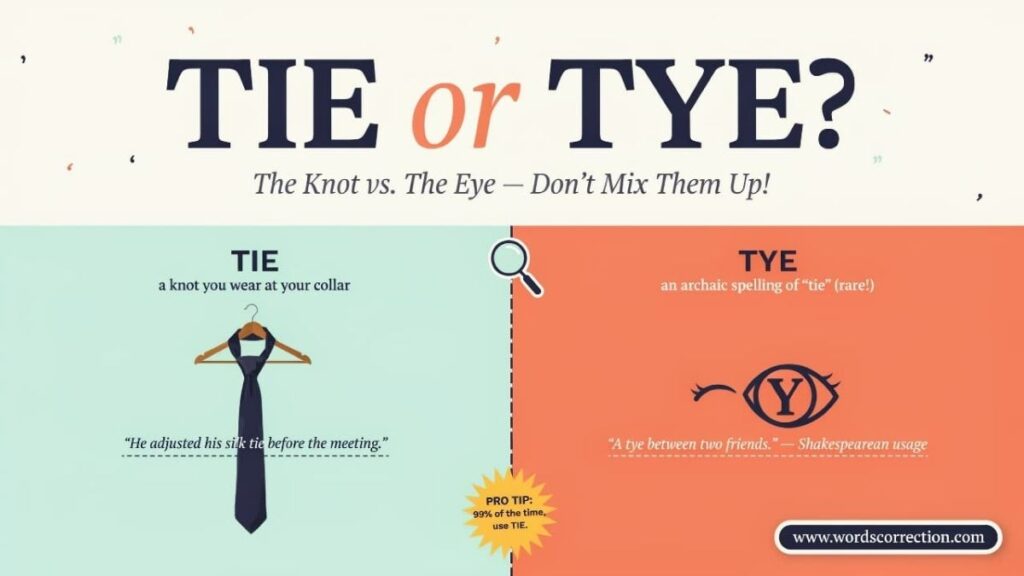
English spelling can turn a simple word into an unexpected puzzle. One common example is the question: tie or tye? If you’ve ever hesitated before typing it, you’re not alone. Although “tye” looks like it could be an alternative spelling, modern English gives tie the starring role in everyday writing. “Tye” does exist, but its uses are generally historical, regional, technical, or connected to proper names. Understanding this distinction can save you from an unnecessary spelling stumble. This guide explores the tie or tye meaning, spelling, pronunciation, and usage, helping you choose the correct form with confidence in any context.
Tie or Tye Quick Answer
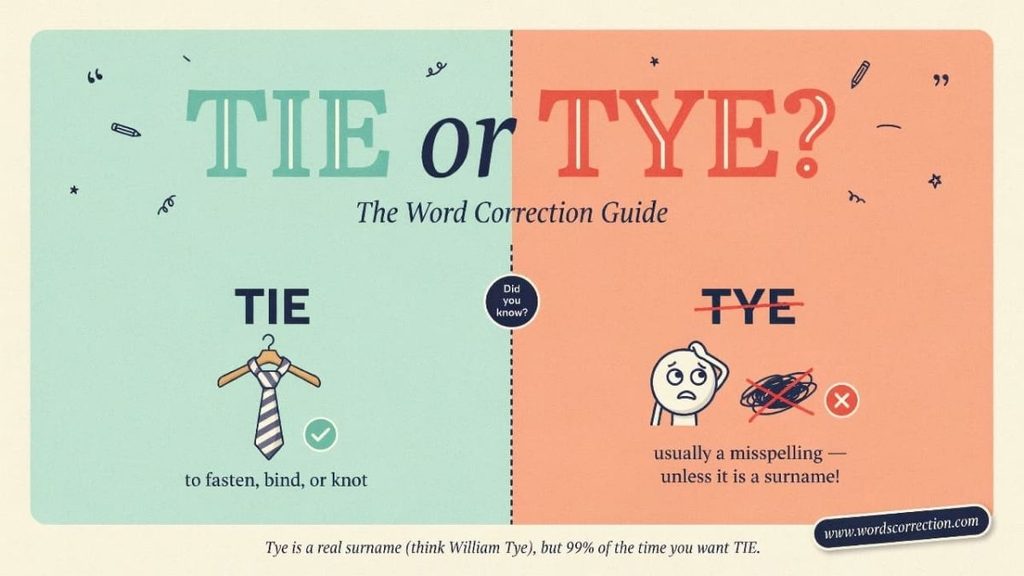
Tie is the standard spelling in modern everyday English.
Use tie when you mean:
- to fasten something with a knot
- to secure something with string, rope, or cord
- to connect or attach things
- a necktie or bow tie
- an equal score in a game
- a connection or relationship
- a sports match that forms part of a competition in British English
Tye is a much less common English word. It has documented historical, dialectal, specialized, and proper-name uses. In some sources, it appears as an obsolete form of tie. In others, it refers to specific technical or regional concepts.
So, if you’re asking, “is it tie or tye?”, the practical answer is:
Use “tie” for ordinary modern English. Use “tye” only when the specific context calls for it.
Simple Rule
Here’s the easiest rule to remember:
Tie = normal modern English
Tye = rare, historical, dialectal, specialized, or context-specific English
For example:
- Tie your shoes. Correct
- Tie a knot. Correct
- Wear a tie. Correct
- The game ended in a tie. Correct
- Tie the sapling to the stake. Correct
- Tye your shoes. Incorrect in standard modern English
- Tye a knot. Incorrect in standard modern English
Tie vs Tye What’s the Difference?
The difference between tie and tye isn’t simply that one is correct and the other is always wrong.
The two forms have overlapping historical roots, but modern usage has separated them sharply. Tie became the ordinary spelling for the common English word. Tye survived in narrower uses. Some dictionary sources also identify it as an obsolete spelling of tie.
Tie Meaning
The word tie works as both a verb and a noun.
As a verb, tie generally means to fasten, connect, secure, bind, or join something. You might tie your shoelaces, tie a package, tie a rope, or tie two pieces of string together.
As a noun, tie has several meanings. It can refer to:
- a necktie
- a knot or fastening
- an equal score in a competition
- a relationship or connection
- a structural connection or support
- a musical symbol connecting notes
The word can even take on different meanings depending on regional usage. For example, tie can describe a sports match in British English or a railroad support in North American English.
Tye Meaning
The tye meaning depends heavily on context.
English dictionaries record several uses, including:
- an obsolete form of tie
- a patch of common land, often a village green
- a mining trough used to separate valuable material from waste
- a nautical chain or rope used in raising or lowering a yard
That makes tye vs tie meaning a context question rather than a simple spelling contest.
If someone writes, “Please tye your shoes,” the intended word is almost certainly the modern verb tie.
If a historical mining document contains the word tye, however, it may be using a legitimate technical term.
Is Tye a Word?
Yes. Tye is a word, but that doesn’t mean you can freely use it wherever you would use tie.
This distinction often causes confusion.
A word can appear in an English dictionary and still be:
- obsolete
- dialectal
- highly specialized
- historical
- technical
- uncommon
For example, tye has documented uses in historical and specialized vocabulary. That doesn’t make it the standard spelling for ordinary sentences such as “Tie your shoes.”
So the answer to “is tye a word?” is yes.
The answer to “is tye a correct word?” is also yes, provided the context supports the particular meaning.
However, if someone writes:
Please tye your shoes.
that doesn’t make tye correct simply because the word exists. The sentence requires the ordinary modern verb tie.
Learn the difference between confusing more English words
Congrats or Congratulations Which One Is Correct?
Is Tye a Real Word?
Yes, but real word and standard spelling for every situation are two different ideas.
| Question | Answer |
| Is tie a word? | Yes |
| Is tye a word? | Yes |
| Is tie the standard everyday spelling? | Yes |
| Can tye have legitimate meanings? | Yes |
| Can tye replace tie in ordinary writing? | Generally no |
| Is tye found in specialized dictionaries? | Yes |
| Is tye used as an obsolete form of tie? | Yes |
Tie Meaning What Does Tie Mean?
If you’re asking “what does tie mean?”, the answer depends on how the word functions in a sentence.
Tie as a Verb
The most familiar meaning is to fasten or secure something.
For example:
- Tie the rope around the post.
- Tie your shoelaces.
- Tie the package with string.
- She tied her hair back.
- They tied the branches together.
The idea of fastening or connecting appears in many uses of the verb.
You can tie something with a rope, cord, string, ribbon, or similar material. You can also use tie figuratively when describing things that connect people, ideas, events, or organizations.
Learn the difference between tricky more English words
Devide or Divide Difference, Meaning and Usage
Tie as a Noun
The noun has several common meanings.
Clothing: A tie is a narrow piece of fabric worn around the neck.
Sports: A tie can mean an equal score.
Connection: A tie can describe a bond or relationship.
Fastening: A tie can be something used to hold or connect objects.
Music: A tie connects two notes of the same pitch so they are performed as a continuous sound.
The central idea behind many of these meanings is connection. Something that ties two things together creates a link between them.
What Does Tye Mean?
The answer to “what does tye mean?” requires more care.
In one documented British dialect use, tye refers to a trough used in mining to separate valuable material from waste.
In another British usage, tye can refer to a patch of common land, often a village green.
Historical sources also record tye as:
- an obsolete form of tie
- a historical word connected with tying or fastening
- a nautical chain or rope
- a trough used in mining
Therefore, the tye definition isn’t one fixed definition. Its meaning changes according to the source and context.
Learn the difference between commonly mixed-up more words
Synched or Synced Correct Spelling, Meaning and Usage
Spelling Tie or Tye Which One Is Standard?
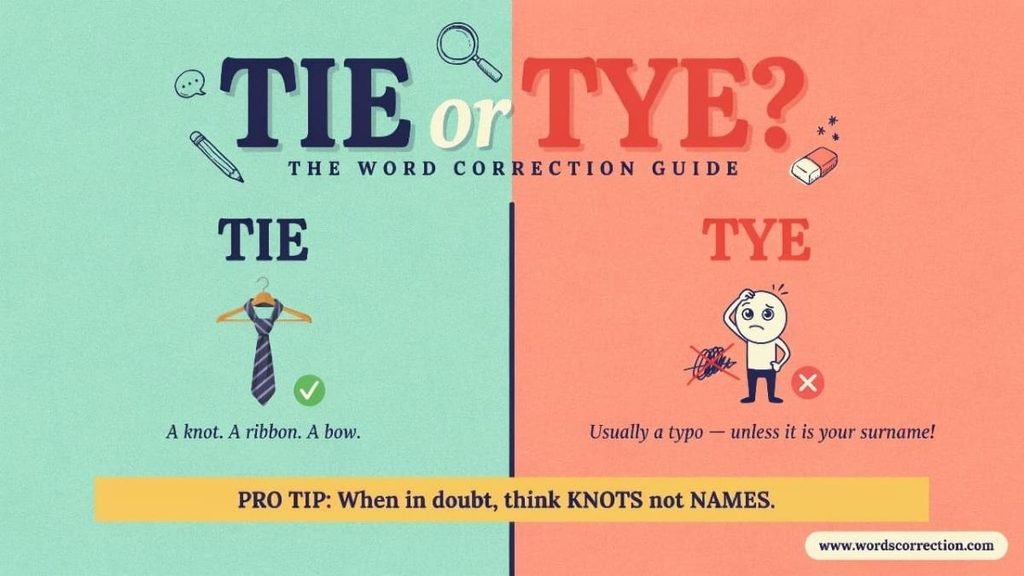
The tie or tye spelling question becomes much easier when you separate modern standard English from historical vocabulary.
For ordinary writing, tie is the standard spelling.
You should write:
- tie your shoes
- tie a knot
- tie a ribbon
- tie the rope
- wear a tie
- tie-dye
- the game was a tie
The modern spelling is well established in contemporary English.
How Do You Spell Tie?
The standard spelling is:
T-I-E
So, when someone asks, “How do you spell tie?”, the answer is straightforward: T-I-E.
Don’t write tye when you mean the ordinary modern verb or noun.
How Do You Spell Tye?
If the specific word is tye, it is spelled:
T-Y-E
That spelling is legitimate in documented contexts. It simply isn’t the normal spelling of the everyday word tie.
Tie or Tye Pronunciation
The tie pronunciation and the pronunciation of many documented uses of tye are the same.
How Do You Pronounce Tie?
Tie is pronounced /taɪ/.
It rhymes with:
- buy
- by
- cry
- fly
- high
- sky
How Do You Pronounce Tye?
In documented English uses, tye is also commonly pronounced /taɪ/.
This creates an important spelling lesson:
Words can sound alike without being interchangeable in writing.
The pronunciation doesn’t tell you which spelling to choose. The meaning and context do.
Learn the difference between tricky grammar more words
Directer or Director Correct Spelling and Usage
Tie or Tye in English When Should You Use Each?
If you’re wondering about tie or tye in English, start with the meaning you want.
Tie or Tye for a Knot
The correct phrase is:
tie a knot
Examples:
- Tie a knot at the end of the rope.
- She knows how to tie a strong knot.
- He tied the knot securely.
Not:
- Tye a knot
The ordinary English verb is tie.
Tie or Tye for Shoes
The correct phrase is:
tie your shoes
or:
tie your shoelaces
For example:
Please tie your shoes before you start running.
The child learned how to tie his shoelaces.
The spelling remains tie, regardless of whether you’re talking about shoes, rope, ribbon, or string.
Tie or Tye for Clothing
The correct spelling is tie.
Examples include:
- necktie
- bow tie
- black tie
- silk tie
- school tie
So if you’re searching for tie or tye for clothing, the answer is simple:
Tie.
Tie or Tye in Sports
Use tie when competitors have the same score.
For example:
The teams finished the match in a tie.
The two players are tied at 3–3.
The word can also describe a match within a larger competition, particularly in British English.
Tie or Tye for Relationships
Again, use tie.
Examples include:
- family ties
- strong social ties
- business ties
- cultural ties
- emotional ties
Here, tie means a connection, relationship, or bond.
Learn the difference between confusing word pairs
Attendance or Attendence Correct Spelling and Usage
Tie or Tye Slang Is Tye Slang?
The phrase “tie or tye slang” can create confusion because tye isn’t simply a slang version of tie.
The word tie appears in several informal expressions, including:
- tie one on — an informal expression meaning to get drunk
- tie the knot — an expression meaning to get married
- tie someone in knots — to confuse or complicate something
- tie yourself in knots — to become confused or overcomplicate an issue
These expressions don’t turn tye into a slang spelling of tie.
If someone asks, “Is tye slang?”, the safer answer is no. It is better understood as a rare historical, dialectal, technical, or context-specific word.
Tie-Dye or Tye-Dye?
This is one of the most common spelling traps.
The standard form is:
tie-dye
Not:
tye-dye
The compound comes from the process of tying or binding fabric before applying dye.
Examples:
- She bought a colorful tie-dye shirt.
- They made tie-dye patterns at school.
- The fabric was prepared using a tie-dye technique.
If you’re unsure about tie or tye in a sentence involving dyed fabric, choose tie-dye.
Learn the difference between often confused words
Many or Meny What’s the Right English Word?
Common Mistakes in both
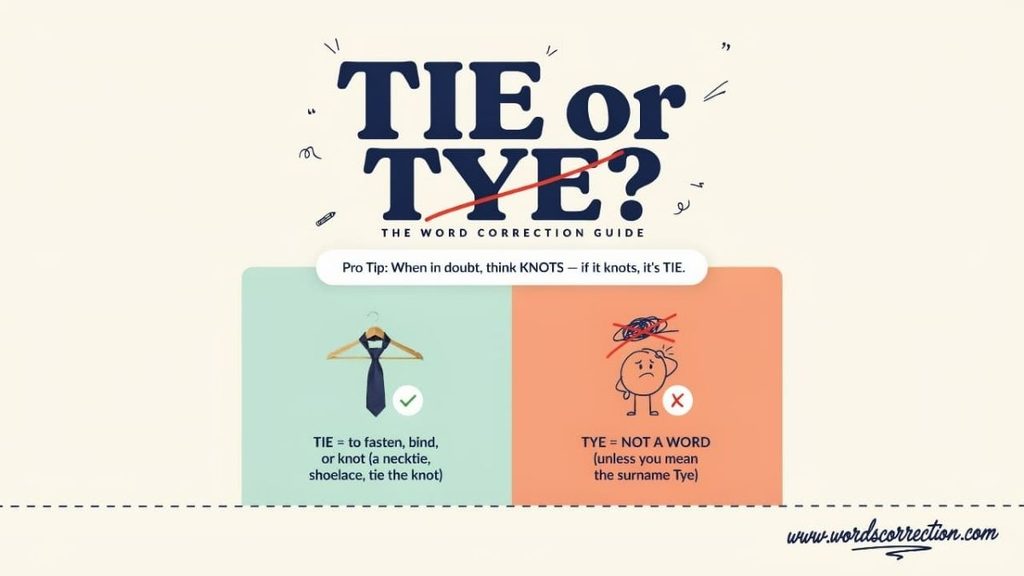
Using “Tye” Instead of “Tie”
This is the most straightforward mistake.
Incorrect:
Please tye the package.
Correct:
Please tie the package.
The problem isn’t that tye has never existed. The problem is that the sentence requires the standard modern verb tie.
Writing “Tye a Knot”
Incorrect:
He knows how to tye a knot.
Correct:
He knows how to tie a knot.
A useful memory trick is to connect tie with its other forms:
tie → tied → tying
The spelling changes in tying, but the base word doesn’t become tye.
Writing “Tye-Dye”
Incorrect:
She wore a tye-dye shirt.
Correct:
She wore a tie-dye shirt.
Learn the difference between basic English word mistakes
Finalise or Finalize Meaning, Difference and Usage
Assuming British English Uses “Tye”
This is another common misconception.
British English does have specialized and dialectal uses of tye, but tye isn’t the British spelling of ordinary tie.
Both British and American English use tie for the common word.
Assuming “Tye” Is Always a Mistake
The opposite mistake can happen too.
If tye appears in a historical document, regional expression, technical text, or proper name, automatically changing it to tie could change the intended meaning.
Context matters.
Tie vs Tye British English and American English
British and American English differ in some spelling and vocabulary choices. However, tie isn’t normally one of those spelling differences.
Both varieties use tie for the common word.
| Meaning | American English | British English |
| Fasten with rope or string | tie | tie |
| Make a knot | tie | tie |
| Necktie | tie | tie |
| Equal score | tie | tie |
| Connection or bond | tie | tie |
| Sports match in a competition | Less common in this sense | tie |
| Rare dialectal mining term | tye in specialized sources | tye |
| Patch of common land | Rare/specialized | tye in British dialect |
The key point is simple:
Don’t change tie to tye simply because you’re writing for a British audience.
The History of Tie and Tye
The history of these words helps explain why the spellings can look so similar.
The modern word tie has deep Germanic roots. Older forms of the word referred to cords, bands, thongs, and things used for binding. Related forms developed into the modern verb and noun we use today.
English spelling wasn’t always standardized. Before modern spelling conventions became firmly established, writers represented words in different ways.
That historical flexibility helps explain why forms resembling tye appear in older English.
Over time, however, modern standard English settled on tie for the common word.
What About “Tye”?
Tye survived in several corners of the language.
Some sources preserve it as an obsolete form of tie. Other sources record independent regional or technical meanings.
This distinction matters:
Historical existence doesn’t equal modern everyday usage.
A spelling can be genuine without being the spelling a modern writer should choose in ordinary communication.
Learn the difference between commonly misused words
Classes or Class’s Meaning, Difference and Usage
Tye as a Historical and Regional Word
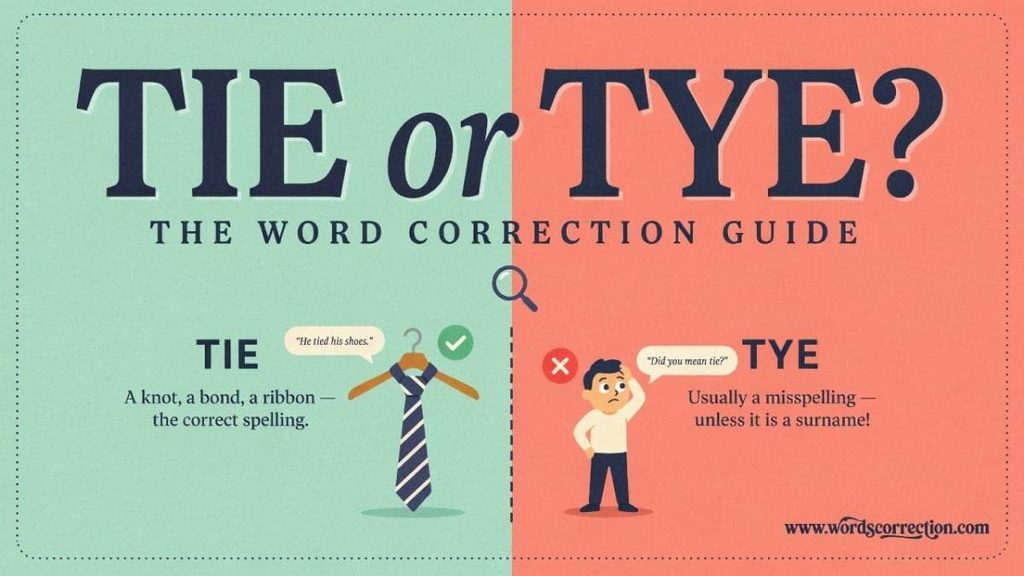
One particularly interesting use of tye appears in British place-related vocabulary.
A tye can refer to a patch of common land, often a village green. The term is associated with historical British usage.
That means a sentence such as:
The villagers gathered on the tye.
could have a completely different meaning from:
The villagers gathered to tie the banners.
The first uses tye as a historical or regional noun. The second uses the ordinary verb tie.
The spelling isn’t simply a typo. The words have different histories and meanings.
Tye in Mining
Another specialized meaning shows why dictionary entries for tye can surprise modern readers.
In historical British mining vocabulary, tye can refer to a trough used to separate valuable material from waste.
In other words, someone reading an old mining document might encounter tye in a sentence where replacing it with tie would make no sense.
This is an excellent example of why a dictionary entry doesn’t automatically make a word suitable for everyday writing.
A word can be legitimate while remaining highly specialized.
Tye in Nautical Vocabulary
Historical sources also record tye as a nautical term.
In this context, a tye can refer to a chain or rope used as part of the mechanism for raising or lowering a yard on a sailing vessel.
Modern readers are unlikely to encounter this meaning unless they’re reading historical maritime material.
Still, it demonstrates that tye in English has a longer history than its rarity in everyday writing might suggest.
Tye as a Name
Tye can also appear as a proper name or surname.
This creates another situation where correcting Tye to Tie would be inappropriate.
For example:
Tye submitted the report before noon.
If Tye is someone’s name, changing it to Tie changes the person’s name.
The same principle applies to:
- surnames
- first names
- place names
- business names
- historical names
Proper names have their own established spellings. They shouldn’t be changed simply because another spelling is more common in ordinary English.
Learn the difference between everyday English mistakes
Uncapable or Incapable Which Spelling Is Correct?
Tie in Everyday English
The wide range of meanings attached to tie explains why the word appears so frequently.
Clothing
He wore a blue tie with a white shirt.
Shoes
She stopped to tie her shoelaces.
Rope
Tie the rope securely to the post.
Package
Tie the box with a strong cord.
Connection
The two communities have strong cultural ties.
Sports
The teams ended the game in a tie.
Music
The tie connects two notes of the same pitch.
Competition
The record was tied in the final round.
One short word can cover fastening, clothing, competition, relationships, music, construction, and more.
That’s why learning the standard spelling matters. You encounter tie in countless everyday situations.
Learn the difference between more words people mix up
Analyses or Analysis Meaning, Difference and Usage
Tie or Tye Examples in Sentences
Correct Examples With “Tie”
- Tie your shoes before you leave.
- Please tie the package securely.
- She wore a red tie to the ceremony.
- The teams finished in a tie.
- Strong family ties can last for generations.
- He used a cord to tie the branches together.
- The children learned how to tie a knot.
- They sell colorful tie-dye shirts.
Examples Where “Tye” Can Be Legitimate
- The historical text uses tye as an obsolete form of tie.
- The dictionary records tye as a British term for common land.
- The mining document describes a tye used to wash ore.
- The historical sailing text refers to a tye as part of the rigging.
- Tye was written that way because it was the person’s name.
These aren’t ordinary substitutes for the everyday word tie.
Tie or Tye in a Sentence Side-by-Side Examples
| Context | Correct form | Example |
| Shoes | tie | Tie your shoes. |
| Knot | tie | Tie a knot in the rope. |
| Clothing | tie | His tie matches his shirt. |
| Sports score | tie | The game ended in a tie. |
| Relationship | tie | They have strong family ties. |
| Tie-dye | tie | She bought a tie-dye shirt. |
| Historical spelling | tye | The old manuscript uses tye. |
| British common land | tye | The village gathered on the tye. |
| Mining | tye | The tye was used to wash ore. |
| Nautical | tye | The sailor adjusted the tye. |
| Personal name | Tye | Tye joined the meeting. |
Tie or Tye A Useful Case Study
Consider these three sentences:
A: Please tye the rope to the post.
B: The document describes a tye used in the mine.
C: Tye arrived at the station.
At first glance, the words seem to be simple spelling variations.
They’re not.
In Sentence A, the writer means fasten. The standard spelling is tie.
In Sentence B, tye can refer to a specialized mining term.
In Sentence C, Tye may simply be a person’s name.
The same spelling can therefore lead to three very different interpretations. Context does the heavy lifting.
Learn the difference between tricky English words with easy explanations
Devide or Divide Difference, Meaning and Usage
Tie or Tye in English Grammar
The ordinary word tie has familiar grammatical forms.
| Form | Word |
| Base form | tie |
| Third-person singular | ties |
| Present participle | tying |
| Past tense | tied |
| Past participle | tied |
Examples:
- I tie my shoes.
- She ties her shoes.
- He is tying the rope.
- They tied the package.
- The package was tied securely.
What Is the Past Tense of Tie?
The past tense is:
tied
Example:
She tied the ribbon yesterday.
Notice that the past tense isn’t tye or tyed.
What Is the Present Participle of Tie?
The present participle is:
tying
Example:
He is tying the shoelaces.
The final e disappears before -ing, giving us tying.
What Is the Plural of Tie?
The plural noun is:
ties
Examples:
- three ties
- several family ties
- strong economic ties
Is Tye a Scrabble Word?
Yes.
Tye is listed as a playable Scrabble word. In Scrabble vocabulary, it can refer to a nautical chain.
This creates another useful distinction:
A valid Scrabble word isn’t necessarily an ordinary replacement for a common English word.
Scrabble dictionaries include many uncommon, technical, historical, and regional words that most people rarely use in everyday conversation.
So tye can be a valid word while still being the wrong choice in a sentence such as:
Tie your shoes.
Learn the difference between confusing more English words step by step
Businesses or Business’s Meaning, Grammar and Correct Usage
Tie vs Tye Comparison Table
| Feature | Tie | Tye |
| Standard everyday English | Yes | No |
| Common verb | Yes | Rare or obsolete |
| Common noun | Yes | Rare or specialized |
| Fasten something | Yes | No in modern standard usage |
| Tie a knot | Yes | No |
| Tie shoes | Yes | No |
| Necktie | Yes | No |
| Bow tie | Yes | No |
| Tie-dye | Yes | No |
| Equal sports score | Yes | No |
| Relationship or bond | Yes | No |
| British dialect mining term | No | Yes |
| Patch of common land | No | Yes, regional |
| Nautical term | No | Yes, historical or specialized |
| Obsolete spelling | No | Yes |
| Proper name | Possible | Possible |
| Scrabble word | Yes | Yes |
Why Do People Spell Tie as Tye?
The confusion makes sense once pronunciation enters the picture.
Tie and many documented uses of tye have the same basic pronunciation, /taɪ/.
When two words sound alike, spelling becomes the only visible distinction.
English contains many words where pronunciation doesn’t provide enough information to determine spelling. Writers may therefore choose the spelling that seems intuitive.
The -ie and -ye patterns can also create uncertainty. English has words containing both patterns, so a writer who knows only the sound may hesitate.
The safest solution isn’t to memorize a complicated spelling rule.
Instead, remember these common expressions:
Tie a knot.
Tie your shoes.
Wear a tie.
If the meaning is ordinary, tie is almost certainly the spelling you need.
Is Tye an Old Spelling of Tie?
Sometimes, yes.
Historical and dictionary sources record tye as an obsolete form of tie.
However, that historical relationship doesn’t mean every modern occurrence of tye represents an old spelling of tie.
Some meanings survived as regional or technical vocabulary. Others appear in names and place names.
That distinction becomes especially important when reading older documents.
If an old text uses tye to mean a bond or fastening, the writer may be using an older spelling of tie.
If a technical dictionary defines tye as a mining trough, however, that’s a specialized word rather than simply a spelling mistake.
When to Use Tie
Use tie when:
- you’re writing ordinary modern English
- you’re talking about shoes or shoelaces
- you’re describing a knot
- you’re discussing ropes, cords, or strings
- you’re describing a necktie or bow tie
- you’re discussing a tied sports score
- you’re describing a relationship or connection
- you’re using expressions such as tie up or tie the knot
- you’re writing tie-dye
- you’re writing an essay, email, article, report, or business document
For nearly every everyday situation, tie is the correct choice.
When to Use Tye
Use tye only when the context specifically supports it.
Possible contexts include:
- an obsolete historical form of tie
- a British dialect term
- a mining term
- a nautical term
- a proper name
- a surname
- a place name
- another documented specialized use
When in doubt, check a reliable dictionary or the original source rather than assuming that tye is either always correct or always wrong.
Should I Use Tie or Tye?
If you’re writing normal modern English, use tie.
That’s the practical answer to “should I use tie or tye?”
Use:
Please tie the rope.
He wore a black tie.
They tied the game.
She tied her shoelaces.
The two countries have strong ties.
Don’t replace those forms with tye.
However, don’t automatically correct Tye if you see it in a name, historical source, regional expression, or specialized text.
Practice Session Tie or Tye
Fill in each blank
- Please ______ your shoelaces before you start running.
- He wore a blue ______ with his formal suit.
- The two teams ______ after the final round.
- Please ______ the package securely before mailing it.
- She learned how to ______ in the rope during the camping trip.
- They decided to ______ next spring.
- ______ your shoes properly so you do not trip.
- The correct spelling for the standard modern word is ______.
- The past tense of tie is ______.
- The correct -ing form of tie is ______.
- It is incorrect to write “______ the knot” when you mean getting married.
- Please ______ the rope around the post.
- The match ended in a ______ because both teams had the same score.
- He carefully ______ the string around the box.
- They are ______ the knot in a small ceremony next month.
- The expression “______ the knot” means “to get married.”
- A neck______ is commonly worn with formal clothing.
- The word ______ is the standard spelling when referring to fastening something.
- “______” may appear as a personal name or in rare historical or specialized contexts.
- She is ______ her shoelaces before leaving the house.
- Yesterday, he ______ the rope to the fence.
- The children were ______ ribbons around the gifts.
- You should ______ the ends of the rope together.
- The wedding announcement said that the couple would ______ later this year.
- Remember: tie → ______ → tied when using the common forms of the verb.
Answers
- tie
- tie
- tied
- tie up
- tie a knot
- tie the knot
- Tie
- tie
- tied
- tying
- tieing
- tie
- tie
- tied
- tying
- tie
- tie
- tie
- tye
- tying
- tied
- tying
- tie
- tie the knot
- tying
Here’s a trusted source for clear more words Comparison:
Grammar Update
Frequently Asked Questions About “Tie or Tye”
Is it tie or tye?
“Tie” is the standard spelling in modern English. It can function as a verb meaning to fasten or secure something and as a noun referring to a necktie, knot, connection, or equal score. “Tye” is a rare or archaic variant and is also sometimes used in names.
What is the meaning of tye?
“Tye” is an uncommon or historical spelling with limited modern usage. It may appear in historical terminology, proper names, or specialized contexts. For ordinary modern English, “tie” is the correct spelling.
What are the two main meanings of tie?
Two common meanings of “tie” are to fasten or secure something and to have the same score in a competition. For example, you can tie your shoes, or two teams can tie the game.
Is it tie up or tye up?
The correct modern expression is “tie up.” It means to fasten, secure, restrain, or complete something, depending on the context. For example: Please tie up the package securely.
Is it tie a knot or tye a knot?
The correct expression is “tie a knot.” The verb is spelled tie, not tye. For example: Tie a knot at the end of the rope.
What does tie mean in slang?
In informal or slang usage, “tie” can have different meanings depending on the context and community using it. However, its standard meanings relate to fastening, connection, clothing, or an equal result.
How do you spell tie when referring to fastening something?
The correct spelling is “tie.” For example: Tie the rope securely to the post. Its related forms include tied and tying.
How do you spell tie when referring to clothing?
The correct spelling is “tie.” A tie is an item of clothing worn around the neck, typically with a shirt as part of formal or business attire.
Is tying grammatically correct?
Yes. “Tying” is the correct -ing form of the verb “tie.” The final e is removed before the -ing ending is added. Therefore, tying is correct, while tieing is not.
How do you spell tying the knot?
The correct spelling is “tying the knot.” The form tieing the knot is incorrect. The expression is an idiom commonly used to mean getting married.
Why do we say tying the knot?
“Tying the knot” is a traditional English idiom meaning to get married. The expression is associated with the symbolic idea of joining or binding two people together, although several cultural traditions have been connected with its historical development.
What does tie a knot mean?
“Tie a knot” means to secure something by forming a knot. For example: Tie a knot in the string to keep it from coming undone.
What does tie the knot mean?
“Tie the knot” is an idiom meaning to get married. For example: They are planning to tie the knot next year.
Is tying the knot an idiom?
Yes. “Tying the knot” is a commonly recognized English idiom meaning to get married. It is generally used in conversational and informal writing.
Is it tying the knot or tieing the knot?
“Tying the knot” is correct. The spelling tieing is incorrect in standard modern English. When -ing is added to tie, the final e is removed, resulting in tying.
What does tie the knot mean in a relationship?
In the context of a relationship, “tie the knot” means to get married. It refers to entering into a formal marital commitment.
What does tying the knot mean in a sentence?
“Tying the knot” means getting married. For example: After several years together, they are finally tying the knot.
What is the difference between tie and tye?
“Tie” is the standard spelling used in modern English, whereas “tye” is uncommon and generally appears in historical, specialized, or proper-name contexts. Use tie for everyday expressions such as tie your shoes, tie a knot, and wear a tie.
Can tye be used as a name?
Yes. “Tye” can be used as a given name or surname. When it is someone’s established name, its original spelling should be retained.
Is tye an acceptable spelling in modern English?
“Tye” exists in limited contexts, but it is not the standard spelling for the common modern uses of “tie.” In ordinary English writing, tie is the appropriate choice.
What is the past tense of tie?
The past tense of tie is “tied.” For example: She tied her shoelaces before leaving the house.
Why is tying spelled without the “e”?
The final e in tie is dropped before the -ing ending is added. Therefore, tie → tying, not tieing. This spelling follows the standard formation of the word’s present participle.
How do you use tie in a sentence?
“Tie” can be used as both a noun and a verb. As a verb: Please tie your shoelaces. As a noun: He wore a black tie to the ceremony.
Is tie used for equal scores?
Yes. In sports and other competitions, “tie” describes a result in which two or more competitors have the same score. For example: The match ended in a tie.
What is the easiest way to remember “tie” vs. “tye”?
Remember that “tie” is the standard spelling for everyday English: tie your shoes, tie a knot, wear a tie, and tie the score. “Tye” is generally restricted to uncommon historical or specialized uses and personal names.
Conclusion
The tie or tye confusion may seem like a minor spelling issue, but English has a talent for making simple words surprisingly tricky. In modern everyday English, tie is the standard and correct spelling. You use it for fastening shoes, securing a rope, wearing a necktie, describing a connection, or referring to an equal score. Tye is also a real word, but it appears mainly in historical, regional, technical, nautical, or proper-name contexts. Therefore, when you’re writing about ordinary everyday situations, tie is the form to choose. Knowing this small distinction can prevent an easy spelling mistake and keep your writing clear, accurate, and professional.

Stella AJS is an experienced blogger and dedicated English language writer at Words Correction. She turns confusing grammar, word meanings, spelling, and usage into clear, practical insights that readers can easily understand and apply. With a passion for precise and engaging writing, Stella helps readers avoid common language mistakes, strengthen their vocabulary, and communicate with greater clarity and confidence.