
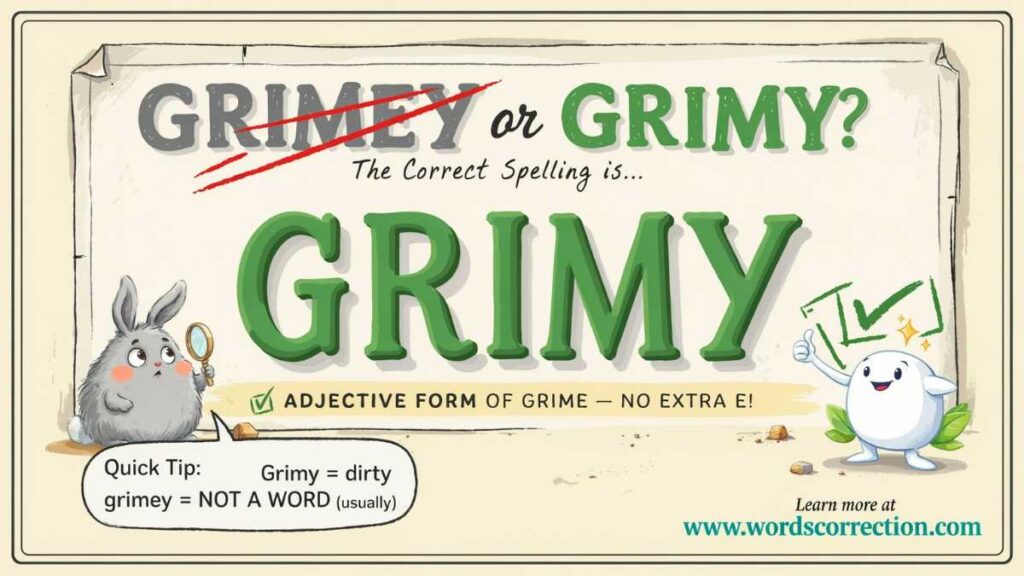
Is it Grimey or Grimy? A single letter can make the difference between correct spelling and a common mistake. Although both versions may look right at first glance, only one is accepted as the standard spelling. If you’ve ever paused while writing this word, you’re not alone. English spelling can be surprisingly tricky, even with familiar words. In this guide we’ll clarify Grimey or Grimy, explain the meaning of grimy and explore how to use it correctly. You’ll also find practical examples, common spelling mistakes and simple tips to help you remember the correct form with confidence.
Grimey or Grimy Which Spelling Is Correct?
Grimy is the correct standard English spelling. It is an adjective that describes something covered with grime or marked by accumulated dirt. Grimey is a nonstandard spelling that you should generally avoid in formal and professional writing.
The confusion comes from the noun grime. When people turn this noun into an adjective, they sometimes keep its final e and write grimey. However, the established adjective drops that letter.
Consider these examples
- Correct: The mechanic washed his grimy hands after repairing the engine.
- Incorrect in standard English: The mechanic washed his grimey hands after repairing the engine.
The difference involves just one letter, but that letter matters when you’re writing for school, work, publications, or professional websites.
| Feature | Grimy | Grimey |
|---|---|---|
| Spelling status | Standard spelling | Nonstandard variant |
| Part of speech | Adjective | Intended as an adjective |
| Meaning | Covered with dirt or grime | Intended to express the same meaning |
| Formal writing | Recommended | Avoid |
| Standard dictionary usage | Established headword | Not the standard form |
| Example | A grimy window | A grimey window (nonstandard) |
Is It Grimey or Grimy?
If you’re wondering, “Is it grimey or grimy?” the answer is grimy.
Use grimy whenever you want to describe something dirty, greasy, or covered with accumulated grime. Although readers may understand grimey, that doesn’t make it the preferred spelling.
For example
- The old factory had grimy walls and broken windows.
- His grimy clothes showed how hard he had worked.
- Years of pollution left the building’s exterior grimy.
Remember this simple distinction: grime is the noun, while grimy is the adjective.
Is Grimey a Word?
Grimey appears in informal writing, online discussions, and occasional creative or stylized language. However, it isn’t the standard spelling of the adjective.
You may encounter it in social media captions, song-related discussions, or casual messages. Some writers use it deliberately for stylistic reasons. Others simply misspell grimy.
For standard English, choose grimy. The fact that people use a particular spelling doesn’t automatically make it appropriate for formal writing.
Why Is Grimy the Correct Spelling?
The answer lies in English word formation.
The adjective grimy comes from the noun grime and the suffix -y. This suffix commonly forms adjectives that mean full of, covered with, or characterized by something.
When the suffix attaches to grime, the final silent e disappears
Grime + y = Grimy
The same general spelling pattern appears in several familiar words
| Base word | Correct adjective | Meaning |
|---|---|---|
| Shine | Shiny | Giving off or reflecting light |
| Noise | Noisy | Making a lot of noise |
| Ice | Icy | Covered with or resembling ice |
| Grease | Greasy | Covered with or containing grease |
| Smoke | Smoky | Filled with or resembling smoke |
| Grime | Grimy | Covered with accumulated dirt |
These examples help explain why grimy doesn’t need an extra e. The spelling follows an established English word-formation pattern.
Learn the difference between tricky words and use them correctly
Whoa or Woah Which Spelling Is Correct?
What Does Grimy Mean? Definition and Explanation
The Grimey or Grimy meaning is simple: something is dirty, especially because dirt, grease, soot, or other substances have built up over time. The word usually suggests more than a little dust or a small stain. It often describes dirt that has settled into a surface and requires proper cleaning to remove.
Grimy definition: Covered with grime; dirty, soiled, or marked by accumulated dirt.
For example, imagine a kitchen that hasn’t received a proper cleaning in several weeks. Grease covers the stovetop, dust sticks to the cabinets, and dark stains mark the floor. Calling that kitchen grimy explains its condition more vividly than simply calling it dirty. Understanding Grimey or Grimy also helps you use the correct spelling in everyday and formal writing.
Here are the main characteristics of something grimy
- Accumulated dirt: Layers of dirt have collected over time.
- Grease or oil: The surface may contain oily or sticky substances.
- Soot and dust: Smoke particles and dust may leave dark marks.
- Stubborn stains: Ordinary wiping may not remove the dirt.
- Unclean appearance: The object or place looks neglected or poorly maintained.
What Does Grimy Mean When Describing a Person?
The grimy person meaning usually refers to someone who looks physically dirty or unwashed. The adjective may describe a person’s hands, face, skin, fingernails, or clothes.
For example
- The grimy mechanic wiped his forehead with an old towel.
- A grimy child ran into the house after playing in the mud.
- The construction worker had grimy hands after a long shift.
- His grimy clothes needed a thorough wash.
However, context matters. Calling someone grimy doesn’t necessarily mean that person has poor hygiene. A mechanic may have clean habits but still develop a grimy appearance while repairing an engine. Likewise, a gardener can finish a day of planting with dirt-covered hands and fingernails.
The word describes appearance or condition rather than someone’s entire personality.
There is also an informal slang meaning worth understanding. In some conversations, calling someone grimy suggests that the person behaves dishonestly, selfishly, or unfairly.
For example
“That was a grimy thing to do to your closest friend.”
Here, grimy doesn’t describe physical dirt. It criticizes someone’s behavior.
This figurative meaning depends on context and tone. In ordinary descriptive English, the physical meaning remains the central one.
What Does Grimy Face Mean?
A grimy face is a face covered with visible dirt, dust, soot, grease, or dark smudges.
Imagine a child playing outside after a rainy afternoon. Mud sticks to the cheeks, dust covers the forehead, and small dirty marks appear around the mouth. You could describe the child’s face as grimy.
Examples
- The little boy returned home with a grimy face and muddy shoes.
- She wiped the grimy face of the toddler with a wet cloth.
- His grimy face showed how long he had worked in the dusty factory.
The expression doesn’t describe a particular skin type or permanent condition. It simply refers to dirt on the face.
What Does Grimy Hands Mean?
Grimy hands are hands covered with accumulated dirt, grease, oil, or other unclean substances.
You might use this expression when describing
- A mechanic repairing an old vehicle.
- A gardener digging in wet soil.
- A construction worker handling cement and tools.
- A painter working with dirty equipment.
- Someone cleaning an old machine.
For example
“The mechanic had grimy hands after spending the entire morning repairing the truck.”
This sentence gives readers a clear picture of the person’s physical condition without needing a lengthy explanation.
What Do Grimy Skin and Grimy Clothes Mean?
The expression grimy skin describes skin with visible dirt, soot, grease, or other substances on its surface. It often appears in descriptions of people who work outdoors or spend time in dirty environments.
Similarly, grimy clothes are garments covered with accumulated dirt, oil, mud, or stains.
| Expression | Meaning | Example |
|---|---|---|
| Grimy skin | Skin covered with dirt | His grimy skin needed a good wash. |
| Grimy clothes | Clothing marked by dirt and grease | The worker changed out of his grimy clothes. |
| Grimy fingernails | Nails containing trapped dirt | Her grimy fingernails showed she had been gardening. |
| Grimy shoes | Shoes covered with dirt | He left his grimy shoes outside. |
Learn the difference between similar English words the easy way
Grime vs Grimy Understanding the Difference
Although grime and grimy share the same root, they perform different grammatical jobs. One names the dirt while the other describes something covered with it.
Grime is a noun. Grimy is an adjective.
This distinction is essential if you want to understand the correct usage of grimy in everyday English.
| Word | Part of speech | Meaning | Example |
|---|---|---|---|
| Grime | Noun | Accumulated dirt or filth | The window was covered in grime. |
| Grimy | Adjective | Covered with grime | The window looked grimy. |
Consider these sentences
- The kitchen counter had a thick layer of grime.
- The kitchen counter looked grimy after weeks without cleaning.
The first sentence names the substance. The second describes the counter’s condition.
You can also use both words in one sentence:
“The mechanic removed the grime from his grimy tools.”
Here, grime identifies the dirt while grimy describes the tools.
Quick grammar tip: If you need a word to name the dirt, use grime. If you need an adjective to describe something dirty, use grimy.
Learn the difference between commonly confused more words in English
Hierarchical vs Hierarchal Which Word Should You Use?
Why Do People Confuse Grimey or Grimy?
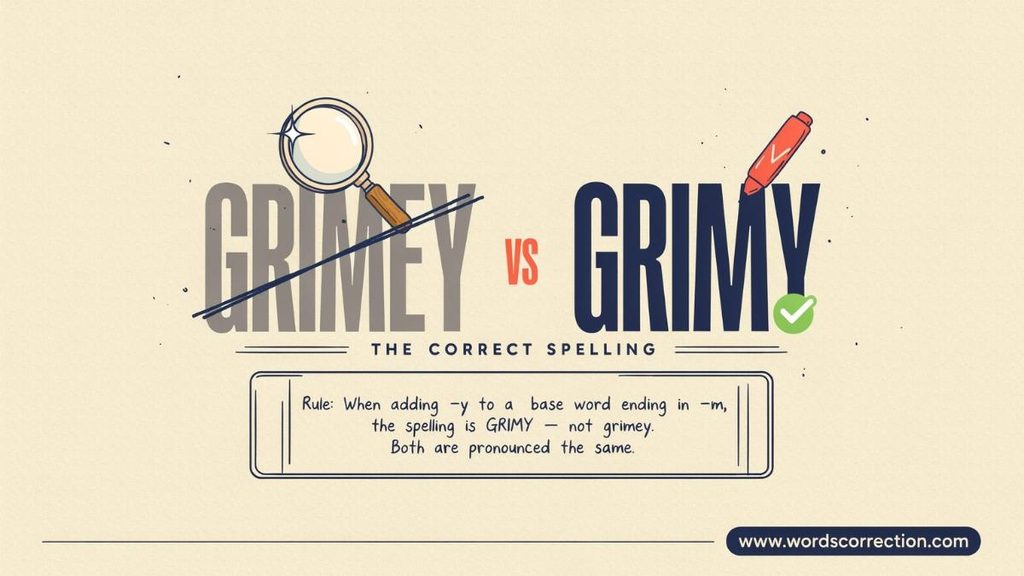
English spelling has plenty of surprises, and Grimey or Grimy is a common example. Sometimes a word follows a familiar spelling pattern, while another word that looks similar follows a different rule. This is why people often confuse Grimey or Grimy when writing in English.
The noun grime ends with a silent e. When forming its adjective, people may assume that the final letter should remain, resulting in the spelling grimey. However, standard English uses grimy. Understanding this spelling difference helps avoid confusion between Grimey or Grimy in everyday and formal writing.
Does the Silent E in Grime Cause the Confusion?
Yes. The final e in grime helps represent the long vowel sound in the word. When the adjective-forming suffix -y attaches, the spelling drops that final letter.
The process looks like this
GRIME → Remove the final E and add Y → GRIMY
Other words demonstrate a similar pattern
- Shine becomes shiny.
- Noise becomes noisy.
- Ice becomes icy.
- Grease becomes greasy.
- Smoke becomes smoky.
These examples make the spelling easier to remember. You don’t need to add another e before the y.
Is Grimey Ever Acceptable in Informal Writing?
You may see grimey in social media posts, casual messages, comments, or creative writing. A writer might choose it deliberately to imitate informal speech or create a particular visual style.
However, this doesn’t change the standard spelling.
For example
- Standard: The old apartment had grimy windows.
- Nonstandard: The old apartment had grimey windows.
If you’re writing an academic paper, business email, blog post, news article, or professional report, choose grimy.
One useful distinction: Understanding a nonstandard spelling doesn’t mean you should use it as your default. Readers may understand grimey, but grimy is the safer and more widely established choice.
Learn the difference between confusing more English words step by step
Eying or Eyeing Which Spelling Is Correct?
Grimy vs Grimey Side-by-Side Comparison
The difference between grimey or grimy isn’t a difference in meaning. Both spellings are generally intended to communicate the same idea. The distinction concerns standard spelling.
| Comparison | Grimy | Grimey |
|---|---|---|
| Standard spelling | Yes | No |
| Dictionary headword | Yes | Not the standard form |
| Intended meaning | Dirty or covered with grime | Usually intended to mean dirty |
| Grammar | Adjective | Intended as an adjective |
| Professional writing | Appropriate | Not recommended |
| Academic writing | Appropriate | Avoid |
| Casual messages | Appropriate | May appear as a misspelling or stylistic choice |
Which spelling should you choose? Use grimy in almost every ordinary writing situation.
How to Use Grimy in a Sentence
Knowing the definition is useful, but seeing the word in different situations makes its meaning easier to understand. The following grimy example sentences show how it works when describing people, household objects, workplaces, and outdoor environments.
Grimy Hands and Fingernails
Hands often become grimy when someone works with grease, soil, dust, or machinery.
Examples
- The mechanic washed his grimy hands before eating lunch.
- Her fingernails looked grimy after an afternoon in the garden.
- The plumber used a rough towel to clean his grimy fingers.
- He left grimy fingerprints on the white cabinet.
- The carpenter’s hands became grimy while repairing the wooden floor.
A Grimy Face or Person
You can use grimy to describe a person’s appearance when dirt covers their skin or clothes.
Examples
- The little girl had a grimy face after playing outside.
- A grimy worker entered the workshop carrying a toolbox.
- The boy’s grimy cheeks were covered with dust.
- He looked grimy after spending hours repairing the old engine.
- The children returned from the playground with grimy knees and muddy shoes.
A Grimy Window or Surface
Windows and other surfaces can become grimy when dust, grease, pollution, and fingerprints accumulate.
Examples
- The grimy windows blocked most of the sunlight.
- She cleaned the grimy kitchen counter with a suitable cleaning solution.
- A layer of dust made the glass surface look grimy.
- The old mirror had become grimy around the edges.
- Years of neglect left the wooden table grimy and stained.
A Grimy Kitchen or Bathroom
Kitchens and bathrooms often collect grease, soap residue, moisture, and dirt. When these substances build up, grimy becomes an appropriate descriptive word.
Examples
- The restaurant closed temporarily to clean its grimy kitchen.
- Grease covered the grimy stovetop.
- The bathroom tiles looked grimy after months without proper maintenance.
- She scrubbed the grimy sink until it looked clean again.
- The neglected kitchen had grimy cabinets and stained floors.
Grimy Streets, Buildings, and Neighborhoods
The word also describes larger environments. A street can look grimy because of vehicle pollution, litter, soot, mud, and accumulated dirt.
Examples
- The old factory stood beside a grimy industrial street.
- The travelers walked through narrow, grimy alleyways.
- Pollution had left the building’s exterior grimy and discolored.
- Rainwater collected along the grimy sidewalk.
- The abandoned warehouse had grimy walls and broken windows.
Grimy in Professional and Workplace Writing
Although grimy sounds descriptive and conversational, it also works in professional writing when you need to describe an actual condition.
For example
- The maintenance team inspected the grimy ventilation filters.
- Workers must clean grimy equipment before storing it.
- The inspection revealed grimy surfaces around the production area.
- The facility requires additional cleaning to remove accumulated grime.
In technical reports, you may prefer more precise descriptions such as grease buildup, surface contamination, or accumulated dirt. However, grimy remains perfectly acceptable when a straightforward adjective communicates the condition clearly.
Learn the difference between tricky English words with easy explanations
Passtime or Pastime Which Spelling Is Correct?
Grimy vs Dirty, Filthy, Grubby, and Grungy
English offers several adjectives for describing something unclean. However, these words don’t always mean exactly the same thing.
Understanding their differences helps you choose the most accurate expression instead of using grimy for every dirty object.
| Word | Meaning | Typical use |
|---|---|---|
| Grimy | Covered with accumulated dirt or grime | Greasy tools, dirty windows, industrial surfaces |
| Dirty | Not clean | Clothes, dishes, floors, hands |
| Filthy | Extremely dirty | Neglected rooms, polluted areas, contaminated objects |
| Grubby | Covered with ordinary dirt | Fingers, hands, small objects |
| Grungy | Dirty, shabby, or worn-looking | Buildings, clothing, interiors |
| Muddy | Covered with mud | Shoes, roads, clothes |
| Greasy | Covered with or containing grease | Kitchen equipment, hair, machinery |
| Dusty | Covered with dust | Furniture, shelves, unused rooms |
Grimy vs Dirty
Dirty is a broad adjective. It can describe almost anything that isn’t clean, including clothes, floors, dishes, hands, and furniture.
Grimy is more specific. It often suggests accumulated dirt that has settled into a surface.
Compare
- The shirt is dirty. (It needs washing.)
- The shirt is grimy. (It has noticeable, possibly ingrained dirt.)
A dirty plate might have a few food stains. A grimy plate suggests a more stubborn layer of dirt or grease.
Grimy vs Filthy
Filthy usually communicates a stronger degree of dirtiness than grimy. It can describe something extremely dirty or unpleasant.
For example
- The grimy window needed a thorough cleaning.
- The filthy bathroom required immediate attention.
The second sentence suggests a more severe lack of cleanliness.
Grimy vs Grubby
Grubby commonly describes dirty hands, fingers, clothes, or small objects.
For example
- The toddler touched the clean wall with grubby fingers.
- The mechanic wiped his grimy hands with a cloth.
Both words can describe dirty hands. However, grimy often emphasizes accumulated grease or dirt while grubby commonly suggests ordinary visible dirt.
Grimy vs Grungy
Grungy can describe something dirty, shabby, worn, or deliberately rough-looking.
For example
- The abandoned building had grimy windows.
- The old apartment had a grungy interior with worn furniture and stained walls.
The words overlap, but grungy can suggest an overall shabby style rather than dirt alone.
Learn the difference between more words people mix up
Ingage vs Engage Which Word Is Correct?
Common Spelling and Usage Mistakes With Grimy
Even a short adjective can cause several writing mistakes. Some involve spelling while others happen because writers confuse related words or choose an adjective that doesn’t fit the situation.
Here are the mistakes worth avoiding.
Writing Grimey Instead of Grimy
This is the most common spelling confusion.
Incorrect: The mechanic’s clothes were grimey after work.
Correct: The mechanic’s clothes were grimy after work.
The standard spelling doesn’t include the extra e. Remember the connection between grime and grimy.
Adding an Unnecessary E After Grime
Writers sometimes assume that the final e must remain when they add -y. However, the established spelling drops it.
- Grime + y = Grimy
- Shine + y = Shiny
- Noise + y = Noisy
The extra letter in grimey isn’t necessary.
Confusing Grime With Grimy
These words have different grammatical functions.
Incorrect: The window was covered with grimy.
Correct: The window was covered with grime.
Correct: The window looked grimy.
Use grime when naming the dirt. Use grimy when describing something covered with it.
Using Grimy When You Mean Messy
A messy room isn’t necessarily grimy.
For example, a bedroom with clothes scattered across the floor and books piled on a desk is messy. However, if the walls, furniture, and floor have accumulated dirt and grease, grimy may be more appropriate.
Compare
- Messy: The bedroom was full of scattered clothes and books.
- Grimy: The bedroom had dirty walls, dusty furniture, and stained floors.
Remember: Messy describes disorder. Grimy describes dirt.
Misspelling the Comparative and Superlative Forms
The word grimy also changes when you compare different levels of dirtiness.
The correct forms are
- Grimy: The base adjective.
- Grimier: The comparative form.
- Grimiest: The superlative form.
Examples
- My work boots are grimy.
- Your work boots are grimier than mine.
- These are the grimiest shoes in the closet.
Notice that the final y changes to i before adding -er or -est. This is another common English spelling pattern.
Learn the difference between everyday English mistakes
Implicit vs Complicit what’s the Differences?
Grimy Word Forms Grimier, Grimiest, Grimily, and Griminess
The word grimy has several related grammatical forms. Understanding them helps you use the adjective correctly and build more varied sentences.
| Word form | Part of speech | Meaning | Example |
|---|---|---|---|
| Grimy | Adjective | Covered with grime | The window is grimy. |
| Grimier | Comparative adjective | More covered with grime | This wall is grimier than that one. |
| Grimiest | Superlative adjective | Most covered with grime | That is the grimiest room. |
| Grimily | Adverb | In a grimy manner | The surface was grimily stained. |
| Griminess | Noun | The condition of being grimy | The griminess of the machine was obvious. |
Grimier The Comparative Form
Use grimier when comparing two people, objects, or places.
Examples
- The garage floor is grimier than the kitchen floor.
- His work gloves became grimier throughout the day.
- The older windows look grimier than the newly installed ones.
Grimiest The Superlative Form
Use grimiest when something stands out as the dirtiest among a group.
Examples
- That abandoned factory has the grimiest windows in the neighborhood.
- These are the grimiest tools in the workshop.
- The basement was the grimiest part of the building.
Grimily The Adverb Form
Grimily is an adverb formed from grimy. It describes an action or condition in a grimy manner.
However, it’s relatively uncommon in everyday English. Most writers find a more natural alternative.
For example:
- Less natural: The walls were grimily decorated.
- More natural: The walls were covered with grime.
Knowing that grimily exists doesn’t mean you need to use it frequently.
Griminess The Noun Form
Griminess refers to the quality or condition of being grimy.
Examples
- The griminess of the abandoned kitchen surprised everyone.
- Years of neglect contributed to the building’s griminess.
- The cleaning crew worked hard to remove the griminess from the equipment.
In everyday writing, dirtiness or accumulated grime may sound more natural depending on the sentence.
Learn the difference between commonly misused words
Xenodochial vs Xenodochium Which Word Should You Use?
Grimy Synonyms and Antonyms What Other Words Can You Use?
Sometimes, repeating the same adjective makes an article or description sound dull. Fortunately, English has several alternatives to grimy.
The best synonym depends on the type of dirt and the level of uncleanliness you’re describing.
Common Synonyms of Grimy
| Synonym | Meaning | Example |
|---|---|---|
| Dirty | Not clean | His dirty shoes were covered in mud. |
| Filthy | Extremely dirty | The filthy kitchen needed cleaning. |
| Grubby | Covered with ordinary dirt | The child had grubby fingers. |
| Grungy | Dirty, shabby, or worn | They entered a grungy old building. |
| Soiled | Marked or stained by dirt | She placed her soiled clothes in the laundry basket. |
| Dingy | Dark, dull, or dirty-looking | The apartment had dingy walls. |
| Squalid | Extremely dirty and unpleasant | They lived in squalid conditions. |
| Begrimed | Covered with dirt or grime | His begrimed hands held the old wrench. |
| Mucky | Covered with mud or dirt | The dog walked across the mucky floor. |
| Unclean | Not clean or hygienic | The inspector identified an unclean surface. |
Some synonyms describe physical dirt while others suggest poor living conditions, neglect, or an unpleasant appearance. Choose the word that communicates the exact idea.
What Is the Opposite of Grimy?
The opposite of grimy is generally a word that describes cleanliness.
Common antonyms include
- Clean
- Spotless
- Immaculate
- Pristine
- Sanitary
- Hygienic
- Polished
- Unstained
Examples
- The grimy windows became spotless after cleaning.
- His dirty hands were clean after washing.
- The neglected kitchen looked immaculate after renovation.
- The old machinery appeared pristine after restoration.
Quick distinction: Clean is the most direct opposite of grimy. Words such as spotless and immaculate suggest an even higher level of cleanliness.
Learn the difference between basic English word mistakes
Stigmatism vs Astigmatism Which Term Is Correct?
A Mini Case Study Choosing Between Grimy, Dirty, and Messy
Imagine a property manager inspecting three apartments before new tenants move in. Each apartment has a different cleaning problem.
Which adjective should the manager use?
Apartment A The Untidy Bedroom
Clothes cover the floor, books sit on the bed, and several boxes block the doorway. However, the furniture and walls are clean.
Best word: Messy
The main problem is disorder rather than accumulated dirt.
Apartment B The Neglected Kitchen
Grease covers the stovetop, dirt surrounds the sink, and layers of grime have collected on the cabinets.
Best word: Grimy
The surfaces have accumulated stubborn dirt and grease.
Apartment C The Extremely Dirty Bathroom
The bathroom contains heavy stains, unpleasant odors, and severe dirt buildup.
Best word: Filthy
The condition suggests an extreme lack of cleanliness.
This example demonstrates why word choice matters. Although all three apartments need attention, each adjective communicates a different condition.
- Messy describes disorder.
- Grimy emphasizes accumulated dirt.
- Filthy communicates extreme uncleanliness.
The right adjective makes your description more accurate and easier to understand.
How to Remember the Correct Spelling of Grimy
A spelling rule becomes easier to remember when you connect it with familiar words. Instead of memorizing grimy as an isolated spelling, remember how it develops from grime.
Here are three simple techniques.
Remember the Grime + Y Connection
Think of the noun grime and the adjective grimy as a pair.
- Grime = Dirt.
- Grimy = Covered with dirt.
This connection helps you remember both the meaning and spelling.
Drop the Silent E Before Adding Y
The final e disappears when forming the standard adjective.
Think about these examples
- Shine → Shiny
- Noise → Noisy
- Ice → Icy
- Grime → Grimy
Once you recognize the pattern, writing grimey becomes easier to avoid.
Remember a Simple Sentence
Use a short sentence that connects the word with a familiar situation
“The mechanic’s hands were grimy after fixing the car.”
Whenever you remember this sentence, you’ll also remember the correct spelling.
Grimy Pronunciation How Do You Say It?
The correct pronunciation of grimy is /ˈɡraɪ.mi/ in both standard American and British English.
The word contains two syllables
- First syllable: /ɡraɪ/
- Second syllable: /mi/
The stress falls on the first syllable.
Is Grimy Pronounced Differently in American and British English?
The standard pronunciation is essentially the same in American and British English.
| Feature | American English | British English |
|---|---|---|
| IPA | /ˈɡraɪ.mi/ | /ˈɡraɪ.mi/ |
| Syllables | Two | Two |
| Main stress | First syllable | First syllable |
| First vowel | Long I sound | Long I sound |
You can hear the same basic pronunciation in both varieties.
The spelling confusion doesn’t come from a major pronunciation difference. Grimy and the nonstandard spelling grimey are generally intended to represent the same spoken word.
Learn the difference between often confused words
Realize vs Realise What Is the Difference?
Origin and History of the Word Grimy
The word grimy has been part of English for centuries. Its history begins with the noun grime, which refers to dirt, soot, or accumulated filth.
The adjective grimy dates to approximately the 1610s and developed from grime with the addition of the adjective-forming suffix -y.
Where Does the Word Grime Come From?
The exact origin of grime is uncertain. Historical accounts connect it to Middle English grim, meaning dirt or filth, and suggest a possible relationship with Low German words associated with dirt.
The deeper proposed origin relates to a Proto-Indo-European root meaning “to rub.” This connection reflects the idea of dirt being rubbed or smeared onto a surface.
What Does the Suffix -Y Mean?
The suffix -y commonly forms adjectives from nouns. It can mean full of, covered with, or characterized by the thing named in the original word.
For example
- Dust → Dusty
- Grease → Greasy
- Cloud → Cloudy
- Salt → Salty
- Grime → Grimy
This pattern explains the relationship between the noun and adjective.
The word grimy has retained its standard spelling over time. Its long history also explains why dictionaries recognize it as an established English adjective rather than a recent informal expression.
Grimy in Different Contexts Formal, Informal, and Slang Usage
The meaning of grimy can change slightly depending on the situation. Although its primary definition relates to physical dirt, speakers also use it figuratively.
Grimy in Formal English
In formal writing, grimy describes something covered with dirt or accumulated grime.
Examples
- The inspection revealed grimy surfaces throughout the facility.
- The cleaning team removed dirt from the grimy ventilation system.
- Several grimy windows required professional cleaning.
It’s an acceptable adjective in professional reports, descriptive writing, and academic work when the context calls for it.
Grimy in Everyday Conversation
In everyday conversation, people use grimy to describe dirty objects, clothing, and surroundings.
For example
- “Your hands are grimy. Wash them before dinner.”
- “This kitchen looks grimy.”
- “I need to clean these grimy windows.”
The word sounds natural and communicates more than a general statement that something isn’t clean.
What Does Grimy Mean in Slang?
In some informal conversations, grimy has a figurative meaning. It can describe someone who behaves dishonestly, selfishly, or unfairly.
For example
- “That was a grimy move.”
- “He treated his friends in a grimy way.”
- “Taking credit for someone else’s work was pretty grimy.”
In these examples, the word criticizes behavior rather than physical dirt.
The expression can also describe music with a dark, gritty, or rough sound. Context determines the intended meaning.
However, don’t assume every use of grimy carries a slang meaning. In most ordinary descriptions, it refers to dirt or an unclean condition.
Grimy in American and British English
Good news for English learners: you don’t need to memorize separate American and British spellings.
Grimy is the standard spelling in both American and British English.
| Variety | Standard spelling | Pronunciation |
|---|---|---|
| American English | Grimy | /ˈɡraɪ.mi/ |
| British English | Grimy | /ˈɡraɪ.mi/ |
There is no need to switch to grimey when writing for a British audience or an American publication.
How Do You Say Grimy in French?
The French translation of grimy depends on the context and the noun it describes.
Common translations include
- Crasseux / Crasseuse: Covered with ingrained dirt or grime.
- Sale: Dirty or unclean.
- Encrassé / Encrassée: Clogged or covered with accumulated dirt.
- Sordide: Squalid or extremely unpleasant, particularly when describing conditions.
For example
| English | French |
|---|---|
| Grimy hands | Mains crasseuses |
| A grimy face | Un visage sale |
| A grimy window | Une fenêtre sale |
| A grimy kitchen | Une cuisine crasseuse |
| A grimy machine | Une machine encrassée |
The most appropriate translation depends on what you’re describing. For instance, crasseux often works well for something covered with stubborn dirt while sale is a more general word for dirty.
Practice Session Grimey or Grimy
Test your understanding of the correct spelling, meaning, synonyms, antonyms, and grammatical usage of grimy with the following exercises.
- The correct standard spelling is __________, not grimey.
- The mechanic’s hands were covered in __________ after repairing the engine.
- The word grimy is commonly used as an __________.
- A surface covered with accumulated dirt can be described as __________.
- The opposite of grimy is __________.
- The comparative form of grimy is __________.
- The superlative form of grimy is __________.
- The noun that refers to accumulated dirt or filth is __________.
- A person who behaves dishonestly may be described as __________ in slang.
- Dirty and filthy are common __________ of grimy.
- The windows had become __________ after years without cleaning.
- Grimey is considered a __________ spelling in standard English.
- The word grimy can describe dirty clothes, hands, walls, and __________.
- Something completely free from dirt can be described as __________.
- The adjective grimy describes something covered with dirt, grease, or __________.
- In slang, a grimy person may be described as shady or __________.
- The phrase “grimy shoes” refers to shoes covered with __________.
- Grimy is a standard word used in both British and __________ English.
- The word grimier is used when comparing __________ dirty things.
- The word grimiest identifies something that is the __________ dirty among three or more things.
- A neglected building with dirty walls may be described as __________.
- The word grime functions as a __________ in English.
- A clean and spotless room is the __________ of a grimy room.
- The phrase “grimy kitchen floor” uses grimy to describe the __________.
- For formal writing, always use __________ instead of the nonstandard spelling grimey.
Answers
- Grimy
- Grime
- Adjective
- Grimy
- Clean
- Grimier
- Grimiest
- Grime
- Grimy
- Synonyms
- Grimy
- Nonstandard
- Floors
- Spotless
- Filth
- Dishonest
- Dirt
- American
- Two
- Most
- Grimy
- Noun
- Opposite
- Floor
- Grimy
Here’s a trusted source for clear word meanings:
Cambridge Dictionary
FAQ’s About Grimey or Grimy
What does grimey mean in slang?
In slang, grimey describes someone who behaves dishonestly, unfairly, or deceptively. It can also refer to suspicious behavior or situations that seem untrustworthy.
What is a grimy person?
A grimy person is someone who appears physically dirty or unclean. In informal slang, the term can also describe someone who behaves dishonestly, selfishly, or unfairly toward others.
What is another word for grimey?
Other words for grimey include dirty, filthy, greasy, muddy, soiled, unclean, and contaminated. When referring to someone’s behavior, suitable alternatives include shady, deceitful, dishonest, and sneaky.
What does grimy mean?
Grimy is an adjective that describes something covered with accumulated dirt, grease, or grime. It commonly refers to dirty surfaces, clothing, hands, buildings, and other objects.
Is it Grimey or Grimy?
Grimy is the standard and grammatically accepted spelling in English. Grimey is a nonstandard alternative occasionally used in informal communication, but grimy is preferred in academic and professional writing.
What does grimy mean in Urban Dictionary?
In urban slang, grimy can describe someone who behaves dishonestly, betrays another person’s trust, or engages in questionable activities. The exact meaning depends on the conversation and context.
What does grimy mean for kids?
For children, grimy means very dirty or covered with substances such as mud, dust, or grease. For example, a child’s hands after playing in the garden might be described as grimy.
Is grimy an adjective?
Yes, grimy is an adjective used to describe something covered in dirt or grime. It provides additional information about a noun, as in “grimy shoes,” “grimy windows,” or “a grimy floor.”
Is grimy a valid word in Scrabble?
Yes, GRIMY is a valid English-language Scrabble word. It is an adjective meaning dirty or covered with accumulated grime.
What is the antonym of grimy?
The most common antonym of grimy is clean. Other suitable opposites include spotless, immaculate, pristine, hygienic, and unsoiled.
Is poopy a valid word in Scrabble?
Yes, POOPY is accepted in standard English-language Scrabble word lists. It is an informal adjective used to describe something associated with poop or resembling it.
Are offensive words allowed in Scrabble?
Some offensive or vulgar terms may appear in official Scrabble dictionaries, depending on the applicable word list. A word’s acceptability is determined by the dictionary used for the game rather than whether it is considered polite.
What is the rarest word in Scrabble?
There is no officially recognized rarest Scrabble word. However, certain valid words are rarely played because they are archaic, specialized, or uncommon in everyday English.
Is ZZZ a valid Scrabble word?
Yes, ZZZ is accepted in some official English-language Scrabble dictionaries. It represents the familiar written sound associated with sleeping.
Which Scrabble words contain no vowels?
Examples include CRWTH, CWM, and RHYTHM. These words do not contain the traditional vowel letters A, E, I, O, or U, although Y functions as a vowel in some of them.
Is there a three-letter Scrabble word containing Q?
Yes, QAT, QIS, and QUA are examples of valid three-letter Scrabble words containing Q. Their acceptance should be checked against the official dictionary edition used in the game.
Which three-letter words have no vowels?
Examples of three-letter words without traditional vowel letters include SHH, TSK, and PSST. These expressions demonstrate how certain English words can be formed without A, E, I, O, or U.
Are there any Scrabble words made entirely of consonants?
Yes, English Scrabble includes several words without traditional vowel letters. Examples include CWM, CRWTH, and TSKTSK. Some contain Y, while others consist entirely of consonant letters.
Is grimey a real English word?
Grimey is occasionally used in informal writing, online conversations, and slang. However, it is not the standard spelling recognized for ordinary English usage. Grimy is the correct spelling for formal, academic, and professional contexts.
What does being dirty mean in slang?
In slang, being dirty can describe dishonest, unfair, or disrespectful behavior. It may refer to someone who betrays trust, treats others poorly, or engages in questionable activities.
What does the word grimier mean?
Grimier is the comparative form of grimy. It describes something that is dirtier or more covered with grime than another object or surface. For example, “The kitchen floor is grimier than the hallway floor.”
What is the difference between grimy and filthy?
Grimy generally describes something covered with accumulated dirt, grease, or grime. Filthy usually indicates an extremely dirty or unpleasant condition. Both words describe a lack of cleanliness, but filthy often suggests a greater degree of dirtiness.
What is the superlative form of grimy?
The superlative form of grimy is grimiest. It describes the dirtiest or most grime-covered person, place, or object in a comparison. For example, “This is the grimiest window in the entire building.”
Can grimy be used to describe a place?
Yes, grimy can describe any place that appears dirty or has accumulated dust, grease, or grime. For example, an abandoned building, neglected hallway, dirty alley, or poorly maintained garage may be described as grimy.
What is the difference between grime and grimy?
Grime is a noun that refers to accumulated dirt, grease, or filth, whereas grimy is an adjective describing something covered with that dirt. For example, “The grime on the window makes the entire surface look grimy.”
Learn the difference between confusing word pairs
Coaches or Coach’s Which Spelling Is Correct?
Conclusion
Choosing between Grimey or Grimy may seem like a minor spelling detail, but using the correct form makes your writing clearer and more professional. The standard spelling is grimy, an adjective that describes something covered with dirt, grease, or accumulated grime. Although grimey may look logical, it is considered a nonstandard spelling and should generally be avoided in formal and everyday writing.
The easiest way to remember Grimey or Grimy is to connect the two words: grime + y = grimy. Once you understand this simple pattern, you’re less likely to let an unnecessary letter sneak into your writing. So, the next time you describe a dirty window, dusty surface, or filthy pair of hands, choose grimy. Understanding Grimey or Grimy will help you maintain correct spelling in your everyday writing.

Stella AJS is an experienced blogger and dedicated English language writer at Words Correction. She turns confusing grammar, word meanings, spelling, and usage into clear, practical insights that readers can easily understand and apply. With a passion for precise and engaging writing, Stella helps readers avoid common language mistakes, strengthen their vocabulary, and communicate with greater clarity and confidence.




