
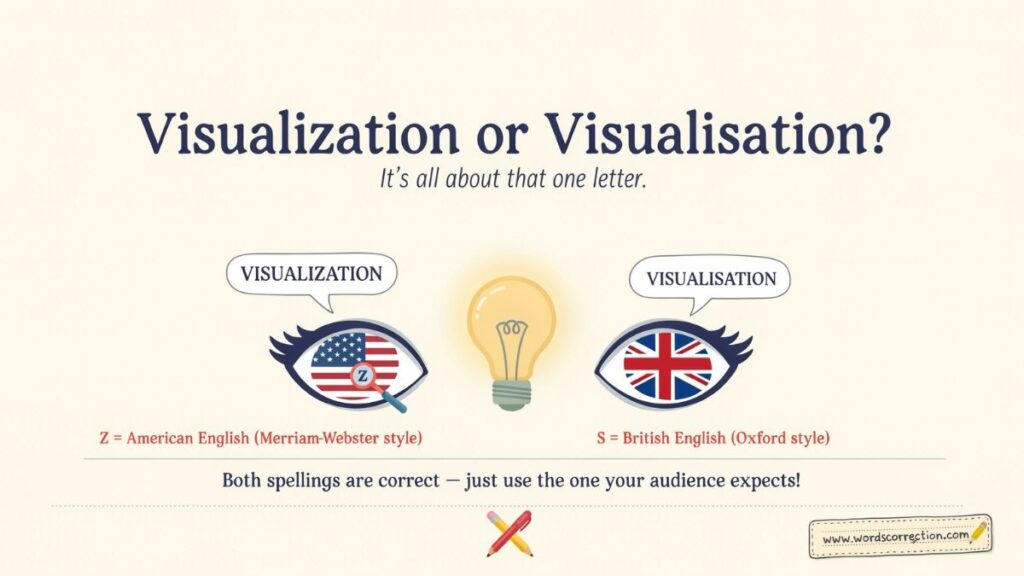
The difference between visualization or visualisation can be confusing, especially when both spellings look correct. So, which one should you use? The good news is that both are correct, but they are used in different types of English. American English prefers visualization, while British English usually uses visualisation. The only difference is one letter but choosing the right spelling can make your writing clearer and more consistent. Let’s look at what both words mean how they differ and which spelling you should use in your writing.
Quick Answer Visualization or Visualisation?
Both visualization and visualisation are correct spellings of the same noun. They describe the process of forming a mental picture, imagining something, or presenting information visually.
The main difference is regional spelling preference
- Visualization: The standard spelling in American English.
- Visualisation: The preferred spelling in British English and commonly used in several other varieties of English.
For example
- American English: The teacher used data visualization to explain the results.
- British English: The teacher used data visualisation to explain the results.
Neither spelling changes the meaning or pronunciation of the word. The important thing is to follow the spelling convention expected by your readers and remain consistent throughout your writing.
What Is the Difference Between Visualization and Visualisation?
The difference between visualization and visualisation is simply the letter z versus s.
Both words have the same definition, grammatical function, and pronunciation. They are nouns formed from the verb visualize or visualise, meaning to form a mental image or make something visible.
The spelling you choose usually depends on your preferred variety of English.
| Feature | Visualization | Visualisation |
|---|---|---|
| Spelling | Uses z | Uses s |
| Main usage | American English | British English |
| Meaning | Forming or presenting a visual image | Forming or presenting a visual image |
| Part of speech | Noun | Noun |
| Pronunciation | Generally the same | Generally the same |
| Example | Data visualization helps explain trends. | Data visualisation helps explain trends. |
Remember: Visualization and visualisation are not two different concepts. They are regional spelling variations of the same word.
Learn the difference between confusing more English words
Visualization Meaning and Definition
Visualization is the process of creating a mental image of something or representing information through visual elements. It can involve imagining an object, picturing a future event, or turning complex information into charts, graphs, and diagrams.
The word has several uses depending on the context.
For example, a student might visualize an event while reading a novel. An athlete might visualize a successful performance before a competition. A business analyst might use data visualization to make sales figures easier to understand.
Simple Definition of Visualization
Visualization means creating a picture in your mind or presenting information in a visual form.
Examples
- Visualization helps students understand difficult ideas.
- The athlete used visualization to prepare for the competition.
- The company improved its reports with data visualization.
- Guided visualization can help people imagine a calm environment.
In each sentence, the word refers to creating or using a visual representation.
Learn the difference between commonly mixed-up more words
Hierarchical vs Hierarchal Which Word Should You Use?
Visualisation Meaning and Definition
Visualisation has exactly the same meaning as visualization. The only difference is its spelling.
British English generally uses visualisation, while American English uses visualization. The word can describe mental imagery, the presentation of information, or the process of making an idea easier to understand through visual representation.
Simple Definition of Visualisation
Visualisation is the process of forming a mental picture or presenting information through images, charts, diagrams, or other visual elements.
Examples
- Visualisation can make complicated information easier to understand.
- The coach encouraged visualisation before the match.
- The report includes data visualisation to explain the results.
- The students practised visualisation during the lesson.
These examples show that visualisation works in the same way as visualization. Only the regional spelling changes.
Learn the difference between tricky grammar more words
Eying or Eyeing Which Spelling Is Correct?
Why Are There Two Spellings?
English spelling developed differently in different regions. Over time, American and British English adopted different conventions for certain words, including those ending in -ize and -ise.
This explains why American English commonly uses visualization, while British English generally uses visualisation.
The difference is not unique to this word. You can see the same pattern in many other English words.
| American English | British English |
|---|---|
| Realization | Realisation |
| Organization | Organisation |
| Recognize | Recognise |
| Analyze | Analyse |
| Modernization | Modernisation |
| Civilization | Civilisation |
| Visualization | Visualisation |
However, there is an important detail British English does not always require -ise. The Oxford spelling convention also accepts and uses -ize in many words, including visualization. Therefore, the choice can depend on the style guide or publication you’re following.
The Role of the -ize and -ise Endings
The endings -ize and -ise often represent the same sound and grammatical function. In many words, the difference is mainly a matter of spelling convention.
American English generally prefers -ize, while traditional British publishing often favors -ise. However, some British publications follow Oxford spelling and use -ize.
For this reason, it’s better to check the style guide you’re expected to follow rather than assume that every British writer uses the same spelling.
American vs British English Which Spelling Should You Use?
The easiest way to choose between visualization and visualisation is to consider your audience.
Visualization in American English
Visualization is the standard spelling in American English. It is widely used in American schools, universities, businesses, newspapers, and online publications.
If you’re writing for an American audience, choose visualization.
Examples
- Data visualization helps businesses understand customer behavior.
- The teacher used visualization techniques to explain the lesson.
- Mental visualization can help athletes prepare for competition.
- The software offers several tools for information visualization.
Visualisation in British English
Visualisation is the traditional preferred spelling in British English. It commonly appears in British academic writing, newspapers, educational materials, and professional publications.
If you’re writing for a British audience and following a style guide that uses -ise, choose visualisation.
Examples
- Data visualisation makes complex information easier to understand.
- The teacher introduced visualisation techniques during the lesson.
- Mental visualisation can support athletic preparation.
- The report uses visualisation to present important findings.
What About Canadian, Australian, and New Zealand English?
The spelling can also vary across other English-speaking countries.
| English variety | Common spelling preference |
|---|---|
| American English | Visualization |
| British English | Visualisation |
| Canadian English | Visualisation is common, but usage can vary |
| Australian English | Visualisation is commonly preferred |
| New Zealand English | Visualisation is commonly preferred |
These are general preferences, not absolute rules. Organizations, universities, publishers, and individual style guides may use different conventions.
If you’re writing for a particular publication or institution, follow its spelling policy. Consistency matters more than choosing one regional form over another.
Learn the difference between confusing word pairs
Passtime or Pastime Which Spelling Is Correct?
Visualization and Visualisation in Sentences
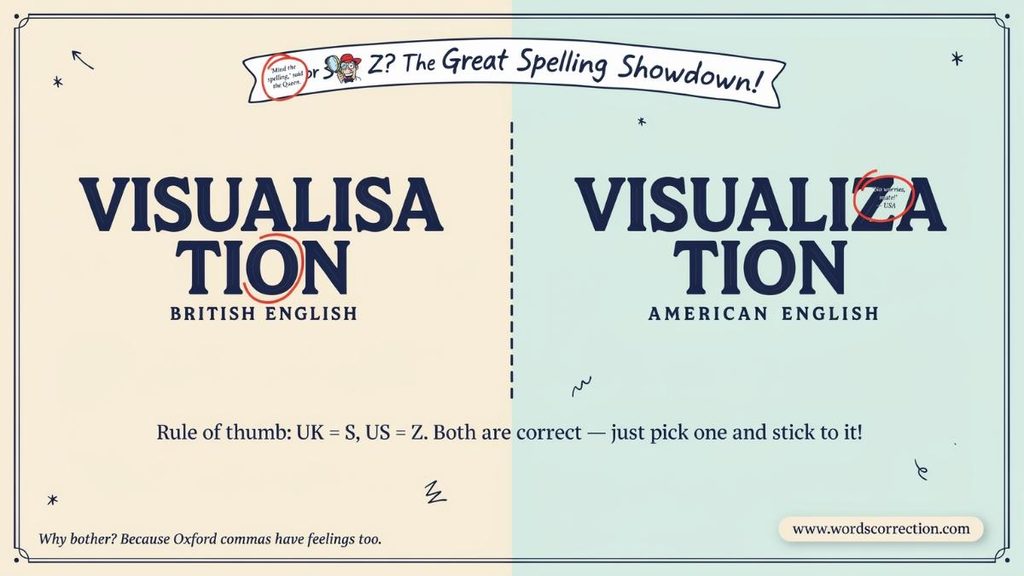
Seeing both spellings in context makes the difference easier to understand. The following examples show how each version works in everyday, academic, professional, and technical writing.
Everyday Examples
- Visualization helps me imagine how the room will look after renovation.
- Visualisation makes it easier to picture a future goal.
- The children used visualization to understand the story.
- The instructor introduced visualisation as part of the exercise.
- Visualization can help turn an abstract idea into a clear mental picture.
Academic Examples
- The research paper examines the role of visualization in learning.
- Visualisation techniques helped participants understand the experiment.
- Students used data visualization to interpret the research findings.
- The study explored how mental visualisation affects memory.
- The teacher included visualization activities in the lesson plan.
Business and Technology Examples
- The company uses data visualization to track monthly sales.
- The dashboard provides clear visualisation of customer trends.
- The software includes advanced visualization tools.
- The team improved its presentation through better visualisation.
- Effective data visualization helps managers make informed decisions.
Sports and Personal Development Examples
- The athlete practised visualization before the final match.
- The coach recommended visualisation to improve concentration.
- Visualization helped the runner mentally prepare for the race.
- The team used visualisation exercises before the tournament.
- Mental visualization can help athletes rehearse important movements.
Notice that the meaning stays the same in every example. Only the spelling changes.
Learn the difference between often confused words
Ingage vs Engage Which Word Is Correct?
Different Types of Visualization
Visualization isn’t limited to creating pictures in your imagination. It also plays an important role in education, psychology, business, technology, sports, and creative work.
Here are some common types and how people use them.
Mental Visualization
Mental visualization is the process of creating images in your mind without seeing the actual objects or scenes.
For example, you might imagine the layout of a new house before it is built or picture the route you need to take before leaving home.
People also use mental imagery when reading books, planning activities, learning new skills, or preparing for challenging situations.
Example: Before giving a presentation, Sara imagined herself speaking confidently in front of the audience. This mental rehearsal helped her organize her thoughts and feel more prepared.
Data Visualization
Data visualization means presenting information through visual formats such as charts, graphs, maps, and diagrams.
Instead of reading a long list of numbers, people can use visual representations to identify patterns, compare results, and understand trends.
Businesses, researchers, educators, and analysts use data visualization to communicate information more clearly.
Common examples include
- Bar charts
- Line graphs
- Pie charts
- Heat maps
- Scatter plots
- Interactive dashboards
Example: A marketing team uses a line graph to compare website traffic over six months. The chart makes it easier to identify periods of growth and decline.
Creative Visualization
Creative visualization involves imagining a desired outcome or situation. People may use it to clarify goals, plan projects, or mentally rehearse an activity.
For instance, someone preparing for a job interview might imagine answering questions calmly and explaining their experience clearly.
However, imagining success alone doesn’t guarantee it. Visualization works best when combined with preparation, realistic planning, and action.
Example: A student imagines completing an important project on time. They then create a schedule and follow it to reach that goal.
Sports Visualization
Athletes sometimes use visualization to mentally rehearse movements, strategies, and competition situations.
A tennis player, for example, might imagine serving accurately, responding to an opponent’s shot, or staying focused during a difficult point.
This mental practice can support physical training by helping athletes prepare for specific situations.
Example: Before a tournament, a tennis player mentally rehearses a series of serves and returns. The exercise helps the player think through the movements and approach the match with a clearer plan.
Guided Visualization
Guided visualization is a technique in which someone uses spoken instructions, descriptions, or audio recordings to imagine a particular scene or experience.
A guide might ask a person to picture a quiet beach, a peaceful garden, or another relaxing environment.
This technique is sometimes used in relaxation exercises, mindfulness activities, and stress-management programs.
Example: During a relaxation session, an instructor asks participants to imagine sitting beside a calm lake and listening to the gentle movement of the water.
Learn the difference between basic English word mistakes
Implicit vs Complicit what’s the Differences?
Visualization vs Visualisation A Side-by-Side Comparison
The following table summarizes the main differences and similarities.
| Category | Visualization | Visualisation |
|---|---|---|
| Spelling | American form | Traditional British form |
| Preferred region | United States | United Kingdom |
| Meaning | Creating a mental image or visual representation | Creating a mental image or visual representation |
| Pronunciation | Generally the same | Generally the same |
| Grammar | Noun | Noun |
| Verb form | Visualize | Visualise |
| Adjective form | Visualized / visualizing | Visualised / visualising |
| Common use | American publications and academic writing | British publications and academic writing |
The table highlights one important point: these are spelling variations, not separate words with different meanings.
How Do You Pronounce Visualization and Visualisation?
Both visualization and visualisation are generally pronounced the same way. The spelling difference does not normally change how the word sounds.
The pronunciation begins with the sound of visual and ends with the familiar -zay-shun sound.
A simple pronunciation guide is
vizh-oo-uh-luh-ZAY-shun
The final syllable receives the main stress.
Because pronunciation can vary slightly by accent and dictionary transcription, you may see different phonetic representations. If you need the exact pronunciation for a particular accent, check a reliable American or British dictionary.
Learn the difference between commonly misused words
Xenodochial vs Xenodochium Which Word Should You Use?
Synonyms and Related Words
Several words are related to visualization and visualisation. However, they don’t all mean exactly the same thing. The best choice depends on what you want to describe.
| Word | Meaning | Example |
|---|---|---|
| Mental imagery | Pictures or scenes created in the mind | Mental imagery can help students remember information. |
| Visualization | The process of creating a mental or visual representation | Visualization makes the concept easier to understand. |
| Illustration | A picture or drawing that explains something | The book includes an illustration of the process. |
| Representation | Something that presents or describes another thing | The chart is a visual representation of the results. |
| Diagram | A drawing that explains how something works | The diagram shows the parts of the machine. |
| Depiction | A visual or written presentation of something | The painting offers a depiction of village life. |
| Imagery | Language or mental pictures that create a sensory impression | The writer uses vivid imagery throughout the story. |
| Rendering | A visual representation of an object or design | The architect prepared a 3D rendering of the building. |
Note: These words are related, but they’re not always interchangeable. For example, illustration usually refers to a picture or drawing, while mental imagery specifically describes images formed in the mind.
Word Forms of Visualization and Visualisation
Understanding the related word forms can help you use the term correctly in different sentences.
| Part of speech | American English | British English |
|---|---|---|
| Verb | Visualize | Visualise |
| Noun | Visualization | Visualisation |
| Past tense | Visualized | Visualised |
| Present participle | Visualizing | Visualising |
| Adjective | Visualized | Visualised |
Examples of Different Word Forms
- Visualize: Try to visualize the final design before you begin.
- Visualise: The coach asked the players to visualise the winning moment.
- Visualization: Visualization can make the learning process more engaging.
- Visualisation: Visualisation is often used in mental rehearsal.
- Visualized: She visualized the finished project before starting the work.
- Visualised: He visualised the route before beginning the journey.
- Visualizing: Visualizing your goals can help you plan your next steps.
- Visualising: Visualising the process made the task easier to understand.
When choosing a spelling system, remember to keep the related forms consistent. If you use visualization, use visualize and visualizing as well. If you use visualisation, use visualise and visualising.
Learn the difference between everyday English mistakes
Stigmatism vs Astigmatism Which Term Is Correct?
Common Mistakes to Avoid
Although the difference between visualization and visualisation is simple, writers sometimes make avoidable spelling and usage mistakes.
Mixing American and British Spellings
One common mistake is using both spelling styles in the same piece of writing without a clear reason.
For example
Inconsistent: The organization introduced a new visualisation system to improve data analysis.
Consistent American English: The organization introduced a new visualization system to improve data analysis.
Consistent British English: The organisation introduced a new visualisation system to improve data analysis.
The best approach is to choose one spelling convention and apply it throughout the document.
Assuming One Spelling Is Incorrect
Some writers believe that visualisation is a misspelling because they are familiar with American English. Others assume that visualization is incorrect because they follow traditional British spelling.
Neither assumption is right. Both forms are accepted English spellings.
Confusing Visualization With Illustration
Visualization and illustration are related, but they don’t always describe the same thing.
Visualization can refer to mental imagery or a visual presentation of information. Illustration usually refers to a picture, drawing, or example that explains something.
For example
- Visualization helps me imagine the finished building.
- The illustration shows the finished building.
The first sentence describes forming a mental picture. The second refers to an actual visual representation.
Forgetting the Related Word Forms
Changing the spelling of the noun without changing its related forms can make your writing inconsistent.
For example, avoid using visualization in one sentence and visualising in another if you’re following a consistent American English style.
Instead, use:
- American English: visualize, visualization, visualizing
- British English: visualise, visualisation, visualising
Treating the Spelling Difference as a Difference in Meaning
The final z or s doesn’t create a new definition. Both forms refer to the same process.
Don’t choose one spelling because you think it describes a different type of visualization. Choose it according to your audience and style guide.
Learn the difference between more words people mix up
Realize vs Realise What Is the Difference?
Which Spelling Should You Use?
Your choice depends on where your readers are and which spelling convention your writing follows.
Use visualization when
- You’re writing for an American audience.
- Your organization follows American English.
- You’re preparing content for a US-based publication.
- Your style guide prefers -ize spellings.
Use visualisation when
- You’re writing for a British audience that follows -ise spelling.
- Your organization uses traditional British English.
- You’re preparing content for a publication that prefers -ise endings.
- Your style guide specifically requires this form.
If you’re writing for an international audience, either spelling can work. Just choose one and use it consistently.
For example, if your article uses color, organize, and analyze, then visualization will fit naturally. If it uses colour, organise, and analyse, then visualisation will usually be the better match.
Learn the difference between tricky English words with easy explanations
Coaches or Coach’s Which Spelling Is Correct?
Practice session about Visualization or Visualisation
Instructions Read each sentence carefully and fill in the blank with the correct word.
1. __________ is the standard American English spelling.
2. __________ is the preferred British English spelling.
3. Both spellings have the same __________.
4. The process of creating mental images is called __________.
5. To create a mental image, you __________ something in your mind.
6. In British English, the verb is spelled __________.
7. Different types of data __________ help people understand complex information.
8. The word visualization is a __________.
9. In American English, the correct spelling is __________.
10. The British English form of visualizing is __________.
11. Mental __________ refers to pictures or scenes created in the mind.
12. Charts, graphs, and __________ can help present information visually.
13. Visualization can involve creating mental __________ of objects or situations.
14. The difference between visualization and visualisation is mainly __________.
15. American English uses the letter __________ in visualization.
16. British English uses the letter __________ in visualisation.
17. Data __________ makes complex information easier to understand.
18. Scientific __________ helps researchers interpret complex data.
19. The word visualization comes from the word __________.
20. A condition in which someone has little or no voluntary mental imagery is called __________.
21. A person or tool that creates visual representations may be called a __________.
22. The adjective form related to visualization is __________.
23. Visualization is commonly used in __________ English.
24. Visualisation is commonly used in British English as well as other varieties that follow British spelling, such as __________ English.
25. When writing an article, maintain spelling __________ throughout the content.
Answers
- Visualization
- Visualisation
- Meaning
- Visualization
- Visualize
- Visualise
- Visualizations
- Noun
- Visualization
- Visualising
- Imagery
- Diagrams
- Imagery
- Regional
- Z
- S
- Visualization
- Visualization
- Visual
- Aphantasia
- Visualizer
- Visual
- American
- Australian
- Consistency
Here’s a trusted source for clear word meanings:
Cambridge Dictionary
FAQ’s
What does visualization mean?
Visualization is the process of creating mental images or representing information through visual elements. It can involve imagining a situation, picturing an idea, or presenting complex information using charts, graphs, and diagrams.
Why are visualization and visualisation spelled differently?
The difference comes from regional English spelling conventions. Visualization is the preferred spelling in American English, while visualisation is commonly used in British English. Both words have the same meaning and pronunciation.
Is visualization an American or British English word?
Visualization is primarily the American English spelling. British English generally uses visualisation, although both forms are recognized and understood across English-speaking regions.
Do visualization and visualisation have the same pronunciation?
Yes, both words are pronounced the same way. The difference is purely orthographic, meaning it relates to spelling rather than pronunciation or meaning.
How do you pronounce visualization?
Visualization is pronounced vizh-oo-uh-luh-ZAY-shun, with the primary stress on the fourth syllable. The British spelling, visualisation, follows the same pronunciation.
When should you use visualization instead of visualisation?
Use visualization when writing for an American audience or following US English conventions. Use visualisation when writing for British, Australian, or New Zealand audiences. Always follow the spelling standards of your target audience.
Is visualization accepted in British English?
Yes, visualization is understood and recognized in British English. However, visualisation is the more conventional spelling in the UK and is generally preferred in British publications.
Is visualisation accepted in American English?
Visualisation is understandable to American readers, but it is not the standard American spelling. US English typically uses visualization in academic, professional, and everyday communication.
What is the plural form of visualization?
The plural form of visualization is visualizations. It follows the standard English rule of adding -s to a singular noun. For example, “The report includes several visualizations of the research data.”
What are the different forms of the word visualization?
The main grammatical forms include visualization (noun), visualize (verb), visualizing (present participle), visualized (past tense), and visualizer (noun). In British English, these are commonly spelled visualisation, visualise, visualising, visualised, and visualiser.
What is the verb form of visualization?
The verb form is visualize in American English and visualise in British English. It refers to the process of forming a mental image or creating a visual representation of an idea, object, or situation.
What is the adjective form of visualization?
Visual and visualized are common adjective forms associated with visualization. Visual describes something related to sight or images, while visualized refers to something represented or formed as a mental image.
What is another word for visualization?
Common synonyms and related terms include imagery, illustration, depiction, representation, and mental imagery. The appropriate alternative depends on the context. For example, mental imagery is suitable for psychological discussions, while graphical representation is more relevant to data presentation.
What is the opposite of visualization?
Visualization does not have one universally accepted opposite. In the context of mental imagery, an absence of voluntary mental images is associated with aphantasia. In information presentation, a text-based explanation may serve as an alternative to visual representation.
How do you use visualization in a sentence?
Visualization can describe either the formation of mental images or the presentation of information through visual elements. For example, “The athlete used visualization techniques to prepare mentally for the competition.” Another example is, “The analyst used data visualization to present the company’s annual performance.”
What are three examples of visualization in everyday life?
Everyday examples include mentally picturing a successful presentation before delivering it, imagining how furniture will look in a rearranged room, and interpreting weather patterns through a visual map. These activities demonstrate how visualization supports mental preparation and information processing.
What are the main types of visualization?
Common types include mental visualization, data visualization, scientific visualization, information visualization, and artistic visualization. Each serves a different purpose, such as developing mental images, interpreting complex data, illustrating scientific concepts, or communicating ideas visually.
What are the most common visualization techniques?
Popular visualization techniques include guided imagery, mental rehearsal, creative visualization, positive visualization, and graphical data representation. These techniques are used in different fields to support mental preparation, improve focus, communicate information, and simplify complex concepts.
How is visualization used in psychology?
Psychology uses visualization to support mental preparation, emotional regulation, relaxation, and performance improvement. Techniques such as guided imagery and mental rehearsal help individuals imagine specific situations, practice responses, and develop strategies for managing challenging experiences.
What is mental visualization used for?
Mental visualization helps individuals imagine situations, rehearse actions, prepare for future events, and develop a clearer understanding of their goals. It is commonly used in sports, education, professional development, and personal performance training.
How does visualization help improve memory?
Visualization can support memory by connecting information with meaningful mental images. Techniques such as mind mapping, visual associations, and diagrams help organize information into recognizable patterns, making certain details easier to understand and recall.
Can visualization improve focus and concentration?
Yes, visualization can help improve focus and concentration by encouraging individuals to direct their attention toward specific tasks and objectives. Mental rehearsal and guided imagery can also support preparation, reduce distractions, and establish a clearer sense of direction.
What is the difference between mental visualization and data visualization?
Mental visualization involves creating images or scenes in the mind, whereas data visualization presents information through graphical formats such as charts, graphs, maps, and dashboards. Mental visualization supports imagination and mental preparation, while data visualization helps people analyze, interpret, and communicate information.
What are the most common applications of data visualization?
Data visualization is widely used in business analytics, healthcare, education, finance, scientific research, marketing, and journalism. Professionals use charts, graphs, dashboards, and interactive maps to identify trends, compare datasets, communicate findings, and support informed decision-making.
Which spelling should you use for an international audience: visualization or visualisation?
The best spelling depends on your target audience and preferred English style guide. Use visualization for American English audiences and visualisation for British, Australian, and New Zealand audiences. For international publications, either spelling is acceptable, provided you maintain consistency throughout the content.
Learn the difference between confusing more English words step by step
Grimey or Grimy Which Spelling Is Correct?
Conclusion
Choosing between visualization and visualisation is simple once you understand the difference. Both spellings are correct and carry the same meaning. American English uses visualization, while traditional British English generally prefers visualisation. Neither spelling is wrong; the right choice depends on your audience and preferred style of English. To avoid confusion, choose one form and use it consistently throughout your writing. A single letter may separate these two spellings, but using the correct form for your audience helps keep your writing clear, professional, and polished.

Stella AJS is an experienced blogger and dedicated English language writer at Words Correction. She turns confusing grammar, word meanings, spelling, and usage into clear, practical insights that readers can easily understand and apply. With a passion for precise and engaging writing, Stella helps readers avoid common language mistakes, strengthen their vocabulary, and communicate with greater clarity and confidence.




