
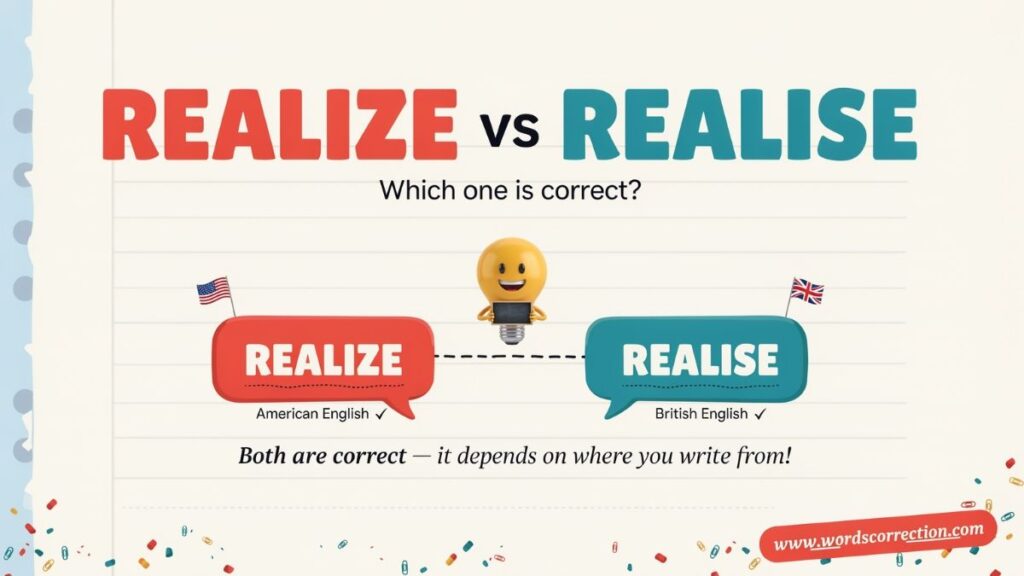
Choosing between realize vs realise can be confusing, especially when both spellings are correct. So, which one should you use? The answer depends on the type of English you follow. American English generally uses realize, while British English commonly prefers realise. Although the difference is only one letter, using the right spelling helps keep your writing clear and consistent. In this guide, you’ll learn the meaning of both words, understand their spelling differences, explore regional preferences, and see practical examples to help you use each form correctly and confidently.
Realize vs Realise Quick Answer
Realize and realise are two accepted spellings of the same English verb. Neither changes the word’s meaning, pronunciation, or grammatical function. The main difference comes from regional spelling preferences.
- Realize: The standard spelling in American English.
- Realise: A common and widely accepted spelling in British, Australian, and New Zealand English.
- Oxford English: Uses realize as part of its traditional -ize spelling convention.
- Canadian English: Generally favors realize.
- Indian English: Both forms appear, although realise is common in British-influenced writing.
For example
- American English: I didn’t realize how late it was.
- British English: I didn’t realise how late it was.
Both sentences communicate exactly the same message. The spelling changes, but the meaning stays the same.
Realize vs Realise Meaning and Definitions
Before exploring the spelling difference, it’s important to understand what these words actually mean. The meaning of realize and realise is identical because both forms represent the same verb.
Both spellings describe becoming aware of something, understanding a situation, or achieving something that previously existed as an idea, plan, or ambition.
The word has two primary meanings
- To understand or become aware: To recognize a fact, notice something, or suddenly understand a situation.
- To achieve or make something happen: To accomplish a goal, fulfill a plan, or bring an idea into reality.
Let’s examine both meanings more closely.
Realize and Realise Meaning To Become Aware or Understand
The first meaning describes the moment when you recognize something or understand information that you didn’t fully understand before.
Sometimes, you discover a fact gradually. On other occasions, everything suddenly makes sense. Both situations involve realizing something.
For example
- I didn’t realize that the meeting had started.
- She finally realised why her computer kept shutting down.
- We realized that we had taken the wrong road.
- He didn’t realise how much his support meant to his friends.
In each sentence, the verb describes awareness or understanding.
Imagine forgetting your umbrella on a rainy morning. You might not notice the mistake until you step outside. At that moment, you realize what you’ve done.
The word can also describe recognizing something about yourself, another person, or the world around you.
For instance
- She realized that she needed more practice.
- They realised the importance of saving money.
- I suddenly realized that I had misunderstood the instructions.
Realize and Realise Meaning To Achieve or Make Something Happen
The second meaning focuses on achievement rather than awareness. When you realize something in this sense, you make an idea, ambition, or plan become real.
This meaning often appears in discussions about dreams, business goals, personal ambitions, and long-term plans.
Consider these examples
- She worked hard to realize her dream of becoming a doctor.
- The company hopes to realise its expansion plans next year.
- The team finally realized its full potential.
- The project helped the organization realise its long-term vision.
Here, the verb doesn’t simply mean understanding something. It describes turning an intention into an actual result.
An important distinction: The meaning depends on context. In one sentence, realize can mean recognizing a mistake. In another, it can mean achieving a lifelong ambition.
This flexibility makes the verb useful in everyday conversations as well as formal and professional writing.
Learn the difference between tricky words and use them correctly
Requestor or Requester Which Spelling Is Correct?
Realize vs Realise Key Differences
Now that the meaning is clear, let’s examine what actually separates these two spellings.
The difference isn’t complicated. Both words belong to the same verb family, follow the same grammatical rules, and express identical meanings. Their primary distinction comes from the spelling conventions used in different varieties of English.
Spelling Difference Realize vs Realise
The most obvious difference is the letter near the end of each word.
- Realize uses the letter z.
- Realise uses the letter s.
This variation belongs to a broader English spelling pattern involving the suffixes -ize and -ise.
American English generally uses -ize in words such as
- Organize
- Recognize
- Modernize
- Apologize
- Realize
British English commonly uses the corresponding -ise forms
- Organise
- Recognise
- Modernise
- Apologise
- Realise
However, British spelling isn’t as simple as replacing every z with an s. Oxford English follows a different convention and retains -ize in many words where the suffix comes from the Greek -izo.
Also, some English words retain -ise regardless of the regional spelling system. Examples include advertise, advise, exercise, surprise, and compromise.
Therefore, the -ize vs -ise spelling difference follows established word-specific conventions rather than one universal replacement rule.
American vs British English Usage
Regional spelling preferences explain why readers encounter both forms.
American English generally uses realize.
In the United States, realize is the standard spelling in schools, newspapers, books, business documents, and everyday communication.
For example
- I didn’t realize you were waiting.
- You need to realize your potential.
- She realized that the answer was correct.
The American spelling system generally favors -ize in words of this type. Merriam-Webster also uses realize as its standard dictionary entry.
British English commonly uses realise.
In the United Kingdom, realise is widely used in everyday writing and follows the spelling preferences of many British publishers, schools, and organizations.
For example
- I didn’t realise you were waiting.
- You need to realise your potential.
- She realised that the answer was correct.
However, British English also accepts realize. Oxford’s spelling convention explains why the z form appears in British dictionaries and publications.
This distinction matters because British English doesn’t have one universal spelling preference. Different dictionaries and publishers can follow different house styles.
Pronunciation of Realize vs Realise
Here’s some good news: you don’t need to learn two pronunciations.
Realize and realise have the same standard pronunciation. The difference exists only in writing.
Both forms are pronounced
/ˈriː.ə.laɪz/
The word contains three syllables, with the main stress on the first syllable.
The final sound is /z/, not /s/. This remains true even when the word contains the letter s in its British spelling.
For example, the final sound in realise matches the voiced consonant sound in words such as eyes and rise.
Remember this simple rule:
Different spelling, same pronunciation, same meaning.
Realize vs Realise Grammar Word Forms and Rules
The two spellings follow identical English grammar rules. You don’t need to change sentence structure when switching between regional spelling conventions.
However, the spelling difference continues in their related forms.
| Grammatical Form | American English | Common British Spelling |
|---|---|---|
| Base verb | Realize | Realise |
| Third-person singular | Realizes | Realises |
| Past tense | Realized | Realised |
| Past participle | Realized | Realised |
| Present participle | Realizing | Realising |
| Noun | Realization | Realisation |
Notice that the letter z changes to s throughout the related word forms when you follow the common British -ise convention.
For example
- She realizes her mistakes quickly.
- She realises her mistakes quickly.
- They have realized their potential.
- They have realised their potential.
Both versions are grammatically correct.
The same principle applies to the present participle and noun forms. Just remember to maintain your chosen spelling convention throughout the document.
Learn the difference between similar English words the easy way
Traveler or Traveller Which Spelling Is Correct?
Realize vs Realise Comparison Table
Sometimes, a side-by-side comparison explains more than several paragraphs. The following table summarizes the main differences and similarities between the two spellings.
| Feature | Realize | Realise |
|---|---|---|
| Letter difference | Z | S |
| Standard American usage | Yes | Generally no |
| Common British usage | Accepted in Oxford style | Yes |
| Meaning | Understand or achieve | Understand or achieve |
| Pronunciation | Same | Same |
| Grammatical function | Verb | Verb |
| Past tense | Realized | Realised |
| Present participle | Realizing | Realising |
| Noun form | Realization | Realisation |
| Canadian usage | Generally preferred | Less common |
| Australian usage | Accepted in some styles | Generally preferred |
Similarities Between Realize and Realise
Despite their different spellings, these words share several important characteristics
- Both are verbs.
- Both have identical definitions.
- Both describe awareness, understanding, or achievement.
- Both have the same pronunciation.
- Both follow the same grammatical rules.
- Both appear in formal and informal writing.
- Both can describe personal experiences, professional achievements, and everyday situations.
For example, these sentences are equally correct
- I finally realized that I needed a break.
- I finally realised that I needed a break.
The spelling changes, but the message doesn’t. No grammatical adjustment is necessary.
Learn the difference between commonly confused more words in English
Whoa or Woah Which Spelling Is Correct?
Realize vs Realise in American English and British English
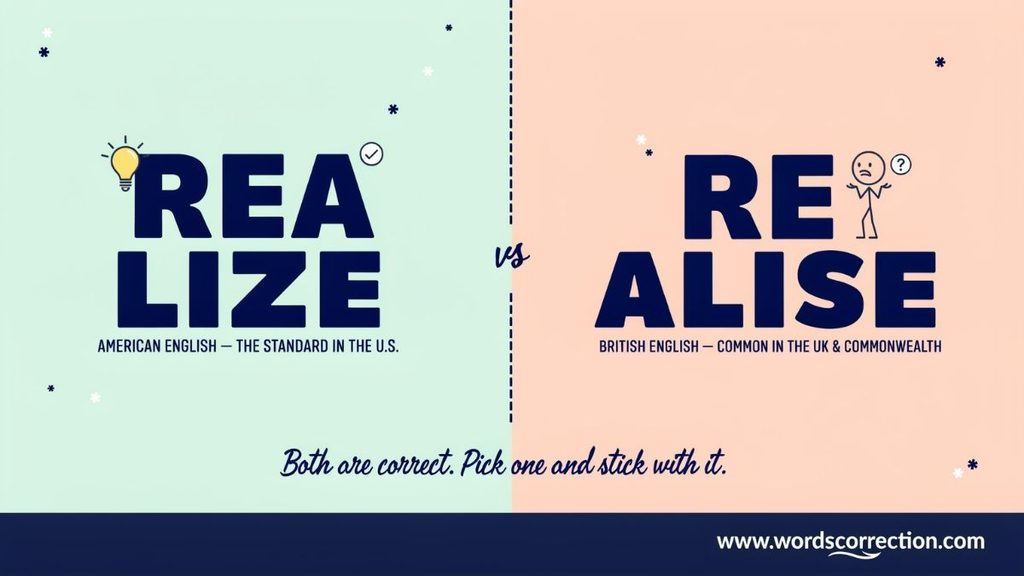
English has developed several regional varieties over time. Although American and British English share the same basic grammar and vocabulary, their spelling conventions sometimes differ.
The realize vs realise debate is a good example of this variation.
Realize in American English
American English generally uses realize with a z. This spelling follows a broader American preference for the -ize ending in words that allow this variation.
You’ll commonly encounter it in
- American newspapers and magazines.
- School textbooks and academic assignments.
- Business reports and professional emails.
- Websites targeting American readers.
- Books published for the US market.
Realize examples in American English
- I didn’t realize how expensive the repair would be.
- She hopes to realize her dream of opening a restaurant.
- We realized that the original plan needed improvement.
- The manager wants employees to realize their potential.
In American writing, realize is the expected choice. Although readers may understand realise, the latter doesn’t follow the usual American spelling preference.
If you’re writing for an American audience, choose realize, realized, realizing, and realization.
Realise in British English
British English commonly favors realise with an s. This spelling appears in many British newspapers, educational materials, publishing houses, and professional communications.
For example
- I didn’t realise how expensive the repair would be.
- She hopes to realise her dream of opening a restaurant.
- We realised that the original plan needed improvement.
- The manager wants employees to realise their potential.
However, there’s an important detail worth understanding.
British English doesn’t reject every word containing -ize. The Oxford spelling convention deliberately uses -ize in many words that come from the Greek -izo.
As a result, both realize and realise can be correct in British English.
Is Realize Correct in British English?
Yes! This is one of the most misunderstood parts of the realize vs realise debate.
Many people assume that realize belongs exclusively to American English. However, Oxford University Press uses the -ize spelling in words where the ending has the relevant Greek origin.
According to Oxford’s spelling convention, examples include
- Realize
- Organize
- Recognize
- Modernize
- Civilize
The Oxford spelling system follows the historical roots of these words rather than automatically replacing z with s.
However, not every British publisher follows Oxford’s approach.
For example, the University of Oxford’s general style guide prefers -ise for its institutional communications. Oxford University Press, by contrast, traditionally follows the -ize convention in relevant words.
This distinction explains why British publications can use different spellings without either being grammatically incorrect.
Realize or Realise in the UK What Does Oxford Dictionary Say?
The question of whether Oxford uses realize or realise deserves a direct answer.
Oxford English recognizes both spelling forms, but Oxford University Press traditionally favors realize.
The Oxford English Dictionary and related Oxford dictionary resources document spelling variations. Oxford’s -ize convention reflects the historical Greek origin of certain words.
Meanwhile, other British style guides prefer -ise because it’s more common in everyday British usage.
Here’s how the preferences compare
| Reference or Style | Preferred Spelling |
|---|---|
| Oxford University Press | Realize |
| University of Oxford general style guide | Realise |
| Many British publishers | Realise |
| American English dictionaries | Realize |
| General British -ise style | Realise |
The difference isn’t a disagreement about grammar. It’s a difference in editorial and spelling conventions.
Learn the difference between confusing more English words step by step
Realise vs Realize in Australian, Canadian, New Zealand, and Indian English
American and British English aren’t the only varieties worth considering. Other English-speaking countries have developed their own spelling preferences, sometimes borrowing conventions from both sides of the Atlantic.
If you’re writing for an international audience, understanding these regional differences can help you avoid unnecessary editing problems.
Realise vs Realize in Australian English
Australian English generally follows British spelling conventions. Therefore, realise is the more common choice in Australian writing.
You’ll often see
- Realise
- Realised
- Realising
- Realisation
Australian government publications, educational institutions, and professional organizations commonly use -ise endings.
For example:
- I didn’t realise how important the opportunity was.
- She finally realised her professional ambitions.
- The organization hopes to realise its goals.
However, Australian English can accommodate alternative spellings depending on the dictionary, publisher, or organizational style guide.
For formal Australian writing, consult an established Australian dictionary or the relevant publication’s style guide.
Australian spelling generally favors realise, but following a consistent editorial standard remains the safest approach.
Realise vs Realize in Canadian English
Canadian English has an interesting combination of British and American spelling conventions.
For example, Canadians often write
- Colour rather than color.
- Centre rather than center.
- Theatre rather than theater.
However, Canadian English generally prefers realize rather than realise.
This preference reflects the influence of North American spelling conventions, even though Canadian English retains several British-style spellings.
Examples
- I didn’t realize how much time the project would take.
- She realized that the instructions were incomplete.
- They hope to realize their business ambitions.
The Government of Canada’s language guidance recommends -ize endings in Canadian English. It also advises writers to consult reliable Canadian dictionaries and maintain consistent spelling.
Realize vs Realise in New Zealand English
New Zealand English generally follows British spelling conventions. Consequently, realise is widely used in New Zealand publications, educational writing, and professional communication.
For example
- I didn’t realise the event started so early.
- They realised that their approach needed improvement.
- She wants to realise her career ambitions.
However, individual publishers and organizations may follow different house styles. Some international publications also use Oxford spelling.
When writing for New Zealand readers, realise is a sensible default unless a specific style guide says otherwise.
Realize vs Realise in Indian English
Indian English has strong historical connections with British English. As a result, realise is common in Indian schools, newspapers, formal documents, and professional writing.
However, realize also appears in Indian publications, especially in international business communication, American-influenced content, and digital media.
For example
- I didn’t realise how difficult the examination would be.
- She realized that regular practice was necessary.
- The students hope to realise their academic goals.
Both forms are understandable. However, writers targeting Indian institutions or readers should follow the spelling conventions of their chosen publication.
Practical recommendation: Use realise when following traditional British-influenced Indian English. Use realize when following American or Oxford-style spelling.
Learn the difference between tricky English words with easy explanations
Hierarchical vs Hierarchal Which Word Should You Use?
Realize vs Realise Sentence Examples
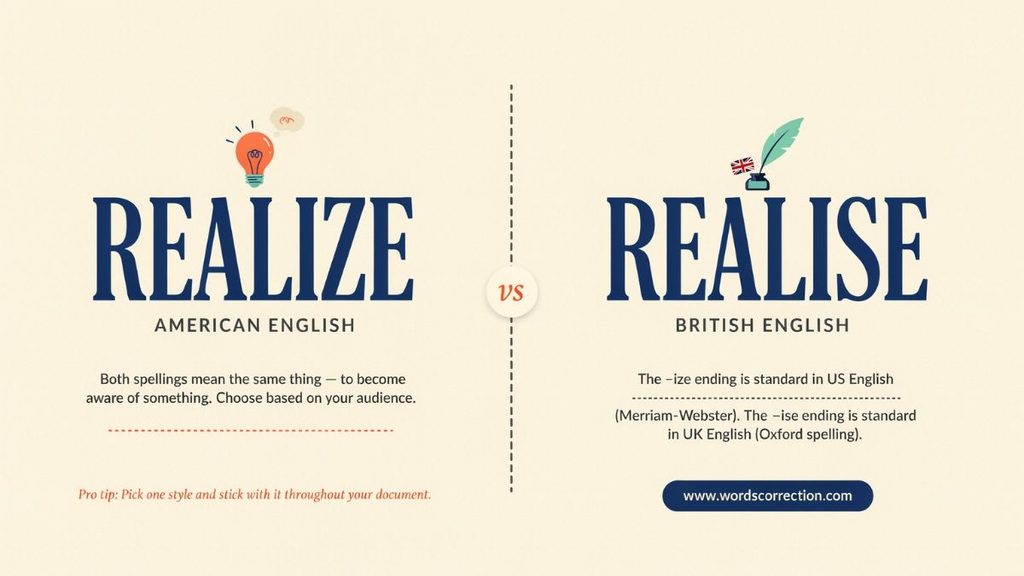
Understanding a spelling rule becomes much easier when you see it working in real sentences.
The following examples demonstrate how both forms work in everyday communication, education, business, and formal writing.
Examples of Realize in Sentences
Here are several examples using American English spelling.
| Sentence | Meaning |
|---|---|
| I didn’t realize you were at home. | I wasn’t aware you were home. |
| She realized her mistake immediately. | She recognized that she had made an error. |
| They hope to realize their dreams. | They want to achieve their ambitions. |
| We realized that the deadline was approaching. | We became aware of the approaching deadline. |
| He finally realized his full potential. | He achieved or demonstrated his abilities. |
| Did you realize how much it cost? | Were you aware of its price? |
These examples show that realize works in both casual and formal situations.
Examples of Realise in Sentences
The following examples use the common British English spelling.
| Sentence | Meaning |
|---|---|
| I didn’t realise you were at home. | I wasn’t aware you were home. |
| She realised her mistake immediately. | She recognized that she had made an error. |
| They hope to realise their dreams. | They want to achieve their ambitions. |
| We realised that the deadline was approaching. | We became aware of the approaching deadline. |
| He finally realised his full potential. | He achieved or demonstrated his abilities. |
| Did you realise how much it cost? | Were you aware of its price? |
Notice how the meaning remains unchanged. Only the spelling follows a different regional convention.
Realize vs Realise in Everyday Conversations
Imagine two friends discussing a missed appointment.
American English
“I didn’t realize we had a meeting today. I completely forgot!”
British English
“I didn’t realise we had a meeting today. I completely forgot!”
Both conversations sound natural within their respective spelling conventions.
Realize vs Realise in Emails and Professional Writing
Professional communication often requires consistent spelling, especially when dealing with international clients.
American-style email
“I didn’t realize that the report needed additional information. I’ll update the document and send the revised version shortly.”
British-style email
“I didn’t realise that the report needed additional information. I’ll update the document and send the revised version shortly.”
Neither version is more professional than the other. The important thing is to match your audience and organizational style.
Realize vs Realise in Formal Writing
Both spellings work in academic papers, reports, essays, and professional documents.
Consider these examples
- The researchers realized that their initial assumptions were incorrect.
- The researchers realised that their initial assumptions were incorrect.
- The organization aims to realize its long-term objectives.
- The organization aims to realise its long-term objectives.
The choice depends on the English variety and style guide required by the institution.
A Practical Case Study One Article, Two Spelling Conventions
Imagine a content writer preparing an article about personal development.
The article contains the following sentence
“People often realize their strengths after facing difficult situations.”
If the writer targets American readers, the sentence works perfectly.
However, if the publication follows traditional British spelling, the writer should change it to:
“People often realise their strengths after facing difficult situations.”
Now imagine that the same article contains these additional words
- Organize
- Recognized
- Realization
- Modernizing
A British publication following -ise spelling may prefer
- Organise
- Recognised
- Realisation
- Modernising
The lesson is simple: changing one word isn’t always enough. You must check the related spelling patterns throughout the entire article.
Learn the difference between more words people mix up
Eying or Eyeing Which Spelling Is Correct?
Realize vs Realise Common Spelling and Grammar Mistakes
Although the difference seems small, writers sometimes make avoidable mistakes when switching between American and British English.
Here are some common problems and how to fix them.
Assuming Realize Is Always American
Many writers believe that realize belongs exclusively to American English. That’s not accurate.
Oxford English uses realize as part of its traditional spelling convention. Several British academic and publishing organizations also accept this form.
Incorrect assumption: Realize is always an American spelling and should never appear in British writing.
Correct explanation: Realize is standard in American English and accepted in British English, particularly under Oxford spelling conventions.
Assuming Realise Is Incorrect
Another common misconception is that realise represents a spelling error.
In reality, realise is a widely accepted British English spelling. Australian and New Zealand English also commonly use it.
Incorrect assumption: You must always write realize because realise is grammatically wrong.
Correct explanation: Both spellings are correct. Your regional spelling convention determines which one you should choose.
Mixing American and British Spelling
Imagine writing an article that contains the following sentence:
“The company realized its mistake and decided to reorganise the entire department.”
The sentence mixes realized with reorganise. Although readers can understand it, the inconsistent spelling makes the writing look less polished.
A consistent American version would be
“The company realized its mistake and decided to reorganize the entire department.”
A consistent British -ise version would be
“The company realised its mistake and decided to reorganise the entire department.”
The exception: A publication following Oxford spelling can correctly use realized and organize alongside other British spellings such as colour and centre. Consistency means following one defined style rather than assuming every British word must contain an s.
Confusing Realized and Realised
Both forms represent the past tense of the same verb.
The correct choice depends on the spelling convention
- American English: Realized
- Common British English: Realised
- Oxford English: Realized
Don’t treat one form as the present tense and the other as the past tense. They express the same grammatical tense.
Changing Only the Main Word
Some writers correctly change realize to realise but forget to update its related forms.
For example
- Realize → Realise
- Realized → Realised
- Realizing → Realising
- Realization → Realisation
- Realizes → Realises
When editing a document, check all related forms to maintain spelling consistency.
Learn the difference between everyday English mistakes
Passtime or Pastime Which Spelling Is Correct?
Realize vs Realise Past Tense, Present Participle and Noun Forms
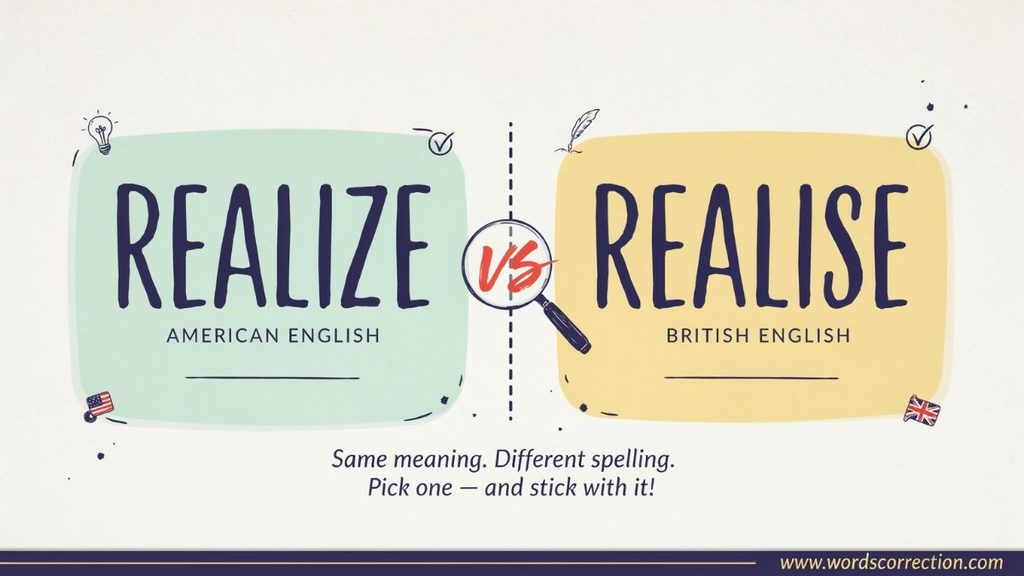
The spelling difference doesn’t disappear when the verb changes form. Instead, the s or z convention continues throughout the word family.
Understanding these forms helps prevent mistakes in essays, reports, emails, and other types of writing.
Realize or Realise Past Tense Realized vs Realised
The past tense of realize is realized. The past tense of realise is realised.
Both forms describe something that happened or became understood in the past.
Examples
- I realized that I had forgotten my keys.
- I realised that I had forgotten my keys.
- She realized her childhood dream.
- She realised her childhood dream.
Both forms also work as past participles.
For example
- He has realized his mistake.
- He has realised his mistake.
- They had realized the importance of teamwork.
- They had realised the importance of teamwork.
The grammatical construction stays exactly the same.
Realizing vs Realising Present Participle
The present participle describes an ongoing action or appears in certain verb constructions.
American English uses realizing, while common British English uses realising.
Examples
- I am realizing how important this decision is.
- I am realising how important this decision is.
- She is realizing her full potential.
- She is realising her full potential.
Both forms can also function as gerunds.
For example
- Realizing your mistakes is the first step toward improvement.
- Realising your mistakes is the first step toward improvement.
The word functions in the same way regardless of the spelling.
Realization vs Realisation Noun Form
The noun forms are realization and realisation.
Both describe the act of becoming aware of something or making an idea become real.
Examples
- The realization that she had won the competition surprised her.
- The realisation that she had won the competition surprised her.
- The company celebrated the realization of its expansion plans.
- The company celebrated the realisation of its expansion plans.
These nouns appear in academic writing, business reports, personal development articles, and everyday communication.
Realizes vs Realises Third-Person Singular
When the subject is he, she, or it, the verb takes an -s ending.
The two forms are
- American English: Realizes
- Common British English: Realises
Examples
- She realizes the importance of education.
- She realises the importance of education.
- He realizes that he needs more experience.
- He realises that he needs more experience.
Both forms follow the same subject-verb agreement rules.
Learn the difference between commonly misused words
Ingage vs Engage Which Word Is Correct?
Which Spelling Should You Use Realize or Realise?
Now comes the practical question: which spelling should you actually choose?
The answer depends on your audience, location, and preferred writing style. Neither spelling is universally superior.
However, choosing the right one from the beginning can save you time when editing a document.
Use Realize for American English
If you’re writing for readers in the United States, choose realize.
Use the related American forms consistently
- Realize
- Realizes
- Realized
- Realizing
- Realization
This approach matches standard American spelling conventions and the usage found in American dictionaries such as Merriam-Webster.
Use Realise for Traditional British English
If your audience is primarily British and your publication follows common -ise spelling conventions, choose realise.
Use these related forms
- Realise
- Realises
- Realised
- Realising
- Realisation
This choice also suits many Australian and New Zealand publications.
Use Realize for Oxford English
If your publisher or organization follows Oxford spelling, use realize.
Remember that Oxford spelling doesn’t mean using American English throughout a document.
For example, an Oxford-style British document may contain
- Realize
- Organize
- Recognize
- Colour
- Centre
- Travelling
This combination is perfectly acceptable under the relevant Oxford conventions.
What About International Writing?
International writing presents a slightly different challenge.
Your readers may come from several countries, each with its own spelling preferences. In this situation, choose a consistent English variety and follow a reliable dictionary or style guide.
Here are some practical recommendations
| Target Audience | Recommended Spelling |
|---|---|
| United States | Realize |
| United Kingdom (common -ise style) | Realise |
| United Kingdom (Oxford style) | Realize |
| Australia | Realise |
| Canada | Realize |
| New Zealand | Realise |
| India | Realise is common in British-influenced writing |
For international websites, also consider your main audience. A website targeting American readers should generally follow American English, while an Australian publication should usually follow Australian conventions.
A useful writing rule: Consistency matters more than choosing one spelling over the other.
If you begin with realize, maintain that spelling throughout your content unless you’re following a publication-specific convention that requires otherwise.
Learn the difference between basic English word mistakes
Implicit vs Complicit what’s the Differences?
Why Do Realize and Realise Have Different Spellings?
The difference between realize and realise comes from the historical development of English spelling.
English has absorbed vocabulary from several languages, including Greek, Latin, and French. As words entered English, their spellings sometimes reflected their origins and changed according to regional writing practices.
The ending -ize has historical roots in the Greek suffix -izo. It became established in English long before modern American spelling conventions developed.
The -ize ending isn’t a modern American invention. It has appeared in English writing for centuries and remains part of Oxford’s spelling system.
Over time, many British publishers and educational institutions adopted or preferred -ise for words that could take either ending.
American English, meanwhile, generally retained -ize in these words.
This development helps explain why the two forms exist today.
Why Do Americans Spell Realize With a Z?
American spelling conventions generally favor -ize in words where this ending is accepted.
This preference reflects the influence of historical English spelling and later efforts to establish consistent American writing conventions.
The letter z also appears in many other American words, including
- Organize
- Recognize
- Apologize
- Emphasize
- Modernize
However, it’s worth remembering that American English doesn’t use z in every similar-looking word. For example, Americans write advertise, exercise, and surprise.
The spelling depends on the word’s history and accepted usage.
Why Do Many British Writers Spell Realise With an S?
Many British writers follow the -ise convention because it has become a familiar and widely used feature of British spelling.
British dictionaries, publishers, schools, and organizations often prefer this form.
However, British English has never had one universal rule requiring every eligible word to end in -ise. Oxford spelling demonstrates this clearly.
The difference reflects competing spelling traditions rather than a disagreement about the English language.
Learn the difference between often confused words
Xenodochial vs Xenodochium Which Word Should You Use?
Practice Session About Realize vs Realise
Instructions: Choose the correct spelling or word form to complete each sentence. Check your answers in the answer session below.
- I didn’t ______ my mistake until later.
- She began to ______ her dream.
- He finally ______ the truth.
- Americans usually write ______.
- British writers commonly use ______.
- I just ______ that I forgot my keys.
- They hope to ______ their goals.
- She has ______ how important education is.
- He is slowly ______ his potential.
- Did you ______ what happened?
- I ______ that I was wrong yesterday.
- The company wants to ______ its plans.
- She didn’t ______ the danger.
- He suddenly ______ his mistake.
- We need to ______ our ideas.
- I have ______ the importance of teamwork.
- When I ______ the truth, I will tell you.
- She is ______ her childhood dream.
- They finally ______ their ambition.
- Do you ______ how difficult it is?
- He couldn’t ______ what was happening.
- I never ______ how much time had passed.
- The team hopes to ______ its vision.
- She has ______ her full potential.
- Writers should ______ one spelling style.
Answers
- Realize
- Realize
- Realized
- Realize
- Realise
- Realized
- Realize
- Realized
- Realizing
- Realize
- Realized
- Realize
- Realize
- Realized
- Realize
- Realized
- Realize
- Realizing
- Realized
- Realize
- Realize
- Realized
- Realize
- Realized
- Choose
Here’s a trusted source for clear word meanings:
Cambridge Dictionary
FAQ’s
What is the difference between realize and realise?
Both words have the same meaning: to become aware of something, understand a fact, or make something happen. Realize is the preferred American spelling, while realise is commonly used in British English.
Which spelling is preferred in American English, realize or realise?
Realize is the standard spelling in American English. American dictionaries, including Merriam-Webster, use the Z spelling.
Which spelling is commonly used in British English?
Realise is widely used in British English. However, realize is also accepted in British writing, particularly under Oxford spelling conventions.
Do realize and realise have the same meaning?
Yes, both spellings have identical meanings. They can describe becoming aware of something, understanding a situation, or achieving a particular goal.
Why do British writers sometimes spell realize with an S?
British spelling conventions commonly use -ise endings in words such as realise, organise, and recognise. However, some British publishers follow Oxford style and prefer -ize endings.
Does the Oxford Dictionary accept both realize and realise?
Yes. Oxford recognizes both spellings, but its preferred Oxford spelling convention generally uses -ize endings, including realize.
Is realize considered correct in British English?
Yes, realize is correct in British English, particularly when following Oxford spelling conventions. Both realize and realise are accepted variants.
Is realise accepted in American English?
Realise is understandable but is not the standard American spelling. American English generally uses realize in formal and everyday writing.
How do you spell realized in British and American English?
The spelling depends on the regional convention. American English uses realized, while British English commonly uses realised. Both forms have the same meaning.
Is it spelled realizing or realising?
Both spellings are correct. Realizing is the standard American form and follows Oxford spelling, while realising is commonly used in British English.
What is the difference between realization and realisation?
There is no difference in meaning. Realization is the American and Oxford spelling, whereas realisation is commonly preferred in British English.
Why does the spelling of realize change between countries?
English spelling conventions developed differently across regions. American English generally favors -ize, while British English often uses -ise in words such as realise.
Is realize or realise more common in Australian English?
Realise is the more common spelling in Australian English. It follows the traditional British spelling convention used in Australian writing.
Which spelling is preferred in Canadian English?
Both forms are recognized in Canadian English, but realize is generally preferred in Canadian spelling. Writers should follow the style guide required for their publication.
What does the verb realize mean in everyday English?
Realize means to understand something, become aware of a fact, or recognize a situation. It can also mean turning an idea or plan into reality.
What does the phrase I just realized mean?
“I just realized” means that someone has recently understood or discovered something. For example, “I just realized that I left my notebook at home.”
What is the correct way to use realize in a sentence?
Use realize when describing awareness, understanding, or discovery. For example, “I realize that learning a new language takes patience.”
Can you give an example of realise in British English?
Certainly. Here is an example: “She began to realise how important education was to her future.” The spelling follows the common British English convention.
Is I realized grammatically correct?
Yes, “I realized” is grammatically correct. It uses the simple past tense to describe something you understood or became aware of in the past.
Should I write I realize or I realized when talking about the past?
Use “I realized” when describing something you understood in the past. Use “I realize” when expressing something you understand in the present.
When should I use I have realized instead of I realized?
Use “I have realized” when a past realization is relevant to the present. Use “I realized” when referring to a completed event at a specific time in the past.
What is the difference between when I realize and when I realized?
“When I realize” refers to a present or future situation, while “when I realized” describes something that happened in the past. For example, “When I realize my mistake, I correct it” and “When I realized my mistake, I apologized.”
What are some alternatives to the phrase I realize?
Depending on the context, you can use “I understand,” “I recognize,” “I see,” “I acknowledge,” or “I am aware.” Each alternative expresses a slightly different shade of meaning.
What are some synonyms for realize when expressing understanding?
Common synonyms include understand, recognize, comprehend, appreciate, grasp, and perceive. Choose the word that best matches the meaning you want to communicate.
How can I maintain consistent realize and realise spelling in formal writing?
Choose one spelling convention based on your audience or preferred style guide. Use realize for American or Oxford-style spelling and realise for traditional British spelling. Apply the same convention to related forms throughout your document.
Learn the difference between confusing word pairs
Stigmatism vs Astigmatism Which Term Is Correct?
Conclusion
The difference between realize vs realise is simply a matter of spelling, not meaning. Both words have the same definitions and grammatical uses. The choice depends on the variety of English you follow. American English generally prefers realize, while British English commonly uses realise. Neither spelling is incorrect, but consistency matters, especially in professional and academic writing. Once you understand this regional difference, choosing the right form becomes much easier. Keep your audience in mind, follow one spelling style throughout your writing, and you’ll never need to second-guess this word again.

Stella AJS is an experienced blogger and dedicated English language writer at Words Correction. She turns confusing grammar, word meanings, spelling, and usage into clear, practical insights that readers can easily understand and apply. With a passion for precise and engaging writing, Stella helps readers avoid common language mistakes, strengthen their vocabulary, and communicate with greater clarity and confidence.




