
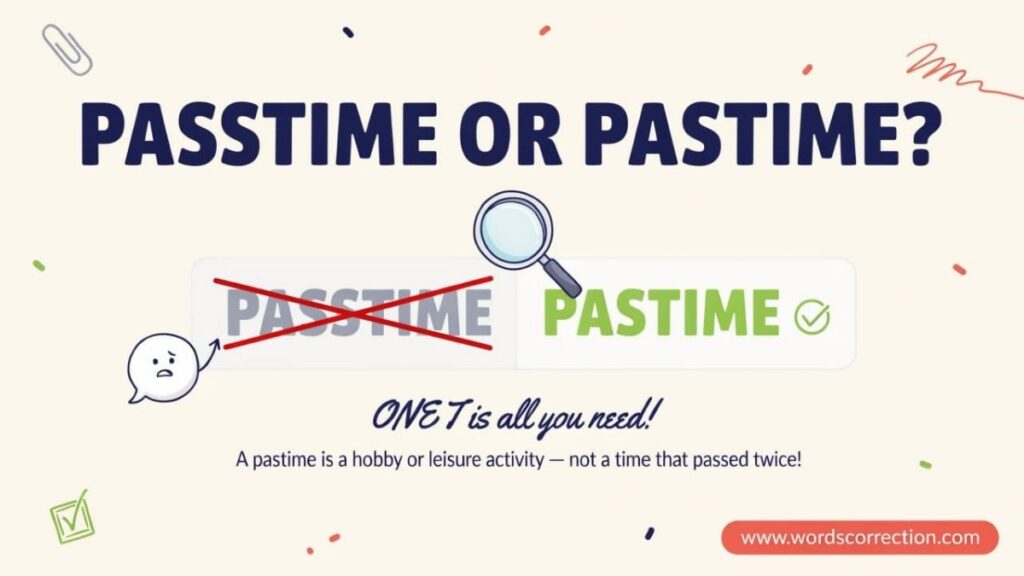
The difference between pastime or passtime may seem like a minor spelling issue, but one extra letter can turn a simple word into a common writing mistake. If you’ve ever written “passtime” when referring to your favorite hobby, you’re not alone. English spelling can make even familiar words surprisingly confusing. The good news is that pastime is the only correct spelling in standard English. However, pass time is also correct when used as a verb phrase, though it has a different meaning. Understanding this distinction will help you avoid the common mistake and use both expressions accurately and confidently.
Quick Answer Passtime or Pastime?
Pastime is the correct spelling. It is a noun that refers to an enjoyable activity people pursue during their free time. Passtime is a common misspelling and is not recognized as the standard form in English.
However, pass time is a correct two-word expression. It functions as a verb phrase and means to spend time doing something, particularly while waiting or looking for entertainment.
Consider these examples
- Correct: Reading novels is my favorite pastime.
- Incorrect: Reading novels is my favorite passtime.
- Correct: I play mobile games to pass time while traveling.
- Correct: Gardening is one of her favorite pastimes.
The following table highlights the differences
| Expression | Correct? | Meaning | Example |
|---|---|---|---|
| Pastime | Yes | An enjoyable free-time activity | Painting is my favorite pastime. |
| Passtime | No | Nonstandard misspelling | Swimming is my favorite passtime. |
| Pass time | Yes | To spend time doing something | I read books to pass time. |
| Past time | Yes, in a different context | An earlier period or something overdue | It’s past time to leave. |
Remember: Use pastime when naming an enjoyable activity. Use pass time when describing how someone spends a particular period.
What Does Pastime Mean? Definition and Usage
A pastime is an activity someone enjoys during their spare time. It generally provides entertainment, relaxation, or personal satisfaction rather than fulfilling a professional obligation or daily responsibility.
In simple terms, a pastime is something you choose to do because you enjoy it.
For example, someone who reads mystery novels regularly might consider reading a favorite pastime. Another person may spend weekends gardening, playing basketball, or learning a musical instrument. These activities qualify as pastimes because people pursue them for personal enjoyment.
In standard English, pastime functions as a noun. It can describe one recreational activity or several interests that someone enjoys during their leisure time.
Pastime Definition in Everyday English
The word pastime generally describes an activity that makes someone’s free time more enjoyable. However, its meaning extends beyond simple entertainment. Many pastimes also encourage creativity, improve practical skills, and provide opportunities for social interaction.
Consider some of the benefits associated with common pastimes
- Relaxation: Reading, gardening, and painting can provide a peaceful break from everyday responsibilities.
- Entertainment: Watching movies, listening to music, and playing games offer enjoyable ways to spend leisure time.
- Creativity: Drawing, writing, photography, and crafting allow people to explore their creative interests.
- Social connection: Team sports, board games, and group activities encourage interaction and strengthen relationships.
- Personal development: Learning a language, practicing an instrument, or studying photography can help develop valuable skills.
A pastime doesn’t need to be expensive, complicated, or time-consuming. Even taking a daily walk or solving crossword puzzles can become a meaningful part of someone’s routine.
Examples of Common Pastimes
People have different interests and lifestyles, so their pastimes vary considerably. Some prefer quiet indoor activities, while others enjoy outdoor recreation, sports, or social entertainment.
Here are some common examples
| Category | Pastime Examples |
|---|---|
| Creative activities | Painting, drawing, writing, photography |
| Sports and fitness | Swimming, cycling, running, playing tennis |
| Indoor activities | Reading, chess, puzzles, knitting |
| Outdoor activities | Gardening, hiking, fishing, camping |
| Entertainment | Watching movies, listening to music, playing video games |
| Learning activities | Learning languages, studying history, practicing instruments |
| Social activities | Playing board games, volunteering, joining clubs |
These examples demonstrate that a pastime doesn’t require a particular skill level or background. The defining feature is that someone chooses the activity for enjoyment.
Learn the difference between confusing more English words
A Unique or An Unique Which Is Correct?
What Does Passtime Mean? Is Passtime a Word?
The spelling confusion usually begins when people associate pastime with the familiar expression pass time. Because both expressions relate to spending time, some writers assume that combining pass and time should produce passtime.
However, that assumption leads to a spelling error.
Standard English dictionaries recognize pastime as the correct noun. Passtime is generally treated as a misspelling rather than an accepted alternative.
Although the incorrect form occasionally appears in informal writing, online discussions, and search queries, its appearance doesn’t make it standard English.
Why Is Passtime Incorrect?
The spelling of pastime developed historically. It isn’t simply a modern combination of the verb pass and the noun time.
Consequently, adding another s because pass contains two letters s produces an incorrect spelling.
Compare these examples
| Incorrect Spelling | Correct Spelling |
|---|---|
| My favorite passtime is reading. | My favorite pastime is reading. |
| Fishing is his favorite passtime. | Fishing is his favorite pastime. |
| She enjoys several passtimes. | She enjoys several pastimes. |
| What is your favorite passtime? | What is your favorite pastime? |
Spelling tip: Pastime contains one s after the initial letters pa. Remember this form whenever you write about hobbies or recreational activities.
Learn the difference between commonly mixed-up more words
Heros or Heroes which spelling is correct?
Pastime or Pass Time What’s the Difference?
Although pastime and pass time look and sound similar, they perform different grammatical functions. The distinction becomes clear when you examine how each expression works in a sentence.
Pastime is a noun, whereas pass time is a verb phrase. One identifies an enjoyable activity, while the other describes the action of spending time.
For example
- Pastime: Playing chess is an enjoyable pastime.
- Pass time: I play chess to pass time during long journeys.
Both expressions are grammatically correct, but they communicate different ideas. Replacing one with the other can change the meaning or structure of a sentence.
When to Use Pastime
Use pastime when referring to an activity someone enjoys during their leisure time. It identifies the activity itself rather than explaining how someone spends a particular period.
Consider these examples
- Reading is my favorite pastime.
- Gardening has become a relaxing pastime for my mother.
- Playing basketball is a popular pastime among students.
- Collecting vintage coins is an interesting pastime.
- Photography is one of his favorite pastimes.
In these sentences, pastime answers the question, “What activity do you enjoy?”
You can use it when discussing hobbies, recreational interests, and enjoyable ways to spend your spare time.
When to Use Pass Time
Use pass time when describing how someone spends a period of time. This expression frequently appears in situations involving waiting, traveling, or finding temporary entertainment.
For example
- I listen to podcasts to pass time during my commute.
- She plays word games to pass time while waiting for her appointment.
- We watched a movie to pass time during the flight.
- He reads newspapers to pass time at the airport.
- They chatted to pass time during the long wait.
In these examples, pass functions as a verb and time acts as its object.
The expression often describes temporary activities rather than long-term interests. Someone might read a magazine to pass time at an airport without considering reading their main hobby.
Learn the difference between tricky grammar more words
Thier or Their which is correct?
Pastime or Pass Time Comparison Table
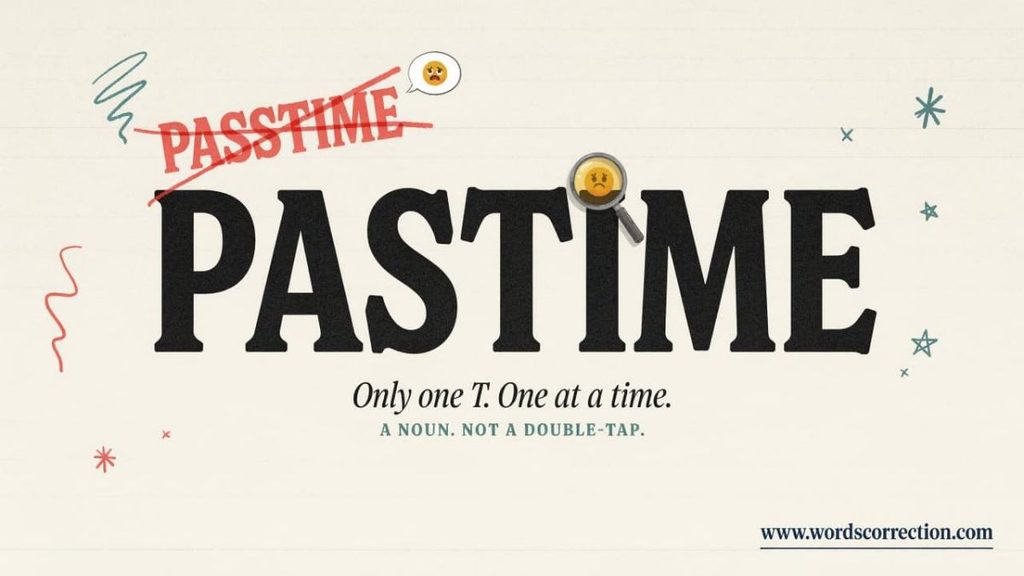
| Feature | Pastime | Pass Time |
|---|---|---|
| Grammatical role | Noun | Verb phrase |
| Meaning | An enjoyable activity | To spend time doing something |
| Main purpose | Names a recreational interest | Describes an action |
| Example | Cooking is my pastime. | I cook to pass time. |
| Plural form | Pastimes | No plural form as a phrase |
| Common context | Hobbies and leisure activities | Waiting and temporary entertainment |
Favorite Pastime or Pass Time Which One Is Correct?
The correct expression depends on what you want to communicate.
Use favorite pastime when identifying an activity you particularly enjoy. Use pass time when explaining how you occupy yourself during a specific period.
Compare these sentences
- Correct: Reading is my favorite pastime.
- Correct: I read books to pass time.
- Incorrect: Reading is my favorite pass time.
- Incorrect: I read books to pastime.
The first sentence identifies an enjoyable activity. The second explains what someone does to spend time.
Understanding this distinction also helps when choosing between favorite pastime and pass time in everyday conversations. Although the expressions look similar, they aren’t interchangeable.
Learn the difference between confusing word pairs
Benefitting or Benefiting Which Spelling Is Correct?
Past Time vs Pastime What’s the Difference?
Another common source of confusion is past time vs. pastime. Although these expressions contain similar letters, their meanings and grammatical functions differ.
Pastime is a single noun referring to an enjoyable recreational activity. Past time consists of two separate words and can refer to an earlier period or indicate that something is overdue.
For example
- Pastime: Playing guitar is his favorite pastime.
- Past time: We discussed events from a past time in history.
- Past time: It’s past time for the meeting to begin.
In the final example, past indicates that the expected time has arrived or passed.
What Does Past Time Mean?
The expression past time has different uses depending on the sentence.
Referring to an earlier period: It can describe a period that has already happened.
Example: Life was very different in past times.
Indicating that something is overdue: The expression it’s past time means that something should happen because the appropriate time has arrived or passed.
Example: It’s past time we updated the old computer system.
In these constructions, past functions differently depending on the grammatical structure. It doesn’t turn the expression into the noun pastime.
Pastime vs Past Time Comparison Table
| Expression | Meaning | Example |
|---|---|---|
| Pastime | An enjoyable activity | Cycling is my favorite pastime. |
| Past time | An earlier period | People lived differently in past times. |
| It’s past time | Something is overdue | It’s past time to make a decision. |
Quick tip: If you’re referring to a hobby or recreational activity, use pastime. If you’re discussing an earlier period or something overdue, use past time.
Learn the difference between often confused words
Freshman or Freshmen what’s the Difference?
Origin and History of the Word Pastime
The spelling of pastime becomes easier to understand when you examine its historical development. The word traces its roots to the Middle English expression passe tyme, which referred to spending time pleasantly or making time pass through an enjoyable activity.
Over time, the expression developed into the single compound noun used in modern English. This historical background explains why the spelling of pastime does not simply follow the modern spelling of the verb pass.
Although some people mistakenly search for passtime or pastime, pastime is the correct standard spelling in modern English. Today, it refers to an activity people pursue for pleasure, relaxation, or entertainment. Its spelling remains consistent in standard English.
Why Does Pastime Have Only One S?
The spelling reflects the word’s historical development rather than a straightforward combination of the modern words pass and time.
English contains many words whose modern spellings don’t follow the most obvious way of combining their original parts. Historical changes often explain these differences better than assumptions based on pronunciation.
For example, writers may assume that pastime should contain two s letters because the verb pass does. However, the accepted spelling contains only one.
The most reliable approach is to learn pastime as a complete word instead of trying to reconstruct its spelling whenever you use it.
Learn the difference between basic English word mistakes
Requestor or Requester Which Spelling Is Correct?
How to Use Pastime Correctly in a Sentence
Understanding a word’s definition is important, but knowing how it functions in a sentence makes your writing more accurate.
Because pastime is a noun, it can appear in several grammatical positions. You can use it as a subject, an object, or a subject complement.
Pastime as a Subject
A subject identifies the person, place, thing, or idea that a sentence discusses.
Examples
- Reading is a peaceful pastime.
- Gardening provides an enjoyable pastime for older adults.
- Swimming is a popular pastime during summer.
- Photography is an activity that requires patience and creativity.
In these examples, the activity functions as the subject, while pastime identifies its nature.
Pastime as an Object
A noun can also function as an object in a sentence. In this position, pastime identifies an activity someone enjoys or chooses.
Examples
- She considers painting a relaxing pastime.
- My grandfather enjoys fishing as a pastime.
- Many people choose walking as a healthy pastime.
- He developed photography as a favorite pastime.
Pastime as a Subject Complement
A subject complement follows a linking verb and describes or identifies the subject.
Examples
- Chess is his favorite pastime.
- Reading has always been her preferred pastime.
- Gardening became their shared pastime.
These sentence structures demonstrate how naturally pastime fits into everyday English.
Pastime in a Sentence 15 Practical Examples
The following pastime examples demonstrate how to use the word in different everyday situations.
- Reading mystery novels is my favorite pastime.
- Gardening has become a relaxing pastime for her.
- Playing football is a popular pastime among teenagers.
- My father enjoys fishing as a weekend pastime.
- Photography is an enjoyable pastime that encourages creativity.
- She turned baking into a rewarding pastime.
- Collecting old coins is his favorite hobby and pastime.
- Chess remains a popular pastime around the world.
- Walking in the park is a peaceful pastime.
- My brother enjoys several outdoor pastimes.
- Painting gives her a creative outlet and a relaxing pastime.
- Playing board games is a favorite family pastime.
- Many people discover new pastimes after retirement.
- Learning a musical instrument can become a lifelong pastime.
- Birdwatching is an interesting pastime for nature lovers.
Each example uses pastime as a noun. The activity may be creative, physical, educational, or social, but its primary purpose is enjoyment.
Learn the difference between everyday English mistakes
Traveler or Traveller Which Spelling Is Correct?
What Is the Plural of Pastime?
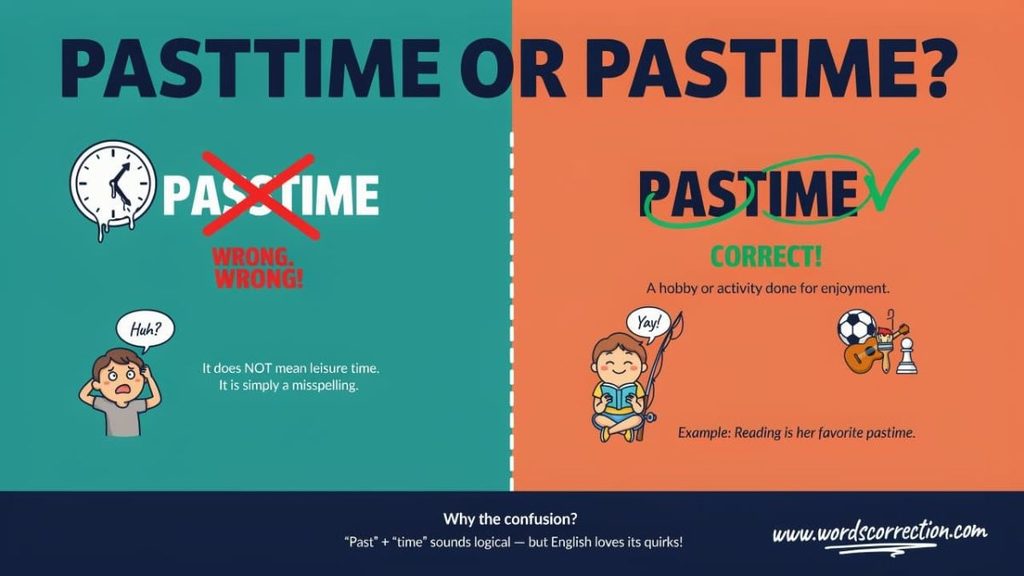
The plural of pastime is pastimes. Form the plural by adding -s to the singular noun.
The spelling remains straightforward. You don’t double the s or change the ending.
| Singular | Plural |
|---|---|
| Pastime | Pastimes |
| Favorite pastime | Favorite pastimes |
| Enjoyable pastime | Enjoyable pastimes |
| Popular pastime | Popular pastimes |
When Should You Use Pastime and Pastimes?
Use the singular form when referring to one activity.
Example: Reading is my favorite pastime.
Use the plural form when discussing two or more activities.
Example: Reading, swimming, and gardening are her favorite pastimes.
Additional examples include
- My favorite pastime is playing tennis.
- My favorite pastimes are reading and painting.
- Everyone has a different pastime.
- Outdoor pastimes become especially popular during warm weather.
- Children often develop new pastimes as they grow older.
Remember: The correct plural is pastimes, not passtimes.
Learn the difference between more words people mix up
Whoa or Woah Which Spelling Is Correct?
American vs British English Is Pastime Spelled Differently?
Some English words have different spellings in American and British English. For example, Americans generally write color, while British writers use colour. Similarly, organize and organise represent a common spelling difference.
However, pastime has the same standard spelling in both American and British English.
| American English | British English | Correct? |
|---|---|---|
| Pastime | Pastime | Yes |
| Pastimes | Pastimes | Yes |
| Passtime | Passtime | No |
| Pass time | Pass time | Yes |
The spelling doesn’t change according to the variety of English you’re using.
Origin and History of the Word Pastime
The spelling of pastime becomes easier to understand when you examine its historical development. The word traces its roots to the Middle English expression passe tyme, which referred to spending time pleasantly or making time pass through an enjoyable activity.
Over time, the expression developed into the single compound noun used in modern English. This historical background explains why the spelling of pastime does not simply follow the modern spelling of the verb pass.
Although some people mistakenly search for passtime or pastime, pastime is the correct standard spelling in modern English. Today, it refers to an activity people pursue for pleasure, relaxation, or entertainment. Its spelling remains consistent in standard English.dience.
Synonyms and Alternatives for Pastime
Repeating the same word too frequently can make writing less engaging. Fortunately, English offers several alternatives to pastime.
A pastime synonym is a word or phrase that describes a similar activity or interest. However, not every synonym carries exactly the same meaning. Some emphasize personal enjoyment, while others focus on relaxation, recreation, or entertainment.
Here are several useful alternatives
| Synonym | Meaning | Example |
|---|---|---|
| Hobby | An activity someone enjoys regularly | Photography is my favorite hobby. |
| Recreation | An activity done for enjoyment | Swimming is a popular form of recreation. |
| Leisure activity | Something done during free time | Gardening is a relaxing leisure activity. |
| Amusement | Something that provides entertainment | Board games offer hours of amusement. |
| Diversion | An activity that takes your mind off something | Reading provides a welcome diversion. |
| Pursuit | An activity someone follows with interest | Painting is a creative pursuit. |
| Recreational activity | An activity performed for enjoyment | Hiking is a healthy recreational activity. |
| Entertainment | Something that provides enjoyment | Movies are a popular form of entertainment. |
Which Pastime Synonym Should You Use?
Choosing the right alternative depends on the context and the meaning you want to express. When comparing passtime or pastime, remember that pastime is the correct spelling, while passtime is a common misspelling.
Hobby: Use this word when discussing an activity someone regularly enjoys or practices. For example, collecting coins is a popular hobby.
Recreation: Choose this term when emphasizing enjoyment and relaxation. For example, swimming provides recreation after a busy workday.
Leisure activity: This phrase works well in educational, professional, and informational writing. For example, walking is a healthy leisure activity.
Diversion: Use it when an activity temporarily takes someone’s attention away from boredom, stress, or another concern. For example, crossword puzzles offer a pleasant diversion during a long journey.
Pursuit: This word often suggests an ongoing interest or activity that someone follows with enthusiasm. For example, photography is a rewarding creative pursuit.
Although these words share similarities with pastime, they aren’t always interchangeable. Understanding the difference between passtime or pastime and choosing the correct synonym will help you write more accurately.
Learn the difference between tricky English words with easy explanations
Common Pastime Examples Indoor and Outdoor Activities
People choose pastimes according to their interests, schedules, budgets, and lifestyles. Some enjoy activities that require concentration, while others prefer physical movement, social interaction, or creative expression.
Understanding these categories also helps demonstrate how people use the word in everyday conversations.
Indoor Pastimes
Indoor pastimes are activities people enjoy inside their homes or other buildings.
Popular examples include
- Reading novels and magazines
- Playing chess or board games
- Drawing and painting
- Cooking and baking
- Knitting and sewing
- Learning a musical instrument
- Solving puzzles
- Playing video games
- Writing stories or keeping a journal
These activities provide entertainment without requiring outdoor space or favorable weather conditions.
Outdoor Pastimes
Outdoor pastimes involve activities people enjoy outside.
Common examples include
- Gardening
- Hiking
- Fishing
- Cycling
- Swimming
- Playing football
- Camping
- Birdwatching
- Photography
- Walking in parks
Many outdoor activities also encourage physical movement and provide opportunities to enjoy nature.
Educational and Creative Pastimes
Not every pastime focuses solely on entertainment. Some activities combine enjoyment with learning and personal development.
Examples include
- Learning a foreign language
- Reading historical books
- Practicing calligraphy
- Studying astronomy
- Writing poetry
- Learning computer programming
- Exploring photography techniques
These activities help people build knowledge and practical skills while enjoying their leisure time.
Case Study Choosing Between Pastime and Pass Time
Consider two friends, Alex and Daniel, who both enjoy reading.
Alex reads mystery novels every evening because he enjoys discovering new stories. Daniel usually reads magazines while waiting for his train.
Both enjoy reading, but their sentences describe different situations.
Alex: “Reading mystery novels is my favorite pastime.”
Daniel: “I read magazines to pass time while waiting for the train.”
Why are both sentences correct?
- Alex uses pastime as a noun to identify an activity he regularly enjoys.
- Daniel uses pass time as a verb phrase to explain how he occupies himself while waiting.
Now consider what happens if they switch the expressions
- Incorrect: Reading mystery novels is my favorite pass time.
- Incorrect: I read magazines to pastime while waiting for the train.
These sentences contain grammatical errors because the expressions perform different functions.
This example demonstrates why understanding the distinction between pastime and pass time is more useful than memorizing their spellings alone.
Common Mistakes to Avoid When Using Pastime
Even experienced writers sometimes confuse similar-looking words. However, understanding a few basic rules can prevent most pastime spelling and grammar mistakes.
Writing Passtime Instead of Pastime
This is the most common spelling error.
Incorrect: Playing tennis is my favorite passtime.
Correct: Playing tennis is my favorite pastime.
The noun always uses one s in standard English.
Confusing Pastime With Pass Time
These expressions have different grammatical functions.
Incorrect: I watch television to pastime after work.
Correct: I watch television to pass time after work.
Use pastime when naming an enjoyable activity. Use pass time when describing an action.
Confusing Pastime With Past Time
The expressions pastime and past time aren’t interchangeable.
Incorrect: Reading is my favorite past time.
Correct: Reading is my favorite pastime.
However, the two-word expression is correct in a sentence such as:
“It’s past time to finish the assignment.”
Using In My Pastime Incorrectly
Another common mistake involves the expression in my pastime.
Although readers may understand the intended meaning, this phrase often sounds unnatural in standard English.
Instead, choose a more natural alternative:
- In my free time, I enjoy reading.
- Reading is my favorite pastime.
- As a pastime, I enjoy gardening.
- One of my favorite activities is painting.
Use in my free time when explaining when you do something. Use pastime when identifying the activity itself.
Using Pastime as a Verb
Pastime is a noun, not a verb. You cannot use it to describe the action of spending time.
Incorrect: She pastimed by playing games.
Correct: She played games to pass time.
Correct vs Incorrect Pastime Examples
| Incorrect Sentence | Correct Sentence | Explanation |
|---|---|---|
| Reading is my favorite passtime. | Reading is my favorite pastime. | Use one s. |
| Swimming is my favorite pass time. | Swimming is my favorite pastime. | Use the noun for an activity. |
| I pastime by reading books. | I pass time by reading books. | Pass time is a verb phrase. |
| My favorite passtimes are painting and writing. | My favorite pastimes are painting and writing. | Use the correct plural spelling. |
| In my pastime, I enjoy cooking. | In my free time, I enjoy cooking. | The alternative sounds more natural. |
| It’s my favorite past time. | It’s my favorite pastime. | Use one word for the recreational activity. |
Learn the difference between commonly confused more words in English
Hierarchical vs Hierarchal Which Word Should You Use?
Practice Session about Passtime or Pastime
Complete the following sentences by choosing the correct word or expression from the context.
1. Reading novels is my favorite __________.
2. The correct spelling of the word is __________.
3. Gardening is an enjoyable __________ for many people.
4. I listen to music to __________ while travelling.
5. Playing chess is one of his favorite __________.
6. The word __________ is commonly misspelled as passtime.
7. She enjoys painting as a relaxing __________.
8. Watching movies is a popular way to spend __________ time.
9. We played cards to __________ while waiting for the train.
10. The plural form of pastime is __________.
11. Swimming is an enjoyable recreational __________.
12. He spends his free time pursuing his favorite __________.
13. The expression “pass time” is used as a __________ phrase.
14. Reading and writing are popular leisure __________.
15. Passtime is considered an incorrect __________ of pastime.
16. Photography has become her favorite __________.
17. People often enjoy different activities during their __________ time.
18. Playing board games is a fun way to __________ time with family.
19. The word pastime is used as a __________ in English grammar.
20. A hobby is an activity people enjoy during their __________ time.
21. It is __________ time to make a decision about the project.
22. Listening to podcasts is a great way to __________ time during a long journey.
23. Painting, gardening, and reading are examples of enjoyable __________.
24. The correct expression for occupying yourself while waiting is __________ time.
25. A good pastime can provide relaxation and __________ during leisure hours.
Answers
- Pastime
- Pastime
- Pastime
- Pass time
- Pastimes
- Pastime
- Pastime
- Free
- Pass time
- Pastimes
- Activity
- Hobby
- Verb
- Activities
- Spelling
- Pastime
- Free
- Spend
- Noun
- Free
- Past
- Pass
- Pastimes
- Pass
- Entertainment
Here’s a trusted source for clear word meanings:
Cambridge Dictionary
FAQ’s
What Does Passtime Mean?
Passtime is a common misspelling of pastime. The correct word, pastime, refers to a hobby, recreational activity, or enjoyable pursuit that someone does during their free time for pleasure or relaxation. When comparing passtime or pastime, remember that only pastime is the standard English spelling.
Is Passtime a Correct English Word?
No, passtime is not an accepted standard English spelling. The correct spelling is pastime, which describes an activity people enjoy during their spare time. For example, reading, gardening, painting, and playing sports are all popular pastimes.
What Are Some Synonyms for Pastime?
Common synonyms for pastime include hobby, recreation, amusement, entertainment, leisure activity, pursuit, and diversion. Although these words have similar meanings, their usage depends on the context. Choosing the right synonym helps make your writing clearer, more natural, and more precise.
Why is pastime spelled with only one S?
The spelling pastime developed historically from the expression pass time. Although the original expression contains two separate words, the established modern spelling combines them into one word with a single S.
Should I write past time or passtime?
Neither form is correct when referring to a hobby. The appropriate spelling is pastime. However, past time is a separate expression used to describe something that should have happened earlier, while passtime is a misspelling.
What is the correct English spelling of pastime?
The correct spelling is P-A-S-T-I-M-E. Pastime is written as one word without a hyphen or space and contains only one S.
What is the plural form of pastime?
The plural form of pastime is pastimes. For example, reading, gardening, swimming, and painting are popular pastimes among people with different interests.
What is the opposite of pastime?
Pastime does not have one exact antonym. However, obligation, duty, responsibility, and chore can express contrasting meanings because they refer to necessary tasks rather than activities pursued for enjoyment.
Is my favorite pastime the correct expression?
Yes, my favorite pastime is grammatically correct and commonly used in English. It describes the recreational activity someone enjoys more than other leisure activities.
Which expression is correct time pass or pass time?
Pass time is the correct expression when describing an activity that occupies someone’s free time or helps them stay entertained while waiting. Time pass is not interchangeable with this phrase, although it can appear in different grammatical constructions.
What does my favorite pastime actually mean?
My favorite pastime refers to someone’s most enjoyable leisure activity. For example, if a person loves gardening and regularly spends free time caring for plants, they might describe gardening as their favorite pastime.
What is considered the best pastime?
There is no universally accepted best pastime because personal interests differ. Reading, painting, playing sports, gardening, cooking, and learning new skills are excellent examples of activities that can make leisure time enjoyable and meaningful.
What is the most memorable time in life?
The most memorable period of life varies from person to person. Childhood, school years, university experiences, personal achievements, and meaningful family moments are often remembered as particularly special stages of life.
What makes a pastime enjoyable?
An enjoyable pastime is an activity that matches someone’s interests, provides relaxation, or encourages creativity. Reading, photography, gardening, drawing, and playing musical instruments are examples of rewarding leisure activities.
How can you pass time without getting bored?
You can make your free time more enjoyable by reading, listening to podcasts, solving puzzles, drawing, learning something new, or engaging in a creative activity. Choosing something interesting helps reduce boredom.
What are some relaxing ways to pass time in bed?
Reading a book, listening to an audiobook, enjoying calm music, or planning the following day’s activities can provide relaxing ways to spend time in bed without requiring much effort.
What are some common examples of pastimes?
Common pastimes include reading books, gardening, cooking, painting, photography, playing chess, knitting, walking, listening to music, and participating in recreational sports. These activities provide enjoyable ways to spend free time.
Can pastime refer to both hobbies and recreational activities?
Yes, pastime can describe both hobbies and other recreational activities. For example, collecting coins, playing chess, and exploring photography can all be described as pastimes because they are pursued for personal enjoyment.
Is pastime appropriate for formal and informal writing?
Yes, pastime is a standard English noun that works in both formal and informal contexts. It can be used naturally in academic writing, professional articles, everyday conversations, and personal descriptions.
How does a pastime differ from a hobby?
A hobby generally refers to an activity someone regularly practices for enjoyment or personal development. A pastime is a broader term for any enjoyable activity that occupies leisure time. Although the meanings overlap, pastime can also describe occasional recreational activities.
Can professional work also be considered a pastime?
Professional work is generally considered an occupation rather than a pastime because it involves responsibilities and commitments. However, an enjoyable personal project or voluntary activity may qualify as a pastime if someone pursues it during their leisure time.
What Is the Difference Between Pastime and Recreation?
When comparing Passtime or Pastime, pastime refers to a specific activity someone enjoys during free time, such as reading or gardening. Recreation is a broader term for activities that provide relaxation, refreshment, and entertainment, such as swimming or playing sports.
How can you use pastime correctly in a sentence?
Pastime is used as a noun to identify an enjoyable activity pursued during leisure time. For example: “Reading historical novels has become my favorite pastime.” In this sentence, pastime describes an activity the speaker enjoys regularly.
Learn the difference between similar English words the easy way
Eying or Eyeing Which Spelling Is Correct?
Conclusion
Understanding the difference between Passtime or Pastime helps you avoid a common spelling mistake and improve your English writing. Pastime is the correct standard spelling for an enjoyable activity, hobby, or recreational pursuit, whereas passtime is an incorrect spelling. In contrast, pass time is a separate verb phrase that means to keep yourself occupied during periods of free time or while waiting.
When comparing Passtime or Pastime, remember that these expressions may look similar but serve different purposes. Reading, gardening, painting, and playing sports are all examples of popular pastimes. Knowing the distinction between Passtime or Pastime will help you recognize the correct spelling and use it confidently in everyday communication.
Ultimately, choosing Passtime or Pastime correctly strengthens your spelling accuracy and makes your writing clearer and more professional. So, whenever you refer to a favorite hobby or leisure activity, choose pastime, not passtime. After all, good spelling is a habit worth making time for.

Stella AJS is an experienced blogger and dedicated English language writer at Words Correction. She turns confusing grammar, word meanings, spelling, and usage into clear, practical insights that readers can easily understand and apply. With a passion for precise and engaging writing, Stella helps readers avoid common language mistakes, strengthen their vocabulary, and communicate with greater clarity and confidence.




